Introduction
Social support is usually conceptualized as any type of help available to an individual in difficult situations and is closely related to the concepts of social integration and social networks (Schwarzer et al., Reference Schwarzer, Knoll, Rieckmann, Kaptein and Weinman2004). Various individuals and social groups (e.g., family members, friends, neighbors, coworkers, therapists, doctors, support groups, religious communities) and institutions can become sources of support. In terms of the function it can fulfill, social support is usually categorized into emotional, informational, instrumental, tangible, and spiritual social support (Schwarzer and Knoll, Reference Schwarzer, Knoll, French, Vedhara and Kaptein2010). Emotional support refers to displaying positive emotions, showing concern, soothing, and lifting one's spirits so that those who suffer are able to express what they feel: pain, concern as well as hope. Informational support allows people to broaden their knowledge about and understand the stressful circumstances linked to their coping abilities. Instrumental support is understood as guidance or instructions on specific ways of behaving in stressful circumstances. Tangible support is expressed in tangible material and financial help. Spiritual support refers to assistance with finding or strengthening the meaning in life, suffering, illness, and death.
Receiving a cancer diagnosis was found to increase the need for social support (Makabe and Nomizu, Reference Makabe and Nomizu2007) since medical treatment and the course of cancer affect almost all areas of a patient's life (Ganz et al., Reference Ganz, Kwan and Stanton2011). Breast cancer is one of the most common types of tumors diagnosed in women, and its treatment usually involves a mastectomy (Brewster and Helzlsouer, Reference Brewster and Helzlsouer2001). Women who have undergone such surgeries often experience emotional problems and concerns related to their body image (Dunn et al., Reference Dunn, Cooper and Neuhaus2011) because mastectomy is still viewed as a symbol of disfigurement, mutilation, and a loss of femininity and appeal (Haloua et al., Reference Haloua, Krekel and Winters2013). If the affected woman experiences exclusion and lack of support, she may feel isolated and lonely, which in turn may lead to a sense of helplessness and resignation (Campos and Besser, Reference Campos and Besser2012).
In the process of coping with the disease, women diagnosed with breast cancer often seek support within their immediate environment (friends, family) and from patient support groups such as mastectomy support groups (Ussher et al., Reference Ussher, Kirsten and Butow2006). Such support may contribute to boosting one's sense of security and at the same time decreasing anxiety and depression. Experiencing intimacy and closeness in supportive relationships increases self-acceptance, reduces helplessness, and helps the women feel less lonely or isolated (Yeşilbalkan, Reference Yeşilbalkan2010). Studies have shown that patients with breast cancer who receive more social support are more likely to comply with doctors' recommendations and more actively engage in their own treatment (Yanez et al., Reference Yanez, Stanton and Maly2012). Moreover, they are more hopeful, reveal greater acceptance of the disease, and cope more effectively (Fors et al., Reference Fors, Bertheussen and Thune2011; Tatala et al., Reference Tatala, Janowski and Wałachowska2013). Participation in cancer support groups helps women become more aware of preventive measures, such as self-observation and self-examination, and facilitates the dissemination of valuable practical information, e.g., where to buy prosthetics, wigs, or special clothing or learn about options for rehabilitation programs or therapy (Ussher et al., Reference Ussher, Kirsten and Butow2006; Fors et al., Reference Fors, Bertheussen and Thune2011).
The positive effects of social support on the general functioning of women who have undergone a mastectomy have been demonstrated in both clinical observations and research (Fors et al., Reference Fors, Bertheussen and Thune2011). However, more detailed associations between perceived social support and particular domains of adjustment in women after a mastectomy have received less attention. Similarly, much less is known about the mechanisms through which social support can lead to better outcomes in functioning. With respect to the last issue, Fordet al. (Reference Ford, Barrow and Stohl1996) proposed a model explaining the links between social support and ways of experiencing one's disease in women with cancer. Their model postulates that messages of social support help women by modifying their perceptions of the experiences related to the disease. The results of studies conducted by these researchers provide arguments for the hypothesis that social support acts through modifications in the subjective appraisal of the disease. Hence, it seems important to further explore whether perceived social support is indeed linked to disease-related appraisals, and if yes, which types of social support could serve as best predictors of the appraisals indicative of better functioning.
Other researchers have proposed that benefits from social support may be attained because social support decreases the risk of developing depressive symptoms and clinical depression (Lee et al., Reference Lee, Park and Lee2011). The study by Lee et al. (Reference Lee, Park and Lee2011) has demonstrated that, among different types of support, low emotional support was one of the major predictors of depression in patients 1 year after mastectomy. In line with these findings, a prospective study has shown that higher social support as perceived by women with breast cancer was correlated with both lower depressive symptoms and higher quality of life at three measurements over a 12-month period. In fact, the relationship between social support and depressive symptoms was relatively weak at baseline and 6-month follow-up (ρ = −0.17 and ρ = −0.18) and became stronger at 12-month follow-up (ρ = −0.40) (Ng et al., Reference Ng, Mohamed and See2015).
Participants and methods
Research aim
The aim of the present study was to analyze the relationships between perceived social support and psychosocial functioning in women who have undergone a mastectomy. In particular, we wanted to verify how different aspects of psychosocial functioning could be related to particular types of social support. We want to expand the existing knowledge in this field by employing the study design in which we explore simultaneously three aspects (domains) of the patients' psychosocial functioning. This seems important, as psychosocial functioning is a complex concept, and as such, it can be best captured by several rather than a single indicator. Therefore, in our study, this concept was operationalized through the following indicators:
(1) Disease-related appraisals: it was assumed that better psychosocial functioning is shown by high appraisals of the disease in terms of value and challenge. In turn, appraising the situation in the categories of threat, obstacle/loss, and harm and assigning greater overall importance to the disease are indicative of poorer psychosocial functioning. It is of note that even though cognitive appraisals are the central process determining the occurrence of stress (Gomes et al., Reference Gomes, Faria and Lopes2016), they have been relatively rarely studied in the context of breast cancer (e.g., Bigatti et al., Reference Bigatti, Steiner and Miller2012), and their relationships with social support still need elucidation in patients with this condition.
(2) Acceptance of life with the disease: it was assumed that better psychosocial functioning is indicated by a greater acceptance of life with disease, which embraces greater life satisfaction despite the disease, reconciliation with the disease and self-distancing from the disease. This indicator of psychosocial functioning seems of particular interest, as it is a positive indicator, whereas only negative indicators of functioning (such as depression or anxiety) have been utilized in the majority of studies.
(3) Severity of depressive symptoms: it was assumed that lower levels of depressive symptoms are indicative of better psychosocial functioning.
In our study, we included both positive and negative indicators of functioning, as we wanted to test whether social support is similarly or differently related to positive vs. negative indicators. We also wanted to verify whether particular indicators of functioning show specific or universal relations with particular types of social support. Such detailed analysis of the relationships between social support and a set of indicators of psychosocial functioning is still missing in previously reported research among patients with breast cancer, particularly in Poland, where this study was carried out.
Measures
The Disease-Related Social Support Scale consists of 30 items in the form of statements describing different types of social support that can be perceived as available for the patient over the course of the disease. The participants respond to each statement on a 4-point scale. The scores can be calculated for five types of social support: emotional, material (tangible), spiritual, instrumental, and informational support. The total score from all items is a global index of perceived social support, where higher values indicate greater perceived social support. In the present study, Cronbach's alphas were high for each subscale (spiritual support α = 0.86; instrumental support α = 0.88; informational support α = 0.82; material support α = 0.87; and spiritual support α = 0.86) and very high for the total score α = 0.95. All intercorrelations between the subscales were positive and statistically significant, ranging from r = 0.39 (instrumental and informational support) to r = 0.80 (spiritual and emotional support). This scale has been validated in various populations of patients (e.g., Brachowicz, Reference Brachowicz2008; Szymona-Pałkowska et al., Reference Szymona-Pałkowska, Janowski and Pedrycz2016), although the current study is the first to apply this tool in patients with cancer.
The Disease-Related Appraisals Scale is a self-report questionnaire measuring cognitive appraisals of the disease. The instrument measures the intensity of the subjective perception of one's own disease in six semantic categories: threat, benefit, obstacles/losses, harm, challenge, and value. In addition, the scale measures an overall level of importance attributed to the disease. The questionnaire consists of 47 items, and each item is assessed on a 5-grade scale. Higher scores indicate a stronger perception of the disease in a given semantic category. The scale is characterized by satisfactory and high-reliability coefficients. Cronbach's alphas for the subscales range from α = 0.64 for the challenge to α = 0.87 for obstacle/loss (Janowski et al., Reference Janowski, Steuden, Kuryłowicz, Janowski and Steuden2009). Only the subscale of benefit was found to have an unsatisfactory internal consistency (α = 0.55); hence, the scores of this subscale were excluded from further analysis. This questionnaire has already been validated in studies with patients suffering from various diseases, e.g., psoriasis (Janowski et al., Reference Janowski, Steuden and Bogaczewicz2014), multiple sclerosis (Ogińska-Bulik and Michalska, Reference Ogińska-Bulik and Michalska2016), and cancer (Krok and Telka, Reference Krok and Telka2018; Krok et al., Reference Krok, Brudek and Steuden2019).
The Acceptance of Life with the Disease Scale is a self-report questionnaire that consists of 20 items. There is a 4-grade scale for each item, and higher scores indicate a greater acceptance of life with the disease. The authors of the scale assumed that patients may display a different degree of acceptance to being ill. Acceptance of life with a disease is understood as an attitude of the acceptance of life with the illness and the discomfort associated with it while simultaneously mostly concentrating on the positive aspects of life despite the difficulties caused by the disease. The scale comprises three subscales extracted in the factor analysis, which are: (1) satisfaction with life despite the disease, (2) reconciliation with the disease, and (3) self-distancing from the disease. The psychometric properties were found to be good or high. Cronbach's alpha for the total score was α = 0.90. For the subscales: life satisfaction despite the disease, α = 0.90; reconciliation with the disease, α = 0.80; and self-distancing from the disease, α = 0.69 (Janowski et al., Reference Janowski, Steuden and Pietrzak2012). The present study is the first in which this instrument is used in patients with breast cancer; however, estimates of reliability as measured by Cronbach's alphas obtained in this study were high and very high: α = 0.92 for satisfaction with life; α = 0.90 for reconciliation with the disease; α = 0.83 for self-distancing from the disease; and α = 0.95 for the total score.
The Beck Depression Inventory is one of the most widely used self-report inventories of depression symptoms. It is composed of 21 categories describing four levels of severity for different depressive symptoms. The participants endorse the statement that describes their symptoms best. Answers are given on a 0–3 scale, where higher scores are indicative of a greater severity of depressive symptoms. The inventory is psychometrically sound, which was demonstrated by a number of studies worldwide (Wardenaar et al., Reference Wardenaar, Wanders and Roest2015). In the current study, a very high-reliability coefficient, α = 0.95, was obtained.
Participants
Seventy women who had undergone mastectomy as part of their treatment for breast cancer participated in the study. They were recruited through the mastectomy support groups. The participants' age ranged from 26 to 87 (M = 56.52, SD = 14.18) years. Women within the age range of 56–65 were the largest subgroup (34%), and 23% of the women were above 65 years old. Among the sample, 57% of patients were married, 23% were single, 10% were divorced, and 10% were widowed. Approximately 59% declared that they were in a long-term relationship, and 41% reported no partner. In 59% of the participants, more than 3 years had passed since the diagnosis of breast cancer. Detailed data on the sociodemographic and clinical characteristics of the participants are presented in Table 1. The participants were informed about the aim and subject of the study. Written informed consent was obtained from each participant. Participation was voluntary and anonymous, and testing was carried out individually by a qualified psychologist. The study protocol had been approved by the Ethical Committee at the University of Economics and Human Sciences in Warsaw, Poland.
Sociodemographic and clinical characteristics of the participants

Statistical analyses
In the first stage of the analyses, the associations between sociodemographic and clinical variables and the global level of social support were analyzed. These analyses included analysis of variance (ANOVA) for comparisons of groups with different marital status, and Student's t-tests for independent samples was applied for comparisons of groups of patients with vs. without a partner and for comparisons of groups with different time elapsed from diagnosis. In the next step of the analysis, two groups of women, with low and high levels of perceived social support, were distinguished on the basis of the median value of the total score of social support. These groups were then compared with regard to cognitive appraisals, acceptance, and depressive symptoms, using Student's t-test for independent samples. Finally, a series of stepwise regression analyses were carried out to determine the specific relations between types of social support and indices of psychosocial functioning.
Results
Sociodemographic and clinical variables and social support levels
Analysis of variance was carried out to compare the reported levels of support in the subgroups of participants with different marital statuses. The lowest indices of support were found in single women (M = 85.19; SD = 14.92) and divorcees (M = 87.57; SD = 15.37). Married women displayed higher levels of support (M = 94.37; SD = 15.33), and widows were shown to perceive the highest levels of support (M = 110.43; SD = 8.44). There was a statistically significant difference between the groups [F (3, 66) = 5.19, p < 0.01]. However, the post hoc Tukey test showed that there are significant differences between widows and married women (p < 0.05) and divorcees (p = 0.05). When analyzing the women as either having or not having a partner, the t-test did not show a significant difference in social support between the compared groups [t (68) = −0.19, p > 0.05]. There was a significant difference in the perceived social support [t (68) = 3.41; p < 0.01] in women who had been diagnosed more than 3 years before the time of the study (M = 98.32; SD = 14.31) and those who were diagnosed less than 3 years previously (M = 85.97; SD = 15.75).
Division of the sample into groups with low and high social support
In the next step of the analysis, women with low and high levels of perceived social support were distinguished on the basis of the median value of the total score of social support. The value of the median was Me = 96.00. Women with scores equal to or below the median were assigned to the low support group, whereas women with scores above the median were assigned to the high support group. The mean values of the global index of social support were M = 80.11 (SD = 11.17) for the group with low social support and M = 106.29 (SD = 6.64) for the group with high social support, with the difference being statistically significant [t (55.34) = −11.92; p < 0.001]. Similarly, statistically significant differences between the groups were observed for all types of perceived social support (Figure 1).
Mean values of the subtypes of social support in groups of women with low and high total scores of social support.

Indicators of psychosocial functioning in groups with low vs. high social support
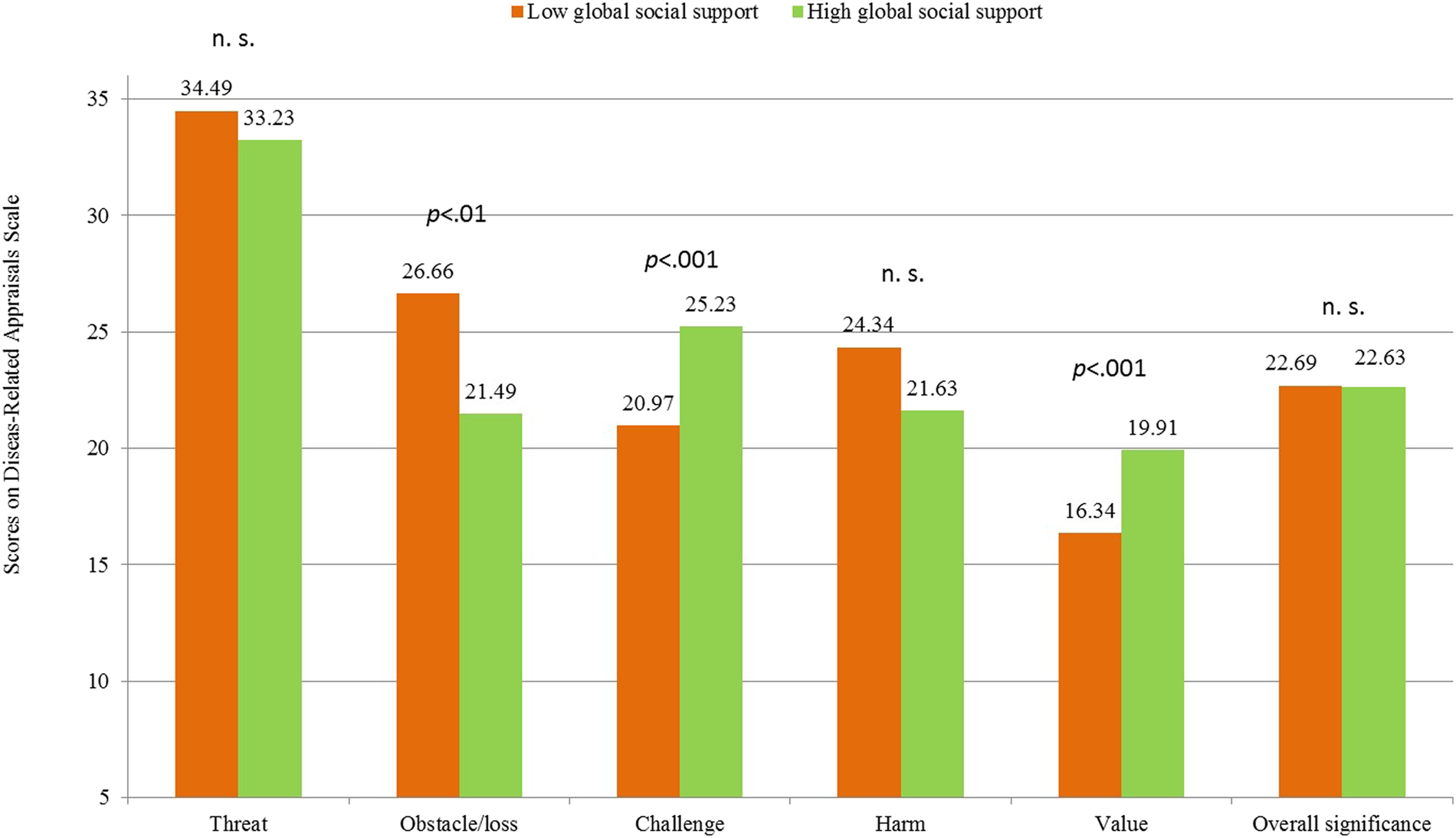
Women with high social support revealed significantly higher appraisals of their disease in terms of value (M = 19.91, SD = 4.29) and challenge (M = 25.23, SD = 3.85) than did women with low social support [value: M = 16.34, SD = 4.66, t (68) = −3.33, p < 0.01; challenge: M = 20.97; SD = 4.33, t (68) = −4.34, p < 0.001]. Additionally, those with high social support appraised their disease significantly lower in terms of obstacle/loss (M = 21.49, SD = 4.75) compared to women with low social support [M = 26.65, SD = 8.01, t (55.24) = 3.28, p < 0.01]. No statistically significant differences between the groups were observed with respect to the remaining categories, i.e., threat, harm, and overall significance attributed to disease (Figure 2). The levels of depressive symptoms, as measured by the Beck Depression Inventory, were found to be significantly higher in women with low social support (M = 22.94; SD = 15.86) compared to those with high social support [M = 10.09; SD = 9.78; t (55.61) = 4.08; p < 0.001].
Mean values of the disease-related appraisals in women with low and high global levels of social support. n.s., nonsignificant.

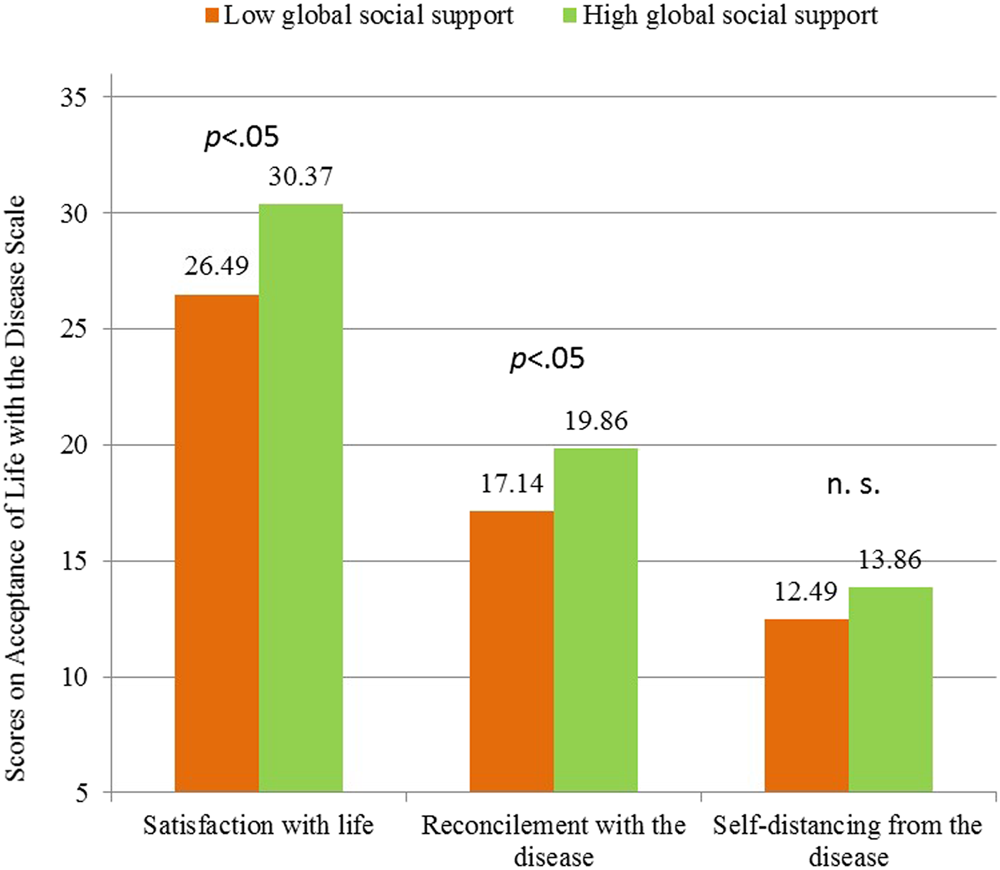
The global index of acceptance of life with the disease was significantly different in the two compared groups. Women with high social support reported significantly higher levels of overall acceptance (M = 64.09; SD = 9.00) than those with low social support [M = 56.11; SD = 15.51; t (54.57) = −2.63; p < 0.05]. Similarly, women with high social support scored significantly higher on two dimensions of acceptance: satisfaction with life (M = 30.37, SD = 3.65) and reconcilement with the disease (M = 19.86, SD = 2.99) than did women with low social support [satisfaction: M = 26.49, SD = 6.70, t (52.54) = −3.02, p < 0.01; reconcilement: M = 17.14, SD = 5.22, t (54.16) = −2.67, p < 0.01]. There was no statistically significant difference in self-distancing from the disease (Figure 3).
Mean values of acceptance of life with disease in women with low and high levels of global social support. n.s., nonsignificant.

Social support and indicators of psychosocial functioning: regression models
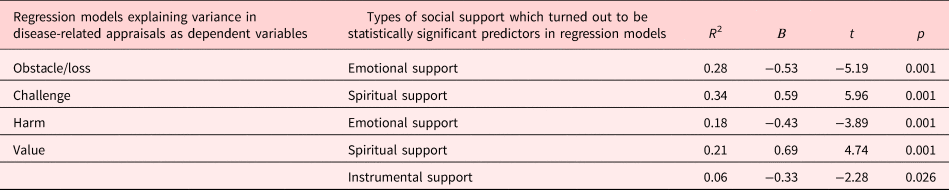
Subsequently, a series of stepwise regression analyses were conducted, aiming at the identification of the types of social support that are the best predictors of the variance, in particular, indices of psychosocial functioning. In each regression analysis, five types of social support were entered as independent variables, and the following indices of social adjustment were introduced as dependent variables: disease-related appraisals, severity of depressive symptoms, and indices of acceptance of life with the disease. A summary of the obtained regression models is presented in Tables 2–4.
Results of a series of stepwise regression analyses with disease-related appraisals entered as dependent variables

Types of social support were entered as independent variables (predictors).
Note: Regression models for the appraisals of Threat and for Overall significance attributed to the disease were not statistically significant and are not in this table.
Results of a series of stepwise regression analyses with depressive symptoms entered as a dependent variable

Types of social support were entered as independent variables (predictors).
Results of a series of stepwise regression analyses with acceptance of life with the disease entered as dependent variables

Types of social support were entered as independent variables (predictors).
The statistically significant regression models were obtained for the majority of indices of psychosocial adjustment. The models were found to be statistically insignificant solely for the appraisal of the disease in terms of threat and for the overall significance attributed to the disease. One type of social support was found to explain the variance in almost all indices of psychosocial adjustment. Only for the appraisal of the disease in terms of value were two types of social support found to be significant in the regression model. Spiritual support was recognized as significant in explaining the indices of psychosocial adjustment and was shown to be a significant predictor for perceiving one's disease in terms of challenge and value for the severity of depressive symptoms and for the general index of acceptance of life with disease and its two sub-dimensions: life satisfaction and reconciliation with the disease. In each of these cases, higher spiritual support predicted better values for indices of psychosocial adjustment. Emotional support was found to be a statistically significant predictor of perception of one's disease in terms of obstacle/loss and harm. In both of these cases, higher emotional support allowed for the prediction of a lower appraisal of disease in these categories. In turn, instrumental support was a statistically important predictor of appraisal of the disease in terms of value and self-distancing from the disease. Higher instrumental support predicted higher scores for both indices. The variance for the indices of psychosocial adjustment explained by social support ranged from approximately 17% for self-distancing from the disease to approximately 34% for the appraisal of the disease in terms of challenge.
Discussion
Receiving a diagnosis of cancer is especially difficult and stressful, often leading to a breakup of adaptive mechanisms. It is manifested in elevated anxiety and depression related to the feeling of a life threat. Breast cancer, one of the most common types of tumors in women, generally requires a surgical procedure. Thus, apart from fearing for their own lives, women with cancer may worry about their appearance and femininity (Koopman et al., Reference Koopman, Angell and Turner-Cobb2001). Hence, the results of various empirical studies carried out in different countries show the need for social support for them (Cicero et al., Reference Cicero, Gullo and Lo Coco2008; Alqaissi and Dickerson, Reference Alqaissi and Dickerson2010). At the same time, the results show that the majority of patients receive more social support after receiving the diagnosis and during treatment, despite any stigma that could be related to having the disease (Bloom and Kessler, Reference Bloom and Kessler1994).
The results obtained in this study indicate that the level of social support perceived by women who have undergone a mastectomy is related to cognitive appraisals of the disease. Women who perceived their social support as high showed a more adaptive pattern of cognitive appraisal of their disease, i.e., they appraised their disease in terms of challenge and value rather than obstacle/loss compared to women with less social support. This pattern of appraisal may lead to developing a more active and effective style of coping with the stress of the illness, which is expressed in a “fighting” spirit and a positive redefinition. Higher levels of social support seem to be related to appraisals that encourage a positive redefinition of living with the disease and seeing it as a personal challenge. Moreover, women who reported greater social support claimed that the illness caused them less inconvenience and losses. It is worth stressing that all the participants revealed that after the mastectomy, they most often felt threatened (pointed to the category of threat), which shows that even if the women feel socially supported, the experience of threat is prominent (Janowski et al., Reference Janowski, Steuden, Kuryłowicz, Janowski and Steuden2009).
Moreover, the results show that women with greater social support had fewer depressive symptoms. This may have clinical significance, suggesting that social support can be an important protective factor against depression. The comparisons between the groups with low and high social support showed differences in acceptance of life with a disease. Women with high social support displayed higher acceptance of the disease, felt more satisfied, and were ultimately happier. They were more likely to reconcile with being ill and maintained a positive mood. The present results are in accordance with the literature, which calls attention to the positive influence of social support in the stressful events of cancer or mastectomy. Denewer et al. (Reference Denewer, Farouk and Mostafa2011) found that social support significantly predicted higher levels of hope in a sample of 300 women after a mastectomy. Sammarco (Reference Sammarco2009) showed that high social support was related to a high quality of life. When women who had undergone a mastectomy attended support groups, they exhibited better life satisfaction and greater happiness (Antle and Collins, Reference Antle and Collins2009). The results of the present study supplement the previous literature with additional data on other positive outcomes of social support.
Another interesting finding is that spiritual support was the most important type of social support. It was found to be the most significant predictor of optimal functioning in terms of cognitive appraisals of the disease, severity of depressive symptoms, and acceptance of life with the disease. It appears that the role of spiritual support, in comparison to other types of support, may be especially valuable because a life-threatening disease can trigger a crisis of values and inspire questions about the sense of life and death (Levy et al., Reference Levy, Lathrop and Herberman1992). Spiritual support could be a source of strength and foster growth more effectively than nonreligious forms of social support and may be more valuable, especially to those dealing with health concerns such as breast cancer (LeBarre and Riding-Malon, Reference LeBarre and Riding-Malon2017).
Furthermore, research indicates that breast cancer patients benefit from spiritual support because they reveal a particular need for this type of support. In a meta-analysis on the experiences of women with breast cancer, Adams et al. (Reference Adams, McCann and Armes2011) concluded that the need for social support was prominent. In a qualitative study, Roff et al. (Reference Roff, Cassandra and Nelson-Gardell2009) identified four sources of spiritual support for breast cancer survivors: God, members of a religious community, family members and friends, and healthcare workers. The results showed that there was a strong call for spiritual support regardless of the cultural and religious context, e.g., for Muslim (Alqaissi and Dickerson, Reference Alqaissi and Dickerson2010) or Jewish (Ben-Arye et al., Reference Ben-Arye, Schiff and Steiner2012) participants.
On the other hand, it is possible that the need for spiritual support can be specific to patients with breast cancer, whereas for other medical conditions, other types of support are more significant. For instance, studies on social support for people affected by psoriasis (Janowski et al., Reference Janowski, Steuden and Pietrzak2012) revealed that material support is the most central; it was an important predictor of a greater acceptance of life with disease, higher quality of life, and fewer depressive symptoms. In light of these results, the present study suggests that providing women with spiritual support post-surgery may be one of the more considerable goals of psychological counseling because this type of support is associated with better psychosocial adjustment.
It is worth mentioning that some researchers state that the relationship between spirituality or religiousness and adaptation to illness may be ambiguous. In a prospective study, Gall et al. (Reference Gall, Kristjansson and Charbonneau2009) showed no significant correlations between different aspects of spirituality and adaptation. In turn, they found that women who were not as involved in spiritual/religious matters before they became ill were more doubtful and conflicted with regard to transcendent issues compared to women who were more engaged in religion or spirituality.
Analyzing the other types of social support, emotional support was found to be a significant predictor for two categories of appraisal of the disease: obstacle/loss and harm. The negative correlations between them mean that higher emotional support predicted lower scores for these appraisals. Hence, it can be concluded that emotional support is a protective factor against negative appraisals of the disease (obstacle/loss, harm) and spiritual support is a strengthening factor for positive appraisals (challenge, value).
It is worth observing that even though social support was considered a predictor for the indices of psychosocial functioning, it is not the only possible direction for interpreting the obtained results. Perceiving more social support may lead to better functioning of the patients, both directly and indirectly, by alleviating stress and its effects (Gerin et al., Reference Gerin, Milner and Chawla1995). This relationship can also be seen because people who generally function better may be more effective in actively searching for support from their environment or perceive their support as stronger. The majority of scholars declare that the relationship between social support and the quality of functioning in the face of disease is bidirectional (Sarason and Sarason, Reference Sarason and Sarason2009). This interpretation can be applied to the results of the present research as well. Better spiritual support may lead to better functioning; however, people who function better perceive their illness more positively, accept it more, feel less depressed, and actively search for spiritual support, which in turn may help them cope with stress by reevaluating the meaning of the disease (cf. Mattioli et al., Reference Mattioli, Repinski and Chappy2008).
The observed results may be modified by a set of more basic sociodemographic factors. The moderators taken into account in this study, such as marital status and amount of time since the diagnosis or mastectomy surgery, may alter the perception of social support.
Generally, the results of the current study can be particularly useful for mental health practitioners who work with patients with breast cancer, as this study shows which types of social support are of key importance for the improvement of psychosocial functioning of women with breast cancer. This study provides cues for the practitioners on which types of social support should be enhanced in order to achieve better outcomes in those patients who show decrements of a particular domain of functioning.
When analyzing the importance of the present study, it is necessary to address its limitations. The women who took part in the research varied in terms of age and clinical variables, e.g., time since receiving the diagnosis and undergoing the procedure. These factors can be associated with perceived social support and simultaneously interact with each other, which was not controlled in this study. Moreover, among the participants, there was a large subgroup of older women, who are generally more prone to depressive disorders. This could have been reflected in an increased score of depression symptoms. Finally, other important variables may be related to the psychosocial functioning of women with cancer. Different forms of treatment, both psychological and medical, are bound to play a significant role, especially shortly after undergoing a mastectomy.