Introduction
Pulse crops are historically important because of their ability to symbiotically fix nitrogen, to provide complementary protein in combination with cereals and to supply significant quantities of some of the micronutrients essential for human nutrition. About 60 Mt of pulses are produced each year (Food and Agricultural Organization (FAO), 2009), and lentil (Lens culinaris Medik.) is the world's sixth largest pulse crop with annual production of about 4 Mt. Consumption of pulses as a crop group has declined in global consumption relative to human population growth, but lentil is an exception (Vandenberg, Reference Vandenberg, Ali and Kumar2009). World consumption has quadrupled since the 1960s, presumably because lentils cook in approximately the same time as milled rice.
Preservation of genetic resources and maintenance of biodiversity remain lofty goals. Unless genetic resources are maintained and used, however, support for increase and preservation of these fundamental resources of genetic improvement may decline. In this paper, we review the history and current status of genetic resources of the genus Lens, followed by discussion of the use of these genetic resources and potential strategies that could accelerate the use of genetic resources. The genetic resources of the genus Lens include six differentiated species. A recent review of the phylogeny of Lens (Cubero et al., Reference Cubero, Perez de la Vega, Fratini, Erskine, Muehlbauer, Sarker and Sharma2009) indicated that based on hybridization barriers, the primary gene pool includes L. culinaris subsp. culinaris and L. c. subsp. orientalis (Boiss.) Ponert, and the secondary gene pool includes Lens odemensis (Ladiz.). The tertiary gene pool includes Lens nigricans (M. Bieb.) Godr. and Lens ervoides (Brign.) Grande, which may become part of secondary gene pool by means of embryo rescue. The two remaining species, Lens tomentosus (Ladiz.) and Lens lamottei, belong to either the secondary or tertiary gene pool. The body of available scientific information used to determine taxonomy suggests that there is a great genetic diversity within the wild species. The genus Lens originates from the area of Spain to eastern Afghanistan, an ecogeographical swath of Mediterranean, continental and mountain climates (Cubero et al., Reference Cubero, Perez de la Vega, Fratini, Erskine, Muehlbauer, Sarker and Sharma2009; Furman et al., Reference Furman, Coyne, Redden, Sharma, Vishnyakova, Erskine, Muehlbauer, Sarker and Sharma2009). All species are self-pollinated diploids (2n = 2x = 14) and have evolved into genetically isolated groups whose phylogeny is not yet clearly understood.
Lentil germplasm in ex situ collections
Grain legumes species of the closely related genera Lens Miller, Vicia L., Lathyrus L. and Pisum L. are founder crops of the agriculture systems that developed in Western Asia thousands of years ago. Agricultural botanists in the 18th century began collecting such self-pollinating crops, which were relatively easy to maintain and well suited for diversity studies. Living collections of diverse lentil germplasm were studied by Alefeld (Reference Alefeld1866) who was among the first to name and distinguish infraspecific, phenotypically different lentil types. The first genebank collection of lentils was assembled in the Soviet Union by the All-Union Institute of Plant Industry at Leningrad (today: N.I. Vavilov Institute of Plant Industry, VIR, St Petersburg, Russia). Elena I. Barulina (1895–1957), the second wife of Nikolai I. Vavilov (1887–1943), was the leading lentil researcher and intensively studied this diverse collection. In the 1920s, she recognized 58 botanical varieties and grouped the gene pool into two subspecies based on seed size (Barulina, Reference Barulina1930). Large-seeded (6–9 mm seed diameter) types were named as subsp. macrosperma (Baumb.) Barulina, and small-seeded (2–6 mm seed diameter) were classified as subsp. microsperma (Baumb.) Barulina. Lens culinaris subsp. microsperma evolved in the eastern geographical range of lentil cultivation, while subsp. macrosperma evolved under domestication in the Mediterranean and European regions.
Barulina recognized the importance of including wild Lens species in breeding and evolution research. She distinguished them as species and collected both L. nigricans and L. orientalis in 1924 on the Crimean peninsula (Vishnyakova, Reference Vishnyakova2006). The fact that Barulina and Vavilov were close outside the scientific sphere likely resulted in increased attention given to this genus by Vavilov during his extensive travels from 1920 to 1940 (Kurlovich et al., Reference Kurlovich, Rep'ev, Petrove, Buratseva, Kartuzova and Voluzneva2000). Barulina conducted genetic studies of the lentil gene pool demonstrating that the older centres of diversification of lentil (Afghanistan, India and Ethiopia) were rich in dominant alleles, while the peripheral regions had more recessive alleles (Vishnyakova, Reference Vishnyakova2006).
The lentil collection at VIR remains an important global genebank collection. When Vavilov and his associates accumulated the collection before 1940, they captured the diversity of landraces in Europe and elsewhere before lentil became a widely neglected crop in industrialized countries. In the 1930s, the Soviet Union grew 1 million ha of lentil and was the largest supplier to the world market (Vishnyakova, Reference Vishnyakova2006). Another important source for traditional European landraces is the national genebank in Germany (Leibniz Institute for Plant Genetic and Crop Plant Research, Gatersleben, 472 accessions), one of the oldest genebanks. It includes the threatened relicts of this crop recently collected in Italy (Piergiovanni, Reference Piergiovanni2000). More recently, the prospect of exporting lentils created by expanding global consumption, and to some extent greater recognition of the health benefits and changing lifestyles associated with reduced meat consumption, has resulted in a comeback of lentil in industrialized countries, and genebank material has received increased attention (Horneburg and Becker, Reference Horneburg and Becker2008).
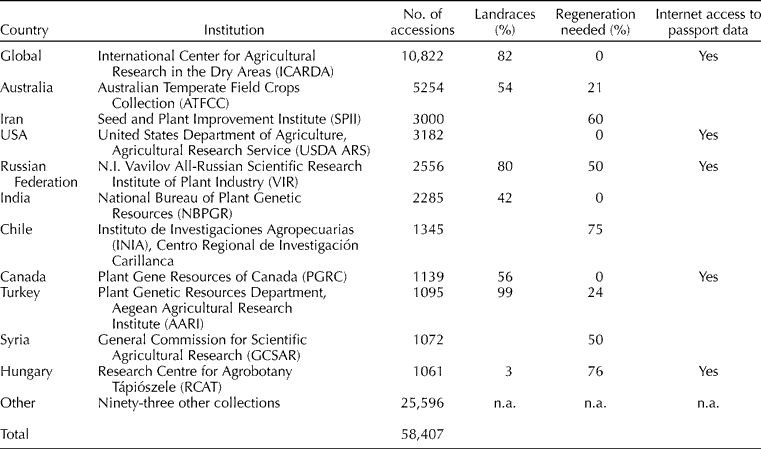
An ongoing survey of worldwide ex situ collections of lentil germplasm accessions lists more than 43,214, and about 4000 additional accessions are preserved in genebanks around the world (Global Crop Diversity Trust, 2008). The World Information and Early Warning System on plant genetic resources for food and agriculture of the FAO lists a total of 58,404 lentil accessions worldwide (FAO, 2010). Table 1 is based on both sources and lists the 12 genebank collections with more than 1000 accessions, which hold about 56% of the total lentil germplasm worldwide. Each genebank has its own history, strengths and weaknesses, which are also reflected in differences in diversity, quality, accessibility, uniqueness and secure storage of the germplasm. Two reviews on lentil ex situ collections have recently been published (Redden et al., Reference Redden, Maxted, Furman, Yadav, McNeil and Stevenson2007; Furman et al., Reference Furman, Coyne, Redden, Sharma, Vishnyakova, Erskine, Muehlbauer, Sarker and Sharma2009).

Several national genebanks, including those presented in Table 1, and the genebank at the International Center for Agricultural Research in the Dry Areas (ICARDA) were established after 1970. More than 113 collection missions by ICARDA focused on Western Asia – Near East added 1734 and 374 cultivated lentil and wild species accessions, respectively, to the ICARDA collection (Redden et al., Reference Redden, Maxted, Furman, Yadav, McNeil and Stevenson2007). Gaps remain for germplasm from North Africa and Central Asia (Furman et al., Reference Furman, Coyne, Redden, Sharma, Vishnyakova, Erskine, Muehlbauer, Sarker and Sharma2009), although some expeditions were conducted recently in the Caucasus and Central Asia (Redden et al., Reference Redden, Maxted, Furman, Yadav, McNeil and Stevenson2007). It can be assumed that the collection in India contains autochthonous landraces. The genebank in Turkey is rich in landraces (Atikyilmaz, Reference Atikyilmaz2010). Other studies using germplasm of national collections in Pakistan (Sultana and Ghafoor, Reference Sultana and Ghafoor2008), Ethiopia (Fikiru et al., Reference Fikiru, Tesfaye and Bekele2007) and China (Liu et al., Reference Liu, Guan, Xu, Zhang, Gu and Zong2008) document the landrace material from the respective countries in ex situ collections. The status of in situ preservation of the wild lentil species or the on-farm conservation of diverse cultivated lentil germplasm is not well documented (Furman et al., Reference Furman, Coyne, Redden, Sharma, Vishnyakova, Erskine, Muehlbauer, Sarker and Sharma2009; GapAnalysis, 2010).
Recently, the wild relatives of cultivated lentil have received more attention as genetic resources in plant breeding. An Internet survey shows that 449 accessions of wild lentil taxa are preserved in ex situ collections worldwide (GapAnalysis, 2010). The ICARDA collection, in particular, is rich in such germplasm, and the United States Department of Agriculture, Agricultural Research Service (USDA ARS) at Pullman (Washington) has 134 wild species accessions. Redundancy within and among lentil collections exists, but no systematic overview of duplication among the genebanks has been developed. Furman et al. (Reference Furman, Coyne, Redden, Sharma, Vishnyakova, Erskine, Muehlbauer, Sarker and Sharma2009) reported on mutual safety duplication between ICARDA and the Indian National Bureau of Plant Genetic Resources as well as duplication of ICARDA material in Mexico. The Svalbard Global Seed Vault stores 8923 accessions as back-up material of lentil germplasm. Of these, 8804 are from ICARDA, and the remainder is from genebanks of Ukraine, Germany and the Nordic countries (NordGen, 2010). Introduction of material for lentil breeding in Australia and Canada resulted in the second largest lentil collection in Australia and a considerable collection in Canada (Table 1), consisting mainly of duplicates from other genebanks. More endemic material is found in collections in the centres of diversity, such as the Western Asia, India, Ethiopia, Spain, Portugal and Morocco (Global Crop Diversity Trust, 2008). The dependence of countries with a relative short history of agriculture such as Canada on new introductions is obvious (Richards, Reference Richards, Veteläinen, Helgadóttir and Weibull2007). Interestingly, the emerging breeding programmes in Canada and Australia also seem to have stimulated additional genebank activity in the traditional lentil growing regions.
In the 1980s, the so-called core collection approach was developed to promote more efficient utilization and rationalization of the ever-increasing genebank collections (Brown, Reference Brown1989). The idea was to capture the relevant diversity of a base collection in a representative subset that includes about 10% of the accessions. For lentil, several core collections were established. In 1995, the USDA ARS created a core collection of 234 accessions from the base collection of 2839 accessions (Erskine and Muehlbauer, Reference Erskine and Muehlbauer1991; Simon and Hannan, Reference Simon and Hannan1995). Phenological, morphological and agronomical characters' diversity were subsequently assessed for a core collection of 287 accessions of the USDA ARS lentil collection (Tullu et al., Reference Tullu, Kusmenoglu, McPhee and Muehlbauer2001). Redden et al. (Reference Redden, Maxted, Furman, Yadav, McNeil and Stevenson2007) described that 384 accessions were added to the USDA ARS core collection recently. An ICARDA core collection of 577 accessions was screened for lentil vascular wilt (Sarker et al., Reference Sarker, Bayaa and Erskine2001). The ICARDA core collection was expanded to a global composite core lentil collection for the Generation Challenge Program (Furman, Reference Furman2006). As core collections tended to become large, minicore collections with about 1% of the accessions of the base collection have been recently proposed (Upadhyaya et al., Reference Upadhyaya, Gowda, Reddy, Chadha, Kuo and Gowda2007). These examples demonstrate that the core collection principle is dynamic. Genebank curators are constantly challenged to provide subsets of germplasm suitable for the needs and capacities of genebank clients. As knowledge of diversity of the base collection increases by characterization and evaluation, it will become easier to select diverse and representative subsets of accessions. This implies that geographical origin is still a good base for capturing the widest range of diversity, in particular for landrace material. The core collection approach has definitely stimulated research on germplasm diversity in lentil.
The accessibility of passport data via the Internet is not yet resolved for all genebanks (Table 1). Attempts to access the International Lentil Information System that, according to Redden et al. (Reference Redden, Maxted, Furman, Yadav, McNeil and Stevenson2007) and Furman et al. (Reference Furman, Coyne, Redden, Sharma, Vishnyakova, Erskine, Muehlbauer, Sarker and Sharma2009), provides passport and characterization data for lentil germplasm via the Internet were not successful. So far, only the software of the Genetic Resources Information Network, which is used by USDA ARS and Plant Gene Resources of Canada (Canada), provides lentil characterization data to genebank clients. However, by contacting the genebank curators directly, it is possible to obtain detailed accession information from genebanks. The personal contact may help to guide users to the desired accessions. Basic characterization of lentil germplasm following the guidelines given by the International Board of Plant Genetic Resources (now known as Biodiversity International) is practiced in most genebanks. Guidelines for lentil germplasm characterization were recently published (Street et al., Reference Street, Rukhkyan, Ismail, Dulloo, Thormann, Jorge and Hanson2008). The standard descriptors for lentil are applied by many genebanks (IBPGR and ICARDA, 1985).
Use of genetic resources in conventional lentil improvement
In breeding programmes, new cultivars are usually developed by crossing lines that are genetically related to modern varieties, improved landraces and breeding lines or to a lesser extent between modern varieties and unadapted lines. The latter may require rounds of backcross selections and recurrent selection to reduce the linkage drag of undesired loci introduced from unadapted sources. Genetically variable and less productive materials are eliminated from thousands of progenies generated during the various stages of crosses and selfing. Hundreds of advanced materials may be grown at several locations for several years to fix and select superior phenotypes that are adapted and stabilized in the target region(s). The replacement of landraces by improved cultivars developed through breeding is still an ongoing process in lentil and has been considered less critical in the past (Ali et al., Reference Ali, Keatinge, Roider Khan and Ahmad1991) than it is today leading to a narrow genetic base of lentil as reported by Tanksley and McCouch (Reference Tanksley and McCouch1997); Erskine et al. (Reference Erskine, Chandra, Chaudhary, Malik, Sarker, Sharma, Tufail and Tyagi1998); Gupta and Sharma (Reference Gupta and Sharma2007).
Continued genetic improvement of lentil is essential in all production regions since consumption continues to grow more rapidly than human population growth, and it will be necessary to maintain and increase genetic gains in yield. All traditional consuming regions continue to eat lentils, and many nations now import lentils from a relatively small group of exporting nations. New opportunities may exist for expansion of lentil consumption in the industrialized world due to recognition of climatic changes, benefits of legumes in fixing atmospheric nitrogen and nutritional properties. Without access to and use of diverse germplasm, the options for genetic gain in lentil may be difficult to realize. Screening of germplasm of diverse origin is still frequently used for detecting useful parents for crop improvement. The recent establishment of a large lentil collection in Australia illustrates this clearly. Lentil breeding in Canada started by screening introductions from the USDA ARS system (Slinkard and Vandenberg, Reference Slinkard, Vandenberg, Slinkard and Knott1995). However, with the advancement of new cultivars, breeders may become reluctant to increase genetic diversity to avoid the negative impacts of genetic drag caused by incidental transfer of unwanted alleles from landraces or primitive forms of the lentil crop. The requests for accessions of diverse germplasm for screening could become less common, an observation made by genebanks of the important cereal crops.
On a global scale, lentils are increasingly grown in three main climatic regions, each accounting for about a third of global lentil production. The first major type of adaptation is that where lentil evolved as a crop, the winter production regions of the Mediterranean, characterized today by regions such as southeastern Anatolia and Syria and climatic analogues such as southeastern Australia. The crop is sown prior to the winter solstice, and is harvested 6–7 months later as the summer solstice approaches. Under these conditions, the crop experiences increasing day length and temperature during the entire life cycle. The second major adaptation grouping is the south Asian region, encompassing northeast India, lowland Nepal and western Bangladesh, where the lentil crop is sown in October–November and harvested in February–March. This means that the entire crop life cycle of lentil in south Asia occurs during winter of the northern hemisphere where day length is less than 12 h and temperatures decline during the juvenile phase and then rise during the reproductive phase. Lentil was more recently introduced to this region from the centre of diversity. The third adaptation zone is the temperate summer, characterized by the northern grain belt of North America at latitudes from 47 to 53°N and areas north of the Taurus – Himalayan mountain axis. In this climatic zone, crops are sown in spring and experience lengthening days in the first half of the growth cycle, followed by shortening days during most of the reproductive cycle. Direct introduction of lentil germplasm from one of these climatic zones to another is virtually impossible because of poor photoperiod–temperature adaptation. Many plant breeders avoid the use of unadapted material as parents because of the linkage drag associated with this gene pool effect.
For the past 15 years, the lentil-breeding programme in Canada has used a system nicknamed SINGing or Systematic Introduction of New Germplasm. Each year, evaluations of non-adapted lentil germplasm are used to identify lines with possible traits of interest other than yield. The underlying assumption is that variation for yield-related traits is undetectable when masked by overriding photoperiod–temperature effects. Selected unadapted lines are systematically crossed with adapted breeding lines, and the progeny are once again crossed so that unadapted lines represent no more than 12.5% of the pedigree. The resulting germplasm is then entered into regular breeding programme evaluations. This effectively overcomes the adaptation barrier and eventually allows expression of diverse alleles in breeding lines that can become contributors to yield gain in adapted cultivars.
Enhancement of lentil germplasm through wide crosses
According to Moose and Mumm (Reference Moose and Mumm2008), genetic variation can be generated from breeding populations, segregating populations, use of unadapted exotic germplasm, wide interspecific crosses, use of transgenic events or combination of these sources. In cases where crops face unique biotic or abiotic constraints, it may be useful to introduce variability from outside the species. Sources of resistance to major stresses in lentil, including winter hardiness, drought tolerance, and resistance to rust, vascular wilt and ascochyta blight have been documented in the wild gene pool (Bayaa et al., Reference Bayaa, Erskine and Hamdi1994, Reference Bayaa, Erskine and Hamdi1995; Hamdi and Erskine, Reference Hamdi and Erskine1996; Ahmad et al., Reference Ahmad, Russell and McNeil1997). Also, variability for morphological characters such as branches per plant, earliness, seeds and seed yield per plant, plant height, and flowers per peduncle was assessed in wild germplasm compared to the cultigen (Gupta and Sharma, Reference Gupta and Sharma2006). Recently, high levels of resistance to broomrape (Orobanche spp.) were identified in L. ervoides, L. odemensis and L. orientalis (Fernández-Aparicio et al., Reference Fernández-Aparicio, Sillero and Rubiales2009). Wild species of lentil were recently screened systematically using phenotypic assessment of reaction to infection by resistance to ascochyta blight and anthracnose, the major biotic constraints in Canadian lentil production (Tullu et al., Reference Tullu, Buchwaldt, Lulsdorf, Banniza, Barlow, Slinkard, Sarker, Tar'an, Warkentin and Vandenberg2006, Reference Tullu, Banniza, Tar'an, Warkentin and Vandenberg2010). The results suggested that the highest frequency of resistance to these diseases was found in L. ervoides followed by L. nigricans and L. lamottei. These results were obtained by phenotypic assessment of reactions of accessions to infection. Early work by Ladizinsky et al. (Reference Ladizinsky, Braun, Goshen and Muehlbauer1984) and others (Ferguson et al., Reference Ferguson, Maxted, van Slageren and Robertson2000) showed that it was possible to make crosses between L. culinaris and the wild species in the primary and the secondary gene pools (reviewed recently by Cubero et al. (Reference Cubero, Perez de la Vega, Fratini, Erskine, Muehlbauer, Sarker and Sharma2009)). Results of hybridization work are reported in the literature up to the point of producing F1 plants, but there is almost no literature reported on subsequent introgression, particularly outside the primary gene pool. To our knowledge, only a few lentil-breeding programmes are actively involved in genetic improvement of lentil using introgression of genes from wild species.
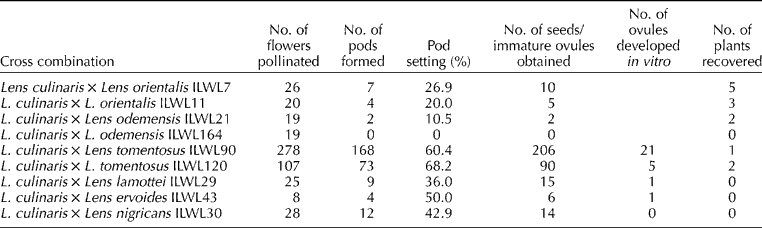
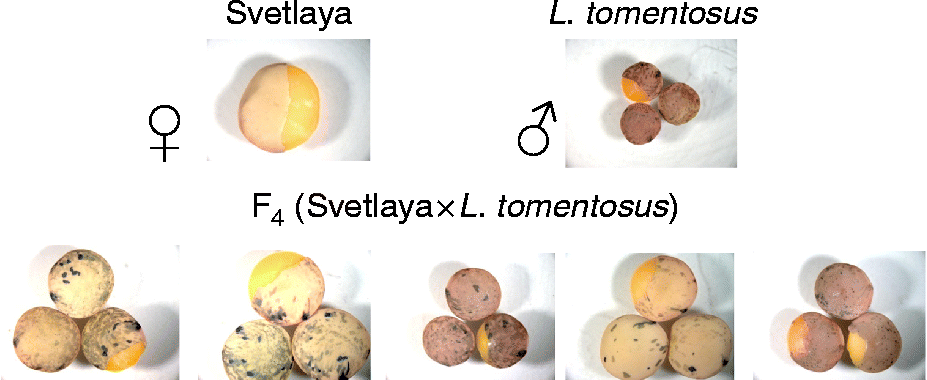
In India, advanced materials of interspecific crosses of L. culinaris with L. orientalis and L. odemensis revealed an increase in variability contributed by positive alleles from both parents that could be utilized in breeding cultivated lentil (Gupta and Sharma, Reference Gupta and Sharma2007). In Russia, a systematic attempt to introgress wild Lens species began in 2003. Table 2 shows typical results of interspecific hybridizations among lentil taxa, including in vitro embryo culture and production of hybrid seeds. Successful crossing of L. culinaris with L. orientalis and L. odemensis was possible by conventional techniques, and F1 seed germination in vitro was successfully used to produce hybrid plants. The hybrid plants obtained in these crosses developed normally in following generations that allowed selection of highly productive hybrid lines that showed recombination of flower, seed and cotyledon colour characters (Fig. 1). Seed yield of interspecific F7–8 lines in 2009 varied from 1.1 to 2.1 t/ha, levels comparable to parental cultivars of L. culinaris. Seed protein of the hybrid lines was as high as 30%, beyond the maximum of 28% observed in parent lines.
Results of interspecific crosses in the genus Lens at the All-Russian Research Institute of Grain Legumes and Groat Crops 2003–2006

Seed colour diversity of parents and F4 interspecific hybrids of Lens culinaris ‘Svetlaya’ × Lens tomentosus (A colour version of this figure can be found online at journals.cambridge.org/pgr).

In the case of L. culinaris × L. tomentosus, mature pods were formed but hybrid seeds were unfilled and unviable. When L. culinaris was crossed with species of L. ervoides, L. lamottei and L. nigricans, there was abortion of pods at 10–15 d after pollination. Ovule rescue techniques were used to overcome the interspecific incompatibility between L. culinaris and other wild species. Fertilized ovules were cultured at 7–20 d old on nutrient media containing mineral salts of Murashige and Skoog (MS) or B5, vitamins of B5, 30 or 50 g/l of sucrose, 100 mg/l of inositol, 1000 mg/l of casein hydrolyzate, 5.5 g/l of agar combined to growth regulators in the following compositions: 2.25 mg/l of 6-benzylaminopurine (BAP) +0.2 mg/l of indole-3-acetic acid (IAA); 1 mg/l of BAP +0.2 mg/l of IAA; 1 mg/l of BAP +1 mg/l of α-naphthylacetic acid; 2 mg/l of zeatin +0.2 mg/l of IAA. Various methods were used for lentil embryo development in vitro: direct embryogenesis, multiple shoot formation, phenomena of flowering and pod setting in vitro. To optimize rooting of lentil shoots, a method based on explant polarity was successful in some cases (Fratini et al., Reference Fratini, Ruiz and Pérez de la Vega2003). Regenerated shoots were cultured in inverted orientation in rooting media. Rooted plantlets were ready to be planted into soil, where they normally flowered and formed seeds after acclimatization.
In the cross L. culinaris × L. tomentosus, 296 immature ovules at 8–19 d after pollination were planted onto nutrient media. Three hybrid plants were recovered from the 26 ovules, which successfully developed further on media (Table 2). Plants from the F1–5 generations were viable with variable degree of fertility. Some plants in segregating generations were completely sterile, some had normal fertility and some had low fertility expressed as the presence of aborted seeds in fully ripe pods. Hybridity was confirmed phenotypically by flower colour and seed-coat colour variation and biochemically by sodium dodecyl sulphate polyacrylamide gel electrophoresis of seed storage protein, and hybridity of all lines obtained was also confirmed (Fig. 1). This is the first time that interspecific hybrids of L. culinaris × L. tomentosus were recovered and described.
The experience in Canada with breeding lentil for resistance to anthracnose caused by Colletotrichum truncatum provides an illustrative example of the value of wide crosses in the genus Lens. After screening 1771 accessions of Lens culinaris subsp. culinaris, only 16 had some level of resistance to race Ct1 of anthracnose, and no resistance was found to the more aggressive race Ct0 (Buchwaldt et al., Reference Buchwaldt, Anderson, Morrall, Gossen and Bernier2004). The same results occurred when accessions of L. culinaris subsp. orientalis were screened with race Ct0. But the secondary/tertiary gene pool accessions had a high frequency of resistance to both anthracnose races (Tullu et al., Reference Tullu, Buchwaldt, Lulsdorf, Banniza, Barlow, Slinkard, Sarker, Tar'an, Warkentin and Vandenberg2006). Transfer of resistance from the secondary/tertiary gene pool was attempted by hybridizing L. ervoides PI 72815 and L. culinaris cv. Eston using ovule and embryo rescue techniques (Cohen et al., Reference Cohen, Ladizinsky, Ziv and Muehlbauer1984). The hybrid embryo was micrografted to an L. culinaris rootstock to produce F2 seeds. This population was advanced to the F8:9 to produce a population of 150 recombinant inbred lines (RILs) (unpublished data), which should maximize genetic variation and will allow future discovery of new genes not only for disease resistance but also for quantitative trait loci (QTLs) of other important traits.
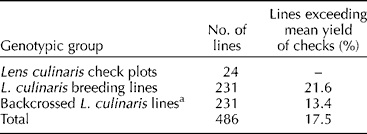
The success of this approach was reported by Fiala et al. (Reference Fiala, Tullu, Banniza, Séguin-Swartz and Vandenberg2009) where the resistance to anthracnose from L. ervoides was transferred to L. culinaris. In this case, anthracnose was transferred from L. ervoides L01-827A by hybridization with L. culinaris cv. Eston. L01-827A was the sole surviving plant discovered after inoculating a L. orientalis accession, which was susceptible to anthracnose. This points out that wild species accessions may often be heterogeneous mixtures, certainly within species and even between species. This hybrid was also developed into a RIL population, which has supplied valuable breeding material for introgression of anthracnose resistance. Vail (Reference Vail2010) showed that the interspecific hybrid lines consistently showed higher levels of anthracnose resistance in field evaluations, even under high disease pressure. F4 seeds of three F3 lines were used to backcross anthracnose resistance into several market classes of cultivated lentil. Several backcross cycles were completed; then, the resulting F2, F3 and F4 generations were screened in the field in a mixed race anthracnose disease nursery. Breeding lines were derived from the backcross selections and entered into preliminary unreplicated yield trials for the first time in 2009. Results so far suggest that there is no phenotypically detectable linkage drag effect on yield (Table 3) since many breeding lines exceeded the mean yield of check cultivars in the trials at frequencies similar to those expected for regular L. culinaris breeding lines. The results of the successful transfer of anthracnose resistance from L. ervoides using interspecific hybridization followed by intensive backcrossing indicate that yield was not affected. Further evaluation and introgression may show that yield potential will be enhanced by the introduction of new genetic variation. Lentil cultivars with greatly improved resistance to anthracnose will become available in the next 3–4 years, providing substantial environmental and economic benefits. We also have preliminary evidence that L. ervoides hybrid lines may exhibit a high level of resistance to stemphylium blight caused by Stemphylium botryosum.
Yield performance of lentil-breeding lines in six preliminary field trials in 2009 at Saskatoon, Canada

a Backcrossed for four generations starting with L. culinaris × Lens ervoides hybrid F4 plant.
A current research goal in lentil breeding in Canada is enabling introgression of genetic variation from the entire Lens genus by overcoming all barriers to hybridization through a concerted effort using embryo rescue and micrografting. We know that these techniques can be used to develop hybrids between L. culinaris and L. lamottei (Fiala, Reference Fiala2006). The overall objective is to make successful crosses between cultivated, progenitor and secondary gene pool species to allow introgression of functional genes into the breeding programme. We expect that by using a combination of these tissue culture techniques, the remaining barriers to transferring genes from wild species to cultivated lentil will be overcome.
Integration of genomic and genetic resources in lentil improvement
Molecular approaches to genetic analysis have until recently made limited progress in improving the understanding of the lentil genome. Lentil-breeding programmes do not yet use marker-assisted selection (MAS) to any extent because the lentil genetic maps are PCR-based anonymous markers (restriction fragment length polymorphism (RFLP), amplified fragment length polymorphism (AFLP), amplified polymorphic DNA (RAPD) and simple sequence repeat (SSR) (Hamwieh et al., Reference Hamwieh, Udupa, Choumane, Sarker, Dreyer, Jung and Baum2005; Review: Muehlbauer et al., Reference Muehlbauer, Seungho, Sarker, McPhee, Coyne, Rajesh and Ford2006)). Recently, lentil markers developed from sequences derived from the Medicago truncatula genome were mapped in lentil (Phan et al., Reference Phan, Ellwood, Hane, Ford, Materne and Oliver2007). Molecular markers could be valuable tools in breeding processes including enriching of F1 crosses, choice of donor parents and recovery of recurrent parent genotypes in backcrosses, forward selection of linkage blocks with markers and background selection. Application of molecular markers may improve pre-breeding, including germplasm characterization/fingerprinting, systematic sampling of germplasm to create core and minicore germplasm, phylogenetic analysis and making decisions regarding seed purity. But combining the conventional breeding with genome-based strategies for lentil improvement has not kept pace with the progress made in the global megacrops such as maize, rice and soyabean.
Finding superior genotypes for commercial release is a challenge, and one way of increasing the selection efficiency is to improve genetic gain by expanding genetic variation of the desired target traits. In traditional breeding, capturing this genetic diversity using phenotypic characterization alone may limit cultivar development. The genetic base can be widened by expanding the pool of germplasm using the allelic diversity at the nucleotide level. Remarkable progress has been recently achieved in the area of genomics as DNA-based marker assays have been developed for crop plant species. With large expressed sequence tag (EST) collections, usually from a set of representative genotypes, a number of genes are represented with information for each of the selected genotypes. This random sequence information has been used in predictive approaches for SSR (EST-SSRs, Rafalski, Reference Rafalski2002), single nucleotide polymorphisms (SNPs, Kota et al., Reference Kota, Rudd, Facius, Kolesov, Thiel, Zhang, Stein, Mayer and Graner2003; Varshney et al., Reference Varshney, Graner and Sorrells2005) and conserved orthologous sequences (Fulton et al., Reference Fulton, Van der Hoeven, Eannetta and Tanksley2002; Rudd et al., Reference Rudd, Schoof and Klaus2005). SNPs are the smallest unit of genetic variation and represent the most abundant type of sequence polymorphisms in plant and animal genomes. These sequence variations are estimated to occur once every 500–1000 bp (Picoult-Newberg et al., Reference Picoult-Newberg, Ideker, Pohl, Taylor, Donaldson, Nickerson and Boyce-Jacino1999). SNPs are usually discovered in silico from pre-existing datasets of genomic sequences or ESTs (Kota et al., Reference Kota, Rudd, Facius, Kolesov, Thiel, Zhang, Stein, Mayer and Graner2003; Rostoks et al., Reference Rostoks, Borevitz, Hedley, Russell, Mudie, Morris, Cardle, Marshall and Waugh2005) and through sequencing or resequencing of candidate genes or anonymous PCR products (Ponting et al., Reference Ponting, Drayton, Cogan, Dobrowolski, Spangenberg, Smith and Forster2007). When compared with other types of markers (RFLP, RAPD, AFLP and SSR), SNPs are amenable to high throughput screening enabling simpler and quicker processes facilitated by automation, robotics and bioinformatics (Rafalski, Reference Rafalski2002). The more the genetic variation, the greater the probability of capturing allelic variants for stress-tolerant traits. One of the effects of implementing modern methods of genetic analysis geared to allowing targeted introduction of genes is that this may increase requests to genebanks for exotic germplasm such as wild relatives of crops as a means of expanding the available genetic variation for lentil.
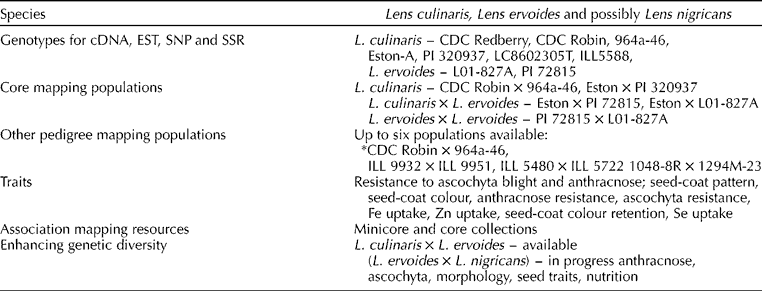
Because lentil is a relatively small crop, the financial resources have not been available to develop genomic strategies until recently when technology costs began to decline. In anticipation of the decline of technology costs, some key genetic resources for genomic analysis in lentil were developed at the Crop Development Centre (CDC) beginning in 2003 (Table 4). The fact that lentil has a large genome was also a barrier posed by the enormous costs of sequencing in the past. It is now possible to foresee using combination of technologies consisting of complementary DNA (cDNA) libraries, EST development and SNP discovery, bioinformatics platforms, core genetic maps and association mapping, which will lead to the goal of using marker-assisted breeding.
Germplasm, molecular resources and wide crosses for genetic enhancement of lentil

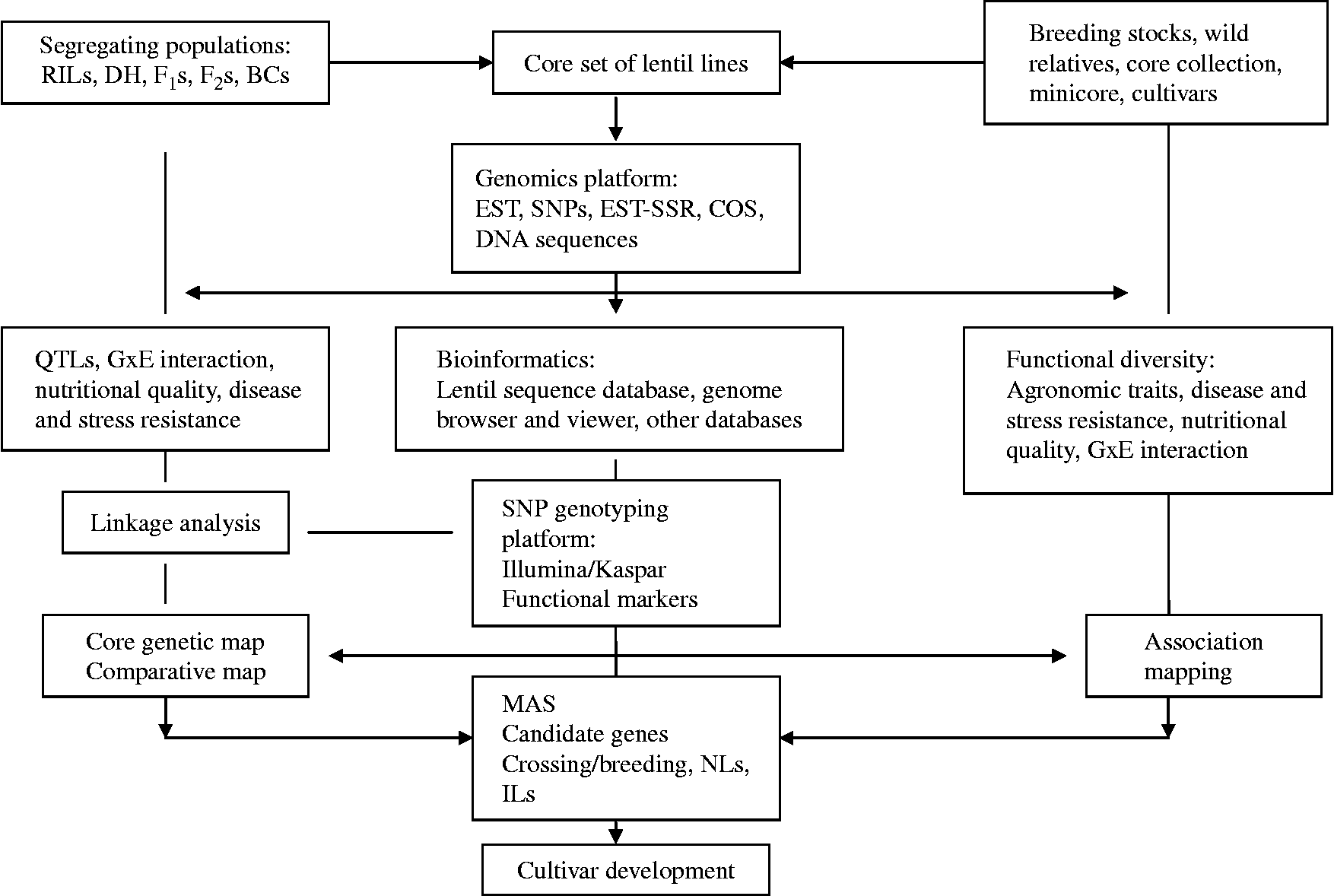
Research groups in Canada, Australia, the United States, India and ICARDA are leading the advancement in harnessing genomic technology for lentil improvement in a collaborative effort. This field is advancing rapidly and little information is published so far. We report here mostly on some of the efforts underway from a Canadian perspective. Global gene expression profiling is one method of identifying functionally associated genes. Two successive EST projects were undertaken under the NAPGEN EST project initiative (https://www.nrc-cnrc.gc.ca/eng/programs/pbi/plant-products/napgen.html); about 10,000 EST sequences were submitted to the NCBI database (GI: 268537582 to GI: 268547094) Vijayan et al., Reference Vijayan, Vandenberg and Bett2009). Under an Agricultural Development Fund project initiative of the government of Saskatchewan, large-scale identification of ESTs was initiated in pulse crops (lentil, chickpea, pea and common bean). The eventual goal is to develop MAS technologies for implementation in breeding programmes. Specific milestones were established to narrow the gap between the needs of cultivar development programme and integration of genomic resources. Essentially, the development of 454 cDNA libraries and ESTs was a major step taken for transcription profiling at the mRNA level. For full integration of molecular resources into lentil breeding, equally important are a global SNP genotyping platform (Illumina); development of intraspecific and interspecific mapping populations and core genetic maps; QTLs and MAS; and association mapping. Figure 2 outlines the relationships.
Overview of current and future germplasm and genomic resources in lentil breeding.

So far, SNP detection has been undertaken in the entire collection of ESTs by comparing sequence data of each of seven lentil genotypes against the reference genotype ‘CDC Redberry’ using a parallel process and modifications to an existing SNP discovery pipeline (Barbazuk et al., Reference Barbazuk, Emrich, Chen, Li and Schnable2007). The designed assay for each SNP will be supported in a GBrowse (Stein et al., Reference Stein, Mungall, Shu, Caudy, Mangone, Day, Nickerson, Stajich, Harris, Arva and Lewis2002) installation at CDC, University of Saskatchewan. Two SNP genotyping platforms will be used to access the nucleotide variation identified for mass genotyping in the breeding programme. The high-density Illumina Golden Gate assay queries up to 1536 loci simultaneously and will enable the rapid development of high-density genetic maps in lentil and support other applications such as association mapping. Secondly, a robust SNP genotyping assay (KASPar) will also be established for individual loci previously associated with gene controlling traits of interest and will be ideal for routine MAS. The resources will provide a core genetic map, which will in turn support the understanding of genome structure, mapping of key traits, assessment of genetic relationships between individuals and populations, and applications of MAS. Figure 2 outlines the relationships and resources linking genomic analysis of lentil to plant breeding and cultivar development.
We expect that the cultivated lentil genome will be sequenced before 2015 and that the wild species will also be resequenced, setting the stage for genome-wide approaches to genetic improvement of lentil. These will be critical steps for both broadening the genetic base and increasing selection efficiency in lentil breeding. The wild species accessions in the global genetic resource inventory represent less than 1% of the world collection, and this small fraction likely represents the greatest untapped pool of genetic variation in lentil. Genomic-based evidence for higher levels of genetic variability within the wild species of lentil is accumulating rapidly as the body of sequence-based genomic information expands. For example, the number of SNPs detected between two accessions of L. ervoides using sequence data derived from conserved orthologous markers was more than twice the number detected between two L. culinaris lines (Vail et al., Reference Vail, Bett, Cook and Vandenberg2010, unpublished). The effort to collect wild lentil species should be intensified before this valuable germplasm disappears because of the increasing negative impacts of human population growth and climatic change. An investment should also be made in the use of SNP profiles to genetically characterize the entire collection of wild lentil species. This will help to determine how much overlap exists in the collection and also help to refine the definition of species. It maybe that the wild species have remained more isolated in small genetic pools compared to the cultivated lentil, which has been continuously moved by human populations. Improvement of reliable propagation methods for wild species is also required as well as standardized phenotypic and phenological assessment. Giving the highest priority to maintenance and development of these extremely valuable genetic resources for lentil will help to ensure that this crop can maintain high rates of genetic gain and increase as a valuable component of the human diet and agricultural ecosystems.