So-called “heterotaxy syndrome” is characterised by isomerism of the thoracic organs and random arrangement of the abdominal organs.Reference Loomba, Hlavacek, Spicer and Anderson 1 Although once distinguished on the basis of splenic anatomy, segregation on the basis of the morphology of the atrial appendages is now considered optimal.Reference Uemura, Ho, Devine and Anderson 2 Those with right isomerism will have atrial appendages that are broad and pyramidal. Such patients typically have complex congenital malformations of the heart requiring univentricular palliation, tracheobronchial angle of >135°, bilaterally trilobed lungs, intestinal malrotation, and absence of the spleen.Reference Uemura, Ho, Devine and Anderson 2 – Reference Loomba, Pelech, Shah and Anderson 6 Those with left isomerism will have atrial appendages that are both narrow and finger like, less complex congenital malformations of the heart, symmetrical tracheobronchial angles of <135°, bilaterally bilobed lungs, and multiple spleens.Reference Loomba, Shah and Anderson 4 , Reference Loomba, Ahmed, Spicer, Backer and Anderson 7 , Reference Loomba, Shah and Anderson 8
These findings are more than anatomic curiosities and frequently have significant consequences – for instance, those with isomerism can have functional asplenia in the setting of a normally located solitary spleen or multiple spleens.Reference Nagel, Williams, Stewart, Paul and Stumper 9 In addition, functional asplenia may also leave these patients at increased risk for thrombocytosis and subsequent thromboembolic events.Reference Yamamura, Joo and Ohga 10 – Reference Loomba 12 Postoperative outcomes and complications in these children have also been demonstrated to be different.Reference Koudieh, McKenzie and Fraser 13 – Reference Loomba, Aggarwal, Arora and Anderson 15 It has long been recognised that those with isomerism are at higher risk for morbidity and mortality.Reference Loomba 14 , Reference Loomba, Willes, Kovach and Anderson 16 – Reference Loomba, Nijhawan and Anderson 19 A part of these increases is related to the presumed increased risk of bacteraemia in this population.Reference Bartz, Driscoll and Dearani 18 , Reference Wu, Wang and Lue 20 – Reference Humes, Feldt, Porter, Julsrud, Puga and Danielson 27 There are limited data, however, regarding bacterial infection in the population of patients with isomerism, and on how this can be effectively prevented and managed. In this study, we aimed to characterise the infectious characteristics of a cohort of patients with isomerism and to determine the impact of splenic anatomy and other factors on their bacteraemic risk in only children with isomerism; we did not compare with children without isomerism.
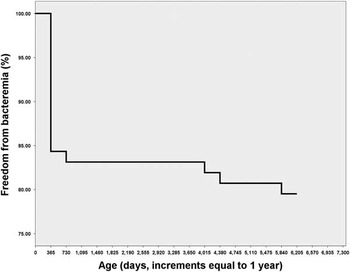
Kaplan–Meier curve demonstrating freedom from bacteraemia in patients with isomerism.

Methods
Our methodology was approved by the Institutional Review Board at our institution and complies with the Declaration of Helsinki. Medical records of all patients with CHD and isomerism who were cared for at Children’s Hospital of Wisconsin since 1998, the year electronic medical records was implemented at the institution, were reviewed. This included both patients born in or after 1998, as well as those born earlier who transitioned their care to our heart centre after 1998. Those who were born before 1998 at our institution and remained alive at the time of establishment of our electronic medical record system were also captured.
The charts were reviewed, and patients were included if they had CHD and isomerism. CHD was defined as any intracardiac lesion or abnormality of systemic venous return to the heart. Isomerism was defined as having the aforementioned CHD in the setting of abnormal arrangement of the abdominal organs, pulmonary isomerism, or anatomic splenic abnormalities. The diagnosis of isomerism for this study was established on the basis of chart review. Bacteraemia was defined as a positive blood culture at our institution. The state of antibiotic prophylaxis against encapsulated bacteria was also assessed for all patients. Compliance of the use of prophylactic antibiotics could not be assessed.
Data regarding cardiac anatomy were obtained primarily from echocardiographic investigations, although cardiac MRI and cardiac catheterisation data were also available for some patients. Anatomic splenic status in all but two patients was based on abdominal ultrasonography. Patients were excluded if they did not have CHD, isomerism, or ample clinical data. Children with chromosomal anomalies were not excluded from this study.
The intracardiac features considered to indicate the presence of isomeric right as opposed to left atrial appendages were assessed independently by two authors (R.L. and R.H.A.), with cognisance taken also of the findings in the other systems of organs. These included, but were not limited to, overall cardiac anatomy, venoatrial connections, and splenic anatomy.
Infectious disease end points for which data were collected included, but were not limited to, splenic morphology, prophylactic state, history of bacteraemia, as well as organisms cultured during episodes of bacteraemia. Categorical variables are presented as absolute numbers and percentages, whereas continuous variables are presented as medians and ranges. Continuous variables were compared using a Mann–Whitney U–test, and categorical variables were compared using χ2 analysis.
Survival analysis was carried out using Cox regression to assess the impact of selected variables of interest in predicting episodes of bacteraemia. Data analysis were conducted using SPSS (Chicago, Illinois, United States of America). A p-value of <0.05 was considered to be statistically significant.
Results
Baseline characteristics
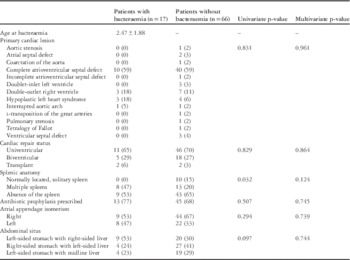
A total of 83 patients were identified as having CHD and isomerism. Of the group, 37% were known to have absence of the spleen, 57% had anatomic polysplenia, and 6% had a normally located spleen. Episodes of bacteraemia occurred in 17 patients (20%). Patients with and without episodes of bacteraemia did not differ in their baseline characteristics other than with respect to splenic anatomy. Perhaps surprisingly, those with a history of bacteraemia were more likely to have multiple spleens, whereas those without a history of bacteraemia were more likely to have absence of the spleen or a normally located and solitary spleen (Table 1). Total follow-up time for the cohort was 587 patient years, with a mean follow-up time of 7.0 years/patient.
Characteristics of patients with and without a history of bacteraemia.

Bacteraemia overview
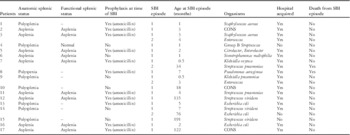
The nature of the episodes of bacteraemia is provided in Table 2. There was a total of 21 instances of bacteraemia, with a total of 22 cultured bacterial organisms. The median age at bacteraemia was 4 months, with a range from 15 days to 19 years. The most common bacterial organisms were coagulase-negative Staphylococcus, Streptococcus viridans, and Escherichia coli, where each grew in three (14%) cultures. Enterococcus, Staphylococcus aureus, Streptococcus, and pneumoniae each grew in two (9%) cultures. Group B Streptococcus, Citrobacter, Enterobacter, Stenotrophamonas maltophilia, Klebsiella oxytoca, Pseudomonas aeruginosa, and Klebsiella pneumoniae each grew in one (5%) culture (Table 2). Using susceptibility data from our institution, eight of 22 (36%) cultured organisms should have been susceptible to amoxicillin, three of 22 (14%) should have had intermediate susceptibility to amoxicillin, and 11 of 22 (50%) should have been resistant to amoxicillin.
Patient-level data of patients with history of bacteraemia.

CONS = coagulase negative staphylococcus; SBI = severe bacterial infection
Cardiac anatomy in those with bacteraemia
Of the 17 patients with bacteraemia, 10 (59%) had a primary cardiac diagnosis of atrioventricular septal defect with common atrioventricular valve, three (18%) had double-outlet right ventricle, three (18%) had hypoplastic left heart syndrome, and one (5%) had isolated interruption of the inferior caval vein. The diagnosis of isomerism was made prenatally in 11 (65%) patients, with postnatal diagnosis made at a mean age of 5 days in the remainder. Left isomerism was found in eight (47%) patients and right isomerism in nine (53%). Abdominal arrangement was usual in five patients (29%), mirror imaged in four (24%), mixed in four (24%), and considered indeterminate in four (24%). The circulation was functionally univentricular in 11 (65%) patients, biventricular in five (29%), and transplant in one (6%).
Antibiotic prophylaxis
Out of the total cohort, 58 (70%) patients were prescribed prophylactic antibiotics as a component of care. Such prophylaxis consisted of either ampicillin or amoxicillin in all patients. Compliance with prophylaxis could not be accurately assessed. Bacteraemia occurred in a total of six (24%) of those not receiving prophylactic antibiotics and in 11 (19%) of the patients prescribed prophylactic antibiotics. It was not possible independently to confirm compliance with the prophylactic regime.
The median age at commencement of antibiotic prophylaxis was 8 days, with a range from zero to 850 days. Of those who were prescribed prophylactic antibiotics, the regime was discontinued in six patients at a median age of 16 years, with a range from 0.5 to 23 years. Of those with discontinued prophylaxis, four (66%) had anatomic asplenia, one (17%) had anatomic polysplenia, and one (17%) had a normally located spleen.
Almost two-thirds (65%) of our patients were knowingly on prophylaxis at the time of bacteraemia, with the remaining one-third (35%) not receiving prophylactic antibiotics at the time of bacteraemia. Of these six patients, five had anatomic polysplenia, whereas the remaining patient had anatomic asplenia.
Nosocomial versus community-acquired bacteraemia
Nosocomial infections accounted for 18 (86%) instances of bacteraemia; 19 instances of nosocomial bacteriaemia occurred over a total of 16 patients. The majority of these infections occurred postoperatively, with lines in place. Of the episodes with nosocomial source of bacteraemia, patients were on prophylactic antibiotics at the time of 14 of 18 (78%) of these episodes. Of the bacteria isolated from nosocomial instances of bacteraemia, six of 18 (33%) should have been susceptible to amoxicillin.
Community-acquired infections accounted for three (14%) of the instances of bacteraemia. The three instances of community-acquired bacteraemia occurred over a total of three patients, all of whom were not on prophylaxis and all of whom had multiple spleens. These patients had growth of Group B Streptococcus, Streptococcus viridans, and Escherichia coli from their blood cultures. According to the susceptibilities at our institution, the former two bacteria are generally susceptible to amoxicillin, whereas the latter is not susceptible.
Children greater than 5 years of age
With regard to older children, there were only four instances of bacteraemia that occurred after 5 years of age. These patients ranged from 6 to 15 years of age. Of these episodes, two (50%) were due to Streptococcus virdans, with the others due to Escherichia coli and coagulase-negative Staphylococcus. At the time of bacteraemia, two of the patients with multiple spleens were not receiving prophylactic antibiotics, whereas the other two patients, known to have asplenia, were receiving prophylaxis. Both patients with multiple spleens had community-acquired bacteraemia, whereas both with asplenia had nosocomial bacteraemia. None of these patients with bacteraemia died. Of the three organisms identified, one should have been susceptible to amoxicillin according to the known susceptibilities at our institution.
Mortality
Bacteraemia resulted in the death of two patients. These two patients accounted for 12% of all patients in this cohort who had an episode of bacteraemia, and 2% of the overall group. Among them, one patient (patient 7, Table 2) was 34 months of age at the time of death and was experiencing his second episode of bacteraemia. His first episode occurred at less than one month of age, due Klebsiella oxytoca infection, whereas the second episode was due to Streptococcus pneumoniae. The first episode was nosocomial, whereas the second episode was believed to be community acquired. The child had an atrioventricular septal defect with common atrioventricular valve, double-outlet right ventricle, pulmonary atresia, left-sided and anterior aorta, and a right-sided aortic arch. He had bronchi that were bilaterally right in morphology. He had undergone a Blalock–Taussig shunt, as well as a bidirectional Glenn anastomosis. In the time leading to his death, the child had presented to the emergency room after he had a seizure in the setting of a fever and large emesis where he was found to be hypoxic. He was transferred to the cardiac ICU where he required extracorporeal membrane oxygenation and high-dose inotropic support. A few hours into his hospitalisation, blood cultures showed growth of Streptococcus pneumoniae. The child was already on broad-spectrum antibiotics. The child became anuric, coagulopathic, and continued to have haemodynamic compromise. After discussion with his family, support was withdrawn on the day of admission. This child did have anatomic asplenia and was receiving prophylactic antibiotics.
The second death (patient 7, Table 2) was of a baby girl aged 7 months with an atrioventricular septal defect, tetralogy of Fallot, bilateral superior caval veins with the left vein draining to a coronary sinus, interruption of the inferior caval vein, and a right aortic arch. She had been admitted to our unit for atrioventricular septation and placement of a conduit from the right ventricle to the pulmonary arteries. She had been noted previously to have multiple spleens by abdominal ultrasound and had been commenced on prophylactic antibiotics early on during hospitalisation. Postoperatively, she required extracorporeal membrane oxygenation support for reduced ventricular function, from which she was weaned after a period of 12 days. Following decannulation, she required escalation in her inotropic support and re-opening of her sternum. At that time, Pseudomonas aeruginosa was cultured from her blood. She was placed on appropriate antibiotic therapy. She was also found to have echocardiographic findings of endocarditis and underwent replacement of the conduit, as well as removal of vegetation from her right atrium. Subsequent to the re-operation, she manifested multi-organ failure and required respiratory oscillation. Despite increased support, she remained refractory to treatment. After discussion with her family, support was withdrawn.
Cox regression analysis
Cox regression analysis was conducted with all variables being found not to be predictive of bacteraemia. Although splenic anatomy was significant in the univariate analysis, it lost significance in the multivariate model (p=0.124).
Discussion
So-called “heterotaxy” is a complex syndrome, which goes beyond simple discordance in sidedness. The essence of its cardiac manifestations is isomerism of the atrial appendages, but the issues of management extend far beyond the anatomical features. Multiple systems of organs are affected, both anatomically and functionally, particularly the immune system. Splenic anatomy can vary from a normally located spleen in the minority to the extremes of multiple or absent spleens.Reference Uemura, Ho, Devine and Anderson 2 Splenic function, moreover, may be compromised with any form of splenic anatomy, and thus all patients with isomerism are at increased risk for bacterial infections, thrombocytosis, and thromboembolism.Reference Yamamura, Joo and Ohga 10 , Reference Loomba and Anderson 11 Gross structural abnormalities in the spleen as well as microscopic changes in the ultrastructure and function of splenic cilia are postulated to be causally responsible for splenic dysfunction.Reference Loomba, Ahmed, Spicer, Backer and Anderson 7 , Reference Nagel, Williams, Stewart, Paul and Stumper 9 , Reference Rodin, Sloane and Nghiem 28
The risk of major infection was quantified in a large multicentric study of over 30,000 children undergoing cardiac surgery. The aim was to determine risk factors for infection, with a prevalence of 13.3% found in those deemed to be at major risk of infection.Reference Barker, O’Brien and Welke 29 This group of patients included those who were younger than 90 days, had a preoperative stay of more than 1 day, required preoperative ventilatory support, and had a genetic abnormality. This prevalence was lower than the prevalence of bacteraemia noted in one-fifth of our cohort. It is similar, however, to the prevalence noted in other studies.Reference Waldman, Rosenthal, Smith, Shurin and Nadas 30 , Reference Prendiville, Barton, Thompson, Fink and Holmes 31 A more recent study, not limited to patients with isomerism, but including 95 patients with isomerism, showed that one-third of the latter patients had an episode of nosocomial severe bacterial infection. Our findings indicate that neither splenic anatomy nor arrangement of the other abdominal organs have any impact on the rates of bacteraemia.
Median age at discovery of bacteraemia in our cohort was 4 months. A majority of the infectious events reported by others also occurred before 1 year of age. The latest instance of bacteraemia in our cohort occurred when the patient was 15 years of age, again being consistent with previous studies.Reference Barker, O’Brien and Welke 29 , Reference Waldman, Rosenthal, Smith, Shurin and Nadas 30 , Reference Chiu, Shao and Wang 32 Studies characterising infections in those with either surgical or post-traumatic splenectomies have found that a majority of infections happened within 3 years following splenectomy, although there are some reports of infection after an interval of 65 years. Overall, nonetheless, it is younger patients with isomerism who are at greater risk for bacterial infections.Reference Bisharat, Omari, Lavi and Raz 33 , Reference Hansen and Singer 34
In all, two-thirds of our patients were receiving prophylactic antibiotics, specifically amoxicillin. There are no current guidelines dictating the use of prophylactic antibiotics in patients with isomerism. Prophylaxis, however, seems reasonable in this population, as those with splenic dysfunction have a 600-fold increase in the risk of mortality from infection, with overall mortalities as high as 40 to 70%.Reference Bisharat, Omari, Lavi and Raz 33 , Reference Lynch and Kapila 35 – Reference Brigden and Pattullo 38 Mortality in our cohort was lower than that previously reported, at 12%, but this may be due to the higher rate of prophylaxis when compared with some of the previous studies. Of the two patients who died in our cohort from bacteraemia, one had asplenia, whereas the other had multiple spleens. Both patients, nonetheless, were receiving prophylaxis. The effectiveness of prophylaxis in the population of isomeric patients, therefore, remains unclear.
Additional data from the sickle cell population may be significant in this regard. These investigations have demonstrated decreases in both morbidity and mortality subsequent to antibiotic prophylaxis, particularly when started before 4 months of age – for example, results from the Prophylaxis with Oral Penicillin in Children with Sickle Cell Anemia trial demonstrated a reduction of nearly 85% in septicaemia due to Streptococcus pneumoniae subsequent to the use of prophylactic penicillin.Reference Gaston, Verter and Woods 39 A follow-up study, also in sickle cell patients, then demonstrated that prophylaxis could safely be stopped at 5 years of age.Reference Falletta, Woods and Verter 40 In our experience, four-fifths of all episodes of bacteraemia occurred in patients younger than 5 years of age. With regard to the four episodes of bacteraemia occurring after the age of 5 years, two patients were receiving antibiotic prophylaxis at the time of the episode, whereas two were not receiving antibiotic prophylaxis.
It seems reasonable, therefore, to use these data when considering the fate of patients with isomerism until specific data are available for the latter group. Patients with sickle cell disease also suffer from splenic dysfunction, making these two populations comparable from the stance of immunocompromise. Our data demonstrate that, in the setting of a relatively high incidence of prophylaxis, at 70%, bacteraemia is caused by encapsulated organisms ~20% of the time compared with other studies. Of the organisms cultured in our cohort, about one-third were susceptible to amoxicillin, one-sixth generally had intermediate susceptibility to amoxicillin, and half were resistant to amoxicillin.
Reports have indicated that antibiotic prophylaxis has altered the epidemiology of postoperative infections, such that the responsible organisms are resistant to usual therapy, leading to infections that are more difficult to treat. Although rates of bacterial infections were found to decrease, however, mortality was unaffected. This almost certainly reflects the resistance of the responsible organisms, which are therefore more difficult to treat.Reference Classen, Evans, Pestotnik, Horn, Menlove and Burke 41 , Reference Siegel, McCracken, Threlkeld, Milvenan and Rosenfeld 42
To date, it is usually splenic anatomy that has dictated the clinical management of children with isomerism with respect to infectious concerns. It is now well established that, however, patients with multiple spleens, or even those with solitary and normally located spleen in the setting of isomerism, may have functional asplenia.Reference Nagel, Williams, Stewart, Paul and Stumper 9 Thus, it is surely wiser to base decisions regarding the risk of infection on knowledge of splenic function. This can be assessed by means of Howell–Jolly bodies or pitted red blood cells.Reference Crosby 43 – Reference Corazza, Ginaldi and Zoli 46 These tests, nonetheless, can be less than reliable earlier in life, and assessment can be difficult at ages younger than 2 years.Reference Combs, Gupta and Mehta 47 Establishment of normal splenic function at this time can permit the discontinuance of prophylactic antibiotics, but those with functional asplenia should continue to receive prophylaxis until 5 years of age. It is also important to ensure that children with functional asplenia remain properly vaccinated. 48 Pneumococcal and Haemophilus influenzae b vaccinations were more available during our study period than previous studies, which may also account for lower rates of bacteraemia and mortality.
A limitation of our study, and indeed the majority of other previous studies, is that splenic function is most often not tested in patients with isomerism. It is well known that those with multiple spleens, and even those with a solitary and normally located spleen, may have functional asplenia. We found functional asplenia in the majority of our individuals with bacteraemia. Thus, care providers must be aware of the risk of functional asplenia in these populations, and that the children may benefit from antibiotic prophylaxis. Serial evaluation of splenic function may help guide the need for the requirement of antibiotic prophylaxis in these patients, and avoid the overuse of prophylaxis. All of this, however, is conjecture and demonstrates the need for additional studies in this population. Another limitation is that we did not look at specific immune cell subsets. A recent study by Chiu et al demonstrated that low number of IgM memory B cells is an independent risk factor for infection in those with isomerism, but we were unable to study this effect as we do not routinely characterise immune cell populations.Reference Chiu, Shao and Wang 49
The strengths of our study include the assessment of a large number of patients over a long period of follow-up, as well as a complete description of the types of bacteria and their antibiotic susceptibilities. The inclusions of detailed phenotypic variations in splenic and visceral anatomy are important and also novel. The major limitations of the study are its retrospective nature and the low number of patients.
Conclusion
The risk of bacteraemia in patients with isomerism is not confined to those with asplenia. Somewhat surprisingly, we found it to be more prevalent in our cohort in those known to have multiple spleens. Cardiac anatomy, abdominal anatomy, and the use of antibiotic prophylaxis do not appear to alter this risk. Functional assessment of the immunological splenic status may provide better future stratification of risk.
Acknowledgements
None. Authors contributions: R.S.L., A.P., and R.A. designed the study. R.S.L. collected and analysed the data and wrote the manuscript. A.P. and R.A. reviewed the data and wrote the manuscript.
Financial Support
This research received no specific grant from any funding agency, commercial, or not-for-profit sectors.
Conflicts of Interest
None.
Ethical Standards
As described in the methods, this study complies with the Helsinki Declaration and was approved by the local institutional review board.