Introduction
Anorexia nervosa (AN) is a serious psychiatric disease with the highest mortality rate among all mental disorders with a weighted annual mortality for AN of 5.10 deaths per 1000 person-years (Arcelus, Mitchell, Wales, & Nielsen, Reference Arcelus, Mitchell, Wales and Nielsen2011). Due to the prevailing fear of gaining weight, persistent preoccupations with thoughts about food and body weight are typically observed in AN. This attentional bias toward disorder-specific cues has been found to affect the recall of autobiographical memory (AM) regarding disorder-specific events (Huber et al., Reference Huber, Salatsch, Ingenerf, Schmid, Maatouk, Weisbrod and Nikendei2015).
AMs are defined as declarative and explicit memories of past experiences with personal meaning. They are recalled from the unique perspective of the self, including thoughts, actions and feelings (Conway, Reference Conway2005), and can be described on a continuum ranging from ‘specific’ to ‘overgeneralized’. While specific AMs relate to a single event, overgeneralized AMs (OGM) are related to several episodes over an extended period of time. The overgeneralization of memories has been identified as an important emotion regulation strategy in affective disorders, since unspecific memories of negative events are less likely to trigger negative emotions. Although enabling emotional avoidance, this phenomenon incurs maladaptive long-term effects such as a reduced ability to experience emotions and to integrate emotional events in episodic memory (Williams et al., Reference Williams, Barnhofer, Crane, Herman, Raes, Watkins and Dalgleish2007).
Dysfunctional regulation of emotions is pivotal in the development and maintenance of AN (Brockmeyer et al., Reference Brockmeyer, Skunde, Wu, Bresslein, Rudofsky, Herzog and Friederich2014; Racine & Wildes, Reference Racine and Wildes2015) and previous studies have found that patients with AN display OGM for emotional life events (Huber et al., Reference Huber, Salatsch, Ingenerf, Schmid, Maatouk, Weisbrod and Nikendei2015; Nandrino, Doba, Lesne, Christophe, & Pezard, Reference Nandrino, Doba, Lesne, Christophe and Pezard2006). The tendency of recalling OGM increases with the duration of the disorder (Nandrino et al., Reference Nandrino, Doba, Lesne, Christophe and Pezard2006) and has been directly linked to emotional avoidance in AN (Dalgleish et al., Reference Dalgleish, Williams, Golden, Perkins, Barrett, Barnard and Watkins2007). Furthermore, lower body weight in patients with AN is associated with a diminished experience of negative emotions when recalling sad AM (Brockmeyer, Grosse Holtforth, Bents, Herzog, & Friederich, Reference Brockmeyer, Grosse Holtforth, Bents, Herzog and Friederich2013). In a previous investigation, we observed increased OGM in patients with AN in response to disorder-related (i.e. food/body-related) cues (Huber et al., Reference Huber, Salatsch, Ingenerf, Schmid, Maatouk, Weisbrod and Nikendei2015). Accordingly, focusing emotional expression during therapy has been found to be related to improved treatment outcome in AN (Friederich et al., Reference Friederich, Brockmeyer, Wild, Resmark, de Zwaan, Dinkel and Herzog2017). Thus, the examination of underlying neurophysiological mechanisms of disorder-related AM might be a further step to address where treatment can ‘step in’.
Previous studies have identified a network of brain regions subserving different cognitive processes during retrieval of AM. Regions within prefrontal, temporal, and parietal cortices, as well as limbic structures, are involved (Fossati, Reference Fossati2013). Furthermore, the angular gyrus has been found to be related to the subjective experience of remembering in a first-person perspective (Bonnici, Cheke, Green, FitzGerald, & Simons, Reference Bonnici, Cheke, Green, FitzGerald and Simons2018). Up to date, the neurophysiological correlates of AM have been studied in patients with depression and posttraumatic stress disorder, revealing dysfunctional neural processing during AM-retrieval in both disorders (Thome, Terpou, McKinnon, & Lanius, Reference Thome, Terpou, McKinnon and Lanius2020; Young, Bellgowan, Bodurka, & Drevets, Reference Young, Bellgowan, Bodurka and Drevets2013, Reference Young, Bellgowan, Bodurka and Drevets2014; Young, Drevets, Bodurka, & Preskorn, Reference Young, Drevets, Bodurka and Preskorn2016). However, to our knowledge, neural processing during retrieval of AM has not yet been investigated in patients with AN. Since dysfunctional emotion regulation strategies have been related to the development and maintenance of AN, the aim of the present study was to investigate the neural correlates of disorder-related AM recall in patients with AN. Using functional magnetic resonance imaging (fMRI), we assessed changes in hemodynamic activation as well as functional connectivity during AM recall in patients with AN and normal-weight healthy controls (HC). Resting-state brain connectivity was assessed to control for intrinsic group differences in functional networks. Based on our previous research (Huber et al., Reference Huber, Salatsch, Ingenerf, Schmid, Maatouk, Weisbrod and Nikendei2015), we expected that patients with AN would recall less specific AMs in response to food/body-related cues and display a pattern of brain activation reflecting reduced emotional processing and increased prefrontal control.
Methods
Participants
Twenty-nine female patients currently ill with AN were compared to 30 female HC. Patients with AN were recruited between March 2018 and September 2019 from our in- and outpatient department (Zipfel, Lowe, Reas, Deter, & Herzog, Reference Zipfel, Lowe, Reas, Deter and Herzog2000). Each measurement started at 10:00 h and lasted for approximatively 4 h, until 14:00 h. We employed a standardized operating procedure detailing every step of data collection (see online Supplementary Fig. S1). The first author of this manuscript was solely responsible for the collection of data. Twenty-six out of 29 patients with AN included in the study were at the beginning of inpatient treatment at our clinic. This treatment is specifically tailored to eating disorders and consists of an individually negotiated eating contract to achieve the desired increase in weight, as well as multimethod therapeutic offers such as individual, group, and music therapy (Arastéh, Baenkler, & Bieber, Reference Arastéh, Baenkler and Bieber2018; Herzog, Friederich, Wild, Lowe, & Zipfel, Reference Herzog, Friederich, Wild, Lowe and Zipfel2006; Köhle et al., Reference Köhle, Herzog, Joraschky, Kruse, Langewitz and Söllner2016). The remaining three patients were recruited from intensive care units (n = 2) as well as from past studies of our group (n = 1). HC were locally recruited via advertisements. All patients met the diagnostic criteria for AN restrictive subtype (N = 21) or purging subtype [N = 8, DSM-5 criteria (Association, Reference American Psychiatric Association2013)] and had a body mass index (BMI) below 17.5 kg/m2 and above 13 kg/m2. HC had a BMI between 18.5 and 25 kg/m2, and no lifetime or current medical illness that could potentially affect appetite or weight. Five patients were receiving psychopharmacological medication (antidepressants N = 1, neuroleptics N = 4). Both groups were matched regarding age and premorbid intelligence (Table 1). All participants were right-handed and over the age of 18 years. Exclusion criteria included current pregnancy, claustrophobia, metallic implants and lifetime diagnoses of bipolar disorder, psychosis, substance abuse and borderline personality disorder. The Medical Ethics Committee at the Ruprecht-Karls-University in Heidelberg, Germany, approved this study (S-592/2015) and written informed consent was obtained from all participants.
Participant characteristics by group

AN, anorexia nervosa; HC, healthy controls; MWTB, Multiple Selection Vocabulary Test (German Version); TMT, Trail Making Test, EDE-Q, Eating Disorder Examination Questionnaire; TFEQ, Three-Factor Eating Questionnaire; ERQ, Emotion Regulation Questionnaire; STAI, State-Trait Anxiety Inventory; PHQ-9, Patient Health Questionnaire-9.
Psychometric assessment
Psychometric scales were used to assess eating disorder symptoms [Eating Disorder Examination Questionnaire (EDE-Q; Hilbert, Tuschen-Caffier, Karwautz, Niederhofer, & Munsch, Reference Hilbert, Tuschen-Caffier, Karwautz, Niederhofer and Munsch2007), Three-Factor Eating Questionnaire (TFEQ; Stunkard & Messick, Reference Stunkard and Messick1985)], symptoms of depression [Patient Health Questionnaire (PHQ-9; Kroenke & Spitzer, Reference Kroenke and Spitzer2002), anxiety (State-Trait Anxiety Inventory; Spielberger, Reference Spielberger, Weiner and Craighead2010) as well as emotional reappraisal and suppression [Emotion Regulation Questionnaire (ERQ; Abler & Kessler, Reference Abler and Kessler2009). Verbal and education-related intelligence was assessed with the Multiple Selection Vocabulary Test (Lehrl & Merz, Reference Lehrl and Merz1989) and general intelligence with the matrix-reasoning subtest of the Wechsler Abbreviated Scale of Intelligence (Weschler, Reference Weschler1999). Neuropsychological tests included the Trail Making Test (TMT; Reitan, Reference Reitan1958) and the Wechsler Memory Scale-Revised (WMS-R; Härting et al., Reference Härting, Markowitsch, Neufeld, Calabrese, Deisinger and Kessler2000).
Procedures
We employed a case-controlled, cross-sectional fMRI design investigating both the neural correlates of AM-retrieval and resting-state functional connectivity. MRI scanning took place at the same time of the day (12:00 h) for each participant; psychometric assessment was performed prior to scanning. Resting-state MRI was performed prior to the task and participants were instructed to close their eyes, not to think of anything in particular, and not to fall asleep.
fMRI task
We employed a modified version of the AM-task (Young et al., Reference Young, Bellgowan, Bodurka and Drevets2013, Reference Young, Bellgowan, Bodurka and Drevets2014, Reference Young, Drevets, Bodurka and Preskorn2016) (AMT), where participants had to recall AMs in response to both AN-relevant (i.e. food/body-related) as well as neutral cue-words and rate these memories according to the degree of specificity and valence. Participants were informed beforehand about the different levels of specificity their AMs could correspond to: a specific memory refers to a specific event in one day, a categorical memory refers to several events, an extended memory refers to an extended period of time, and a semantic memory refers to a statement of fact without an associated memory. Participants were provided with examples for each level of specificity and were instructed to preferably recall a specific AM. Prior to scanning, participants practiced in detail how to classify memories into different categories. During the task, participants had to rate the level of specificity of each recalled memory. Immediately after scanning, participants were asked to describe the memory recalled for each AM cue word to check their specificity ratings. The first author then confirmed the participants' ratings of specificity. Trials for which participants failed to remember the recalled memory were excluded from all further analysis. The rating of recalled memories was not blinded. Furthermore, a semantic example generation condition was employed to control for abstract or general knowledge retrieval. Specifically, 10 food- and body-related and 10 neutral cue-words were presented for 12 s each, and participants were instructed to think examples related to the presented cue word. Following this, participants had to rate the perceived degree of difficulty to generate examples (very easy, easy, somewhat easy, somewhat difficult, difficult, or very difficult) and the number of examples generated (0, 1–2, 3–4, 5–6, 7, or ⩾8). Duration of each rating was 10 s. To control for attention, participants were presented with a riser detection task following the presentation of each cue and each set of ratings. In line with Young et al. (Reference Young, Bellgowan, Bodurka and Drevets2013), all cue words were scrambled into lowercase non-word letter strings, and participants had to count the number of ‘risers’ in the string (i.e. a letter rising above the top of the other letters, e.g. ‘cbor’ has the riser b). The presentation time was jittered with a mean of 6 s. For 50% of riser-strings (randomly selected), participants had to indicate whether the number of risers in the previous string was even or odd via button press. The sequence of cue word presentations was pseudorandomized (to prevent sequential presentations of cue-type). The task was divided into three runs, each run was composed of 13 (and in one run 14) memory cue words, six example generation (and in one run seven) cue words, and 19 riser letter strings. The total duration of the task was 70 min. Additional information is given in the online Supplementary Figs. S1 and S3.
fMRI acquisition
Images were collected using a Tim Trio 3-T whole-body MR scanner (Siemens Medical Solutions, Erlangen, Germany) equipped with a 32-channel head coil. A T2*-sensitive single-shot EPI sequence was employed (see online Supplementary material).
Statistical analysis
Analysis of behavioral performance
Data were analyzed using SPSS 25 (SPSS Inc.). Group differences in demographic variables and AMT performance were assessed using two-way mixed ANOVAs and independent-sample t tests. Pearson correlations were used to assess associations between task performance and neuropsychological as well as psychometric data.
fMRI analysis: AM-task
fMRI data were preprocessed and analyzed with SPM8 (http://www.fil.ion.ucl.ac.uk/spm/software/spm8/). The fMRI analysis was not blinded with respect to group affiliation. The senior author of this study performed all analysis steps. The observed clusters of activation were labelled based on the expertise of the senior author and checked with the AAL-atlas as included in the xjView toolbox (https://www.alivelearn.net/xjview). Pre-processing steps of MRI-data are given in the online Supplementary material.
At the single-subject level, a general linear model was constructed with AM-retrieval as well as semantic example generation as regressors of interest; individual parametric maps were then calculated for the following contrasts: (a) recall of specific food/body-related AM v. food/body-related semantic example generation (Specific_Food_AM_v._Food_Example), (b) recall of specific neutral AM v. neutral semantic example generation (Specific_Neutral_AM_v._Neutral_Example), (c) semantic example generation (food/body-related and neutral) v. implicit baseline (Food_Neutral_Example_v._Baseline), (d) recall of unspecific (categorical, extended and semantic) food/body-related AM v. food/body-related semantic example generation (OGM_Food_v._Food_Example), (e) recall of specific food/body-related AM v. recall of specific neutral AM (Specific_Food_AM_v._Specific_Neutral_AM), (f) food/body-related semantic example generation v. neutral semantic example generation (Food_Example_v._Neutral_Example), (g) recall of specific food/body-related AM v. recall of unspecific food/body-related AM (Specific_Food_AM_v._OGM_Food), and (h) recall of specific neutral AM v. recall of unspecific neutral AM (Specific_Neutral_AM_v._OGM_Neutral).
At the group level, the resulting contrast images were entered into a random-effects whole-brain analysis. One-sample t tests were employed for within-group analyses and independent two-sample t tests for group differences during the contrasts of interest. Since the mean number of trials where participants were able to remember at least one AM was above 10 in both groups (food/body-related words: mean = 11.76, s.d. = 4.43, neutral words: mean = 11.97, s.d. = 3.82), we expect to achieve a satisfactory statistical power to compare brain activation between groups. Since the mean number of trials where participants recalled an unspecific AM (categorical, extended and semantic AM combined) was low [7.64 (s.d. = 4.41) for food/body-related words and 6.45 (s.d. = 3.24) for neutral words], we only performed an exploratory analysis regarding the recall of unspecific food/body-related AMs. Age was entered as a covariate of no interest in both within- and between-group analyses. Results significant at p < 0.05 cluster-level family-wise error (FWE) corrected are reported, with a cluster-defining threshold of p < 0.001 uncorrected and minimal cluster size of k > 50.
Connectivity analysis
We performed a psychophysiological interaction analysis to assess functional coupling between the precuneus and angular gyrus and the rest of the brain. Precuneus and angular gyrus masks were based on the results from the group comparison during the contrast Specific_Food_AM_v._Food_Example. At the individual level, a model was created for each seed including a regressor modeling the interaction term and two regressors of no interest modeling the task and the respective time series of seeds. Whole-brain one-sample t tests were used to assess within-group activation and two-sample t tests to assess differences between groups.
Whole-brain regression analysis
To assess the relation between brain activation during the AMT and disorder-related symptoms, we performed multiple regression analyses for the contrast Specific_Food_AM_v._Food_Example with depression scores (PHQ-9), eating disorder symptoms (EDE-Q, TFEQ), and emotion regulation scores (ERQ). Separate regression analyses were performed for each scale, with individual scores entered as a regressor of interest.
Resting-state data analysis
Resting-state fMRI data were preprocessed and analyzed using SPM8 (http://www.fil.ion.ucl.ac.uk/spm/software/spm8/). The preprocessing procedure was identical for both resting-state and event-related fMRI data. Following data artefacts and outlier detection, we performed a spatial group independent component analysis (Calhoun, Adali, Pearlson, & Pekar, Reference Calhoun, Adali, Pearlson and Pekar2001) using the Group ICA Toolbox (GIFT; http://mialab.mrn.org/software/) to identify components corresponding to the default mode-, salience-, and executive network. Group comparison was performed using two-sample t tests including the individual component images for each network of interest and with age as a covariate of no interest.
Results
Subject data
The data of two patients with AN had to be excluded as one patient aborted the measurement due to claustrophobia and the second patient reported substance abuse following inclusion in the study. Twelve patients with AN (41.4%) suffered from current or lifetime depression and one patient from specific phobia. Demographic and clinical characteristics of participants are given in Table 1.
Psychometric assessment
Group-specific mean values and standard deviations as well as the results of the t tests for independent samples for the psychometric scales are displayed in Table 1. Patients with AN showed an increased expression of eating disorder-associated symptomatology in all subscales of the EDE-Q (p < 0.001), as well as in the ‘dietary restrained’ subscale of the TFEQ (p < 0.001), but not in the TFEQ subscales ‘disinhibition’ (p = 0.90) and ‘hunger’ (p = 0.27). Furthermore, patients with AN displayed a higher score for the ‘suppression’ subscale (p < 0.01) of the ERQ, whereas HC displayed higher scores for the ‘reappraisal’ (p < 0.01) subscale. Increased levels of anxiety (STAI), depressive symptom expression (PHQ-9) as well as obsessive-compulsive traits (PTQ) were observed in patients with AN when compared to HC (all p's < 0.001). Finally, we observed no differences in premorbid intelligence level (MWTB) between groups (p = 0.09), but lower mean scores in fluid intelligence (WIE matrix test), visuomotor processing speed (TMT A) and cognitive flexibility (TMT B) in patients with AN (all p's < 0.01). No significant group differences were found for the subtest of the WMS-R, ‘digit span forwards’ (phonological short-term memory; p = 0.26) as well as ‘digit span backwards’ (working memory; p = 0.05).
AM-task results
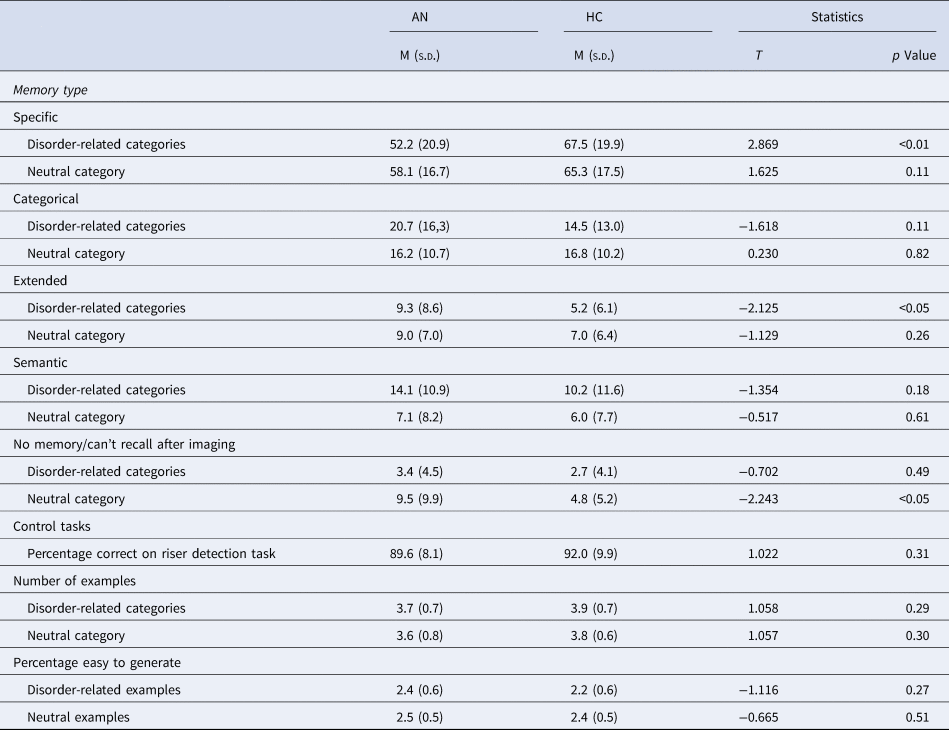
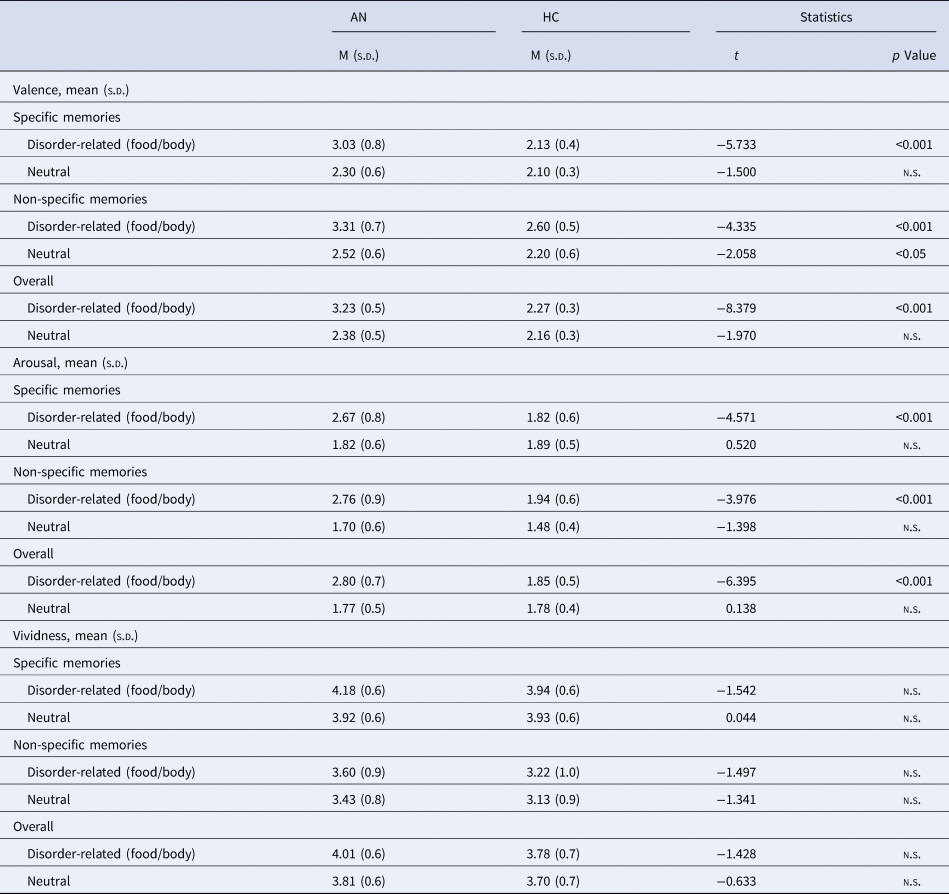
The percentage of memories recalled are given in Table 2. HC recalled more specific food/body-related AMs than patients with AN (p = 0.01), whereas no difference for specific neutral AMs (p = 0.11) was observed. Patients with AN rated specific disorder-relevant stimuli as more negative and more arousing (all p's < 0.001) than HC. Vividness ratings did not differ between groups (all p's > 0.05). Results of ratings are given in Table 3. Finally, reported age at recalled memory did not differ between groups (online Supplementary Table S10). Regarding the example generation task, we observed no significant differences between groups neither for the level of difficulty nor for the number of examples generated (see Table 2; all p's > 0.27), regardless of the cue category (i.e. food/body-related v. neutral).
Percentage of memories recalled by cue-category and group

AN, anorexia nervosa; HC, healthy controls.
Rating of specific and categorical autobiographical memories

AN, anorexia nervosa; HC, healthy controls. Participants selected the number of Valence: 1 = positive, 2 = something positive, 3 = something negative, 4 = negative; Arousal: 1 = relaxed, 2 = something relaxed, 3 = neutral, 4 = something tense, 5 = tense, and Vividness: 1 = not vivid, 2 = little vivid, 3 = neutral, 4 = something vivid, 5 = very vivid.
Correlation analyses
No correlations were found in the AN group between food/body-related AMs and PHQ-9, EDE-Q, TFEQ, ERQ (all p's > 0.29). Whilst we observed no group difference in working memory (WMS), there were significant group differences in processing speed and cognitive flexibility (TMT, see Table 1, p < 0.001), but no correlations were found within the two study groups for number of specific AMs (food/body-related and neutral) and WMS, TMT or BMI (all p's > 0.15).
fMRI findings
AM-task within-group results
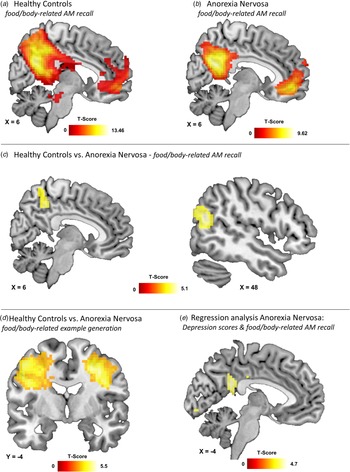
During the Specific_Food_AM_v._Food_Example contrast, we observed a network of brain regions corresponding to the ‘default mode network’ in both HC and patients with AN (Fig. 1). Specifically, we observed activations including the medial prefrontal cortex, posterior cingulate cortex, precuneus and angular gyrus. Similar brain regions were observed in both groups during Specific_Neutral_AM_v._Neutral_Example as well as during OGM_Food_v._Food_Example. During the contrast Specific_Food_AM_v._OGM_Food, both groups displayed activations in the precuneus; however, only HC displayed significant activations during the contrast Specific_Neutral_AM_v._OGM_Neutral (a detailed account of brain regions observed is given in online Supplementary Tables S1 and S2). Although HC failed to show any significant activation during Specific_Food_AM_v._Specific_Neutral_AM as well as during Food_Example_v._Neutral_Example, patients with AN showed activation patterns corresponding to the default mode network in these contrasts. When comparing example generation with riser baseline, both groups showed activation in the inferior frontal gyrus, caudate nucleus, middle temporal gyrus, and supplementary motor area.
BOLD activity during recall of specific food/body-related AM v. food/body-related semantic example generation (fMRI results). (a) BOLD activity in the default mode network during recall of specific food/body-related AM v. food/body-related semantic example generation in HC (N = 30). (b) BOLD activity in the default mode network during recall of specific food/body-related AM v. food/body-related semantic example generation in patients with AN (N = 29). (c) Group differences in BOLD activity in the precuneus (left) and angular gyrus (right) during recall of specific food/body-related AM v. food/body-related semantic example generation (HC>AN). (d) Group differences in BOLD activity in the bilateral precentral gyrus during food/body-related semantic example generation v. neutral semantic example generation (AN>HC). (e) Whole-brain regression analysis: positive correlation with depression scores (PHQ-scale) during specific food/body-related AM v. food/body-related example generation in HC and patients with AN (posterior cingulate cortex). All results significant at p < 0.05 cluster-level FWE-corrected are reported, with a cluster defining threshold of p < 0.001 uncorrected and minimal cluster size of k > 50.

AM-task between-group results
HC displayed stronger activation in the angular gyrus and precuneus during Specific_Food_AM_v._Food_Example (Fig. 1, online Supplementary Table S3). However, patients with AN displayed increased activation in the precentral gyrus during Specific_Neutral_AM_v._Neutral_Example and in the precentral and middle temporal gyrus during Food_Example_v._Neutral_Example. There were no significant group differences during OGM_Food_v._Food_Example, Specific_Food_AM_v._Specific_Neutral_AM, Specific_Food_AM_v._OGM_Food, and Specific_Neutral_AM_v._OGM_Neutral. Furthermore, we observed no significant differences between groups during the comparison of example generation with riser baseline. To explore potential differences between AN subgroups, we performed a comparison of patients with restrictive AN (N = 21) and purging AN (N = 8). Although underpowered, the results are given in online Supplementary Table S9. We observed no differences between groups, except an increased activation in the thalamus in the restrictive AN group during the contrast Specific_Food_AM_v._Food_Example (p < 0.001).
Connectivity analysis
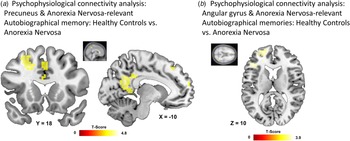
In HC, a network of brain regions showed functional connectivity with the precuneus during Specific_Food_AM_v._Food_Example, notably the bilateral caudate nucleus, cingulate cortex, frontal and precentral gyrus. Patients with AN displayed connectivity with the caudate nucleus and frontal operculum. Group comparison revealed stronger connectivity in the posterior cingulate cortex and middle frontal gyrus in HC (Fig. 2 and online Supplementary Tables S4 and S5). Functional connectivity analysis during the same contrast with the angular gyrus as seed revealed significant activations in the caudate nucleus, frontal operculum, frontal and middle temporal gyrus, and gyrus rectus for the HC group, and activation in the dorsolateral prefrontal cortex, frontal operculum, and medial frontal gyrus in patients with AN. HC showed stronger activation in the inferior frontal, middle frontal, and superior frontal gyrus when compared to patients with AN (online Supplementary Tables S6 and S7).
Psychophysiological connectivity and regression analysis during recall of specific food/body-related AM v. food/body-related semantic example generation (fMRI results). (a) Between-group results – psychophysiological interaction analysis: whole-brain connectivity with the precuneus during specific food/body-related AM v. food/body-related example generation (left: middle frontal gyrus, right: posterior cingulate cortex). (b) Between-group results – psychophysiological interaction analysis: whole-brain connectivity with the angular gyrus during specific food/body-related AM v. food/body-related example generation (inferior, middle, and superior frontal gyrus). All results significant at p < 0.05 cluster-level FWE-corrected are reported, with a cluster-defining threshold of p < 0.001 uncorrected and minimal cluster size of k > 50.

Regression analysis
During Specific_Food_AM_v._Food_Example, we observed a positive relation between depression scores (PHQ scale) and activation in the posterior cingulate cortex, fusiform gyrus as well as lingual gyrus in patients with AN (Fig. 2 and online Supplementary Table S8). We observed no results in the HC group.
Resting-state connectivity analysis
Online Supplementary Fig. S2 displays the different networks of interest obtained using spatial correlation with a priori defined structural masks. However, we observed no results when comparing component activity between groups.
Discussion
To our knowledge, this is the first brain imaging study investigating the neural correlates of disorder-related AM in AN compared to HC. On a behavioral level and in line with previous studies (Bomba et al., Reference Bomba, Marfone, Brivio, Oggiano, Broggi, Neri and Nacinovich2014; Huber et al., Reference Huber, Salatsch, Ingenerf, Schmid, Maatouk, Weisbrod and Nikendei2015), we observed no differences in frequency between groups for the recalled AMs in response to neutral cues, but increased food/body-related OGM in patients with AN. Both groups displayed activation patterns in prefrontal, parietal, and cingulate regions during recall of food/body-related as well as neutral AM. However, group comparisons revealed a stronger recruitment of the precuneus and angular gyrus during food/body-related AM-retrieval in HC, and a stronger activation in the somatosensory cortex during food/body-related example generation in AN. While we did not observe group differences in resting-state functional connectivity, our psychophysiological connectivity analysis revealed increased connectivity in the HC group between the precuneus and posterior cingulate cortex and between the angular gyrus and dorsolateral prefrontal cortex during recall of food/body-related AM. Finally, patients with AN showed a positive relation between depression scores and activation in the posterior cingulate cortex during food/body-related AM-retrieval.
Our behavioral results are in line with previous reports of increased OGM during recall of disorder-specific memories in depression (e.g. memories related to ‘grief’) and posttraumatic stress disorder (e.g. memories related to ‘accidents’). This is further evidence for the importance of OGM in different psychiatric disorders as well as the need to address dysfunctional emotion regulation strategies during treatment. Additionally, in line with Huber et al. (Reference Huber, Salatsch, Ingenerf, Schmid, Maatouk, Weisbrod and Nikendei2015), patients with AN as compared to HC reported increased negative valence as well as increased arousal when recalling eating disorder-relevant AMs. Since this was observed during both the recall of specific and overgeneralized memories, this points toward an increased emotional reactivity when forced to recall disorder-related memories (Zhu et al., Reference Zhu, Hu, Wang, Chen, Guo, Li and Enck2012). However, we found no differences in vividness ratings of disorder-related stimuli between patients with AN and HC, which points toward the protective effect of OGM as an emotion regulation strategy. On a neural level, both groups displayed activation profiles commonly associated with AM-retrieval (Fossati, Reference Fossati2013). However, when comparing groups, we observed increased activation of the angular gyrus and precuneus in HC during retrieval of specific food/body-related AM. The precuneus is implicated in self-reference, episodic memory, and memory-related imagery (Freton et al., Reference Freton, Lemogne, Bergouignan, Delaveau, Lehéricy and Fossati2014), and has been related to the vividness of AM-recall (Sreekumar, Nielson, Smith, Dennis, & Sederberg, Reference Sreekumar, Nielson, Smith, Dennis and Sederberg2018). The angular gyrus is implicated in memory retrieval and the subjective experience of remembering via integration of memory features within an egocentric framework (Bonnici et al., Reference Bonnici, Cheke, Green, FitzGerald and Simons2018). Consequently, our results may indicate a less idiocentric representation of disorder-related AM in patients with AN. This fits within the narrative of emotional suppression and avoidance as an important feature and maintenance factor of AN (Oldershaw, Lavender, Sallis, Stahl, & Schmidt, Reference Oldershaw, Lavender, Sallis, Stahl and Schmidt2015; Treasure & Schmidt, Reference Treasure and Schmidt2013). This conclusion is supported by the results of our regression analysis, where depression scores were positively related to posterior cingulate cortex activation during food/body-related AM-retrieval in patients with AN. As a central hub for self-referential processing (Morel et al., Reference Morel, Villain, Rauchs, Gaubert, Piolino, Landeau and Chételat2014), reduced activation in this region may therefore facilitate emotional avoidance via reduced self-referential processing during food/body-related memory retrieval. Furthermore, deactivation in posterior regions of the brain is a common finding in studies investigating the neural correlates of AN. Hypoactivation in inferior parietal, somatosensory as well as occipital regions during the processing of food-related pictures (Kim, Ku, Lee, Lee, & Jung, Reference Kim, Ku, Lee, Lee and Jung2012; Santel, Baving, Krauel, Munte, & Rotte, Reference Santel, Baving, Krauel, Munte and Rotte2006; Uher et al., Reference Uher, Murphy, Brammer, Dalgleish, Phillips, Ng and Treasure2004) but also during viewing of body images (Vocks et al., Reference Vocks, Busch, Gronemeyer, Schulte, Herpertz and Suchan2010) has previously been observed. Our results add to the growing literature in AN research highlighting the important role of parietal brain regions in the development and maintenance in AN. However, we failed to observe differences between groups when comparing the recall of specific food/body-related AM with the recall of unspecific food/body-related AM. This observation has to be treated with caution; since the number of trials where participants recalled an unspecific AM was low, we lacked statistical power to detect meaningful differences between groups.
Furthermore, when compared to patients with AN, HC displayed increased connectivity between the precuneus and posterior cingulate cortex during recall of food/body-related AM. This points toward increased self-referential processing, since both regions have been found to be strongly implicated in episodic memory retrieval and self-awareness (Freton et al., Reference Freton, Lemogne, Bergouignan, Delaveau, Lehéricy and Fossati2014). Connectivity between the angular gyrus and dorsolateral prefrontal cortex was also increased in HC during recall of food/body-related AM. This indicates efficient and controlled memory retrieval, due to the prominent role of the dorsolateral prefrontal cortex in executive functions such as working memory (Barbey, Koenigs, & Grafman, Reference Barbey, Koenigs and Grafman2013). Taken together, connectivity within brain regions during food/body-related AM-recall indicates intact and efficient retrieval in HC, but not in patients with AN.
Interestingly, patients with AN displayed increased activation in the somatosensory cortex during generation of food/body-related examples. Hyperactivity in the somatosensory cortex during processing of emotional stimuli has been related to alexithymia, or the inability to describe and identify subjective experiences of emotions, and is thought to reflect a hypersensitivity to physical sensations (Moriguchi & Komaki, Reference Moriguchi and Komaki2013). Accordingly, increased neural sensitivity to interoceptive and somatosensory stimuli has been observed in AN, possibly facilitating restrictive and avoidant behaviors (Bischoff-Grethe et al., Reference Bischoff-Grethe, Wierenga, Berner, Simmons, Bailer, Paulus and Kaye2018). Specifically, anxiety associated with food intake is related to intensified interoceptive sensations (Khalsa et al., Reference Khalsa, Craske, Li, Vangala, Strober and Feusner2015), which may explain the increased activation observed in somatosensory regions during the generation of disorder-related examples. Furthermore, as opposed to HC, patients displayed activation in typical, AM-associated regions during food/body-related example generation. Accordingly, patients with AN may have difficulties to generate disorder-related semantic examples without personal reference, which is in line with the commonly observed dysfunctional top-down control during processing of emotional stimuli in AN (Simon, Stopyra, & Friederich, Reference Simon, Stopyra and Friederich2019). Contrary to our expectations, we did not observe a pattern of neural activation reflecting reduced emotional processing and increased prefrontal control. Although counterintuitive at first, we believe that this may in part be caused by the nature of the employed experimental task. Since we assessed the recall of memories, we investigated the result of an emotional regulation strategy (as evidenced by the increased occurrence of OGM) aimed at reducing the emotional impact of disorder-related memories. Accordingly, we postulate that OGM represents a protective mechanism acting via neural deactivation rather than top-down regulation.
To assess whether possible dysfunctional activations observed during AM-recall may reflect a general dysfunction of brain networks implicated in memory and emotional processing, we performed a resting-state functional connectivity analysis. However, we failed to observe group differences in our networks of interest. This is in line with some, but not all previous studies. Specifically, previous studies investigating the default mode network found conflicting results, with some studies observing alterations in patients with AN (Boehm et al., Reference Boehm, Geisler, King, Ritschel, Seidel, Deza Araujo and Ehrlich2014) whereas others did not (Phillipou et al., Reference Phillipou, Abel, Castle, Hughes, Nibbs, Gurvich and Rossell2016). This may be caused by different analytical approaches and sample heterogeneity (Gaudio, Wiemerslage, Brooks, & Schioth, Reference Gaudio, Wiemerslage, Brooks and Schioth2016).
Limitations
To prevent an excessive duration of our fMRI-task, we did not include additional cue-categories related to negative emotions or perfectionism. However, it would be interesting to investigate these categories in future brain imaging studies. Furthermore, since sex-related differences in neural processing during AM have been previously observed (Compère et al., Reference Compère, Sperduti, Gallarda, Anssens, Lion, Delhommeau and Piolino2016), our findings in female-only participants with AN should be generalized to male patients with caution. Additionally, our conclusions are limited due to the cross-sectional nature of our study. Future studies should investigate the neural correlates of AM using a longitudinal design to assess treatment-related changes. Including groups of patients currently ill with AN, in remission from AN or participants at-risk would allow the investigation of trait-related aspects of AM and circumvent possible influences of differences in grey matter volume. Since the number of trials where participants recalled OGM was low (for both food/body-related words and neutral words), the statistical power to detect meaningful differences between groups was low. The null results of this comparison should therefore be explored in additional studies with adequate statistical power. We did not collect information on menstrual status, which is a potential limitation of this study. Since dietary restriction facilitates the avoidance or reduction of negative emotions in AN (Schmidt & Treasure, Reference Schmidt and Treasure2006) and since we did not control for satiety, the effect of satiety state on AM recall in AN should be further investigated. Patients with AN displayed lower scores in processing speed and cognitive flexibility. However, no group differences were found for working memory and premorbid level of intelligence and we observed no correlations between number of specific AMs and processing speed or cognitive flexibility. Together with the findings of no associations between executive processing and OGM in the literature (Williams et al., Reference Williams, Barnhofer, Crane, Herman, Raes, Watkins and Dalgleish2007), we believe that differences during AM recall are not mainly related to cognitive deficits.
Conclusion
In AN, disorder-related AM is characterized by reduced activation and connectivity of brain regions involved in self-referential processing and memory retrieval. The often observed emotional avoidance in AN may be facilitated by a reduced subjective and thus less idiocentric representation and recall of food/body-related AM. This provides new insights for future research and underscores the importance of targeting dysfunctional affect regulation strategies during treatment. Increasing the patients' awareness of past and present experiences may help to reduce overgeneralized retrieval and encoding.
Supplementary material
The supplementary material for this article can be found at https://doi.org/10.1017/S003329172100221X.
Acknowledgements
We thank Marion A. Stopyra for proofreading the paper. The authors also thank the patients with AN and healthy controls for their contribution. Funding for the study on which these data are based is provided by the Swiss Anorexia Nervosa Foundation (SANS, Project No 57-16).
Financial support
The Swiss Anorexia Nervosa Foundation (SANS, Project No 57-16).
Conflict of interest
None.