Transoesophageal echocardiography has become a powerful tool in the diagnosis and management of children with congenital cardiac malformations. While transoesophageal echocardiography is routinely performed in an outpatient setting in adults, either with no sedation or under conscious sedation,1 this is not the case in children. Children are not able to tolerate this procedure under light sedation, and in many institutions these procedures are performed in the operating room under general anaesthesia.2 The purpose of our study, therefore, was to determine the safety and efficacy of deep sedation with propofol for transoesophageal echocardiography in children carried out in an outpatient setting. We hypothesized that propofol would be an effective sedative for such patients, and that the adverse events would be minimal.
Materials and methods
Selection of patients
After approval from the Human Subjects Protection Office at the Milton S. Hershey Medical Center and Pennsylvania State University Children's Hospital, medical records of all children who had undergone outpatient transoesophageal echocardiography between May 1998 and March 2001 were retrospectively reviewed. Patients over 21 years of age, and those for whom the total dose of propofol, and/or haemodynamic data, could not be documented were eliminated from further analysis. Data acquired for each patient included gender, age, height, weight, body surface area, total propofol dose, propofol dose per kilogram, other sedative medications given, adequacy of sedation, elective intubation, cardiac function as assessed by transoesophageal echocardiography, minimum and maximum heart rate, blood pressure, saturations of oxygen, and any complications noted.
Protocol for transoesophageal echocardiography
After appropriate informed consent was obtained, transoesophageal echocardiography was performed in a private room located in our recovery unit for cardiac catheterization, the room being adjacent to both the cardiac catheterization laboratory and the emergency department. Patients were given nothing by mouth before the procedure, this period being at least four hours for liquids and six hours for solids, and were monitored for saturations of oxygen, electrocardiogram, and blood pressure. An intravenous catheter was placed, and oxygen was delivered via nasal cannula either before or shortly after the onset of sedation. The paediatric intensivist was responsible for sedation and monitoring the patient, while the paediatric cardiologist was responsible for the transoesophageal echocardiogram. A nurse was present at all times to assist with the procedure, and equipment for cardiorespiratory resuscitation was readily available.
After adequate sedation was achieved, the gag reflex was tested using a tongue depressor. When the gag reflux was attenuated, the transoesophageal echocardiographic probe was inserted, and the mouth guard properly positioned. During sedation, the paediatric intensivist continuously monitored the patient for any problems involving the airway, the respiratory organs, or the haemodynamic situation. All adverse events were noted on the clinical record. The paediatric cardiologist performing the transoesophageal echocardiogram evaluated cardiac function. At the conclusion of the study, the transoesophageal echocardiographic probe and mouth guard were removed, and the patient was monitored until fully recovered and was discharged home.
Administration of propofol
Propofol was administered in aliquots to achieve first, a level of sedation adequate to place the transoesophageal echocardiographic probe, and second, to maintain adequate sedation throughout the procedure. This was accomplished by giving an initial bolus of propofol, followed by subsequent boluses to achieve a level of sedation that attenuated the gag reflex, allowing insertion of the transoesophageal echocardiographic probe without abolishing the respiratory drive. Once the transoesophageal echocardiographic probe was inserted, sedation was maintained by giving bolus injections as needed throughout the study.
Statistics
Statistical analysis (StatView, Abacus Concepts, Incorporated), was performed on the data to determine the minimum, maximum, and mean values. Bivariate plots were used graphically to display the data and linear regression was used to analyse the dose per kilogram versus body weight.
Results
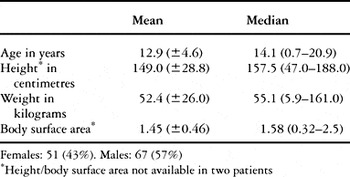
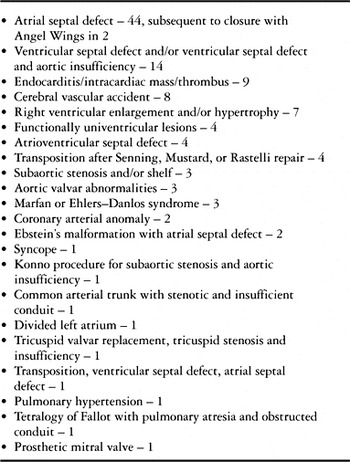
Of the 163 patients identified, 118 met the criterions for entry and were included in the study. Their demographics are given in Table 1. Transoesophageal echocardiography was performed to evaluate a wide spectrum of cardiovascular disease as noted in Table 2. All of the patients were haemodynamically stable as an outpatient, and none had an acute atrial arrhythmia, significant systemic or suprasystemic pulmonary hypertension, severe cyanosis with polycythaemia, or un-repaired tetralogy of Fallot.
Table 1. Demographics.

Table 2. Spectrum of suspected or known cardiac disease analyzed.

The mean total propofol dose was 384 plus or minus 193 milligrams, with the mean dose per kilogram being 8.3 plus or minus 4.4 milligrams. As noted in Figure 1, the propofol dose per kilogram decreased concomitant with the weight of the patient (R equals 0.46; p less than 0.0001).

Figure 1. The total dose of propofol per kilogram decreased concomitant with the increase in weight of the patient.
Of the patients, 10 (9%) received additional medications as sedatives in addition to propofol, with 5 receiving ketamine, 3 midazolam, and 2 a combination of ketamine and midazolam.
Adequate sedation, as defined by attenuation of the gag reflex allowing insertion of the transoesophageal probe and the ability to complete the transoesophageal echocardiographic study with the patient in a somnolent cooperative state, was achieved in all 118 patients. Significant coughing, and/or gagging, were noted in only 6 (5%) patients. The transoesophageal echocardiographic study had to be terminated early in only a single patient due to gagging, snoring, and brief desaturation of oxygen. Adequate imaging of the pertinent anatomy, nonetheless, was accomplished. Coughing and/or gagging were not felt to be significant in any of the patients, except the one patient noted above. On occasion, insignificant gagging was noted during probe manipulation.
We intubated 3 of the patients for the transoesophageal echocardiographic study. Of these, a child of 1.6 years with Down's syndrome, and another child of 1.3 years, were electively intubated because of their young age. The remaining patient was intubated after developing respiratory difficulties once he was sedated. It was subsequently determined that this patient had suffered from sleep apnoea for years, but that information was not offered in the preprocedural history.
Cardiac function was normal in 114 (97%), and abnormal in 4 (3%). All of the patients with abnormal function had undergone surgical repair for a congenital cardiac malformation, and had decreased function noted on a previous echocardiographic study.
Haemodynamic analysis demonstrated that the mean decrease in heart rate during the period of observation was 32 plus or minus 18 beats per minute, mean decrease in systolic blood pressure 39 plus or minus 21 millimetres of mercury, and the mean decrease in diastolic blood pressure was 28 plus or minus 20 millimetres of mercury. None of the patients became haemodynamically unstable or were treated for hypotension during the time of sedation.
All non-intubated patients received supplemental oxygen via nasal cannula that was applied either before or just after the onset of sedation. Intubated patients received supplemental oxygen as needed. Transient hypoxaemia, with saturations of oxygen less than 90%, was observed in 20%, or 23 of the 118 subjects, with one patient requiring intubation, two requiring ventilation using a bag mask, and occasionally the head tilt/chin lift manoeuvre was used to maintain patency of the airway.
Complications were noted in 14 patients, or 12%. Most of the complications were minor, occurring in 9 of the 14 patients, and consisted of infiltration of the intravenous line, mild stridor, coughing, gagging, and the use of flumazenil for prolonged sedation. This latter patient had received midazolam and no periods of haemodynamic instability or hypoxaemia were observed. Significant complications occurred in 5 patients, or 4%, and included respiratory difficulties requiring intubation in the patient who had sleep apnoea that was unknown to us prior to sedation, significant stridor requiring jaw lift followed by pronounced obstruction of the airway upon removal of the probe and bite block requiring bag and mask ventilation, low saturations of oxygen subsequent to the procedure requiring bag and mask ventilation, use of the head tilt/chin lift manoeuvre to maintain the airway, and significant gagging, snoring, and brief desaturation following insertion of the probe necessitating early termination of the study to assure to patency of the airway. Known side effects of propofol were noted in 4 patients, consisting of myoclonus and hiccups.
We needed to re-admit one patient because of complications (0.9%). This was the patient with unknown sleep apnoea, who required intubation as an emergency. He was extubated within 2 hours, observed uneventfully overnight, and discharged the next day. The remaining 117 patients were discharged home at the conclusion of the procedure.
Discussion
Our study confirms that sedation with propofol provides an optimal environment to perform transoesophageal echocardiography in children in an outpatient setting, permitting the evaluation of a wide spectrum of congenital cardiac malformations. Sedation was adequate in all 118 patients, and in over nine-tenths was achieved using propofol as a single agent. Propofol was administered as an initial bolus to achieve a level of sedation adequate to allow insertion of the transoesophageal echocardiographic probe, and the appropriate level of anaesthesia was maintained by giving additional boluses as needed.
Propofol can have significant cardiovascular side effects, and a decrease in preload, heart rate, systolic blood pressure, diastolic blood pressure, mean arterial blood pressure, stroke volume, cardiac index, left ventricular stroke work index, systemic vascular resistance, myocardial contractility, myocardial blood flow, myocardial oxygen consumption, cardiac output,3–8 end systolic pressure-volume relationship,9 and cardiac arrest with electromechanical dissociation10 have been described.
The cardiorespiratory depressant effect of propofol can be minimized3 by titrating the dose to produce the desired clinical effect, rather than administering a fixed dose based on body weight. In our patients, adequate sedation was achieved with a mean dose of 8.3 milligrams per kilogram, and was inversely related to body weight. With dosing in this range, none of our patients experienced a clinically significant change in haemodynamic state or cardiac function. Respiratory problems encountered during the time of sedation were infrequent, occurring in less than one-tenth, and were consistent with those reported in the literature.6, 11–14 Significant problems were seen in only 5 of the patients, with only 3 patients requiring further intervention. Transient hypoxaemia is common, occurring in one-fifth, and resolves without incident in nine-tenths. We recommend that patients receive oxygen by nasal cannula, beginning either before or shortly after sedation, and that patients less than two years of age be electively intubated for the procedure.
The most serious side effect of propofol, the so called “propofol syndrome”,15–22 has been described in patients receiving sedation for periods of 18 to 115 hours, and in critically ill children in the paediatric intensive care unit. Although contraindicated in this subset of patients, the safety and efficacy of propofol for short-term sedation is well-established,16, 23 and the risk of propofol syndrome should not provoke undue concern in patients being sedated for transoesophageal echocardiography in the outpatient setting.
Sedation for transoesophageal echocardiography with propofol must be performed in the proper setting with adequate ancillary support. Although our study did not include patients with acute atrial arrhythmias, significant pulmonary hypertension, severe cyanosis with polycythaemia, or those who were at risk for spelling in the setting of tetralogy of Fallot, these patients may also need to have transoesophageal echocardiography performed. It is our opinion that this group of patients should have the procedure performed in either the operating room or intensive care unit, using a sedative agent that will best support the haemodynamic state of the individual patient. Such patients should not have transoesophageal echocardiography performed in an outpatient setting.24 We recommend that the procedure be performed in a private room in close proximity to either the cardiac catheterization laboratory or the emergency department.
In many centres in the United States of America, propofol can only be administered by an intensivist or anaesthesiologist. We recommend that this individual be responsible for sedating and monitoring the patient, while the cardiologist performs the transoesophageal echocardiogram. A nurse must be available to help with the procedure. The patient will require a functioning intravenous catheter, and monitoring should include heart rate, saturations of oxygen, and periodic non-invasive measurement of blood pressure. Proper equipment must be readily available for urgent management of the airway, and for cardiac resuscitation. Patients will need to be monitored until fully recovered from sedation, and can then be discharged home. In addition to the standard history, patients or their parents need to be questioned closely about the presence of sleep apnoea.
There are some limitations to our retrospective study. Information about the duration of anaesthesia, the time to full recovery, the time to discharge after the procedure, the presence of nausea or vomiting, the size of the initial and subsequent bolus doses of propofol, as well as the time over which they were given, and the presence of atrial and/or ventricular ectopy, could not be obtained but would have provided valuable information. While none of our patients exhibited any clinical signs suggestive of “propofol syndrome”, analysis of blood gases would have proven that there were no early warning signs of this significant problem.