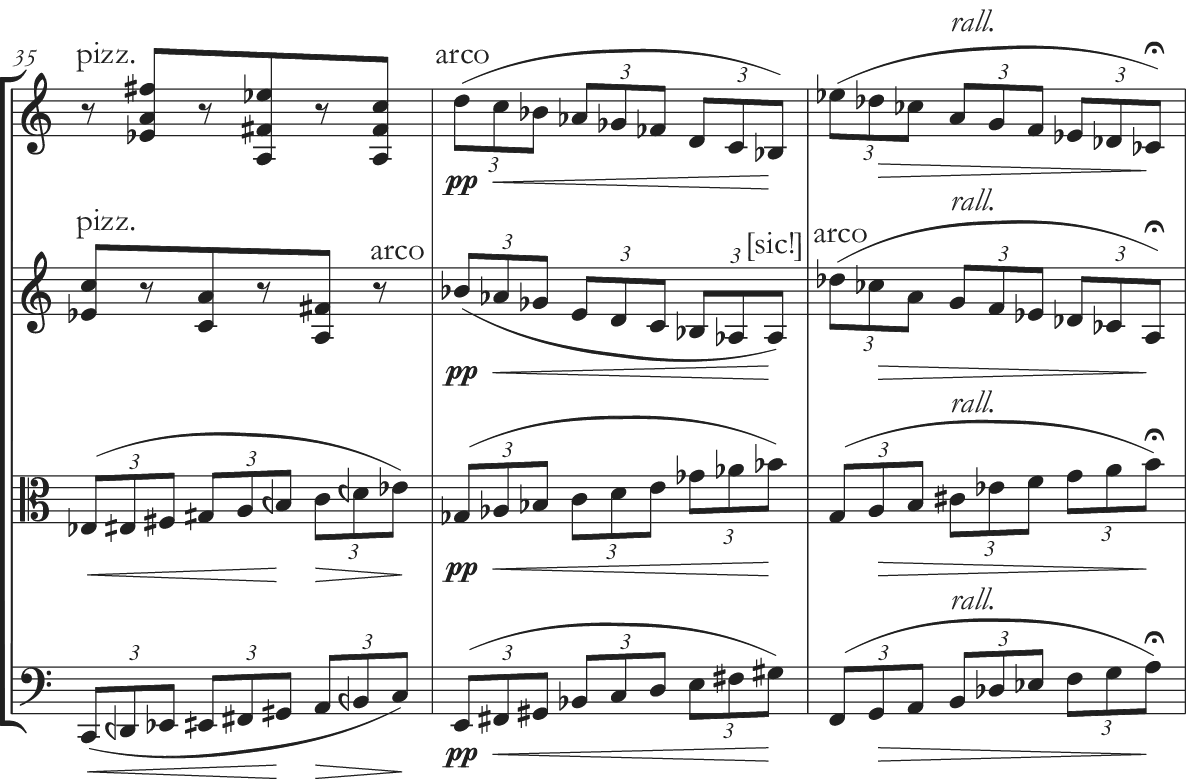
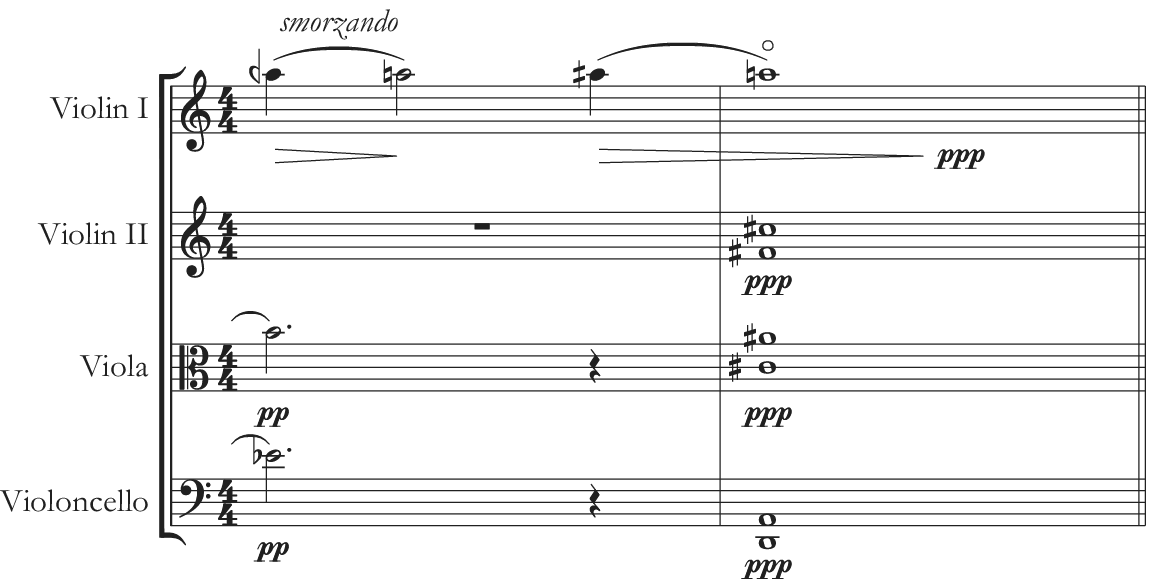
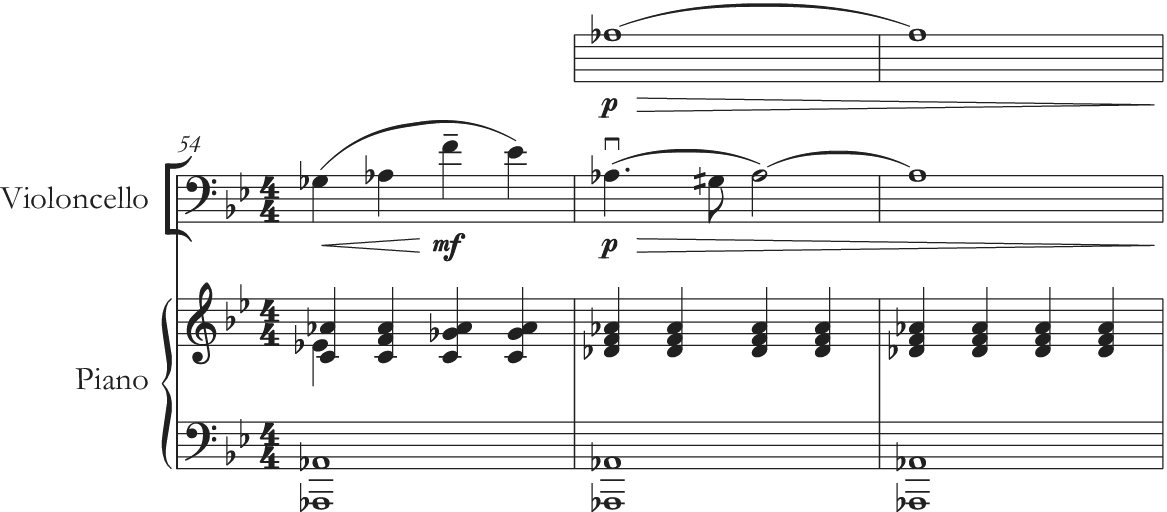
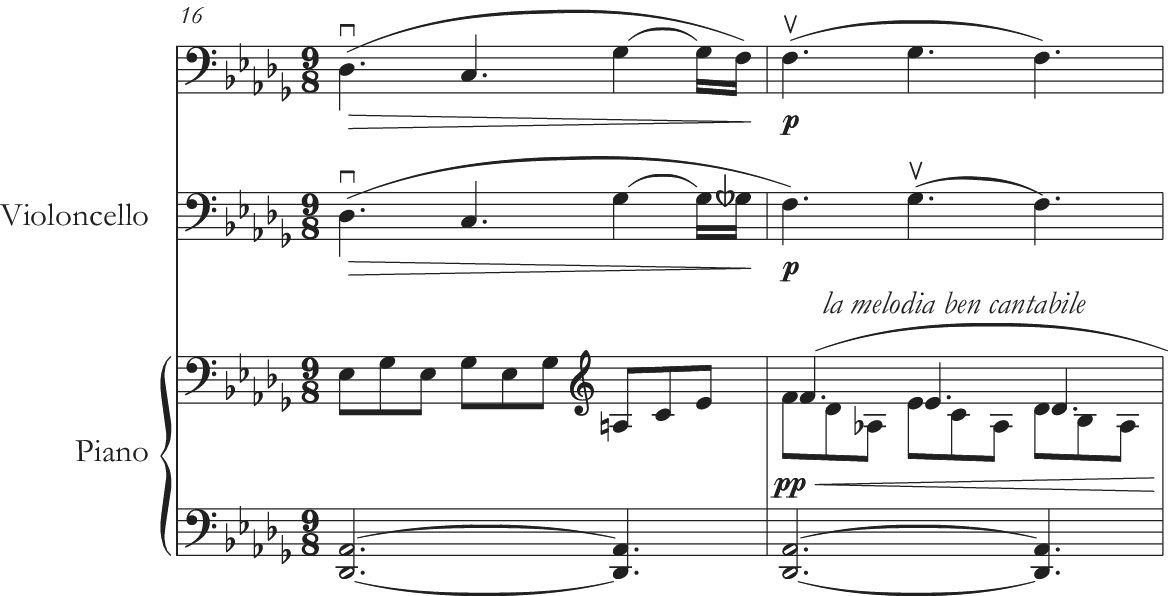
It will surely be abundantly clear that no additions to our technical equipment – no quarter-tonal, no modal systems, no additions of new timbres to our orchestral resources, in short, no technical means whatever – will in themselves aid us in our efforts to widen the field of musical appeal.
John Foulds, Music To-day (1934)Footnote 1Early twentieth-century debates on progress and innovation in music frequently mirror the hysteria underlying broader fin-de-siècle discourses. The decline of the West becomes that of melody, of the diatonic system, of Richard Wagner or of the arts in general. In his examination of Ferruccio Busoni’s poetics, Albrecht Riethmüller characterizes these debates as ‘shrill and destructive’ (schrill und destruktiv) where they sought to discredit, unseat or make obsolete music in a more reactive vein.Footnote 2 But how ‘reactive’ was this music really? Many musical figures of this time, including the pianist-composer Busoni (1866–1924) and the cellist-composer John Foulds (1880–1939), were more ‘janus-faced’ (janusköpfig) modernists than we usually give them credit for.Footnote 3 They had individualized methods both to promote musical progress and to rein in their own technical or material innovations. Foulds, for example, regularly employed all the additional ‘technical equipment’ whose use he appears to be doubting in the above epigraph. Busoni promoted third-tones in writing, but never composed with them.Footnote 4 Compared with Arnold Schoenberg, Anton Webern and, as Riethmüller maintains, Claude Debussy, Gustav Mahler and Richard Strauss, Busoni and Foulds appear to be somewhat reactive, or restrained, modernists. Both composers possessed a deep insight into their colleagues’ developments and took a keen interest in contemporary critique of the diatonic and chromatic systems (in short, of tonality, which, they might have argued, is the necessary condition for microtonality). They promoted microtonal scales, post-tonal systems and new instruments and timbres, but they were quick to deploy defensive strategies, both in their writing on music and in composition. Similar approaches were taken by Charles Ives (1874–1954) and Alois Hába (1893–1973), and by lesser-known composers contributing to this debate, such as Richard Stein (1882–1942), Julián Carrillo (1875–1965) and Ivan Vyschnegradsky (1893–1979). Through their music and writings they constitute a loose international network and present a wide range of twentieth-century tonal strategies.Footnote 5 In this article they are therefore grouped as restrained microtonalists with a common, tonally rooted agenda. This view of early twentieth-century microtonal aesthetics and technique breaks with recent traditions of writing on microtones, which is mostly concerned with individual composers’ work, microtonal techniques, notation, performance, teaching and definitions, as well as later microtonal innovations as part of the post-war avant-gardes, or descriptive histories of national microtonal schools or developments, in which these composers play only minor roles.Footnote 6
But why microtones, of all the exciting new techniques, materials and perspectives the early twentieth century produced? After all, even in the early decades of the twentieth century microtones were not exactly new. In a retrospective overview of the technique, history and structure of these intervals, the microtone pioneer Rolf Maedel sought to remind his readers of this fact by quoting Schoenberg’s assertion in Harmonielehre that ‘equal temperament was only ever a ceasefire’.Footnote 7 Generally, ‘microtones’ are really intervals (rather than pitch classes) that are smaller than the semitone, and as such they feature not only in musics and music-theoretical works of ancient Greek and of Indian, Arab and Turkish origin, but also in sixteenth- and seventeenth-century theoretical works by Marin Mersenne, Francisco de Salinas and Gioseffo Zarlino. Even later, there are occasional interventions in the early nineteenth century, such as Johanna Kinkel’s observations on Chopin’s struggle ‘to free the quarter-tones which flit between the enharmonics like ghostly shadows’.Footnote 8 The late nineteenth and early twentieth centuries, however, ushered in unprecedented interest in these ultrachromatic intervals throughout the West, resulting in a growing number of designs for microtonal keyboard instruments such as harmoniums and pianos, new scales and chords, and ideas for notation.Footnote 9 Although the interval of the quarter-tone is probably the most common of Western microtonal intervals, many different suggestions for divisions smaller than the semitone were considered and tried out in the early twentieth century. Together, they were used to promote, and to experiment with, microtonal intervals even before more systemic questions of temperament or spectral music arose.Footnote 10
Early twentieth-century cross-fertilizing strands in acoustics, aesthetics, instrument-building and criticism abound, and more often than not they are distinctly international.Footnote 11 The Russian futurist Nikolay Kul′bin (1868–1917), for example, published his manifesto ‘Die freie Musik’ in Vassily Kandinsky and Franz Marc’s German-based almanach Der blaue Reiter in 1912.Footnote 12 At this point, Busoni’s Sketch of a New Esthetic of Music had just been translated into English after he had experienced Thaddeus Cahill’s microtonal telharmonium in New York. Ives had been inspired for his far-reaching experiments by the German physician-physicist Hermann von Helmholtz’s Die Lehre von den Tonempfindungen als physiologische Grundlage für die Theorie der Musik (as had Harry Partch, who drew from this book his interest in just intonation).Footnote 13 The Czech composer Hába, a pupil of Busoni, read about a lecture by the German composer and instrument-builder Willy von Möllendorff in Vienna in the 1920s, shortly after which he attended Stein’s first international quarter-tone congress in Stein’s Berlin flat (joining forces with the Russian emigré Vyschnegradsky and the Germans Jörg Mager and von Möllendorff, and possibly even meeting the Mexican Carrillo and the Russian Artur Lourié).Footnote 14 While the source of Foulds’s initial interest in microtones is unknown, it was subsequently fuelled by his interest in Indian music and music theory, by theosophy and by the specific influence of his wife, Maud MacCarthy (1882–1967), a violinist, singer, poet, ethnographer and esoteric teacher, who had studied Indian classical music in depth, and whose (partly microtonal) rāgas Foulds had listened to and transcribed.Footnote 15
Despite the considerable differences that might be expected in each composer’s individual approach to microtones, their notation and the extent of the use of microtonality in this music, these composers were also united in their creation of personal origin myths. It is likely that the first modern European microtonal piece was Lubet d’Albiz’s Création harmonique: Étoile musicale composée pour piano ou orgue à quarts de ton for a quarter-tone instrument built by Alexandre-Joseph Vincent and Bottée de Toulmon (c.1858), but both Foulds and Carrillo asserted independent discovery of microtonal intervals in the late nineteenth century.Footnote 16 The fact that their alleged earliest microtonal pieces, as well as those of other composers, are lost, confuses attempts to establish firm fixed points in the early years of modernist microtonality. Yet most microtonal composers of the early twentieth century wove stories of discovery into their theorization of microtonal composition. Carrillo, for example, claimed to have discovered sixteenth-tone intervals in 1895 by dividing his violin strings with a pocketknife instead of a finger.Footnote 17 (Partch similarly marked a cello fingerboard with 29 steps within the octave and then had this fingerboard fitted onto a viola corpus.Footnote 18) By comparison, Foulds’s own microtonal origin myth has two sources. In the race for the ‘earliest’ quarter-tones, he claimed pride of place for a lost string quartet of 1898. In Music To-day, this piece served as his proof of the technical feasibility of quarter-tones and their ‘capability of expressing certain psychological states in a manner incommunicable by any other means known to musicians’.Footnote 19 He distinguished these purely Western and experimental quarter-tones from his second, separate, influence, the Indian microtones (srutis) that he encountered through MacCarthy’s work in 1915. MacCarthy (then still Mrs Mann), meanwhile, had begun to give sold-out demonstrations of Indian classical and folk-music traditions in British universities and town halls.Footnote 20 These either purely experimental or non-Western origins contrast with more homely myths spun by Ives and Hába. Their myths do not involve a claim of discovery, but one of rediscovery or cultivation: Hába’s initial inspiration came from the quarter- and eighth-tones he had heard in the Moravian folk songs of his childhood,Footnote 21 while Ives remembered his father building his first microtonal instrument after listening to the local church bells in a thunderstorm.Footnote 22
Most microtonalists also shared a belief that microtones enrich, but never replace, a more or less stable diatonic foundation for music, or at least certain central principles of tonality, such as tonal centres or triads. This gap between highly innovative ‘ultrachromatic’ systems on the one hand and a suggested diatonic basis on the other needs to be bridged, and most early twentieth-century microtonal composers attempted to do so with aesthetic operations that involve microtones as one option among many in their ‘material toolbox’. Consequently, they felt they were assembling music from two distinct worlds, one diatonic, the other microtonal, with microtones achieving different degrees of presence in their diatonic environment. The result is often colouristic (especially in Foulds’s and Stein’s music, but also in Hába’s), and the thinking behind these colouristic strategies can perhaps best be compared with that of their contemporaries who embedded octatonic collections within tonal surroundings.Footnote 23 (Examples of similarly assembled octatonic–tonal effects appear in Igor Stravinsky’s Symphonies d’instruments à vent (1920) and Svadebka (Les noces, 1923), where Richard Taruskin finds colouristic ‘octatonic-specific’ ‘Rite [of Spring] chords’. Similar ‘ferocious’ elements can be found in Nikolay Rimsky-Korsakov’s earlier opera Sadko (1895–6).Footnote 24) More broadly, this idea of assembling music with different materials and different tools also resembles the process of Claude Lévi-Strauss’s concept of bricolage,Footnote 25 which is commonly encountered but seldom remarked upon in musical composition. In The Savage Mind, Lévi-Strauss defined this process in similar terms of restraint: ‘The elements which the “bricoleur” collects and uses are “pre-constrained” like the constitutive units of myth […] And the decision as to what to put in each place also depends on the possibility of putting a different element there instead.’Footnote 26
This early twentieth-century ‘pre-constraint’ of the microtonal elements in a composer’s toolbox, the tentative or sometimes even only theoretical thinking, and the case-to-case decision of how to use them within tonal frameworks provide a curiously reactive backdrop to the more systematic microtonal thinking of composers after 1945. Busoni, for example, theorized microtones, but never followed this up with compositions, much to the frustration of Hába, his mentee. Foulds, by comparison, composed with quarter-tones, but was very suspicious of anything that would resemble a theory or systematic application. By contrast, Ives, Hába and Carrillo both composed and theorized, and the last two even established two of the three pre-war microtonal ‘schools’: Hába’s department of microtonal music at the Prague Conservatoire, 1924–49 (interrupted during Nazi occupation and the Second World War), and Carrillo’s Grupo 13 from 1925 onwards.Footnote 27 All these composers (and others, such as Vyschnegradsky, Georgy Mikhaylovich Rimsky-Korsakov, Partch, von Möllendorff, Maedel and Mager) worked with microtones as if from scratch, in what Georg Friedrich Haas called a ‘confusing […] multiplicity of starting points’, to differing degrees and with varying success.Footnote 28
Yet their microtonal thinking is strikingly similar with regard to their musical background and microtonal aesthetics. This article’s first main section, ‘Moth to the flame’, introduces the main protagonists – Stein, Hába, Busoni, Ives, Foulds, Kul′bin, Vyshnegradsky and Carrillo; and it mines their writings for common concerns and tropes. These tropes of microtonal aesthetics and theory are: (1) rediscovery (the idea that microtones have always existed, whether in nature, in European folk music or in non-European musics; that they can evoke nostalgia), (2) the refinement of tonality (the idea that microtonal music does not replace, but extends tonal possibilities), (3) the preservation of tonality (the closely connected idea that the restrained use of microtones can actually help tonality survive, and that the preservation of tonality is more important than microtonal experiments) and (4) the exercise of restraint (the broader idea that microtones can be theorized, but not yet used in compositions, or that they may only be tried out and are merely optional). These four tropes not only rear their heads in most early twentieth-century microtonal composers’ aesthetics, but dominate these composers’ music, as the second main section, ‘Practice and preaching’, argues.
Moth to the flame: microtonal aesthetics
To what extent can we allow material progress in music to dictate to our ears what they should like? Can our ears even get used to something like quarter-tone intervals? These and other questions were common in the reception, criticism and composition of early twentieth-century microtonal music. They (and their answers) take different forms and guises depending on who is writing. Pre-First World War England, for example, was experiencing an Indian boom, which increased interest in theosophy (with its foundation in Hinduism), as well as in Indian art, architecture and music practices.Footnote 29 At the forefront were MacCarthy’s unique demonstrations of instruments, of performing and improvisation techniques and traditions, and of microtonal scales.Footnote 30 She appears to have sung these scales with great precision (which excited Donald Francis Tovey) and invited English composers to consider Indian solutions for their compositional problems.Footnote 31 At around the same time, the building of microtonal instruments increased rapidly on the Continent, often but not always through collaborations between composers and instrument-makers looking to refine common listening habits.Footnote 32
Nevertheless, microtones, with their seeming rejection of the common diatonic and chromatic paradigm, were under fire from the beginning. The influential German writer and critic Paul Bekker (a strong advocate of Franz Schreker and Schoenberg), for example, held an ambivalent opinion about the chances of a microtonal future for music. ‘The “cry for the quarter-tone” is a few years old already,’ he remarked in his 1923 booklet Neue Musik. Despite their relative age, Bekker found that microtones were utopian, claiming that Busoni’s previous writings had ‘an aftertaste of Jules Verne’.Footnote 33 Bekker’s main critique was that quarter-tones (probably the most popular microtonal interval) dilute the tonal system and accelerate a degeneration of listening habits begun in chromatic music: ‘Evaluated psychologically, the introduction of quarter-tones means a sharpening, but at the same time effeminacy of our sensation of tone.’ According to Bekker, we end up with a microtonal scale that, ‘without doubt, is a gain on the surface, but actually means a degeneration of aesthetic character and effect’.Footnote 34 This connection of microtones with a feminizing and thus degenerating effect upon a threatened masculine tonality aligns with contemporaneous broader concerns about the gendering of chromatic and atonal music. An example is Ives, whose masculinist-rationalist strategies to disguise his boyhood shame about liking ‘decadent’ music were justified in retrospect as the search for ‘that self-restraint […] which can control the emotional & intellectual impulses, as a “man” not a degenerate’.Footnote 35 Faced with this fear of ultra-chromatic feminizing microtones, Bekker offered a compromise that suggests the restriction of quarter-tones ‘to colouristic purposes […] within the orchestra’.Footnote 36 Without doubt, this position best supports Bekker’s overall concern for the development of a new form of melodic linear expression and the preservation of the primacy of melody more broadly. Had Bekker known Foulds, he would have realized that this was already being practised.
Bekker’s unease is already present in the earliest published microtonal score, Stein’s Zwei Konzertstücke for cello and piano, op. 26 (1906), and its associated writing on quarter tones. Stein was a German composer and music critic who spent the duration of the First World War in Spain and later retired to the Canary Islands. As a well-travelled 20-year-old, he had published a collection of Icelandic Inuit songs in 1902, probably discovering microtones in the process.Footnote 37 He came to write music in most standard genres, including a short opera.Footnote 38 In his Preface to the Konzertstücke, Stein sought to excuse the use of quarter-tones in these short pieces, anticipating that his ‘attempt will – probably – merely draw derision and disconcertment’.Footnote 39 Yet composers’ complaints about the lack of genuinely new music, Stein mused, could not be blamed on the diatonic system. Rather, the lack of true genius and a discerning audience prevented a leap forward. Stein therefore classified his own quarter-tone innovations as a ‘suggestion – no more and no less’ for the ‘reintroduction’ (Wiedereinführung) of microtones into Western music.Footnote 40 According to Stein, ‘As we cannot be too careful with the introduction of new things, I have no intention for now to use quarter-tones more extensively.’ Footnote 41 Stein’s microtonal musings already included the four defensive manoeuvres: rediscovery, refinement, preservation and restraint. He thus foreshadowed many elements that later microtonalists stressed in their respective origin myths. For Stein, quarter-tones were a ‘found’ tool, rediscovered in order to serve the heightened sensitivity of the twentieth-century listener. Yet they needed to be applied sparingly within the diatonic system in order to serve our tonal drives. As such, they could refine and preserve tonality until such a time when a true genius would free music of any such restraints.
Stein introduced two quarter-tonal features in order to attain his goals: first, a third, ‘neutral’ triad (neutrale[r] Dreiklang) type (or gender, in Stein’s thinking), with its major third a quarter-tone lowered, thus extending the diatonic duality of major and minor;Footnote 42 and second, leading notes a quarter-tone sharpened, regaining the thrill – or ‘satisfaction’ (Befriedigung) – of our ‘leading-note urge’ (Leittonbedürfnis).Footnote 43 Stein thus implied a basic listening psychology of an audience dominated by primeval drives. In a later report on quarter-tones, he sought to justify both a guilty listening pleasure and the – seemingly contradictory – historical necessity of cleansing a ‘hysterically exalted’ (hysterisch-exaltiert) Western music by refining the ‘barbarian’ (Barbaren) parts of our musical senses.Footnote 44 This took the form of the ability to hear microtonal intervals. In the wake of his research among the Inuit and their microtonal music, Stein must have felt that he was returning to Western civilization a tool which musical barbarians still possessed and which Westerners needed to retrain in order to appreciate.Footnote 45 The curious undercurrent of race and exoticism, coupled with the feeling of unveiling one’s own cultural prehistory through foreign civilization, here supports the notion that we all follow a basic tonal drive, whose fulfilment the ‘children of the twentieth century’ seek with ever subtler means (in this case, the sharpened leading note).Footnote 46 We can read in this vein his manifesto, in which he assumed the role of spokesperson of microtonal composers:
We quarter-tone composers do not at all want to introduce a new system of composition, like other modernists. We do not fight anyone. And we do not understand why we are being fought so bitterly from so many sides. For in our opinion any new artwork is all about whether it is viable and vital […] We use quarter-tones because we cannot do without them, because we need them in order to express our musical ideas; but we don’t all compose similar kinds of music […] What unites us in the great difference between our artistic goals is perhaps just this: artistic honesty and a strong intensity of musical sensitivity.Footnote 47
The Czech composer, teacher and theorist Hába grew up with the microtonal music of his native Moravia, and seems to have found his later use of microtones less awkward to justify than Stein. Hába’s own microtonal story is built around the omnipresent microtones in the songs his mother sang and the music of folk singers whom he accompanied as a violinist in the band of his home town, Vizovice.Footnote 48 According to his musical autobiography Mein Weg zur Viertel- und Sechsteltonmusik, he quickly picked up the fine differences as a teenager and sought to harmonize the folk singers’ melodies with microtonal chords on his violin.Footnote 49 In a differing memory, recalled in the Preface to his Neue Harmonielehre des diatonischen, chromatischen, Viertel-, Drittel-, Sechstel- und Zwölftel-Tonsystems, his playful intoning of ‘wrong notes’ with his two brothers Josef and Vincenz is credited as the foundation for his aural concept of microtones (for the lack of which he criticized his mentor Busoni, explaining that the latter’s longing for third- and sixth-tones had to remain unfulfilled because he [Busoni] failed to develop an ability to imagine the results – or to build an instrument that simply would have made the microtones audible’).Footnote 50 Hába sought to invoke the idea that microtonal intervals came to him naturally, and he perceived them as an authentic and artless practice, which he only refined in his own system. At a later point, his interest was additionally fuelled by his discovery at a symposium that microtones were also used in Arabic and Turkish music. However, it was Rudolf Steiner’s theosophically inspired anthroposophy that provided Hába with the concept of the ‘free act’ that enabled him to defend his quarter- and sixth-tones retrospectively from accusations of being ‘formalist’ or even ‘degenerate’, and to position them as a creative act of the mind without formal restrictions.Footnote 51 Building on this idea of microtonality as something both natural and spiritual, Hába kept abreast of the most recent microtonal developments by Stein and others, which he found mentioned in a progressive handbook on music history that he studied while working as a young schoolteacher.Footnote 52 Hába also developed his own accidentals for the microtonal intervals in the various systems – accidentals for raising and lowering third-tones, quarter-tones, sixth-tones and specific twelfth-tones.Footnote 53 He was certainly lucky in being able to contribute to the building of microtonal instruments and in having as his mentors Schreker, Hermann Scherchen and Busoni. (Later, the Czech Ministry of Culture itself became Hába’s patron.) In addition to these influences, he situated himself in the line of the progressive Czech composer-theorists František Skuherský, Karl Stecker and Vítězslav Novák, microtonally extending their liberating rule of unlimited combinations of chords of different keys without prior modulation: ‘Every tone can be connected [in Beziehung bringen] to any other tone from any tonal system. Every interval and chord can be connected to any other interval or chord from any tonal system.’Footnote 54
Yet despite this progressive outlook (additional factors certainly being his connection with Schoenberg’s Verein für Musikalische Privataufführungen and his work for Universal Edition Vienna as a proofreader), diatonic thinking remained central in the form of a fundamental major–minor distinction. Although more confident than his mentor Busoni in composing with microtones, Hába took care not to lose sight of semitonal ‘landmarks’ in his music. When asked by Alban Berg about his idea of a tonal centre in his quarter-tone music, Hába allegedly explained: ‘I want to know where I am tonally, not unlike a pilot up high who is interested in which cities he is flying over. Of course, it doesn’t need to interest him all the time.’Footnote 55 Hába continued to stress the need to combine semitonal and microtonal worlds in order to achieve ‘natural’ music. In his account of the Munich première of his quarter-tone opera Die Mutter in 1931, for example, he claimed that the work presents a drama following the established principle of per aspera ad astra or, as Hába phrased it, ‘“from minor to major” – put musically; “from Good Friday to the Resurrection”, in the sense of the Christian life-affirming paradigm (not the antique tragic one)’.Footnote 56 Throughout Mein Weg zur Viertel- und Sechsteltonmusik, Hába made use of the major–minor paradigm as the defining principle of his microtonal music. There, he ordered intervals and chords by how ‘dur’ or ‘moll’ they sounded and explained that while Schoenberg and Berg ‘wanted to break out of traditional listening’, he ‘wanted to differentiate it further’ (that is to say, he wanted to refine tonality through the use of microtones).Footnote 57 In his Neue Harmonielehre, finally, he explicated this pervasiveness of the new microtonality in terms of the old tonality: ‘The principle of tonality and polytonality remains in existence in the quarter-tone system […] Likewise, the principle of tonicity [Tonzentralität] remains valid, but in an extended sense’ (guaranteeing the preservation of tonal principles).Footnote 58
Hába met Busoni in 1922, by which time the latter had been theorizing microtones and struggling with the sounding results for a good 16 years. While Hába was full of enthusiasm for the possibilities of his tonal microtonality, he painted a depressing portrait of his mentor Busoni. In 1907, mere months after the publication of Stein’s Konzertstücke, Busoni had weighed into the debate with his Entwurf einer neuen Ästhetik der Tonkunst, the first published theoretical piece of writing to demand a microtonal revolution.Footnote 59 In this booklet, Busoni argued that third-tones (divisions of the whole tone into three equal parts, and of the whole-tone scale into 18 such third-tones) were a step towards ‘eternal harmony’.Footnote 60 In passing, he also nodded to the trope of rediscovery in crediting Debussy, Liszt and Strauss with developing a feeling for ‘how the intervals of the Series of Seven might be differently arranged (graduated)’.Footnote 61 Adequate training, Busoni hoped, would enable listeners to distinguish the sound of microtonal intervals from that of badly tuned instruments.Footnote 62 As a consequence of his tripartite division of the whole tone, Busoni was in effect calling for the partial retraction of equal temperament. Instead of the outdated ‘series of seven’, he suggested two whole-tone scales a semitone apart (one starting on C, the other on C♯), with each whole tone of each scale divided into three (for example, labelling the third-tone steps from C to D: C, C♯, D♭, D). The two basic scales with their 18 divisions each form two third-tone chromatic scales. Overlaying them creates an ultrachromatic scale with 36 sixth-tone intervals. More curious than his subsequent suggestion to overthrow standard notation and branch out into sixth-tones is the way in which Busoni then restrained this system with reference to the imperative of preserving tonality: ‘Were we to adopt [third-tones] without further preparation, we should have to give up the semi-tones and lose our “minor third” and “perfect fifth”; and this loss would be felt more keenly than the relative gain of a system of eighteen one-third tones.’Footnote 63 Like Stein, even the progressive Busoni believed that the time was not yet ripe.
Busoni’s Entwurf drew energetic opposition, not just from Schoenberg in the well-known dismissal in his Harmonielehre of contemporary microtonal experiments as ‘senseless’,Footnote 64 but also from Hans Pfitzner. In order to reckon with Busoni, Pfitzner had put on his ‘heavy armour of the honourable German defender of the arts’ (‘schwere[s] Rüstzeug des ehrbaren deutschen Kunstverteidigers’), as Bekker described it in an ironic understatement.Footnote 65 Pfitzner’s goal was to reject what he exaggeratedly described as Busoni’s attempt to overthrow the entire Western musical tradition with the help of some American modernist microtone machine (Cahill’s harmonium).Footnote 66 Although Pfitzner’s nationalist game is easy to see through (in his view, German music of the ‘great masters’ constituted a rich fount of melodic development and could supply Western art music for the foreseeable future without the need to resort to microtones), his outright rejection of microtonal experiments chimes with Bekker’s more cautious dismissal.
But in 1922, Busoni himself turned against his previous microtonal aesthetics. In ‘Bericht über Dritteltöne’ he retracted his previous enthusiasm – much to Hába’s frustration.Footnote 67 The reasons for his change of mind are conjecture, but Hába reports a telling conversation with Busoni around the time of writing. When asked by the younger Hába (gently nicknamed ‘Ali Baba’ by Busoni) why he had not executed his third-tone theory in composition, Busoni replied evasively (for example, he claimed that he ‘had too much to do in the semitonal system so far’ to turn to microtones).Footnote 68 Busoni also complained that he had been unable to obtain a harmonium or piano in sixth-tones to help him hear those intervals; this in turn had hindered composition. In his later account of this conversation, Hába suspected that Busoni actually had no notion of the harmonic possibilities of this system.
Busoni’s statement in the ‘Bericht’ that he had too much to compose diatonically is used as an excuse for more fundamental doubts. Busoni admitted that he had been able to conduct only limited experiments with third-tones among friends, and on insufficiently prepared instruments, so that it was difficult to establish whether a third-tone chromatic scale was perceived as ‘out-of-tune semitones’ (verstimmte Halbtöne) or as an orderly ultrachromatic scale. While this scale enriches the potential for melodic expression, Busoni reasoned that there was no harmonic system to control this potential – and such a system would have had to be dictated by the ear. This, in turn, was impossible without the envisaged sixth-tone harmonium. One may only wonder what, if anything, would have happened had Busoni not died shortly before Hába had the first such instrument built in 1924, inspired by his conversations with the supportive Busoni. But in the absence of microtonal instruments, Busoni’s final stance towards microtonal possibilities took on the guise of universal ambivalence about progress in music: ‘If there is anything as bad as trying to inhibit progress, it is forcing progress rashly.’ And: ‘I stick with my maxim that progress must be an enriching of means, not their displacement. Rash innovators begin by negating and erasing the existing.’Footnote 69 Although intended as a refinement of tonality as defined in his earlier Fundamentaltheorie, Busoni’s fascination with microtones thus ended as a wary rejection of modernism.
Ives’s opinion on quarter-tones resembles that of Hába. Neither of the two had Busoni’s doubts about the feasibility of microtones, and both experimented pragmatically with quarter-tones, with which Ives had been familiar since his father, George, had discovered that the local church bells rang in microtonal intervals.Footnote 70 In ‘Some “Quarter-Tone” Impressions’ (1925), Ives remembered how his father had built a microtonal instrument shortly after the church-bell incident and had begun teasing his family and the neighbours with its unfamiliar sounds. Eventually, his father decided that microtones made sense only as passing notes or ornamentation in piano music. Although Ives felt that microtones were a natural and welcome source for renewal, he followed the general tendency in microtonal aesthetics of his time in refusing to see them as a magic bullet. Instead, he suggested a steady and slow transfusion of microtonal thinking into Western music, by helping listeners hear the advantages of ultrachromatic colour. A piano piece, for example, that had once been heard ornamented microtonally would afterwards sound ‘like something wanted but missing – a kind of sensation one has upon hearing a piano after a harpsichord’ (a notion similar to Stein’s ‘leading-note urge’, perhaps).Footnote 71 Nevertheless, a form of aural pessimism led Ives to believe that ‘it will probably be centuries, at least generations, before man will discover all or even most of the value in a quarter-tone extension. And when he does, nature has plenty of other things up her sleeve.’Footnote 72
In ‘Some “Quarter-Tone” Impressions’, Ives proceeded to give advice on how to write and listen to quarter-tonal music. Suggesting that readers try out quarter-tones on a two-keyboard piano (where the upper keyboard is tuned a quarter-tone higher than normal temperament), he discussed his concerns about finding a long-term purpose for quarter-tones, rather than writing music that merely sounds out of tune. A melody using quarter-tones as passing notes, he mused in this context, ‘is agreeable and has its uses, but broadly speaking it seems to me a kind of begging the question’.Footnote 73 If, however, such ‘quarter-tone melodies’ were harmonized not with diatonic triads but with mixed diatonic/quarter-tone tetrachords, Ives saw a real use in ‘their ability to relieve the monotony of literal repetition’.Footnote 74 This manifests itself in two parameters: (1) harmonically (quarter-tonal chords, Ives suggested, do not ‘hold up […] that organic flow’ when repeated, whereas diatonic chords do), and (2) rhythmically (when grafted onto ‘definite tonality’, a phrase in quarter-tone intervals in alternation with its diatonic twin clarifies the rhythmic scheme).Footnote 75 As such, quarter-tones could extend the harmonic language and assist composers in solving contemporary problems. But even here the trope of restraint broke into modernist utopia in Ives’s famous claim:
Quarter-tones or no quarter-tones, why tonality as such should be thrown out for good, I can’t see. Why it should be always present, I can’t see. It depends, it seems to me, a good deal – as clothes depend on the thermometer – on what one is trying to do, and on the state of mind, the time of day or other accidents of life.Footnote 76
Ives’s unprejudiced approach and trust in his musical instincts is mirrored in Foulds’s approach to quarter-tones. Suspicious of systematization (of which Busoni and Hába may stand as representatives), Foulds believed that the composer’s choice of musical materials is dictated by the piece at hand and that one particular pitch-organizational system has no priority over a collage of techniques and materials. Foulds had begun his musical career as a self-taught cellist, composer and conductor affiliated to Manchester’s Hallé Orchestra under Hans Richter. When he turned to composition as his main occupation, his light and incidental music brought him modest financial success, whereas his concert and stage works had a mixed reception. Interested in spiritualism and theosophy, he and MacCarthy had struck the nerve of their time with the large-scale World Requiem (1919–21) commemorating the dead of the First World War. But success was fickle and Foulds sought his luck in Paris and later in India, where he assembled a European–Indian orchestral ensemble at All-India Radio before dying suddenly from cholera after having been transferred to Calcutta.
Foulds had set down his rudimentary quarter-tone aesthetics in his op. 92, the polemic survey Music To-day (1934). The severe criticism of Hába’s quarter-tonal system is at the heart of Foulds’s claim to independence from contemporary European microtonalists. Foulds had studied Hába’s Second String Quartet, op. 7 (1921), and had come to the conclusion that it seemed too artificially modern.Footnote 77 He scolded Hába’s quarter-tone accidentals as ‘unnecessarily confusing to the eye, even after prolonged acquaintance with them’.Footnote 78 Of the music, Foulds complained that the quartet used quarter-tones excessively, but that it failed to offer any ‘new ideations’. Its effect was ‘as if a poet should retell the old, old story of Cinderella in words every one of which should contain a “th”’.Footnote 79 The criticism echoes Busoni’s resigned verdict that quarter-tones alone are not a sufficient condition for a good piece of new music. Elsewhere in Music To-day, however, Foulds declared that quarter-tones are necessary conditions of good new music: ‘[Atonal, polytonal, modal, quarter-tonal] devices are needed by the adventurous spirit whose wings can bear him to the enchanted land of Hy Brāsil.’Footnote 80 Busoni (nicknamed ‘Faithful Failure’ in Music To-day), for example, is criticized for his music’s lack of polytonality or atonality.Footnote 81
Imagining himself firmly on the side of musical progress by writing about new scales, tuning systems and even atonality in Music To-day, Foulds still couched his remarks on progressive materials and tools in a defensive language. He thus sought to distinguish his quarter-tones from what the critical English layman might disregard as either a violin playing out of tune or the latest Continental fashion. Foulds’s stance on quarter-tones (as well as on other modernist techniques) was that they could be deployed only in rare moments in his music; namely when no Western technique was able to convey a comparable ‘psychological state’, or when they were firmly embedded in a traditional structure or form. As his criticism of Hába shows, Foulds was suspicious of any one progressive tool used systematically, for fear of the impression of amateurish excess this might produce: ‘Again it seems necessary to repeat that […] any demi-semi composer might seize upon this device of quarter-tones and exploit it for the sake of any cheap notoriety he might obtain because of its superficial newness. No real artist would countenance such a procedure.’Footnote 82 It is clear that by ‘real artist’ Foulds meant himself, as opposed to Hába and Busoni, who for his taste either overused or underused microtones. His suggestion that quarter-tones be reserved for special moments in order to avoid ‘cheap notoriety’ echoes Stein and Ives and their belief that the introduction of quarter-tones into Western music would proceed slowly and cautiously.
This being said, Foulds’s individual stance deserves qualification. His was an isolated microtonal voice in Britain, itself a musical scene not only somewhat lagging behind the Continent in this area, but also obsessing over musical professionalism.Footnote 83 No microtonal congresses, concerts, custom-built instruments or scores were available in Britain until the 1930s. And even once (Western) microtones surfaced there in the 1930s, generally progressively minded composers such as Constant Lambert or Christian Darnton were damning in their criticism. The former launched an attack on Hába not unlike Foulds’s own Cinderella accusation. Lambert made the point that ‘the quarter-tone quartets of Aloys Haba [sic], for example, differ from the quartets of Brahms only through being written in the quarter-tone scale. Once we have assimilated their somewhat uninviting sounds, we find ourselves back in the old world of thought and form.’Footnote 84 Darnton, a composer who regularly took part in the activities of the International Society for Contemporary Music, also rejected microtones. On the basis of his participation at a London demonstration of a microtonal harmonium built by a Dr Sandberg, he observed in 1940 ‘that the interval that produced the greatest sensation of physical pain was the Third of a Tone’ and, somewhat contradictorily, that ‘no one in the audience was able to tell which of any two adjacent microtones was the higher in pitch’.Footnote 85 An extension of the chromatic scale that would cause both physical pain and tonal confusion was to be rejected, of course. If Lambert’s and Darnton’s dismissals may stand as a mere skimming of the British musical surface, Foulds’s caution can perhaps be read as a sensible response, if anything, to a comparatively restrictive national discourse.
The common ideas (derived from the rediscovery trope) that microtones are something natural or that they refine tonality in crisis pervade even more experimental approaches, two of which may stand as representatives here. The futurist, composer and medical doctor Kul′bin was among the earliest representatives spearheading a broader reception of microtones within modernist circles in central and eastern Europe (among them the Russians Mikhail Matyushin, Lourié and Vyschnegradsky). Kul′bin wrote a manifesto on microtones for Kandinsky and Marc’s collection of modernist painting and writings Der blaue Reiter, in which he articulated the idea of ‘free music’ (freie Musik).Footnote 86 This free music not only was modelled on the sounds of nature – ‘light, thunder, wind rushing, water rippling, birds singing’ – but also followed nature’s laws.Footnote 87 Quarter-tones – and later smaller intervals – represented this free music (he wrote), and would permit new forms of aural enjoyment through the host of new microtonal melodies, chords, dissonances and their respective resolutions (rather as Stein and Busoni held). For example, Kul′bin suggested that a microtonal enrichment of the diatonic system would result in ‘natural’ elevated levels of jouissance that would grip listeners. He suggested that microtones should be able to imitate birdsong (an idea he shared with fellow futurist Matyushin, a member of Georgy Rimsky-Korsakov’s experimental Petrograd/Leningrad Circle of Quarter-Tone Music).Footnote 88
Vyschnegradsky, a Russian emigré microtonalist in Paris, had similarly radical ideas, culminating in a postulated crisis of tonality. He had derived his microtonal ideas from Western music’s historical tendency to divide the whole tone into ever smaller divisions, and Vyschnegradsky’s own music came to feature third-, quarter-, sixth- and eighth-tones. His ‘ultrachromaticism’ or ‘diatonicized chromaticism’ is spelt out in the 24 Préludes for two pianos, op. 22 (1934, rev. 1957–61 and 1974–5). These run through a cycle of ‘major fourths’ (the fourth one raised by a quarter-tone, which is the middle of Vyschnegradsky’s 13-tone scale).Footnote 89 But Vyschnegradsky’s crisis was not merely one of tonality, but a Riethmüllerian ‘deep musical and psychological crisis that crosses all our culture today: from this crisis, a new musical language must be born’.Footnote 90 This new microtonal language, Vyschnegradsky’s ultrachromaticism, did not stem from a ‘return to the primitive’, but was based on the romanticist refining ‘tendency towards chromaticism, to the dissonance, and finally, to the quarter-tone’.Footnote 91
Vyschnegradsky not only was at the centre of a middle-European microtonal group, but also corresponded with the Mexican composer Carrillo, who represents a notable exception in tone and theory to the tropes present in most early twentieth-century microtonal thinking. Like Foulds, Carrillo had entered the race for the earliest microtones and confidently laid claim to getting there first. Carrillo’s origin myth, involving a pocketknife and a violin string, led to the fully fledged microtonal system he called ‘el sonido trece’ (‘the 13th sound’).Footnote 92 Alejandro L. Madrid rightly warns that this version needs to be taken with a pinch of salt, since we have only the composer’s word for it (and a composer who, by the time he promoted this myth of origin, was under pressure to defend his originality against a growing number of critics).Footnote 93 Although it is likely that Carrillo did experiment with microtones very early, it seems strange that he should have completely neglected the potential consequences of his discovery in writing and in composition until 1922, when he became aware that there was already a lively European microtone scene and upon this discovery started a prolific series of compositions and writings heralding his ‘Revolución del sonido 13’.Footnote 94
In the years between 1895 and 1922, Carrillo led an unsteady life between revolution-torn Mexico, Europe and New York. His early compositions, Madrid has argued, are those of an early modernist in the broadest sense. He absorbs, plays with and twists European nineteenth-century models (for example in his First Symphony).Footnote 95 Nevertheless, Carrillo’s origin myth is important as a retrospective self-fashioning as a radical modernist. Claiming inspiration neither from folk music nor from non-Western music or sounds of nature (and thus rejecting the trope of rediscovery), Carrillo simply stated, ‘In 1895 I succeeded in dividing the whole tone into sixteen equal intervals. This accomplishment expanded the possible contents of an octave far beyond the twelve tones which had imprisoned music for centuries.’Footnote 96 He named the new-found system Sonido 13, first after the pitch one sixteenth above the lowest G on the violin, and later as a symbol of his breaking through the 12 semitones in the octave – a name wisely chosen to cover his later far-reaching divisions of the octave not only into quarter-tones, but also into third-, fifth-, seventh-, eighth-, ninth-, eleventh-, thirteenth-, fifteenth- and sixteenth-tones.Footnote 97 Carrillo claimed this achievement not just for himself, but for his nation, and thus for the Americas as opposed to Europe: ‘Humanity is indebted to Mexico for discovering tones 13 to 96 in the nineteenth century and tones 97 to infinity in the twentieth century.’Footnote 98 The entangled claim of his nation’s historic rights with his personal accomplishment is further coupled with Carrillo’s denial of Hellenic and medieval Western microtone explorations.Footnote 99 Consequently, he did not see his microtones as a continuation of a common tradition like most European microtonalists, but emphasized his system’s disruptive force: ‘The thirteenth sound will be the cataclysm that will destroy everything, it will put the finish on music as it exists at present.’Footnote 100
Following his invention, Carrillo did not seek to relate his microtonal intervals to the diatonic or chromatic system in order to justify their existence. According to Madrid, the full unfolding of his system took shape as Sonido 13 grew, and as part of a contemporary discourse of European influence on Mexico, during which ‘Carrillo refashioned his Sonido 13 revolution from the source of enrichment of the Western music tradition – with the addition of new pitches into the E[qual] T[emperament] system – into a project to cleanse the system from its historical “errors”’.Footnote 101 In 1924, for example, he had still maintained that his microtonal system stood in the ‘glorious German music tradition’, but that it was still a genuinely Mexican invention.Footnote 102 Both non-Western music and the past of Western music came to be excluded from this imagined march towards an ideal future shaped by Sonido 13 as a system, which was being established alongside Carrillo’s discovery of acoustic ‘truths’ in the harmonic series. Owing to the contemporary opposition from other Mexican composers and theorists (the so-called Grupo 9) and also to the all-encompassing nature of Sonido 13, Carrillo theorized his microtones to a degree unmatched by contemporary writing. A body of books, booklets, articles and written battles fought mostly in the newspaper El universal serves as evidence of Carrillo’s repartee. His arguments are laid out in a sometimes aggressive tone, but they are also substantiated by extended tuning experiments with harps (according to Carrillo up to 128th-tones) and, by proxy, far-reaching conclusions for the harmonic series and acoustics, both of which are foreign to his European contemporaries.Footnote 103 Whether the resulting calculations – of numbers of possible pitches within the octave, or ratios within the harmonic series – are correct is less important here than Carrillo’s claim to total dominance of the material, which led him to a system ‘absolutely free of whole tones and semitones’.Footnote 104 This hermetic microtonal system is worlds away from Busoni, and even from more synthetic approaches such as Vyschnegradsky’s crisis myth. In theory, Carrillo’s system rejects all four common European microtonal tropes while it attempts to break music history in half.
Carrillo apart, the similarities between early twentieth-century microtonal thinkers outweigh the differences between them. Many microtonal composers of that time curbed their enthusiasm in relation to the possible infusion of Western music with microtones. It seemed logical to most of them to suggest a step-by-step introduction of microtones in order to give the ear the opportunity to develop alongside the evolution of the microtone (as in Stein’s, Ives’s or Foulds’s writings). Others even suggested ‘taming’ microtones in a major–minor duality (Hába), or merely theorizing them (Busoni). But crucially, all shied away from the atonal taboo, whether driven by systematic experimentation, ethnomusicological research, childhood reminiscences or modernist ideology. Therefore, the tropes of tonal refinement and the preservation of tonality gained importance in their writings, and were accompanied by advice on notation and on the avoidance of the dreaded ‘out-of-tune’ performance scenario. The common concern about the viability of microtones is tempered, however, by their justifying reminders of structural models and natural sounds, or of the history of European as well as non-European musics, psychology or combinations of these. Physics, acoustics and indeed tuning systems played a small part in their exploration of microtones (in contrast with that of later microtonalists, and albeit that Carrillo’s engagement with the harmonic series is an exception). For the time being, the diatonic system remained the foundation of microtonal music.
Practice and preaching: microtonal composition
Most microtonal compositions of the early twentieth century sit on a continuum between two extremes: at one end of the scale lie Stein’s minimally invasive microtonal procedures, at the other Carrillo’s dense level of microtonal surface imposition on diatonic or whole-tone structures. In between, composers deploy microtones in surprisingly different scenarios, which map onto, expand and sometimes even destabilize the four tropes of rediscovery, refinement, preservation and restraint.
Rediscovery: nymphs, Celts and church bells
The trope of rediscovery plays a less explicit role in early twentieth-century microtonal composition than it does in the writings prefacing or accompanying this music. Nevertheless, there are several cases of nostalgic or reminiscent quarter-tones. These are all attempts to evoke an atmosphere of remote places, times and moods, and are therefore explicitly colouristic effects. They extend tonal or near-atonal frameworks at specific moments and then disappear again.
A prominent example of this procedure can be found in Karol Szymanowski’s ‘Driady i Pan’ (‘Dryads and Pan’), the third piece of Mity (Myths) for violin and piano, op. 30 (1915). The piece draws on extended techniques to imitate the arcadian creatures described in its title: fleeting glissandos and harmonics to imitate Pan’s flute, and quarter-tones to represent the appearance of the tree nymphs in its introduction and coda. Although its only quarter-tone, D–, penetrates no deeper than the mere surface of a few bars, this pitch powerfully announces a piece whose Hellenistic arcadian music comes from a time and place beyond our own.Footnote 105
A degree of stasis also characterizes most of Foulds’s quarter-tone music. The unfinished Lyra celtica for wordless contralto and orchestra, op. 50 (mid-1920s), is a rarity in his quarter-tonal catalogue: it prescribes microtones in the voice part’s cadenza at the beginning of the first movement, ‘Lento’, and anchors them in a highly colouristic ‘Celtic’ atmosphere, a blend of what Malcolm MacDonald characterized as Foulds’s ‘customary pentatonically and modally-inflected melodic lines with sophisticated whole-tone and “pan-diatonic” harmonies in an evocative, iridescent sound-fabric’.Footnote 106 Lyra celtica’s quarter-tones satisfy a strong nostalgic–exoticist urge in Foulds’s oeuvre (as opposed to the more modernist urge carefully unfolded in this article’s epigraph). In this concert piece, microtones therefore appear as rediscovered objects from an imagined Celtic arcadia, rather than as avant-garde tools. MacDonald has found the idea of microtones in a vocal score ‘bizarre, to say the least – till one remembers that Foulds was married to a woman who could sing the Hindu scale of 22 tones to the octave with flawless accuracy’.Footnote 107 Although it is not clear that Lyra celtica was written for MacCarthy as the vocalist, her influence on the conception may be assumed, locating the work closer to their Indian musical explorations.
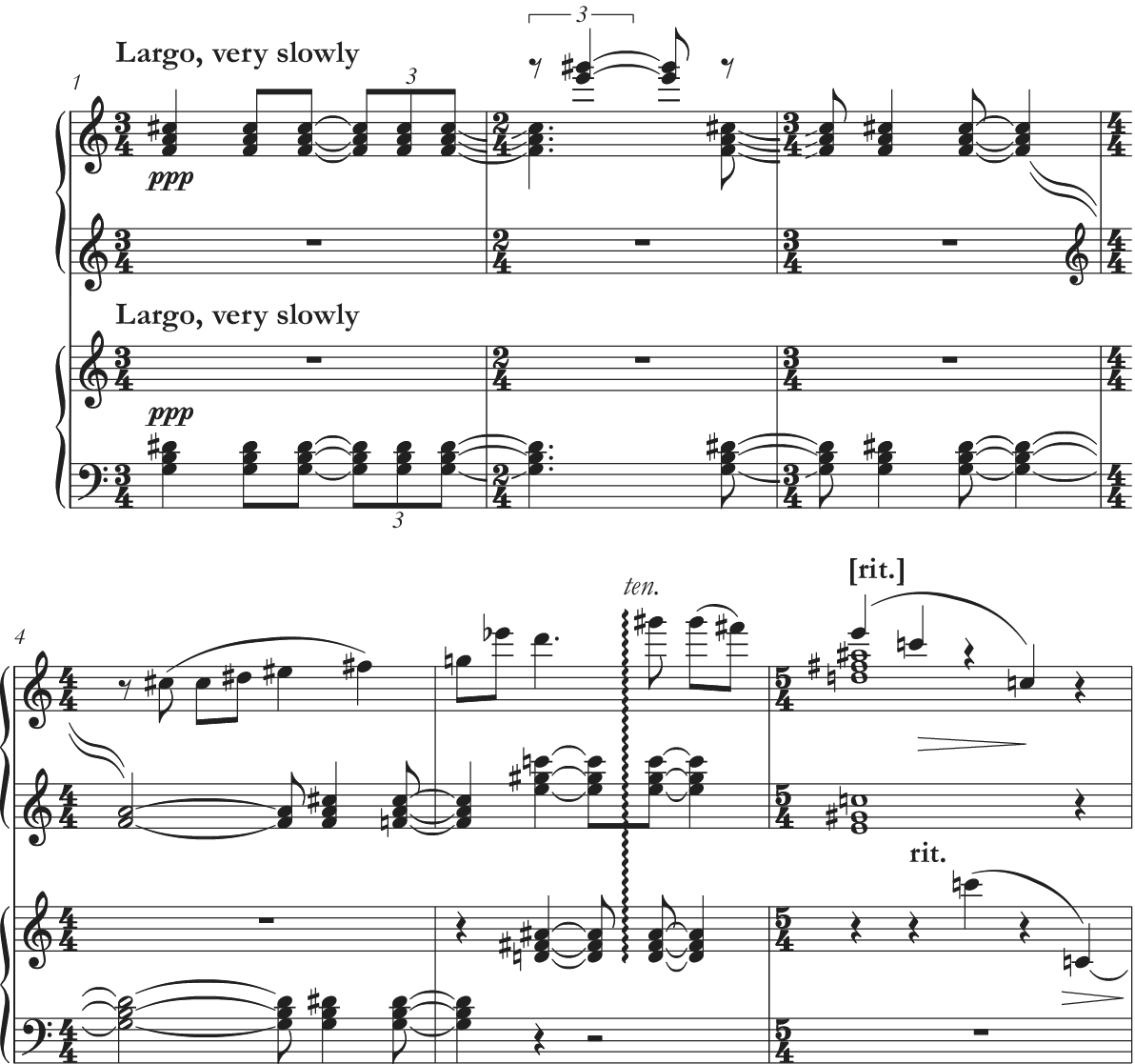
A stronger example of rediscovery is the first of Ives’s Three Quarter-Tone Pieces for Two Pianos (1923–4), which triggered his 1925 essay ‘Some “Quarter-Tone” Impressions’. By the time these pieces had come into existence, the majority of his less theoretical quarter-tone music had already been written: Tone Roads no. 3 (1911, 1913–14), the second movement of the Symphony no. 4 (1912–18, 1921–5) and ‘Like a Sick Eagle’ from the Set for Chamber Orchestra no. 1 (1915–16) precede not only Ives’s own theory, but also the European microtonal boom of the 1920s. The Three Quarter-Tone Pieces are Ives’s most thorough exploration of quarter-tones and best show his priorities and pragmatism. This pragmatism sits in the notation, above all, with its aim of keeping visual challenges to a minimum. This comes at the cost of indeterminacy: of the two pianos, both of which are notated normally, either Piano 1 needs to be tuned a quarter-tone higher, or Piano 2 a quarter-tone lower than equal temperament, so that Piano 1 is always a quarter-tone higher than Piano 2. In the essay, Ives gave a short explanation of the pieces, pointing to each of their different aims, construction and rising quarter-tonal engagement. The first, ‘Largo’, had originally been written for one quarter-tone piano and explores quarter-tones merely as enriching elements for the augmented triads that make up the piece’s extended tonal framework. Quarter-tone intervals occur both simultaneously between chords in the two parts, and within melodic lines involving the two pianos. But they do not yet penetrate the bitonal structure on a deeper level (as they do in the following two pieces). Rather, the Largo’s quarter-tones function as embellishments, and they send their listener back to Ives’s origin myth. The opening bitonal augmented triads at quarter-tonal distance are reminiscent of George Ives’s church bells, while the ‘false octave’ in bar 6 cuts to the chase of the quarter-tonal issue – the play surrounding what is notated identically (the printed C) but sounds different (C♮ versus C+ or C–, depending on how the pianos are tuned (see Example 1). Ives’s quarter-tonal invasion in ‘Largo’ is thorough (in so far as quarter-tone intervals are omnipresent), but at the same time mild (in so far as it sits statically in relation to the bitonality).
Ives, ‘Largo’ from Three Quarter-Tone Pieces for Two Pianos, bars 1–6. Piano 1 sounds one quarter-tone higher than Piano 2. Extracts from Three Quarter-Tone Pieces by Charles Ives (EP66285).

Refinement: ‘bastard C-sharps’
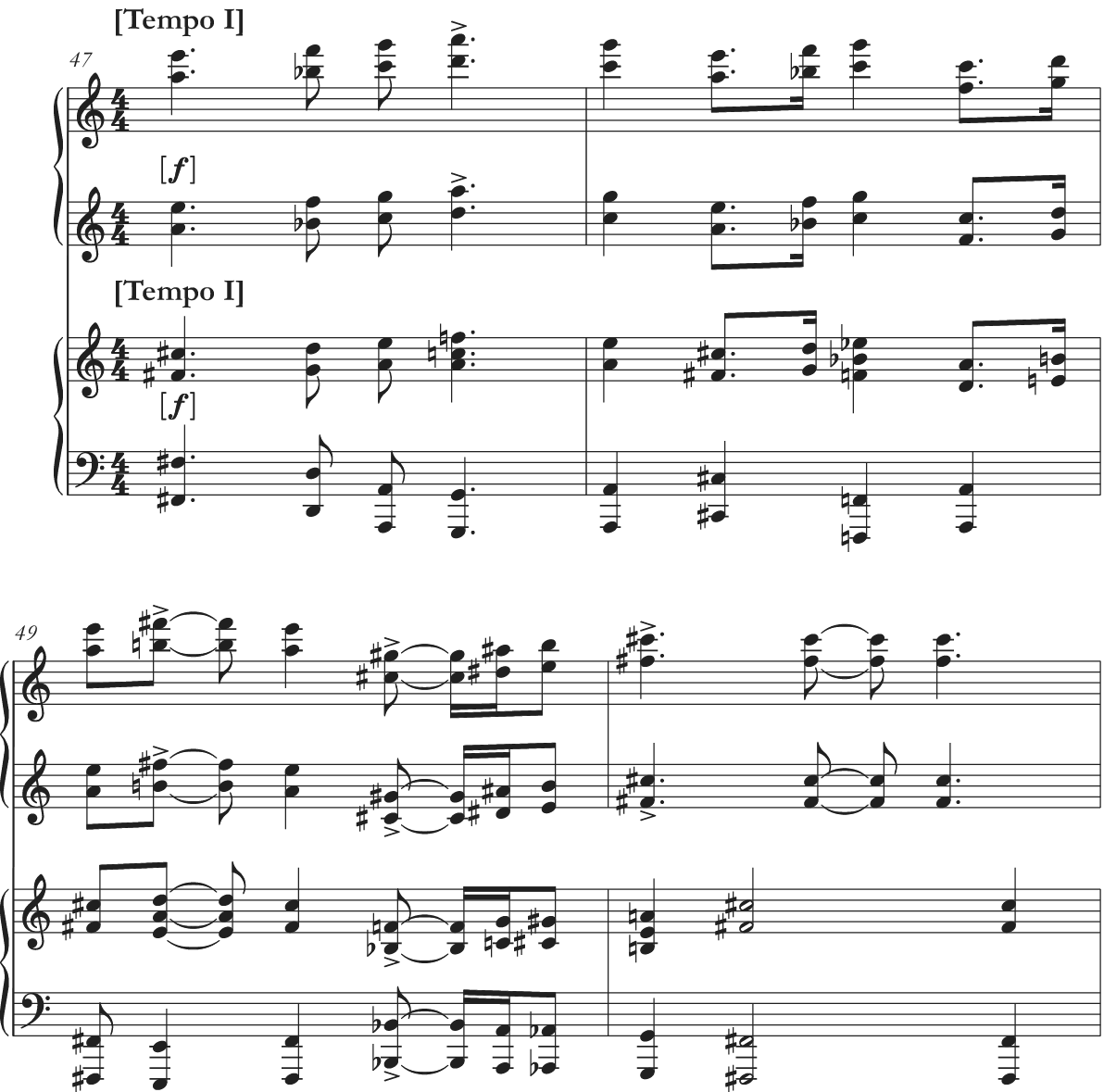
The last two of Ives’s Three Quarter-Tone Pieces are more daring than the first. The second piece, ‘Allegro’, is virtuosic (it had originally been conceived in this final form as a two-player piece). Repetitions of various small motifs in the two parts a quarter-tone apart resume the previous play with the idea of ‘same but different’ (see, for example, bars 3, 11–12, 29 and 31). But for Ives, the basic function of quarter-tones here lies mostly in their ability to ‘relieve the monotony of literal repetition’, and so to refine and extend the possibilities offered by non-microtonal bitonality.Footnote 108 The effect of this newly conceived repetition is tried out on the small motivic snippets themselves and on pre-existing rhythms (which are reminiscent of his own Ragtime Dances). According to Ives, both these motifs and the rhythms profit from their quarter-tonal refinement (see Example 2).
Ives, ‘Allegro’ from Three Quarter-Tone Pieces for Two Pianos, bars 47–50. Piano 1 sounds one quarter-tone higher than Piano 2. Extracts from Three Quarter-Tone Pieces by Charles Ives (EP66285).

Ives was somewhat dismissive of this piece, despite its complexity: as a study of rhythm, he decided, its use of quarter-tones ‘doesn’t amount to much’.Footnote 109 It is the last piece, ‘Chorale’, that fully brings to fruition Ives’s thoughts on quarter-tone intervals. Like the first piece, ‘Chorale’ was originally conceived for one player only, but it succeeds in bringing his more intricate ideas to bear. It is based on a genuine quarter-tone chord (rather than the previous bitonality a quarter-tone apart) and closes with a tune resembling a quarter-tonally refined God Save the King. This primary quarter-tone chord C♮/D♯+/G♮/A♯+ is the one Ives theorized post factum as the best compromise of all possible quarter-tone tetrads:
Strike C and G on the lower keyboard and D sharp on the upper […] This chord to most ears, I imagine, sounds like a C major or C minor chord [triad], out of tune. Add A sharp on the upper keyboard and that impression disappears […] If listened to several times in succession, it gathers a kind of character of its own – neither major, minor, nor even diminished.Footnote 110
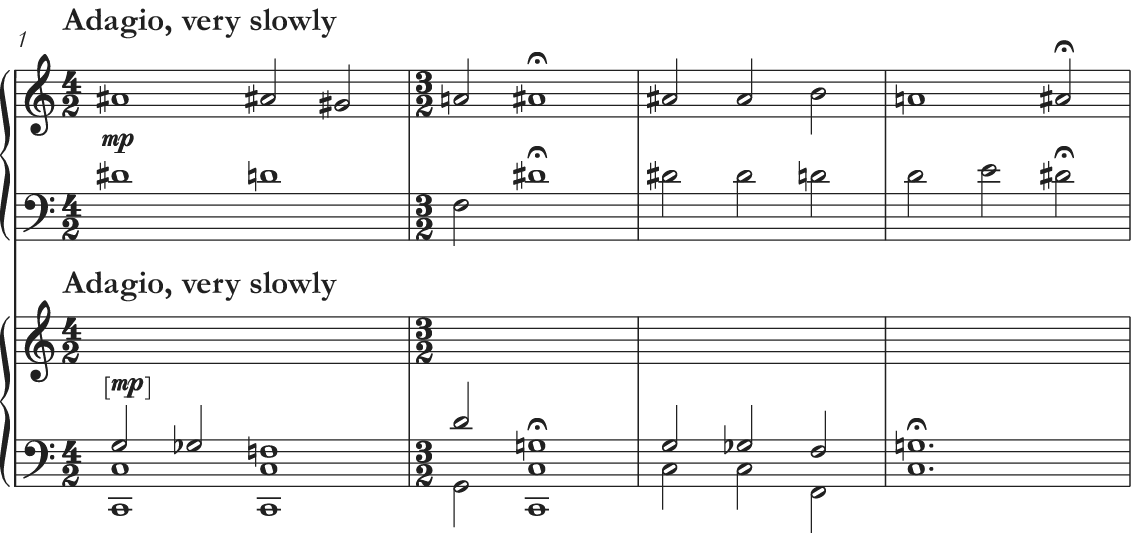
In this passage, Ives permitted himself a gaze into a post-tonal abyss (with the departure from the diatonic system and its familiar major–minor modes and sounds), and in ‘Chorale’ he put these thoughts into practice. In order to allow the ear to get used to it, he repeated this chord several times, sometimes inverted and enriched by versions of a secondary fundamental chord (see Example 3). This secondary chord, he decided, should ‘give a feeling of less finality than the first, […] have lesser intervals, and, in general, a contrasting character, and a note in common [with the primary chord]’.Footnote 111 This chord may pan out as C♮/D+/F♮(/G♯+), thus a construction mirroring the primary chord’s intervals.
Ives, ‘Chorale’ from Three Quarter-Tone Pieces for Two Pianos, bars 1–4. Piano 1 sounds one quarter-tone higher than Piano 2. Extracts from Three Quarter-Tone Pieces by Charles Ives (EP66285).

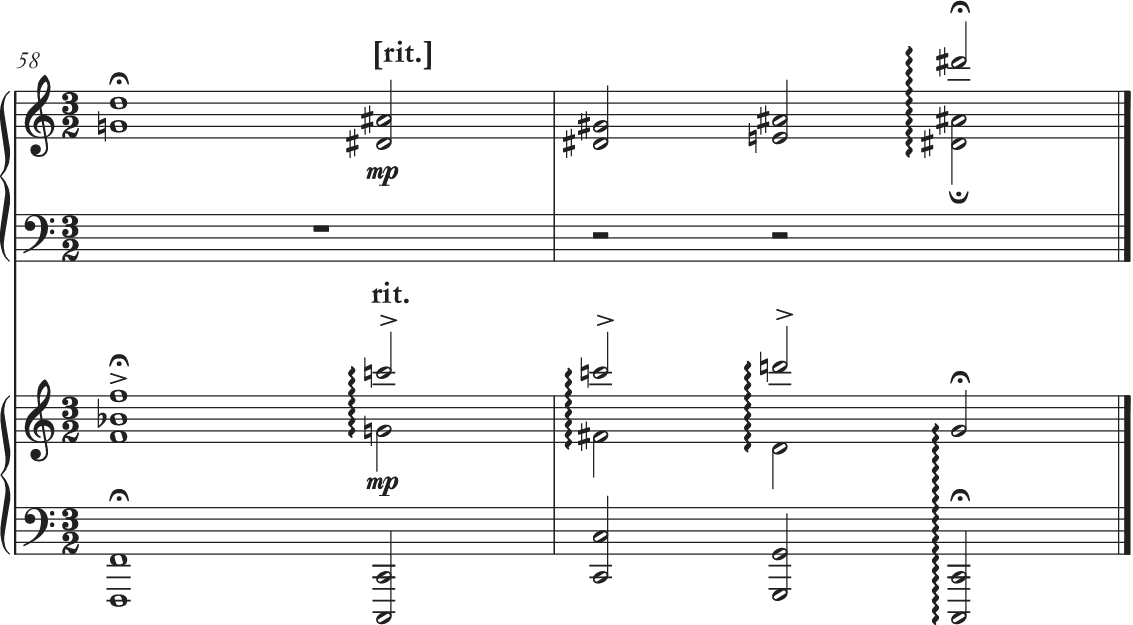
On the basis of his first integrally quarter-tonal chord, Ives then established his ‘cantus firmus’, a motif reminiscent of the melody of God Save the King, which first appears tentatively in bars 3–4 (shown in Example 3). Here, this cantus firmus is still in a foetal form, internally chromatic with an accompaniment using quarter-tone intervals. Over the course of ‘Chorale’ it lengthens, becomes more recognizable, adopts quarter-tones and finally reappears in a comic, fully quarter-tonal form in the coda (bars 48ff.; it has to be spread through both parts in order to achieve this feat). Ives’s carefully engineered fundamental quarter-tone chord aside, the ear latches on to the well-known melody. This is not so much because the original tune itself is tonal, but because by building the entire piece on this pre-used tonal tune, Ives made his audience listen continuously for tonal gist (major–minor relationships in the ubiquitous melody snippets). Once this has happened, even the fundamental chord can tantalize its listeners with its ‘neutral’ element, D♯+, especially when the chord is inverted so that this pitch is the highest note (right at the end; see Example 4). It is this feature that marks even this more structurally microtonal piece as a refinement of tonality, rather than a departure from it. Together, Ives’s Three Quarter-Tone Pieces establish an ascent of quarter-tone integration from melodic (‘Largo’) through rhythmic (‘Allegro’) into harmonic space (‘Chorale’). His experiments are tongue-in-cheek, driven by his characteristic enjoyment of experimentation, collage and (ultra)chromatic refinement.
Ives, ‘Chorale’ from Three Quarter-Tone Pieces for Two Pianos, bars 58–9. Piano 1 sounds one quarter-tone higher than Piano 2. Extracts from Three Quarter-Tone Pieces by Charles Ives (EP66285).

By comparison, Carrillo’s approach to microtones is more comprehensive, but the musical execution does not represent his system in its most extreme form. Far from deploying his theorized 128th-tones, for example, he contented himself in the five Primeras composiciones a base de 16avos de tono y sus compuestos (1922–5) with sixteenth-tones; the rest are quarter-, eighth-, third- and occasional fifth-tones. Throughout his career, Carrillo also wrote music without microtones, thereby somewhat diminishing the esoteric aura surrounding his microtonal aesthetics. But the underfoot invasion of bricolage and collage in his oeuvre is not limited to this implicit division in his catalogue. A real break with tonality through microtones, one could argue, might require not only that these microtones be ubiquitous, but also that they emancipate themselves in order to occupy a harmonic function in addition to a melodic one – the same task that occupied Ives in his ‘Chorale’. The first criterion (intense microtonal surface use) Carrillo challenged head on; the second (harmonic function) he evaded. As Madrid has demonstrated by means of Schenkerian analysis, the relationship between Carrillo’s microtonal foreground and (a)tonal middleground and background underwent a development from organic/romanticist/German to fractured/modernist thinking during the 1920s.Footnote 112 At the end of this development (for example in ‘En secreto’, the second movement of the Third String Quartet, Dos bosquejos, c.1928), Carrillo deployed quarter-tones on the surface, while his middleground and background did not necessarily build on diatonic or chromatic relationships any more. In a broad sense, this development is modernist, since it breaks with the German nineteenth-century ideal of organicism, opting instead for a fractured and static impression. But at the same time this procedure restricts the impact of microtones on the deeper layers of the composition. And this, paradoxically, makes it seem less modernist – if microtones are taken to represent modernist signifiers.
There is (as yet) no equivalent to Schenkerian analysis or Fortean set theory in the analysis of Carrillo’s type of microtonal music, which borders on the atonal. Madrid’s analysis of foreground, middleground and background pitch-class collections in ‘En secreto’ must therefore remain to a degree limited.Footnote 113 This piece has a structure which leads its listener from quarter-tones as passing notes (section A) to a juxtaposition of symmetrical microtonal scales and diminished chords (section B) to a shortened recapitulation of sorts (section A') through to Carrillo’s typical use of harmonics in an extended coda (see Table 1). Although the piece ends in an enriched G major, it is based on two main types of material: the whole-tone scale or collection 6-35 and the diminished-seventh chord or collection 4-28. In the governing section A, Carrillo uses quarter-tones to shuffle downwards and upwards through a chromatic field, with the four parts moving in parallel, first a whole tone apart from each other (a), then minor thirds apart (the interval of the diminished-seventh chord, b). This procedure represents the simplest way to refine tonal fields by means of microtones. In ‘En secreto’, Carrillo’s quarter-tones do not yet exceed the establishment of what might be called a highly systematized ultrachromatic surface (the score even looks tidy). Here, quarter-tones are, as yet, only refining surface effects. It is in section B that Carrillo used the sets 6-35 and 4-28 to develop something new. In the nine bars of this section, he worked with two diminished-seventh chords a semitone apart and two whole-tone scales, also a semitone apart (see Table 2). The diminished chords can appear as simple broken chords (in bars 31–2; see Example 5), in parallel motion in two parts, and in a more complex setting where the interval of the minor third is divided in two with the help of quarter-tones, to form a scale of equal steps of three quarter-tones each (in bars 29–30, for example). These two options are complemented by bars using the whole-tone scale (bars 34 and 36, for example). The impression of great variety is helped by the fact that no two neighbouring bars present the same option (bar 29 functions as a scale fragment that is an upbeat to bar 30). ‘En secreto’ shares these microtonal division blocks with the earlier Preludio a colón for soprano and ensemble, where this quarter-tonal scale features several times and is extended to divide the perfect fourth into two equal intervals of five quarter-tones each (see Example 8 below). But section B of ‘En secreto’ also serves to pinpoint the just-about-tonal basis of Carrillo’s microtonality: although the effect of this music is distinctly dissonant, its basis is not freely atonal, but remains restricted to whole-tone and diatonic collections. With its foundation in the 6-35 and 4-28 sets, the piece is the logical development from the preceding movement, ‘Meditación’, which not only employs quarter-tones in quite a similar way to section A of ‘En secreto’, but also is established on the basis of small chromatic collections – 4-28 and even C major.
CARRILLO, ‘EN SECRETO’, SECTION OVERVIEW
| Section A | Section B | Section A' | Coda | |||||||||||||||||||||||
|---|---|---|---|---|---|---|---|---|---|---|---|---|---|---|---|---|---|---|---|---|---|---|---|---|---|---|
| musical elements | a | b | a | b' | cf. Table 2 | a | b' | C1 | a' | C2 | ||||||||||||||||
| material (pitch-class sets) | 6-35 | 4-28 | 6-35 | 4-28 | 4-28, 6-35 | 6-35 | 4-28 | 4-28, C7 | 6-35 | G7, 9 | ||||||||||||||||
| bar structures | 4 + 4 | 4 + 4 | 4 + 4 | 4 | 9 | 4 + 4 | 4 | 11 | 6 | 6 | ||||||||||||||||
| rehearsal figures | A | C | D | E | ||||||||||||||||||||||
Note: Rehearsal figure B is missing from the score.
CARRILLO, ‘EN SECRETO’, SECTION B, BAR-BY-BAR OVERVIEW
| Bar | Element |
|---|---|
| 29 | 4-28microtonal scale |
| 30 | 4-28microtonal scale |
| 31 | 4-28 |
| 32 | 4-28 (−1) |
| 33 | 4-28microtonal scale |
| 34 | 6-35 |
| 35 | 4-28microtonal scale |
| 36 | 6-35 |
| 37 | 6-35 (+1) |
Carrillo, ‘En secreto’, bars 29–37.


Later orchestral works confirm that Carrillo’s microtones often serve to refine, rather than to break, diatonic or chromatic fields. The Concertino for Quarter- and Eighth-Tone Violoncello and Orchestra (c.1945), for example, features similar excessive ultrachromatic figures in the virtuosic, dominant and not very thematic solo part, and regular occurrences of quarter-tones in the string parts of the orchestra. The piece’s theme is characteristically chromatic with an octave leap that is typical of Carrillo and reminiscent of his fingerprint harmonics (see Example 6). As in ‘En secreto’, parts frequently function from the foundation of a diminished chord or chromatic collection.
Carrillo, Concertino for Quarter- and Eighth-Tone Violoncello and Orchestra, cello solo, bars 5–6.

Towards the end of Carrillo’s drive towards microtonal predominance, a piece like the First Concerto for Quarter-Tone Violin and Orchestra (1949) leans further towards atonality and is thus less concerned with the refinement of a pre-existing tonal space. Its solo part, like that of the Concertino for Cello and Orchestra, still excels in ultrachromatically enriched virtuosic figures. The harmonic basis still does not consist of microtones themselves, but a variety of collections based on chromatic, whole-tone and octatonic scales and their fragments pushes the piece towards a tonal edge (see Example 7). The price paid for this greater freedom from the restraints of tonal remnants is the overall lack of material capable of supporting a longer melodic development. Small-scale quarter-tone figures are omnipresent in the solo violin, other solos and the orchestra, but wherever a real motif develops, it often lacks these very quarter-tones (cf. bar 56, tranquillo).
Carrillo, First Concerto for Quarter-Tone Violin and Orchestra, reduction for violin and piano, bars 21–3.

For Carrillo, this lack was irrelevant, because the ultimate goal of Sonido 13 was to achieve ‘compositions absolutely free of whole tones and semitones’.Footnote 114 And within the parts, he did attain his goal: Preludio a colón, Dos bosquejos and the solo parts of the Concertino and the Concerto avoid whole-tone or semitone steps within their parts. If steps are not quarter-tonal, they are drawn from artificial microtonal scales, for example where each step is exactly three or five quarter-tones (see Example 8). Again, this type of scale embodies a refining tendency in Carrillo’s work. Nevertheless, across parts and in the orchestral accompaniments of the Concertino and the Concerto, whole-tone and semitone intervals abound, somewhat stealing the thunder of Carrillo’s proclaimed radicalism and allowing for a much larger excess of tonal remnants than his aesthetics would have us believe: despite its goal of replacing the diatonic and chromatic systems, his music did not fully break with non-microtonal intervals.
Carrillo’s quarter-tone scales: (a) ¾-step scale as used in ‘En secreto’, (b) 5/4-step scale as used in Preludio a colón.

Similar layers developed in Hába’s microtonal music, for example in the Second String Quartet, op. 7 (1920), and the Fantasy for Violin and Quarter-Tone Piano, op. 21 (1925). It is not surprising that Foulds criticized the score of Hába’s Quartet: at first glance, both the Quartet and the Fantasy are riddled with quarter-tone accidentals; and Hába’s policy that such accidentals should be valid for only one note increases the score’s visual complexity. Hába himself was proud to claim that his Quartet is ‘monothematic’: its ‘leading parts are derived in part from a main melody’, as he suggested, but the other parts are ‘free’ (that is, non-thematic).Footnote 115 Its sections – Allegro, Scherzo, Largo, Allegro – show that Hába was already experimenting with his later idea of pitch polarity as opposed to traditional keys.Footnote 116 Remotely reminiscent of Stravinsky’s tonal polarity, ‘pitch polarity’ is a useful term to describe the loosening of traditional thematic structures and procedures. For example, Hába’s polar pitch in the Quartet is D, while in the Fantasy it is C. These pitch poles are destabilized occasionally through bitonality or even chromatic atonality, but since the poles are not bound to a major or minor key, these interventions do not for Hába require particular preparation.Footnote 117 This seems to contradict his writings, which stress the major–minor paradigm. But these post-tonal extensions in his music happen in a controlled environment, which surrounds its microtones with much more complex but less radical music than Carrillo’s.
Two observations on Hába’s use of quarter-tones can be made. The first of these is that Hába does not experiment with quarter-tone-based scales (cf. Carrillo’s 3/4- and 5/4-step scales). Horizontal, scale-based quarter-tone development is less pronounced in the Quartet than the enrichment of post-tonal harmony through quarter-tones, as is true to Hába’s stated refining aim: ‘It is my concern to permeate the semitone system with more delicate sound nuances, not to abolish it [but] to extend the possibilities of expression already given by the old system.’Footnote 118 Consequently, Hába’s quarter-tones open up an ultrachromatic space in the Quartet, without falling into a simplistic parallel diatonicism (where C major is replaced by C+ major, and so on). There are certain limits to this free enrichment, however, and these limits ensure that the diatonic system remains in place as a remote framework. For example, no section of the Quartet (including its ending) closes with a chord featuring quarter-tones. The closing chords at the end of the Largo section and at the end of the piece centre on the pitch polarity D, but they play with other extended possibilities. The Largo ends bitonally with D major/D augmented and F♯ major/minor (or the set 5-21 {0,1,4,5,8}; see Example 9). The piece itself ends with a reduced version of this chord, in effect D augmented with the added fourth G, or set 4-19 {0,1,4,8}. Both chords are prepared through chromatic, sometimes quarter-tonal, suspensions, refining what Stein would have called our ‘leading-note urge’.
Hába, Second String Quartet, op. 7, ending of the Largo section (one bar before figure 31).

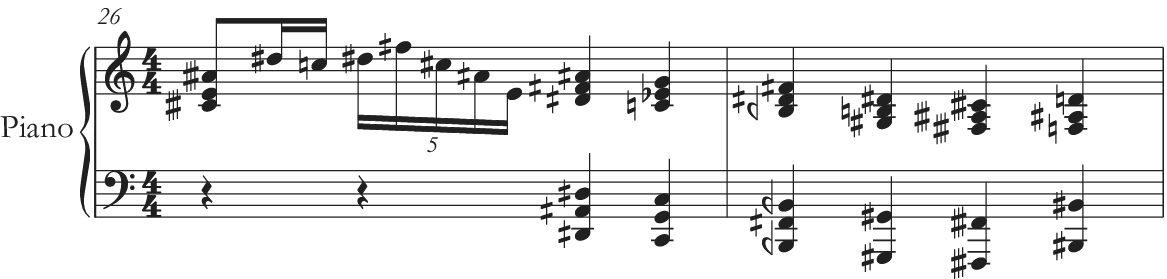
In the slightly later Fantasy, however, Hába temporarily returned to a more diatonically grounded style. He frequently used ‘pure’ parallel quarter-tone chords, for example in the falling sequence of D+ minor, C minor, B– major, G♯ minor and F♯+ minor (see Example 10), and ended this more rhythmically driven piece in C major–minor (based on Stein’s ‘neutral’ chord, with E– instead of E or E♭). Hába’s opera Die Mutter (1927–9) likewise ends on an enriched major tonic chord (this time D major with additional E+).
Hába, Fantasy for Violin and Quarter-Tone Piano, op. 21, piano part, bars 26–7.

The second observation is that, while he lacked Carrillo’s level of quarter-tonal scale development, Hába was more enterprising with quarter-tonal intervals and leaps. Hába’s quarter-tonal space opens new possibilities for advanced microtonal string playing and, in the Fantasy, for pianists experienced in dealing with quarter-tonal keyboard instruments. Although actual quarter-tonal intervals occur most frequently within the parts of the Quartet (for example C to C+), there are also frequent 3/4 intervals to be mastered (for example upwards from E to F+ or downwards from B♭ to A–), and occasional leaps, for example upwards from B♮ to G–. The use of these bigger intervals enabled Hába to write lyrical quarter-tone themes – something which Carrillo’s scale-focused approach discouraged in favour of virtuosity.
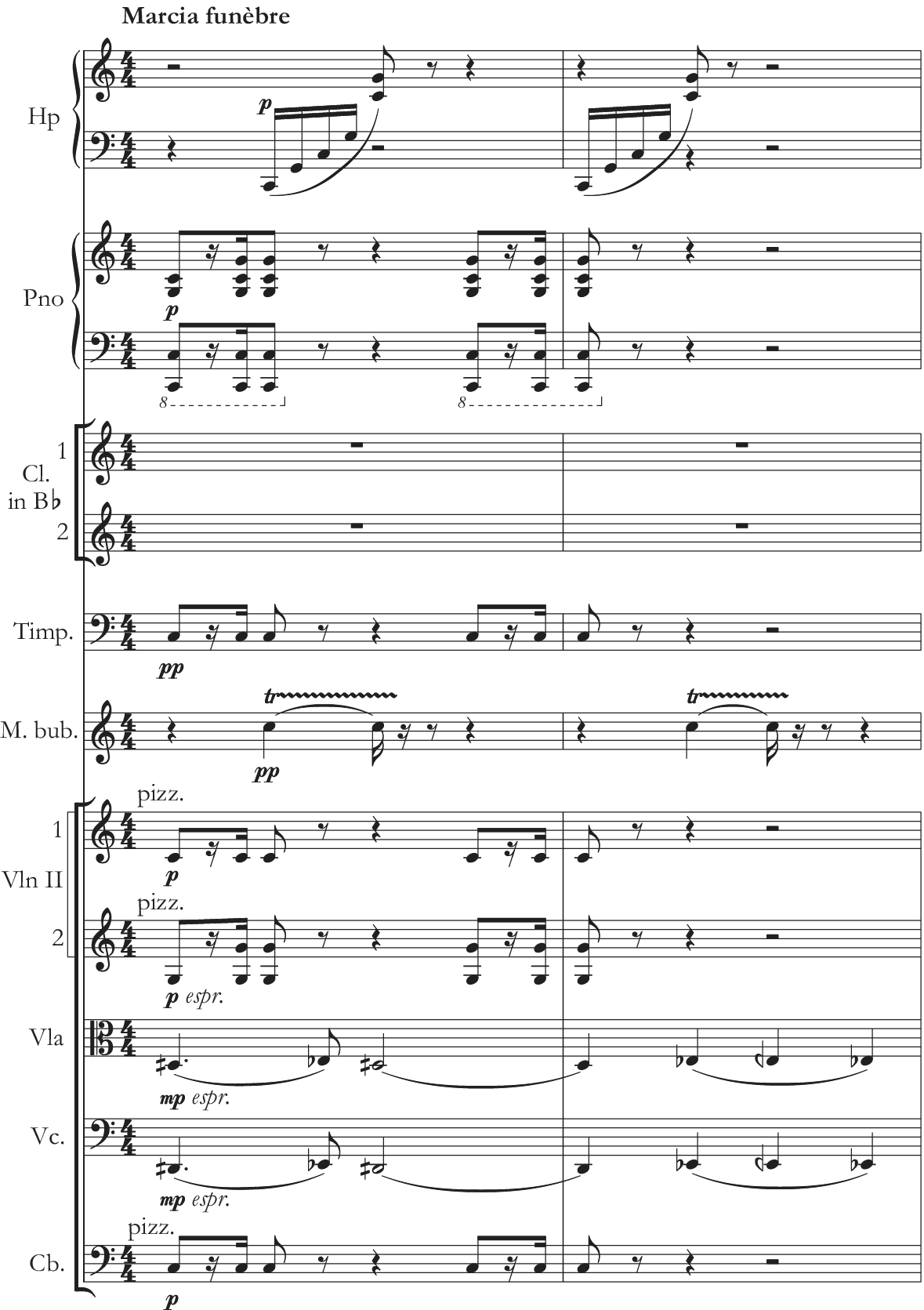
Sometimes, Hába even made use of quarter-tones as a purely colouristic tool, and he thereby allowed quarter-tones to influence the piece in question on a less thematically driven level. An example is the Funeral March closing the first scene of Die Mutter. Hába evoked tradition with a C minor piece, which is divided between slow punctuated march interjections in the piano, percussion and initially violins and basses on the one hand, and highly ultrachromatic progressions by step in the violas and cellos on the other. The latter roam widely along the quarter-tone scale over the course of the March, but begin by shuffling around E♭ – the pitch class needed to define this as a piece in a minor key (see Example 11). This conjunct approach is reminiscent of Carrillo’s emblematic sliding motions and Foulds’s arrested developments (as the following section shows). For Hába, this colouristic approach may have represented a loosening of his usual tight integration of quarter-tones, but it allowed him to hammer home the ‘obstacles’ of the opera’s per aspera ad astra principle and send refined but strong diatonic signals. Opera, after all, needs drama and new effects, and a quarter-tonal funeral march provides for all these requirements.
Hába, Die Mutter, Funeral March at figure 25/7.


Neither Hába nor Carrillo effectively attempted to destroy tonality completely, although their sometimes precarious refinement and microtonal excess permitted the occasional gaze into the atonal abyss. But their loyalty to extended tonality stood firm, and was a feature they shared with the younger and even more experimental microtonalist Partch, whose work bridged the gap between the early approaches in this article and the European–American post-Second World War scene. Partch’s turn to microtones had several sources, among them the diverse musical influences of his childhood in the American Midwest and his discovery of just intonation through Helmholtz’s theories.Footnote 119 Although he destroyed his earlier European-influenced music and turned towards American and Eastern musical influences, he drew upon the trope of refinement to critique equal temperament and promote microtones. In his essay ‘Patterns of Music’, he compared the poverty of the composer with their scale of 12 semitones to a painter with a much more fluid palette of microtonal colours able to refine composition and revitalize it:
Consider the writer of music. Before him is also a scale. […] In his mind he approaches C-sharp, one of the five blacks. He approaches it, and he lands on it. His action is direct, simple, predetermined. There are no shades of C-sharp, no shades of red, for him. The one shade that his gods will allow him to use is before him. He is taught that that is enough; it is good, traditional, and proper, and he feels a vague sense of immorality in even wondering about those possible bastard C-sharps.Footnote 120
Preservation: ‘If I’m not land, I’m sea’
In ‘Some “Quarter-Tone” Impressions’, Ives devoted a short but humorous section to the role of the fifth in quarter-tone (indeed, in any) music:
The fifth seems to say, ‘You can’t get away from the fact that I am boss of the overtones – the first real partial. I have the octaves to walk on. If I’m not land, I’m sea, and you can’t travel around the world without me.Footnote 121
This little rhyme indicates that Ives acknowledged a natural acoustic pull of the perfect fifth. And his fundamental quarter-tone chord (made up from two fifths seven quarter-tones apart – for example, C/G and D♯+/A♯+) confirms this impression. Hába likewise obeyed the lure of the perfect fifth in quarter-tone music, and built special effects with it (for example in what sounds like folk-song-inspired piano interludes with parallel fifths in the Fantasy op. 21 (bars 85ff.). But no early twentieth-century quarter-tonal music has a deeper relationship with the fifth than Foulds’s. In his music, this interval guarantees the stability and preservation of diatonic tonality faced with potentially destabilizing quarter-tonal interjections.
Foulds’s quarter-tones occur only in the strings and only in slow movements, as small-scale events which seek a short-term rupture of their surroundings. The perfect fifth is the only interval to be tasked with these quarter-tone shifts in his music. Within these boundaries, quarter-tones feature in works as varied as the Cello Sonata (1905, rev. 1927), the orchestral pieces Mirage (Music Poem no. 5, op. 20, 1910) and ‘Colombine’ from Music Pictures Group III, op. 33 (1912), the World Requiem, op. 60 (with Maud MacCarthy, 1919–21), the piano concerto Dynamic Triptych, op. 88 (1929) and Quartetto intimo, op. 89 (1931–2). The only exception to these rules may be the appearance of 22 irregular microtones in the soprano part of the aforementioned opening Lento of Lyra celtica.
Foulds’s simplest standard quarter-tone procedure can be found in the Quartetto intimo and in the Cello Sonata, the latter of which represents probably his earliest exploration of quarter-tones.Footnote 122 The sonata’s quarter-tones appear twice in the middle movement (Lento) in D minor. Since the movement presents a very simple but non-traditional binary form (AA'), these two occurrences are identical apart from their transposition a fourth up the second time. Below a rhythmic A octave pedal in the piano, the cello plays the perfect fifth F/C, which moves upwards to G♭/D♭ via the intermediate quarter-tone interval F+/C+. This miniature movement is repeated downwards and upwards, and finally stretches through contrary motion to a quarter-tonally augmented fifth on its way to the major sixth F/D (see Example 12). The brief episode functions as a coda to the first of the movement’s two parallel sections, and as a lead into the beginning of the second section. Harmonically, it sits between a short, meandering ‘bell-like’ phrase in A major in the piano and the start of the second section in D minor. As such, it ruptures a traditional V–I procedure. The second occurrence somewhat mirrors this with its interruption of the Leittonwechsel transformation from B minor to G major.
Foulds, Cello Sonata, second movement, bars 49–57.

In the quartet, by comparison, quarter-tones appear only once in an even simpler slide in the slow movement in the cello part, here from the fifth C–G through to D♭–A♭. These slides are Foulds’s standard quarter-tonal gestures. As destabilizing elements and an unexpected interruption of the surrounding music, they provided a kind of Verfremdungseffekt. Their strict limitation to parallel fifths (the backbone of ‘normal’ music, if Ives is to be believed) guarantees that the quarter-tones are safely contained and the tonal framework is dramatically extended but never endangered.
This function is even more obvious in pieces that apply quarter-tones more daringly. An example is the ‘Lento assai’ section of the third movement of the Wagnerian tone-poem Mirage. Foulds’s standard procedure of sliding perfect fifths is applied twice in the strings (rehearsal nos. 31 and 34, distinguished only by transposition), again in order to alienate and interrupt an otherwise chromatic structure. As there are four string parts, the chord A/E/C/G or 4-26 {0,3,5,8} now forms the basis of a downward quarter-tonal slide through to G/D/B♭/F, and finally to F/C/A♭/E♭. Although the principle remains the same as in the previous pieces, the addition of a second fifth created the first quarter-tone chords in Foulds’s music (albeit these are still built on the interval of the perfect fifth).
An even greater complication of fifth slides is achieved in Foulds’s piano concerto Dynamic Triptych and in ‘Colombine’, a short movement from a series of atmospheric colouristic studies based on paintings Foulds saw at the Paris Salon of 1906. In the introduction to the Lento movement of Dynamic Triptych, two interlocking fifths (B/F♯ in the basses and D/A in the cellos) slide in opposite directions for the first time in Foulds’s music (cellos downwards, double basses upwards), so that the respective two strands end on the other’s original pitch class (see Example 13). The simultaneous retrograde-scale motion interrupts the previous modal fourth chord steps, and opens the stage for the solo piano’s entry on the fundamental fifth D/A. As in the earlier pieces, the quarter-tones’ function is Verfremdung, and they create a clearing for the entrance of a new tonal element (here, the solo part).
Foulds, Dynamic Triptych, second movement, figure 2/2.

Foulds called ‘Colombine’ ‘a study in full-tones, half-tones and quarter-tones’. The piece was inspired by a painting of the same title by Alfred-Louis Brunet Debaine, and forms a light-hearted scherzo with a prominent part for the glockenspiel (but no deep wind or double basses). Initially, the movement is based on the whole-tone scale, but it also features a theme with semitones, and finally a much slower and shorter quarter-tone episode further on (true to the order announced in the piece’s subtitle). Characteristically for Foulds, the movement displays quarter-tones only during two pivotal (and again parallel) moments, and only in the strings. But in an exaggeration of Dynamic Triptych, these quarter-tones fall and rise in greater independence over the course of eight bars, and thus create probably the longest microtonal Verfremdung in Foulds’s music. It renders an expected temporary closing gesture into an F♯ major void, because the parts drift further apart instead of moving in parallel fifths. The result is that the strings emerge from their quarter-tonal episode in a 4-z29 {0,1,3,7} set, instead of the expected major chord (see Example 14).
Foulds, ‘Colombine’, bars 56–63 (string parts only).

Here, tonality is in much more immediate danger from the alien quarter-tones than in any other music by Foulds, mostly because the quarter-tones are only loosely confined to their standard interval of the fifth. They start from an F♯ major chord, move quickly to D minor and back, thence to G major, back to F♯ major, D minor and enharmonically interchanged E♭ minor (or half-diminished seventh chord, if the cello’s C is taken into account as the root). While the interval of the fifth looms large in the relationships between these chords, it cannot provide the normal tonal guarantee it usually does, and in effect led Foulds into an otherwise alien country. But what is perhaps most surprising about this piece is that the normally conservative British press welcomed what was the first large public performance of microtonal music during the piece’s appearance in Henry Wood’s 1912 Promenade Concerts season. Unlike many of Foulds’s European microtonalist colleagues’ performances, this event was not limited to fellow enthusiasts and experts, but featured in a popular series of large-scale concerts. The reception was carefully positive. The critic of The Referee mused, for example, that Foulds ‘is to be commended for making it short and for the deftness with which he has introduced this novel effect’.Footnote 123 Foulds’s quarter-tonal excursion was appreciated at least, and he may have had MacCarthy’s untiring work to thank for this. Her broadcasts and talks had prepared the public well for this musical adventure, which, above all, was clearly intended to present a specific effect that its composer took pains not to overuse, true to his credo. Even here, Foulds did not stray far from his rigid approach to quarter-tones, which can seem at times like an inflexible alienating formula whose perfect fifths prevent modernist spillage into the surrounding late Romantic language.
Restraint: ‘satisfy even the worst sticklers’
Stein’s foray into quarter-tones was among the earliest microtonal explorations, but it was also the most restrained. This position of restraint was characterized by a general unwillingness to engage with microtones in practice, since they were seen as too advanced to be intelligible for the foreseeable future. Busoni’s later stance and his failure to produce microtonal compositions is a case in point, as is that of Joseph Yasser. Yasser (1893–1981), a Russian-trained Polish organist turned musicologist, immigrated to the USA in 1923 and in 1930 began working as an organist for synagogues and writing on various aspects of Jewish music.Footnote 124 In one of his most thought-provoking essays, ‘The Future of Tonality’, he postulated obstacles to his microtonal theory of ‘supra-tonality’.Footnote 125 According to Yasser, musical scales and modes had developed from a pentatonic division of the octave (‘infra-tonality’, made up of the five notes of the pentatonic scale, C, D, F, G, A, and two auxiliary notes, E and B – he called this the ‘5 + 2’ scale) through to the seven notes of common-practice equal-temperament music (‘tonality’, with its five auxiliary semitones, in effect the black keys on the piano keyboard – Yasser’s ‘7 + 5’). From here, they had to progress into supra-tonality, which would synthesize tonality and atonality of the early twentieth century (consequently, a ‘12 + 7’ scale, equalling a 19-step microtonal division of the octave). The richness of Yasser’s theory, which he refined in A Theory of Evolving Tonality (1932) into one of ‘centitones’ and finally ‘millitones’, is striking, and unlike most contemporary quarter-tone theories it draws on just intonation.Footnote 126 Yet his call for restraint includes all practical applications of microtones, and seems to be particularly suspicious of a playful approach such as Ives’s. Like Busoni and Stein, Yasser was quick to issue a warning:
The establishment of new and, at least, rudimentary rules of harmony and counterpoint (presupposing, of course, an entirely new classification of consonances and dissonances) would probably represent the next and no less complicated problem to be tackled before any ‘supra-tonal’ musical compositions could be created at all, before even the simplest class-room harmonization based on the supra-diatonic scale could be properly executed.Footnote 127
The consequence was to be that any aspiring composer would have to be retrained and should start studying supratonal harmony from scratch. Needless to say, it never came to that.
For Stein, the only composer in this group to present restraint in actual composition, the preservation of tonality was of paramount importance and acted as his justification for using quarter-tones. This urge towards preservation was so strong that it did not lead him just to a very sparing application of quarter-tones, but to their restriction or even erasure in performance. Although interested in quarter-tone instruments and actively involved in the theorization and promotion of microtones, Stein upended Foulds’s notion that microtones could be used where the desired effect cannot be achieved in any traditional way: ‘I have deliberately used quarter-tones only in those places that can be done without them through paraphrasing – by which I hope to satisfy even the worst sticklers.’Footnote 128 The statement implied that Stein considered his quarter-tones as somewhat premature experiments whose right to exist had not yet been proved. Consequently, they needed to be restrained, which meant giving the performer of his quarter-tone pieces the option of omitting them altogether.
In practice, he believed that the cello was best suited to venture into quarter-tone music, simply because quarter-tones are easier to locate and play on the comparatively widely spaced cello fingerboard (the same thinking influenced Partch’s cello fingerboard pasted onto a viola). Stein’s only published pieces with quarter-tones are therefore the Zwei Konzertstücke for cello and piano. Both are firmly diatonic, the first in G minor and the second in D♭ major. Stein eschewed the introduction of a ‘neutral’ triad he had announced in his Preface to the Konzertstücke (for example C/E–/G) and instead restricted quarter-tones to their function in satisfying the new century’s heightened ‘leading-note urge’. Therefore, his quarter-tonal interjections in the Konzertstücke fulfil two functions: first, as auxiliary notes they serve to stabilize harmonic resting points (for example the fifth A♭ in a D♭ major chord in the first of the Konzertstücke; see Example 15a); and second, as passing notes they either create a leading note where the chromatic scale would not offer another intermediate step (see Example 15b), or simply sharpen chromatic ascents or descents (see Example 15c). As basic as these insertions are, they frequently impact on phrasing and rhythm in relation to their chromatic alternatives – a sign perhaps that Stein, like Ives, was aware of the importance of quarter-tones for a rhythmic renewal.
Stein, Zwei Konzertstücke, no. 1, bars 54–6 (original non-microtonal alternative given above the cello line).

Stein, Zwei Konzertstücke, no. 2, bars 16–17 (original non-microtonal alternative given above the cello line).

Stein, Zwei Konzertstücke, no. 2, bars 9–10 (original non-microtonal alternative given above the cello line).

By far the most extensive quarter-tonal feature in the Konzertstücke is the fast downward quarter-tonal scale over 38 steps in the cello over an A♭/E♭ pedal in the piano (see again Example 15c). Like all quarter-tonal occurrences in Stein’s Konzertstücke, the scale is provided with a 19-step chomatic alternative for ‘sticklers’. The effect, nearing that of a glissando, is virtuosic rather than adding anything essential. But it strengthens Stein’s chromatically Romantic conception of the piece’s fast-changing dynamics and tuneful melodies in the cello. Played without the quarter-tones, the pieces are quite unremarkable (somewhat confirming Ives’s claim that a piece, once microtonally ornamented, sounds boring when these ornaments are removed). Where they are taken on board, however, they do succeed somewhat in refining listening habits through their heightened leading-note tension.
Against all odds, some early twentieth-century microtonal pieces elicited positive responses, which was perhaps least expected by their own composers. An example is Foulds’s ‘Colombine’, whose quarter-tones Rosa Newmarch justified by pointing to ‘the subtle gradations in tone’ in the painting, which had ‘forced [Foulds] over the old border-line of semitones in his effort to give an approximate effect’.Footnote 129 But 20 years later, even comparatively progressive composers such as Lambert and Darnton still rejected quarter-tones as painful and unintelligible. On the Continent, Bekker’s and Pfitzner’s aforementioned reservations towards Busoni had damaged not only Busoni’s reputation as a composer, but also the viability of microtones before the trend had even fully developed. In 1929, Leonid Sabaneev spoke up against quarter-tones, microtonal instruments, notation and composers in a powerful dismissal of the whole idea in the Musical Times: ‘The impression conveyed by all these experiments and devices is that they are curiously foreign to the general stream of music, are outside musical territory, so to speak, and hence unnecessary.’Footnote 130 His dismissal of Hába and Vyschnegradsky in particular was an attack on these microtonal bricoleurs and their ability to modernize music: ‘The construction of the musical whole is borrowed from the past, and our mind, in following this music, involuntarily thinks of it in connection with what has gone before. And it cannot be otherwise.’Footnote 131
A more balanced report, Artur Holde’s ‘Is There a Future for Quarter-Tone Music?’, sought to lend some credit to the usefulness of microtones in the face of the twentieth-century angst over diatonic exhaustion: ‘The danger of a “played-out” scale seemed banished with one stroke. Connections with distant, unexplored sound worlds seemed to be established. How many new possibilities for expression were now opened up for the composer! Would not a radical expansion of available tonalities represent the beginning of a new era in music?’Footnote 132 His further thoughts of quarter-tones as the basis for ‘radically different systems of tonality’ and a ‘new order of intervals’ use the familiar words we tend to apply when thinking about the music of the early twentieth century.Footnote 133 But as the frequency of notions of restraint in early microtonal compositions and writings shows, Holde’s modernist enthusiasm tried to protect composers from charges they had already foreseen and circumvented. By adhering to the tropes of rediscovery, refinement, preservation and restraint, they had sought to provide against admonitions of radicalism. Although the buzz quietly died down and later microtonalists did not particularly seek out Stein, Foulds, Hába, Carrillo, Busoni, Vyschnegradsky or even Ives as their forerunners, this loose group of early twentieth-century composers and theorists deserves credit for its adventurous attempts to save an endangered tonality.