Introduction
Adversative connectives like German aber and English but can be realized in monologic and dialogic structures, which – all else being equal – can lead to a difference in the contribution that the adversative connective makes to the utterance. In dialogue, sentence-initial but can for example signal an illocution that is absent from the corresponding structure in monologue, as exemplified in (1) and (2).
(1) Shrek is ugly, but he married Fiona.
(2) A: Shrek is ugly.
B: But he married Fiona!
The example in (1) is a typical instance of the denial of expectation use of adversative connectives (cf. Lakoff, Reference Lakoff, Fillmore and Langendoen1971). But evokes a negative coherence relation (cf. Sanders, Spooren, & Noordman, Reference Sanders, Spooren and Noordman1992) between the proposition expressed by the second clause he married Fiona and an assumption that can be derived from the first clause: someone who is ugly is unlikely to marry a beautiful princess. The use of an adversative connective indicates a contrast that is established on the basis of an assumption inferred from a previous element of the discourse or world knowledge (Blakemore, Reference Blakemore2002; Hall, Reference Hall2007; Lang, Reference Lang, Couper-Kuhlen and Kortmann2000; Sæbø, Reference Sæbø and Weisgerber2003). In (2) the dialogic split expands the denial of expectation use in that the statement of speaker B can be understood as a disagreement with or limitation of speaker A's statement in that B is either questioning that Shrek is ugly or is calling the inference ‘ugly people do not get married’ into question (cf. Spooren, Reference Spooren1989; Thomas, Reference Thomas2005).
Clearly, the difference between the use of but in (1) and in (2) must be considered when studying the acquisition of adversative connectives in conversational production data. Diessel (Reference Diessel2004), for instance, found that children's production of coordinated clauses is preceded by juxtaposed clauses that may also cut across speaker turns. Studies analyzing the role of adversative connectives in children's early productions do not always match Diessel's finding. Adversative connectives first appeared in coordinated monologic structures at least twice as often as in dialogic structures in a study of the conversational data of four English children between the ages of 1;7 and 3;0 (Bloom, Lahey, Hood, Lifter, & Fiess, Reference Bloom, Lahey, Hood, Lifter and Fiess1980). Bloom et al., conclude from this that children learn the marking of adversative relations with adversative connectives as part of their own utterances and only later expand their use of adversative connectives to dialogic structures. The contradiction between claims like those of Bloom et al., and Diessel raises the question whether adversative connectives are learned as part of a multi-clause utterance as a means to structure the information that a child intends to communicate, or whether children first use adversative connectives in dialogic structures when organizing interpersonal communication and structuring their discourse.
Uses of adversative connectives
In this paper, the term adversative connective is used in a broad sense to refer to linking devices that can operate on both a local and a more global level. Adversative connectives can signal coherence on different levels of the discourse (e.g., Sanders et al., Reference Sanders, Spooren and Noordman1992; Sweetser, Reference Sweetser1990). For instance, German aber and English but can be used to link propositions (semantic opposition) and inferences thereof (denial of expectation).
(3) Peter is hungry, but Paul is not. semantic opposition
(4) Peter is allergic to alcohol, but he drinks a beer occasionally. denial of expectation
In (3) a contrast is expressed between being hungry and not being hungry, and the contrasting predications are related to two different topics, Peter and Paul. In (4) drinking a beer occasionally is contrasted with an inference that can be drawn from the first clause: someone who is allergic to alcohol probably does not drink beer. Adversative connectives can also be used to introduce speech acts and mark upcoming talk as relating to a new episode (cf. Schiffrin, Reference Schiffrin1987, pp. 24ff.).
(5) This soup is really hot, but I like it. illocution
(6) Yesterday, John and I went for a long walk in the woods; but let's talk about the party first. theme management
In (5) the adversative connective evokes an inference on the illocutionary level: the first clause can be understood as criticism. The second clause contrasts with this criticism and expresses praise. In (6) the hearer could infer from the first clause that a report about a walk in the woods is about to follow. The adversative connective is used to introduce a contrasting theme.
Use types of adversative connectives cannot always be assigned unambiguously. Quite often there is more than one interpretation available. It is for instance possible to understand a sentence like Peter is hungry, but Paul is not in a denial of expectation sense, ‘Peter being hungry does not imply that Paul is hungry’, or in a semantic opposition sense where being hungry is contrasted with not being hungry (cf. Lakoff, Reference Lakoff, Fillmore and Langendoen1971, p. 133). Besides their primarily illocutionary interpretation, many adversative connective utterances also have a denial of expectation reading. If interpreted on the illocutionary level, the example given in (5) contrasts criticism with praise. If understood in a denial of expectation sense, the inference drawn from the first clause (the speaker does not like the soup) contrasts with the proposition expressed in the second clause.
Adversative connectives in acquisition studies
Children's productions of adversative connectives have mainly been studied in relation to other connectives (Bloom et al., Reference Bloom, Lahey, Hood, Lifter and Fiess1980; Evers-Vermeul & Sanders, Reference Evers-Vermeul and Sanders2009; Kyratzis & Ervin-Tripp, Reference Kyratzis and Ervin-Tripp1999) and in narratives (Peterson, Reference Peterson1986). Several studies provide evidence that the different uses of adversative connectives do not appear at once, but findings are inconsistent with regard to a developmental sequence. Children were found to produce adversative connectives to mark illocutions before using them to relate events described by statements or vice versa (e.g., Bloom et al., Reference Bloom, Lahey, Hood, Lifter and Fiess1980; Kyratzis & Ervin-Tripp, Reference Kyratzis and Ervin-Tripp1999; Peterson, Reference Peterson1986; Spooren & Sanders, Reference Spooren and Sanders2008). As different types of production data have been used (conversational versus narrative) it is likely that the selection of databases influences the distribution of the different uses of adversative connectives (Spooren & Sanders, Reference Spooren and Sanders2008). In conversational production data, dialogue-specific uses are more likely to occur than in narrative production data.
It has been noted that children frequently use connectives in utterances that cut across speaker turns (Diessel, Reference Diessel2004; Evers-Vermeul & Sanders, Reference Evers-Vermeul and Sanders2009; Lustigman & Berman, Reference Lustigman and Berman2016). In a recent study of three Hebrew children's conversational data, the adversative connective aval ‘but’ predominantly appeared in co-constructed utterances in two of the children from the onset of adversative connective use around 2;00 up to an age of 3;1. In the phase following the onset of connective use, the proportion of dialogic structures increased in all children, but decreased in two children in the phase when the adversative connective aval ‘but’ entered the system (Lustigman & Berman, Reference Lustigman and Berman2016, p. 173). Diessel analyzed five English children's use of connectives in conversational data and found that 80% of the first 15 but-clauses were linked to an utterance produced by an adult speaker (Diessel, Reference Diessel2004, p. 164). In Diessel's study, clauses cutting across speaker turns dominate the but-clauses used by the children up to an age of 5;0: 54.3% were linked to an utterance produced by an adult speaker and only 30.5% were produced within a speaker turn, while 15.2% couldn't be clearly assigned (2004, p. 163). This distribution was modulated by prosody: intonationally unbound but-clauses which can be linked to a clause produced either by an adult or by the child constituted 77.9% of all but-clauses, while intonationally bound but-clauses produced within a speaker turn constituted 22.1% of all but-clauses up to an age of 5;0 (2004, p. 195). When analyzed in one-year steps, the proportion of intonationally bound clauses with coordinating connectives (and-, but-, because-, and so-clauses) increased: the proportion of prosodically integrated coordinated sentences reached 22.9% between the ages of 3;0 and 4;0, and 34.3% between the ages of 4;0 and 5;0. At the same time, the use of intonationally unbound clauses decreased. As unbound clauses include both within speaker and across speaker turns, this result cannot be directly equated with a decrease in dialogic realizations. A study based on the conversational data of Dutch children corroborates Diessel's findings. Evers-Vermeul and Sanders (Reference Evers-Vermeul and Sanders2009, pp. 842ff.) could show that the connective want ‘because’, for instance, first appeared in separate clauses around age 3;0. Around their fifth birthday children produced want as part of separate clauses in 40 (71%) independent and 16 (29%) integrated clauses.
In Diessel's (Reference Diessel2004) study, pragmatically linked utterances produced by different speakers are the preferred structural option at early stages of connective use and constitute 80% of the very first uses of adversative connectives. This result is captured in his model of the emergence of conjoined clauses (2004, p. 171), which predicts that integrated clauses with a connective emerge after sentences that pragmatically link a connective clause to a preceding utterance produced by either the same or a different speaker.
In our study, we focused on the first year of adversative connective use and scrutinized the monologic versus the dialogic realizations of adversative connectives with respect to their use types and their age-related changes. In monologic realizations, children relate the adversative connective clause to an utterance they have produced themselves, while in dialogic realizations they attach it to the production of another speaker. Unlike Diessel, who included only finite clauses in his study, we analyzed all interpretable finite, non-finite, and verbless utterances. For example, an answer like Aber nein ‘but no’ (Leo, 2;01) to the question Leo, willst du ein Brot? ‘Leo, would you like a slice of bread?’ was included as the communicative intent is identifiable. Based on a dataset comprising and-, but-, because-, and so-clauses, Diessel could show that the proportion of bound utterances produced by English-speaking children increased within one year. We investigated whether there is an increase in the children's use of monologic utterances within the first year of adversative connective use and focused on the effects the different use types might have on the choice of a monologic or a dialogic form.
German versus English
We analyzed the data of two children acquiring German and two children acquiring English, as one of our ultimate goals is to investigate language-specific influences on the acquisition process of adversative connectives. At this point, the investigation of language is mainly explorative as only the data of two children per language were analyzed. However, we do hope to find indications of tendencies that we can explore further with more data at a later point in our study. Although the semantics of German aber and English but are largely parallel, German differs from English in that aber has a modal interpretation that is unavailable in English in sentences like Heute ist es aber warm ‘It's really warm today’ (cf. Weydt, Harden, Hentschel, & Rösler, Reference Weydt, Harden, Hentschel and Rösler1983). Exclusive but on the other hand is expressed using the German preposition außer ‘except for’ and not aber in sentences like Nobody but John came (cf. König, Reference König1991). Furthermore, German has the specific correction marker sondern, for which English provides no separate expression, for example, Ich möchte kein Pony reiten, sondern ein Pferd ‘I do not want to ride a pony but a horse’. In the data we analyzed, language-specific uses almost never occurred and were excluded from the analysis.
Syntactically, but behaves like a conjunction and as such occupies a fixed position between the two clauses unless used as an exclusive particle. The position of aber is more variable as it can appear preverbally, postverbally, or at the end of the clause. Therefore, aber has been classified as a floating adverbial connective (Breindl, Volodina, & Waßner, Reference Breindl, Volodina and Waßner2014). Despite these syntactic differences, we treated the corpora as fairly parallel with respect to the general functions of but and aber. In our study, we examined the role of the four use types of but and aber (semantic opposition, denial of expectation, illocution, theme management) and related them to discourse structure (monologic versus dialogic) in order to shed light on the following questions:
(A) Does the distribution of the four different use types of adversative connectives (semantic opposition, denial of expectation, illocution, theme management) vary with discourse context (monologic versus non-monologic)?
(B) Are there age-related differences regarding monologic versus non-monologic realizations of adversative connectives?
(C) Are there indications of language-related differences?
Method
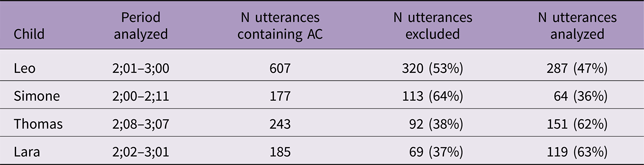
The present analysis is based on two dense and two non-dense corpora available at CHILDES (MacWhinney, Reference MacWhinney2000). We analyzed the data of the German children Leo (dense corpus; Behrens, Reference Behrens2006) and Simone (Miller, Reference Miller1979) and of the English children Thomas (dense corpus; Lieven, Salomo, & Tomasello, Reference Lieven, Salomo and Tomasello2009) and Lara (Rowland & Fletcher, Reference Rowland and Fletcher2006) for a period of 12 months in succession after the first occurrence of an interpretable and non-imitated utterance containing the German adversative connective aber or the English adversative connective but. Utterances were extracted with 10 lines of context before and after the target utterance. We excluded all non-interpretable utterances as well as imitations and formulaic uses from the analyses (Table 1).
Number of Utterances Containing Adversative Connectives and Proportions of Analyzed and Excluded Data

Notes. AC: adversative connective; proportions of the excluded and analyzed data are given in brackets after the raw numbers of utterances.
Two raters categorized all remaining instances with respect to their attachment type as monologic (M) or dialogic (D). A token was coded as monologic when both the adversative connective clause and the clause the adversative connective clause related to were produced by the child. Utterances were coded as dialogic when the child reacted to an utterance or clause produced by another speaker or when there was no identifiable antecedent available, as when the child was reacting to actions rather than utterances. We also coded yes, but and no, but utterances as dialogic, as the child did not produce the first clause herself. The inter-rater reliability between the two raters for the attachment type classification was κ = .70.
Subsequently, we categorized the utterances with regard to the four use types (semantic opposition, denial of expectation, illocution, theme) described above. Our first three use types largely correspond to Sweetser's (Reference Sweetser1990) categories: content (semantic opposition), epistemic (denial of expectation), and speech act (illocution). Examples from the child data can be found in (7)–(10).
(7) mother: du, ich glaub die Trambahn passt nich drauf auf die Eisenbahnschienen, Leo.
‘I think the tram does not fit on the railway tracks, Leo.’
leo: Zug aber.
‘But the train does.’ (semantic opposition; Leo 2;02)
(8) simone: Die is kaputt.
‘This one is broken.’
simone: Das machte aber nix Maxe.
‘But it does not matter, Maxe.’ (denial of expectation; Simone 2;09)
(9) mother: I don't want you having my envelope.
lara: But I want one envelope. (illocution; Lara 2;07)
(10) mother: Who's the b@l and q@lFootnote 1 man?
thomas: A man to drive a truck but I'm going xxxFootnote 2 ready for my journey. (theme; Thomas 3;06)
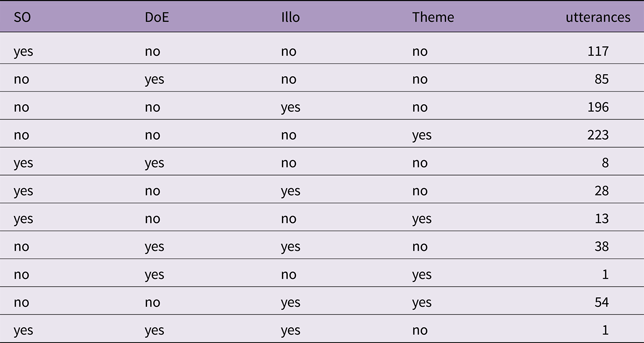
The two coders followed a coding scheme for the four categories that was developed on the basis of sample sentences and variations thereof. Sample sentences were mostly modeled on examples found in the literature on adversative connectives. Several manifestations were identified for each category. For instance, four different manifestations were identified for the use type semantic opposition, with topic change or topic maintenance combining either with a binary or with a multiplex opposition, e.g., Peter drinks beer, but Tom does not drink beer (topic change, binary opposition), Peter drinks beer, but he does not drink wine (topic maintenance, multiplex opposition). If necessary, a description was included, e.g., for the use type denial of expectation: ‘S2 induces and cancels a S1-based expectation’ The butter is rancid, but I'm eating it (S2 refers to the sentence with the adversative connective, S1 refers to the associated preceding sentence). During the coding procedure, adaptions of the coding scheme were sometimes necessary. The use type theme, for instance, initially only included theme changes, but was later found to include instances where speakers used an adversative connective to return to a theme or elaborate on a detail of a given theme. Adaptations of the coding scheme resulted in a revision of the already coded data. As adversative connectives can simultaneously mark a contrast on different levels of discourse representation and an unambiguous classification is difficult to achieve, coders could assign more than one category (see Table 2). The inter-rater reliability was found to be κ = .54, which is low but not unusual for this kind of data (cf. Robaldo & Miltsakaki, Reference Robaldo and Miltsakaki2014; Spenader & Lobanova, Reference Spenader and Lobanova2009; Spooren & Degand, Reference Spooren and Degand2010). If discrepancies in categorization occurred, the raters reached an agreement through discussion, which could either result in a single assigned category (in cases where one of the raters committed a coding error), or in assigning an additional category. In cases where one coder found the use type impossible to label, the token was excluded from the database. Only utterances with unambiguous coding (one category only) entered the analysis.
Frequencies of Assigned Categories (Simple and Multiple)

Notes. SO – semantic opposition; DoE – denial of expectation; Illo – illocutionary use; Theme – theme management.
Results
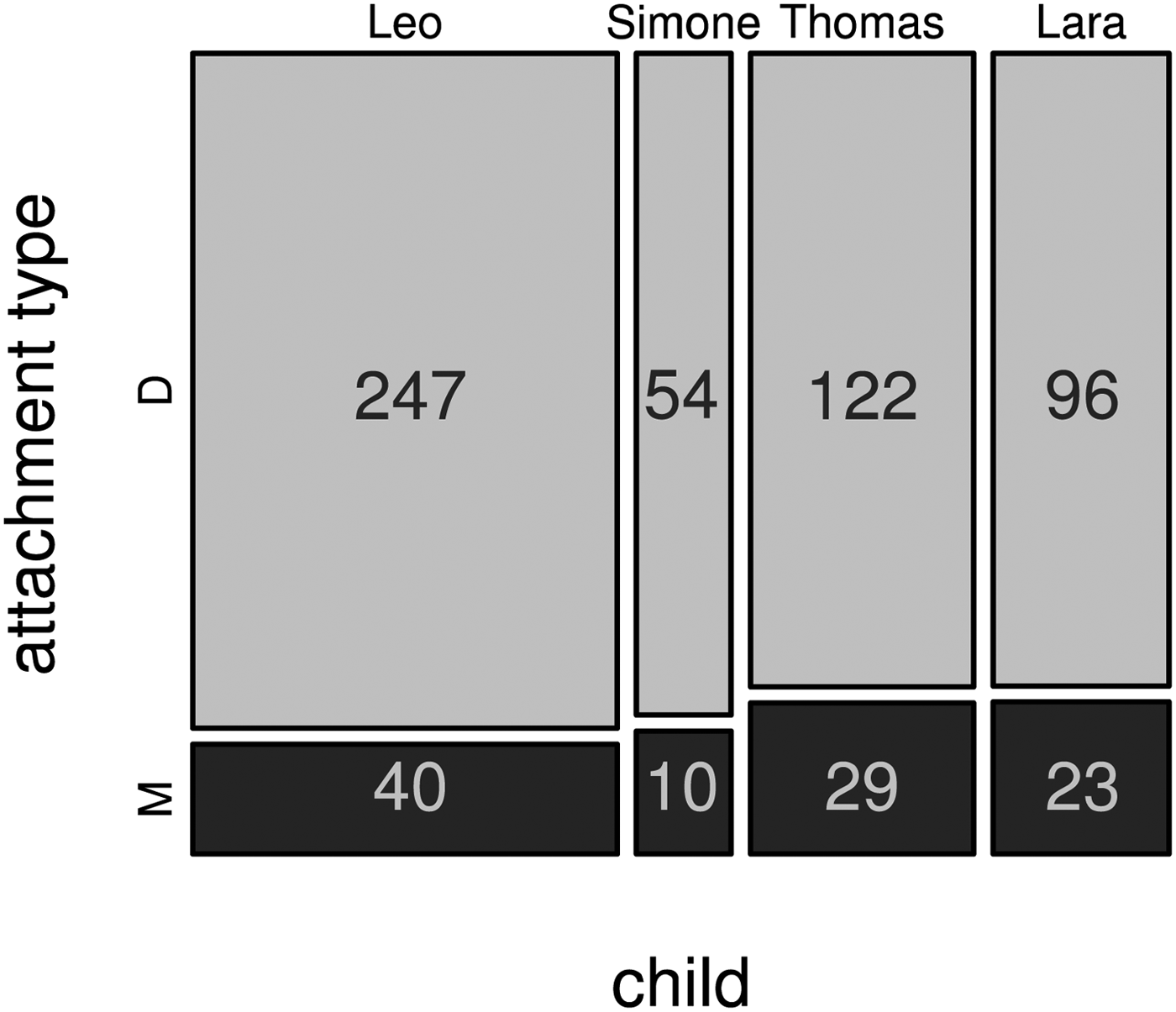
As Figure 1 suggests, monologic utterances displayed lower proportions than dialogic utterances for all four children. And, indeed, binomial tests on the four proportions for the four children give p values well below .001 in all cases, after adjustment for multiple testing. The proportions of monologically and dialogic attached utterances did not vary substantially across children (χ 2(3) = 2.9, p = .4).
Numbers of monologic (M) and dialogic (D) utterances in the data of the four children in the data analyzed. The horizontal divisions and, consequently, the heights of the colored fields indicate proportions within one child; the horizontal division or the width of the vertical bars labeled by child names represents the proportions of total data per child.

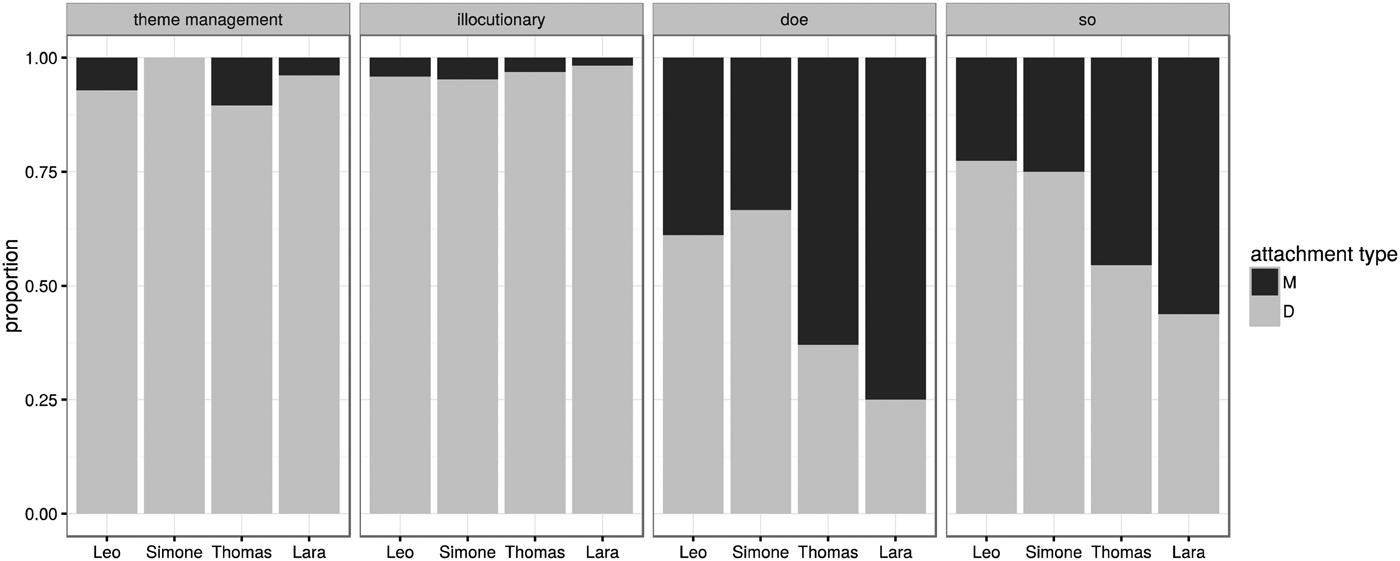
Additionally, denial of expectation and semantic opposition showed higher proportions of monologic realizations compared to illocutionary and theme-management functions, which showed higher proportions of dialogic realizations compared to denial of expectation and semantic opposition (Figure 2).
Proportions of dialogic (D) and monologic (M) attachment type per use type of adversative connectives in the data of the individual children.

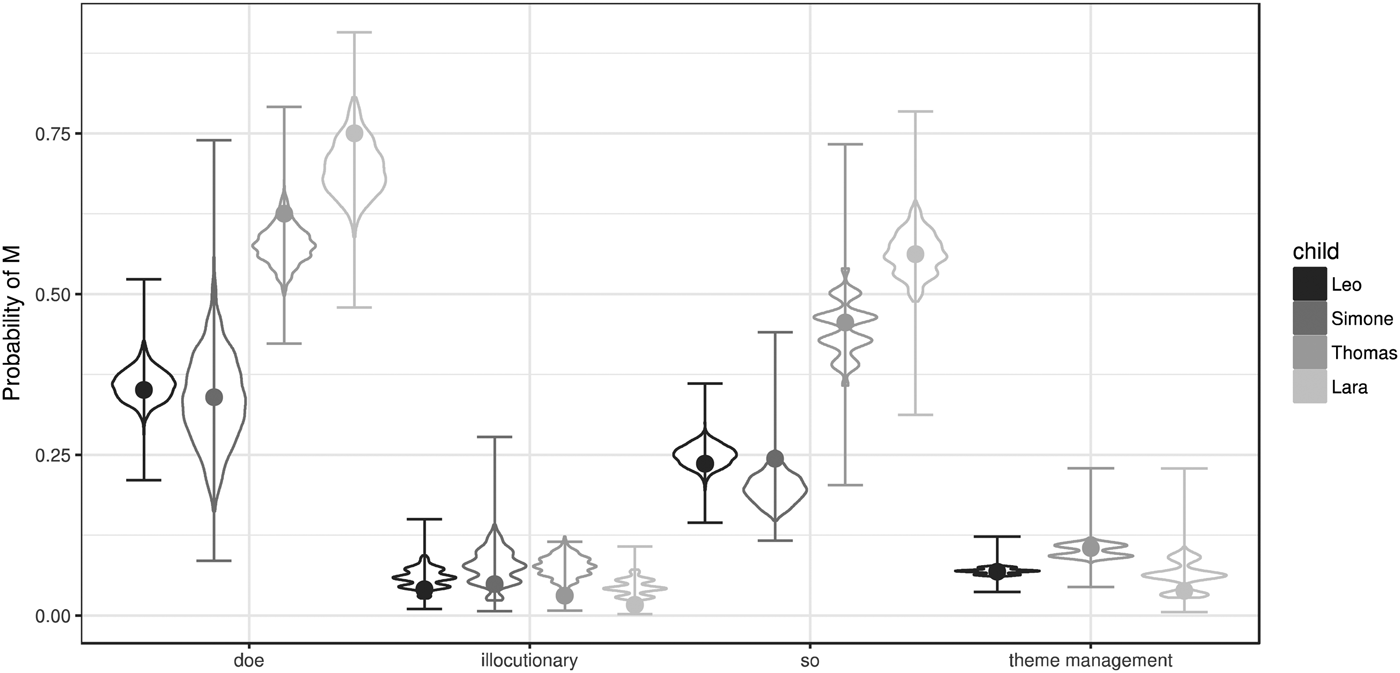
Figure 3 shows the predicted probabilities of monologic realizations in the four use types of adversative connectives and the results of a simulation evaluating the impact the ambiguous points could have had, had they not been ambiguous and therefore been removed. We assessed the influence of the ambiguous datapoints by assigning them randomly to one of the annotated use cases. This procedure was repeated a thousand times. The sampled distribution of the results is completely located within the confidence intervals.
Predicted probabilities of monologic realizations (M) in the four use types of ACs (bordered areas show possible distributions of ambiguous datapoints).

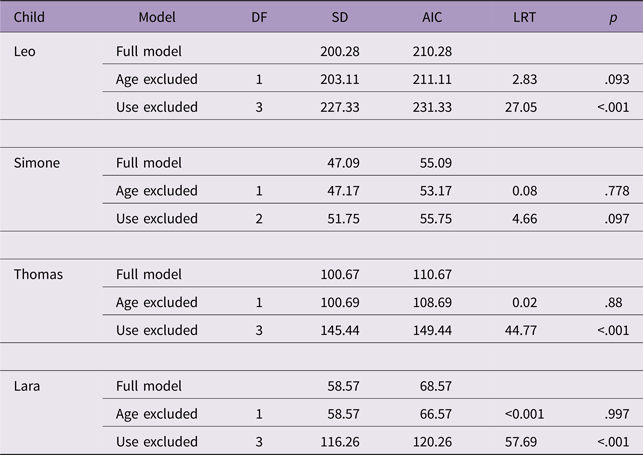
In order to find out how age and the four adversative use types influence the probability of monologic realizations of but- and aber-utterances we computed a binomial logistic regression model with the binary outcome variable of either monologic or dialogic realization and the two predictors Age and Use Type. Age was taken as a continuous variable, counting months since birth. Use Type was added as a categorical variable with the four possible values semantic opposition, denial of expectation, theme, and illocution.Footnote 3 We set up a separate model for each child from the start. This has to be kept in mind when interpreting p values. If we used the data of just one child to postulate overall significance, we would have to correct for multiple testing. If, on the other hand, we have significant results for all children or at least the children with sufficient data, these results mutually reinforce each other and raise confidence in the actual existence of an effect.
We compared the full models to models reduced in complexity by backward exclusion of variables; p values were derived by χ 2-tests on log-likelihood differences (times –2), as implemented in the R function drop1 (R Core Team, 2015). For all children but Simone, the factor Use Type significantly improved the fit of the model.Footnote 4 The predictor Age did not significantly improve the fit of the model for any of the children (Table 3).
Logistic Regression with Backward Exclusion – Model Comparison Results (Modelling the Probability that an Adversative Connective Was Used in a Monologic Realization)

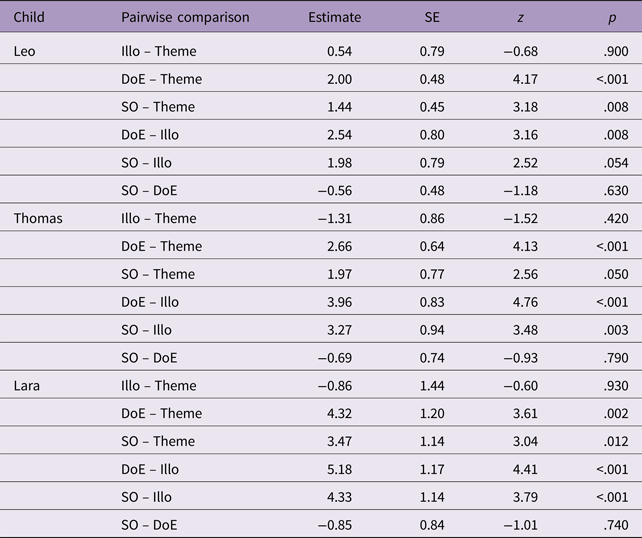
In order to properly interpret the main effect of Use Type, i.e., to find out whether there were significant differences between the uses regarding the probability of monologic but and aber utterances, we performed multiple comparisons with Tukey contrasts between the four use types (R-function glht; cf. Hothorn, Bretz, & Westfall, Reference Hothorn, Bretz and Westfall2008). The adjusted p values are shown in Table 4.
Multiple Comparisons between Use Types in Monologic Realizations (Modelling the Probability that an Adversative Connective Was Used in a Monologic Realization)

Notes. DoE – denial of expectation; Illo – illocutionary use; SO – semantic opposition; Theme – theme management. Caption: single comparisons for the children with significant Use Type effects. The column labeled ‘estimate’ gives the estimated difference in logit space. The column ‘SE’ contains the standard error. The remaining two columns show the z value and the (adjusted) p value.
The results showed a significant association of both semantic opposition and denial of expectation with monologic attachment in the data of Leo, Lara, and Thomas. There were no significant differences between semantic opposition and denial of expectation regarding the frequency of monologically attached utterances for any of the three children. Similarly, there were no significant differences between illocution and theme, both use types being associated with dialogic attachment. In Simone's data, none of the comparisons showed significant effects, not surprisingly, as her dataset is very small and considerably smaller than the datasets of the other three children. However, the absence of a significantly different distribution can be taken as an indication that her data do not provide a counter-example either. As she did not use aber for monologic theme management, we could not conduct comparisons with that use type for her data. We interpret our findings as evidence for the stability of the pattern depicted in Figure 2 across children. While denial of expectation and semantic opposition are associated with a greater probability of monologic realizations, theme and illocution were rather used in non-monologic realizations.
Furthermore, our data suggest a difference between the German and the English children concerning the production of monologically attached utterances. As illustrated in Figure 3, the probability of monologically expressed denial of expectation and semantic opposition uses appeared to be higher in the English children than in the German children. Unfortunately, since we modeled each child separately for the aforementioned reasons, we cannot decide significance for the between variable Language from those models. These reasons boil down to the fact that we only have data from four children. For the same reasons it would be very hard to separate any Language effect from inter-child variation under any model. Thus, the hypothesis of between-language differences can only be tested with another dataset.
Discussion
Our analysis provided evidence for the affinities the different use types of the German and English adversative connectives aber and but show with respect to monologic and dialogic realizations. Given that only two children per language were analyzed, the evidence that our analysis provided for a difference between the two languages must be regarded as limited. While dialogic forms clearly dominated in the data, the different use types led to a differentiation of discourse structure: semantic opposition and denial of expectation uses of adversative connectives occurred more frequently in monologic multi-clause utterances, while illocution and theme-management uses more readily adhered to realizations of adversative connectives across speaker turns. The higher proportion of dialogic realizations is in line with Diessel (Reference Diessel2004), who reported a predominance of utterances cutting across speaker turns in the first years of connective use. However, we did not find an age-related increase in monologic realizations in the data of any of the children scrutinized in the present study. The fact that instances per child and use type are relatively few in all cases is not a problem per se as significant results (influence of use type on monologic and dialogic realizations) are not affected by this problem. The fact that we independently found similar and significant results for all three children for whom we do have a reasonable data basis reinforces our trust in those results considerably. But of course, the relatively small dataset results in low power and renders the evidence against Age dependency rather weak. As the total number of instances of aber is relatively small even in the dense corpora that we looked at, the lack of statistically significant differences due to Age must be treated with care.
Use types of adversative connectives and language-specific differences
Our analyses showed that although monologic but and aber were present in the production data from early on, the children's use of dialogic but and aber clearly predominates. This predominance is not evenly distributed across all use types of adversative connectives and we could show that, within monologic realizations, semantic opposition uses and denial of expectation uses are represented by higher numbers of instances compared to monologic realizations of theme-management and illocutionary uses. The children mainly use adversative connectives to structure the course of the conversation (theme management) or to relate their opposing opinions to those of their interlocutors (illocutionary function). The adversative relations between statements and inferences thereof, on the other hand, are more often realized within the control of a single speaker. Peterson (Reference Peterson1986) showed that children's (3;6 to 9;6) uses of but in narration were mainly (monologic) realizations of semantic opposition and denial of expectation meanings. Clearly, these results show that the different use types of adversative connectives strongly depend on the text type specific distribution of dialogic versus monologic realizations and that children are sensitive to this distinction from early on. The observed correlation between discourse structure (monologic versus non-monologic) and the use type of adversative connective must therefore be considered in attempts to determine acquisition orders of adversative connectives, as text types correlate with the proportion of monologic and non-monologic realizations and thereby with certain meaning relations. For instance, Evers-Vermeul and Sanders (Reference Evers-Vermeul and Sanders2011) showed that the epistemic use of the causal connective because (cf. Spooren & Sanders, Reference Spooren and Sanders2008) never appeared first in early longitudinal data. In experimental data with a descriptive, a directive, and an argumentative task, on the other hand, results were more diverse, and epistemic uses frequently occurred in the younger age group (three-year-olds) in the argumentative task (Evers-Vermeul & Sanders, Reference Evers-Vermeul and Sanders2011, pp. 1653ff.).
As only a few examples of the modal use of aber and the use of sondern were found in the data, they were excluded from the analysis. So far it is therefore unclear if these uses influence the acquisition of the adversative connectives aber and but. Together with the exclusive use of but (which did not occur in our data), these three uses mark the most obvious language-specific differences, but they do not seem relevant at early phases of adversative connective acquisition. The four similar use types of adversative connectives in German and English on the other hand are represented by a larger number of instances and show similar distributions. It therefore seems reasonable to conclude that the similarities between German and English determine adversative connective acquisition in a similar way. However, the data suggest that the two English children were more likely to produce adversative connectives in monologic realizations than the two German children, as illustrated in Figure 3. With two children per language this finding is not robust and more children and other languages need to be analyzed. It is possible that the greater proportion of monologic realizations in the English data is an effect of the conjunction status of but. The more variable aber allows a variety of structures and typically relates an utterance to the pragmatic pretext when used as a particle. If the fact that aber can be used adverbially correlates with a lower proportion of monologic realizations compared to English but, a similar effect should be observable for Dutch maar, which can also be used as an adverb and as such has been attested in early acquisition data (cf. De Beijer, Reference De Beijer2009).
Dialogic and monologic realizations and age
Although the results of our analysis do not allow us to rule out that the proportion of monologic realizations increases (or decreases) throughout the first year of adversative connective use, the findings do not support the existence of a developmental sequence either. Neither monologic nor dialogic realizations enter the database abruptly, but are represented from the beginning. Our sample of four children is comparable to that of Diessel, who analyzed five children, but differs from Diessel's in that it covers a shorter period, includes not only finite clauses, and contains two dense corpora. It is possible that the dense corpora have captured early examples of monologic but-clauses that might be lacking when fewer data are available.
If both monologic and dialogic realizations of adversative connectives are present throughout the first year of use, this could indicate that children know from the onset how to use but-clauses for the connection of utterances produced by the same or another speaker. The predominance of but-clauses cutting across speaker turns therefore cannot be interpreted as a step in development that needs to be expanded to monologue. Our findings are thus not compatible with Bloom et al.'s (Reference Bloom, Lahey, Hood, Lifter and Fiess1980) claim that the use of adversative connectives in dialogue is developed from the children's use of adversative connectives in monologue. Regarding Diessel's (Reference Diessel2004) model, the lack of an age effect may indicate that his findings are specific with respect to the development of coordinated finite clauses. Looking at children between the ages of 3;0 and 5;0, Diessel has shown that pragmatically combined dialogic utterances precede children's monologic realizations of coordinated but-clauses. In our data, there is no indication that children cannot relate a but-clause to their own utterance even at the onset of adversative connective use. As we did not restrict our analysis to finite clauses, but analyzed adversative connectives within the first year of use only, children seem to be able to relate but-clauses to a variety of their own productions before they form complex monologic coordinations of finite sentences with adversative connectives.
It should also be mentioned that the total of unbound but-clauses produced within a speaker turn in Diessel's study is 37 for five children up to the age of 5;0 (Diessel, Reference Diessel2004, pp. 164, 195) and the impact of the but-clauses on the model that is based on and-, but-, so-, and because-clauses for the development of coordinated sentences is therefore difficult to estimate. It is possible that the different connectives contribute to the proportion of dialogic and monologic realizations to different degrees. In Lustigman and Berman's (Reference Lustigman and Berman2016) study of Hebrew children's conversational data, for instance, dialogic realizations increased in all children after the first connectives appeared in the children's productions (ve- ‘and’ and še- ‘that’), but decreased in two of three children after they began to use the adversative connective aval ‘but’ and the connectives ki ‘because’ and az ‘then’ or ‘so’ (2016, p. 173).
Our data suggest that children are able to relate two parts of an utterance in an adversative manner irrespective of who produced the first clause from early on, but tend to produce more dialogic realizations for illocutionary and theme-management purposes in conversational data. While it comes as no surprise that dialogic realizations of adversative connectives occur in higher proportions in conversational data compared to narrative data, the relation between monologic and dialogic realizations of adversative connectives and use type has so far not received a lot of attention. Our findings suggest that future research on the emergence of the various uses of adversative connectives needs to take into account the type of attachment (monologic, dialogic) as a factor with possibly different cross-linguistic effects. Furthermore, it would be relevant to know if other coordinating connectives follow similar routes with regard to monologic and dialogic realizations.
Acknowledgements
This research was funded by the Deutsche Forschungsgemeinschaft (DFG), Grant BI 482/4-2. We would like to thank our colleagues at the Leibniz-Zentrum Allgemeine Sprachwissenschaft in Berlin, Jeruen Dery, Damaris Bartz, and Natalia Gagarina, for helpful comments.