The history of sudden-onset disasters reveals few examples in which a strong connection was made between the crisis event and public health. Disasters have the notable capacity to immediately “define public health and expose its vulnerabilities.”Reference Burkle 1 Scientists have begun to tally and explore not only the direct morbidity and mortality resulting from disaster events, but also the rising numbers of indirect and preventable health consequences. Societies have for a number of decades primarily focused attention and resources on the response phase of sudden-onset disasters and highly visible elements, such as refugees, while omitting broader effects and less visible impacts, such as conflict-affected residents.
Today, public health is increasingly referred to as an essential component of disaster awareness and science, especially across the entire disaster cycle (prevention, preparedness, response, and recovery) and for both sudden-onset and slow-moving crises. More attention to the role of public health is being substantiated as societies become focused on crises resulting from climate extremes, rapid unsustainable urbanization (especially undocumented urban slums), emergencies of scarcity (water, food, arable land, natural resources, and energy), and biodiversity crises (extinctions, protected reserves, ecosystem health). These crises invariably result in major public health emergencies and demand unprecedented public health expertise, resources, and decisions (Figure 1).
Current and Future Crises Share a Common Thread: All Produce Major Public Health Emergencies.

This being said, it is unfortunate that the overall track record of health and public health influence in setting priorities and decisions on the global scene has been severely lacking. For example, the Hyogo Declaration Framework for Action (HFA-1) in 2005 “simply failed to convince the political decision makers” at the time that “health” was a priority in disaster risk reduction and disaster risk management. 2 , Reference Burkle, Egawa and MacIntyre 3 In fact, the term “health” was not effectively promoted as a priority and was only mentioned thrice in HFA-1 and twice in the pre-HFA-2 draft document.Reference Burkle, Martone and Greenough 4 In confirming that an evidence-based core, especially in health, should be part of the process of the global platform for disaster risk reduction, Virginia Murray of Public Health England and a major consultant to the draft process stated, “…it is expected that the Hyogo Framework for Action (HFA-2) anticipated for March 2015 will recognize the need to govern disaster risk reduction and resilience through clear responsibilities, strong coordination, enabled local action, appropriate financial instruments and a clear recognition of a central role for science.”Reference Burkle, Martone and Greenough 4
Convincing decision-makers of the health and public health requirements in crisis situations precipitated by climate change will require considerable political advocacy to ensure an ongoing funding commitment for preparedness. Political decision-makers will likely remain focused on response alone. Education will be necessary for decision-makers to see the benefits in recognizing the merits of a refocus on prevention and preparedness. In public health emergencies, more people succumb to mortality and morbidity from destroyed or deficient public health infrastructure and social protections than from the direct effects of the disaster itself—whether it is sudden or slow moving. In economic terms, both federal and state funding methods continue to prioritize “response” despite studies suggesting that for every US $1 given for risk reduction policies and programs, US $4 of emergency response is saved.Reference Burkle, Martone and Greenough 4 , 5
Being acutely aware of the health deficiencies resulting from HFA-1, Japan organized regional symposiums designed to gather information that could be used to bolster diplomatic efforts in ensuring health priorities for HFA-2. Breakout sessions, which were organized under the crosscutting principle that “health integration is imperative for disaster risk reduction in the Hyogo Framework for Action,” conducted their work within 5 subthemesReference Burkle 6 :
-
1. Frameworks and principles relating to medical preparedness and health management in disasters
-
2. Health planning for all phases of a disaster, including risk assessment with concern for vulnerable populations
-
3. Psychosocial/mental health concerns and building community resilience
-
4. Infrastructure and logistics
-
5. Education and training.
All the themes that came out of this regional meeting supported the key health messages that were emerging from each and every regional effortReference Burkle, Egawa and MacIntyre 3 :
-
∙ Make health (not just saving lives) an explicit outcome of the new global framework on disaster risk reduction (DRR) and disaster risk management (DRM).
-
∙ Include health targets and indicators for the monitoring and reporting on DRR and DRM.
-
∙ Emphasize sectors that are vital for managing disaster risks, including health, education, and agriculture.
-
∙ Make safe hospitals a global priority for action to ensure that new and existing health facilities remain operational in emergencies and disasters.
In addition, the 62nd World Health Assembly endorsed a new World Health Organization work plan on climate change and health. 7 This included the following:
-
∙ Advocacy: to raise awareness that climate change is a fundamental threat to human health
-
∙ Partnerships: to coordinate with partner agencies within the United Nations (UN) system and ensure that health is properly represented in the climate change agenda
-
∙ Science and evidence: to coordinate reviews of the scientific evidence on the links between climate change and health and develop a global research agenda
-
∙ Health system strengthening: to assist countries to assess their health vulnerabilities and build capacity to reduce health vulnerability to climate change.
ASSESSING PREPAREDNESS AND COMMUNITY RESILIENCE
The impacts of climate change threaten natural ecosystems and the built environment, such as health services, transport infrastructure, the electrical grid, water quality, sanitation systems, and other municipal utilities that protect and preserve the health of a state. Direct and indirect impacts also threaten to damage intangibles, such as human and social capital, that stabilize and provide resilience to communities.Reference Norris, Stevens and Pfefferbaum 8 Climate change could have serious impacts on public health systems and general health services if they are not appropriately strengthened.Reference Portier and Thigpen Tart 9 Research into the vulnerability of these service-based, resilience systems is critical to identifying what requires adaptation, limiting secondary crises and preserving life.
Despite the current influence of the idea of resilience, no agreement exists over its exact meaning. Morecroft et al emphasized that two broad understandings of resilience can be identified in the ecological literature: (1) “the amount of disturbance that an ecosystem can withstand without changing self-organized processes and structures” and (2) “the return to a stable state following a perturbation.”Reference Morecroft, Crick and Duffield 10 In the disaster community, the term resilience is not generally used to imply a return to a previous state, which is its literal meaning, but a return to normalcy and a higher state of preparedness. Returning to the state that existed before a disaster would imply that no learning had taken place, which is unfortunately common.Reference Mitroff 11 The UN Development Programme defines building resilience as a “transformative process of strengthening the capacity of men, women, communities, institutions, and countries to anticipate, prevent, recover from and transform in the aftermath of shocks, stresses and change.”Reference Winderl 12 Once the resilience of a system is exceeded, a “tipping point is reached and a new stable state is entered into, from which it may not be possible to return to the former state.” This was and remains a critical issue in the recovery and resiliency of post-earthquake Christchurch in New Zealand.Reference McColl and Burkle 13 Differentiating between absorptive, adaptive, and transformative capacities can be used to assess resilience capacity in individuals, households, communities, and states.Reference Béné, Wood and Newsham 14
WHY AN EMPHASIS ON COMMUNITY-LEVEL RESPONSE?
The traditional “top-down” approach to managing major crises has dominated thinking and research for decades. This includes normal emergency management hierarchy at the city, state, and national levels and is the foundation of strategic and tactical operations that influence governmental decisions. Both the 2003 SARS pandemic and the 2009 swine flu epidemic challenged this approach. In studies from 5 continents, both strategic- and tactical-level plans functioned well, but major flaws occurred in local community-level operational capacity.Reference Burkle 15 This has sparked researchers to look at improving emergency management planning by focusing on strengthening local capacity.
Considerable growth and interest has occurred in the meaning and use of the term community and the cultural nuances such terms bring.Reference Burkle 15 Factors that increase a “crisis resilience profile” are the increased severity and frequency of natural and technological disasters, increasing risk as public health infrastructure capacity declines, and the changing taxonomy of natural disasters as more knowledge of the science of these events are uncovered. There is a demand for evolving shared models of cultural interaction, especially locally, and how this knowledge impacts the state, the region, and the manner in which relief and aid is put into practice.Reference Canton 16
Individual communities live with particular risks and have developed considerable capacity to manage those specific threats to promote societal and ecological resilience. Traditional top-down assessments tend to be generic in content and lack necessary specificity. Letting communities anticipate and assess individual and local characteristics and risks has revealed that considerable information was not discovered through the top-down approach.Reference Rogers 17 Efforts to improve community preparedness and resilience can only be addressed properly within the communities themselves.Reference Rogers 17 Thus, the role of external parties should be limited to the provision of resources and expert knowledge to supplement local understanding and provide management options.
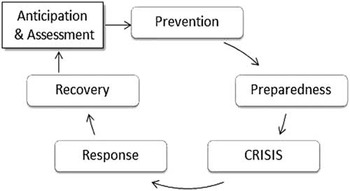
The region of Oceania is already suffering severely from the consequences of climate change and there is a stark contrast in how the area’s well-resourced, developed nations are adapting compared with the under-resourced, lesser-developed ones. For example, Australia has introduced several emergency management agendas to improve resilience, including restoring the emphasis on “prepared communities.” Australia has added “anticipation and assessment” to the disaster cycle (Figure 2), requiring all communities to define their characteristics and needs on the basis of specific disaster risks.Reference Rogers 17
The Disaster Cycle at the Community Level Includes the Additional Components of Anticipation and Assessment. Source: Rogers, 2011.Reference Rogers 17

This “registration of risks,” as a pre-emergency requirement, is a ‘‘precursor to mitigation’’ through formally registering threat identification and targeting risk assessment resources.Reference Rogers 17 This process “enhances the implementation of resilience as more than a metaphor but as a meaningful strategy and a formative framework for best practice.”Reference Reaves, Termini and Burkle 18 These assessments are proactively incorporated into a National Risk Register located and fulfilled at the regional level. When a disaster occurs, the requirements are immediately forwarded to the community without any additional assessment. Communities work together with controllers of state resources to mitigate these risks before any disaster strikes. Where this approach has been implemented in recent severe flooding, the response and recovery phases were accelerated, proved more effective and efficient, and did not result in a single fatality.Reference Rogers 17 Common mistakes made by decision-makers are that they routinely assume communities lack this expertise, and authorities fail to recognize the capacity of capable, nonexpert citizens and community organizers to facilitate response and recovery if given the opportunity and resources to do so.Reference McColl and Burkle 13 , Reference Burkle 19 Crisis/disaster risk reduction begins and ends at the local level where impacts manifest.
More and more disaster managers are accepting the importance of a “prepared community” approach. The concept first saw success in the United Kingdom and has been effectively operationalized in Australia and recently adopted in New Zealand.Reference Coles and Buckle 20 A community-based or “bottom-up” approach can yield important insight on local responses to climate change. It also recognizes that short-term exposure to variability is an important source of vulnerability superimposed on long-term change.
At the community level, perceptions and experiences with climate extremes can identify inherent characteristics that enable or constrain a community to respond, recover, and adapt. As such, local and traditional knowledge are essential to climate change research and should be incorporated into research design and implementation. This approach provides locally relevant outcomes that could promote more effective decision-making, planning, and management in remote areas susceptible to climate change hazards.
RESEARCH AND DATA NEEDS IN COMMUNITY RESILIENCE
Here, adaptive capacity is reflective of resiliency, such that a resilient system has the capacity to prepare for, avoid, moderate, and recover from climate-related threats or change. Building adaptive capacity helps reduce vulnerability. Holling posited that instead of aiming for a precise capacity to handle some future scenario, what is required to maintain a stable system is a qualitative capacity to absorb and accommodate uncertain and unexpected changes.Reference Holling 21
Community-based research aimed at assessing vulnerability requires an interdisciplinary approach from a variety of institutions, local decision-makers, resource users, and community members. Local and traditional knowledge are well known to assist in understanding climate change impacts in remote regions.Reference Bielawski 22 , Reference Fast and Berkes 23 The focus must be on understanding and developing local-level capacity to adapt and respond to climate change and describe the institutional frameworks that govern decisions at different scales. Resilience research must be based at the community level and must incorporate local knowledge, traditional ecological knowledge, and cultural frameworks for understanding local ecosystems.Reference Riedlinger and Berkes 24 This approach will facilitate the local framing and understanding of complex scientific perspectives of climate change and will allow for better examination of how global changes will be expressed and interpreted locally.Reference Usher 25 This approach will improve the foundation for locally relevant decision-making and adaptive capacity building to build more resilient communities.Reference Dolan and Walker 26
First we can admit that resilience to climate extremes and climate change cannot be properly measured or debated in any location at this point in time. State decision-makers must recognize (1) intersectoral collaboration, (2) key public and private partnerships, and (3) communities as 3 critical and interconnected entities that determine both capacity and capability in preparing for and responding to climate extremes and climate change. All are crucial, interdependent, and share membership both geographically and geopolitically in defining both “community” and community resilience as a whole. Taking from Arbon et al’s development of a model and tool to measure community disaster resilience, the 3 entities must “accept their roles” both individually and collectively as components of a larger “community.”Reference Arbon, Gebbie and Cusak 27 , Reference Arbon, Gebbie and Cusak 28 A community disaster resilience toolkit was designed so that community members could collectively accept their roles to
-
∙ Foresee and/or acknowledge threats and risks to climate extremes/change and their potential health consequences.
-
∙ Work with emergency service organizations and other agencies.
-
∙ Invest in a “sense of community” and social capital.
-
∙ Take responsibility to reduce the health and socioeconomic impact of disruptive events, emergencies, disasters, and adverse climate-related events.
These factors must be addressed and explored across the entire disaster cycle, prevention through to recovery, with an emphasis on infrastructure and social program protection in the context of health and public health.
A public health response across the entire disaster cycle is only as good as the data it accumulates and analyzes. Arguably, the data needed to design statewide plans in any location are not currently available, but can be acquired from all 3 entities. Given that all communities are “unique and discrete” from one another,Reference Rogers 17 , Reference Reaves, Termini and Burkle 18 including vulnerable populations and their demographics and individual and collective health risks, it follows that time and resources must be allocated to determine and analyze what the risks are within each community and what would be required to prevent (mitigate), prepare, respond, recover (rehabilitate), anticipate, and assess any threatening events.
This recommendation can be completed through a well-designed survey tool, first completed by each community. This assessment should determine
-
1. Localized community risks
-
2. Community-defined capacities and capabilities
-
3. What the communities determine is necessary for disaster risk reduction and management
-
4. What would be needed for their particular and unique community disaster risk reduction assessment.
The other 2 entities (key partnerships of both private and public and intersectoral collaborations) must then be surveyed and evaluated against the outcomes of the completed community surveys.
However, determining which evaluation tool to use can be difficult. Levine reviewed 5 different systems for evaluating resilience.Reference Levine 29 Each system quantified resilience on the basis of functionality, indicators and characteristics, food access, and activities and from theoretical resilience frameworks. These approaches treated resilience as if it were a concrete thing. Levine concluded that the focus needed to shift to impact monitoring. This approach states that a change in resilience should be assessed by assessing the degree to which constraints have been removed and opportunities increased. One example of a suitable survey tool is the Community Disaster Resilience Scorecard Toolkit.Reference Arbon, Gebbie and Cusak 27
It must be emphasized that results are expected to differ from community to community. Additionally, the information will vary depending on the specific disaster event. Although there will certainly be commonalities, being that the results are disaster-specific and unique to each community, no generic set of resources will fit every community. This information is essential to determine both the health and public health consequences, which will govern subsequent preparedness activities.
To effectively understand and manage the health risks associated with climate change, states need to evaluate and manage their nonperishable public health repair infrastructure:
-
1. Survey all communities, partners, and collaborators for vulnerabilities, capacities, and resources. Obtain information from 3 critical and interconnected entities that determine both the capacity and capability of a community in preparing for and responding to climate extremes and climate change: communities, key public and private partners, and intersectoral collaborators. The survey includes an evaluation of:
-
a. Localized community risks
-
b. Community-defined capacities, capabilities, and resources
-
c. What the communities determine is necessary for disaster risk reduction and management
-
d. What communities need to satisfy their particular and unique community disaster risk reduction assessment
-
-
2. Store all data in a national or state disaster risk reduction bank—a crisis register database.
-
3. Identify gaps and work with communities before crises occur to mitigate identified risks using state resources.
-
4. Enable rapid on-demand, online access to the data.
-
5. Immediately forward response requirements to crisis-affected communities without any additional assessment.
Results from each locale should be compiled in a state or national risk register or “Disaster Risk Reduction Bank.”Reference Rogers 17 , Reference Reaves, Termini and Burkle 18 This information and risk reduction resources need to be stored in an accessible host country or regional database to be instantly available for immediate response in the event of a crisis. Every system has inherent weaknesses and the difficulty with this system is that keeping the risk register database current will be challenging. However, over time and after several ongoing assessments, a picture and pattern will emerge that defines the risks, the risk reduction priorities, and what resources are required for every surveyed location in the disaster bank. This will facilitate risk management if and when a climate extreme threat or event occurs. Assessment of the health and public health risks is essential. With this level of grassroots information, a statewide plan can follow. The plan would strategically and tactically address specific requirements at the state and community levels. It would emphasize communities by focusing on maintaining, responding, and recovering public health protections and infrastructure necessary for health security.