INTRODUCTION
Ascension and Saint Helena Islands are isolated volcanic islands in the South Atlantic Ocean, separated by almost 1300 km. The nearest mainlands are Angola and Brazil, located 1870 km from Saint Helena and 2200 km from Ascension, respectively. Their locations prompted scientific expeditions in the mid-19th Century. Ascension Island was visited by the Beagle in 1836 and by the Challenger expedition in 1876 (Manning & Chace, Reference Manning and Chace1990). The first marine scientific collection in Saint Helena occurred in May 1775, as part of a circumnavigation voyage, where two fish specimens were collected (Edwards & Glass, Reference Edwards and Glass1987). There were no significant collections of marine annelids until 1945 when Joan Colman visited Saint Helena (Day, Reference Day1949) and later in 1989 by the Amsterdam Expedition to Ascension Island (Hartmann-Schröder, Reference Hartmann-Schröder1992). Specimens from the aforementioned collections provided material for the description of eight species, such as the eunicid Eunice prognatha McIntosh, 1855, the sigalionid Sthenelais helenae Kinberg, Reference Kinberg1856 and the goniadid Goniada felicissima Kinberg, 1865 (Hartman, Reference Hartman1959).
For both islands, records of annelids from the family Amphinomidae, commonly known as fireworms, are rare. Only Day (Reference Day1949) has recorded the species Eurythoe complanata (Pallas, Reference Pallas1766) and Hermodice carunculata (Pallas, Reference Pallas1766) in Saint Helena. In Ascension Island, Baird (Reference Baird1864) recorded H. carunculata, while Monro (Reference Monro1930) and Hartmann-Schröder (Reference Hartmann-Schröder1992) recorded Eurythoe complanata. Amphinomids are globally distributed from the intertidal to the deep sea, with some species living in chemosynthetic environments (Borda et al., Reference Borda, Kudenov, Bienhold and Rouse2012, Reference Borda, Kudenov, Chevaldonné, Blake, Desbruyères, Fabri, Hourdez, Pleijel, Shank, Wilson, Schulze and Rouse2013). Common fireworm species live in shallow waters and can be abundant in rocky and coral reef habitats in the Atlantic Ocean (Barroso et al., Reference Barroso, Klautau, Solé-Cava and Paiva2010; Yáñez-Rivera & Salazar-Vallejo, Reference Yáñez-Rivera and Salazar-Vallejo2011). These species can reach large sizes (up to 50 cm long and over 2 cm wide). Saint Helena is also the type locality of Notopygos crinita (Grube, Reference Grube1855), another amphinomid species; however, no samples of this species have been collected since Grube's description.
Here we present the characterization of Eurythoe complanata and H. carunculata from a recent expedition (2012) to Ascension and Saint Helena which permitted in situ photography and sampling. Previous records of both species from these islands lacked detailed comments about their morphology. Here, we update and clarify the taxonomy according to recent revisions of both genera.
MATERIALS AND METHODS
In August–September 2012, fireworm specimens were photographed in situ and collected from tide pools and by SCUBA diving at a depth range of 0–25 m – the exact localities are indicated for each species.
In order to incorporate information for all specimens, the total number of chaetigers, body length (BL) and width to chaetiger 10 (BW), were measured and graphed. The ranges of values are provided in the description of each species. Biometric measurements were used to determine allometric relationships based on log-transformed data and a linear regression model using the Prism 5.0c for Mac OS X, GraphPad Software.
Semi-permanent slides of parapodia from chaetigers 10 and 30 were prepared to describe chaetal features. In Hermodice specimens, the caruncle and branchial features were also considered. Digital photographs were taken by a camera attached to both stereo and compound microscopes to illustrate the morphology.
Samples in ethanol were deposited in the Regional Collection of Invertebrates (EMU), ICML, UNAM, Mazatlán, Sinaloa, Mexico and in the collection of the Museum of Natural History, Los Angeles, Allan Hancock Foundation Polychaete Collection (LACM-AHF), USA.
RESULTS
SYSTEMATICS
Family AMPHINOMIDAE Savigny in Lamarck, Reference Lamarck1818
Genus Eurythoe
Eurythoe complanata (Pallas, Reference Pallas1766)
(Figures 1A & 2A–E)
Live specimens from Ascension Island: (A) Eurythoe complanata (Pallas Reference Pallas1766); (B) Hermodice carunculata (Pallas Reference Pallas1766). Images provided by Peter Wirtz.

Aphrodita complanata Pallas, Reference Pallas1766, pl. 8, Figures 19–26.
Eurythoe complanata Ehlers, Reference Ehlers1887; Monro, Reference Monro1930; Day, Reference Day1949; Ebbs, Reference Ebbs1966, Figure 7.
MATERIAL EXAMINED
[EMU-10967] Ascension Island Sta. C18-3 Darby Beach, collected on 25 August 2012, 8 m depth; Sta. C38-13 Panam Bay, collected on 3 September 2012, 13 m depth; [LACM-AHF-XXX] Sta. C40-5 Comfortless Cove, collected on 1 September 2012, 7 m depth (three specimens). [EMU-10968] Saint Helena Island Sta. 130201/10 and 130208/13 Munden's Point, 15°55.25′S 5°43.08′W, collected on 1 and 8 January 2013, 6–12 m depth.
DESCRIPTION
Seven complete specimens (number of chaetigers 38–80, 1.8–9 cm BL, 0.4–0.8 cm BW). Body elongated, rectangular in transversal section, pale. Live specimens orange in colouration (Figure 1A). Prostomium semicircular, four eyes. Median antenna cirriform in central position on prostomium; pair of lateral antennae placed on anterior prostomial margin, similar to median antenna. Buccal lips carrying lateral palps.
Caruncle oval through three chaetigers, longer than wide; central large smooth lobe covers lateral folded lobes.
Branchiae from chaetiger 2, present throughout body. Each branchia consists of several filaments. Parapodia biramous, dorsal and ventral cirri compound with similar length along body.
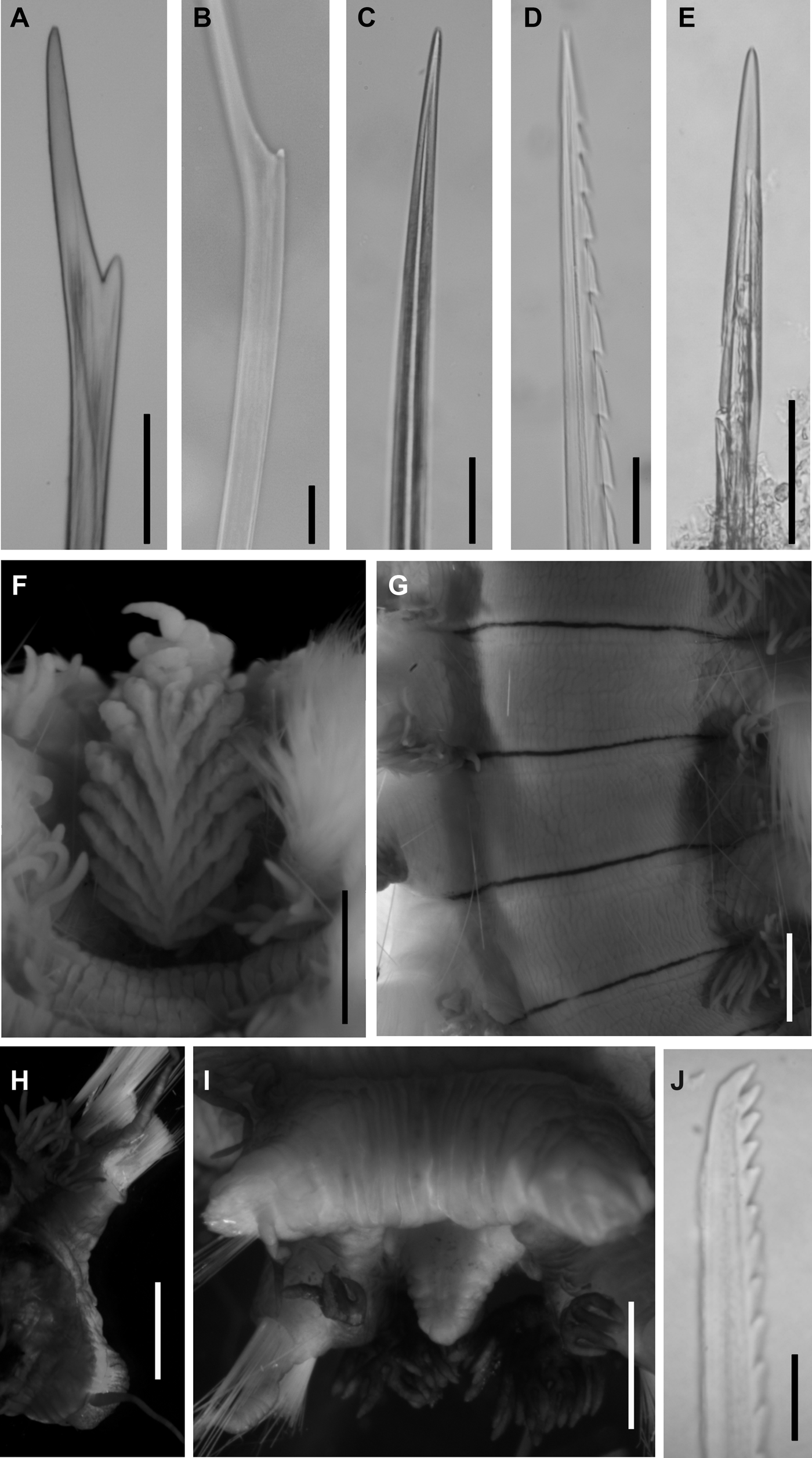
Neurochaetae asymmetrically bifurcated (Figure 2A). Notochaetae from different kinds: spurred capillar (Figure 2B), spine (Figure 2C), harpoon (Figure 2D) and aciculae (Figure 2E).
Eurythoe complanata (Pallas Reference Pallas1766) from Saint Helena: (A) bifurcate neurochaetae; (B) spurred capillary notochaetae; (C) spine; (D) harpoon notochaetae; (E) aciculae; and Hermodice carunculata (Pallas Reference Pallas1766) from Saint Helena: (F) caruncle, dorsal view; (G) median segments, dorsal view; (H) chaetiger 10, lateral view; (I) posterior end regeneration, ventral view, worm from Ascension Island; (J) neurochaetae. Scale bars: A, E, 0.1 mm; B, 0.01 mm; C, D, I, J, 0.05 mm; F–H, 1 mm.
Anus termino-dorsal. Posterior end margin with a distal lobe.
REMARKS
At least 20 nominal species have been described in the genus Eurythoe; however, most of them have been considered minor synonyms of Eurythoe complanata (Ebbs, Reference Ebbs1966). A recent evaluation by Barroso et al. (Reference Barroso, Klautau, Solé-Cava and Paiva2010) with molecular and morphological approaches evidenced two cryptic species in the Atlantic Ocean: the island restricted Eurythoe laevisetis Fauvel, Reference Fauvel1914 described from the Gulf of Guinea and Eurythoe complanata described from Antigua Island with coastal and island distribution across the Atlantic. These two species, which could be sympatric, can be differentiated morphologically by the presence–absence of harpoon notochaeta (Barroso et al., Reference Barroso, Klautau, Solé-Cava and Paiva2010). From Saint Helena, Day (Reference Day1949) registered numerous small-sized specimens (<2 cm) and noticed some notochaetal variation between the anterior and medio-posterior part along the worms. However, as harpoon notochaeta are diagnostic, this permits distinguishing Eurythoe complanata from Eurythoe laevisetis, which lacks harpoon notochaeta (Fauvel, Reference Fauvel1914; Barroso et al., Reference Barroso, Klautau, Solé-Cava and Paiva2010). From Ascension Island, Monro (Reference Monro1930) reported 27 specimens and Hartmann-Schröder (Reference Hartmann-Schröder1992) three specimens. Both authors reported Eurythoe complanata and Monro discussed the differentiation from Eurythoe laevisetis. All of our samples present harpoon notochaeta (Figure 2D), which is morphologically consistent with Eurythoe complanata.
ALLOMETRY
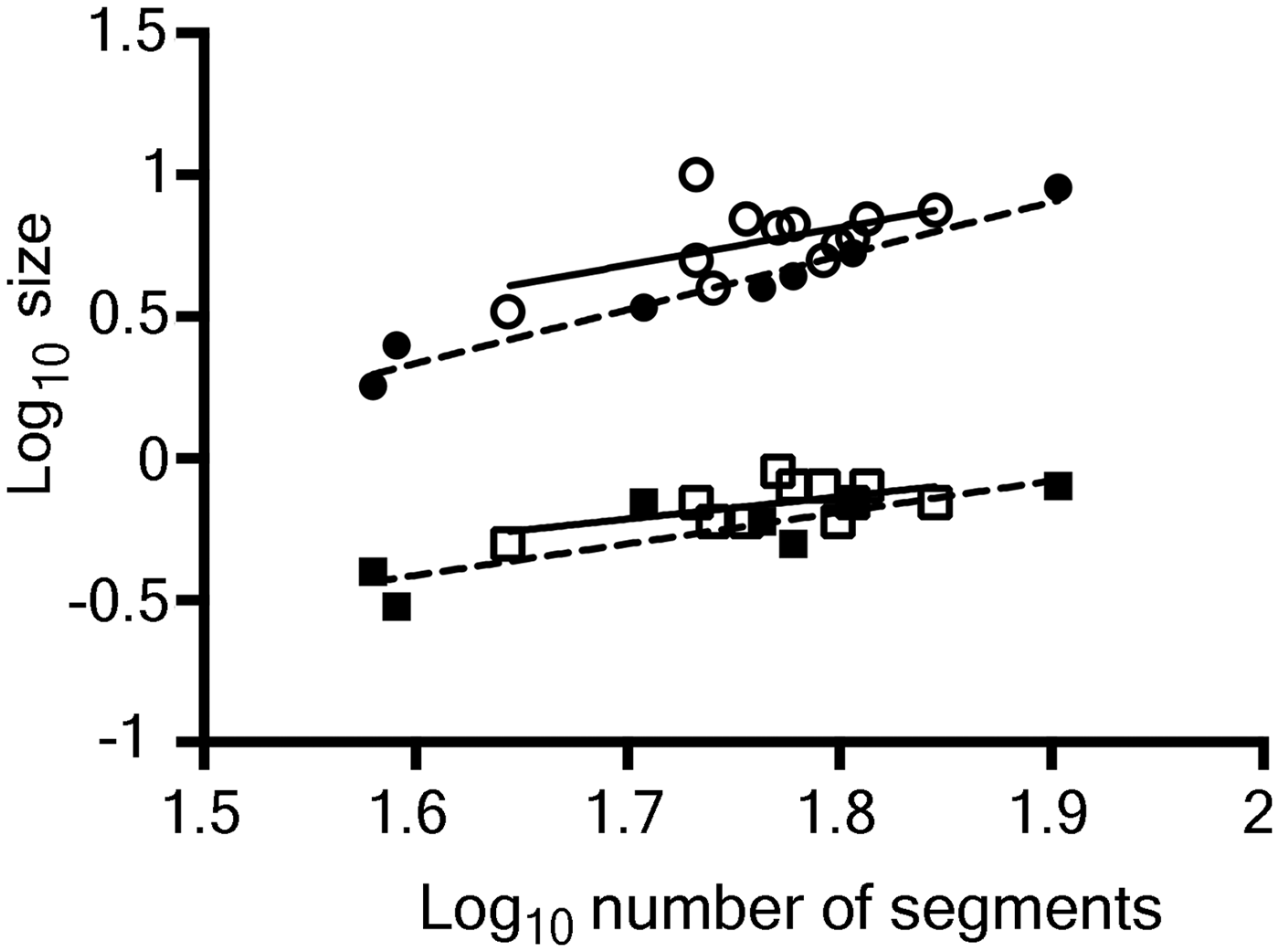
Body length and width have a positive allometric relationship with the number of segments (BL = 1.896x − 2.699, R 2 = 0.95; BW = 1.110x − 2.188, R 2 = 0.71), despite the fact that the size variations of all specimens showed the same pattern of growth (Figure 3).
Allometric relationships between number of segments and body length (circles) and width (squares) of Eurythoe complanata (filled symbols) and Hermodice carunculata (open symbols).
DISTRIBUTION
This species occurs in shallow waters from coastal mainlands and islands in the Atlantic Ocean (Barroso et al., Reference Barroso, Klautau, Solé-Cava and Paiva2010).
Genus Hermodice
Hermodice carunculata (Pallas, Reference Pallas1766)
(Figures 1B & 2F–J)
Aphrodita carunculata Pallas, Reference Pallas1766, Figures 12 & 13.
Amphinome dydimobranchiata Baird, Reference Baird1864.
Hermodice carunculata Kinberg, Reference Kinberg1857 (n. comb.); Ebbs, Reference Ebbs1966, Figure 8; Yáñez-Rivera & Salazar-Vallejo, Reference Yáñez-Rivera and Salazar-Vallejo2011, Figure 5.
Hermodice carunculata dydimobranchiata Day, Reference Day1949.
MATERIAL EXAMINED
Syntypes of Amphinome dydimobranchiata Baird, Reference Baird1864 [BMNH–1983.11.6.2]. Ascension Island, coll. by Mr Watson; (four specimens) damaged.
[EMU-10969] Ascension Island Sta. C4-1 Wigan Pier, collected on 20 August 2012, 11 m depth; Sta. C5-2 Darby wreck, collected on 20 August 2012, 13 m depth; Sta. C18-2, Darby Beach, collected on 25 August 2012, 8 m depth; Sta. C36-7 Wigan Pier, collected on 2 August 2012, 13 m depth; [LACM-AHF-XXX] Sta. C39-3 Wigan Pier, collected on 3 September 2012, 10 m depth. [EMU-10970] Saint Helena Island Sta. 130201/10 and 130208/13, Munden's Point, 15°55.25′S 5°43.08′W, collected on 1 and 8 January 2013, 6–12 m depth.
DESCRIPTION
Twelve complete specimens (number of chaetigers 44–70, 3.3–7.5 cm BL, 0.5–0.7 cm BW), one specimen posterior regeneration 22 chaetigers, 1.4 cm long and 0.4 cm wide. Body elongated, truncated at ends.
Prostomium semicircular with four eyes, anterior larger. Median antenna central, longer than lateral antennae. Palps smaller than lateral antennae. Caruncle oval with 7–10 convergent folds, size from 1.8–3 mm long and 0.8–2 mm wide (Figure 2F).
Living specimens of orange colouration (Figure 1B), three specimens with inter-segmental black lines even notable after alcohol (Figure 2G).
Branchiae from chaetiger 1 present throughout the body. Dorsal and lateral branches with several filaments in each branchiae. In chaetiger 10, lateral branch with 3–13 branchial filaments and dorsal branch with 14–53 branchial filaments.
Parapodia biramous, massive, each ramus with a single cirrus (Figure 2H). Pygidium truncate with a distal lobe.
Harpoon notochaetae and simple capillaries. Neurochaetae with or without a spur (Figure 2J). Neuroaciculae with a lance form in a single series.
REMARKS
Morphological differences in branchial and anal lobe features suggested by Yáñez-Rivera & Salazar-Vallejo (Reference Yáñez-Rivera and Salazar-Vallejo2011) to distinguish two species in the genus Hermodice were challenged by molecular evidence (Ahrens et al., Reference Ahrens, Borda, Barroso, Paiva, Campbell, Wolf, Nugues, Rouse and Schulze2013). Ahrens et al. (Reference Ahrens, Borda, Barroso, Paiva, Campbell, Wolf, Nugues, Rouse and Schulze2013) found that Hermodice carunculata is a genetically cohesive species within its Atlantic distribution and into the Mediterranean Sea, with a low genetic divergence (<3% COI) between the East and West populations. Thus, Hermodice is a monotypic genus. Specimens show morphological variations in pigmentation pattern as presence–absence of an intersegmental black line and great variation in the number of branchial filaments.
Branchial features were considered relevant since the description of Hermodice dydimobranchiata (Baird, Reference Baird1864) from Ascension Island. However, this is not a valid species and the branchial features could be related to local environmental conditions such as oxygen concentrations (Ahrens et al., Reference Ahrens, Borda, Barroso, Paiva, Campbell, Wolf, Nugues, Rouse and Schulze2013). Moreover, the variety Hermodice carunculata dydimobranchiata recorded by Day (Reference Day1949) from Saint Helena is also not valid, since Hermodice carunculata represents only one species with a broad distribution across the Atlantic Ocean (Ahrens et al., Reference Ahrens, Borda, Barroso, Paiva, Campbell, Wolf, Nugues, Rouse and Schulze2013).
The anal lobe morphology could be useful in identifying the West Atlantic Hermodice (Ahrens et al., Reference Ahrens, Kudenov, Marshall and Schulze2014). All specimens evaluated here exhibited the anal lobe morphology consistent with the Western population. One specimen showed posterior-end regeneration, with an evident size difference between the non-regenerated and regenerated portions (Figure 2I). The anal lobe is well developed, as was observed in regeneration after experimental amputation (Ahrens et al., Reference Ahrens, Kudenov, Marshall and Schulze2014).
ALLOMETRY
Body length and width have a positive allometric relationship with the number of segments; however, the regression model was not significant. Specimens of this species do not show a regular pattern of growth even without considering the regenerated worm (Figure 3).
DISTRIBUTION
This species is widely distributed in temperate rocky shores and coral reefs in the Atlantic Ocean and Mediterranean Sea (Ahrens et al., Reference Ahrens, Borda, Barroso, Paiva, Campbell, Wolf, Nugues, Rouse and Schulze2013).
DISCUSSION
At least two species of fireworms are present in Ascension and Saint Helena Islands; Eurythoe complanata and Hermodice carunculata. Both exhibit a broad distribution throughout the Atlantic Ocean, as demonstrated with genetic tools (Barroso et al., Reference Barroso, Klautau, Solé-Cava and Paiva2010; Ahrens et al., Reference Ahrens, Borda, Barroso, Paiva, Campbell, Wolf, Nugues, Rouse and Schulze2013). An Ascension–Saint Helena group has been identified in biogeographic analyses of reef fish fauna (Floeter & Gasparini, Reference Floeter and Gasparini2000), and other marine invertebrates including decapods (Chace, Reference Chace1966) and echinoderms (Pawson, Reference Pawson1978). However, neither fireworm species is endemic to the South Atlantic oceanic islands nor has been characterized as part of the Ascension–Saint Helena group. This biogeographic feature may be revealed via population genetics as was observed in a private lineage of H. carunculata for the St. Peter and St. Paul Archipelago (Ahrens et al., Reference Ahrens, Borda, Barroso, Paiva, Campbell, Wolf, Nugues, Rouse and Schulze2013).
The broad distribution across the Atlantic Ocean of both species could indicate an important role of Ascension and Saint Helena populations in maintaining genetic connectivity. However, morphological evidence related to the anal lobe suggests that H. carunculata in both islands correspond to the West Atlantic population. A genetic analysis, including material from Ascension and Saint Helena Islands, will be necessary to elucidate the genetic connectivity among populations of the South Atlantic oceanic islands. The hypothesized long-distance dispersing rostraria larvae have been attributed to amphinomids; however, this could be insufficient to explain the broad distribution since estimated dispersal distances occur at intermediate scales (≈100 km), with a ten-day pelagic larval duration (Levin, Reference Levin2006). The only amphinomid larval development study has indicated that the development of segments begins at four days after fecundation (Kudenov, Reference Kudenov1974). Thus, it is probable that the pelagic larval duration is not as long as previously thought. More studies are required to elucidate the role of larval dispersion in the population connectivity in both species, especially as pelagic larval duration is influenced by environmental conditions and dispersal distances that are species, season and location specific (Cowen & Sponaugle, Reference Cowen and Sponaugle2009). However, species with similar reproductive features, larval lifestyles and habitats exhibit similar patterns of connectivity guided by physical processes (López-Duarte et al., Reference López-Duarte, Carson, Cook, Fodrie, Becker, DiBacco and Levin2012).
Eurythoe complanata has been identified as an invasive species in the Mediterranean on the basis of the assumed longevity of rostraria larvae, and the combination of sexual and asexual reproduction (Arias et al., Reference Arias, Barroso, Anadón and Paiva2013). The validation of invasive species status with molecular data is necessary to determine the limits of the natural distribution and anthropogenic introduction. According to Kudenov (Reference Kudenov1974), asexual reproduction in E. complanata suggests that the body breaks into two or more parts, with the subsequent regeneration of anterior and posterior ends. Here we found a regenerated posterior end in H. carunculata that could be evidence of similar reproductive strategies. Nevertheless, a detailed characterization of the reproductive biology in Hermodice is required.
We consider this study a step forward towards shedding light on fireworms from Ascension and Saint Helena Islands; however, further genetic analyses including materials from these remote islands will be required in order to begin elucidating the genetic connectivity among populations across the Atlantic Ocean.
ACKNOWLEDGEMENTS
B. Yáñez-Rivera is grateful to the Shallow Marine Surveys Group (SMSG) and Peter Wirtz for sharing the material from these remote places. The funding for this work came from a grant to the SMSG from the Darwin Initiative (EIDCF012) and to the St. Helena Government from Darwin project (19-031). We are grateful to the SMSG and the South Atlantic Environmental Research Institute for organizing the expedition to Ascension. We are also very grateful to the Ascension Island Government, the members of staff at the Conservation Centre and Ascension Island Dive Club for their cooperation, accommodation and hospitality. We are grateful to British Forces South Atlantic Islands for their logistic support. For the work on St. Helena, our thanks go to the St. Helena Government Marine Section, in particular, Elizabeth Clingham, Leeann Henry and Annalea Beard, and to our volunteer diver Steve Brown.