Disorganized attachment, characterized by lack of a coherent strategy to deal with the stress of separation and reunion with the mother during the Strange Situation (Main & Solomon, Reference Main, Solomon, Brazelton and Yogman1986), is an important early risk factor for socioemotional problems throughout childhood and into adulthood (Carlson, Reference Carlson1998; Moss, Cyr, & Dubois-Comtois, Reference Moss, Cyr and Dubois-Comtois2004; van IJzendoorn, Schuengel, & Bakermans-Kranenburg, Reference van IJzendoorn, Schuengel and Bakermans-Kranenburg1999). Disorganization can be defined as a dysfunction in emotional regulation, including the experience of fear (Carlson, Reference Carlson1998). The caregiver serves as a source of fear to the child as well as the biologically based, expectable source of reassurance, which leads to the concurrent activation of both the fear and attachment systems (Carlson, Reference Carlson1998; Main & Solomon, Reference Main, Solomon, Brazelton and Yogman1986, Reference Main, Solomon, Greenberg, Cicchetti and Cummings1990). These conflicting motivations within the child lead to maintenance of extreme arousal at a time when child capabilities are inadequate to ensure self-regulation. Such conflict and premature reliance on individual organization during a developmental period when dyadic child–caregiver regulation is normative is believed to interfere with the development of effective relational capabilities, communication, and internal organizational skills related to emotion regulation.
Between preschool and school age, two thirds of children showing disorganized attachment adopt a role-reversed controlling attachment pattern with the caregiver (Moss et al., Reference Moss, Bureau, Cyr, Mongeau and St.-Laurent2004). The increase in controlling behavior with the caregiver during the preschool period may be linked to attempts by disorganized children to reduce stress levels, which cannot be regulated through child dependency on the caregiver (Moss, St.-Laurent, Tarabulsy, & Bureau, Reference Moss, St.-Laurent, Tarabulsy, Bureau, Solomon and George2011). However, the controlling child's strategy of orienting away from seeking comfort, protection, and the meeting of their own needs and toward maintaining engagement with the parent on the parent's terms increases the likelihood of child internalizing and externalizing psychopathology (Moss et al., Reference Moss, Bureau, Cyr, Mongeau and St.-Laurent2004). Thus, despite their superficial “organized” attachment strategy, controlling children, like those who continue to manifest behavioral disorganization, are at significant risk for maladaptation between early childhood and young adulthood. Although characteristics of parenting are greatly associated with the risk for disorganized attachment, few attachment studies consider more complex models of the etiology of disorganized attachment that account for the influence of multiple child factors.
Disorganization and Early Maternal Care
Traditional models of the etiology of disorganized attachment emphasize the role of atypical and highly dysfunctional parenting. Helpless or hostile caregiving places the child in a “fright without solution” paradox (Lyons-Ruth, Melnick, Bronfman, Sherry, & Llanas, Reference Lyons-Ruth, Melnick, Bronfman, Sherry, Llanas, Atkinson and Goldberg2004; Main & Solomon, Reference Main, Solomon, Brazelton and Yogman1986, Reference Main, Solomon, Greenberg, Cicchetti and Cummings1990), undermining the infant's primary attachment strategy and causing him/her to behave in ways that are not obviously aimed at proximity with the caregiver, despite his/her need for comfort.
Beyond helpless/hostile caregiving, highly insensitive maternal care is also related to disorganization (Bakermans-Kranenburg & van IJzendoorn, Reference Bakermans-Kranenburg and van IJzendoorn2011; Laucht, Esser, & Schmidt, Reference Laucht, Esser and Schmidt2001; Moss, St.-Laurent, et al., Reference Moss, St.-Laurent, Tarabulsy, Bureau, Solomon and George2011), both in its own right and over and above the contribution made by atypical maternal behavior (Moran, Forbes, Evans, Tarabulsy, & Madigan, Reference Moran, Forbes, Evans, Tarabulsy and Madigan2008). Maternal sensitivity, defined as a mother's ability to perceive her child's signals appropriately and respond to them promptly and contingently (Ainsworth, Blehar, Waters, & Wall, Reference Ainsworth, Blehar, Waters and Wall1978), is an important precursor to secure attachment (Ainsworth et al., Reference Ainsworth, Blehar, Waters and Wall1978; Atkinson, Niccols, et al., Reference Atkinson, Paglia, Coolbear, Niccols, Poulton, Leung, Tarabulsy, Larose, Pederson and Moran2000; de Wolff & van IJzendoorn, Reference de Wolff and van IJzendoorn1997; Jaffe, Beebe, Feldstein, Crown, & Jasnow, Reference Jaffe, Beebe, Feldstein, Crown and Jasnow2001; van den Boom, Reference van den Boom1994) and affects social–emotional development as it scaffolds neurobiological development (e.g., the stress regulatory systems; Glaser, Reference Glaser2000; Gunnar & Quevedo, Reference Gunnar and Quevedo2007). Sensitive maternal care promotes the moderation of physiological stress by young children (Atkinson et al., Reference Atkinson, Gonzalez, Kashy, Santo Basile, Masellis and Pereira2013; Derryberry & Rothbart, Reference Derryberry, Rothbart, Izard, Kagan and Zajonc1984) and is associated with fewer behavioral problems (Feldman & Eidelman, Reference Feldman and Eidelman2004).
Of particular importance in the context of attachment generally, and maternal sensitivity and disorganization more specifically, is the issue of controlled attention, the ability to concentrate focus on consciously selected stimuli and inhibit focus on potential distractors. Attention is considered central to attachment theory (Atkinson et al., Reference Atkinson, Leung, Goldberg, Benoit, Poulton and Myhal2009) because the whereabouts of the attachment figure is continuously monitored by all children (Bretherton, Reference Bretherton, Coelho and Ahmed1980; Maier et al., Reference Maier, Bernier, Pekrun, Zimmermann, Strasser and Grossmann2005), with variance in attention underlying the unique nature of each attachment pattern (Atkinson et al., Reference Atkinson, Leung, Goldberg, Benoit, Poulton and Myhal2009). For example, ”[A]ttention is fluid in secure babies … and liable to dysregulation or collapse in disorganized babies” (Main, Reference Main, Goldberg, Muir and Kerr1995, p. 427). Similar considerations pertain to attachment at the preschool age. Moss and St. Laurent (Reference Moss and St.-Laurent2001) showed that disorganized preschoolers, who focus attention on coping with parental figures who induce fear or feelings of abandonment in them, have fewer cognitive and attentional resources available for learning and exploration.
Furthermore, attentional capacity is a necessary (although not a sufficient) condition for sensitive parenting, insofar as excessive orienting away from the infant precludes response to infant signals. Thus, mothers who self-report a tendency to orient away from stressful stimuli also show lower sensitivity in interaction with their infants (Atkinson et al., Reference Atkinson, Scott, Chisholm, Blackwell, Dickens and Tam1995). Pederson et al. (Reference Pederson, Moran, Sitko, Campbell, Ghesquire and Acton1990) pointed out, “mothers of more secure infants were more frequently characterized as noticing their babies' signals and using these signals to direct behavior” (italics added, p. 1974); “sensitivity involves an openness to signals” (p. 1976). Meta-analytic evidence indicates that the prediction of infant attachment security from observations of maternal responsiveness is significantly stronger when the mother is experimentally induced to divide her attention between infant and another task, as compared to when the mother's attention is not experimentally divided (Atkinson, Niccols, et al., Reference Atkinson, Niccols, Paglia, Coolbear, H. Parker and Poulton2000). Mileva et al. (Reference Mileva-Seitz, Steiner, Atkinson, Meaney, Levitan and Kennedy2013) showed that less sensitive mothers tend to orient away from the infant more frequently and for longer durations than do more sensitive mothers. They also found a significant negative correlation between infant-directed vocalizing and frequency of orienting away from the infant. Mileva et al. (Reference Mileva-Seitz, Fleming, Meaney, Mastroianni, Sinnwell and Steiner2012) also showed that maternal orienting away is significantly negatively related to infant activity. Hence, there is a relation between maternal attention and infant behavior (although the direction of the causality is not reflected in this correlation). Atkinson, Paglia, Coolbear, Niccols, Poulton, et al. (Reference Atkinson, Paglia, Coolbear, Niccols, Poulton, Leung, Tarabulsy, Larose, Pederson and Moran2000) concluded that “effective attention allocation … lie[s] at the core of sensitive interaction” (p. 49).
Maternal attention has also been linked directly to disorganized attachment in infants (Atkinson et al., Reference Atkinson, Leung, Goldberg, Benoit, Poulton and Myhal2009). Administered an emotional Stroop task, disorganized mothers/mothers of disorganized infants were less adept at disengaging from negative emotion/negative attachment stimuli than from neutral stimuli, a selective attention deficit not exhibited by disorganized mothers/mothers of organized infants. Thus, disorganized mothers and the mothers of disorganized infants showed a less controlled attentional focus than the mothers of infants with organized attachment patterns.
Based on the above review, we investigate mothering behavior in two ways in the present study. One involves assessing maternal sensitivity through observational rating scales, as developed by Ainsworth et al. (Reference Ainsworth, Blehar, Waters and Wall1978) and typically used in attachment research. The second assessment strategy focuses more specifically on the issue of maternal attention to the child. This strategy is more akin to the ethological approach used in studies of maternal behavior in other animals, where we have been interested in the psychobiology of mothering. This strategy involves determining the frequency and duration of specific behaviors emitted by the mother and the infant during their interactions. This micro “ethological” measure provides an alternative way of looking at mothering “motivation” or intensity. The major focus of this study is maternal attention, given our interest in dopamine, as explained in more detail below. However, as mentioned, maternal attention is a necessary but insufficient condition for maternal sensitivity. Therefore, we supplemented analyses with formalized attachment rating scales (Ainsworth et al., Reference Ainsworth, Blehar, Waters and Wall1978).
Genetic Influences
Attachment theory has mostly not included more complex models of the development of disorganized attachment that allow for the interplay of particular child factors with parenting characteristics in the prediction of disorganization. This approach is illustrated by van IJzendoorn and Bakermans-Kranenburg (Reference van IJzendoorn and Bakermans-Kranenburg2006), who showed that maternal unresolved loss or trauma, a distal feature of environmental risk, is associated with infant disorganization, but only in the presence of the dopamine receptor D4 gene (DRD4) seven-repeat (7R) polymorphism. In the present study, we assess the interplay of two environmental risk factors (specifically maternal sensitivity and birth weight) and DRD4 as they relate to infant disorganization at 36 months.
Recent advances in molecular genotyping permit the incorporation of genetic variation into models of developmental risk. Recent studies have identified DRD4 to be of particular salience in the pathway to disorganized attachment. Dopamine is expressed in pathways mediating reward related to social interaction, including mother–child interaction (Insel, Reference Insel2003). Dopamine is also expressed in the amygdala and amygdala prefrontal circuits involved in cognitive processes (Wang, Zhong, Gu, & Yan, Reference Wang, Zhong, Gu and Yan2003) and anxiety-related behavior such as the stress response (Armbruster et al., Reference Armbruster, Mueller, Moser, Lesch, Brocke and Kirschbaum2009; LeDoux, Reference LeDoux2000; Phelps & LeDoux, Reference Phelps and LeDoux2005). The encoding gene for the DRD4 receptor has a number of functional variants, including a 48 base pair variable number tandem repeat in exon 3 ranging from 2 to 11 copies. The most common functional variants are the 4 repeat (4R) and 7R. The longer variants (6 repeat to 10 repeat) are associated with lower dopamine receptor efficiency. DRD4 expression is also influenced by an upstream regulatory region, the functional single nucleotide polymorphism (SNP) –521C/T. The C variant is associated with greater novelty seeking and extraversion (Munafo, Yalcin, Willis-Owen, & Flint, Reference Munafo, Yalcin, Willis-Owen and Flint2008).
It is curious that studies have reported contradictory findings about which variant of the polymorphism is most likely to predict disorganized attachment. Three studies from the same Hungarian low-risk middle-class community sample have found an increased risk for disorganized attachment in 12-month-old infants with at least one 7R allele (Lakatos et al., Reference Lakatos, Toth, Nemoda, Ney, Sasvari-Szekely and Gervai2000), an association strengthened with at least one –521 SNP T allele (CT or TT; Lakatos et al., Reference Lakatos, Nemoda, Toth, Ronai, Ney and Sasvari- Szekely2002). After examining parental genotypes, these authors also concluded that carrying neither the 7R nor the T allele was a resilience factor for the development of early (secure) attachment (Gervai et al., Reference Gervai, Nemoda, Lakatos, Ronai, Toth and Ney2005). In contrast, Cicchetti, Rogosch, and Toth (Reference Cicchetti, Rogosch and Toth2011) reported a greater likelihood of disorganization and stability of disorganization (age 1–2 years) in the non-7R group. Three studies (Bakermans-Kranenburg & van IJzendoorn, Reference Bakermans-Kranenburg and van IJzendoorn2004; Luijk et al., Reference Luijk, Saridjan, Tharner, van IJzendoorn, Bakermans-Kranenburg and Jaddoe2010; Spangler, Johann, Ronai, & Zimmermann, Reference Spangler, Johann, Ronai and Zimmermann2009) did not find an association between disorganized attachment and DRD4, –521 C/T or both genotypes, and a meta-analysis only found a small effect size (0.05; Bakermans-Kranenburg & van IJzendoorn, Reference Bakermans-Kranenburg and van IJzendoorn2011). The inconsistency in the association between DRD4 and disorganized attachment suggests other factors may serve as moderators.
Consistent with the etiological hypotheses of disorganized attachment proposed by Main and Hesse (Main & Solomon, Reference Main, Solomon, Brazelton and Yogman1986), the moderating effect of early caregiving has been examined in several studies including a meta-analysis (Bakermans-Kranenburg & van IJzendoorn, Reference Bakermans-Kranenburg and van IJzendoorn2011). However, studies report paradoxical findings about which DRD4 allele constitutes the risk or susceptibility allele. Bakermans-Kranenburg and van IJzendoorn (Reference Bakermans-Kranenburg and van IJzendoorn2011) report that in conditions of adverse caregiving environments, children with the 7R variant have higher levels of disorganized attachment than children without this variant. For example, maternal unresolved attachment, an adult attachment category predictive of infant disorganization, interacts with DRD4 7R to predict disorganized attachment (van IJzendoorn & Bakermans-Kranenburg, Reference Bakermans-Kranenburg and van IJzendoorn2006). In contrast, Gervai et al. (Reference Gervai, Novak, Lakatos, Toth, Danis and Ronai2007) found that disruptive maternal affective behavior interacts with the short form, 4R, to predict disorganized attachment, and that 7R mutes the infant's responsiveness to adverse care. Cicchetti et al. (Reference Cicchetti, Rogosch and Toth2011) examined how the outcome of an intervention study with maltreating mothers and their infants is moderated by genetic factors. For maltreated children receiving the intervention, having the 7R allele predicts less disorganized attachment and lower stability of disorganized attachment postintervention. By contrast, for the control (nonmaltreated) children, the 7R allele predicts more disorganized attachment postintervention.
Birth Weight
The theory of the biological sensitivity to context suggests that developmental risk, such as perinatal risk, interacts with postnatal influences to prepare the infant to match or calibrate their biological and behavioral systems to their postnatal environment (Ellis & Boyce, Reference Ellis and Boyce2008). Perinatal risk may interact with other biological and environmental factors in predicting outcomes (Belsky & Pluess, Reference Belsky and Pluess2009). Child birth weight, as an indication of intrauterine growth retardation (IUGR), is one of the major risk factors for infant morbidity and mortality, and has long-term effects on developmental processes. Several factors affect fetal growth, including fetal, maternal, and placental features, as well as their interactions (Valero De Bernabe et al., Reference Valero De Bernabe, Soriano, Albaladejo, Juarranz, Calle and Martinez2004).
Children with IUGR, because of a fragile or less developed nervous system, have a reduced ability to regulate their response to the environment. With reduced internal regulatory capacity, such children may be particularly vulnerable to adverse parental experiences but also more receptive to very positive experiences. For example, Nomura and Chemtob (Reference Nomura and Chemtob2007) found that children with low birth weight adjusted for gestational age (AGA) and child maltreatment are at higher risk for delinquency at adolescence and poor emotional well-being and depression in adulthood relative to those with neither risk factor. Whiteside-Mansell, Bradley, Casey, Fussell, and Conners-Burrow (Reference Whiteside-Mansell, Bradley, Casey, Fussell and Conners-Burrow2009) confirmed this vulnerability to adversity, regarding family conflict. Conversely, two studies have reported that early maternal sensitivity interacts with low birth weight to predict positive outcomes. For example, Laucht et al. (Reference Laucht, Esser and Schmidt2001) found that children with low birth weight exposed to high maternal sensitivity show decreased internalizing and hyperkinetic problems at the ages of 2, 4.5, and 8 compared to those exposed to lower levels of sensitivity. Weiss, Wilson, Hertenstein, and Campos (Reference Weiss, Wilson, Hertenstein and Campos2000) reported that vulnerable children with low birth weight and/or perinatal risk are more likely to develop a secure attachment when exposed to nurturing maternal touch. Only in the study by Nomura and Chemtob (Reference Nomura and Chemtob2007) is birth weight adjusted for gestational age. No study, though, has examined disorganized attachment as an outcome.
While the majority of research has emphasized the deleterious neurological and cognitive outcomes such as learning and attention, recent studies have explored the association between IUGR (as measured by weight AGA) and socioemotional development. For example, birth weight AGA is linked in longitudinal studies with the development of anxious and depressive psychopathology in early adolescence (Costello, Worthman, Erkanli, & Angold, Reference Costello, Worthman, Erkanli and Angold2007; Rice, Harold, & Thapar, Reference Rice, Harold and Thapar2006; Smolla, Béliveau, Lépine, Lévesque, & Martin, Reference Smolla, Béliveau, Lépine, Lévesque and Martin2009). Rice et al. (Reference Rice, Harold and Thapar2006) found that birth weight AGA predicts parent-rated depressive symptoms when controlling for other known risk factors. Similarly, Costello et al. (Reference Costello, Worthman, Erkanli and Angold2007) found that low birth weight predicts a fivefold increase in female adolescent depression. Such findings suggest that, in a process consistent with fetal programming, fetal growth predicts childhood development. In utero events affect the development of neural systems that regulate emotional and cognitive development. Increased fetal glucocorticoid levels have been associated with impaired fetal growth, altered neural development, and increased expression of genes associate with behavioral and endocrine stress responses (Challis et al., Reference Challis, Sloboda, Matthews, Holloway, Alfaidy and Patel2001; Maccari et al., Reference Maccari, Darnaudery, Morley-Fletcher, Zuena, Cinque and Van Reeth2003; Meaney, Szyf, & Seckl, Reference Meaney, Szyf and Seckl2007; Seckl & Holmes, Reference Seckl and Holmes2007).
There is also modest evidence that genetic factors moderate the association between birth weight and the development of attachment. For example, Rice et al. (Reference Rice, Harold and Thapar2006) reported that low birth weight AGA interacts with genetic risk (as measured by twin status) in the prediction of depressive symptoms in 8- to 17-year-olds. More specifically, Broekman et al. (Reference Broekman, Chan, Goh, Fung, Gluckman and Saw2011) reported that birth weight AGA interacts with genotype in numerous serotonergic genes to predict internalizing symptoms in a sample of children aged 8 to 12 years of age.
Consistent with evidence for other disorders such as diabetes (Wei et al., Reference Wei, Li, Sung, Lin, Chiang and Li2007), emerging research suggests that an increased susceptibility to psychopathology may not be restricted to infants born small. Fetal growth across the entire gradient predicts the risk for psychopathology with reverse or J-shaped associations between birth weight and a number of disorders. Several studies have shown that macrosomia (excessive birth weight) is a significant predictor of later psychiatric disorder, internalizing and externalizing (Van Lieshout & Boyle, Reference Van Lieshout and Boyle2011). Two studies demonstrate a curvilinear relationship between birth weight and attention problem scores (van Mil et al., Reference van Mil, Steegers-Theunissen, Motazedi, Jansen, Jaddoe and Steegers2015) as well as with anxiety and depressive scores (Broekman et al., Reference Broekman, Chan, Goh, Fung, Gluckman and Saw2011), such that birth weight at either end of the measure poses higher risks.
In the area of attachment and birth weight, in particular, studies have been imprecise in two respects. First, for the most part, they have not uncoupled the effect of birth weight from that of prematurity. This means that some subjects in these low birth weight studies might not actually have IUGR but rather low birth weight, because gestation had been prematurely ended. Few studies have uncoupled the effects of intrauterine growth constraints from those associated with the complications of early birth, such as immature organ development and early parent–child separation. The second source of imprecision in these studies is that many of them were conducted before the development of the disorganized attachment classification (Main & Solomon, Reference Main, Solomon, Brazelton and Yogman1986, Reference Main, Solomon, Greenberg, Cicchetti and Cummings1990) or were based on instrumentation that does not assess disorganization, that is, the Attachment Q-set (AQS; Waters & Deane, Reference Waters and Deane1985).
One study found that vulnerable children with low birth weight (<2500 g), preterm birth, and/or perinatal complications are more likely to be insecurely attached at 12 months, according to the AQS (Weiss et al., Reference Weiss, Wilson, Hertenstein and Campos2000). The results of a study examining children separated at birth from parents (because of preterm birth or severe illness) did not show an association between birth weight and attachment organization at 12–19 months (Rode, Chang, Fisch, & Sroufe, Reference Rode, Chang, Fisch and Sroufe1981).
Studies of exclusively preterm children yield contradictory findings. Plunkett, Klein, and Meisels (Reference Plunkett, Klein and Meisels1988) found that preterm low birth weight children are more likely to be insecurely attached at 24 months, whereas Frodi et al. (Reference Frodi1983) reported no association with attachment security at 52 weeks. Concerning very low birth weight (<1500 g) preterm children, Mangelsdorf et al. (Reference Mangelsdorf, Plunkett, Dedrick, Berlin, Meisels and McHale1996) found that very low birth weight preterm children were more likely to be insecurely attached at 14 (AQS) and at 19 months (Strange Situation; assessments included a variant of disorganization). Brisch et al. (Reference Brisch, Bechinger, Betzler, Heinemann, Kachele and Pohlandt2005), using an attachment system that included disorganization, found more insecure attachment at 24 months only in children who were neurologically impaired. In contrast, Goldberg, Perotta, Minde, and Corter (Reference Goldberg, Perrotta, Minde and Corter1986) found no association between birth weight and attachment security at 12 months past term. Easterbrooks (Reference Easterbrooks1989), although using the disorganized attachment classification, reported no association between very low birth weight preterm status and attachment security at 13 and 20 months. There is a paucity of studies examining the role of birth weight in nonpreterm children on the development of attachment and especially on the less studied, disorganized subtype.
Although the reviewed literature suggests that birth weight might interact with caregiving quality and child genetic variables (DRD4) in predicting disorganized attachment, the direction of the association seems less predictable. To our knowledge, no study has yet examined the combined effects of constitutional risk, molecular genetics, and relevant environmental influences on the development of child attachment disorganization.
Objectives and Hypotheses
Specifically, we examined (a) whether birth weight AGA predicts child disorganized attachment at 36 months; (b) whether the association between birth weight is linear or curvilinear; (c) whether the association between birth weight AGA is moderated by the child's DRD4 genotype, in a Gene × Environment (G × E) model; (d) whether the association between birth weight AGA is moderated by early maternal sensitivity at 6 months; and (e) whether in a three-way interaction, birth weight AGA, child DRD4 genotype, and early maternal care at 6 months predict child disorganized attachment at 36 months.
We hypothesized that birth weight would operate with a curvilinear effect and that children with extreme birth weight (low and high) AGA and 7R DRD4 would be more likely to have disorganized attachment. We also hypothesized that the risk factors of birth weight and DRD4 would interact, such that children with extreme birth weight (low and high) and the 7R would be more likely to have disorganized attachment when exposed to less sensitive maternal care.
Method
Participants
Participants were mother–child pairs from the ongoing longitudinal Maternal Adversity, Vulnerability and Neurodevelopment (MAVAN) project. MAVAN is a Canadian community-based birth cohort composed of more than 650 women recruited from Montreal and Hamilton. Women 18–43 years of age were recruited between 2003 and 2009 during routine ultrasound examinations and from prenatal care clinics in maternity hospitals. Eligibility criteria for women were age 18 years of age or over at the expected date of delivery, less than 24 weeks gestational age, singleton and term pregnancy (≥37 weeks), and fluency in English or French. Exclusion criteria were the presence of severe chronic maternal illness, past obstetrical complications, or major fetal/infant anomaly. Children exhibiting significant developmental delays, identified with the Bayley scale, were excluded from the study. Greater details are available elsewhere (O'Donnell et al., Reference O'Donnell, Gaudreau, Colalillo, Steiner, Atkinson and Moss2014).
Retention rates for the MAVAN subjects are 97.4% at 6 months, 84.0% at 18 months, and 80.6% at 36 months, with the majority of subjects dropping out when the parent returned to work. Compared to mothers who remained in the study, mothers who left the study did not differ significantly on measures of age at delivery, depression, or education. Compared to children who remained in the study, children lost to follow-up did not differ significantly on measures of birth weight. The present study includes 650 mother–child dyads included in the final imputation model.
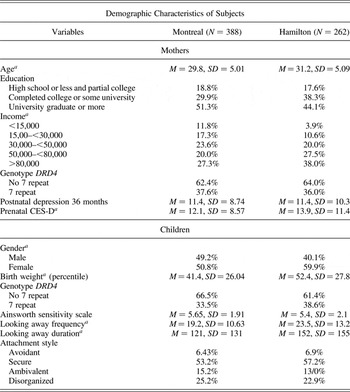
There were slightly more boys than girls. Mothers were on average 30.6 years of age at recruitment, and approximately half were in the university graduate or higher category (Table 1). Unstandardized prenatal depression scores ranged from 0 to 49 (M = 12.28, SD = 10, α = 0.92). The demographic and socioeconomic distribution of women in this study was similar to that of women from the Generation R Study and the Avon Longitudinal Study of Parents and their Children, two comparable prenatal cohort studies (Van Batenburg-Eddes et al., Reference Van Batenburg-Eddes, Brion, Henrichs, Jaddoe, Hofman and Verhulst2013).
Descriptive statistics of MAVAN mother and child at 36 months (N = 650 pairs)

a Significant difference between Montreal and Hamilton.
Procedure
Women consenting to participate were interviewed at 24–36 weeks of pregnancy to obtain data on demographic, medical and obstetric history, stressors, social support, and pregnancy. Birth outcomes were extracted from the chart of the birthing unit. Mothers and their children were seen at each study time point (i.e., 3, 6, 12, and 18 months and yearly from age 24 months onward). Mothers were assessed using extensive sociodemographic and psychological measures, while children were assessed using neurodevelopmental and socioemotional measures. Early maternal care was assessed at 6 months in a 20-min videotaped nonfeeding and unstructured home interaction session followed by a 10-min divided attention task. Mothers were asked to interact normally with their infants. During the last 10-min period, mothers completed scales while still caring for the infant. The purpose of this task was to place the mother in a situation that divides attention. Behavior under these conditions augments the predictive capacity of sensitivity ratings (Atkinson, Paglia, Coolbear, Niccols, Poulton, et al., Reference Atkinson, Paglia, Coolbear, Niccols, Poulton, Leung, Tarabulsy, Larose, Pederson and Moran2000). A macroanalytic (Ainsworth sensitivity scales) and a microanalytic (Behavioural Evaluation Strategies and Taxonomies) measure of maternal behavior were used to code observed maternal behavior.
Measures
Birth weight
Because fetal growth may differ by race, gender, socioeconomic environment, geographical area, and altitude, birth weight from the chart was cross-referenced with Canadian normative data (Kramer et al., Reference Kramer, Platt, Wen, Joseph, Allen and Abrahamowicz2001) to calculate birth weight AGA, measured as a percentile. Infant birth weight ranged from 2.19 to 5.34 kg (M = 3.37 kg, SD = 0.47 kg), while birth weight AGA ranged from 0 to 100 percentile (M = 46.53, SD = 27.64).
DRD4 genotype
Child and maternal genotypes were obtained with the use of buccal swabs, using the TaqMan methods on the ABI-7000 for SNP markers and ABI-3100 for repeat polymorphisms. To ensure a clear result, any ambiguous genotypes were discarded and the subjects were regenotyped until the results were unambiguous. Each 20th marker was regenotyped to check for error rates (0.5%). DRD4 was coded dichotomous as the presence or absence of 7R, the lowest expressing genotype, and others. The genotype distribution represented that of a predominantly white population sample. For both the Montreal and Hamilton samples the distribution of DRD4 conformed to the Hardy–Weinberg equilibrium (p = .58 and .95, respectively). There were no gender differences, χ2 (1) = 0.01, p = .92; χ2 (1) = 0.4, p = .52 (lab of J. Kennedy). For DRD4, 65.2% of the children and 67.0% of the mothers were carriers of the 7R allele.
Maternal sensitivity
The Ainsworth Maternal Sensitivity Scales (Ainsworth et al., Reference Ainsworth, Blehar, Waters and Wall1978) are a reliable and validated gold standard measure of sensitivity. The measure includes four 9-point Likert rating scales: cooperation, accessibility, acceptance, and sensitivity. Videotaped mother–child interactions were coded by research assistants and then compared to videos coded by an expert coder. Interclass correlation for the Ainsworth mean score at 6 months, which we use in this study, was 0.88 (N = 28; lab of L. Atkinson). The mean Ainsworth maternal sensitivity scale was 5.61 (SD = 2.0).
Maternal behavior
Second by second behaviors observed during mother–infant interaction were coded using the Behavioural Evaluation Strategies and Taxonomies coding system (Educational Consulting, Inc.; S & K NorPark Computer Design, Toronto). This analysis generated duration and frequency data for multiple maternal behaviors by use of a computer keyboard with keys indexed for each behavior. Coded behaviors include frequency and duration of looking away from the infant, vocalizing to the infant (quiet talk, motherese, singing, and adult talk), and instrumental caregiving (burping, wiping face, adjusting blanket, and grooming the infant). These behaviors and coding scheme have been used in our past research (Giardino, Gonzalez, Steiner, & Fleming, Reference Giardino, Gonzalez, Steiner and Fleming2008; Krpan, Coombs, Zinga, Steiner, & Fleming, Reference Krpan, Coombs, Zinga, Steiner and Fleming2005; Mileva-Seitz et al., Reference Mileva-Seitz, Kennedy, Atkinson, Steiner, Levitan and Matthews2011). Interrater reliability was obtained by having two observers code the same 18 videos of mother–infant interactions twice. Interrater reliability was high, with r values ranging from .67 to .96 across all behaviors, and .74 to .90 for looking away frequency and duration. In addition, the intrarater reliability was computed, based on the second observer independently coding 10 videotapes of mothers interacting with their infants on two separate occasions. All of the behaviors analyzed were highly correlated, with r values ranging from .821 to 1.0 (lab of A. Fleming). On average, mothers looked away 21.5 times and for a total of 133.2 s during the videotape interaction.
These looking away scores have been validated against dimensional ratings of maternal sensitivity, as described above (Mileva-Seitz et al., Reference Mileva-Seitz, Steiner, Atkinson, Meaney, Levitan and Kennedy2013). Moreover, dopamine DRD1 SNPs are associated with maternal orienting away (Mileva-Seitz et al., Reference Mileva-Seitz, Fleming, Meaney, Mastroianni, Sinnwell and Steiner2012). Analyses of variance with Tukey post hoc tests showed the heterozygote group oriented away from the infant significantly less frequently compared with the other homozygous genotypes in rs265981 and rs686, and trended in the same direction for rs4532. Mileva et al. (Reference Mileva-Seitz, Fleming, Meaney, Mastroianni, Sinnwell and Steiner2012) showed with respect to DRD1 that mothers carrying one copy of haplotype 1 and one copy of haplotype 12 had lower levels of orienting away. Mileva et al. (Reference Mileva-Seitz, Fleming, Meaney, Mastroianni, Sinnwell and Steiner2012) concluded that orienting away, infant-directed vocalizing, and sensitivity are likely separate but overlapping components of the complex maternal phenotype, akin to endophenotypes in psychiatric research. Mileva et al. (Reference Mileva-Seitz, Fleming, Meaney, Mastroianni, Sinnwell and Steiner2012) argued that lower rates of orienting away are indicative of lesser maternal distractibility and greater maternal sustained attention on the infant, an argument strengthened by the negative correlation between orienting away and maternal sensitivity (Mileva-Seitz et al., Reference Mileva-Seitz, Steiner, Atkinson, Meaney, Levitan and Kennedy2013).
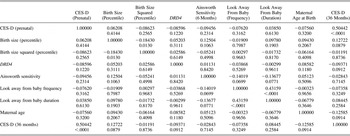
In general, frequency and duration of looking away are correlated with one another and tend to show effects in the same direction (Table 2). Frequency was a more direct measure of mothers' inattention.
Correlation table for variables predicting Disorganized attachment

Note: Spearman correlation coefficients, with probability > |r|.
Attachment
The modified separation–reunion procedure described by Cassidy and Marvin with the MacArthur Working Group on Attachment (Reference Cassidy and Marvin1992) for preschool-age children was followed. It consists of four episodes lasting 5 min each: (a) separation between mother and child; (b) reunion; (c) second separation; and (d) second reunion. During both separations, the child was left alone. Following the separations, the mother was told to rejoin the child but received no specific instructions concerning the reunions. The separation–reunion sequence took place in a room in which age-appropriate toys were scattered. The attachment classifications (secure, avoidant, ambivalent, or disorganized) were based on behavior observed in both reunions, with details of coding criteria for each classification provided in (Moss, Bureau, Cyr, Mongeau, & St.-Laurent, Reference Moss, Bureau, Cyr, Mongeau and St.-Laurent2004). The criteria for identifying disorganized attachment at preschool age are similar to those identified in Main and Solomon (Reference Main, Solomon, Greenberg, Cicchetti and Cummings1990) with the additional criteria of role-reversed behavior with the caregiver of a punitive or caregiving type. Children are subclassified as behaviorally disorganized if they display inexplicable, contradictory, or odd behavior in the presence of the caregiver similar to infant disorganized behaviors. Children are subclassified as controlling–punitive if they attempt to control their parent's behavior in a hostile, role-reversed punitive manner. Those who show role reversal in a helpful, attentive, caregiving manner are subclassified as controlling–caregiving. Because children in all three disorganized subclassifications lack a coherent strategy to organize emotions and behaviors toward the caregiver at the time of the reunion, they are typically combined with the disorganized group for analyses (Moss et al., Reference Moss, St.-Laurent, Dubois-Comtois, Cyr, Kerns and Richardson2005).
Overall agreement between the two coders for the major classifications (A, B, C, D) was calculated on 20% of the tapes, and excellent interrater reliability was obtained (89%, κ = 0.83, p < .01). Coding is based on information gathered from five modalities: physical proximity and contact, body positioning, speech, gaze, and affect. The validity of this procedure for classifying attachment behavior in children of this age range has been demonstrated in several studies (Moss et al., Reference Moss, Bureau, Cyr, Mongeau and St.-Laurent2004, Reference Moss, St.-Laurent, Dubois-Comtois, Cyr, Kerns and Richardson2005, NICHD Early Child Care Network, 2001). In many studies primarily focused on disorganization, A, B, and C categories are combined into an organized category (based on the assumption that they involve organized attachment strategies for seeking proximity to the caregiver), enabling a dichotomous comparison with the disorganized group. Attachment was available for 301 children as follows: 166 secure, 40 ambivalent, 20 avoidant, and 75 disorganized. Breakdown of the disorganized group in the behaviorally disorganized, controlling–punitive, and controlling–caregiving groups was 53, 3, and 19, respectively. As is common practice, children in all three disorganized subclassifications were combined into one group. This was justified based on both sample size limitations and the idea that for both behaviorally disorganized and controlling children, the internal working model underlying the behavioral strategy is characterized by disorganization in socioemotional regulation as evidenced by performance on doll-play and other representational measures of attachment (Moss, St.-Laurent, et al., Reference Moss, St.-Laurent, Tarabulsy, Bureau, Solomon and George2011). Missing values were imputed for the logistic regression (see below).
Covariates
The Bayley Scales of Infant Development—Second Edition (Bayley, Reference Bayley1993) was administered at 6, 12, and 18 months of age. The Mental Developmental Index and Psychomotor Developmental Index were extracted.
Other covariates were obtained from the Health and Well Being of Mothers and Their Newborns questionnaire (Kramer et al., Reference Kramer, Lydon, Seguin, Goulet, Kahn and McNamara2009) administered prenatally and at 6, 12, 24, and 36 months postnatally. Postnatal depression was assessed with the Center for Epidemiologic Studies Depression Scale (CES-D) at 6, 12, 24, and 36 months. The CES-D, a 20-item self-report measure of depressive symptomatology (Radloff, Reference Radloff1977) validated for pregnancy (e.g., Davis, Glynn, Waffarn, & Sandman, Reference Davis, Glynn, Waffarn and Sandman2011). The CES-D items are rated on a 4-point Likert scale that ranges from rarely or none of the time to most or all of the time. The highest score is 60, and a score of 16 or higher is suggestive of a depressive disorder. Scores were centered to facilitate interpretation of regression coefficients. Maternal education, assessed prenatally, was dichotomized as “university graduate or higher” or “others.” The original categories (Table 1) were collapsed into two groups in light of small-sized categories.
Analyses
Logistic regression
Intraclass correlation, which depicts the proportion of variance in attachment accounted for by site of recruitment, was estimated to 0 in all analyses. Therefore, a mixed model was not used. Furthermore, site was not correlated with disorganized attachment. All assumptions for regression were respected. Outliers were assessed with the use of standardized Pearson residual values and were removed if their value was greater than 2.8 (or <–2.8) or greater than 2.00 (or <–2) with a combined leverage larger than 2p/n (Hoaglin & Welsch, Reference Hoaglin and Welsch1978).
A logistic regression model was created, with birth weight, child DRD4 genotype, and maternal care (separate models for Ainsworth sensitivity, looking away frequency, and looking away duration), and disorganized attachment as the outcome. Birth weight AGA was treated as a continuous variable (percentile), even when transformed (squared) to reflect a better fitting curvilinear (J-shaped) association. Maternal care variables were treated as continuous and were centered. To assess the effect size of our models, we used a McFadden R 2. To assess the accuracy of our models, we used the area under the curve (AUC), which is the probability of correctly determining which children are disorganized or not. A value between 0.9 and 1 is considered outstanding, a value between 0.8 and 0.9 is considered excellent, a value between 0.7 and 0.8 is considered acceptable, and a value below than 0.7 is considered poor.
Covariates were identified by preliminary analyses driven by theoretical conception. Variables were retained as covariates for the final analyses when they were associated with both a predictor and the outcome. This included maternal postnatal depression and maternal education. Child gender and maternal age were retained as a priori covariates. Variables considered as covariates but not retained for the final analyses were maternal alcohol use (not associated) and family income (not as robust a predictor as maternal education). Because allele frequency distributions can differ across ethnic groups (Kidd et al., Reference Kidd, Morar, Castiglione, Zhao, Pakstis and Speed1998) and heterogeneous ancestry samples can reduce power (Tian, Gregersen, & Seldin, Reference Tian, Gregersen and Seldin2008), ancestry was also considered. We ran our models with and without the non-White Caucasian subjects. We also examined a model where White race was entered as a covariate. The results were similar in all cases. All results are for the entire sample and are adjusted for the relevant covariates.
Multiple imputation
Missing values were imputed for the logistic regression using the MICE (multivariate imputation by chained equations) algorithm (van Buuren & Groothuis-Oudshoorn, Reference van Buuren and Groothuis-Oudshoorn2011). The imputation model was used to explain the pattern of missing data and to obtain imputed values for these missing data and included the following variables: all variables used in the regression, including maternal prenatal CES-D, prenatal income, prenatal alcohol intake, and the use of psychotropic medication during pregnancy. No variable had to be removed because of excessive missing data. Imputed values were based on regression estimates. As recommended, five imputed data sets were created. The quality of the imputations depends on the amount of missing data. When the amount of missing data does not exceed 50%, five imputations are enough to obtain valid estimates (Schafer, Reference Schafer1999). R software (version 2.7.2; R Foundation for Statistical Computing, Vienna, Austria) was used to perform imputation; all other analyses were performed using SPSS statistical software (version 15.0; SPSS Inc., Chicago). Estimates were not biased by the imputation because executing the models with the subset of subject with complete measures yielded the same results and even a model with a slightly better fit. Both models (with and without imputed data) are presented.
Results
Covariates of disorganized attachment
Gender was not associated with disorganized attachment (χ2 = 0.93, df = 1, p = .33). As expected, there were significant effects for maternal education (χ2, df = 6, 21.070, p = .0014), with higher disorganized attachment in children whose mothers had less than university education. Income was also associated with disorganized attachment (χ2 = 28.852, df = 12, p = .0041), such that children from lower income homes were more likely to be disorganized. There was no association with maternal age, prenatal alcohol consumption, or prenatal maternal depression. However, children with disorganized attachment had higher maternal depression scores on the CES-D (14.9; SD = 10.7) at the 36-month time point of attachment than children without disorganized attachment (10.9; SD = 9.57; p = .0068)
Gene–environment correlation
There was no significant association between birth weight AGA (percentile) and maternal care at 6 months, be it Ainsworth sensitivity (r = .047, p = .3149), frequency of looking away behavior (r = –.012, p = .8091), or duration of looking away behavior (r = .082, p = .1266). This also applied for DRD4, with no association between the presence of 7R and Ainsworth sensitivity (r = .011, p = .8420), frequency of looking away behavior (r = .039, p = .5269), or duration of looking away behavior (r = –.003, p = .9611). Therefore, we have no reason to suspect that the child's constitutional factors evoked the observed variations in maternal care, albeit only DRD4 was tested. There was also no relation between mother's DRD4 and measures of maternal care, suggesting maternal DRD4 genotype did not better explain the association between maternal care and child disorganized attachment.
Main effect of birth weight
There was no association between birth weight AGA and disorganized attachment, using a categorical (r = –.08, p = .3) measure of disorganized behavior. Actually none of the analyses reported here were significant when birth weight AGA was entered, without transformation. Consistent with recent publications (Alati et al., Reference Alati, Najman, O'Callaghan, Bor, Williams and Clavarino2009; Broekman et al., Reference Broekman, Chan, Goh, Fung, Gluckman and Saw2011; van Mil et al., Reference van Mil, Steegers-Theunissen, Motazedi, Jansen, Jaddoe and Steegers2015), reporting a curvilinear relationship between birth weight and psychopathology, birth weight was centered and squared, (birth weight – 50)2. All analyses with birth weight hitherto refer to birth weight transformed (centered and squared). This allowed for high and low value of birth weight (e.g., –30th percentile and 70th percentile) to be treated equally. There was no association between the transformed birth weight AGA and disorganized attachment (t = 0.41, df = 179, p = .68).
Moderation of birth weight by genotype
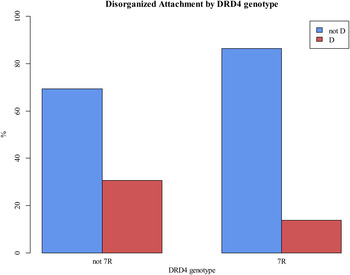
There was a strong negative association between 7R and disorganized attachment (χ2 = 16.88, df = 1, p < .0001). Almost all cases of disorganized attachment were found in children without a 7R (Figure 1). In a two-way interaction model (χ2 = 14.49, df = 3, p = .002) examining the prediction of disorganized attachment from birth weight AGA and DRD4, the interaction term of birth weight AGA and DRD4 was not significant (β = –0.0007, p = .24). The lack of a moderation of birth weight by genotype was found consistently across all our models.
(Color online) Disorganized attachment by dopamine receptor D4 (DRD4) genotype.

Moderation of the effects of birth weight by maternal care
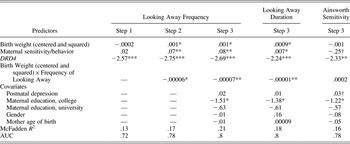
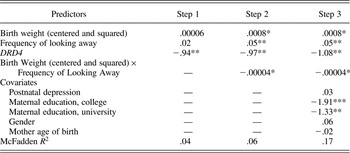
There was no main effect of maternal care as measured by maternal looking away frequency and duration, and Ainsworth maternal sensitivity. The two-way interaction model, F (4, 557) = 5.07, p < .0001, examining the prediction of disorganized attachment from birth weight AGA and maternal looking away frequency was significant (Table 3, Step 2). Although there were trends for maternal looking away duration and Ainsworth maternal sensitivity, maternal looking away frequency produced the best model (lowest Akaike information criterion). Increased looking away frequency was associated with increased probability of disorganized attachment in children with lower birth weight (squared) AGA. Adding covariates to the model (Table 3, Step 3) did not change the results; the model remained significant, F (9, 1056) = 4.96, p < .0001, and the parameters of DRD4 (β = –1.06, p < .01), and the interaction between birth weight and maternal looking away remained significant (β = –0.00004, p < .05).
The prediction of disorganized attachment from the interactions of Birth Weight × Looking Away Frequency, Birth Weight × Looking Away Duration, and Birth Weight × Ainsworth Sensitivity

Note: In looking away frequency Step 1, χ2 (3) = 23.95***; in looking away frequency Step 2, χ2 (4) = 30.8***; in looking away frequency Step 3, χ2 (9) = 38.75***; in looking away duration Step 3, χ2 (9) = 34.85***; and in Ainsworth sensitivity Step 3, χ2 (9) = 34.64***. AUC, Area under the curve. †p < .10. *p < .05. **p < .01. ***p < .001.
Three-way interaction: Best model
The three-way interaction model (χ2 = 36.93, df = 7, p < .0001) did not better explain our results. There was no significant interaction among birth weight AGA, DRD4, and maternal care. The data were best explained by a model that included the two-way interaction of birth weight and maternal looking away frequency as well as the main effect of DRD4 (Table 3). Analyses with imputed data revealed a similar model (Table 4).
The prediction of disorganized attachment from the interaction of birth weight and looking away frequency using multiple imputation

Note: In Step 1, F (3, 435) = 4.29**; in Step 2, F (4, 589) = 4.65**; and in Step 3, F (9, 1147) = 4.87***. *p < .05. **p < .01.
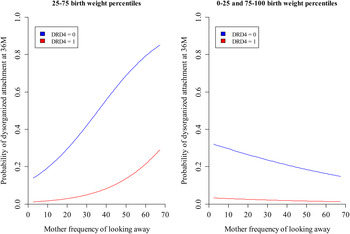
Figure 2 depicts how looking away frequency differentially influences the probability of disorganized attachment as a function of birth weight AGA. To better characterize the interaction, we conducted simple slope analyses (Aiken & West, Reference Aiken, West and Reno1991), and the birth weight AGA variable was evenly divided into midrange (25th to 75th percentile) and extreme range (<25th and >75th percentile). Translating this back to untransformed birth weight, children with birth weight AGA in the midrange were more likely to develop a disorganized attachment when exposed to less sensitive maternal care, in the form of more frequent looking away (simple slope analysis: β = 0.064, p = .0055). However, for children at either extremity of the birth weight range, there was no association, such that the probability of disorganized attachment remained the same, regardless of looking away behavior (simple slope: β = –0.0436, p = .1393). Other measures of maternal attunement moderated birth weight AGA less significantly (duration of maternal looking away behavior) or not at all (Ainsworth sensitivity or frequency/duration of vocalizations).
(Color online) The prediction of disorganized attachment at 36 months from mother looking away frequency at 6 months and dopamine receptor D4 (DRD4) seven-repeat allele status for average birth weight and extreme birth weight children.

The results in Figure 2 are presented separately for DRD4 7R and non-7R to underline how significant the main effect of DRD4 is, sometimes up to threefold, in spite of the absence of a three-way interaction. In the final model, having a 7R allele was associated with a decreased probability of disorganized attachment. Maternal education was also associated with a decreased probability of disorganized attachment (β = –1.51; p = .02). The AUC of our final model was very good (AUC = 0.8, SE = 0.04). Around 80% of the children where correctly assigned as disorganized or not based on our model. Therefore, our model has good accuracy.
Discussion
Our findings suggest that a main effect of DRD4 polymorphism and an interaction effect of birth weight (adjusted for gestational age) and maternal care at 6 months, specifically maternal looking away behavior, predict disorganized attachment at 36 months. These unique findings are strengthened by a prenatal longitudinal design, independent and objective measurements of all the variables, detailed measures of maternal care, and complementary and novel analyses.
Three findings stand out. First, we did not find a main effect of birth weight or of maternal care as measured by looking away behavior on disorganized attachment. Second, we did find that birth weight and maternal care interacted to predict disorganized attachment. Specifically, the effect of birth weight on disorganized attachment at 36 months of age was moderated by the how much the mother looked away from her infant at 6 months of age. This is consistent with evidence that prenatal experience significantly influences child development and socioemotional functioning. It is already established that birth weight is associated with an increased risk for cardiovascular and endocrine conditions (Barker, Reference Barker2004) as well as psychopathology (Schlotz & Phillips, Reference Schlotz and Phillips2009). This is the first evidence that birth weight predicts the child's attachment organization in certain contexts of maternal care. One wonders whether the organism with greater growth-associated pressures (at either end) might be affected similarly in how it experiences the environment. Although the role of child factors in the prediction of disorganized attachment is not a novel finding, much of the literature has focused on the role of genotype. This is the first study to our knowledge to consider the role of birth weight.
The role of maternal behavior in the prediction of disorganized attachment is also consistent with the extant literature (Hesse & Main, Reference Hesse and Main2006). Extreme parental insensitivity (Bakermans-Kranenburg & van IJzendoorn, Reference Bakermans-Kranenburg and van IJzendoorn2011; Laucht et al., Reference Laucht, Esser and Schmidt2001; Moss, St.-Laurent, et al., Reference Moss, St.-Laurent, Tarabulsy, Bureau, Solomon and George2011), attentional inflexibility (Atkinson et al., Reference Atkinson, Leung, Goldberg, Benoit, Poulton and Myhal2009), and lack of comforting maternal–infant contact (Weiss et al., Reference Weiss, Wilson, Hertenstein and Campos2000) have been associated with development of disorganized attachment. Our findings suggest that the effect of maternal care is contingent on an important child factor, that is, birth weight. Maternal care, and specifically maternal looking away frequency, was associated with disorganized attachment only when birth weight was within the midrange. This suggests that the effect of maternal behavior and early environmental experiences do not operate independently of the child.
Of particular interest is the finding that child birth weight moderated the effect of maternal care, such that poorer care predicted disorganization only for children with normal range birth weight. Whereas we had hypothesized that extremes of birth weight would more likely be associated with higher disorganized attachment, we found the reverse association. Children with midrange birth weight had a greater probability of disorganized attachment when maternal looking away behavior increased. Children in the extreme ranges, however, were influenced minimally by maternal looking away behavior. It is possible that with greater birth weight pressures, these extreme birth weight children are less susceptible to interactive influences on development of social–emotional and cognitive processes at that period (6 months) but may be so at a later point in development.
Another interesting hypothesis is that more neglectful parental behavior may prepare the extreme birth weight offspring for adverse surroundings by causing elevated levels of glucocorticoids, fearfulness, and vigilance that promote detection of potential threat and avoidance learning. These mechanisms are potentially helpful in an environment where one must struggle for survival (Avinun & Knafo, Reference Avinun, Knafo, Grusec and Hastingsin press; Evans, Reference Evans2004). However, for normally developing children this is the beginning of the period (6–12 months) when the attachment system develops rapidly and particular secure/insecure patterns emerge. These patterns emerge from the degree of synchronization of maternal care with the infant's need to maintain equilibrium between dependency and exploratory needs. In this sense, high levels of maternal looking away behavior are an indication of the disrupted parental affective communication, which has been shown to predict disorganized attachment by 12 months of age (Lyons-Ruth & Jacobvitz, Reference Lyons-Ruth, Jacobvitz, Cassidy and Shaver2008).
Third, we found, across all models, that DRD4 7R was protective against disorganized attachment. In contrast, in the literature, the 7R variant is either not associated with disorganized attachment or is associated with an increased probability of disorganized attachment, as was reported by Lakatos (Reference Lakatos, Nemoda, Toth, Ronai, Ney and Sasvari- Szekely2002) in the Hungarian sample or by Cicchetti et al. (Reference Cicchetti, Rogosch and Toth2011) for children with no maltreatment history. Even in G × E studies where DRD4 is reported to interact with maternal care (Bakermans-Kranenburg & van IJzendoorn, Reference Bakermans-Kranenburg and van IJzendoorn2006) or unresolved trauma (van IJzendoorn & Bakermans-Kranenburg, Reference van IJzendoorn and Bakermans-Kranenburg2006), the 7R variant has been the susceptible allele. The 7R variant has only been associated with a decreased risk for disorganized attachment in maltreated children (Cicchetti et al., Reference Cicchetti, Rogosch and Toth2011), or in those exposed to disruptive maternal affective behaviors (Gervai et al., Reference Gervai, Novak, Lakatos, Toth, Danis and Ronai2007), the explanation being that the 7R genotype was less relevant when children experienced extremely adverse environments. It is unlikely that our finding is explained by levels of maltreatment in our low-risk sample (not considered in our models) or disruptive maternal behaviors (considered in our models). There is evidence nonetheless for the protective role of dopamine 7R in a community sample. Ebstein et al. (Reference Ebstein, Levine, Geller, Auerbach, Gritsenko and Belmaker1998) found the 7R variant is associated with better infant orientation and state regulation. Our findings add to the complexity of the literature about the association of DRD4 with disorganized attachment, especially as one extends the developmental model into the preschool age. The inclusion of a significant child cofactor (i.e., child birth weight) seems to increase the complexity of the interpretation but underscores the idea that G × E interactions must be interpreted in light of specific characteristics of the child.
Overall, the results are most parsimoniously interpreted in the context of attention, a construct considered central to attachment theory (Atkinson et al., Reference Atkinson, Leung, Goldberg, Benoit, Poulton and Myhal2009). The whereabouts of the attachment figure are continuously monitored by all infants (Bretherton, Reference Bretherton, Coelho and Ahmed1980; Maier et al., Reference Maier, Bernier, Pekrun, Zimmermann, Strasser and Grossmann2005), and the variance among them is explained by the attachment patterns they adopt. Furthermore, dopamine has been implicated in the relation between maternal attention and disorganized attachment (Atkinson et al., Reference Atkinson, Leung, Goldberg, Benoit, Poulton and Myhal2009). Dopamine is involved in selective attention (which involves simultaneous inhibition and direction of attentional processes) and in suppressing irrelevant responses and selecting newly appropriate behaviors (Winstanley, Theobald, Dalley, & Robbins, Reference Winstanley, Theobald, Dalley and Robbins2005). Disorganized individuals show a breakdown of both attentional (Atkinson et al., Reference Atkinson, Leung, Goldberg, Benoit, Poulton and Myhal2009) and behavioral systems. With respect to the latter, disorganization is defined as the collapse of attachment strategy under conditions of stress; under such conditions, disorganized individuals select a set of behaviors that are irrelevant to their need for downregulation of discomfort (Hesse & Main, Reference Hesse and Main2006). Moreover, dopamine plays an important role in consolidating stimulus traces under conditions of extreme stress (Oades, Reference Oades1985), chronically experienced by disorganized babies, and interferes with future function under stress conditions. More specifically, and based in part on evidence that the DRD4 gene is implicated in attentional, cognitive, and emotional processes, several studies (Gervai et al., Reference Gervai, Nemoda, Lakatos, Ronai, Toth and Ney2005; Lakatos et al., Reference Lakatos, Toth, Nemoda, Ney, Sasvari-Szekely and Gervai2000, Reference Lakatos, Nemoda, Toth, Ronai, Ney and Sasvari- Szekely2002; van IJzendoorn & Bakermans-Kranenburg, Reference van IJzendoorn and Bakermans-Kranenburg2006) support DRD4 involvement in attachment disorganization, as discussed above.
Moreover, in the context of mother–child behavior, “looking away” serves as a fundamental, behavioral instantiation of attention. It has been argued that inattention (avoidance) is a sufficient condition for maternal insensitivity, given that it precludes perception of infant signals (Atkinson et al., Reference Atkinson, Scott, Chisholm, Blackwell, Dickens and Tam1995; Pederson et al., Reference Pederson, Moran, Sitko, Campbell, Ghesquire and Acton1990). Of interest in the present study, maternal looking away behavior modified the impact of birth weight more strongly than a fuller measure of maternal sensitivity, a particularly interesting phenomenon given that the interaction was studied in the context of a dopamine gene known to influence attention.
Finally, there is the issue of prenatal programming as it pertains to disorganization. The question is, why would a fetus prepare itself for disorganization? Given the disruptions to controlled attention, discussed above, what could the possible advantages of disorganization be? Atkinson et al. (Reference Atkinson, Leung, Goldberg, Benoit, Poulton and Myhal2009) made the following argument. The disorganized infant feels him/herself to be under threat because the caregiver is either frightened or frightening. Under such conditions of threat, it may be advantageous to shut down controlled processing in favor of habitual, environmentally dependent processes that have ensured survival in the past (Arnsten, Reference Arnsten1998). Controlled processes, attentional flexibility foremost among them, are often downgraded during stress while automatic processes are enhanced, especially under conditions where the individual has little control, as would be the case for the infant under conditions of helpless/hostile caregiving. Furthermore, dopamine plays a particularly important role in the selection of controlled versus automatic processing (Arnsten, Reference Arnsten1998). Overall, these considerations may explain why the infant prepares him/herself for disorganization prenatally, why the DRD4 gene plays an important role in the disorganization outcome, and why maternal behavior provides the context necessary to this outcome.
Conceptualizing our findings within the context of attention also helps link the processes described here to psychopathology more broadly (Atkinson et al., Reference Atkinson, Leung, Goldberg, Benoit, Poulton and Myhal2009). Attentional deficits serve to cause and maintain emotional disturbance (Posner & Rothbart, Reference Posner and Rothbart2000). Williams, Mathews, and MacLeod (Reference Williams, Mathews and MacLeod1996) proposed that attentional bias contributes to an iterative process whereby slight increases in emotional difficulty increase the salience of particular stimuli, which in turn magnifies the emotional power of those stimuli. It seems likely then that the automatic attentional bias of disorganized individuals toward negative attachment experiences magnifies concern about these experiences such that they increasingly preclude broader attention allocation and become psychopathological. The present data show that these processes are not driven not only by maternal behavior but also by aspects of the child, including genetic and prenatal biological factors, in interaction with maternal factors, in a cycle of mutual influence.
Limitations
The interpretation of our findings should be made in light of certain limitations. Our results indicate that maternal care and birth weight interacted to predict disorganized attachment. Although many confounding pathways were not significant in our analyses, it still remains possible that other unmeasured aspects of the child evoked changes in maternal behavior (identified or not), thus leading to disorganized attachment. Moreover, in future research with larger samples, it will be interesting to delineate the pathways leading to the different subtypes of disorganization seen at preschool and early school age (i.e., controlling–punitive, controlling–caregiving and behaviorally disorganized).
When compared to other genetic studies, the MAVAN has a relatively smaller number of participants. Our power, however, is strengthened by the accuracy of our genotyping method (Wong, Day, Luan, Chan, & Wareham, Reference Wong, Day, Luan, Chan and Wareham2003), precise functional subcategorization of the DRD4 allele (7R or not), and observational measures of maternal care. Nonetheless, meaningful G × E effects might have been undetected in this study as a result of insufficient statistical power. Conversely, the risk of Type I errors can emerge from the use of three operationalizations of caregiving quality and two operationalizations of birth weight (linear and curvilinear). Although the risk was minimized by theory-driven analysis, sparse models with specified analytic steps, and the convergence of the findings across three slightly different measures of the parenting construct, the replication of such striking findings will be essential.
Finally, we only examine a monogenic model. There is growing evidence for the interaction of genes (Gene × Gene) and specifically the association of DRD4 with the serotonin transporter linked polymorphic region gene (Ebstein et al., Reference Ebstein, Levine, Geller, Auerbach, Gritsenko and Belmaker1998) but also with monoamine oxidase A (Serretti et al., Reference Serretti, Cristina, Lilli, Cusin, Lattuada and Lorenzi2002) and cathechol-O-methyltransferase genes (Olsson et al., Reference Olsson, Byrnes, Anney, Collins, Hemphill and Williamson2007). One interesting possibility, for example, would involve norepenephrine-related genes, given that norepenephrine acts in concert with dopamine to influence attentional processes and likely attachment disorganization (Atkinson et al., Reference Atkinson, Leung, Goldberg, Benoit, Poulton and Myhal2009).
Future directions for translating research on the influential child into preventive interventions
These results highlight the importance of considering the complex interplay of parenting and child factors in understanding the complex pathways toward psychopathology. They also highlight the importance of individualizing intervention efforts in order to prevent the onset of disorganization in early childhood. In this respect, intervention programs oriented directly at increasing the predictability, consistency, and warmth of parental behavior toward the child that have been shown to reduce disorganization (e.g., Cicchetti, Rogosch, & Toth, Reference Cicchetti, Rogosch and Toth2006; Moss, DuBois-Comtois, et al., Reference Moss, Dubois-Comtois, Cyr, Tarabulsy, St.-Laurent and Bernier2011) must be implemented with an eye on developmental timing and particular child needs. Two findings stand out in providing more precise directions as the population that such interventions should target. First, the absence of the 7R allele of DRD4 increased the risk for disorganized attachment. Second, the presence of higher looking away behaviors in children in midranges of birth weight also increased the risk for disorganized attachment. However, because both of these findings are novel, they would have to be reproduced before they could be instrumentalized into more precise strategies of prevention.
With approaches such as video feedback (Juffer, Bakermans-Kranenburg, & van IJzendoorn, Reference Juffer, Bakermans-Kranenburg and van IJzendoorn2008; Moss et al., Reference Moss, Tarabulsy, St.-Georges, Dubois-Comtois, Cyr and Bernier2014), parents are coached in becoming attentive to child responses to their interventions that guide them in adjusting their behavior in an individualized child-sensitive manner. Our findings also suggest that outcomes of such programs must always be assessed using child measures over time, rather than parental measures such as stress reduction. Given that the pathway toward disorganized attachment appears to be complex, involving interplay of biological, genetic, and parenting factors, successful prevention programs must address the particular needs of the child. Accordingly, research is also needed on the impact of such programs with children with different birth weight status and genetic dispositions. Considering multiple child factors instead of single factors may yield different interpretations of the efficacy of such programs for individual children.