Introduction
Most research on the association between maternal smoking during pregnancy (SDP) and offspring antisocial behavior (ASB) has been consistent with a causal inference (Olds, Reference Olds1997; Ernst et al. Reference Ernst, Moolchan and Robinson2001; Wakschlag et al. Reference Wakschlag, Pickett, Cook, Benowitz and Leventhal2002). The causal inference has been supported recently by human research, including studies conducted across several countries (Brion et al. Reference Brion, Victora, Matijasevich, Horta, Anselmi, Steer, Menezes, Lawlor and Smith2010), controlling for numerous confounds (Paradis et al. Reference Paradis, Fitzmaurice, Koenen and Buka2010), and that have explored differences in brain structure and functional processes in exposed and unexposed offspring (for a review, see Derauf et al. Reference Derauf, Kekatpure, Neyzi, Lester and Kosofsky2009). The results also are consistent with recent basic animal research on brain changes associated with prenatal nicotine exposure, including alterations in nicotinic acetylcholine receptors (e.g. Gold et al. Reference Gold, Keller and Perry2009).
Recent quasi-experimental studies in humans, however, have suggested that family background characteristics account for the statistical association between SDP and offspring ASB (for a review, see Knopik, Reference Knopik2009). These studies, which use design features to rule out alternative hypotheses (Shadish et al. Reference Shadish, Cook and Campbell2002; Rutter, Reference Rutter2007), suggest that unmeasured risk factors that covary with maternal SDP probably increase the risk for ASB in the offspring instead of a direct prenatal environmental influence of SDP on the risk for ASB.
Several studies on ASB have compared differentially exposed siblings by looking at risk for ASB among offspring where the mother changed her smoking across pregnancies. This design controls genetic and shared environmental factors that are confounded with SDP as alternative explanations for the apparent effect of SDP (Rutter, Reference Rutter2007; Lahey & D'Onofrio, Reference Lahey and D'Onofrio2010; Donovan & Susser, Reference Donovan and Susser2011). If the sibling who was exposed to greater SDP had higher levels of ASB (a within-family association), a causal association would be supported. In contrast, if both siblings had the same level of ASB, the results would suggest that SDP does not cause ASB. Gilman et al. (Reference Gilman, Gardener and Buka2008) found that differentially exposed siblings did not vary in their rates of childhood conduct problems. D'Onofrio et al. (Reference D'Onofrio, Van Hulle, Waldman, Rodgers, Harden, Rathouz, Rathouz and Lahey2008) also found that maternal SDP was not associated with increased risk for childhood conduct problems or oppositional problems when comparing differentially exposed siblings. A recent study found comparable results when exploring the association between SDP and offspring criminal convictions during adolescence and early adulthood (D'Onofrio et al. Reference D'Onofrio, Singh, Iliadou, Lambe, Hultman, Grann, Neiderhiser, Långström and Lichtenstein2010a). These findings were confirmed in a novel in vitro fertilization study of maternal SDP and childhood conduct problems (Rice et al. Reference Rice, Harold, Boivin, Hay, Van den Bree and Thapar2009), which controls genetic confounds by examining risk factors in women who were not genetically related to their children (Thapar et al. Reference Thapar, Harold, Rice, Ge, Boivin, Hay, van den Bree and Lewis2007).
Certainly, converging evidence across numerous studies and across various designs is necessary to support a causal inference (e.g. Rutter et al. Reference Rutter, Pickles, Murray and Eaves2001). It is important to note that the existing quasi-experimental studies on ASB are limited by several problems. First, many of the studies are limited by measurement problems. Many studies relied on the same reporter (the mother) for the assessment of both SDP and ASB (Rutter, Reference Rutter2007). Also, one study (D'Onofrio et al. Reference D'Onofrio, Singh, Iliadou, Lambe, Hultman, Grann, Neiderhiser, Långström and Lichtenstein2010a) has been criticized for using extreme measures of ASB (criminal convictions), which may make the interpretation of findings difficult, if not impossible (Talati & Weissman, Reference Talati and Weissman2010). Second, a great majority of the studies are only based on childhood conduct problems, not ASB during adolescence when the societal costs and suffering associated with ASB are greater (e.g. Loeber et al. Reference Loeber, Farrington, Stouthamer-Loeber and Van Kammen1998).
Third, the lack of measures of adolescent ASB also is problematic because SDP may differentially influence specific developmental trajectories of ASB. One study suggests that SDP may be more strongly associated with early-starting and chronic forms of ASB (Brennan et al. Reference Brennan, Grekin and Mednick1999), which is consistent with the current theories suggesting that the trajectory of ASB is associated with early neurocognitive deficits (e.g. Moffitt, Reference Moffitt, Cicchetti and Cohen2006). Fourth, few of the quasi-experimental studies have been able to test the assumptions inherent in their designs. For example, the sibling-comparison design has a number of limitations, including the inability to account for whether exposure to the risk in one pregnancy carries over to other pregnancies, historical changes, and factors that influence why women change their smoking behavior over time (Lahey & D'Onofrio, Reference Lahey and D'Onofrio2010; Donovan & Susser, Reference Donovan and Susser2011).
The current study sought to address these issues by: (a) examining the associations between SDP and multiple measures of ASB in a large study of offspring of a representative sample of women in the USA, (b) investigating these associations while comparing differentially exposed siblings with the same biological mothers, and (c) testing assumptions inherent in the sibling-comparison design.
Method
Sample
Mothers
The mother-generation for the current study was drawn from the National Longitudinal Survey of Youth 1979 (NLSY79). The NLSY79 was a nationally representative household sample of 14- to 22-year-old male and female youth selected using a stratified and clustered design, with an oversample of African American and Hispanic youth (Baker & Mott, Reference Baker and Mott1989). The NLSY79 sample consisted of the 4926 females (1472 African American, 977 Hispanic and 2477 non-Hispanic white and other groups) who have given birth to children.
Offspring
Biennial assessments of all biological offspring of all NLSY79 women began in 1986 (Chase-Lansdale et al. Reference Chase-Lansdale, Mott, Brooks-Gunn and Phillips1991). Participation in the 12 assessments through 2008 averaged >90%. Mothers answered questions about each of their children's behavior and environments in every assessment. Youth aged 10 years and over also reported on their behavior and environments in each assessment. A total of 11 506 offspring have been born to all of the women in the NLSY79 cohort through 2008. Observations were dropped from the current analyses if the observations were missing information about: the mother's identification number (n=11); maternal SDP (n=1255), which was mostly due to an invalid skip pattern during a wave of assessment (D'Onofrio et al. Reference D'Onofrio, Van Hulle, Waldman, Rodgers, Harden, Rathouz, Rathouz and Lahey2008); and adolescent ASB (n=5010), which consisted mostly of offspring who were too young to be assessed for adolescent ASB. The analyses, therefore, were based on 6066 offspring born to 2694 mothers.
Measures
Maternal SDP
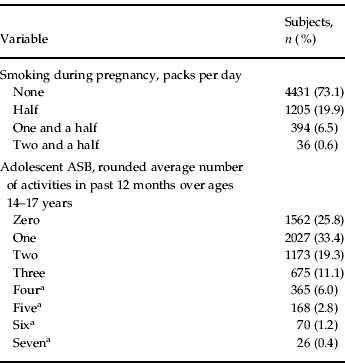
In every wave since 1986, National Longitudinal Mother–Child Supplement (CNLSY) mothers were asked about their frequency of SDP for each pregnancy using a four-point scale. Information was obtained from the mother on birth outcomes and smoking and drinking during pregnancy in the first assessment following the child's birth. The frequency of maternal SDP is presented in Table 1. Using plasma biomarkers as the criterion variables, the validity of self-reported tobacco use during pregnancy has been demonstrated to be high in other studies (George et al. Reference George, Granath, Johansson and Cnattingius2006). Nonetheless, there is some systematic inaccuracy of false negatives (George et al. Reference George, Granath, Johansson and Cnattingius2006) and underestimating the amount of smoking (Post et al. Reference Post, Gilljam, Bremberg and Galanti2008). The resulting imperfect sensitivity of self-reported smoking measures results in conservative tests of maternal smoking effects. The strongest evidence for the validity of maternal reports, however, is that they are consistently correlated with objective measures of the offspring's physical growth retardation (Day et al. Reference Day, Goldschmid, Robles, Richardson, Cornelius, Taylor, Geva and Stoffer1991). Previous CNLSY studies have found SDP to be highly correlated with offspring birth weight (D'Onofrio et al. Reference D'Onofrio, Van Hulle, Waldman, Rodgers, Harden, Rathouz, Rathouz and Lahey2008).
Distribution of maternal smoking during pregnancy and offspring adolescent ASB

ASB, Antisocial behavior.
a Included in identifying a group of teenagers with high ASB.
Offspring ASB
Adolescent-reported ASB and high ASB
Across ages 14–17 years, youth completed a self-report questionnaire of ASB in private. They reported on seven delinquent behaviors during the past 12 months from the Self-Reported Delinquency Scale (SRD; Elliott & Huizinga, Reference Elliott and Huizinga1983): hurt someone badly enough to need bandages or a doctor; lied to parent about something important; took something from a store without paying for it; intentionally damaged or destroyed property that didn't belong to you; had to bring your parent(s) to school because of something you did wrong; skipped a day of school without permission; and ran away from home overnight. The SRD is the benchmark measure in contemporary delinquency research (Loeber et al. Reference Loeber, Farrington, Stouthamer-Loeber and Van Kammen1998; Moffitt et al. Reference Moffitt, Caspi, Rutter and Silva2001). The seven SRD delinquency items were selected for the CNLSY because they tap high-prevalence acts that are highly correlated with more serious delinquent behaviors. In three waves of the CNLSY, the young adult SRD delinquency scale also included 10 additional items. The seven-item scale delinquency correlated highly with the sum of the remaining more serious delinquency items, had good internal consistency, and showed excellent criterion validity in both genders (Lahey et al. Reference Lahey, Van Hulle, D'Onofrio, Rodgers and Waldman2008).
To create a measure of ASB we calculated a rounded average of the reported items across assessments from 14 to 17 years of age. The distribution of the self-reported ASB from 14 to 17 years of age is presented in Table 1. The distribution indicates that a majority of the offspring reported at least one item during the past year. In addition to of number of items reported in the previous year we also created a binary indicator of high ASB, which was based on the highest 10% of the distribution of the SRD.
Criminal convictions
Offspring also reported on their convictions for numerous offenses, including assault; robbery (using weapon or force); theft; fencing stolen goods; vandalism; other property offenses; marijuana possession; sale or distribution of marijuana; illicit drug possession; manufacturing, sale or distribution of illicit drugs; underage drinking; major traffic offense; or other crime. The offspring also reported the first age at conviction, which ranged from 10 to 30 years old. We predicted risk for ever being convicted, based on the first age of conviction. Kaplan–Meier estimates of the prevalence of criminal convictions revealed that 25.2% of offspring were convicted by the age of 30 years, with a higher prevalence in males (35.4%) than females (15.3%), which are consistent with national estimates (Federal Bureau of Investigation, 2011).
Chronic ASB
To create an index of early-starting and chronic ASB, we used a combination of mother-rated childhood conduct problems from 4 to 9 years old and adolescent self-reported ASB. Mothers rated childhood conduct problems using the Behavior Problems Index (BPI), a measure that selected items from the Child Behavior Checklist (Achenbach, Reference Achenbach1978). The mean of the seven BPI items indexed childhood conduct problems, and the items overlap substantially with those used to define child conduct problems in longitudinal studies (Moffitt et al. Reference Moffitt, Caspi, Rutter and Silva2001; Fergusson & Horwood, Reference Fergusson and Horwood2002). Previous studies have documented the factor structure and stability of the measure in the CNLSY, as well as the relationship with maternal SDP (D'Onofrio et al. Reference D'Onofrio, Van Hulle, Waldman, Rodgers, Harden, Rathouz, Rathouz and Lahey2008). To create a group of offspring with early-starting and chronic ASB we selected individuals who were in the top 20% on both measures. The measure was restricted to individuals with assessments at both time points (n=3793), with 243 individuals (6.4%) meeting the criteria for chronic ASB, which is generally consistent with recent epidemiological estimates (e.g. Odgers et al. Reference Odgers, Moffitt, Broadbent, Dickson, Hancox, Harrington, Poulton, Sears, Thomson and Caspi2008; Barker & Maughan, Reference Barker and Maughan2009).
The measures of offspring ASB were highly associated with each other. Each additional item on the adolescent-reported ASB was associated with greater risk for criminal convictions (HR 1.56, p<0.001) and for membership in the chronic ASB group (OR 2.94, p<0.001). High ASB (the top 10% of the self-reported ASB) was associated with more reported criminal convictions (HR 4.18, p<0.001) and with membership in the chronic ASB group (OR 19.83, p<0.001).
Offspring-specific covariates
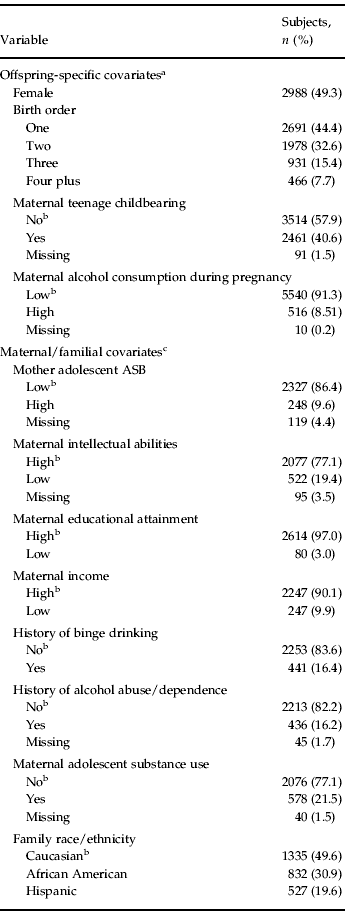
Table 2 describes the distribution of the covariates used in the study. To account for missing values in all of the covariates, we created dummy codes to compare any individuals with missing values with those observations with low risk. The study included a number of covariates that vary within families, including gender, offspring birth order and maternal age at childbearing. Maternal age at childbearing compared teenage childbearing with non-teenage childbearing. High maternal alcohol consumption during pregnancy was also assessed, which was measured by reported drinking more than 3–4 days per month compared with those with less frequent consumption (D'Onofrio et al. Reference D'Onofrio, Van Hulle, Waldman, Rodgers, Rathouz and Lahey2007).
Distribution of offspring-specific and familial covariates

ASB, Antisocial behavior.
a Based on 6066 offspring.
b Used as the reference group in the analyses. ‘Missing’ presents offspring or families with missing values for the variable.
c Based on 2694 unique mothers.
Maternal/familial covariates
The analyses controlled for maternal reports of her history of adolescent delinquency (Rodgers et al. Reference Rodgers, Rowe and Li1994), which was indexed by comparing women in the top 10% with those in the rest of the distribution. Low maternal intellectual ability was based on the bottom 20% of the distribution of a composite score from the Armed Services Vocational Aptitude Battery, which was given in 1980. Low maternal educational attainment was assessed by fewer than 12 years of completed education. Low income was measured as familial income at the age of 30 years below $5795 in 1986 dollars (the bottom 10% of the distribution). The 1994 assessment included a detailed assessment of lifetime history of alcohol problems. The mothers were asked the number of binge episodes and a 25-item assessment of alcohol abuse and dependence items. If women ever reported binge drinking or any abuse of dependence items, they were considered to be at high risk for each measure. Maternal adolescent substance use was indexed by self-report of any of the following substances during adolescence: cocaine, amphetamines, barbiturates, tranquilizers, psychedelic drugs, or heroin. Finally, we included family race/ethnicity, as measured by maternal self-report in the NLSY79 study, which included Caucasian, African American and Hispanic groups.
Sampling weights
Based on clustered, unequal selection probability design, the NLSY79 provides weights indicating the inverse of the probability of each participant being selected into the sample. In family-based analyses, these weights apply equally to all CNLSY offspring to a given mother.
Analyses
Regression-based analyses
We used three models to examine the relationship between maternal SDP and each measure of ASB. We fit the models in Mplus 6.11 (Muthén & Muthén, Reference Muthén and Muthén1998–Reference Muthén and Muthén2010). Each model used robust standard errors at the original NLSY79 household level to account for the non-independence of the observations in extended families, and each model used the sampling weights.
Model 1 predicted each measure of ASB by maternal SDP, offspring gender and birth order. The parameter estimate associated with maternal SDP represents what we will refer to as the unadjusted association. Model 2 added all of the measured offspring-specific and maternal/familial covariates. The parameter associated with SDP quantifies the association of ASB to SDP while statistically controlling for the measured covariates. Model 3 predicted offspring ASB in the context of a fixed-effects model at the mother level, which holds constant all factors that siblings share (Allison, Reference Allison2009). This model therefore compared differentially exposed siblings and thereby provided an estimate of the association between SDP and ASB while controlling for all familial factors – both genetic and environmental – that make siblings similar. The models were based on 1088 offspring of 353 mothers who varied their smoking across pregnancies.
Because the distributions of the measures for ASB were different, the analyses used several analytical models. For offspring-reported adolescent ASB behavior counts we used negative binomial models to predict the mean number of ASB behaviors per person, a model that allows for over-dispersion of the response distribution relative to the Poisson (Long, Reference Long1997). We used logistic regression models to predict the dichotomous variables of high ASB and chronic ASB. The negative binomial and logistic regression models were each based on a two-level analysis with a random intercept at the second level to account for the clustering of siblings within a family. Finally, because the reports of convictions were right-censored (the offspring had not lived through the entire risk period), we used Cox proportional hazards survival analysis models to predict first offspring criminal conviction. A sandwich estimator was used to account for the familial clustering in the survival analysis models.
Sensitivity analyses
We ran additional analyses to test a number of moderators, rule out alternative explanation for the results, and examine some of the assumptions in the sibling-comparison design.
First, we examined whether offspring gender and maternal alcohol consumption during pregnancy moderated the association between maternal SDP and offspring ASB.
Second, we reran the analyses predicting each measure of ASB using a categorical assessment of maternal SDP (smoked or not during pregnancy) to examine whether any possible inaccuracy in reporting the amount of cigarette smoking could account for the results.
Third, we ran the models without the sampling weights to determine the extent to which the use of sampling weights influenced the results.
Fourth, we tested a number of the assumptions in the sibling-comparison design, especially regarding the stable unit treatment value assumption – the assumption that exposure to the risk does not influence other unexposed participants (Rubin, Reference Rubin2006), which is particularly relevant for sibling-comparison designs (Lahey & D'Onofrio, Reference Lahey and D'Onofrio2010). If smoking in one pregnancy influenced all subsequent pregnancies, then a sibling-comparison approach would provide the wrong answer. Women who decrease their smoking over time may be quite different from those who increase their SDP. Furthermore, if the validity of the assessment of SDP has changed over time, the sibling-comparison approach could provide misleading results. To address these concerns, we ran a bi-directional case-crossover study (e.g. Meyer et al. Reference Meyer, Williams, Hernandez-Diaz and Cnattingius2004) predicting adolescent-reported ASB in which we compared differentially exposed siblings among the first two children of women who either: (a) increased their smoking over time or (b) decreased their smoking over time. If the sibling-comparison parameters in both groups revealed no association, the results would suggest that the findings from the overall sibling-comparison approach are robust to these assumptions.
Results
Regression-based analyses
Adolescent-reported ASB
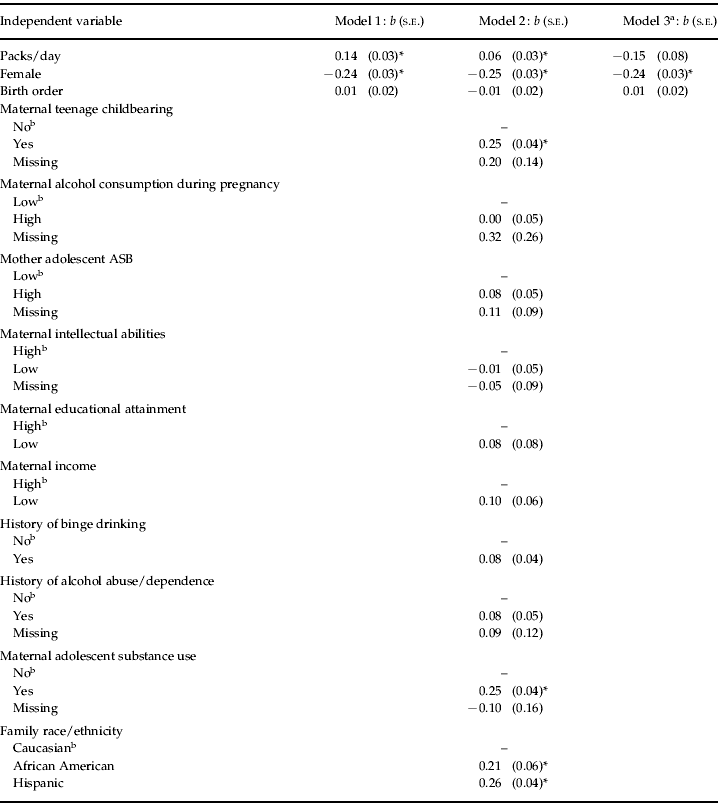
The parameter estimates and standard errors associated with each independent variable in the negative binomial models predicting adolescent-reported ASB are presented in Table 3. The SDP parameter estimates are reproduced in Table 4 as ratios of mean ASB behavior counts per person, with associated CIs. In model 1, each additional pack of cigarettes a mother smoked per day during pregnancy was associated with a 15% relative difference in mean ASB behaviors. When controlling for all measured covariates, the results from model 2 indicated that the association between SDP and ASB was attenuated (a 6% difference in ASB behaviors) but was still statistically significant. After fitting model 3, the fixed-effects (sibling-comparison) model that compared differentially exposed siblings, we found that the association went in the opposite direction (a negative 14% difference in ASB behaviors). Although the parameter was not statistically significant, the CI excludes all ratios of means over 1.01, strongly suggesting that SDP does not lead to an increase in ASB. Taken as a whole, these analyses suggest that siblings have similar levels of ASB, regardless of level of exposure to maternal SDP.
Regression parameter estimates of negative binomial models exploring the association between maternal smoking during pregnancy and adolescent-reported ASB

ASB, Antisocial behavior; s.e., standard error.
All parameters are presented as log ratios of means (s.e.).
a Based on the sibling-comparison model.
b Used as the reference group in the analyses. Parameters associated with the missing variables compared offspring with missing values on the covariates with those in the reference group.
* p<0.05.
Relative mean ASB behaviors, odds of high and chronic ASB, and hazard of criminal conviction for offspring antisocial behavior associated with maternal smoking during pregnancy for three analytical models

Parameters represent the relative increase in mean number of behaviors for ASB, in odds of high or chronic prevalent ASB, or in hazard of first criminal conviction associated with a mother smoking an additional pack per day (confidence interval).
ASB, Antisocial behavior.
a Based on a multi-level negative binomial model.
b Based on a multi-level logistic regression model.
c Based on a multi-level survival analysis.
High ASB
The parameter estimates associated with SDP for the other measures of ASB are presented in Table 4 (full results are available upon request). In model 1, maternal SDP predicted increased odds [odds ratio (OR) 1.34] of being in the highest 10% of the adolescent-reported ASB. In model 2, which included statistical covariates, maternal SDP was not statistically associated with increased odds of high ASB (OR 1.08). In model 3 (the sibling-comparison model), maternal SDP was not associated with high ASB (OR 0.67). Again, the estimate suggested decreased odds of high ASB, but was not statistically significant.
Criminal convictions
In model 1, a Cox proportional hazards model indicated that maternal SDP predicted increased risk (hazard) for being convicted of a criminal offence [hazard ratio (HR) 1.51]. The inclusion of measured covariates in model 2 attenuated the parameter estimate (HR 1.32), but the association was still statistically significant. The results of model 3, the fixed-effects (sibling-comparison) model, however, indicated no increased risk (HR 0.98) as a function of SDP. The results are consistent with the hypothesis that differentially exposed siblings have similar rates of criminal convictions.
Chronic ASB
The results of model 1 indicated that maternal SDP predicted increased risk (OR 1.57) for having chronic ASB. Maternal SDP robustly predicted chronic ASB in model 2 when statistical covariates were included in the model (OR 1.31). Model 3 results indicated that the association between SDP and chronic ASB went in the opposite direction but the parameter was not statistically significant (OR 0.80). Again, the results are consistent with the notion that maternal SDP is not associated with chronic ASB when comparing differentially exposed siblings.
Sensitivity analyses
First, the results indicated that neither offspring gender nor maternal alcohol consumption during pregnancy moderated the association between maternal SDP and offspring ASB, as measured by adolescent-reported ASB, while controlling for the measured covariates (full results available upon request).
Second, analyses predicting each measure of ASB using a dichotomous measure of SDP revealed comparable results. In the entire sample maternal SDP predicted each measure of adolescent-reported ASB. The associations were somewhat attenuated but remained statistically significant when including the measured covariates. However, when comparing differentially exposed siblings the associations were greatly attenuated and were not statistically significant.
Third, rerunning the analyses without the sampling weights provided comparable findings, indicating that the use of the sampling weights did not skew the results.
Fourth, we used a bi-directional, case-crossover approach that compared differentially exposed siblings in (a) women (n=185) who increased their smoking across their first two pregnancies (OR 0.83, 95% CI 0.69–1.02) and (b) women (n=108) who decreased their smoking across their first two pregnancies (OR 0.98, 95% CI 0.70–1.37). Thus, SDP did not predict ASB in either group, and the difference (b logit=0.17, s.e.=0.20, p=0.40) was not statistically significant.
Discussion
The current study found converging evidence across all measures of ASB, including adolescent-reported counts of antisocial activities, membership in the highest 10% of ASB, criminal convictions, and membership in a group of individuals with chronic ASB across childhood and adolescence. Maternal SDP was robustly correlated with ASB in offspring during adolescence when statistically controlling for measured covariates, but when genetic and environmental factors that are correlated with SDP across families were controlled in sibling comparisons, no evidence was found for a causal influence of SDP on offspring ASB during adolescence.
The results and conclusions are consistent with previous quasi-experimental studies of child conduct problems (D'Onofrio et al. Reference D'Onofrio, Van Hulle, Waldman, Rodgers, Harden, Rathouz, Rathouz and Lahey2008; Gilman et al. Reference Gilman, Gardener and Buka2008; Rice et al. Reference Rice, Harold, Boivin, Hay, Van den Bree and Thapar2009) and provide converging evidence with previous research predicting offspring criminal convictions (D'Onofrio et al. Reference D'Onofrio, Singh, Iliadou, Lambe, Hultman, Grann, Neiderhiser, Långström and Lichtenstein2010a). The results are also consistent with recent quasi-experimental studies of related constructs, including intellectual abilities and academic achievement (Lambe et al. Reference Lambe, Hultman, Torrang, MacCabe and Cnattingius2006; D'Onofrio et al. Reference D'Onofrio, Singh, Iliadou, Lambe, Hultman, Neiderhiser, Långström and Lichtenstein2010b; Lundberg et al. Reference Lundberg, Cnattingius, D'Onofrio, Altman, Lambe, Hultman and Iliadou2010), different indices of ADHD (Thapar et al. Reference Rice, Harold, Boivin, Hay, Van den Bree and Thapar2009; Lindblad & Hjern, Reference Lindblad and Hjern2010; Obel et al. Reference Obel, Olsen, Henriksen, Rodriguez, Järvelin, Moilanen, Parner, Linnet, Taanila, Ebeling, Heiervang and Gissler2011), and psychiatric assessments of adolescent functioning (D'Onofrio et al. Reference D'Onofrio, Singh, Iliadou, Lambe, Hultman, Grann, Neiderhiser, Långström and Lichtenstein2010a) and stress coping (Kuja-Halkola et al. Reference Kuja-Halkola, D'Onofrio, Iliadou, Langstrom and Lichtenstein2010). The conclusion also is consistent with recent studies that found that the associations between SDP and offspring cognitive and behavioral problems are confounded by measured familial risks (Batty et al. Reference Batty, Der and Deary2006; Roza et al. Reference Roza, Verhulst, Jaddoe, Steegers, Mackenbach, Hofman and Tiemeier2009; Boutwell & Beaver, Reference Boutwell and Beaver2010; Lavigne et al. Reference Lavigne, Hopkins, Gouze, Bryant, LeBailly, Binns and Lavigne2011) when using extensive covariates and/or propensity score matching.
One strength of the current study was the opportunity to test some of the assumptions in the sibling-comparison design (Lahey & D'Onofrio, Reference Lahey and D'Onofrio2010; Donovan & Susser, Reference Donovan and Susser2011). The results of the bi-directional case-crossover approach suggest that carry-over effects of SDP from one pregnancy to another, possible changes in the validity of self-report SDP over time, or other historical changes do not unduly influence the interpretation of the sibling-comparison results (also see Lundberg et al. Reference Lundberg, Cnattingius, D'Onofrio, Altman, Lambe, Hultman and Iliadou2010).
Limitations
All quasi-experimental designs have threats to their internal and external validity (Shadish et al. Reference Shadish, Cook and Campbell2002). For example, the current study was not able to test every assumption in the sibling-comparison design, such as the specific generalizability of the findings from women who varied their smoking behavior across pregnancies to women without variability. We also did not explore the role of measurement error (for a review, see Heath et al. Reference Heath, Kessler, Neale, Hewitt, Eaves and Kendler1993), although the assessments of SDP and ASB have been shown to have excellent reliability.
Another statistical limitation of sibling-comparison designs is the reduction in power to detect associations because the estimates can only be based on the comparison of offspring of women who varied their smoking (Lahey & D'Onofrio, Reference Lahey and D'Onofrio2010), as is the case with all fixed-effects models (Allison, Reference Allison2009). But, the lack of finding statistically significant associations with maternal SDP was not due solely to low statistical power. The CIs around the SDP parameter predicting adolescent-reported ASB in the sibling-comparison models indicated that the data are not consistent with the hypothesis that SDP causes ASB. And, previous sibling-comparison analyses in the CNLSY have found that SDP is independently associated with offspring birth weight (D'Onofrio et al. Reference D'Onofrio, Van Hulle, Waldman, Rodgers, Harden, Rathouz, Rathouz and Lahey2008), which indicates that the use of the design with this dataset can detect small effects for some traits. Because the CIs around the estimates from the sibling-comparison models predicting criminal convictions and chronic ASB are larger, however, the findings will need to be replicated in larger samples.
The current study also did not include all offspring of the NLSY79, as many of the offspring are not yet adolescents, but the analyses tried to account for this limitation by utilizing sampling weights. And, as is true for all regression analyses, there is the possibility that confounding variables masked a causal influence. In the sibling-comparison analyses such variables must (a) vary within families, (b) be positively associated with SDP, and (c) be negatively associated with ASB. Finally, the analyses do not identify the true causes of the association between SDP and offspring ASB because sibling-comparison studies by themselves cannot identify the source of the familial confounding (Lahey & D'Onofrio, Reference Lahey and D'Onofrio2010; Donovan & Susser, Reference Donovan and Susser2011).
Given the limitations in the current study, research using other approaches, such as an in vitro fertilization design (Rice et al. Reference Rice, Harold, Boivin, Hay, Van den Bree and Thapar2009), adoption studies (Leve et al. Reference Leve, Neiderhiser, Scaramella and Reiss2010), offspring of siblings and twins (D'Onofrio et al. Reference D'Onofrio, Van Hulle, Waldman, Rodgers, Harden, Rathouz, Rathouz and Lahey2008), and larger sibling-comparison studies are required to test the causal inference regarding the association between SDP and offspring ASB and identify the confounding factors.
Implications and directions for future research
Overall, the results of the current study failed to find evidence consistent with a causal prenatal environmental effect of SDP on offspring ASB. The current study addressed concerns that previous quasi-experimental studies relied on maternal reports for both SDP and ASB (Rutter, Reference Rutter2007) and predicted extreme measures of ASB that do not generalize (Talati & Weissman, Reference Talati and Weissman2010); in the current sibling-comparison analyses SDP did not predict either common forms of adolescent-reported ASB or rare indices of high ASB. In fact, we know of no quasi-experimental study of SDP that has shown an independent association between SDP and any measure of psychosocial, behavioral or cognitive development (for a review, see Knopik, Reference Knopik2009). This suggests that previous human studies overestimated the causal influence of maternal SDP on ASB. It is important to stress that these findings are in contrast to the results of quasi-experimental studies of pregnancy-related risks for which there is clear evidence consistent with a causal environmental effect (e.g. Cnattingius, Reference Cnattingius2004; Johansson et al. Reference Johansson, Dickman, Kramer and Cnattingius2009).
The current results and the growing quasi-experimental research have important implications for many fields (D'Onofrio et al. Reference D'Onofrio, Rathouz, Lahey, Kendler, Jaffee and Romer2011). More translational research is needed to understand the discrepant findings from quasi-experimental human research and experimental animal studies. Perhaps, biological differences in human and animal pregnancies (Huizink, Reference Huizink2009), such as mechanisms responsible for parturition (Mitchell & Taggert, Reference Mitchell and Taggert2009), account for some of the differences. Gene–environment interaction studies also must consider that SDP may not be an environmental causal influence. Also, prevention efforts must seriously consider familial confounding – interventions may need to target the reduction in SDP and the familial risk factors that frequently co-occur with SDP.
Acknowledgements
The work was supported by a grant from the Eunice Kennedy Shriver National Institute of Child Health and Human Development (no. R01 HD061384).
Declaration of Interest
None.