Introduction
Trade-offs among different traits that contribute to fitness are a necessary consequence of resource limitation and, if genetically determined, can constrain life-history evolution. One approach to infer such genetically-based trade-offs is to estimate genetic correlations among life-history traits. Although often congruent with the expectation (Roff, Reference Roff2000), the literature also contains many estimates of genetic correlations that are not consistent with expected trade-offs, for example, positive genetic correlations between early reproduction, late reproduction and survival in rotifers, ostracods, waterfleas and aquatic oligochaetes (Bell, Reference Bell1984a,Reference Bellb; Reference Bell1986), positive genetic correlations between offspring size and offspring number in waterfleas and aphids (e.g. Spitze, Reference Spitze1995; Vorburger, Reference Vorburger2005) or negative correlations between development time and body size in water striders and crickets (e.g. Simons & Roff, Reference Simons and Roff1996; Klingenberg & Spence, Reference Klingenberg and Spence1997). Such findings are indicative of substantial genetic variation for general vigour rather than resource allocation, and they raise the question of how this genetic variation is maintained in a population. After all, natural selection is expected to favor the more vigorous genotypes and, thus, eliminate this variation. This is particularly true for asexual organisms (which include most of the empirical examples cited above), in which clonal selection is a very powerful force that should erode clonal variation for general vigor. One explanation that has been proposed to accommodate such findings is that this variation is the result of spontaneous deleterious mutations (Charlesworth, Reference Charlesworth1990; Houle, Reference Houle1991; Houle et al., Reference Houle, Hughes, Hoffmaster, Ihara, Assimacopoulos, Canada and Charlesworth1994). The input of spontaneous mutations and their removal by selection can reach a balance under which substantial genetic variation for life-history traits is maintained (Lande, Reference Lande1976). Since spontaneous mutations tend to be unconditionally deleterious, they may generate variation in general vigor and, thus, positive genetic correlations among fitness components. Another possible explanation is that natural populations harbour genetic variation not only for resource allocation but also for the ability to acquire resources and that the latter typically exceeds the former (van Noordwijk & de Jong, Reference van Noordwijk and de Jong1986; de Jong & van Noordwijk, Reference de Jong and van Noordwijk1992; Reznick et al., Reference Reznick, Nunney and Tessier2000). Under this scenario, some genotypes are able to acquire more resources than others and can, thus, allocate more to all aspects of their life-histories, resulting in positive genetic correlations among fitness components. This hypothesis is not incompatible with the former. Houle (Reference Houle1991) showed that such an inequality in genetic variation could be maintained under mutation-selection balance if the number of loci affecting resource acquisition is higher than that affecting resource allocation, as yet an untested assumption. An alternative way by which genetic variation for resource acquisition ability may be maintained is by a special type of genotype×environment interaction, termed a ‘cost of acquisition’ by Reznick et al. (Reference Reznick, Nunney and Tessier2000). This cost is incurred when the environment changes. For example, if genotypes that are good foragers when resources are abundant were poor foragers when resources are scarce, genetic variation for resource acquisition could be maintained by environmental variation in resource availability. This situation appears to apply to Daphnia, for which Tessier et al. (Reference Tessier, Leibold and Tsao2000) have found that different clonal genotypes are favoured along a gradient of resource abundance, yet the hypothesis can be generalized to include any environmental factor that affects the overall condition and, thus, fitness of an organism in a genotype-specific manner.
A previous life-table experiment on the aphid Myzus persicae (Sulzer) from a single Australian population detected substantial fitness differences among clones that arise from strong positive genetic correlations among major life-history traits (Vorburger, Reference Vorburger2005), a result consistent with genetic variation for resource acquisition that may be maintained by a cost of acquisition. A factor that could cause such a cost in M. persicae is the host plant. Many phytophagous insects exhibit intraspecific variation in host specialization, presumably due to genetically-based trade-offs in performance on different hosts (Jaenike, Reference Jaenike1990), for which aphids provided some of the best empirical examples (Via, Reference Via1991; Mackenzie, Reference Mackenzie1996). Myzus persicae is a very polyphagous species (Blackman & Eastop, Reference Blackman and Eastop2000); yet, some studies focusing on simple fitness estimates detected significant host plant×clone interactions (Weber, Reference Weber1985, Reference Weber1986; Edwards, Reference Edwards2001; Vorburger et al., Reference Vorburger, Sunnucks and Ward2003b), showing that genotypes may differ in their relative fitness on different hosts. Variable performance across different hosts is a plastic response of the genotype, and such genotype×environment interactions are indicative of genetic variation for phenotypic plasticity (Scheiner, Reference Scheiner1993). This variation allows plasticity to respond to selection and may result in the evolution of more generalized (shallow reaction norms) or more specialized genotypes (steep reaction norms).
This concerns the interpretation of the life-table experiment by Vorburger (Reference Vorburger2005), which was conducted on a single, benign host plant, cabbage (Brassica oleracea). The seemingly ‘better’ clones in this experiment may just have been the ones best adapted to cabbage (and, thus, able to extract most resources from it) but may perform poorly on other hosts. This point is related to the caveat voiced by Service and Rose (Reference Service and Rose1985) that positive genetic correlations among fitness components may be an artifact of novel laboratory environments because genotypes from the field are likely to differ in their pre-adaptedness to laboratory conditions. So while fitness estimates from a single host indicate a hierarchy of better and worse genotypes, they may just be differentially adapted and maintained in the population by spatiotemporal variation in host availability. Hence, the proposed cost of acquisition may, in essence, be a cost of specialization.
That the host species may be responsible for a cost of acquisition in M. persicae was suggested by a temporal survey of clonal diversity in the source population of the clones used in the life-table experiment of Vorburger (Reference Vorburger2005) ; the relative frequencies of common clones underwent strong and rapid fluctuations indicative of strong clonal selection, and some (albeit minor) differences in their host associations suggested that these fluctuations may be related to changes in the abundance of annual host plants (Vorburger, Reference Vorburger2006). In this paper, we present the results of an experiment that attempted to test for the existence of a host-mediated cost of acquisition by manipulating the plant species on which life-history variation was assayed.
Materials and methods
Study organisms
The peach-potato aphid, Myzus persicae, is very polyphagous and an economically important pest of many crops, particularly of the families Brassicaceae and Solanaceae. Today, it has a worldwide distribution, but it is presumed to be of Asian origin (Blackman & Eastop, Reference Blackman and Eastop2000). Like many aphids, M. persicae exhibits extensive life-cycle variation, ranging from cyclical parthenogenesis (many generations of parthenogenetic reproduction interrupted by a single sexual generation per year) to strictly obligate parthenogenesis (see Dedryver et al., Reference Dedryver, Hullé, Le Gallic, Caillaud and Simon2001, for details on aphid life-cycle variation). The clones used in this study were collected between February and April 2003 at Bacchus Marsh, approximately 50 km west of Melbourne, Australia. The sampling site consists of a vegetable farm mainly producing broccoli (Brassicae oleracea) and adjacent fallows within a larger horticulatural area. At Bacchus Marsh, M. persicae reproduces predominantly by obligate parthenogenesis. This was inferred from an experimental assay of reproductive modes that detected only one holocyclic line out of 32 isofemale lines tested (Vorburger et al., Reference Vorburger, Lancaster and Sunnucks2003a). Furthermore, the genetic population structure of M. persicae at Bacchus Marsh shows a strong signature of clonal reproduction (Vorburger et al., Reference Vorburger, Lancaster and Sunnucks2003a; Vorburger, Reference Vorburger2006), which is not observed in aphid populations consisting largely of cyclical parthenogens (Wilson et al., Reference Wilson, Sunnucks, Blackman and Hales2002; Papura et al., Reference Papura, Simon, Halkett, Delmotte, Le Gallic and Dedryver2003; Vorburger et al., Reference Vorburger, Lancaster and Sunnucks2003a). Hence, we assume that the set of clones tested here consists of obligate parthenogens, although this was confirmed experimentally for only four of the clones (the same genotypes happened to be included in an earlier study: Vorburger et al., Reference Vorburger, Lancaster and Sunnucks2003a). This assumption is not critical, though, because cyclical and obligate parthenogens were shown not to differ in performance traits, neither in M. persicae (Vorburger et al., Reference Vorburger, Sunnucks and Ward2003b), nor in another species, the bird cherry-oat aphid, Rhopalosiphum padi (Rispe et al., Reference Rispe, Simon and Pierre1996).
In Australia, M. persicae mainly uses cultivated plants and introduced weeds as hosts. A survey across the state of Victoria (south-eastern Australia) detected the species most reliably on peppers (Capsicum annuum, 20% of samples), wild and cultivated radish (Raphanus raphanistrum/sativum, 19%), mallows (Malva sp., 19%), two species of nightshade (Solanum physalifolium, 12% and S. nigrum, 11%) and brassica crops (7%) (Vorburger et al., Reference Vorburger, Lancaster and Sunnucks2003a). In a detailed survey of the Bacchus Marsh study site itself (Vorburger, Reference Vorburger2006), M. persicae was found most frequently on broccoli, the main crop at the site (32% of samples), and the weeds S. physalifolium (25%), Malva sp. (19%), Hirschfeldia incana (12%) and Chenopodium album (6%).
The clones used in the present study are identical to the ones used in Vorburger (Reference Vorburger2005), apart from two (clone IDs 5.20 and 6.17) that did not survive the translocation from Australia to the University of Zürich in Switzerland. Since their collection, the clones were maintained on seedlings of cabbage (Brassica oleracea) or radish (Raphanus sativus) under conditions that ensure continuous apomictic parthenogenesis (16-h photoperiod at 20°C). Each of these clones is characterized by a different multilocus genotype at seven microsatellite loci that was used to reconfirm the identity of each clone before the start of the experiment (see Vorburger, Reference Vorburger2005, for genotypes and detailed collection information).
Experimental procedures
Between May and July 2005, we performed a life-table experiment with the 17 test clones to estimate (i) the broad-sense heritabilities of life-history traits on each of three different, unrelated host plants, (ii) the genetic correlations among traits within hosts and (iii) the genetic correlations among the same traits on different hosts (i.e. cross-environment correlations). The three plant species used in this experiment were radish (Raphanus sativus, Brassicaceae), common lambsquarters (Chenopodium album, Chenopodiaceae), hereafter lambsquarters, and black nightshade (Solanum nigrum, Solanaceae), hereafter nightshade. All are annuals. These three plants were chosen because they belong to different families, because they were known to be important hosts for M. persicae in the field (see above) and because preliminary trials in the laboratory showed that they represent very different growth environments for the aphids with strong effects on performance. Radish belongs to the same family as cabbage, which was used in a previous life-table experiment with the same clones (Vorburger, Reference Vorburger2005) and is an even more benign host. Myzus persicae survives very well on radish, and the adults are large and fecund. On lambsquarters, M. persicae survives well too, but the adults remain much smaller and are less fecund. On nightshade, survival is lower, presumably due to chemical defences, for which this plant is well known (Schmidt et al., Reference Schmidt, Kessler, Kessler, Schmidt, Lim, Gase and Baldwin2004); yet, when they survive, adults are quite large and fecund. For the tested clones of M. persicae, another species of Solanum, S. physalifolium, would have been a more representative host because it is more abundant at the Bacchus Marsh sampling site than S. nigrum (C. Vorburger, personal observation). However, we could not obtain any seeds for S. physalifolium. Across south-eastern Australia, on the other hand, S. nigrum was about equally important a host for M. persicae as S. physalifolium (see above).
The experimental procedures were very similar to those used in Vorburger (Reference Vorburger2005). Briefly, each clone was split into 21 sublines (seven per host plant), which were maintained on their respective plants for two generations before life-histories were assayed in the third generation. These subline generations are important to eliminate environmental maternal and grandmaternal effects that could be carried over from the stock culture and would, otherwise, be confounded with genetic differences among clones. Assaying the third generation also provided the time necessary for possible physiological adaptations to the new host plants and, thus, ensured that the trait estimates we obtained were indeed representative for the host plants tested.
One replicate from every clone×host combination was randomly arranged into each of seven plastic trays (randomized complete blocks), which were placed under metal halide lamps (16 h light:8 h dark) in a room with a constant temperature of 20°C. All plants were grown from seeds in 0.07 l pots filled with a commercial seed raising mixture (H1 substrate, Tref B.V., Moerdijk, The Netherlands). Aphids were contained on potted plants with tightly fitting cages made from perspex plastic cylinders that had one end covered with fine curtain fabric. The test generation was initiated by placing four adults from the second subline generation on new seedlings and removing the adults and all but a single newborn nymph after four hours. Five days after the first individuals of the test generation had started to reproduce, the adult aphids were transferred to new seedlings and the offspring on the old plants counted. This was repeated every five days until an aphid had either died or stopped reproducing (i.e. not produced any more offspring during the last five-day interval). The life-history traits we measured comprised development time (time from birth to adult ecdysis, checked at eight-hour intervals), adult weight (weight after ecdysis in μg, measured on a Mettler MX5 microbalance), offspring size (hind tibia length in μm, measured on the first newborn nymphs produced in the second five-day interval), total number of offspring and the daily fecundity calculated for the second five-day interval, which corresponds to the age at which M. persicae reproduces at its maximal rate (Vorburger, Reference Vorburger2005). From the life-table, we also calculated an overall fitness measure for each individual following Service & Lenski (Reference Lenski and Service1982) :
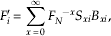
where S xi is the survival of individual i to age class x (one or zero), B xi is the number of female offspring born to individual i in age class x, and F N is an estimate of the finite rate of increase of the entire experimental cohort over the duration of one age class (i.e. five days in this experiment). F N is obtained from the stable-age equation (Lenski & Service, Reference Lenski and Service1982: equation 4), which was solved iteratively. The mean of the F′i is equal to F N (Lenski & Service, Reference Lenski and Service1982). F′i can, thus, be interpreted as the contribution of individual i to population growth, a meaningful measure of individual fitness (Lenski & Service, Reference Lenski and Service1982). Longevity was not analyzed as an individual trait because we knew that, at least under laboratory conditions on benign hosts, most aphids live for much longer than they reproduce (Vorburger, Reference Vorburger2005). As a consequence, most of the observed variation would be in a range that is irrelevant for ecological success. Nevertheless, any mortality prior to the termination of reproduction does affect fitness and is reflected in the total number of offspring and F′i in the present experiment.
Statistical analyses
We used linear mixed models with restricted maximum likelihood estimation as implemented in ASReml (VSN International; http://www.vsn-intl.com) to analyze genetic variation for life-history traits. First, univariate analyses were performed separately for each host plant with block as a fixed and clone as a random effect. We used the variance among clones as our estimate of the genetic variance and the residual variance as our estimate of the environmental variance to calculate the broad-sense heritability, H 2, for each trait as the ratio of the genetic variance to the phenotypic variance (variance among clones+residual variance). Standard errors for H 2 are reported as obtained from ASReml, which are calculated using the delta method (see Lynch & Walsh, Reference Lynch and Walsh1998: pp. 807–813); yet, to test whether heritabilities differed significantly from zero, we compared models with and without the effect of clone using log-likelihood ratio χ2-tests (LRTs). To compare heritabilities between host plants, t-tests were used. We also calculated coefficients of genetic variance, CV G, to compare levels of genetic variation on a scale standardized to trait size (evolvability: Houle, Reference Houle1992) between traits and treatments. This measure is analagous to CV A of Houle (Reference Houle1992) ; yet, due to the use of clones, reflects complete genetic variation rather than additive genetic variation.
Our data were insufficient to estimate the entire variance-covariance matrix of the six traits simultaneously, so we used bivariate models to estimate pairwise genetic correlations among traits on the same host as r g=cov (x, y)/[var (x)×var (y)]1/2. For significance tests of genetic correlations, we compared the log-likelihood of a model with an unrestricted genetic variance-covariance matrix with that of a model in which the genetic covariance among the two traits was restricted to zero. It is important to note here that, due to the life-history traits analyzed, the sign of the genetic correlations is not always consistent with their biological meaning. While for adult body size, fecundity, offspring size and F′i, higher values are biologically positive in the sense that they increase fitness, the opposite is true for development time. As a consequence, positive and not negative genetic correlations between development time and other traits would indicate a trade-off. For example, the commonly assumed trade-off between age and size at maturity would be reflected by a positive correlation between development time and adult body size. Among all traits in which higher values increase fitness, on the other hand, negative genetic correlations are consistent with trade-offs. For example, a trade-off between offspring size and offspring number should be reflected in a negative genetic correlation between fecundity and offspring size.
To address the potential of genotype×environment interactions, we used a mixed model that included the effects of host plant and clone, as well as their interaction. A block effect was also included. For traits in which the host plant×clone interaction was significant, we further quantified to what extent the interaction variance was caused by differences in the genetic variance between environments or by rank-order changes among environments, i.e. crossing reaction norms, using the formula of Robertson (Reference Robertson1959) :

where σ1 and σ2 are the genetic standard deviations of the trait in environment 1 and 2, respectively, and r 12 is the trait's genetic correlation across these two environments. The first component of the equation expresses the difference in genetic variance between environments and the latter component the variance due to crossing reaction norms. The cross-environment genetic correlations and their standard errors were calculated in ASReml by defining a trait measured on different host plants as two different traits (Falconer & Mackay, Reference Falconer and Mackay1996). For some comparisons, the correlation of clone means, r cm, was also calculated as an approximation of the genetic correlation (Via, Reference Via1991).
Results
Host effects on fitness components
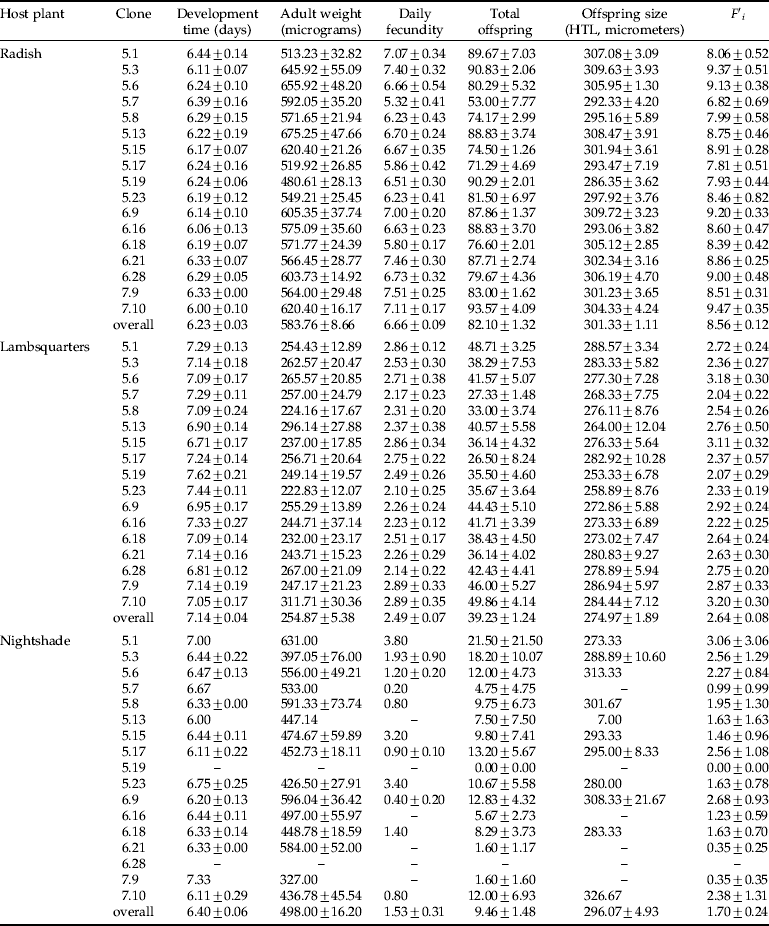
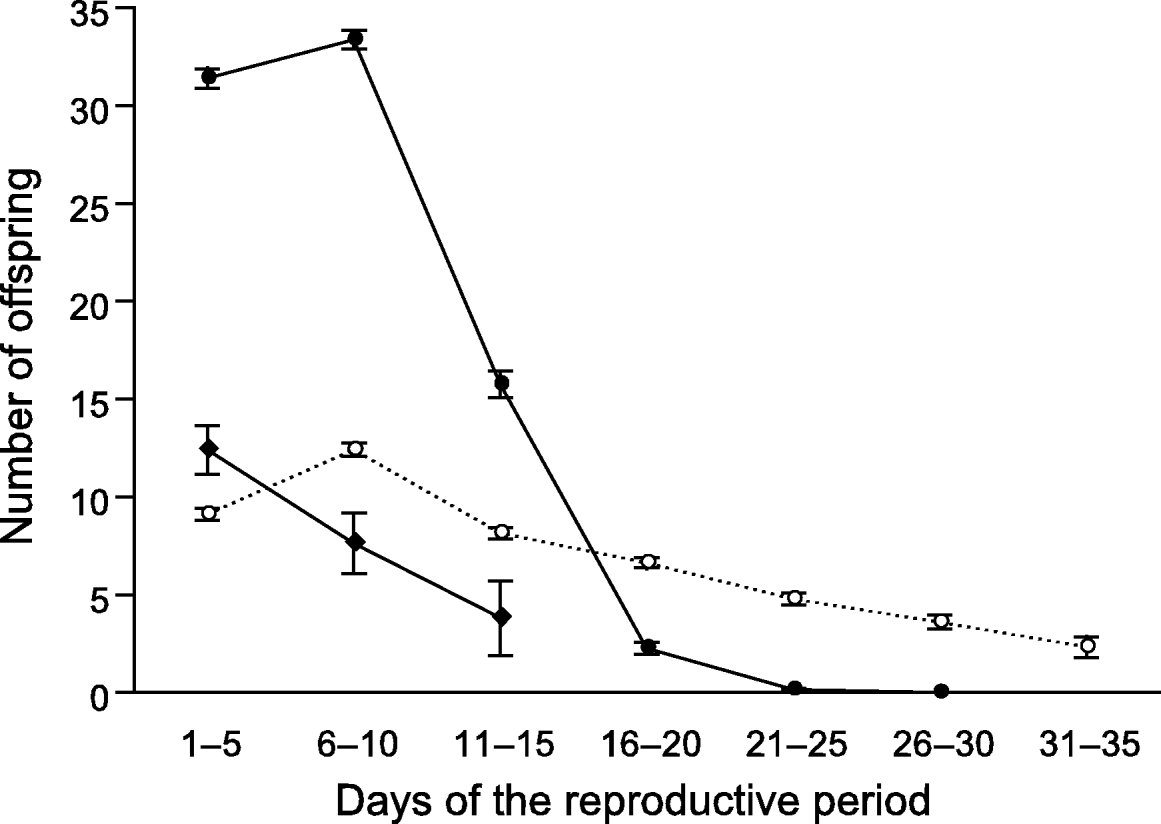
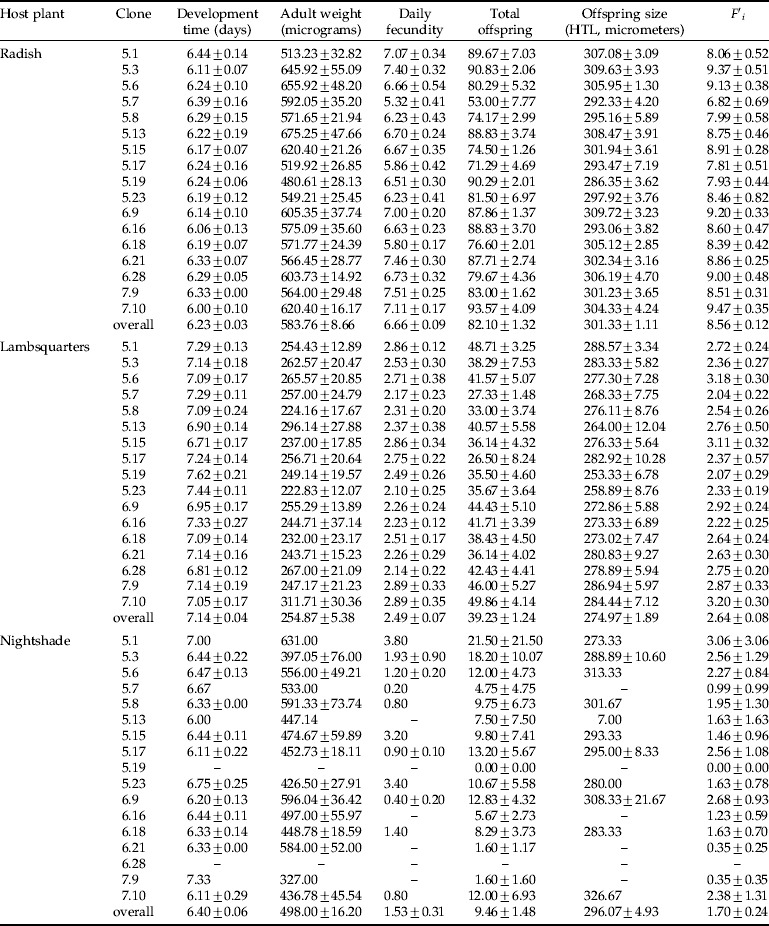
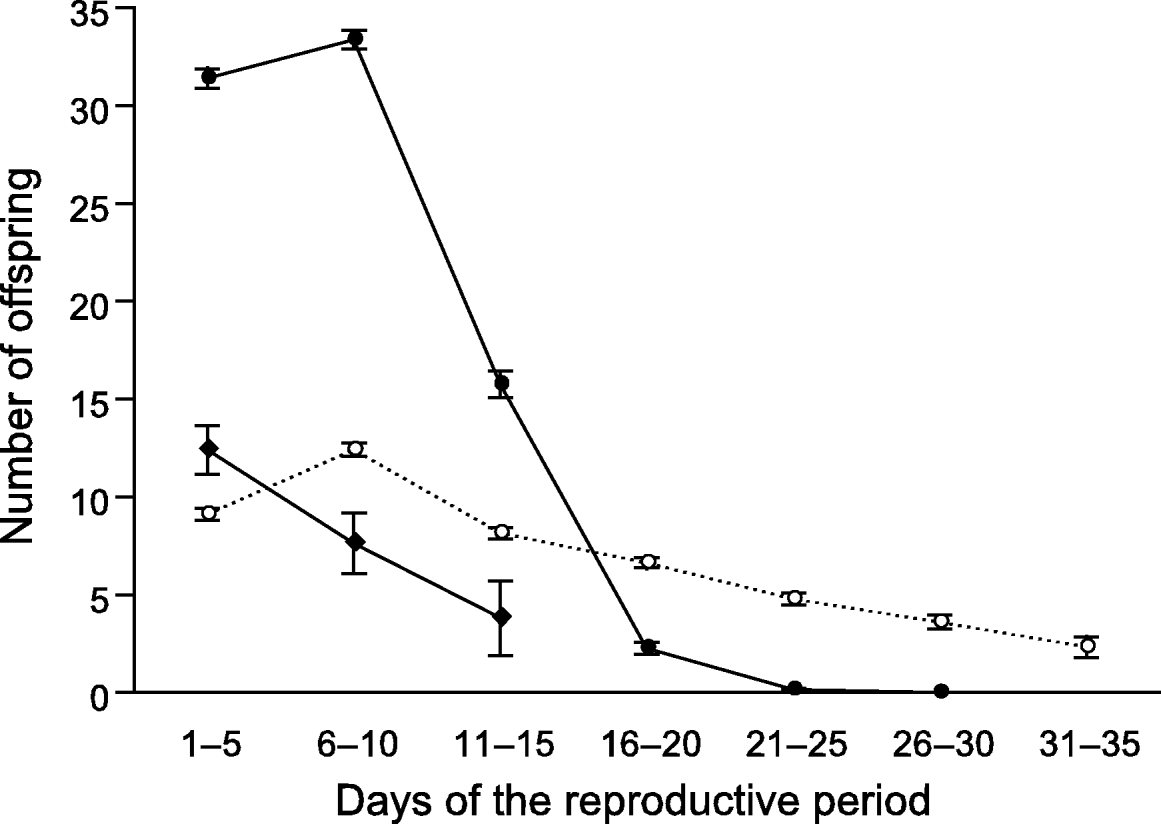
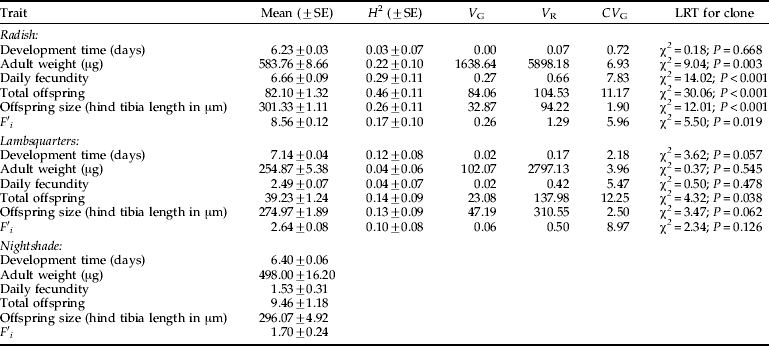
Radish was by far the most benign host plant for M. persicae used in this experiment. Compared to lambsquarters, aphids reached adult ecdysis about one day earlier and were more than two times heavier as adults (table 1). The daily fecundity was also much higher on radish and the offspring were larger. Interestingly, aphids on lambsquarters were able to maintain their lower level of reproduction over a longer period (fig. 1). Nevertheless, the total number of offspring produced over the entire lifetime on lambsquarters was only about half of that on radish, resulting in a much lower estimate of F′i. On nightshade, unfortunately, the mortality was so high that we lost about half of all sublines already before the test generation, resulting in poor and unbalanced replication of our measurements of life-history traits. No sublines were lost on the other two hosts, and survival during the test generation was also very high on radish and lambsquarters. The limited data we could obtain from nightshade show that development time is slightly longer than on radish, while adult and offspring size are slightly lower, yet substantially higher than on lambsquarters (table 1). Fecundity was very low on nightshade and, combined with early mortality, resulted in the lowest estimates of the finite rate of increase, F′i. Trait means for all clones on each host plant are provided in the appendix.
Mean number of offspring produced (±SE) per five-day interval by the 17 clones of Myzus persicae reared on three different host plants. No aphids reproduced for longer than 35 days after adult ecdysis (–•–, radish; · · ·○· · ·, lambsquarters, –◆–, nightshade).
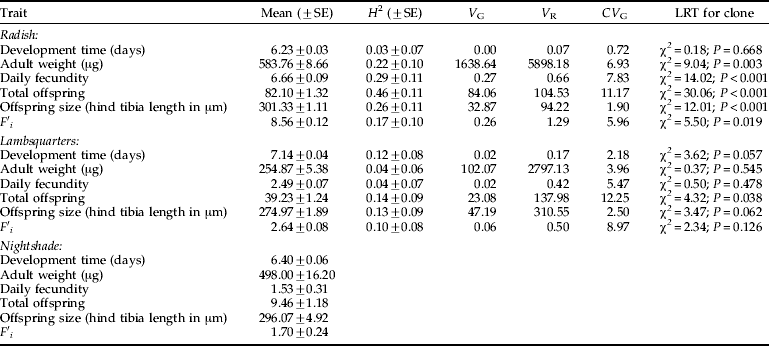
Mean phenotypic values, broad-sense heritabilities, genetic and residual variance components, as well as coefficients of genetic variation for six life-history traits of Myzus persicae measured on three different host plants. Log-likelihood ratio χ2-tests for the effect of clone are presented to infer whether heritability estimates differ significantly from zero. Genetic parameters could not be calculated for nightshade due to an insufficient number of sublines surviving until the test generation.
The low number of surviving sublines did not allow us to estimate the quantitative genetic parameters for life-history traits of aphids growing on nightshade. However, we found that the variation among clones in the proportion of sublines surviving until the test generation was larger than expected by chance (Fisher's exact test, P=0.005), indicating that there is genetic variation for survival on this challenging host.
Genetic variation
On radish, there was significant genetic variation for all traits except development time, with broad-sense heritabilities ranging between 0.17 and 0.46 (table 1). On lambsquarters, the heritability of development time was somewhat higher than on radish and almost significant at α=0.05. For all other traits, the heritabilites on lambsquarters were substantially lower than on radish and mostly non-significant (table 1). However, this difference in heritability was only significant for the total number of offspring produced (t 32=2.08, P=0.045).
Due to lambsquarters being a less benign host for M. persicae, mean trait values were much smaller on this host with the exception of development time, which was longer. A comparison of the coefficients of genetic variation shows that although heritabilities tend to be higher on radish, the amount of genetic variation scaled by trait means is actually comparable between the two hosts and sometimes even higher on lambsquarters (table 1).
Genetic correlations within hosts
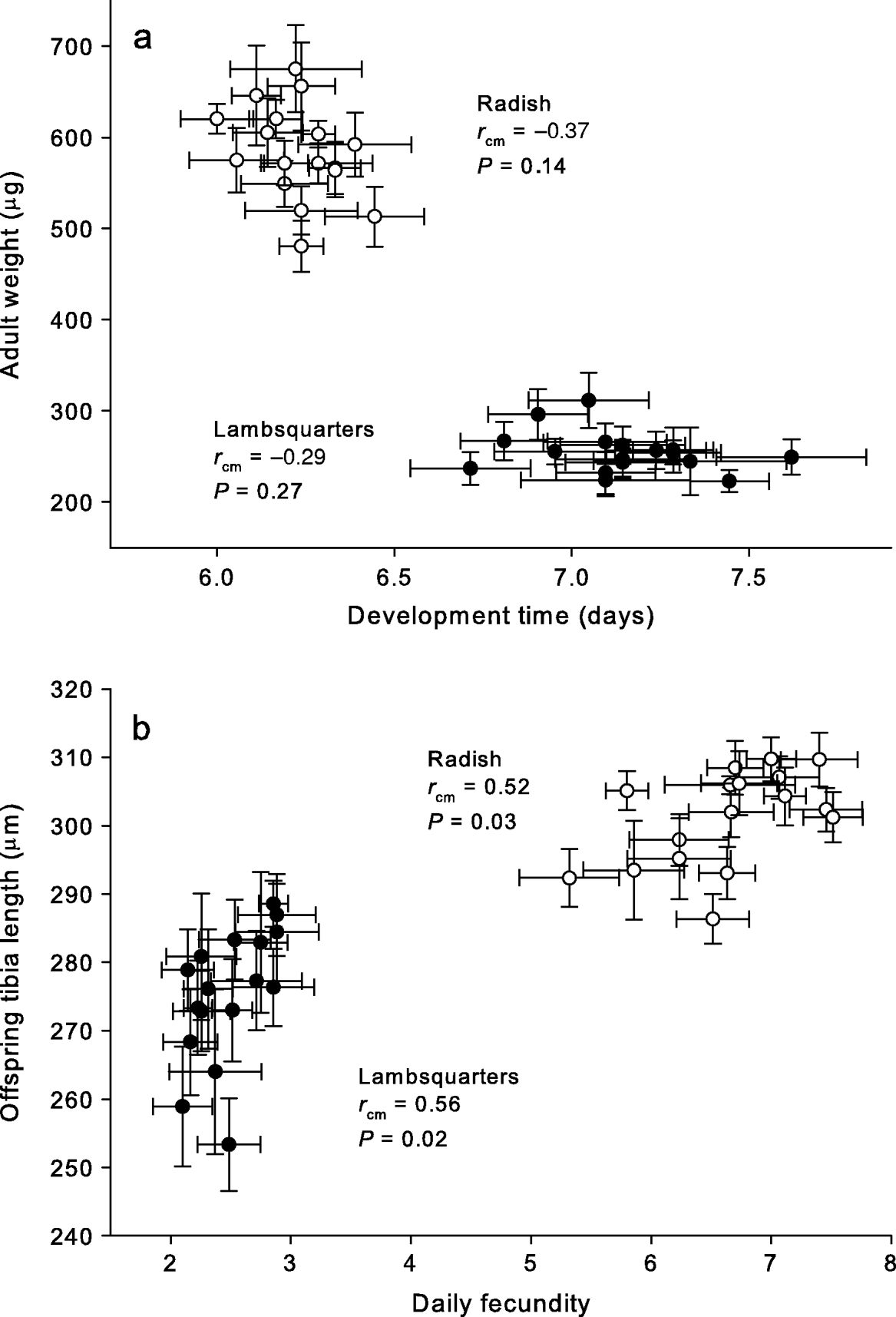
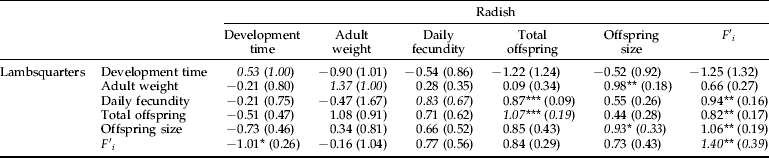
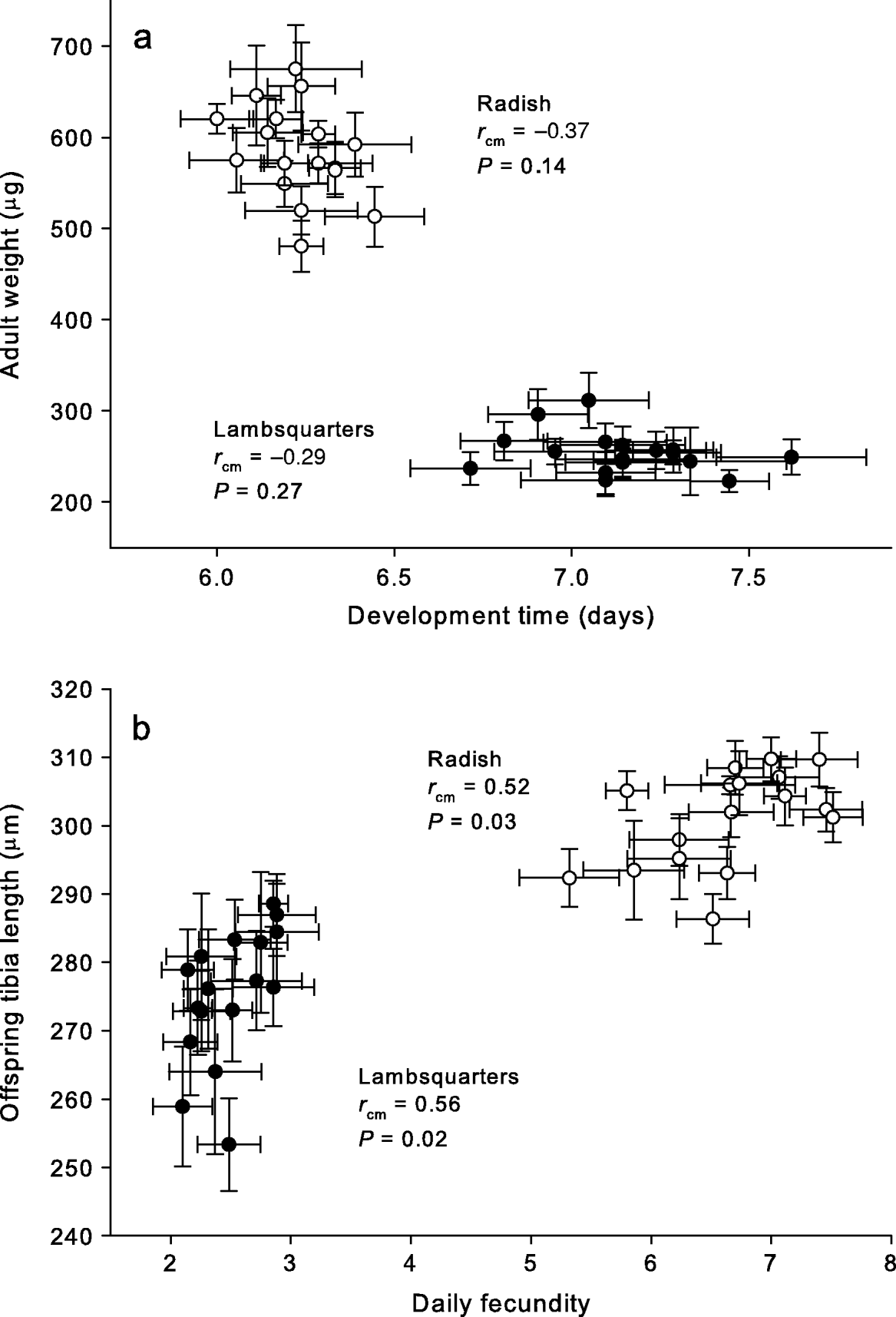
Estimates of genetic correlations notoriously exhibit large standard errors. In the present study, the precision of estimates is somewhat lower than in the previous study with the same clones on cabbage (Vorburger, Reference Vorburger2005) because, due to the inclusion of three host plants, clones were slightly less well replicated within hosts, resulting in fewer significant correlations. Nevertheless, the general pattern of genetic correlations was very similar to that found on cabbage by Vorburger (Reference Vorburger2005), in that they revealed very little evidence for allocation trade-offs among life-history traits (table 2). On radish as well as lambsquarters, all correlations between development time and other components of fitness were negative, suggesting that clones that develop faster tend to reach higher body size (i.e. no trade-off between age and size at maturity, see fig. 2a), which in turn results in higher fecundity and offspring size. This latter relationship is supported by exclusively positive genetic correlations among adult weight, daily fecundity, total offspring, offspring size and F′i on radish (table 2). These correlations were also predominantly positive on lambsquarters, the only two exceptions being weak negative correlations between adult weight and daily fecundity and adult weight and F′i, both estimated with low precision (table 2). Notably, high daily fecundity during the period of maximal reproduction tends to be associated with large offspring size on both hosts (fig. 2b), exhibiting the opposite of an often assumed size-number trade-off in offspring production. The genetic correlation among the two traits estimated with ASReml was not significant for either host (table 2), yet the Pearson correlation of clone means (r cm) shows a significantly positive association (fig. 2b).
Two examples of bivariate relationships between life-history traits in 17 clones of Myzus persicae (means±SE) reared on (○) radish or (•) lambsquarters. (a) Adult weight plotted against development time; (b) offspring size (hind tibia length) plotted against daily fecundity.
Pairwise genetic correlations among life-history traits of Myzus persicae reared on radish (above diagonal) and lambsquarters (below diagonal), as well as cross-environment genetic correlations of the same traits (diagonal, in italics). Standard error estimates obtained from ASReml are given in parentheses.
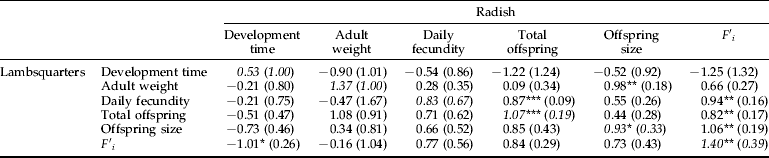
* P<0.05; ** P<0.01; *** P <0.001.
Genotype-by-environment interactions
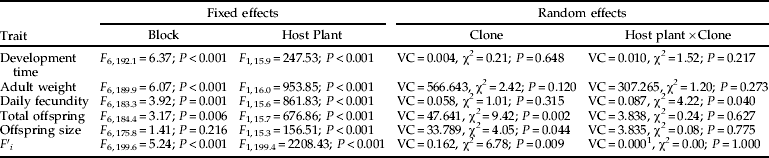
The univariate mixed models showed that the host plant×clone interaction contributed little to the observed variation in life-history traits on radish and lambsquarters (table 3). In fact, this interaction was only just significant for daily fecundity; and, even in that case, the application of Robertson's (Reference Robertson1959) approach showed that it resulted largely from a difference in the among-clone variance between the two treatments (86% of the G×E variance) rather than from the rank-order changes across environments (14% of the G×E variance).
Results of linear mixed models testing for the effects of block, host plant, clone and the host plant×clone interaction on life-history traits of 17 clones of Myzus persicae. The variance components (VC) for random effects are also reported.
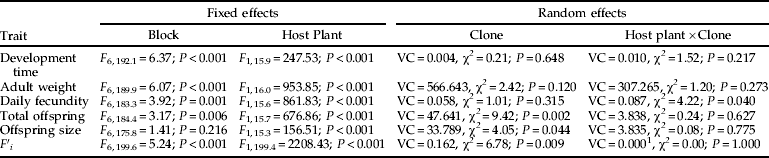
1 Variance component was fixed at the boundary of 0 by ASReml.
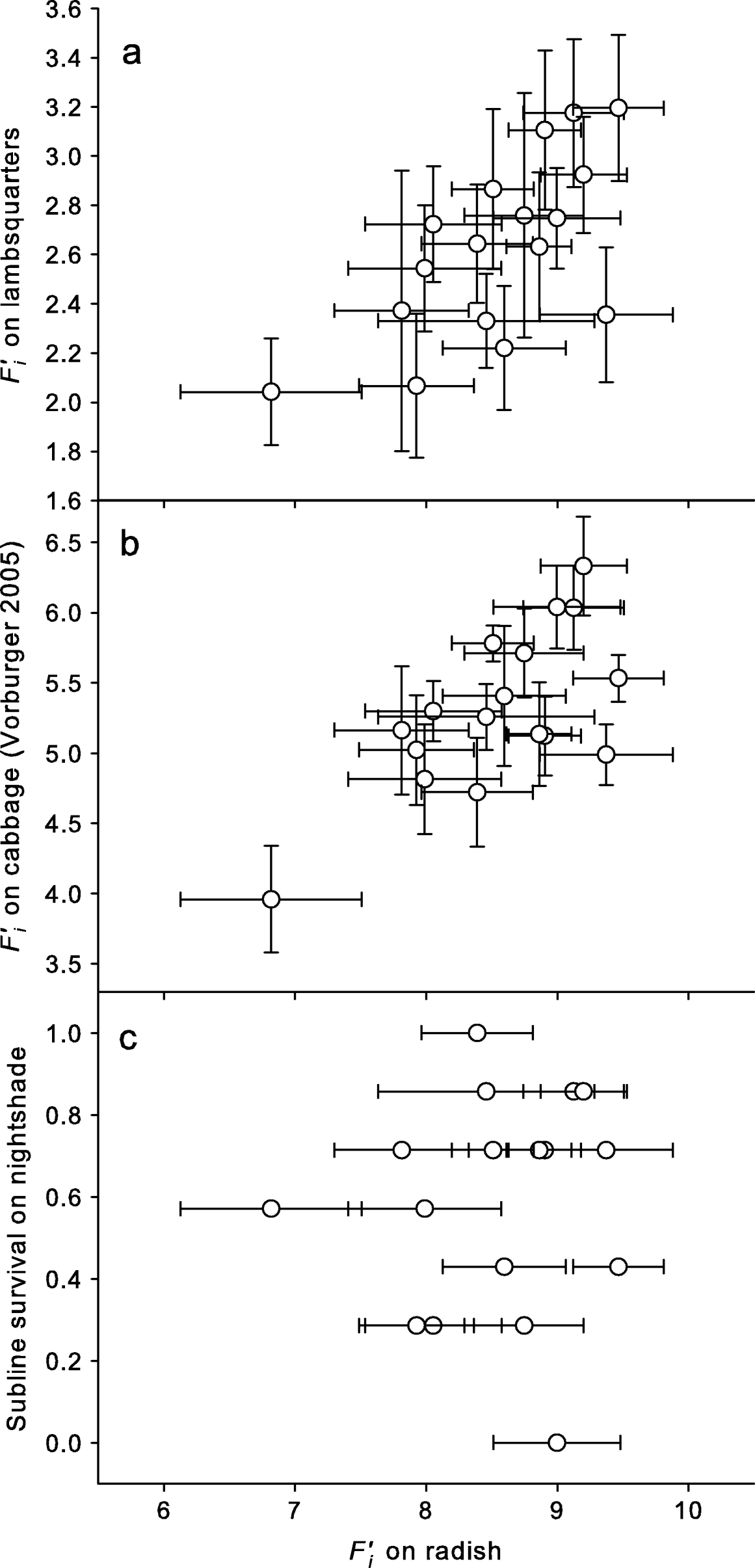
Accordingly, the cross-environment genetic correlations of all life-history traits were large and positive, significantly so for the total number of offspring, offspring size and F′i, our best estimate of overall fitness (table 2). Thus, a fit clone on radish tended to be a fit clone on lambsquarters, too (fig. 3a). None of the cross-environment genetic correlations were significantly different from unity, which is consistent with the lack of significant host plant×clone interactions due to rank-order changes across hosts.
Relationships between fitness of 17 clones of Myzus persicae estimated as mean F′i on radish and (a) mean F′i on lambsquarters, (b) mean F′i on cabbage, estimated in a different experiment by Vorburger (Reference Vorburger2005), and (c) the proportion of sublines surviving on nightshade for three generations in the present experiment.
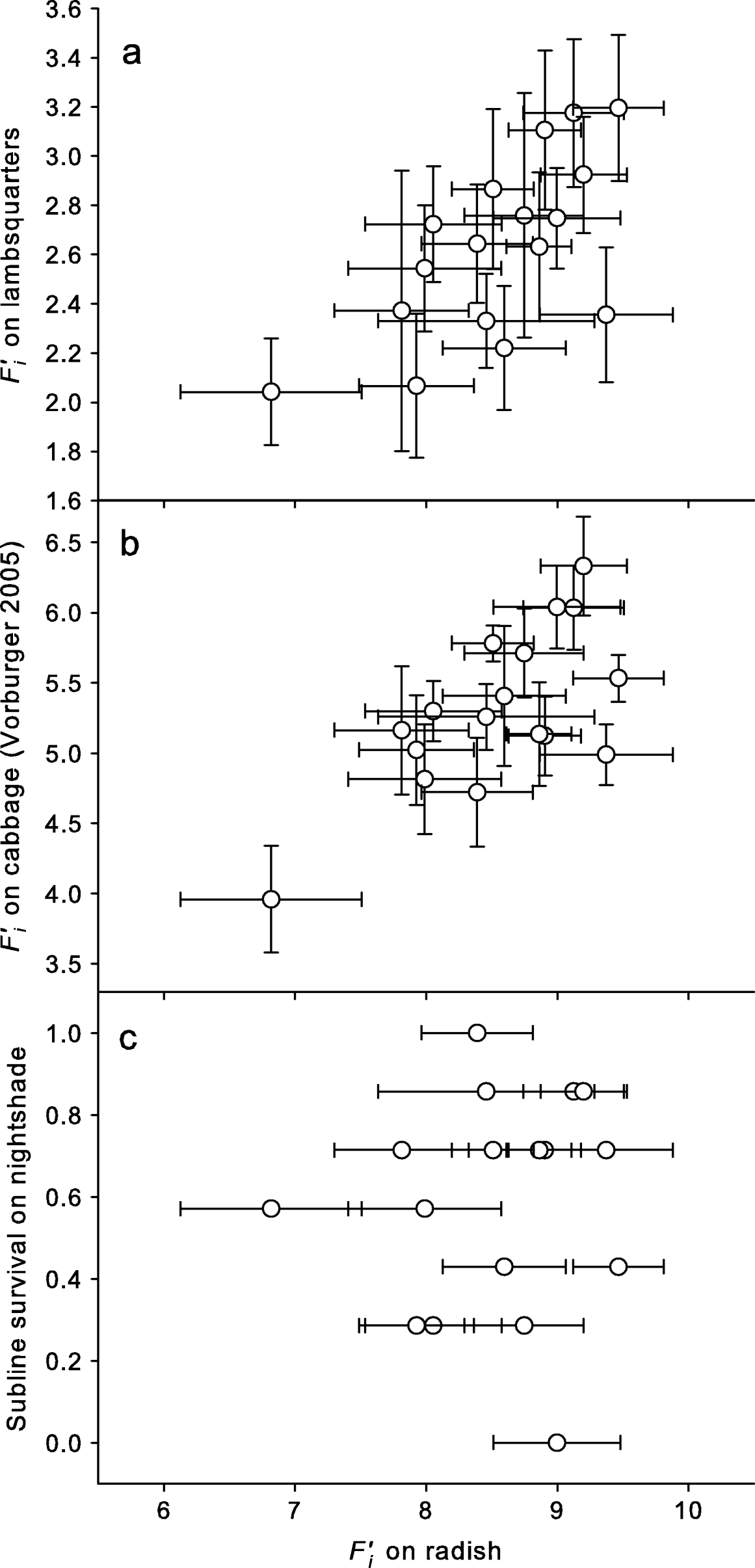
We also compared the estimates for F′i, obtained in the present experiment, with those from the previous life-table experiment with the same clones on cabbage, carried out about 18 months earlier (Vorburger, Reference Vorburger2005). With data obtained from two different experiments, we could only calculate correlations of clone means, r cm, as an approximation of the genetic correlation. These correlations were significantly positive (cabbage-radish: r cm=0.700, P=0.002, fig. 3b; cabbage-lambsquarters: r cm=0.639, P=0.006). We also used clone mean correlations to compare the proportion of surviving sublines on nightshade, the only meaningful estimate of fitness we could obtain on this challenging host, to F′i on the other, more benign hosts. All of these correlations were low and not significantly different from zero (nightshade-radish: r cm=0.074, P=0.778; nightshade-lambsquarters: r cm=0.115, P=0.659; nightshade-cabbage: r cm=−0.126, P=0.631). The relationship between subline survival on nightshade and F′i on radish is illustrated in fig. 3c.
Discussion
On a given host plant in this experiment, different components of fitness of the aphid Myzus persicae were positively associated, even components among which trade-offs could be expected, like development time and body size, or offspring size and offspring number. This confirms a previous finding obtained with the same clones on another host (Vorburger, Reference Vorburger2005). Yet the fact that the fitness hierarchy of clones remained so consistent across host plants, at least across those for which reliable data could be obtained, is counter to our working hypothesis that differences in host adaptation combined with spatial or temporal variation in host availability might maintain the observed genetic variation for life-history traits.
In the context of the evolution of plastic responses to host plants, our experiment indicates that on the unrelated host plants, radish and lambsquarters, the fitness components we measured exhibit little genetic variation for plasticity. Despite large differences in trait means, performance on the different hosts is strongly non-independent, which should hinder the evolution of genotype-specific performance on these hosts and, thus, host specialization. Of course, just two unrelated hosts are a poor representation of the wide variety of plants that M. persicae is able to colonize, and the almost complete lack of genotype×environment interactions observed on radish and lambsquarters may even be untypical. Several studies focusing on some simple fitness correlates do report significant host plant×clone interactions in M. persicae (Weber, Reference Weber1985, Reference Weber1986; Edwards, Reference Edwards2001; Peppe & Lomônaco, Reference Peppe and Lomônaco2003; Vorburger et al., Reference Vorburger, Sunnucks and Ward2003b). In fact, the lack of a correlation observed here between subline survival on nightshade and mean F′i on the two more benign hosts also suggests the potential for rank-order changes in fitness between nightshade and other hosts. Nevertheless, a real host utilization trade-off, expressed as a significant negative genetic correlation in performance, as found, for example, in pea aphids or black bean aphids (Via, Reference Via1991; Mackenzie, Reference Mackenzie1996), is yet to be demonstrated for M. persicae. There is, thus, little to support the idea that the positive genetic correlations among fitness components observed in M. persicae simply reflect host specialization and are maintained by trade-offs in an environment with temporally and spatially variable host availability.
Mutational variance acquired in the laboratory?
A potential problem with this experiment is that it was performed two years after collecting the clones in the field. Because it is prohibitively difficult to keep large numbers of aphid clones as mass cultures in the laboratory, we maintain clones on very small potted plants by transferring a few adults (typically 3–5) to new seedlings every generation, i.e. every 10–11 days. This procedure of serial bottlenecks results in high drift and, thus, a high probability of fixation for random, presumably deleterious mutations, raising the question of how representative the observed variation in the experiment is of the variation originally collected in the field. Although this is a concern that clearly has to be acknowledged, we believe that it does not invalidate the present results. The strong positive correlations of fitness estimates on cabbage, obtained shortly after the collection of clones (Vorburger, Reference Vorburger2005), and those on radish and lambsquarters, obtained here, would not be expected if mutational variance accumulated in the laboratory overrode the genetic variation retrieved from the field.
As an aside, random mutations might also occur at the microsatellite loci used to distinguish our clones. Such mutations would not affect the life-history variation we assayed, but be evident from a change in the microsatellite genotype compared to the one determined upon collection from the field. As yet, however, no such changes have been observed in our clones.
Comparison of heritabilities
Our experiment allowed the comparison of heritabilities of life-history traits between favourable (radish) and rather unfavourable conditions (lambsquarters). Whether environmental quality has consistent effects on trait heritabilities has been a long-standing discussion (Hoffmann & Parsons, Reference Hoffmann and Parsons1991, Reference Hoffmann and Parsons1997; Hoffmann & Merilä, Reference Hoffmann and Merilä1999; Charmantier & Garant, Reference Charmantier and Garant2005). Laboratory exposure to severe stresses like temperature extremes or desiccation were often found to increase heritabilities (Hoffmann & Parsons, Reference Hoffmann and Parsons1991), whereas a recent review of studies performed predominantly in wild populations suggests an increase of heritabilities under favourable conditions, especially for size- or growth-related traits (Charmantier & Garant, Reference Charmantier and Garant2005). The general trend in our study was also one toward higher heritabilities in the more benign environment, yet, that may at least partially be explained by higher trait means on radish. Traits are measured with error. If measurement error is independent of trait size, it will disproportionately inflate V R in the environment producing lower trait means, yielding lower heritabilities in turn (Houle, Reference Houle1992). This is supported by the fact that the only trait with a higher heritability on lambsquarters was development time, for which the mean was indeed higher in the more stressful environment.
The reduced reproductive performance, yet very high survival on lambsquarters, suggests that the stress imposed by this host was mainly nutritional. Thus, it is also worth considering the suggestion by Hoffmann & Merilä (Reference Hoffmann and Merilä1999) that nutritional stress, as opposed to other stress factors, may be peculiar in its effect on heritabilities of life-history traits, in that it prevents organisms from reaching their genetic potential. This may occur if the underlying genes largely determine a trait's maximum value, which cannot be realized under unfavourable conditions, resulting in a lower heritability due to reduced V G. Lifetime fecundity may be such a trait in M. persicae. On radish, a very benign host for this species (Vorburger et al., Reference Vorburger, Sunnucks and Ward2003b), most individuals ceased to reproduce long before their death, suggesting they reached their reproductive capacity. Accordingly, the heritability for this trait was much higher on radish than on lambsquarters, largely due to an almost fourfold higher V G (table 1).
Maintenance of genetic variation
The lack of evidence for negative genetic correlations of fitness among hosts in M. persicae – although consistent with a surprising number of studies on herbivorous insects (Joshi & Thompson, Reference Joshi and Thompson1995; Fry, Reference Fry1996) – leaves the question of how the observed genetic variation for life-history traits is maintained unanswered in M. persicae. Why are seemingly less vigorous genotypes not eliminated by selection? We must, of course, consider that our laboratory estimates of fitness are of limited relevance for fitness in the field. A laboratory experiment cannot capture the complexity of the natural host plant community, and many other factors of potential relevance were simply not manipulated. There is no doubt that the host plant is among the most important environmental variables for an aphid (Hales et al., Reference Hales, Tomiuk, Wöhrmann and Sunnucks1997), and the species we tested are important hosts for M. persicae, yet they represent nothing but a tiny fraction of this polyphagous species' host range. On the other hand, a previous study showed that laboratory-based estimates of fitness on cabbage (which are positively correlated with fitness on radish and lambsquarters; fig. 3a, b) tended to be positively related to the clones' abundance in the field (Vorburger, Reference Vorburger2005), suggesting that such estimates do have some predictive power for performance under field conditions. It is, therefore, advisable to consider hypotheses for the maintenance of the observed clonal variation in life-history traits that do not invoke host-utilization trade-offs. One potential explanation, already proposed earlier (Vorburger, Reference Vorburger2005), is that clones with a high rate of increase and, thus, a high investment in reproduction may be poorly defended against natural enemies, in particular parasitoids, which have a strong impact on aphid populations in the field (Schmidt et al., Reference Schmidt, Lauer, Purtauf, Thies, Schaefer and Tscharntke2003). Such clones would be favoured when parasitoids are rare but disfavoured when parasitoids are common, allowing temporal or spatial variation in parasitoid densities to maintain genetic variation. This hypothesis has received some support from a recent study by Gwynn et al. (Reference Gwynn, Callaghan, Gorham, Walters and Fellowes2005), who found that in the pea aphid, Acyrthosiphon pisum, clones with a high fecundity are more susceptible to the parasitoid Aphidius ervi. However, such a cost of resistance could not be detected in M. persicae. When exposed to two species of parasitoids, the clones used in the present study exhibited significant variation for resistance, but this variation was unrelated to fecundity, rate of increase or any other component of fitness measured here (von Burg et al., Reference von Burg, Ferrari, Müller and Vorburger2008). Yet even in the absence of a trade-off, as long as resistance and reproduction are not positively correlated, different clones may be favoured depending on whether selection on increased resistance or increased reproduction is more important in the environment. This prediction could be confirmed in experimental populations of M. persicae (Herzog et al., Reference Herzog, Müller and Vorburger2007). The role of natural enemies in maintaining clonal diversity in parthenogenetic populations of aphids, thus, clearly deserves further attention.
To summarize, we report strong genetic differences in components of fitness and rather consistent fitness hierarchies across different hosts in a collection of field-collected clones of the aphid M. persicae. Yet to conclude that genotype×environment interactions are unimportant in maintaining the observed genetic variation would be premature. The host plants we used represent a mere trickle of the natural variation and many other important factors like temperature, predators or pathogens remained untested. Also, it seems reasonable to assume that under mutation-selection balance (Lande, Reference Lande1976), unconditionally deleterious mutations could contribute to the variation present in field populations (Charlesworth, Reference Charlesworth1990; Houle, Reference Houle1991; Houle et al., Reference Houle, Hughes, Hoffmaster, Ihara, Assimacopoulos, Canada and Charlesworth1994). Nevertheless, observing genetically-based fitness differences of this magnitude (the most fecund clones produced nearly twice as many offspring as the least fecund ones, see appendix), in a population consisting predominantly of obligate parthenogens, leaves us with the uncomfortable feeling that some essential factor maintaining this variation is not understood. It seems that such seemingly unfit genotypes must compensate by some selective advantage that is yet to be discovered.
Acknowledgements
We thank Vanessa Kellermann and Christina Schmuki for maintaining the aphid lines in Australia and the Swiss Federal Office for Agriculture for the permit to translocate them to the University of Zürich. Many thanks also to Antje Wissgott for providing a protocol to improve germination of Solanum nigrum seeds, to Paul Bienz for help with the cultures and to two reviewers for helpful comments on an earlier version of the manuscript. This study was supported by the ‘Forschungskredit’ of the University of Zürich and the Swiss National Science Foundation.
Clone means (±SE) for the six life-history traits assayed in the life-table experiment. HTL stands for hind tibia length measured on newly born first instar nymphs as an estimate of offspring size.