Background
With the increasing prevalence of Alzheimer’s disease (AD) in the aging population, much attention has been given to screening for the early stages of dementia (Friedrich, Reference Friedrich2009; Nestor, Scheltens, & Hodges, Reference Nestor, Scheltens and Hodges2004). Screening is carried out using brief, focused evaluations (tools) that can provide quantitative information on global cognitive function. Screening tools do not provide a diagnosis of dementia; rather, they serve as indicators of the need for further clinical evaluation for those with suspected cognitive impairment. Screening should not be “population-based” (i.e., given to an entire population over a certain age) since diagnosing dementia is a complex process, and there is no single test that can confirm a diagnosis (Alzheimer Society of Canada, 2008). With the poor diagnostic accuracy of many screening tools, population-based screening would result in a high number of false positive and false negative test results which would negatively influence the use of health care resources (ASC, 2008). However, the ASC does promote early detection of dementia which would allow a person with dementia to make decisions on the course of his/her care while still cognitively capable.
The benefits of early detection may be significant; an early diagnosis of AD would allow a person to potentially benefit from drug and non-pharmaceutical therapies which may improve memory or delay memory decline (Chang & Silverman, Reference Chang and Silverman2004; Kerwin, Reference Kerwin2009). People considered to have mild cognitive impairment (MCI) have cognitive changes beyond normal aging which may or may not develop into dementia (Weiner & Lipton, Reference Weiner and Lipton2009). This phase corresponds to the threshold between normal aging and dementia, allowing the earliest symptoms to be recognized. As a result, identifying those who will go on to develop dementia (e.g., Alzheimer’s disease) is important for effective management of the disease (Weiner & Lipton, Reference Weiner and Lipton2009). Therefore, identifying the screening tool best able to detect the disease early will make a significant contribution to health care delivery. Early detection of dementia may help promote greater quality of life for those with the disease and allow them to actively plan for the future while they are still cognitively capable.
Brief screening tools can provide focused evaluations that are both practical and cost-effective (Kerwin, Reference Kerwin2009). Given time constraints in primary care settings, the use of screening tools by front-line practitioners can be extremely valuable when assessing a high volume of people experiencing cognitive impairment. With the aging population increasing and the increased risk of a person with MCI developing dementia, the American Academy of Neurology has recommended that brief screening instruments be used to assess individuals with suspected cognitive decline (Rozzini et al., Reference Rozzini, Chilovi, Bertoletti, Conti, Delrio and Trabucchi2008).
Currently, there are several screening tools that can be used for the detection of cognitive impairment such as the Mini-Mental State Exam (MMSE) (Folstein, Folstein, & McHugh, Reference Folstein, Folstein and McHugh1975) and the Montreal Cognitive Assessment (MoCA) (Nasreddine et al., Reference Nasreddine, Phillips, Bedirian, Charbonneau, Whitehead and Collin2005). The MMSE is the most widely used tool because of its accuracy in detecting cognitive impairment; consequently, newly developed screening tools are typically compared to the MMSE. Due to the numerous screening tools available, an updated systematic review on the reliability, validity, feasibility, and utility of screening tools is required. There is a paucity of literature that compares the effectiveness of screening tools in predicting the development of dementia. With the importance of early detection using screening instruments, it is necessary to identify which tools are feasible for use by front-line practitioners and also have the ability to predict the development of dementia.
The focus of this systematic review was to examine screening tools that can “predict” dementia based on “early” detection of cognitive impairment. This umbrella term encompasses MCI, amnestic MCI, mild dementia, and questionable dementia. The cognitive impairment can then be evaluated over time (using a “gold standard” tool) to observe and monitor the disease progression.
Research Question
Which screening tool best predicts dementia and is feasible to administer by front-line health care practitioners?
Methods
Relevance Criteria
The following relevance criteria were established for articles to be included in this review:
• published after 1995 as there was not a significant amount of literature on this topic before this date;
• published in English;
• include instruments/questionnaires used for screening dementia;
• screening tools must be “single” instruments that can be administered without specialized training, as opposed to a battery of neuropsychological tests;
• screening tools must (or have been shown to) be valid and reliable measures of cognitive impairment; and
• study design must be longitudinal (i.e., include a follow-up period of at least six months).
These criteria were used as a guide for the search strategy to ensure relevant articles were identified.
Search Strategy
In consultation with a health sciences librarian, we conducted searches using the following databases; Ovid Medline, Scopus, Cumulative Index to Nursing and Allied Health Literature (CINAHL), Excerpta Medica Database (EMBASE), PsycInfo, Sociological Abstracts, Cochrane Library, ProQuest dissertations and theses, Health and Psychosocial Instruments, and Web of Science. Search terms were divided according to three concepts: “screening tools”, “dementia”, and “study type”. Keywords and subject headings were combined with OR and AND across concepts so that all three concepts were combined appropriately. For the first concept, screening tools, we included relevant keywords and subject headings, such as sensitivity and specificity, screening tools, and psychological tests to capture studies that specifically incorporated cognitive tests. The second concept, dementia, included search terms – such as early dementia, mild cognitive impairment, and questionable dementia – to capture the early phase of dementia. The final concept, study type, included words – such as longitudinal, follow-up, and predict – in order to obtain studies that administered a screening tool longitudinally to determine a predictive effect. Keywords and subject headings varied slightly according to the database, and in some cases, the last concept (study type) was excluded if the combination of the first two concepts yielded a small number.
Selecting Studies from Search Results
References from all of the databases that appeared to meet the relevance criteria were imported into RefWorks-COS RefWorks software program. Overlapping references across databases were detected and duplications were excluded. Two reviewers selected articles for further review by evaluating all titles and abstracts using the relevance criteria. Reviewers tended to be overly inclusive at this stage to ensure that studies related to the topic of screening for dementia were not overlooked.
Assessing Studies for Relevance
Abstracts and titles were reviewed independently for potential relevance by two reviewers. When consensus was reached between the reviewers on which articles to obtain, full versions of these potentially relevant papers were retrieved. When no consensus was reached, the full text was retrieved for further review to ensure that relevant articles were not excluded. All retrieved papers were then further evaluated independently by each reviewer using a “relevance tool” comprising a list of questions answered with “yes”, “no”, or “unclear” responses.
The first question addressed the study design in which a minimum follow-up of at least six months was required. Previous studies have found that cognitive changes can develop over a six-month to one-year time period (Mariani, Monastero, & Mecocci, Reference Mariani, Monastero and Mecocci2007; Smith, Gildeh, & Holmes, Reference Smith, Gildeh and Holmes2007). This potential for development of cognitive changes was the most important criterion that needed to be met since follow-up evaluations are essential in determining predictive effects of a screening tool.
The next three questions evaluated the screening tools used in the study. To assess for feasibility, these tools needed to be “single” instruments as opposed to a battery of neuropsychological tests. As well, the screening tools had to be valid and reliable measures of cognitive impairment and used to detect dementia in its early stages. To demonstrate the tool’s ability to measure early dementia, the authors of the study to be included must have administered the screening tool at baseline to a participant group who were either cognitively intact or mildly impaired. Lastly, the sensitivity and specificity of the tool must have been determined. These are standard properties of diagnostic tests that reveal how accurately the condition or disease is detected.
After evaluation completion with the relevance tool, the reviewers compared their ratings. Disagreements in scoring the relevance tool were resolved by consulting with a third reviewer. When criteria were rated as “unclear”, the corresponding author of that paper was contacted to obtain the missing information or to confirm that information was absent from the study. Studies that had any question rated as “no” on the relevance tool were excluded.
Evaluating Quality of the Studies
We used the Quality Assessment of Diagnostic Accuracy Studies (QUADAS) tool (Whiting, Rutjes, Reitsma, Bossuyt, & Kleijnen, Reference Whiting, Rutjes, Reitsma, Bossuyt and Kleijnen2003) to assess the quality of the studies meeting the relevance criteria. The QUADAS tool provides specific guidance for systematic reviews evaluating the methodological quality of diagnostic studies (Hollingworth et al., Reference Haynes, Sackett, Guyatt and Tugwell2006) and consists of 14 questions scored as “yes”, “no”, or “unclear”. Domains evaluated include “patient spectrum, reference standard, disease progression bias, verification bias, review bias, clinical review bias, incorporation bias, test execution, study withdrawals, and intermediate results” (Whiting et al., Reference Whiting, Rutjes, Reitsma, Bossuyt and Kleijnen2003, p. 1). Two reviewers independently evaluated each included study using the QUADAS tool. Disagreements in scoring the QUADAS were resolved by consulting with a third reviewer.
Data Extraction
Data for all included studies were extracted by the first author with the use of a data extraction tool. This included participant demographics and cognitive status, specificity, sensitivity, and test scores (from both the reference and index test) at baseline and at follow-up. The reference standard is the “gold standard” (i.e., a test that is 100% sensitive and specific in detecting the disease) to which the index test (i.e., the screening tool) is compared for accuracy. The authors of four relevant articles with missing data were contacted for information likely to be available – but not reported in the published article – such as participant demographics, baseline, and follow-up scores for the index test. Three authors responded, and two of these (Srikanth et al., Reference Srikanth, Thrift, Fryer, Saling, Dewey and Sturm2006; Tierney et al., Reference Tierney, Szalai, Dunn, Geslani and McDowell2000) were able to provide the missing data. The third author to respond did not calculate the missing data (sensitivity and specificity analysis), and therefore that paper was excluded from our review. One of the four contacted authors did not respond and was also excluded from the review since cognitive status at follow-up was not available in the published article.
Assessment of Cognitive Domains and Items in Screening Tools
The screening tools used in the included studies were evaluated based on cognitive domains and item coverage. This was done to determine similarities and differences between screening tools in terms of their comprehensiveness. The first author mapped individual test items for each screening tool onto the appropriate cognitive domain.
Results
Screening Tests Identified
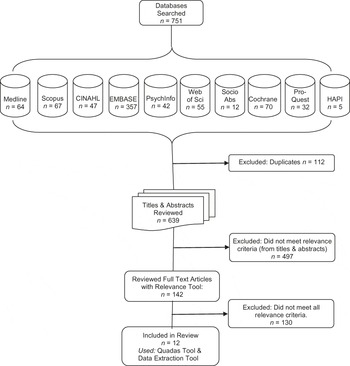
Figure 1 shows a detailed flow diagram of the numbers of included and excluded articles at each stage of the search strategy and selection strategy. The initial search yielded 751 references. After the removal of duplicate articles, 639 references remained. The titles and abstracts were independently reviewed by two reviewers. Of the 639 references, 142 potentially met the relevance criteria, and full-text papers were retrieved for further review. After completion of the evaluation with the relevance tool, 12 studies (encompassing 15 screening tools) remained in the review. The 15 screening tools obtained for this review include the following:
• Alzheimer Disease Assessment Scale Cognitive Subscale (ADAS-cog) (Rosen, Mohs, & Davis, Reference Rosen, Mohs and Davis1984)
• Benton’s Visual Retention Test (BVRT) (Benton, Reference Benton1965)
• Cambridge Cognitive Examination (CAMCOG) (Roth et al., Reference Roth, Tym, Mountjoy, Huppert, Hendrie and Verma1986)
• Cognitive Capacity Screening Examination (CCSE) (Jacobs, Bernhard, Delgado, & Strain, Reference Jacobs, Bernhard, Delgado and Strain1977)
• Isaacs Set Test (IST) (Isaacs & Kennie, Reference Isaacs and Kennie1973)
• Standardized Mini-Mental State Examination (S-MMSE) (Molloy, Alemayehu, & Roberts, Reference Molloy, Alemayehu and Roberts1991)
• Addenbrooke’s Cognitive Examination (ACE) (Mathuranath, Nestor, Berrios, Rakowicz, & Hodges, Reference Mathuranath, Nestor, Berrios, Rakowicz and Hodges2000)
• Addenbrooke’s Cognitive Examination Revised (ACE-R) (Mioshi, Dawson, Mitchell, Arnold, & Hodges, Reference Mioshi, Dawson, Mitchell, Arnold and Hodges2006)
• Chinese Abbreviated Mild Cognitive Impairment Test (CAMCI) (Lam et al., Reference Lam, Tam, Lui, Chan, Chan and Chui2008)
• Informant Questionnaire on Cognitive Decline in the Elderly (IQCODE) (Jorm & Jacomb, Reference Jorm and Jacomb1989)
• Memory Impairment Screen (MIS) (Buschke et al., Reference Buschke, Kuslansky, Katz, Stewart, Sliwinski and Eckholdt1999)
• Mini Mental State Examination (MMSE) (Folstein et al., Reference Folstein, Folstein and McHugh1975)
• Montreal Cognitive Assessment (MoCA) (Nasreddine et al., Reference Nasreddine, Collin, Chertkow, Phillips, Bergman and Whitehead2003)
• Revised Hasegawa’s Dementia Scale (HDS-R) (Imai & Hasegawa, Reference Imai and Hasegawa1994)
• Short Test of Mental Status (STMS) (Kokmen, Naessens, & Offord, Reference Kokmen, Naessens and Offord1987)
Flow Diagram of Search Strategy and Selection Process

Several studies that met the relevance criteria for full-text review were eventually excluded primarily due to a lack of follow-up or insufficient follow-up duration. Many of these excluded studies conducted logistic regression analysis with baseline data to produce pseudo-follow-up scores or predict diagnosis. Although these statistical measures are recognized as valid, actual follow-up assessments are more accurate. Therefore, we included only studies with follow-up evaluations.
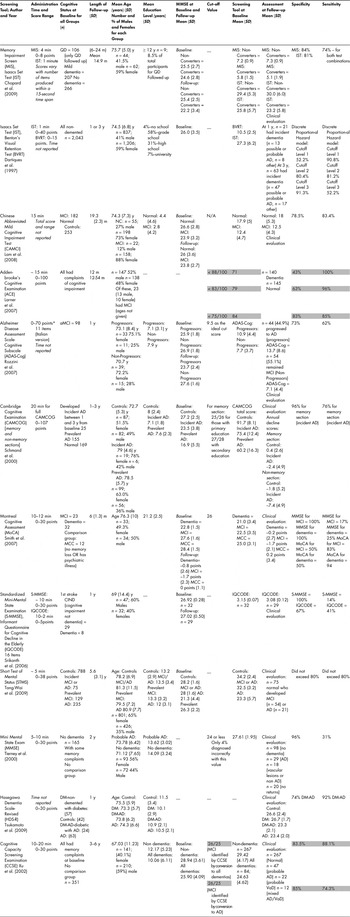
Data extracted from all 12 studies are reported in Table 1. This table presents basic screening tool information such as administration time, participant demographic information, cognitive status at baseline, screening tool and gold standard assessments at baseline and follow-up, as well as the sensitivity and specificity of the screening tool used. Every study – except for Xu, Meyer, Thornby, Chowdhury and Quach (Reference Xu, Meyer, Thornby, Chowdhury and Quach2002), Larner, (Reference Larner2007), and Tsukamoto et al. (Reference Tsukamoto, Akisaki, Kuranaga, Takata, Yokono and Sakirai2009) – compared their screening tool with the MMSE as the reference test, whereas Tierney, Szalai, Dunn, Geslani, & McDowell (Reference Tierney, Szalai, Dunn, Geslani and McDowell2000) used the MMSE as their index test. All studies included a clinical evaluation and extensive neuropsychological assessments at follow-up to confirm final diagnosis.
Characteristics of studies using screening tools to detect early dementia

* indicates that a higher test score signifies cognitive impairment
Dashes indicate data that was not obtained or not reported
AD = Alzheimer’s disease
aMCI = amnestic mild cognitive impairment
CCSE = Cognitive Capacity Screening Examination
Cut-off value = discriminates the presence or absence of cognitive impairment for the comparison tool
DM = non-demented subjects with type 2 diabetes
DM-AD = diabetic patients with Alzheimer’s disease
IST = Isaacs Set Test
m = months
MCC = memory clinic comparison group
MCI = mild cognitive impairment
min = minutes
MIS = Memory Impairment Screen
MMSE = Mini-Mental State Examination
MoCA = Montreal Cognitive Assessment
N/A = not applicable
NC = normal control
n= number of people
QD = questionable dementia
SD = standard deviation
VaD = vascular dementia
y = years
Methodological Quality of Included Studies
Two reviewers completed the QUADAS tool for the 12 included studies. The majority of answers to the QUADAS items were “yes”, and nine studies obtained perfect scores. Three studies (Chopard et al., Reference Chopard, Vanholsbeek, Tio, Pitard, Binetruy and Rumbach2009; Larner, Reference Larner2007; Tsukamoto et al., Reference Tsukamoto, Akisaki, Kuranaga, Takata, Yokono and Sakirai2009) had answers of “no” to one or two of the items. Questions 3 to 11 of the QUADAS tool referred to an index test and reference standard. The authors of included studies considered the index test as the screening tool and used a full clinical examination and diagnosis as the reference standard (“gold standard”). It is recommended that a total summary QUADAS score not be used to categorize studies as high quality or low quality, but that a general interpretation be considered of the responses to all of the items (Hollingworth et al., Reference Haynes, Sackett, Guyatt and Tugwell2006). Since most of the items were rated as “yes” without any ambiguity, these studies were judged as being of high quality. However, answers of “no” only diminish the quality of the study depending on the importance of that particular item since not all items on the QUADAS are of equal importance (Hollingworth et al., Reference Haynes, Sackett, Guyatt and Tugwell2006). Decisions regarding the relative importance of the individual QUADAS items were decided by the first author and one other member of the research team on the basis of the research question and relevance criteria for this review.
Test Accuracy
Cognitive screens should be statistically robust (i.e., of high sensitivity and specificity) and compare well with their associated reference standard (e.g., MMSE), and clinical (e.g., DSM-IV, American Psychiatric Association, 2000), radiological (e.g., MRI), and laboratory (e.g., cerebrospinal fluid analysis) examinations. It should be noted that although several studies used the MMSE as a comparator tool and sometimes referred to it as a “reference standard”, the MMSE is far from perfect, and a full clinical examination is considered to be the ideal reference standard. Specificity refers to the percentage of participants that does not have cognitive impairment and was correctly identified as unimpaired by the test. Sensitivity refers to the percentage of participants that does have a cognitive impairment and was correctly identified by the test as impaired. Screening tools require the determination of the best cut-off value that discriminates those who are cognitively impaired and those who are not. The cut-off value is a point chosen along a score range that distinguishes clearly and consistently the absence or presence of cognitive impairment therefore influencing sensitivity and specificity. As well, some studies may show several cut-off points for their screening tool to determine which is best for optimal sensitivity and specificity (Table 1).
The MMSE (Tierney et al., Reference Tierney, Szalai, Dunn, Geslani and McDowell2000) and the S-MMSE (Srikanth et al., Reference Srikanth, Thrift, Fryer, Saling, Dewey and Sturm2006) had the highest specificity rates at 96 per cent and 100 per cent respectively while the memory section of the CAMCOG (Schmand, Walstra, Lindeboom, Teunisse, & Jonker, Reference Schmand, Walstra, Lindeboom, Teunisse and Jonker2000) also had high specificity (96%). Tests with the lowest specificities included the MoCA (Smith et al., Reference Smith, Gildeh and Holmes2007) at 50 per cent for both the MCI and dementia groups; the ACE (Larner, Reference Larner2007) at 43 per cent for the first cut-off level (88/100), and the combination of the MMSE, IST, and BVRT (Dartiques et al., Reference Dartiques, Commenges, Letenneur, Barber-Gateau, Gilleron and Fabrigoule1997) at 52.2 per cent for the first cut-off value. However, Larner and Dartiques et al. also reported additional cut-off values with improved specificities. Dartiques et al. determined a total of three cut-off values using the discrete proportional hazard model to determine the three-year probability of occurrence of AD.
Tests with the highest sensitivities included the HDS-R (Tsukamoto et al., Reference Tsukamoto, Akisaki, Kuranaga, Takata, Yokono and Sakirai2009) at 92 per cent for the dementia-diabetic group; the ACE (Larner, Reference Larner2007) at 100 per cent and 96 per cent for the first (88/100) and second (83/100) cut-off values respectively; the MoCA (Smith et al., Reference Smith, Gildeh and Holmes2007) at 94 per cent for the dementia group and 83 per cent for the MCI group; the CAMCI (Lam et al., Reference Lam, Tam, Lui, Chan, Chan and Chui2008) at 83.4 per cent; the CCSE (Xu et al., Reference Xu, Meyer, Thornby, Chowdhury and Quach2002) at 88.1 per cent, and the combination of the MMSE, IST, and BVRT (Dartiques et al., Reference Dartiques, Commenges, Letenneur, Barber-Gateau, Gilleron and Fabrigoule1997) at 90.8 per cent for the first cut-off level. Tests with the lowest sensitivities included the MMSE (Tierney et al., Reference Tierney, Szalai, Dunn, Geslani and McDowell2000) at 31 per cent; as well as the S-MMSE and IQCODE at 14 per cent and 41 per cent respectively (Srikanth et al., Reference Srikanth, Thrift, Fryer, Saling, Dewey and Sturm2006).
Predictive Ability
Several investigators calculated the predictive power of their instrument using receiver operating characteristic (ROC) analysis (sensitivity vs. 1-specificity). Predictive power is represented by the area under the ROC curve (AUC). An ideal test would be 100 per cent sensitive and 100 per cent specific resulting in an AUC of 1.0. An AUC higher than 0.5 indicates good classification results (Haynes, Sackett, Guyatt, & Tugwell, Reference Haynes, Sackett, Guyatt and Tugwell2006).
Rozzini et al. (Reference Rozzini, Chilovi, Bertoletti, Conti, Delrio and Trabucchi2008) found the ADAS-Cog to be reasonable in predicting the progression of aMCI participants to AD at one-year follow-up (AUC = 0.67; sensitivity = 62%, specificity = 73%). Schmand et al. (Reference Schmand, Walstra, Lindeboom, Teunisse and Jonker2000) found that the memory section of the CAMCOG predicts incident dementia (i.e., participants who had no cognitive impairment at baseline but subsequently developed dementia over the course of the study) better than the MMSE (AUC = 0.80). Larner (Reference Larner2007) demonstrated good diagnostic accuracy with an AUC of 0.98 for the ACE. Although Smith et al. (Reference Smith, Gildeh and Holmes2007) did not conduct a ROC curve analysis, the MoCA was found to be a good screening tool for predicting dementia in subjects with MCI as demonstrated with its high sensitivity (see Table 1).
Tierney et al. (Reference Tierney, Szalai, Dunn, Geslani and McDowell2000) established that the MMSE accurately predicts emergent AD over a two-year follow-up period but only in participants who tested positively for probable AD. Lam et al. (Reference Lam, Tam, Lui, Chan, Chan and Chui2008) found the CAMCI to have high discriminating power when differentiating between normal control subjects from participants with MCI (AUC = 0.91). Using the discrete Cox proportional hazards model, Dartiques et al. (Reference Dartiques, Commenges, Letenneur, Barber-Gateau, Gilleron and Fabrigoule1997) found the IST to be a better test to predict the development of dementia when compared with the MMSE and BVRT. Chopard et al. (Reference Chopard, Vanholsbeek, Tio, Pitard, Binetruy and Rumbach2009) found that combining the IST and the MIS resulted in an AUC of 0.86 which was superior to the MMSE (AUC = 0.59). Tang-Wai et al. (Reference Tang-Wai, Knopman, Geda, Edland, Smith and Ivnik2003) determined the STMS to be significantly better than the MMSE in discriminating between the four different diagnostic groups in the study. Xu et al. (Reference Xu, Meyer, Thornby, Chowdhury and Quach2002) reported that the CCSE was the best predictive screen in MCI participants for diagnosing all dementia due to its high sensitivity and specificity (see Table 1).
Srikanth et al. (Reference Srikanth, Thrift, Fryer, Saling, Dewey and Sturm2006) found the IQCODE and S-MMSE to be poor in differentiating normal controls from cognitively impaired non-dementia (CIND) subjects (IQCODE AUC = 0.56; S-MMSE AUC = 0.68) but quite good at differentiating between subjects with dementia and without dementia (CNID group) (IQCODE AUC = 0.83; S-MMSE AUC = 0.89). The combination of the S-MMSE and the IQCODE demonstrated the best predictive ability in diagnosing dementia (AUC = 0.96) (Srikanth et al., Reference Srikanth, Thrift, Fryer, Saling, Dewey and Sturm2006).
Cognitive Domain Coverage
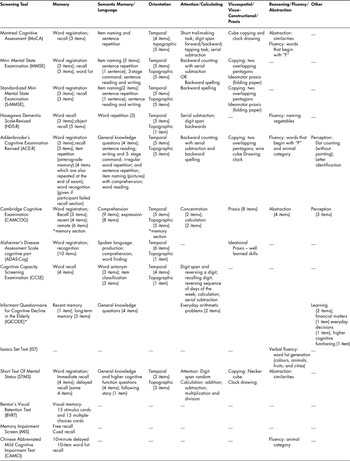
Although not intended to be a replacement for neuropsychological assessments, cognitive screening tests should cover most of the primary cognitive domains. It has been established through neuropsychological testing that different patterns of impairment are associated with particular subtypes of dementia (Cullen, O’Neil, & Evans, Reference Cullen, O’Neil and Evans2007). By including all of the cognitive domains, screening tools will be more sensitive to all dementia subtypes (Cullen et al., Reference Cullen, O’Neil and Evans2007). The key cognitive domains are (a) memory (digit span, word recall), (b) attention, (c) executive functions (trail-making test), (d) language (reading, item naming), (e) praxis (cube copying, clock drawing), and (f) visuospatial abilities (drawing) (Cullen et al., Reference Cullen, O’Neil and Evans2007; Herholz, Perani, & Morris, Reference Herholz, Perani and Morris2006; Yudofsky & Kim, Reference Yudofsky and Kim2004). Screening tools that cover each of the key domains are considered to be “comprehensive”, and those focusing on a single or partial domain are “non-comprehensive” tests (Cullen et al., Reference Cullen, O’Neil and Evans2007). Table 2 lists the cognitive domain coverage by each screening tool from the included studies.
Cognitive domain and cognitive ability coverage by screening tool

Dashes indicate Not Applicable
* indicates that the patient is measured indirectly
The revised version of the ACE, the ACE-R, is the most comprehensive screening tool covering all domains thoroughly with several items in a single domain and a large focus on memory and language. Some of the differences between the content of the ACE-R and the original ACE are that the ACE-R has fewer language items and additional memory and visuospatial items. The MoCA also covers every domain but with fewer items than the ACE-R. Lastly, the STMS also covers all key cognitive domains and can be administered within approximately five minutes.
The remaining screening tools are all non-comprehensive. The BVRT, MIS, and IST are the least comprehensive with only single-domain coverage. Most screening tools (MMSE, S-MMSE, HDS-R, ADAS-Cog, and CCSE) cover all except one or two of the domains.
With the exception of the full CAMCOG and IST, recent memory is universally assessed with varying item categories on word registration, word recall, cued or free recall, and item repetition. Visual construction/praxis and reasoning/fluency/abstraction were the two least-assessed cognitive domains. Visual construction included cube copying and clock drawing. The ADAS-Cog and the CAMCOG were the only tests to measure ideational praxis (sequencing a motor act towards a certain goal) (Weiner & Lipton, Reference Weiner and Lipton2009).
Feasibility
Feasibility can be defined as the average time required to administer a screening tool. The feasibility of a screening tool is important because its intended use is for the primary care setting. To be considered feasible, tests should be easy to administer within a short period of time with no specialized training required.
The IST, MIS, and STMS can be administered within one, four, and five minutes respectively (see Table 1). These cognitive screens have the shortest administration time of all the included studies. The CAMCOG has the longest administration time (20 minutes). However, it is possible to use either the memory and non-memory sections, as opposed to the entire CAMCOG, thus improving its feasibility (Schmand et al., Reference Schmand, Walstra, Lindeboom, Teunisse and Jonker2000). Most screening tools can be administered in between 10 and 15 minutes; MMSE (5–10 minutes), CCSE (10–20 minutes), ACE-R (15 minutes), MoCA (10–12 minutes), S-MMSE (10 minutes), IQCODE (10–12 minutes), and CAMCI (15 minutes). Although the IQCODE has an average administration time, this test does require the presence of an informal caregiver which reduces its feasibility in the clinical setting since the majority of patients with mild impairment will attend the clinic alone. Administration time was not reported for the HDS-R, BVRT, or the ADAS-Cog.
Discussion
The aim of this review was to determine which screening tool best predicts the development of dementia and is feasible for front-line practitioners to administer. Accordingly, test accuracy, screening comprehensiveness, predictive ability, and feasibility were assessed. The search strategy focused on screening tools which can be used to detect “early” dementia. Identifying persons at the early stage of dementia and appropriately treating them may delay their disease process and symptoms.
Rankings and Recommendations
Some screening tools are more accurate and feasible than others; thus, it is important to rank these tools in terms of their overall performance to make informed recommendations for their use in primary care. In most cases, the selected screening tools performed better compared to the MMSE. The MMSE and the S-MMSE alone were both highly specific but poor in sensitivity (Table 1). Yet, when the MMSE was combined with the IQCODE, performance increased dramatically (Srikanth et al., Reference Srikanth, Thrift, Fryer, Saling, Dewey and Sturm2006). This enhanced performance can be attributed to the combination of the clinician’s perspective (MMSE) and the informal caregiver’s perspective (IQCODE) for the detection of dementia.
The best screening tools in terms of test accuracy, predictive ability, and comprehensiveness are the memory section of the CAMCOG, CCSE, CAMCI, and the ACE (good predictive ability and test accuracy only) or ACE-R (good comprehensiveness only). The memory section of the CAMCOG comprises the orientation and memory subscales of the full CAMCOG. Although not fully comprehensive in terms of cognitive domain coverage, this screening tool was successful in predicting incident dementia (AUC = 0.8) over a three-year follow-up period in subjects who had no impairment at baseline. The memory section of this test is also highly specific (96%) with good sensitivity (76%). In addition, testing with this tool would be feasible given that time for administration of only the memory section of the CAMCOG would be less than for the complete tool (20 minutes). Schmand et al. (Reference Schmand, Walstra, Lindeboom, Teunisse and Jonker2000) did not report the actual administration time of the memory section.
The CCSE is also worthy of recommendation. This test has very high sensitivity and specificity when the cut-off value is set to 26/25 (see Table 1). The CCSE is also feasible (administration time: 10–20 minutes) and covers four cognitive domains (memory, semantic memory, orientation, and attention/calculation). Although lacking in comprehensiveness, the CAMCI is another good screening tool with excellent predictability (AUC = 0.98), high sensitivity (83.4%), and good specificity (78.5%) (see Table1).
Lastly, the ACE-R was found to be the most comprehensive test included in this review (see Table 2). The ACE has high diagnostic accuracy (AUC = 0.98) and high sensitivity and specificity when the cut-off value is set to 75/100 but is not as comprehensive as the ACE-R (see Table 1).
Although not ranked the highest, the MoCA, ADAS-Cog, and the combination of the MIS and IST are still considered good screening measures. The MoCA was quite practical in predicting the development of dementia in subjects with MCI but had extremely poor specificity (Smith et al., Reference Smith, Gildeh and Holmes2007; see Table 1). This study also had the shortest follow-up period (6 months) which may not have been long enough to observe cognitive changes detectable by a screening tool (Smith et al., Reference Smith, Gildeh and Holmes2007). Overall, this screening tool is considered a good measure for early detection of dementia, and it was one of the most comprehensive tools in our review.
The ADAS-Cog had relatively good sensitivity and specificity and was quite reasonable in predicting the development of AD in subjects with MCI at baseline over a one-year follow-up period (AUC = 0.67). The comprehensiveness of the screen was moderate (see Table 2).
The combination of the IST and MIS (Chopard et al., Reference Chopard, Vanholsbeek, Tio, Pitard, Binetruy and Rumbach2009) had good sensitivity (74%), and excellent specificity individually (see Table 1). However, these screens perform better in combination (AUC = 0.867) than alone. Individually, both lack comprehensiveness as each measures a single domain (see Table 2).
Factors Influencing Study Outcomes
Several factors such as sample size, proportion of males and females, age, years of education, length of follow-up, and participants lost to follow-up can affect study outcomes. In every study, screening tools were administered to a sample of participants who were at risk for the development of dementia (i.e., age and early signs of cognitive impairment). Age is the greatest risk factor for AD; nearly 50 per cent of individuals over the age of 85 are affected (Burns & Morris, Reference Burns and Morris2008). Therefore, participant age at baseline may be a contributing factor to the development of dementia at follow-up assessments. Xu et al. (Reference Xu, Meyer, Thornby, Chowdhury and Quach2002) and Rozzini et al. (Reference Rozzini, Chilovi, Bertoletti, Conti, Delrio and Trabucchi2008) found that participants who developed dementia or AD at follow-up were older compared to those who remained normal. As well, in the Smith et al. (Reference Smith, Gildeh and Holmes2007) study, participants in the MCI group were older than those in the comparison group (MCC).
Education level has the potential to affect scores on a screening tool. The ADAS-Cog has been shown to be less influenced by education level (Rozzini et al., Reference Rozzini, Chilovi, Bertoletti, Conti, Delrio and Trabucchi2008). In some studies, subjects in the dementia group were less educated than their comparison (non-dementia) group (Smith et al., Reference Smith, Gildeh and Holmes2007; Xu et al., Reference Xu, Meyer, Thornby, Chowdhury and Quach2002).
Sample sizes should be balanced in gender as much as possible to avoid any biased results since women are at a higher risk of developing dementia than men (Weiner & Lipton, Reference Weiner and Lipton2009). Xu et al. (Reference Xu, Meyer, Thornby, Chowdhury and Quach2002) found the incident and prevalent AD groups contained more women compared to the non-dementia group. For the majority of studies included, there were no significant differences in the proportion of males and females.
The length of follow-up can also affect study results. Follow-up must be long enough to observe cognitive change. This change is evident in studies with longer follow-up such as in Schmand et al. (Reference Schmand, Walstra, Lindeboom, Teunisse and Jonker2000), who followed subjects for up to three years. In most studies, a change in cognitive status is observed within one year (see Table 1).
Five out of the 12 studies in this review reported participant losses at follow-up. Chopard et al. (Reference Chopard, Vanholsbeek, Tio, Pitard, Binetruy and Rumbach2009), Tierney et al. (Reference Tierney, Szalai, Dunn, Geslani and McDowell2000), and Lam et al. (Reference Lam, Tam, Lui, Chan, Chan and Chui2008) lost a high percentage of participants (59%, 40%, and 55% respectively). The remaining two studies reported a smaller percentage of participant losses (Dartiques et al. [Reference Dartiques, Commenges, Letenneur, Barber-Gateau, Gilleron and Fabrigoule1997] lost 3%, and Srikanth et al. [Reference Srikanth, Thrift, Fryer, Saling, Dewey and Sturm2006] lost 28%).
Lastly, race and culture are somewhat less apparent factors that can influence test scores. Many screening tools are translated into several languages, but there may be other barriers affecting test performance. For example, in Aboriginal seniors, the process and content of screening tools such as the MMSE may be incompatible with their culture (Cattarinich, Gibson, & Cave, Reference Cattarinich, Gibson and Cave2001). In addition, many lack formal education and may experience difficulty in tasks requiring calculation, language, or constructional praxis (e.g., drawing a pentagon) (Cattarinich et al., Reference Cattarinich, Gibson and Cave2001).
Further research is needed on screening tools that can be used to detect early signs of cognitive impairment. Many screening tools do not cover all key cognitive domains, and this seems to be related to the success of the tool (see Table 2). Comprehensive coverage of these domains is essential also for the differential diagnosis of dementia especially for secondary or tertiary clinicians (Cullen et al., Reference Cullen, O’Neil and Evans2007). A comprehensive screening tool would provide more information on patient symptoms not only at the primary care level but also it would be of relevance to those conducting more thorough examinations. Even at the expense of feasibility, a screening tool should have items in each core domain to assess cognitive impairment properly.
In addition, more research is required on the predictive validity of screening tools. There is a shortage of longitudinal studies with follow-up sufficiently long to observe cognitive change. This is shown by the small number of studies meeting the relevance criteria which included a six-month minimum follow-up. It is essential that screening tools used to detect MCI be evaluated in research designs that incorporate several follow-up assessments over a sufficient length of time to determine if the screening tool has the ability to predict the development of dementia.
Conclusion
This systematic review provided a comprehensive evaluation of the available tools used to detect dementia. The goal was to identify the best screening tools in terms of their predictive ability for detecting persons who will develop dementia and to make recommendations to health care professionals on the benefits and disadvantages of these tools based on the results. The ACE was found to be the best screening tool in terms of predictability, accuracy, and feasibility. However, the modified version (ACE-R) is more comprehensive and is currently used in clinical settings, but the predictive testing completed on the ACE does not currently extend to the ACE-R. The ACE and ACE-R may not be as feasible as some of the more commonly used tools such as the MMSE and MoCA. The benefits of the ACE include the elimination of false positive and false negative results that are encountered with many other screening tools. When detecting dementia in its earliest stages, which is possible with more sensitive tools such as the MoCA, the ACE is less likely to yield a false positive result which may ultimately send a patient for unnecessary neuropsychological testing. Further testing needs to be done on the ACE-R to determine how it performs as a predictive screen.
Lastly, no screening tool captures all domains and meets all criteria for an excellent tool, and some health care professionals may prefer to use one over another for a variety of reasons. Although the ACE best met the criteria for this review, the ACE has been replaced by the ACE-R for clinical use because the ACE-R is more comprehensive. We recommend that the ACE-R be tested as it may also have high predictive ability for detecting persons who will develop dementia.