Introduction
Psychopathological research conducted over the past two decades has undermined the view that delusions are un-understandable (e.g. Bentall et al. Reference Bentall, Corcoran, Howard, Blackwood and Kinderman2001; Blackwood et al. Reference Blackwood, Howard, Bentall and Murray2001). In particular there are two key reasoning anomalies that have been found in adults with delusions. First, people with persecutory delusions (PDs) have theory of mind (ToM) difficulties in that they have trouble accurately inferring other people's beliefs and intentions (e.g. Corcoran et al. Reference Corcoran, Frith and Mercer1995; Corcoran & Frith, Reference Corcoran and Frith2003; Harrington et al. Reference Harrington, Langdon, Siegert and McClure2005). Second, deluded individuals have a tendency to jump to conclusions (JTC) on the basis of insufficient information when reasoning in probabilistic contexts (e.g. Huq et al. Reference Huq, Garety and Hemsley1988; Garety et al. Reference Garety, Hemsley and Wessely1991; Dudley et al. Reference Dudley, John, Young and Over1997). This characteristic style of decision-making seems to apply to delusions irrespective of content and, as Freeman (Reference Freeman2007) notes, there has been little research exploring the JTC bias in relation to PDs specifically. The balance of evidence suggests that the JTC finding is robust and has been found to relate particularly to delusional conviction (e.g. Garety & Freeman, Reference Garety and Freeman1999; Garety et al. Reference Garety, Freeman, Jolley, Dunn, Bebbington, Fowler, Kuipers and Dudley2005; Peters & Garety, Reference Peters and Garety2006). This contrasts with the findings on ToM reasoning which are not so well replicated but which are theoretically compelling in their account of the psychological origins of PDs in particular (for a review, see Harrington et al. Reference Harrington, Langdon, Siegert and McClure2005). While it is clear that neither of these reasoning anomalies can comprehensively account for the generation and maintenance of PDs (e.g. Bentall et al. in press) it seems likely that they both contribute to paranoid ideation.
The vast majority of the studies conducted to date on these psychological variables have focused on schizophrenia as a diagnostic category. However, the context within which psychological models of delusional processes have grown over the last 15 years or so has been one which emphasizes the symptoms of psychosis over the diagnosis of a psychotic illness. This has been driven by compelling theoretical reasons which question the utility of methods relying on data gathered from groups of patients for whom the diagnosis is often the only shared characteristic. Instead, psychologists have argued that the best way to advance understanding of psychosis is to take a symptom-based approach. Indeed, it is clear that just such an approach has led to significant advances in our understanding of the psychological basis of psychotic symptoms (e.g. Frith, Reference Frith1992; Bentall, Reference Bentall2003). Of course, a strict symptom-based approach, if correct, implies that the psychological bases of a psychotic symptom should be the same irrespective of the diagnostic context in which it is seen and PDs are found in several other diagnostic groups including affective disorder. The study reported in this paper is the first to investigate whether the drawing of hasty decisions in probabilistic settings and poor ToM are seen in PDs across diagnostic categories.
Method
Participants
A total of 115 patients in four groups were recruited from in-patient and out-patient clinics in South London and the North West of England. Informed consent was obtained using procedures agreed by a multi-centre research ethics committee. The currently paranoid group consisted of 26 male and 13 female patients with a DSM-IV diagnosis of schizophrenia, schizoaffective disorder or delusional disorder who were experiencing PDs as assessed by the endorsement of the Schedules for Clinical Assessment in Neuropsychiatry (SCAN; WHO, 1997) item 19.012 [‘Does anyone seem to be trying to harm you (trying to poison or kill you?’)] at interview, examination of case notes and endorsement of item 4 (‘Do you ever feel as if you are being persecuted in some way?’) on the Peters Delusions Inventory [PDI; Peters et al. (Reference Peters, Joseph and Garety1999) ]. They had a mean age of 33.95 years (s.d.=8.38) and a mean intelligence quotient (IQ) assessed by the Wechsler Abbreviated Scale of Intelligence (Wechsler, Reference Wechsler1999) of 92.18 (s.d.=10.74). Their mean age of illness onset was 23.00 years (s.d.=7.33), and they were in receipt of a mean antipsychotic dosage of 417.13 mg chlorpromazine (CPZ) equivalent (s.d.=510.51). The mean number of other positive symptoms present in this group was 0.85 (s.d.=0.90).
The remitted paranoid group consisted of 18 male and 11 female schizophrenia spectrum patients who had experienced PDs in the past as evidenced by endorsement of SCAN item 19.012 for a representative illness period, examination of case notes and endorsement of item 4 on the PDI for the representative period identified by the SCAN. However, participants in this group indicated that they did not currently feel paranoid and that they had not suffered from PDs for at least the past fortnight. The current status of these patients was confirmed by case note examination and/or by clinical staff. Patients in this group did report the presence of other positive symptoms, notably auditory hallucinations. Their mean age was 34.66 years (s.d.=10.35); their mean IQ was 98.38 (s.d.=13.17); their mean age of illness onset was 21.82 years (s.d.=5.81) and they were in receipt of a mean of 227.78 mg CPZ equivalent of antipsychotic medication (s.d.=261.14). The mean number of other positive symptoms present in this group was 0.72 (s.d.=0.96).
A paranoid depressed group consisted of 11 male and nine female patients with a primary DSM-IV diagnosis of major depression, currently experiencing PDs as indicated by the SCAN. They had a mean age of 36.00 years (s.d.=10.11), a mean IQ of 98.50 (s.d.=15.75), a mean age of illness onset of 23.93 years (s.d.=11.63) and were in receipt of a mean of 17.50 mg CPZ equivalent of antipsychotic medication (s.d.=37.36). The mean number of other positive symptoms present in this group was 1.05 (s.d.=0.99).
No significant differences existed in terms of the number of other positive symptoms assessed to be present by the SCAN between the three psychotic patient groups [i.e. depersonalization, hallucinations, perceptual experiences; F(2, 85)=0.706, n.s.]. The presence of clear negative signs of psychosis (i.e. underactivity, slow speech, poverty of speech or blunted affect as assessed by the SCAN) or overt formal thought disorder were exclusion criteria for the three psychotic patient groups.
A non-psychotic depressed group consisted of nine male and 18 female patients with a diagnosis of major depression and not experiencing PDs. Their mean age was 48.37 years (s.d.=10.97), their mean IQ was 108.22 (s.d.=12.99), their mean age of onset was 29.11 years (s.d.=14.45), and they were in receipt of a mean dose of 5.55 mg CPZ equivalent of antipsychotic medication (s.d.=28.87).
A healthy adult group of 14 males and 19 females, recruited by advertisement, had a mean age of 39.03 years (s.d.=13.96) and a mean IQ of 108.64 (s.d.=14.48). The initial screening questions from the SCAN were used to determine that they were symptom free.
Measures
A version of the probabilistic reasoning task developed by Phillips & Edwards (Reference Phillips and Edwards1966), commonly known as the ‘beads in a jar task’, was used to investigate the tendency to ‘jump to conclusions’ when considering neutral stimuli. This task was originally used to investigate probabilistic reasoning in deluded patients by Huq et al. (Reference Huq, Garety and Hemsley1988) and has enjoyed widespread use since (e.g. Garety et al. Reference Garety, Freeman, Jolley, Dunn, Bebbington, Fowler, Kuipers and Dudley2005). The proportion of the two coloured beads in the jars in this version was 60:40 with the majority colour being yellow in one jar and black in the other. The participants were shown the order in which beads were drawn from one of the two jars until they felt confident that they knew which of the jars the beads were being drawn from. The number of beads requested before reaching a decision and the jar chosen were recorded. Each participant was shown three sequences of black and yellow beads which had been randomly determined prior to commencement of the study and which were held constant across participants.
A social version of the ‘beads in a jar’ task developed by Dudley et al. (Reference Dudley, John, Young and Over1997) was used as a second measure of the tendency to JTC when considering more salient information. In this task participants were presented with two surveys containing 100 comments about a person. They were told that survey A contained 60 negative and 40 positive comments, while survey B contained 60 positive and 40 negative comments. Participants could see as many comments as they needed before deciding which of the two surveys they came from. The number of comments requested before reaching a decision and the survey chosen were recorded. The same three random sequences used as for the ‘beads’ task were used for each participant.
Six ToM stories developed by J. S. Snowden et al. (unpublished) were used to assess understanding of false belief and deception to second-order level and to provide measures of narrative memory and non-mental state inference capacity. These stories have recently been used by Moore et al. (Reference Moore, Blackwood, Corcoran, Rowse, Kinderman, Bentall and Howard2006) in a study examining PDs in people with very-late-onset schizophrenia-like psychosis and are similar in format to those previously used by Frith & Corcoran (Reference Frith and Corcoran1996) except that they develop from first- (when the contents of a single person's mind must be inferred) to second-order ToM (where the contents of two people's minds must be inferred) within each story. The stories were read out to participants accompanied by a set of cartoon pictures depicting events in the story. At set points during the course of the story participants were asked questions to assess ToM, narrative memory and non-mental state inference skills which examined the ability to draw inferences from the text beyond what was actually stated but which did not involve an inference about the contents of the characters' minds.
Finally, a false-belief picture-sequencing task was used as a non-verbal measure of ToM (Langdon et al. Reference Langdon, Mitchie, Ward, McConaghy, Catts and Coltheart1997). Following two practice sequences, participants were presented with four stories involving a person acting on a false belief. The cards were presented in a fixed random order and participants were instructed to put the cards into the right order so that they would tell a story. The standard scoring system devised by Langdon et al. (Reference Langdon, Mitchie, Ward, McConaghy, Catts and Coltheart1997) was used.
Analysis strategy
In the first instance analysis of variance (ANOVA) with planned contrasts was used to test for group differences on the four reasoning tasks. The first contrast compared groups with current PDs with those without. Contrast 2 compared the performance of patients with PDs in the context of schizophrenia spectrum with those with PDs in the context of depression. Contrast 3 compared the performance of the remitted paranoid patients with that of the non-psychotic depressed patients and the healthy adults and the final contrast compared the performance of the non-psychotic depressed patients with that of the healthy adults. It was expected that contrast 1 would produce a statistically significant result while contrasts 2–4 would prove to be non-significant. Preliminary analyses prior to ANOVA showed that the beads in the jar task and the ToM stories task were associated with between-group heterogeneity of variance [Levene's statistic beads (4, 140)=2.403, p=0.053; Levene's statistic ToM stories (4, 139)=3.014, p=0.02]. Therefore, the Brown–Forsythe robust test for the equality of means (BF) will be reported for the four experimental tasks as it is recommended for use with ANOVA in preference to the F statistic when variances are unequal between groups and where the data are skewed as is the case with all four tasks (Clinch & Keselman, Reference Clinch and Keselman1988).
Preliminary analyses of the data indicated that the assumptions with respect to the use of linear regression were not violated, with plots of the residuals indicating that these were normally distributed for all four measures, and the Cook's distance statistics indicating that outliers were not exerting an undue influence on regression equations. Collinearity statistics (tolerance and variance inflation factors) were all acceptable. Therefore a series of linear regressions using the enter method are reported which investigate possibly confounding factors such as between-group differences in IQ, age and gender. For these analyses three dummy variables were created to enable clinical status to be considered as predictor variables. These were whether or not each case was currently paranoid (paranoid schizophrenia+paranoid depressed versus the other groups), whether or not each case had ever been paranoid (paranoid schizophrenia+paranoid depressed+remitted paranoid versus the other groups) and whether or not each case was currently depressed (paranoid depressed+depressed versus the other groups). Other predictor variables were maleness, age, and IQ. Additionally, for the ToM stories, the percentage correct on the narrative memory questions and the percentage correct on the non-mental state inference questions were also included.
Finally, separate correlation analyses were conducted to examine the relationship between performance on the tasks, antipsychotic medication dosage (expressed as CPZ equivalents), and the conviction, distress and preoccupation scales of the PDI (each measured on 1–5 scales) in the groups for whom these variables are relevant.
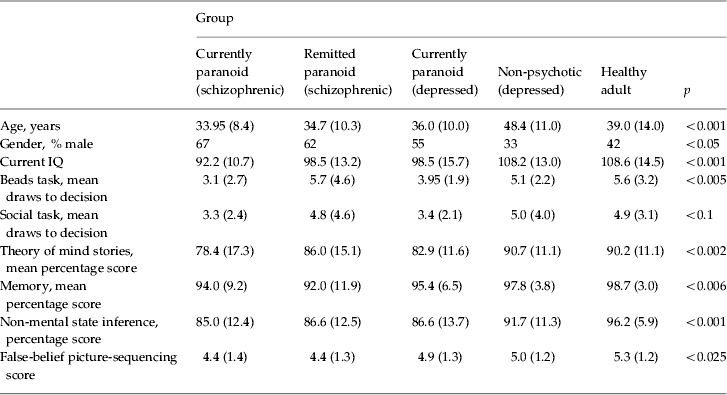
The performance of each group on the measures and their background demographics can be seen in Table 1.
Demographic characteristics of the groups and their performance on the cognitive measures

IQ, Intelligence quotient.
Values are means (standard deviations) except for gender percentage.
Results
Jumping to conclusions
Performance on the two measures of probabilistic reasoning correlated significantly in these participants (r=0.73, p<0.001).
The ANOVA findings relating to performance on the beads in the jar task were consistent with the hypothesis with a significant overall effect for group [BF (4, 97.9)=4.436, p<0.005]. The planned contrasts indicated that contrast 1 was significant at the p<0.001 level, indicating that the groups with current PDs tended to draw conclusions more hastily on this task compared with the other groups. As expected, contrasts 2–4 were non-significant for this task. The regression analysis for the beads task was significant [r 2=0.16, F(6, 137)=4.27, p<0.001]. The significant predictors of performance on this task were age (β=−0.19, t=−2.22, p<0.03) and currently paranoid status (β=−0.35; t=−3.1, p<0.003).
The results of the social probabilistic task were consistent with the beads task but not as compelling. There was an overall trend indicating between-group differences using ANOVA [BF (4, 103.39)=1.99, p=0.1]. Mean scores clearly indicated that those with current PDs were doing less well on this task and this was supported by a significant result for planned contrast 1 (p<0.01). As expected, contrasts 2–4 were non-significant. The regression analysis for this task was significant [r 2=0.13, F(6, 136)=3.49, p<0.005], with IQ significantly predicting performance (β=0.24, t=2.6, p<0.02) and current paranoid status just failing to reach significance at p<0.05 (β=−0.20, t=−1.77, p<0.08).
Theory of mind
Performance on the two measures of ToM correlated significantly in these participants (r=0.41, p<0.001).
The ANOVA findings relating to performance on ToM stories task were consistent with the hypothesis with a significant overall effect for group [BF (4, 127.96)=4.9, p<0.002]. The planned contrasts indicated that contrast 1 was significant at the p<0.001 level, indicating that the groups with current PDs tended to score lower on this task than the other groups. As predicted, contrasts 2–4 were non-significant. The regression analysis for this task was significant [r 2=0.35, F(8, 134)=9.01, p<0.001]. The significant predictors of performance were IQ (β=−0.028, t=3.32, p<0.002), current paranoid status (β=−0.25, t=−2.49, p<0.02) and performance on the narrative memory questions within the task (β=0.37, t=4.42, p<0.001).
The results of the false-belief picture-sequencing task were rather different to those of the stories task. While for this task the overall ANOVA was again significant [BF (4, 132.68)=2.92, p<0.025], this was accounted for by contrast 3 (p<0.02), indicating that the remitted paranoid patients performed worse on this task than the depressed patients and the healthy adults. Contrasts 1, 2 and 4 were all non-significant for this task. The regression analysis for this task was also significant [r 2=0.25, F(6, 140)=7.83, p<0.001], with age (β=−0.23, t=−2.82, p<0.01) and IQ (β=0.39, t=4.71, p<0.001) predicting performance on this task. Having a history of paranoid delusions just failed to significantly predict performance on this task (β=−0.214, t=−1.90, p=0.059) and no other independent variables proved to be significant predictors.
Correlation of task performance with medication dosage, conviction, preoccupation and distress as measured by the PDI
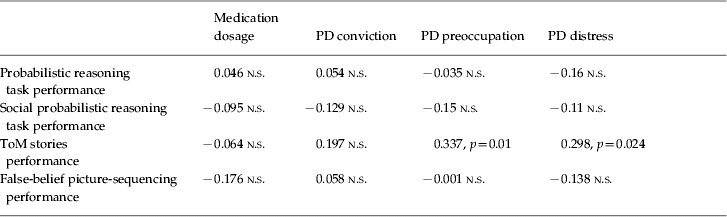
A summary of these findings can be found in Table 2.
Correlations between task performance, medication dosage and the subscales of the PDI
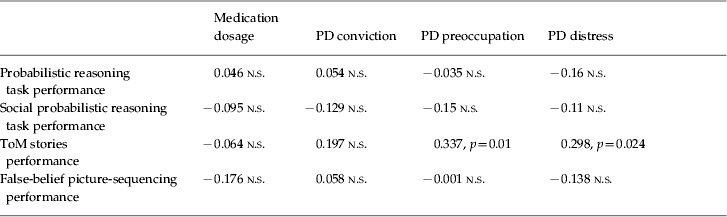
PDI, Peters Delusions Inventory; PD, persecutory delusions;n.s., non-significant; ToM, theory of mind.
Values are correlations (probabilities).
Medication dosage expressed as CPZ equivalents was only considered for the groups with current psychosis or a history of psychosis, as the other groups were not taking antipsychotic medication. No significant correlations were found between performance on any of the four experimental tasks and medication dosage.
The conviction, preoccupation and distress scales of the PDI were considered in the groups who were currently expressing PDs. As shown in Table 2, there were no significant correlations between any of these PDI severity scales and performance on the beads task, the social version of the beads task or the picture-sequencing task. Modest but significant correlations were found between performance on the ToM stories and the preoccupation and distress subscales but not the conviction subscale.
Discussion
These results replicate previous findings showing that people with PDs in the context of schizophrenia spectrum disorders tend to make hasty decisions on probabilistic reasoning tasks (Garety & Freeman, Reference Garety and Freeman1999) and have difficulty inferring the beliefs and intentions of others (e.g. Frith & Corcoran, Reference Frith and Corcoran1996). This study is, however, the first to demonstrate that both of these cognitive tendencies are transdiagnostic features of PDs. The second contrast of the planned comparisons analyses consistently failed to demonstrate any differences in performance across the tasks between the patients with PDs in the context of schizophrenia spectrum disorders and those with PDs in the context of affective disorder. Thus, the finding indicates that the same level of difficulty on these tasks exists in patients with affective disorder as exists in patients with schizophrenia spectrum disorders. Recently, Moore et al. (Reference Moore, Blackwood, Corcoran, Rowse, Kinderman, Bentall and Howard2006) have shown that ToM difficulties but not the tendency to JTC was a feature of PDs in the context of very-late-onset schizophrenia-like psychosis. The authors accounted for the null finding on the JTC task by arguing that any difference was over-ridden by general age-related changes in higher-order cognition, as their comparison groups were matched for age with their psychosis group.
The regression analyses demonstrated that performance on these measures is influenced by demographic variables (in particular age) and cognitive ability. However, the specific transdiagnostic associations with PDs survived the effects of these confounding variables. For three of the four tests examined (the two probabilistic reasoning tasks and the ToM stories), abnormal performance was associated with current delusional state, indicating a clear state-related cognitive dysfunction associated with PDs irrespective of diagnosis. While it is notable that the performance on the JTC task did not correlate with the delusional conviction component of the PDI as has been previously reported (e.g. Garety et al. Reference Garety, Freeman, Jolley, Dunn, Bebbington, Fowler, Kuipers and Dudley2005), the fact that the performance on the ToM stories task correlated significantly with the PDI subscales of preoccupation and distress supports the state-related nature of performance on this verbal ToM task. However, for the false-belief picture-sequencing task there was some evidence to support a trait effect both in the ANOVA where the only significant contrast showed that the remitted paranoid patients performed this task worse than the non-psychotic depressed and the healthy adults. Marginal support for this finding was seen in the regression analyses where having a history of PDs just failed to reach significance at the 0.05 level as a predictor of performance on this task. The idea that the nature of the ToM dysfunction in schizophrenia can be distinguished in terms of state and trait requires further exploration, as it could resolve inconsistent findings in the earlier literature exploring this matter (see Harrington et al. Reference Harrington, Langdon, Siegert and McClure2005). It is possible that the non-verbal nature of this task makes it less sensitive to any further deleterious effects of acute episodes of PDs. Furthermore, there is evidence in the data that the false-belief picture-sequencing task may be more sensitive to diagnosis than to the presence of PDs per se. Examination of the data provide in Table 1 shows that on this task the remitted paranoid and the currently paranoid patients with a diagnosis of schizophrenia are both, in fact, performing poorly and at the same level while the performance of the two depressed groups is also comparable and somewhat better than that seen in the context of schizophrenia. It may be that this task is sensitive to diagnosis because of its strong sequencing and problem-solving components which uncover more general cognitive difficulties associated with the diagnosis of schizophrenia. Had we included the logical sequencing stories that Langdon et al. (Reference Langdon, Mitchie, Ward, McConaghy, Catts and Coltheart1997) devised as part of the picture-sequencing task, we could have explored this issue further. Unfortunately, constraints of time and the consideration of patients' tolerance to the battery dictated the exclusion of this measure in this study.
The fact that the probabilistic reasoning task findings were clearly state related in this study with no evidence in support of trait effects on this task does not support other research where authors have reported that hasty decisions are also taken by participants who are vulnerable to psychosis (Van Dael et al. Reference Van Dael, Versmissen, Janssen, Myin Germeys, van Os and Krabbendam2006; Freeman, Reference Freeman2007). It is unclear why these findings differ but it may reflect the different methodologies used.
In conclusion, this study demonstrates that the same underlying reasoning difficulties that are associated with PDs in the context of schizophrenia spectrum disorders are also associated with PDs in the context of depression. While it is clear that the tendency to JTC is related to the presence of current delusions (i.e. a state effect), there is evidence in this study to suggest that false-belief picture sequencing may be more sensitive to diagnosis and thus may be indicative of trait-related cognitive features of paranoid schizophrenia. Thus it seems that the generic ToM skill may be a cognitive marker of paranoid schizophrenia which undergoes further decline during acute episodes. It is possible that verbal ToM tasks may be more sensitive to this state-related decline than non-verbal ToM tasks. As the diagnostic groups were well categorized in this study and since no differences existed for the presence of other signs and symptoms of psychosis, these transdiagnostic findings relating to PDs are compelling.
Acknowledgements
The work reported here was undertaken with the financial support of an award provided by the Wellcome Trust given to R.C. as the principal investigator (grant number GR064134MA).
Declaration of Interest
None.