Introduction
Several physiological changes occur during pregnancy that could affect thyroid function. Adequate maternal thyroid function is especially important in early pregnancy and is crucial for the development of many organs, including the fetal brainReference Springer, Jiskra, Limanova, Zima and Potlukova1. During the first trimester of gestation, thyroid hormones from the mother are the only source for the developing embryo because fetal thyroid production begins at 12 to 14 amenorrhea weeksReference Morreale de Escobar, Obregon and Escobar del Rey2. Maternal thyroid hormones circulate in fetal blood until birthReference Springer, Jiskra, Limanova, Zima and Potlukova1–Reference Korevaar, Chaker, Jaddoe, Visser, Medici and Peeters3. Maternal thyroid hormone production increases by 20% to 50% to maintain a euthyroid stateReference Alexander, Pearce and Brent4. For women with pre-pregnancy hypothyroidism, levothyroxine treatment frequently needs to be increased during pregnancy and there is potential for periods of nonoptimal treatmentReference Alexander, Pearce and Brent4,Reference Léger, dos Santos, Larroque and Ecosse5 .
The prevalence of thyroid disorders in pregnancy was evaluated in a recent meta-analysis according to diagnostic criteria and screening time. Among studies using the 2.5–97.5 percentile as a normal range for thyroid-stimulating hormone, prevalence rates were 0.5% for overt hypothyroidism, 3.5% for subclinical hypothyroidism and, in the first trimester, 0.9% for overt hyperthyroidism and 2.2% for subclinical hyperthyroidismReference Dong and Stagnaro-Green6. These pathologies must be recognized because they may be associated with pregnancy complications and fetal developmentReference Springer, Jiskra, Limanova, Zima and Potlukova1,Reference Alexander, Pearce and Brent4,Reference Korevaar, Medici, Visser and Peeters7 .
In several studies, overt and subclinical hypothyroidism have been associated with adverse outcomes, including miscarriage, hemorrhage, premature rupture of membranes, gestational hypertension, diabetes, prematurity, cesarean section, induced labor, and reduced fertilityReference Alexander, Pearce and Brent4,Reference Léger, dos Santos, Larroque and Ecosse5,Reference Casey, Dashe and Wells8–Reference Männistö, Mendola, Grewal, Xie, Chen and Laughon14 . The neonatal complications are risk of intrauterine growth retardation and low or large birth weightReference Alexander, Pearce and Brent4,Reference Nazarpour, Ramezani Tehrani, Simbar and Azizi9,Reference Hou, Yu and Zhu15 . The adverse effects of subclinical hypothyroidism on pregnancy outcomes are still not clear, and most of these complications are related to overt hypothyroidism and chronic autoimmune thyroiditisReference De Leo and Pearce16. Maternal hyperthyroidism has been associated with increased risk of infertility, premature birth, gestational hypertension and pre-eclampsia, placenta abruption and induced labor, intrauterine growth retardation and fetal hyperthyroidismReference Alexander, Pearce and Brent4,Reference Nazarpour, Ramezani Tehrani, Simbar and Azizi9,Reference Männistö, Mendola, Grewal, Xie, Chen and Laughon14,Reference Karakosta, Alegakis and Georgiou17–Reference Phoojaroenchanachai, Sriussadaporn and Peerapatdit20 . The associations between thyroid autoantibodies and miscarriage and preterm birth are also well establishedReference Alexander, Pearce and Brent4,Reference van den Boogaard, Vissenberg and Land21,Reference Thangaratinam, Tan, Knox, Kilby, Franklyn and Coomarasamy22 .
However, few studies have evaluated the risk of complications during pregnancy related specifically to pre-pregnancy thyroid diseasesReference Hirsch, Levy, Nadler, Kopel, Shainberg and Toledano23–Reference Earl, Crowther and Middleton25. In women with pre-pregnancy thyroid diseases, pregnancy may lead to suboptimal thyroid hormone concentration because of the inability of the thyroid gland to adapt to physiological changes at the beginning of pregnancy due to the disease itself or to its treatmentReference Nazarpour, Ramezani Tehrani, Simbar and Azizi9. Women with a history of thyroidectomy, radioactive iodine treatment, goiter or hypothyroidism, or Graves’ disease need appropriate medical management of thyroid function during pregnancyReference Alexander, Pearce and Brent4. Thyroid diseases are heterogenous. However, whatever the disorder, these diseases were known before pregnancy and should have been treated before or adequately managed during pregnancy.
Thus, our aim was to explore whether or not, as a group, women with pre-pregnancy thyroid disease had similar pregnancy outcomes as women without such a history. Taking advantage of the data for the French national birth cohort ELFE (Etude Longitudinale Française depuis l’Enfance), we described pregnancy and fetal outcomes in women with and without known pre-pregnancy thyroid diseases.
Methods
Study design
The present analysis relies on data from the ELFE study, the first French national longitudinal birth cohort. The rationale and design of the ELFE cohort were previously described in detailReference Charles, Thierry and Lanoe26. Briefly, participation in the cohort was proposed to women giving birth in 349 maternity hospitals randomly selected among the 544 public and private maternity hospitals in metropolitan France. Recruitment took place on 25 selected days during 2011. The ELFE cohort inclusion criteria were birth at ≥ 33 amenorrhea weeks, single or twin infants, mother ≥ 18 years old, giving informed consent, and not having plans to leave metropolitan France within 3 years. Among eligible mothers, 51% agreed to participate.
The ELFE study was approved by the ethics committee of Créteil (CPP), the national committee on information concerning health research (CCTIRS), and the Data Protection Authority (Commission Nationale de l’Informatique et des Libertés [CNIL]).
Data collection
Research assistants collected information after birth from maternal medical records and during a face-to-face interview while the mother was in the maternity ward.
Pre-pregnancy thyroid diseases
Research assistants collected the diagnosis of severe maternal pre-pregnancy diseases or disability (excluding history of chronic or gestational diabetes or hypertension for which dedicated questions were asked) from medical files where such information is recorded as part of the routine medical history assessment.
From these data, we extracted all diseases potentially associated with thyroid dysfunction. All diseases were coded according to International Classification of Diseases, 10th Revision. In total, 273 women presented thyroid diseases before pregnancy; we classified these women into three groups: women with 1) hypothyroidism due to a disease or as a potential side effect of treatment (Hashimoto’s disease, hypothyroidism unspecified, no thyroid, thyroidectomy, thyroid cancer, and women with levothyroxine treatment; n = 196), 2) hyperthyroidism (Grave’s disease, hyperthyroidism unspecified; n = 49), and 3) other thyroid diseases (goiter, nodules, thyroid dysfunction, or thyroid diseases unspecified, n = 28). We combined women with thyroidectomy (n = 16) and thyroid cancer (n = 4) in the first group because of the small number of cases.
Pregnancy and fetal outcomes
Among all the data related to pregnancy complications, we selected for analyses the following outcomes with a minimum prevalence of 7% in the population, which ensured a power of 90% to detect a minimal relative risk of 1.75 for these diseases with alpha 5% (power increases for more prevalent outcomes): premature rupture of membranes (12 h before labor onset), gestational diabetes, induction of labor (spontaneous labor, induction of labor, and elective cesarean section), maternal hospitalization and mode of delivery (spontaneous vaginal delivery, assisted vaginal delivery [forceps, vacuum, and spatula], and cesarean section). Gestational hypertension and premature birth (< 37 amenorrhea weeks) were not studied because of too few cases in the exposed group. We also studied treatment for infertility before pregnancy. Birth weight, birth length, head circumference, and gestational age at birth were treated as continuous variables. Sex and gestational age-specific z scores customized for maternal weight, height, and parity were computed using a method adapted for the French 2010 national perinatal survey, from that proposed by GardosiReference Ego, Prunet, Blondel, Kaminski, Goffinet and Zeitlin27. Percentiles were then derived and used to define fetal growth categories: small for gestational age (SGA, <10th percentile), appropriate for gestational age (AGA, 10th to 90th percentile), and large for gestational age (LGA, >90th percentile).
Other maternal variables
Sociodemographic data included maternal age (continuous), parity, education level (tertiary education as reference vs. primary and secondary), professional status (employed or student, housewife or parental leave, and other, including unemployment), living with a partner (yes vs. no), place of birth (born in France vs. other country), and maternity unit level.
Health-related variables included state health insurance coverage (regular or specific to precarious situations), smoking during pregnancy (yes vs. no), number of prenatal consultations (< 7, 7–9, ≥ 9), ultrasounds (≤ 5, > 5), and maternal pre-pregnancy weight and height. Body mass index (BMI) was calculated as weight (kg) divided by the height2 (m²) and divided into four categories according to World Health Organization thresholds: underweight, <18.5 kg/m²; normal weight, 18.5 to <25 kg/m²; overweight, 25.0 to <30 kg/m²; and obesity, ≥ 30 kg/m².
Population selected for analysis
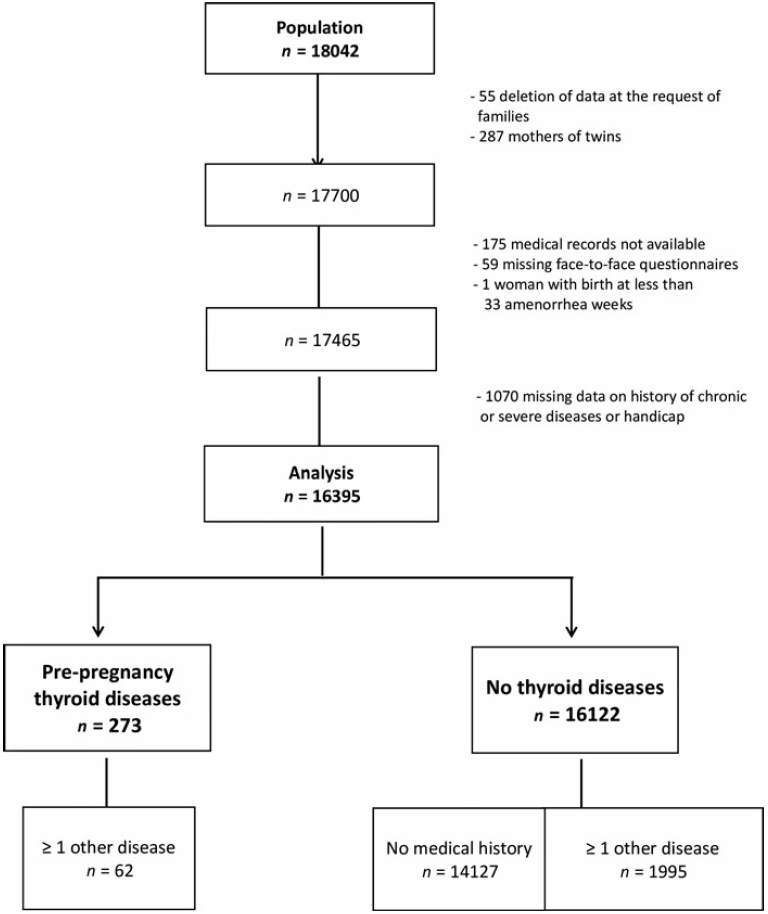
In total, 55 included mothers withdrew from the ELFE cohort and asked for data deletion. Mothers of twins (n = 287) or with missing medical records (n = 175) or face-to-face maternal questionnaires (n = 59) were excluded. For women with available medical records, we excluded 1070 with missing data on medical history. Fig. 1 displays the flow chart for the population selection process. We grouped the selected women into two categories: 16,122 women with no medical history of thyroid diseases and 273 with pre-pregnancy thyroid diseases as described above.
Flow of the women in the study. Selection of women with pre-pregnancy thyroid diseases.

Statistical analysis
Descriptive analysis
We compared sociodemographic characteristics and pregnancy outcomes between patients with and without pre-pregnancy thyroid diseases by chi-square test for categorical variables and ANOVA for continuous variables.
Multivariable analysis
Multivariable logistic, linear, and polytomic regression analyses were used to investigate the association between thyroid diseases and pregnancy outcomes, estimating odds ratios (ORs) and 95% confidence intervals (CIs). We first adjusted our analyses for potential confounders, namely parity, smoking during pregnancy, maternal age, and maternal education. For birth head circumference, weight, and length, we additionally adjusted for gestational age and sex. Second, we adjusted for pre-pregnancy BMI as a continuous variable and investigated its potential role as an intermediate factor in the observed associations. We also introduced an interaction term between pre-pregnancy BMI and pre-pregnancy thyroid diseases to test whether the effect of a history of thyroid disease differed by maternal pre-pregnancy BMI.
Sensitivity analysis
To examine whether the observed relations were due to the thyroid diseases themselves and not other pre-pregnancy diseases, which could be more frequent in our affected group, we repeated our main analysis after excluding women with other medical histories such as autoimmune diseases, history of diabetes, hypertension, and other diseases known to affect pregnancy outcomes.
Because different types of thyroid disorders may be related to specific risks, we separately analysed data for women with pre-pregnancy thyroid diseases associated with hypothyroidism (as defined in the Data collection section) as compared with women without pre-pregnancy thyroid diseases. Women with other thyroid diseases (hyperthyroidism or unspecified) were too few to be considered in a separate analysis and were excluded from this analysis.
Results
Population characteristics
The characteristics of the women are summarized in Table 1. Women with pre-pregnancy thyroid diseases were older, had a higher level of education, were twice as frequently obese, and were less often smokers during pregnancy than women without pre-pregnancy thyroid diseases. The two groups were similar in employment status, country of birth or personal health insurance, and number of prenatal consultations, but women with pre-pregnancy thyroid diseases had more ultrasounds during pregnancy. Women with pre-pregnancy thyroid diseases more frequently underwent treatment for infertility and had gestational diabetes than women without thyroid diseases (12% vs. 7%, P < 0.01, for both) (Table S1).
Characteristics of ELFE women with and without pre-pregnancy thyroid diseases

Data are % (n) or mean ± SD.
* Body mass index (BMI) was classified according to the World Health Organisation as underweight, <18.5 kg/m²; normal weight, 18.5 to <25 kg/m²; overweight, 25.0 to <30 kg/m²; and obesity, ≥30 kg/m².
Multivariable analysis
After adjustment for the first set of confounders, the occurrence of pre-pregnancy thyroid diseases was associated with a 1.6-fold increased risk of infertility treatment and gestational diabetes (95% CI 1.07, 2.31) and (95% CI 1.08, 2.30) (Table 2) but was not associated with mode of delivery, induction of labor, birth weight or length, or head circumference. After additional adjustment for BMI, the risk of gestational diabetes was no longer significant (OR = 1.27 [95% CI 0.86, 1.88]). The interaction between BMI and pre-pregnancy thyroid diseases was not significant for any of the pregnancy outcomes considered (P > 0.05, data not shown).
Multivariable analysis of pregnancy and birth outcomes for women with and without pre-pregnancy thyroid diseases before and after adjustment for confounding factors and pre-pregnancy BMI

Data are odds ratios (ORs) or beta (β) values and 95% confidence intervals (CIs).
Model 1: adjusted for maternal education level, maternal age, parity, smoking during pregnancy and infant sex and gestational age for head circumference, birth weight, and birth length. Model 2: model 1 and adjustment for BMI as a continuous variable.
NA, not applicable (model already adjusted for BMI).
* Maximal n for outcome in unadjusted model (n = 16,302) and minimal n in adjusted model 2 (n = 14,507). When the sample was restricted to women included in the three models, results were similar as above for all three models.
** Assisted delivery: forceps, spatulas, vacuum.
*** A customized standard to assess fetal growth: SGA, small for gestational age (< 10th percentile); AGA, appropriate for gestational age (10th to 90th percentile); LGA, large for gestational age (>90th percentile) (see methods).
a P < .01.
b P < .05.
Exclusion of other medical history
We excluded women with a history of diseases other than thyroid diseases from the thyroid diseases group (n = 62) and control group (n = 1995), which left 211 and 14,127 women in each group (Table 3). Risk of premature rupture of membranes was increased for women with pre-pregnancy thyroid diseases (OR = 1.51 [95% CI 1.01, 2.25]) (P = 0.04). The occurrence of pre-pregnancy thyroid diseases was no longer associated with infertility or gestational diabetes.
Multivariable analysis of pregnancy and birth outcomes for women with pre-pregnancy thyroid diseases and without pre-pregnancy thyroid diseases after excluding women with a history of other diseases from the two groups

NA, not applicable because the model is already adjusted for BMI.
Model 1: adjusted on maternal education level, maternal age, parity, smoking during pregnancy and infant sex and gestational age for head circumference, birth weight, and birth length.
Model 2: model 1 and additional adjustment for BMI as a continuous variable.
1 n: Number of cases in pre-pregnancy thyroid group after excluding other pathologies before adjustment.
* Maximal n for outcome in unadjusted model (n = 14,258) and minimal n in adjusted model 2 (n = 12,701). When the sample was restricted to women included in the three models, results were similar as above for all three models.
** Assisted delivery: forceps, spatulas, vacuum.
*** Customized standard to assess fetal growth: SGA, small for gestational age (< 10th percentile); AGA, appropriate for gestational age (10th to 90th percentile); LGA, large for gestational age (>90th percentile) (see methods).
a P < .05.
Restriction to cases of hypothyroidism
We restricted the analysis to the comparison of women with hypothyroidism before pregnancy (n = 196) to women without thyroid diseases before pregnancy. On univariate analysis, infertility treatment, gestational diabetes, and premature rupture of membranes were significantly more frequent for women in the hypothyroidism group (P < 0.05; Table 4). In total, 20.4% of the women in this group were overweight and 20.9% were obese at conception as compared with 17.2% and 9.8% of women without thyroid diseases before pregnancy. After adjustment on educational level, parity, maternal age, and smoking, the risks remained significantly increased for the same pregnancy complications (data not shown). After an additional adjustment for BMI, associations with premature rupture of membranes and infertility treatment (both P = 0.05) remained, but the association with gestational diabetes was decreased (P = 0.4) (Table 4). Mother’s hypothyroidism before pregnancy was associated with reduced infant head circumference at birth (β = −0.20 [95% CI −0.39, −0.01] cm, P = 0.04). After excluding women with a history of diseases other than thyroid diseases, 149 women were in the pre-pregnancy hypothyroidism group and 14,127 the comparison group. Mother’s hypothyroidism was associated with increased risk of premature rupture of membranes and slightly reduced infant head circumference at birth (β = −0.23 [95% CI −0.44, −0.01], P = 0.04) cm (Table 5).
Comparison of outcomes for women without pre-pregnancy thyroid diseases and with pre-pregnancy hypothyroidism§ (hyperthyroidism or unspecified thyroid diseases excluded)

§ Pre-pregnancy hypothyroidism due to a disease or as a potential side effect of treatment (Hashimoto’s disease, hypothyroidism unspecified, no thyroid, thyroidectomy, and thyroid cancer).
Model 2: adjusted on maternal education level, maternal age, parity, smoking during pregnancy, BMI and infant sex and gestational age for head circumference, birth weight, and birth length.
* Assisted delivery: forceps, spatulas, vacuum.
** A customized standard to assess fetal growth: SGA, small for gestational age (< 10th percentile); AGA, appropriate for gestational age (10th to 90th percentile); LGA, large for gestational age (>90th percentile) (see methods).
Multivariable analysis of pregnancy and birth outcomes for women with pre-pregnancy hypothyroidism§ but no other diseases compared to women without pre-pregnancy thyroid nor other diseases

NA, not applicable because the model is already adjusted for BMI.
§ Pre-pregnancy hypothyroidism due to a disease or as a potential side effect of treatment (Hashimoto’s disease, hypothyroidism unspecified, no thyroid, thyroidectomy, and thyroid cancer).
1 n: number of cases in pre-pregnancy hypothyroidism diseases group before adjustment.
Model 1: adjusted on maternal education level, maternal age, parity, smoking during pregnancy and infant sex and gestational age for head circumference, birth weight, and birth length.
Model 2: model 1 and additional adjustment for BMI as a continuous variable.
* Maximal n for outcome in unadjusted model (n = 14,197) and minimal n in adjusted model 2 (n = 12,646). When the sample was restricted to subjects included in the three models, results were similar as above for all three models.
** Forceps, spatulas, vacuum.
*** Customized standard to assess fetal growth: SGA, small for gestational age (< 10th percentile); AGA, appropriate for gestational age (10th to 90th percentile); LGA, large for gestational age (>90th percentile) (see methods).
a P < 0.01.
b P < 0.05.
Discussion
Our study showed an increased risk of infertility treatment and gestational diabetes and greater frequency of obesity for women with than without pre-pregnancy thyroid diseases. After excluding women with other medical conditions known to interfere with pregnancy, the risk of premature rupture of membranes was increased. Finally, when we specifically investigated women with hypothyroidism before pregnancy, due to a disease or as a potential side effect of treatment, their offspring had a smaller head circumference at birth, on average.
Our findings are consistent with the consequences of thyroid dysfunction. Hypothyroidism, either primary or secondary to treatment of thyroid or pituitary diseases, is often associated with excess weightReference Léger, Ecosse, Roussey, Lanoë and Larroque28. Indeed 19.6% versus 9.8% of our women with and without pre-pregnancy thyroid diseases were obese. In addition, thyroid function may be more often screened in obese patients. Obesity is associated with insulin resistance, hyperinsulinemia, and risk of developing gestational diabetesReference Catalano and Shankar29. It can explain the increased risk of gestational diabetes in our women with pre-pregnancy thyroid diseases because the OR decreased from 1.58 (adjusted model 1) to 1.27 after adjustment for BMI at the beginning of pregnancy. Thyroid hormones are also essential for energy homeostasis, and a dysfunction could affect metabolism: blood pressure, and high-density lipoprotein cholesterol, triglycerides, and glucose levels. Thyroid diseases have been found associated with increased blood glucose levels, insulin resistance, and reduced insulin clearanceReference Iwen, Schröder and Brabant30.
Reduced fertility is also a well-known consequence of obesityReference Catalano and Shankar29, but adjustment for BMI did not modify the risk of infertility treatment associated with pre-pregnancy thyroid diseases. Conversely, excluding women with other diseases reduced the risk in our study, which indicates that some of these diseases, such as autoimmune, hypothalamic, or pituitary anomalies, contribute to the risk of infertility. Care for infertility includes screening for thyroid dysfunction and increases the probability of a diagnosis of thyroid disease before pregnancy. Thus, reverse causality is another potential explanation for our observed association between pre-pregnancy thyroid disease and infertility. In some studies, autoimmune thyroiditis with the presence of antithyroid peroxidase antibodies have been found associated with decreased fertility and miscarriageReference De Leo and Pearce16. Thyroid dysfunction by itself has also been found to affect the physiology of reproduction, miscarriage, and ovulation disordersReference Krassas12.
An association with premature rupture of membranes was described in several studies of women with subclinical hypothyroidismReference Maraka, Ospina and O’Keeffe11,Reference Chen, Du and Dai31 or positive antibodiesReference Cleary-Goldman, Malone and Lambert-Messerlian13. The pathophysiological mechanisms underlying theses associations are unclear but may include a direct effect of thyroid antibodies by an antibody-mediated cytotoxic effectReference Thangaratinam, Tan, Knox, Kilby, Franklyn and Coomarasamy22, a subtle thyroid dysfunction and/or a more generalized autoimmune dysfunctionReference De Leo and Pearce16,Reference Thangaratinam, Tan, Knox, Kilby, Franklyn and Coomarasamy22 . However, in our study, the association between pre-pregnancy thyroid diseases and premature rupture of membranes remained after excluding women with other medical conditions including autoimmune diseases.
We found no association of pre-pregnancy thyroid diseases with gestational age of birth, induction of labor or cesarean delivery, in contrast to other studies comparing women with manifest thyroid dysfunction and other womenReference Léger, dos Santos, Larroque and Ecosse5,Reference Casey, Dashe and Wells8,Reference Nazarpour, Ramezani Tehrani, Simbar and Azizi9,Reference Cleary-Goldman, Malone and Lambert-Messerlian13,Reference Männistö, Mendola, Grewal, Xie, Chen and Laughon14 . In our study, women with pre-pregnancy thyroid diseases should have been monitored for thyroid hormone concentrations and we expected more subtle abnormalities than for diseases discovered during pregnancy.
Contrary to previous studiesReference Teng, Shan, Patil-Sisodia and Cooper10,Reference Hou, Yu and Zhu15 , we did not find any association of pre-pregnancy thyroid diseases with infant birth weight. Women with the more severe fetal outcomes may have been less likely to participate in the study. However, we did not expect such severe cases in relation with pre-pregnancy thyroid disease. Nevertheless, offspring of mothers with pre-pregnancy hypothyroidism had slightly smaller head circumference at birth than those of women without pre-pregnancy thyroid diseases after adjustment for maternal BMI (Table 5). A few studies have published results on birth head circumference. Overt and subclinical hypothyroidism disease have been associated with abnormal fetal growth and a decrease in head circumferenceReference Blazer, Moreh-Waterman, Miller-Lotan, Tamir and Hochberg32,Reference Su, Huang and Hao33 . However, other results reported null associations with head circumferenceReference Männistö, Vääräsmäki and Pouta34. The relation between maternal thyroid dysfunction and neuroimaging outcomes for offspring has been investigated. One study showed an inverted U-shaped association between free thyroxine maternal concentration and total gray matter volume and cortex volume in childrenReference Korevaar, Muetzel and Medici35. Small head circumference is known to increase the risk of subnormal neurodevelopmentReference Lundgren, Cnattingius, Jonsson and Tuvemo36, and long-term follow-up of the neurodevelopment of these children is warranted. Isolated hypothyroxinaemia (decreased free thyroxine and normal thyroid-stimulating hormone levels) is predominantly associated with adverse neurobehavioral development in childrenReference Korevaar, Medici, Visser and Peeters7, risk of poor verbal and nonverbal cognitive development in children at 18 and 30 monthsReference Henrichs, Bongers-Schokking and Schenk37, and delayed psychomotor development at 1 and 2 yearsReference Pop, Brouwers, Vader, Vulsma, van Baar and de Vijlder38. Another recent study highlighted the importance of adequate maternal iodine status in the early stages of pregnancy for optimal development of verbal IQReference Levie, Korevaar and Bath39.
Strengths and limitations
The strengths of our study are its nationwide scope and the availability of data from medical records. However, the medical history information still depends on the accuracy of the physician interview and the memory of the women, and its presence in the maternity medical record depends on the women’s access to health care. A history of thyroid disease was indeed more frequently reported by women with increased level of education, and missing information in the medical history was more frequent for women in disadvantaged situations.
The lack of information on thyroid function and treatment is another limitation. There was no attempt to search for laboratory or imaging exams or related treatments that could confirm the diagnosis and provide information about thyroid function because the amount of data collected at inclusion in the ELFE cohort was already large. More specific studies on the topic with thyroid hormone measurements are warranted.
Moreover, we did not have information on the time between diagnosis and pregnancy that may induce different severity of thyroid diseases. Some of the asymptomatic women may present undiagnosed antibody positivity without thyroid dysfunction, and some women declaring pre-pregnancy hyperthyroidism may have fully recovered from the disease. In our study, although our cohort was large, we could not separately evaluate the effects of pre-pregnancy hyperthyroidism or thyroiditis on pregnancy outcome because of the limited number of affected women. Another limitation was that we were unable to study some outcomes (hypertension and prematurity) because of too few cases in the exposed group. We did not have information on treatment of thyroid disease during pregnancy and whether fetal outcomes differ between women with adequate and non-adequate treated disease. However, our results represent the overall effect and indicate that the average situation in France may not be optimal. Finally, only live births (≥ 33 amenorrhea weeks) were included in the ELFE cohort. If pre-pregnancy thyroid diseases affect the probability of miscarriage or extreme prematurity, our results could be biased, probably by underestimating the effect of thyroid diseases.
Few epidemiologic studies have evaluated the risk of complications during pregnancy related specifically to thyroid diseases before conception. Our observations reflect the complexity of thyroid function and dysfunction on fertility and pregnancy outcome in women with preexisting thyroid diseases. Particular care is required in the management of these women. Knowledge about the consequences of thyroid dysfunction should be optimized by educational strategies to improve medical care and compliance with treatment. Normal thyroid function during pre-conceptional phase and throughout pregnancy should be a key objective for the prevention of pregnancy complications and prevention of morbidity in fetuses and neonates. Moreover, in line with the developmental origins of health and disease theory, pre-pregnancy thyroid pathologies may be among the early conditions that could have long-term consequences on cognitive developmentReference Levie, Korevaar and Bath39. Optimal maternal thyroid function is necessary for offspring development, and further studies are needed to assess neurodevelopment outcomes of children of women with pre-pregnancy thyroid diseases and to understand the underlying mechanismsReference Haddow40,Reference Korevaar, Tiemeier and Peeters41 .
Conclusion
In our study, pre-pregnancy thyroid diseases were associated with risk of infertility treatment, gestational diabetes, and premature rupture of membranes. The association between history of hypothyroidism due to a disease or as a potential side effect of surgical or cancer treatment and moderate adverse effects on fetal head circumference growth needs replication with a larger number of participants.
Supplementary material
To view supplementary material for this article, please visit https://doi.org/10.1017/S2040174420001051
Acknowledgments
The ELFE survey is a joint project between the French Institute for Demographic Studies (INED) and the National Institute of Health and Medical Research (INSERM), in partnership with the French blood transfusion service (Etablissement français du sang, EFS), Santé publique France, the National Institute for Statistics and Economic Studies (INSEE), the Direction générale de la santé (DGS, part of the Ministry of Health and Social Affairs), the Direction générale de la prévention des risques (DGPR, Ministry for the Environment), the Direction de la recherche, des études, de l’évaluation et des statistiques (DREES, Ministry of Health and Social Affairs), the Département des études, de la prospective et des statistiques (DEPS, Ministry of Culture), and the Caisse nationale des allocations familiales (CNAF), with the support of the Ministry of Higher Education and Research and the Institut national de la jeunesse et de l’éducation populaire (INJEP).
We thank the members of the ELFE Ined-Inserm-EFS joint unit and above all the families involved in the ELFE cohort without whom this study would not have been possible.
Financial Support
Marion Lecorguillé received a scholarship from the Open Health Institute for this work. The ELFE study receives a government grant managed by the National Research Agency under the “Investissements d’avenir” program (ANR 11 EQPX 0038).
Conflicts of Interest
The authors have nothing to disclose
Ethical Standards
The authors assert that all procedures contributing to this work have been approved by the ethics committee of Créteil (CPP), the national committee on information concerning health research (CCTIRS), and the Data Protection Authority (Commission Nationale de l’Informatique et des Libertés, CNIL).