Implication
The use of natural extracts, titrated in phenylpropanoid glycosides (PPGs), may improve blood parameters and promote the welfare of intensively farmed hares. This can positively affect the health status and resistance to adverse conditions in breeding couples, allowing them to reproduce and be relocated to areas for restocking. The utilisation of an antioxidant supplement, titrated in PPGs, can provide greater resistance to parasites and disease upon release in a restocking area. It is thus possible to counteract the decline of native species and maintain biodiversity.
Introduction
Free radicals are highly reactive molecules produced under normal biologic conditions, mainly during oxygen consumption in redox reactions that are required to generate energy and eliminate xenobiotic and pathogenic organisms. An excess of free radicals can markedly impair cellular metabolism and significantly damage tissues. Organisms have natural protection mechanisms in the form of enzymatic and chemical detoxification systems against excessive free-radical attack. Thus, under normal physiologic conditions, a balanced state is established between free-radical production and anti-radical defences.
Nevertheless, various lifestyle, nutritional and environmental defences alter the balanced state and result in so-called oxidant stress. This impairment of the individual's overall defence capacity can then favour the development of many diseases.
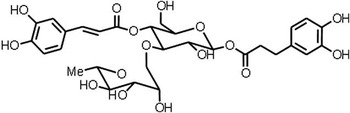
Many substances naturally present in plants, such as phenolics and flavonoids, have the ability to neutralise free radicals. Some of these substances inhibit chain reactions that lead to the formation of additional radicals, thus preventing the propagation of cellular damage. Other substances scavenge free radicals and in turn become oxidised and require regeneration to regain their function (Halliwell, Reference Halliwell1997; Nijveldt et al., Reference Nijveldt, van Nood, van Hoorn, Boelens, van Norren and van Leewen2001). Verbascoside, a phenylpropanoid glycoside (PPG), is one of many plant extracts with demonstrated antioxidant properties. Verbascoside contains a rhamnose unit bound to glucose, which acts as a bridge (Figure 1). The extensive family of phenylpropanoids contains natural molecules that are water soluble, widely distributed in the plant kingdom and have been isolated from medical plants. In vitro studies have demonstrated that these molecules promote anti-inflammatory (Deepak and Handa, Reference Deepak and Handa2000), anti-tumour (Kunvari et al., Reference Kunvari, Paska, Laszlo, Orfi, Kovesdi, Eros, Bokonyi, Keri and Gyurjan1999) and antioxidant (Daels-Rakotoarison et al., Reference Daels-Rakotoarison, Seidel, Gressier, Brunet, Tillequin, Bailleul, Luyckx, Dine, Cazin and Cazin2000) activities through a scavenger effect on reactive oxygen species (ROS; Wang et al., Reference Wang, Kang, Zheng, Yang, Lu, Gao and Jia1996; Gao et al., Reference Gao, Igalashi and Nukina1999). Many studies have also shown the antioxidant activity of verbascoside on cellular systems and on various organs and systems of the human body (Li et al., Reference Li, Xin, Li, Lu, Tong, Gao and Chan1999; Chen et al., Reference Chen, Su, Yang, Li, Wang and Zhou2002). In animal species, the antioxidant properties of verbascoside were demonstrated using the lipid peroxidation dosage on plasma and membrane fluidity of immobilised rabbit erythrocytes (Liu et al., Reference Liu, Li, Guo, Lee, Qin and Chan2003). In weaned piglets, both an increase in oxidative stability of blood parameters and an improvement in growth performance were observed (Corino et al., Reference Corino, Rossi, Musella, Cannata and Pastorelli2007a).
Chemical structure of verbascoside.

The aim of this study was to test the influence of two different levels of a natural extract, titrated in PPGs, on blood parameters and the oxidative status of plasma in pairs of intensively reared hares.
Material and methods
Animals and diets
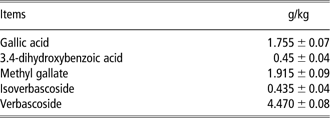
The study lasted 210 days (February to August) and was conducted at the farm ‘Allevamenti Roger’ in the countryside of Isernia, Molise Region, with 45 pairs of Italian hares that were intensively reared in French model cages (Castiglione et al., Reference Castiglione, Castellini and Dal Bosco1996). The animals were uniform in live weight (males: 3.34 and 3.81 kg females), age (2 years ±0.6) and order (all females were multiparous). The hares were divided into three groups of 15 pairs each: a control group (CON) and two experimental groups (T1 and T2). The experimental groups were fed a diet supplemented with 1 or 2 kg/t of a commercial antioxidant, which was produced and provided by Consorzio Powerfeed (Costa de’ Nobili, 27010 Pavia, Italy). The antioxidant supplement contains a water-soluble extract of Verbenaceae (Lippia spp.) leaves, prepared on an industrial scale by a standardised procedure that includes ultrasonic extraction with 60% aqueous ethyl alcohol (EtOH) followed by spray drying with maltodextrins as an excipient. The PPGs and benzoic acid content of the feed supplement are reported in Table 1, according to a certificate of analysis provided by the manufacturer. The quantitative analysis of the phenolic compounds was performed by HPLC-UV-DAD (Rastrelli L, personal communication) according to Piccinelli et al. (Reference Piccinelli, De Simone, Passi and Rastrelli2004). To avoid oxidation in the complete feed, the supplement is microencapsulated within a protective matrix of hydrogenated vegetable lipids using spray-cooling technology (Sintal Zootecnica, Isola Vicentina, Vicenza, Italy).
PPGs and benzoic acid content of feed supplement

PPGs = phenylpropanoid glycosides.
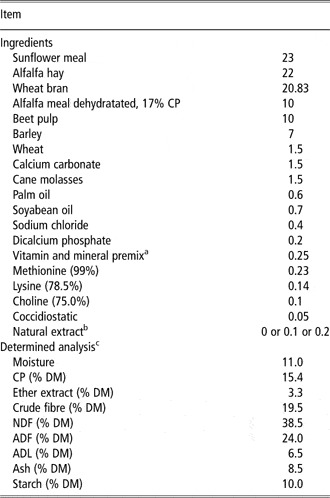
A common feeding programme was used for all hares and consisted of a diet (Martini Spa, Budrio di Longiano FC, Italy) offered ad libitum as 4-mm pellets. The ingredient composition and the determined (AOAC, 2000) nutrient value of the diet are shown in Table 2.
Ingredients and chemical composition of diet (% as-fed basis unless otherwise indicated)

DM = dry matter.
aSupplied per kg of diet: 7,000 I.U. vitamin A (trans-retinyl acetate); 1,600 I.U. vitamin D3 (cholecalciferol); 20 I.U. vitamin E (all-rac-tocopherol-acetate); 1.0 mg vitamin K3 (bisulphate menadione complex); 0.7 mg thiamin (thiamine-mononitrate); 3.0 mg riboflavin; 9 mg pantothenic acid (D-Ca pantothenate); 15mg vitamin B3 (niacin); 100mg choline (coline chloride); 1mg pyridoxine (pyridoxine HCl); 0.016mg vitamin B12 (cobalamin); 16.5mg Cu (CuSO4·5H2O); 75mg Fe (FeSO4·7H2O); 40mg Mn (MnO2); 110mg Zn (ZnO); 0.1mg Co (CoSO4); 0.3mg Se (Na2SeO3); 0.8mg I (Ca(IO3)2) and 125 mg ethoxiquin.
bRespectively 0, 0.1 and 0.2kg for Control (CON), Low (T1) and High (T2) level of feed supplement inclusion groups.
cn = 2.
The hares also had ad libitum access to alfalfa hay. Breeding couples were observed during 7 months for several reproductive cycles and subjected to the following experimental measurements:
1. BW of males and females at 0 day (trial start), 70, 140 and 210 days.
2. Weekly feed intake, collected for breeding pairs and grouped in periods 0 to 70, 70 to 140 and 140 to 210 days.
3. Blood samples at 0, 70, 140 and 210 days.
Blood samples were collected in the morning from the external ear vein by immobilising the animal in a tissue bag, from which only the ears protruded through the slots. The bag, made to fit the animal, maintained their stillness with darkness to keep them calm. Blood samples were collected in two 2-ml vacutainer glass tubes (Venoject, Terumo Europe N.V., Leuven, Belgium): the first contained sodium heparin and the second contained EDTA for measuring haematological parameters. The sodium heparin blood samples were centrifuged for 15 min at 3000 r.p.m.
Blood analyses
Triglycerides, total cholesterol, HDL cholesterol and bilirubin levels in plasma were immediately determined with an automated clinical chemistry analyzer, model ARCO (Biotecnica Instruments S.p.A., Roma, Italy).
The concentration of reactive oxygen metabolites (ROMs) in plasma was determined by a spectrophotometer and a colorimetric method, as proposed by Diacron, using a specific commercial kit at a wavelength of 505 nm (Cesarone et al., Reference Cesarone, Belcaro and Caratelli1999). The results were expressed in Carr Units (1 Carr Unit equals 0.024 mmol/l of H2O2).
The determination of thiobarbituric acid reactive substances (TBARS) was performed in plasma according to Esterbauer and Zollner (Reference Esterbauer and Zollner1989). Briefly, a standard curve was generated using 1,1,3,3-tetramethoxypropane (Sigma Aldrich, St. Louis, USA). Trichloroacetic acid 10% (v/v) was added to the plasma samples, promoting the precipitation of proteins. The resulting mixture was incubated for 15 min on ice. After centrifugation at 2200 r.p.m. at 4°C for 15 min, 0.67% thiobarbituric acid was added to the supernatant. The mixture was incubated in a water bath at 90°C for 10 min, after which the absorbance was read at 532 nm in a spectrophotometer. The results were expressed as μmol of thiobarbituric acid per litre of plasma.
Vitamins A and E were extracted from plasma samples with chloroform (Zhao et al., Reference Zhao, Tham, Lu, Lai, Lee and Moochhala2004) and analysed on an HPLC system (Kontron Instruments, Milano, Italy) consisting of an autosampler (HPLC Autosampler 360, Kontron Instruments, Milano, Italy) with a 20 μl loop, a high pressure mixing pump and a 5 μm, 250 × 4.60 mm C18 column (Phenomenex, Torrance, CA, USA). The mobile phase was 100% methanol at a flow rate of 1.0 ml/min. A fluorimeter detector (SFM) and computer with Kroma System 2000 software were used. The concentrations of vitamins A and E were determined by using an internal standard and the elution time of pure standards.
Whole blood was tested for haematological parameters, including red blood cells, white blood cells, platelets and haematocrit, using the automatic blood cell counter SEAC (Radim Company, Calenzano, FI, Italy).
Statistical analysis
After assessing whether the frequency distribution assumed normality, all variables were subjected to a variance test using the GLM procedure for repeated measures in the SPSS program (2009). The fixed effects of dietary treatment and time, as well as their interaction, were included in the model. No significant differences in blood parameters or feed intake between males and females were found, and therefore the experimental unit was a couple of hares. Differences were considered significant at P < 0.05.
Results
Live weight and feed intake
The live weight and feed intake of breeding pairs did not show any significant changes as a result of the experimental treatment.
Blood parameters
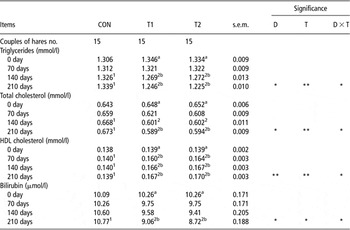
The dietary treatment significantly affected (P < 0.05) all parameters listed in Table 3 (triglycerides, total cholesterol, HDL cholesterol and bilirubin).
Blood values of hares fed control diet (CON) and diets supplemented with two levels of a natural extract titrated in PPGs (T1 and T2 supplemented 1 and 2 kg/t feed, respectively)

PPGs = phenylpropanoid glycosides; D = fixed effect of dietary supplementation; T = fixed effect of time; D × T = interaction dietary supplementation × time.
1,2Means with different superscripts within a row are different (P < 0.05).
a,bMeans with different superscripts within a column are different (P < 0.05).
* = P < 0.05; ** = P < 0.01.
Triglyceride values were significantly lower for the T1 and T2 groups than for the control group CON at both 140 days (−4.3% and −4.1%, respectively) and 210 days (−6.9% and −8.5%, respectively). The length of the dietary treatment resulted in a marked decrease in triglycerides (P < 0.01), to 7.4% and 8.2% in the T1 and T2 groups, respectively, from the beginning to the end of the trial. The control group did not display significant variation over the same period.
Dietary treatment also produced a decrease (P < 0.05) in total cholesterol by 140 days that continued until 210 days, when the T1 and T2 groups had reached reductions of 12.5% and 11.7%, respectively. The effect of time was observed as follows (P < 0.01): total cholesterol values decreased in the T1 and T2 groups from the first to the fourth sampling by 9.1% and 8.9%, respectively. The control group, however, did not present appreciable changes during the same period.
At the end of the study (on day 210), HDL cholesterol was higher (P < 0.01) in the T1 and T2 groups (20.1% and 22.3%, respectively) compared to the control group. The HDL cholesterol values in the experimental groups also increased significantly by the second (70 days) and third sampling points (140 days). A significant increase (P < 0.01) in HDL cholesterol for groups T1 and T2 of 20.1% and 22.3%, respectively, was observed from the beginning to the end of the trial. The control group showed no change over time.
Serum bilirubin decreased (P < 0.05) in response to the dietary treatment. At the end of the trial, groups T1 and T2 had lower values of 15.9% and 19.0%, respectively, compared to the control group. Serum bilirubin decreased by 11.7% and 15.5%, respectively, in groups T1 and T2 from the beginning to the end of the trial.
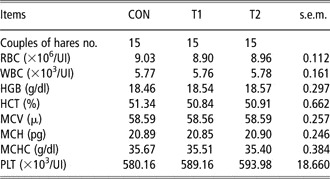
Haematological parameters (RBC, WBC, HGB, HCT, MCV, MCH, MCHC and PLT) did not present statistically significant differences as a result of the dietary treatment over time (Table 4). They were summarised into single data points, such that each parameter was reported as the mean value obtained from the samples taken at 0, 70, 140 and 210 days.
Haematological parameters in couples of hares fed control diet (CON) and diets supplemented with two levels of a natural extract titrated in PPGs (T1 and T2 supplemented 1 and 2 kg/t feed, respectively)

PPGs = phenylpropanoid glycosides.
Fixed effects of dietary supplementation, of time and interaction dietary supplementation × time are not significant.
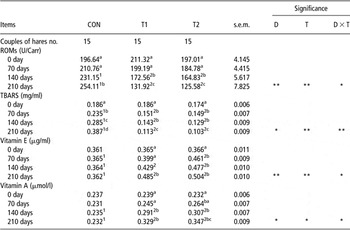
The dietary treatment resulted in a significant improvement in the levels of the markers for oxidative status (ROMs, TBARS, vitamin E and vitamin A; Table 5).
Blood values of oxidative status in couples of hares fed control diet (CON) and diets supplemented with two levels of a natural extract titrated in PPGs (T1 and T2 supplemented 1 and 2 kg/t feed, respectively)

PPGs = phenylpropanoid glycosides; ROMs = reactive oxygen metabolites; TBARS = thiobarbituric acid reactive substances; D = fixed effect of dietary supplementation; T = fixed effect of time; D × T = interaction dietary supplementation × time.
1,2Means with different superscripts within a row are different (P < 0.05).
a,b,c,dMeans with different superscripts within a column are different (P < 0.05).
* = P < 0.05; ** = P < 0.01.
The values of ROMs decreased (P < 0.01) from the third sampling time until the end of the trial (210 days) in both the T1 and T2 groups, in which they were lower by 48.1% and 50.6%, respectively, than the control group values. Time had a significant effect on ROMs, such that the values decreased markedly (P < 0.01) by 37.6% and 36.3% in groups T1 and T2, respectively, as the trial continued. For the same time interval, the control group CON presented values that increased by 29.2% (P < 0.05). TBARS values were also statistically decreased in the T1 and T2 groups, by 70.8% and 73.4%, respectively (P < 0.05), at the end of the trial (210 days) compared to the control group. The differences with respect to the control group were identified as early as the second sampling time and were maintained until the end of the trial. The length of treatment markedly influenced (P < 0.01) the reduction of TBARS values in groups T1 and T2, which decrease by 39.2% and 40.8%, respectively, from the beginning to the end of the trial. TBARS values in the control group increased by 108.1% (P < 0.05) for the same period.
The blood concentration of vitamin E at the end of the trial was significantly increased (P < 0.01) for groups T1 and T2, by 34.0% and 39.2%, respectively, compared to the control group. In particular, the differences in vitamin E content had emerged by 70 days after the start of the trial in the T2 group, and by 140 days in the T1 group. In addition, an effect for time on vitamin E content was observed (P < 0.01). The content increased by 32.9% and 37.7% in the T1 and T2 groups, respectively, whereas vitamin E content in the control group remained unchanged over the same period.
The content of vitamin A increased significantly during the trial (P < 0.05), by 41.8% and 49.6%, respectively, in the T1 and T2 groups compared to the control group CON. Increases were recorded for the treated groups, starting from the third sampling time point. Throughout the experiment, groups T1 and T2 showed significant increases (P < 0.05) of 37.7% and 49.6%, respectively, in vitamin A concentration, while the control group values remained constant.
Discussion
Dietary treatment with an antioxidant supplement titrated in PPGs did not influence the BW or feed intake of pairs of hares. The values remained normal for the species throughout the trial (Paci et al., Reference Paci, Bennati and Bagliacca1999, Reference Paci, Bagliacca, Mozzicafreddo and Lisi2000 and Reference Paci, Lavazza, Profumo, Ferretti and Bagliacca2001; Baldassarre, Reference Baldassarre2005).
The values of blood parameters all conformed to the normal ranges for this species (Marco et al. Reference Marco, Cuenca, Pastor, Velarde and Lavin2003; Massanyi et al., Reference Massanyi, Slamecka, Lukac, Capcarova, Mertin and Jurcik2009), although some were influenced by the treatment, which resulted in improved lipid blood values in hares from groups T1 and T2. In particular, significant reductions in triglycerides and total cholesterol and a marked increase in HDL cholesterol were observed. The increase in plasma concentrations of HDL cholesterol might have been caused by the effect of polyphenols that are involved in the regulation of lipid and glucose metabolism. Some authors (Norata et al., Reference Norata, Pellegatta and Catapano2003; Bursill and Roach, Reference Bursill and Roach2007) have suggested that polyphenols activate the peroxisome proliferator-activated receptor (PPARα), modulating the expression of key proteins involved in the metabolism of HDL in the liver. Triglycerides may also be involved in the same mechanism of PPARα activation by polyphenols, leading to an induction of lipoprotein lipase (LPL) in peripheral tissues and increased lipolysis, which would result in reduced levels of circulating triglycerides and very low-density lipoproteins (VLDL).
Radwan et al. (Reference Radwan, Hassan, Qota and Fayek2008) fed hens diets supplemented with vitamin E, thyme oil, oregano, rosemary and turmeric, and observed a significant decrease in total lipids for the groups receiving oil of thyme and rosemary. No effect was observed for levels of total cholesterol and LDL cholesterol. In broilers fed diets with thyme leaves, Radwan (Reference Radwan2003) and Case et al. (Reference Case, He, Mo and Elson1995) observed a reduction in total lipids and total cholesterol, which was probably due to an inhibiting effect of thymol and carvacrol on HMG-CoA reductase, the enzyme responsible for cholesterol synthesis in the liver. Ali et al. (Reference Ali, Hassan and Abd El-Ghany2007) noted a marked decrease in total cholesterol, LDL cholesterol, triglycerides and total lipids in hens that received feed supplemented with thyme plants.
The decrease in bilirubin levels that we observed is most likely due to the antioxidant activity of polyphenols that inhibits the biochemical pathway involved in bilirubin synthesis (Aliyu et al., Reference Aliyu, Gatsing and Jaryum2007). Similarly, Yousef et al. (Reference Yousef, Salem, Kamel, Hassan and El-Nouty2003) observed that rabbits fed a diet enriched with antioxidants, such as ascorbic acid, had lower bilirubin levels after daily ingestion of aflatoxin B1.
The experimental treatment described here led to an improvement in the oxidative status of blood plasma, and these results are probably due to the action of antioxidant polyphenols in verbascoside. As redox-active molecules, polyphenols can be oxidised and reduced without them becoming highly reactive free radicals. They play a protective role against ROS, thus reducing the lipoperoxides evidenced by the decrease in plasma MDA. The reduction in ROMs and lipid peroxidation (TBARS) can be due both to the direct action of the antioxidant verbascoside, which captures free radicals during the propagation of a chain reaction, and a phase-lock initiation of oxidation by inhibiting pro-oxidant enzymes (Miller et al., Reference Miller, Brzezinska-Slebodzinska and Madsen1993; Kamiloglu et al., Reference Kamiloglu, Beytut and Aksakal2006). These results are in agreement with those reported by Corino et al. (Reference Corino, Cannata, Musella, Pastorelli and Rossi2007b) on weaned piglets fed a verbascoside-supplemented diet. Susca et al. (Reference Susca, Sangalli, Sgoifo Rossi, Biondi and Dell'Orto2005) also observed that Charolais cattle subjected to transport stress had a decrease in the concentration of Malonaldehyde (MDA) when their diet was supplemented with high antioxidant plant extracts. Li et al. (Reference Li, Xin, Li, Lu, Tong, Gao and Chan1999) observed a decrease in the concentration of ROMs in a study on skeletal muscle in rats that had been subjected to stress, but whose diet had been supplemented with verbascoside. Similar results were also reported by Fidan and Dundar (Reference Fidan and Dundar2008), who showed that the administration of Yucca Schidigera and Quillaja Saponaria extracts, both rich in saponins, resulted in decreased MDA in diabetic rats, due to the protective antioxidant effects of phenolic groups, such as resveratrol, present in these plant extracts.
The increase in serum levels of vitamins A and E can be attributed to the ability of verbascoside to strengthen and save the endogenous antioxidant system, controlling oxidative metabolism by reducing the production of reactive radical species and increasing the antioxidant activity of enzymes (Princen et al., Reference Princen, van Duyvenvoorde, Buytenhek, Blonk, Tijburg, Langius, Meinders and Pijl1998; Zhu et al., Reference Zhu, huang, Tsang and Chen1999; Liao and Yin, Reference Liao and Yin2000).
Moreover, results similar to those presented here were obtained in a study on lambs supplemented with verbascoside (Casamassima et al., Reference Casamassima, Palazzo, Presutti and Colella2009). In addition to being stimulated by antioxidants, the increase in plasma values of vitamins A and E is also influenced by the integration of these vitamins in the diet (Mahan, Reference Mahan1991; Hidiroglou et al., Reference Hidiroglou, Farnworth and Butler1993; Njeru et al., Reference Njeru, McDowell, Wilkinson, Linda and Williams1994; Corino et al., Reference Corino, Oriani, Pantaleo, Pastorelli and Salvatori1999; Oriani et al., Reference Oriani, Salvatori, Pastorelli, Pantaleo, Ritieni and Corino2001; Lauridsen et al., Reference Lauridsen, Engel, Jensen, Craig and Traber2002).
Conclusion
The experimental treatment did lead to a significant reduction in triglycerides, total cholesterol and bilirubin, as well as a marked increase in serum levels of HDL cholesterol.
The verbascoside also resulted in improved homoeostatic plasma stability, due to a significant decrease in concentrations of ROMs and TBARS and increased concentrations of vitamins A and E.
The results of this research demonstrate an important role for food supplements and antioxidants on some blood parameters, including lipid profiles and oxidative status of plasma, as shown by a marked decrease in ROMs and TBARS and a significant increase in bodily reserves of the antioxidant vitamins A and E.
Acknowledgements
This study received financial support from the Italian Ministry for University and Research (PRIN 2008). All experiments complied with the current Italian laws and are in compliance with Animal Welfare Regulation. We are sincerely grateful to Prof. Sandra A. I. Wright for language editing of the manuscript.