

INTRODUCTION
Despite growing evidence that the largest animal species in an ecosystem play unique functional roles (Hansen & Galetti Reference HANSEN and GALETTI2009, Owen-Smith Reference OWEN-SMITH1988, Skarpe et al. Reference SKARPE, AARRESTAD, ANDREASSEN, DHILLION, DIMAKATSO, DU TOIT, DUNCAN, HALLEY, HYTTEBORN, MAKHABU, MARI, MAROKANE, MASUNGA, MODISE, MOE, MOJAPHOKO, MOSUGELO, MOTSUMI, NEO-MAHUPELENG, RAMOTADIMA, RUTINA, SECHELE, SEJOE, STOKKE, SWENSON, TAOLO, VANDEWALLE and WEGGE2004), we cannot yet fully understand how their extirpation affects biodiversity and ecosystem function (Corlett Reference CORLETT2013). This holds true even for megaherbivores, or species over 1000 kg, such as elephant and rhinoceros species (Owen-Smith Reference OWEN-SMITH1988). Since their size gives megaherbivores unusual ecological properties (Campos-Arceiz et al. Reference CAMPOS-ARCEIZ, LARRINAGA, WEERASINGHE, TAKATSUKI, PASTORINI, LEIMGRUBER, FERNANDO and SANTAMARIA2008, Skarpe et al. Reference SKARPE, AARRESTAD, ANDREASSEN, DHILLION, DIMAKATSO, DU TOIT, DUNCAN, HALLEY, HYTTEBORN, MAKHABU, MARI, MAROKANE, MASUNGA, MODISE, MOE, MOJAPHOKO, MOSUGELO, MOTSUMI, NEO-MAHUPELENG, RAMOTADIMA, RUTINA, SECHELE, SEJOE, STOKKE, SWENSON, TAOLO, VANDEWALLE and WEGGE2004), theory suggests that the extirpation of megaherbivores will have notable effects on ecosystem processes (Naeem & Li Reference NAEEM and LI1997). Research on whether the loss of megaherbivores leads to expected ecological effects strengthens our understanding of the resilience of natural systems in the face of modern ecological changes.
The role of megaherbivores in seed dispersal may be important for maintaining diversity (Campos-Arceiz & Blake Reference CAMPOS-ARCEIZ and BLAKE2011). Megaherbivore species can swallow and defecate even very large seeds, and some disperse seeds over particularly long distances (Blake et al. Reference BLAKE, DEEM, MOSSIMBO, MAISELS and WALSH2009, Campos-Arceiz & Blake Reference CAMPOS-ARCEIZ and BLAKE2011, Campos-Arceiz et al. Reference CAMPOS-ARCEIZ, LARRINAGA, WEERASINGHE, TAKATSUKI, PASTORINI, LEIMGRUBER, FERNANDO and SANTAMARIA2008). Yet the advantages of dispersal by megaherbivores are of little pertinence if they eat only a tiny proportion of available fruit in nature (Campos-Arceiz & Blake Reference CAMPOS-ARCEIZ and BLAKE2011); thus, measurements of the proportion of available fruit that is reliably handled by megaherbivores compared with other frugivores are necessary (Dennis & Westcott Reference DENNIS and WESTCOTT2006, Jordano & Schupp Reference JORDANO and SCHUPP2000). Previous studies on frugivory by megaherbivores have focused on peculiar fruit, such as Balanites wilsoniana, which is too toxic for most species to eat (Cochrane Reference COCHRANE2003), or Dillenia indica, which starts off too hard for most frugivores to consume (Sekar & Sukumar Reference SEKAR and SUKUMAR2013). Many of the fruit purportedly dispersed by megafauna are accessible to smaller animals as well (Corlett Reference CORLETT1998, Janzen & Martin Reference JANZEN and MARTIN1982, Kitamura et al. Reference KITAMURA, YUMOTO, POONSWAD, CHUAILUA, PLONGMAI, MARUHASHI and NOMA2002). Since these smaller species may be arboreal and more numerous than sympatric megaherbivores, they may be able to consume most available fruit before megaherbivores have a chance.
Nonetheless, the potential advantages that megaherbivore dispersal offers mammal-dispersed plant species may have selected for plants with characteristics that facilitate substantial megaherbivore frugivory. We examine the general hypothesis that megaherbivores are major frugivores (and thus potentially major dispersers) of plant species with easily edible, mammal-dispersed fruit in their ecosystems. As there is no straightforward link between the quantity of fruit removed by a species and its importance as a disperser (Jordano & Schupp Reference JORDANO and SCHUPP2000), we arbitrarily define a major frugivore as an animal species that (a) is amongst the top five consumers of fruit for a given plant species and (b) consumes at least 5% of the fruit handled by frugivores. Focusing on two species believed to be mammal- and bird-dispersed in South Asian tropical forests – Artocarpus chaplasha and Careya arborea –we test the specific hypothesis that Asian elephants will remove at least 5% of fruit consumed by frugivores. To do so, we conducted (1) focal watches of frugivory in A. chaplasha and arboreal camera trapping of C. arborea fruit to quantify relative fruit removal by arboreal frugivores; and (2) camera trapping of fallen fruit to identify the proportion of these fruit removed by the elephant and other frugivores. Since the effectiveness of small-bodied (often arboreal) major frugivores as dispersers can be attenuated by the distances that they disperse seeds (McConkey & Brockelman Reference MCCONKEY and BROCKELMAN2011), we also examined a second specific hypothesis that less than 5% of A. chaplasha seeds spit or thrown by arboreal frugivores would be dispersed more than 100 m from the parent tree. We conducted seed transects to measure the dispersal distances of seeds discarded from the canopy. In sum, our research assesses whether, given the seed-dispersing behaviours of sympatric frugivores, the elephant consumes enough of the easily edible fruit of two species to be a major player in their routine dispersal. Such inquiry helps us understand how the loss of megaherbivores may affect ecosystem processes.
METHODS
Study species
We selected two species which bear fruit locally reported to be eaten by elephants and other mammals: Artocarpus chaplasha Roxb. and Careya arborea Roxb. Both species were reported to fruit early in the monsoon season.
Artocarpus chaplasha (Moraceae) is a large evergreen species ranging from the sub-Himalayan tracts of Nepal east through Myanmar and in the Andaman and Nicobar Islands (Sahni Reference SAHNI1998). Artocarpus chaplasha fruit averages 466 ± 106 g (range = 101–1083 g, N = 259 fruit from 12 trees, variability reported as standard deviation); 9.6 ± 1.5 cm in length top to bottom (range = 5.4–15.0 cm, N = 259 fruit); and 9.3 ± 1.3 cm in width (range = 5.7–12.9 cm, N = 259 fruit). The dispersal of the 1.5-cm seeds of A. chaplasha (averaging 50.9 ± 25.6 per fruit, range = 8–127 seeds, N = 80 fruit) is not well-documented. Datta & Rawat (Reference DATTA and RAWAT2008) write that A. chaplasha is dispersed by hornbills and squirrels in Arunachal Pradesh, India, though the latter are typically seed predators. Sahni (Reference SAHNI1998) suggests birds and monkeys disperse the seeds.
Our second study species is Careya arborea (Lecythidaceae). Careya arborea is a deciduous tree ranging over much of the subcontinent with fruit resembling pears in hardness and 1.5–2 cm seeds (Mabberley Reference MABBERLEY1997, Macnae & Fosberg Reference MACNAE, FOSBERG and Dassanayake1981). Sundarapandian et al. (Reference SUNDARAPANDIAN, CHANDRASEKARAN and SWAMY2005) describe the seeds of C. arborea to be animal-dispersed, but without noting the potential dispersers. Careya arborea fruit (removed from 11 trees) averaged 112.8 ± 59.5 g in mass (range = 29–741 g, N = 401 fruit); 6.8 ± 1.1 cm in length (range = 3.7–12.6 cm, N = 401 fruit); and 5.7 ± 8.5 cm in width (range = 3.7–12.0 cm, N = 401 fruit). Careya arborea fruit varied dramatically in number of seeds, with anywhere from 0 to 42 seeds (mean=6.0 ± 6.0 seeds, N = 116 fruit).
The literature suggests that a range of animals – spider monkey Ateles paniscus (Russo et al. Reference RUSSO, PORTNOV and AUGSPURGER2006); hornbills such as Buceros bicornis and Aceros undulatus (Kitamura et al. Reference KITAMURA, SUZUKI, YUMOTO, POONSWAD, CHUAILUA, PLONGMAI, MARUHASHI, NOMA and SUCKASAM2006, Nakashima et al. Reference NAKASHIMA, LAGAN and KITAYAMA2007); imperial pigeon Ducula badia (Kitamura et al. Reference KITAMURA, SUZUKI, YUMOTO, POONSWAD, CHUAILUA, PLONGMAI, MARUHASHI, NOMA and SUCKASAM2006); gibbon Hylobates lar (McConkey & Brockelman Reference MCCONKEY and BROCKELMAN2011), etc. – can disperse seeds 1.5–4 cm in length either by regurgitation or defecation. As such, both A. chaplasha and C. arborea provide an opportunity to explore whether megaherbivores may be quantitatively important for the dispersal of seeds that – at least in some systems –can be dispersed by much smaller animals. For both species, feeding trials with elephants have proven that elephants pass large proportions of ingested seeds (mean 67.2%, N = 6 elephants for A. chaplasha and 43.1%, N = 3 for C. arborea) without digesting them. Additionally, seeds defecated by elephants were found to germinate at least as well as seeds taken directly from fruit (Sekar et al. in press).
Study area: Buxa Tiger Reserve
Research was conducted from June-August of 2010–2012 in Buxa Tiger Reserve (henceforth Buxa), located in the northern part of the Indian state of West Bengal. The 761-km2 reserve is situated 26o30′–26 o55′N, 89o20′–89 o55′E (Buxa official website 2015), mostly between 80–200 m asl. With an average annual rainfall of c. 4500 mm, the reserve is predominantly a tropical moist forest habitat (Sukumar et al. unpubl. data). Artocarpus chaplasha trees are typically found in clumps in the southern, wetter portion of the reserve as part of the closed canopy. Careya arborea trees are scattered throughout Buxa but were more often found where the canopy was not entirely closed, such as alongside seasonal rivers and in areas with former plantations.
Sukumar et al. (unpubl. data) and the 2010 Forest Department census estimated there to be 217 and 228 elephants, respectively, in Buxa (S. P. Chowdhury, pers. comm). Various other frugivorous mammal species inhabit Buxa, including chital deer (Axis axis), gaur (Bos gaurus), Himalayan crestless porcupine (Hystrix brachyura), rhesus macaque (Macaca mulatta), common palm civet (Paradoxurus hermaphroditus), Malayan giant squirrel (Ratufa bicolor), sambar (Rusa unicolor) and wild pig (Sus scrofa) (nomenclature after Menon Reference MENON2009). Domestic buffalo (Bubalus bubalis) and domestic cattle (Bos primigenius) are also often found in substantial numbers, sometimes penetrating deep into the reserve. Fruit bats have not been observed in Buxa for many years (Sekar pers. obs., N. P. Sharma, pers. comm.). Conspicuous frugivorous bird species in Buxa include the rose-ringed parakeet (Psittacula krameri), Oriental pied hornbill (Anthracoceros albirostris) and great hornbill (Buceros bicornis).
Focal watches (Artocarpus chaplasha)
To determine whether the elephant is a major frugivore of the fruit of A. chaplasha and C. arborea, the relative proportion of fruit consumed by both arboreal and terrestrial frugivores must be measured. Focal watches (N = 39 at 19 trees, totalling 104 h) were conducted to identify diurnal arboreal frugivores of A. chaplasha and (1) quantify the relative consumption of fruit by various arboreal species and (2) compare the proportion of fruit removed by arboreal frugivores to the proportion that fell to the ground. Focal watches covered the period from 5h00 to 19h00 about evenly. Methods followed Sekar & Sukumar (Reference SEKAR and SUKUMAR2013), though observations were always conducted from a vehicle due to safety concerns.
To estimate relative fruit removal rates by frugivores, focal watches were broken into 5-min sampling periods. At the beginning of each period, the number of individuals of each frugivorous animal species in the tree was counted. Then, one focal individual of each species whose activities were visible was observed for 5 min; there may have been bias towards moving (more detectable) individuals. The number of fruit consumed by each focal individual and the treatment of the seeds of the fruit were observed whenever possible.
We observed that individuals of a species tended towards different activities (e.g. eating versus resting) based on the time of day that the species visited the tree. We therefore estimated the number of fruit consumed by a group of frugivores of a given species X during a 5-min period by multiplying the number of individuals of species X in the focal tree during that period by the average number of fruit eaten per 5-min interval by all the focal individuals from that group over the course of that group's visit to the focal tree. A visit was constituted by the continuous occupation of a focal tree by individuals of species X with a gap of less than 10 min. Ultimately the sum of all fruit estimated to have been removed by species X over the course of the focal watches was divided by the number of hours of focal watches (104) and multiplied by 14 to provide an estimate of the average number of fruit removed by this species from a typical A. chaplasha tree each day; since our raw data from focal watches and camera trapping suggested that frugivory by arboreal crepuscular or nocturnal animals in Buxa was probably rare, we assumed we could safely ignore frugivory that occurred during the night in our calculations. Using each 5-min sampling period as the unit, a bias-corrected and accelerated confidence interval was constructed for each species’ daily fruit removal estimate using non-parametric bootstrapping from the boot package in R (Davison & Hinkley Reference DAVISON and HINKLEY1997; R version 3.2.0, http://www.R-project.org).
Similarly, fruit fall rates were estimated by noting the number of fruit seen or heard to fall from the focal tree during each focal watch period. A daily fruit fall rate was calculated as the sum of the expected diurnal fruit fall and nocturnal fruit fall. Diurnal fruit fall was estimated using all the data from the focal watches; nocturnal fruit fall (which assumed no nighttime frugivore activity) was calculated by excluding the data when animals were in the focal tree. For both estimates, confidence intervals were calculated using bootstrapping as above.
Arboreal camera trapping (Careya arborea)
Focal watches were not possible with C. arborea trees for safety and logistical reasons. In order to measure relative rates of fruit removal and fruit fall from the canopy, Reconyx camera traps were used to monitor 63 fruit in the canopies of eight trees; each tree hosted a camera trap for 6–7 d. More data could not be collected due to time limitations and the risks of climbing C. arborea trees when they were wet. The ratio of the number of fruit that fell to the ground to the number that were removed by arboreal frugivores gives us an estimate of the proportion of fruit that become available to elephants and other terrestrial dispersers.
Terrestrial camera trapping and fruit counts
The next step in gauging whether the Asian elephant is a major disperser of A. chaplasha and C. arborea was to measure the proportion of fallen fruit removed by each terrestrial frugivore species. Camera trapping and counts of fruit on the ground were conducted to identify the terrestrial frugivores of both A. chaplasha and C. arborea fruit (Prasad et al. Reference PRASAD, PITTET and SUKUMAR2010, Sekar & Sukumar Reference SEKAR and SUKUMAR2013). Individual trees were found during searches in June and November of 2010. Four trees at a time were selected randomly for camera trapping; a nearby tree was chosen to substitute for randomly chosen trees that had less than half a fruit on the ground. Trees too close to villages or made inaccessible by swollen rivers were excluded. Over two seasons, camera trapping was conducted at 37 A. chaplasha and 14 C. arborea trees.
At each tree, fruit and partial fruit were counted separately and marked by making three holes in a fruit with a sharp piece of bamboo. Rotten fruit were counted when time permitted. Between 0.5 and 5.5 A. chaplasha fruit (mean = 2.4 fruit, with all partial fruit counted as 0.5 fruit) and between 1 and 10 C. arborea fruit (mean = 4.5 fruit) were placed in front of the camera trap such that they resembled the number of fruit found naturally clumped together under the tree. During the first season, we subjectively noted when A. chaplasha fruit we had placed in front of the camera trap appeared to have spoiled, either by rotting or being immersed in mud from the monsoon; for C. arborea fruit, the proportion of fruit rotting was not easy to observe or quantify.
We estimated the relative amount of fruit taken by each frugivore species by dividing the total number of fruit each frugivore species removed from the cameras by the total number of fruit-days monitored. This calculation provided the average proportion of fruit removed from the ground per day by each animal species (Sekar & Sukumar Reference SEKAR and SUKUMAR2013). We again used non-parametric bootstrapping to estimate confidence intervals for these estimates.
Our experience suggested that elephants may be more likely to visit a tree when there were more fruit on the ground; we used the Mann–Whitney test in R to compare the median numbers of marked fruit available when different frugivores triggered the trap to attain evidence of whether such a bias may be occurring.
Seed transects (for Artocarpus chaplasha)
While our hypothesis deals with the quantity of fruit removed by the elephant and other frugivores, information on the quality of dispersal of seeds spat or dropped (i.e. discarded) by arboreal frugivores further contextualize our findings on the relative importance of megaherbivores as potential dispersers of large but easily edible fruit. Seed transects were conducted from the base of A. chaplasha trees to estimate the distances to which arboreal frugivores discarded A. chaplasha seeds (McConkey & Brockelman Reference MCCONKEY and BROCKELMAN2011), allowing a cursory comparison between this type of seed dispersal and the endozoochory that may be provided by larger, terrestrial dispersers. We found two isolated A. chaplasha trees and one row of seven A. chaplasha trees running north to south in the multiple use zone in Buxa. Four 2-m-wide transects were constructed from each tree, with transects extending 40 m north, south, east and west from the base of the tree (for the group of trees, a transect was constructed north from the northernmost tree, east from the central tree, etc.). Each transect was divided into eight 5-m segments. Transects were walked daily for 8 d, and the number of loose seeds and seeds attached to fruit parts were counted; faeces with seeds in them were also noted. Seed counts were used to calculate the number of seeds per unit area for concentric circles around the tree. A mixed-effects model with random effects for each transect sampled and each day of sampling was constructed to predict the proportion of dispersed seeds (seed densities) based on distance from the base of the tree; the observed seed densities were modelled as following a log-normal distribution. JAGS 3.3 (Plummer Reference PLUMMER, Hornik, Leisch and Zeileis2003) was used to fit the Bayesian model and the R2jags package (R version 3.2.0, http://www.R-project.org) was used to call JAGS from R.
RESULTS
Focal watches (Artocarpus chaplasha)
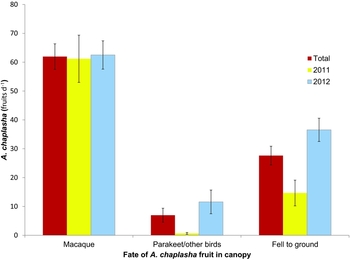
Over the 104 h of focal watches conducted, one species, the rhesus macaque, dominated the removal of fruit from the canopy of A. chaplasha. Figure 1 shows that macaques removed about 62.0 fruit d−1 (assuming no activity at night) per tree, about nine times more than the fruit removed by the rose-ringed parakeet (and another unidentified bird species) and more than twice as much fruit as fell from the canopy. Macaques frequently roosted in A. chaplasha trees overnight, and visited nearby A. chaplasha trees with regularity; macaques would reach out and feel fruit, plucking some and not others. By frequently visiting and roosting in A. chaplasha trees and regularly monitoring their fruit, macaques appeared to make it difficult for other arboreal frugivores (such as Malayan giant squirrels) to reach fruit as they ripened. Similarly, combined with the absence of arboreal frugivores other than macaques (like the common palm civet) in the early morning and late evening during focal watches (and their near-absence in camera traps), our observations suggest that macaques dominate A. chaplasha fruit removal from the canopy in Buxa, leaving relatively few fruit for the forest's less abundant nocturnal arboreal frugivores.
Rates of fruit removal and fruit fall from Artocarpus chaplasha, estimated using data from 104 h of focal watches from 19 trees in Buxa Tiger Reserve. The standard error bars shown were constructed using non-parametric bootstrapping. Removal by the rhesus macaque remains mostly steady between years, whereas a substantial increase in removal by birds and the amount of fruit fall was observed in 2012, suggesting inter-annual variation in fruit production or frugivore activity. Note that these rates mostly apply to trees that have large numbers of ripe fruit in the canopy. Rates of fruit removal and fruit fall are lower when there are few ripe fruit in the canopy, and when most fruit have been removed.

The rose-ringed parakeet was the other main species observed consuming A. chaplasha fruit. These observations were made towards the end of both fruiting seasons, presumably when the fruit were softest. One other bird species flock – possibly the scarlet minivet, Pericrocotus ethologus – made a brief (~5 min) appearance to consume some fruit during one focal watch towards the end of the fruiting season, indicating that our focal watches have not exhaustively identified the minor arboreal frugivores of A. chaplasha. Collectively, birds were estimated to remove 7.0 fruit d−1. No other species was seen eating A. chaplasha fruit, even early in the morning (5h00 onwards) or late in the evening (up to 19h15).
While the parakeet and other birds clearly appeared to consume the pulp and discard the seeds of A. chaplasha fruit one-by-one, macaque treatment of seeds was more complicated. Macaques appeared to discard the vast majority of A. chaplasha seeds, usually close to where they plucked the fruit but sometimes after having moved to a nearby tree. Four of the focal macaques (in 5.6% of scans in which macaque handling of fruit was observable) appeared to consume the fruit without discarding the seeds; these monkeys may have chewed the seeds or swallowed them whole. The focal macaques that did not discard the seeds were all adult individuals; at least two were large adult males.
By jumping on and shaking branches, and by discarding fruit that was not yet ripe, macaques appeared to promote fruit fall while the fruit were not yet too soft to survive the descent. We found that fruit fell at a rate of about 1.64 fruit h−1 per tree (our calculated diurnal rate, effective for 14 h d−1), but once we excluded the times when animals were in the canopy, the data suggested a fruit fall rate of just 0.46 fruit h−1 per tree (the nocturnal rate, which assumed minimal animal activity at night). Overall, we estimated that some 27.6 A. chaplasha fruit were falling from the crown per tree per day.
Arboreal camera trapping (Careya arborea)
Of the 63 C. arborea fruit monitored in eight trees for about 1 wk each (408 fruit-days), 26 fruit fell and four were removed by an apparent frugivore (the Malayan giant squirrel). A common palm civet and an unknown animal were also caught on camera in C. arborea canopy, but they did not remove any of the monitored fruit. These limited data suggest that arboreal frugivory of C. arborea fruit does occur, but that most fruit likely fall to the ground. In one instance, terrestrial camera-trap photos suggested that an elephant may have shaken the tree to induce fruit fall.
Terrestrial camera trap and marked fruit data
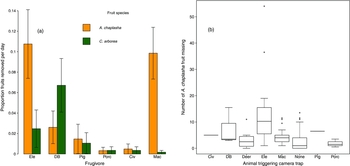
Camera traps monitored 37 A. chaplasha trees, 127 tree-d and 307 fruit-d over the fruiting seasons in 2010 and 2011. Over this time, 78.5 A. chaplasha fruit were removed from the view of the camera traps (all partial fruit were considered 0.5 fruit): 42.0% by elephant, 38.5% by rhesus macaque, 10.2% by domestic bovids (buffalo and cattle), 5.7% by wild pig, 1.9% by common palm civet and 1.3% by porcupine (Figure 2a). Numerous other species, particularly small rodents and mongoose, were caught by the camera multiple times; sambar deer, which was usually caught on camera ignoring the fruit, appeared to nibble at a fruit on one occasion. Artocarpus chaplasha fruit was often found splattered on the ground or in pieces, and seeds were accessible to rodents and perhaps dispersal by water; removal by these vectors was not quantified. Over the monitored period, 24.6% of monitored fruit rotted and 75.4% were removed by frugivores (N = 71).
Camera traps were used in two ways to compare how much fruit different frugivore species removed from the forest floor in Buxa Tiger Reserve. First, for both Artocarpus chaplasha and Careya arborea, the proportion of fruit removed by each frugivore species per day was estimated (a). This was done by tallying the number of fruit removed from camera traps by each frugivore species during the 2010–2011 fruiting seasons and dividing that by the number of fruit-days monitored. Error bars indicate the standard errors, which were calculated using non-parametric bootstrapping. Second, at the end of each day of camera trapping, the number of fruit to go missing from around the tree (including those taken from the camera trap) was counted (b). The numbers of marked A. chaplasha fruit that went missing from around monitored trees each day that an animal species on the x-axis triggered the camera trap is plotted. While this approach attempts to account for all fruit removal from under a monitored tree (and not just removal of fruit in front of the camera trap), note that it is not likely that all the fruit that disappeared from around the tree were always removed by the animal triggering the trap, as the removal of most of the fruit that disappeared was not directly observed (b). Abbreviations are Civ for common palm civet, DB for domestic bovids, Deer for sambar, Ele for elephant, Mac for rhesus macaque, Pig for wild pig, and Porc for Himalayan crestless porcupine.

Between 0.5 and 66 A. chaplasha fruit were marked underneath each tree on a given day (mean = 10.5 ± 10.4 fruit, N = 127). We found an average of 3.5 ± 7.0 rotten fruit (max = 41, N = 36) and an average of 2.65 ± 3.26 new fruit under each tree each day (max = 18, mode = 0, N = 126). Note that since most trees were visited multiple times, these do not constitute independent samples. As many as 54 fruit went missing over the course of any one day. We calculated the number of marked fruit to go missing when a frugivore of a given species triggered the trap (Figure 2b); elephants were associated with the disappearance of large amounts of fruit.
The number of fruit marked under the tree was greater when elephants were caught on camera than when they were not (W = 1081, P = 0.013, N = 117), and the number of marked fruit on the ground was greater when elephants triggered the trap than when macaques did so (W = 168.5, P = 0.026, N = 31).
Due to the scarcity of accessible, fruiting C. arborea trees, camera traps monitored only 63 tree-d and 283 fruit-d at 14 trees over two fruiting seasons. Over this time, 31.5 fruit were removed from the camera traps, of which 60.3% were removed by domestic bovids (cattle), 22.2% by elephant, 9.5% by wild pig, 3.2% by civet, 3.2% by porcupine and 1.6% by macaque (Figure 2a). Careya arborea fruit were also found floating in monsoon flood water, suggesting dispersal can be aided by the monsoons. Wild pig and macaques appeared to chew the fruit and leave the remnants there; they and the civet caught on camera left some if not all of the seeds from the fruit they consumed. While we were not able to quantify the proportion of fruit that rotted, we observed dramatic variation among C. arborea trees, with some (on trails frequented by bovids) having not a rotten fruit beneath them, and others with hundreds.
Between 1 and 234 fruit were marked under each C. arborea tree we visited (mean = 32.0 ± 43.3, N = 63). Excluding one outlier (628), an average of 5.9 ± 13.2 rotten fruit (max = 45, min = 0, N = 25) were found under each C. arborea tree a day. These averages include multiple counts from the same trees.
Seed transects
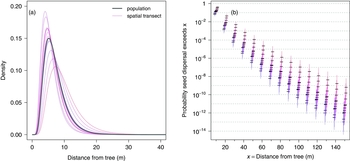
The vast majority (99.7%) of seeds found on our 40-m seed transects were calculated to be within the first 20 m of the base of the tree. Figure 3a shows the mixed-effects lognormal distributions fitted to the 12 seed transects. As indicated in Figure 3b, the probability of a seed being spat or thrown more than 100 m from the tree base on any of the transects is less than 1 in a million. Given the large volume of seeds discarded by macaques, this non-routine, medium-distance dispersal may still affect a substantial number of A. chaplasha seeds. In addition, four macaque faeces containing a total of 12 A. chaplasha seeds were discovered during transects.
Since it was observed during focal watches that arboreal frugivores spat, dropped, or threw down the vast majority of Artocarpus chaplasha seeds handled, seed transects were conducted from the base of A. chaplasha trees to estimate dispersal distances of seeds that were not swallowed. The densities of the predicted seed dispersal distances along each of 12 individual transects in Buxa Tiger Reserve was estimated by fitting lognormal distributions to seed transect data (a). The median of the posterior distribution of the population's average lognormal density is also shown. The probability that a seed will be dispersed × distance from the tree was predicted using a survivor function at 10-m increments for each of the 12 transects in the study (b). The black horizontal line segments indicate the point estimates, while the 95% credible confidence interval for each transect is also shown. Probability is shown on a log scale. (Figure created by Dr Jack Weiss).

DISCUSSION
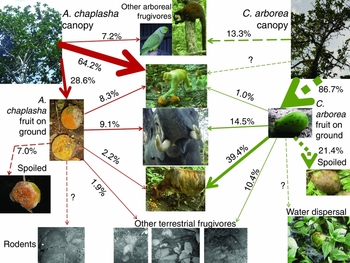
Elephas maximus is a major frugivore even for the soft and easily edible fruit of Artocarpus chaplasha and Careya arborea (Figure 4). Excluding fruit that rots, elephants eat around 9.7% of A. chaplasha fruit and about 18.4% of C. arborea fruit removed by frugivores. This makes the elephant one of the three most substantial frugivores (and potential dispersers) of each of these species in Buxa. The relative importance of the elephant as a disperser of species such as A. chaplasha is augmented by the tendency of arboreal frugivores to discard more than 99.9% of the seeds that they spit, throw, or drop within 100 m of the parent tree. Our field study provides unprecedented empirical evidence from a natural setting that the Asian elephant competes well enough with smaller frugivores to be quantitatively valuable for the dispersal of species not specialized for megaherbivore frugivory, particularly in today's disturbed ecosystems.
A summary of our findings on the frugivory of Artocarpus chaplasha (red arrows on left) and Careya arborea (green arrows on right) in Buxa Tiger Reserve. The numbers indicate the proportion of the fruit from the canopy that follow each path. Dotted and dashed lines indicate preliminary assessments made on very limited data; question marks indicate links for which we have anecdotal evidence but no measurements. For A. chaplasha, rhesus macaque is the main consumer of fruit, especially in the canopy. For C. arborea, a tree largely found in plantations and away from the late-successional core area, domestic bovids removed the most fruit; due to lack of data, the rate of fruit rot for A. chaplasha was used. The elephant is amongst the top three frugivores for both fruit in quantity. Malay giant squirrel, rose-ringed parakeet (photo credit:http://www.flickr.com/photos/pgpalmer_au/6084679426/sizes/l/), wild pig, common palm civet and Himalayan crestless porcupine proved to be more minor frugivores of A. chaplasha and C. arborea.

As expected, the elephant did not exhibit the same dominance as a consumer of A. chaplasha or C. arborea as it had among consumers of species previously studied. The Asian elephant removed 63.3% of the Dillenia indica fruit taken from camera traps (Sekar & Sukumar Reference SEKAR and SUKUMAR2013); the African savanna elephant (Loxodonta africana) removed some 26.3% of the potentially toxic Balanites wilsoniana fruit available (Cochrane Reference COCHRANE2003). Our findings are in keeping with observations (by Kitamura et al. Reference KITAMURA, YUMOTO, POONSWAD, CHUAILUA, PLONGMAI, MARUHASHI and NOMA2002) that while large-seeded fruit may have few dispersers, soft fruit with medium or small seeds (Kitamura et al. Reference KITAMURA, SUZUKI, YUMOTO, CHUAILUA, PLONGMAI, POONSWAD, NOMA, MARUHASHI and SUCKASAM2005) are widely consumed, regardless of fruit size. Yet despite the greater accessibility of A. chaplasha and C. arborea to smaller, typically more abundant frugivores, the elephant still removed enough of the available fruit to be a major contributor to the routine dispersal of these species.
A prominent role for megaherbivores in the dispersal of a widely edible fruit is made possible by several factors. First, a tree species’ ecology may ensure that enough fruit fall to the ground intact to enable dispersal by large terrestrial mammals. Both A. chaplasha and C. arborea trees produce fruit with seeds embedded in the pulp of fruit too large to be readily manipulated by birds such as hornbills. Though macaques could handle A. chaplasha fruit, they still induced substantial fruit fall while fruit were still firm and dropped partially eaten fruit, facilitating terrestrial frugivory (as found in other systems, Prasad & Sukumar Reference PRASAD and SUKUMAR2010). Secondly, our results indicate that, despite their low abundances, megaherbivores may be adapted to successfully compete for fallen fruit. The elephant's wide-ranging habits, likely combined with their memory of the location of food sources, and large appetites may help it compensate for its low abundance (Campos-Arceiz & Blake Reference CAMPOS-ARCEIZ and BLAKE2011). Cochrane (Reference COCHRANE2003), for instance, found that elephants visited 46% of B. wilsoniana trees in time to consume some of their fruit before their seeds were destroyed by bush pigs. We also found that the median number of A. chaplasha fruit available was higher when elephants visited trees than when they did not, suggesting that elephants may be able to sniff out trees at the key moments when many fruit are available for consumption. Finally, the frugivore community of Buxa has likely been affected by poaching and other disturbances. Despite the numerous animal species that found A. chaplasha and C. arborea fruit palatable, most frugivores were only captured removing fruit on camera 1–3 times. Rotting fruit were a regular occurrence, suggesting that the Buxa frugivore community's ability to absorb fruit was saturated. The Asian elephant's cultural status in India (Sukumar Reference SUKUMAR2003) may protect it somewhat from the hunting that locals claim has decimated populations of wild pig, Himalayan crestless porcupine and other frugivores, accentuating the relative importance of the elephant as a seed disperser in Buxa. Since disturbed forests like Buxa are the norm across elephant habitats in South and South-East Asia (Corlett Reference CORLETT2009), our results may indicate that megaherbivores are even more quantitatively important as dispersers in today's forests than previously.
This quantitative importance of the Asian elephant as a disperser of A. chaplasha and C. arborea is compounded by its likely qualitative superiority. Our focal watch data indicate that a large majority of A. chaplasha seeds handled by macaques and birds are discarded instead of swallowed, and our seed transects indicate that less than one in a million discarded seeds is taken more than 100 m. Since macaques handle such tremendous volumes of fruit, even occasional dispersal due to postponed spitting (Corlett & Lucas Reference CORLETT and LUCAS1990) or endozoochory by larger individuals (Stevenson et al. Reference STEVENSON, PINEDA and SAMPER2005) – both of which we documented here – is likely to be ecologically consequential. Still, macaque and elephant dispersal of A. chaplasha and C. arborea seeds are likely to complement each other spatially, much as found for Prunus javanica dispersal by gibbons and macaques (McConkey & Brockelman Reference MCCONKEY and BROCKELMAN2011). Of the other frugivores documented in our study, wild pig, Himalayan crestless porcupine and giant squirrel are more often described as seed predators than as dispersers (Corlett Reference CORLETT2007, Kitamura et al. Reference KITAMURA, SUZUKI, YUMOTO, POONSWAD, CHUAILUA, PLONGMAI, NOMA, MARUHASHI and SUCKASAM2004, Reference KITAMURA, SUZUKI, YUMOTO, POONSWAD, CHUAILUA, PLONGMAI, MARUHASHI, NOMA and SUCKASAM2006, Reference KITAMURA, YUMOTO, POONSWAD and WOHANDEE2007). Our previous work comparing domestic bovids to the elephant as seed dispersers shows that the elephant regularly passes a higher proportion of ingested seeds into its dung than cattle or buffaloes; that elephant-defecated seeds germinate as well as or better than seeds defecated by bovids; and that the elephant can transport seeds ten times as far as domestic bovids (Sekar et al. in press). Further work on macaques, civets, wild pig and domestic bovids, as well as rodents and potential secondary dispersers, will help us better understand the extent to which these alternative dispersers may be able to fill in for megaherbivores as dispersers.
CONCLUSION
We provide empirical evidence consistent with the claim that megaherbivores play a crucial functional role as tropical seed dispersers of species with easily edible fruit. Prior research has classified large, soft fruit as reliant on megafauna for dispersal (Blake et al. Reference BLAKE, DEEM, MOSSIMBO, MAISELS and WALSH2009, Guimarães et al. Reference GUIMARãES, GALETTI and JORDANO2008, Janzen & Martin Reference JANZEN and MARTIN1982); demonstrated that wild megaherbivore dung contains their seeds (Dinerstein Reference DINERSTEIN2003, Tchamba & Seme Reference TCHAMBA and SEME1993); and described the quantitative and qualitative advantages of megaherbivore seed dispersal (Campos-Arceiz & Blake Reference CAMPOS-ARCEIZ and BLAKE2011, Sekar et al. in press). Our study has notable limitations, including some small sample sizes (and thus less precision); difficulties in detection and measurement of fruit removal in the canopy (including lack of access to trees at night); and failure to account for secondary dispersal of seeds by the smallest animal vectors or water. Nonetheless, the sum of the evidence presented here demonstrates that megaherbivores can competitively remove enough such fruit to be considered key dispersers, especially in a disturbed forest system. We also find that smaller species may complement the role of elephants, and that, in Buxa and perhaps many other disturbed forests across South Asia, disturbance-resilient primates and domestic bovids are likely the most available potential functional replacements for megaherbivores as seed dispersers.
ACKNOWLEDGEMENTS
We thank the West Bengal Forest Department for permissions to carry out this research in Buxa Tiger Reserve and for their support in the field. The late Dr Jack M. Weiss contributed the nonlinear mixed effects model for the seed transects, as well as other statistical support. Dr Henry Horn provided useful comments. Dr Andrew Dobson, Dr Soumya Prasad, Dr Ahimsa Campos-Arceiz, Dr Kim McConkey, Dr Andre Pittet, Dr Dan Rubenstein and Dr David Wilcove provided support and input on the methods. Mr Netra P. Sharma and Mr Lachu Tim Sina served crucially as field assistants and guides. Editor Dr Ian Turner and two anonymous reviewers provided helpful revisions. N.S. is a National Science Foundation Graduate Research Fellow. R.S. was a JC Bose National Fellow during the tenure of this study. This research also received support from the Denver Zoological Foundation, Inc., and the World Wildlife Fund's Asian Rhino and Elephant Action Strategy Program.