Introduction
Mild cognitive impairment (MCI) is a transitional state between normal aging and dementia (Petersen et al., Reference Petersen, Smith, Waring, Ivnik, Tangalos and Kokmen1999; Harris et al., Reference Harris, Drake and Allegri2001; Petersen, Reference Petersen, Iqbal, Sisodia and Winblad2002). Identifying this condition would allow early interventions that may reduce the rate of progression to Alzheimer's disease (AD). In Argentina, 13% of MCI patients progress to dementia in the first year and 40% within three years – most of them transform toward AD (Serrano et al., Reference Serrano, Taragano, Allegri, Krupitzki, Martelli and Feldman2007).
Cognitive intervention involves stimulation rehabilitation and training of higher cerebral functions. Cognitive stimulation refers to the involvement in group activities that are designed to increase cognitive and social functioning in a non-specific manner. Cognitive rehabilitation involves individually tailored programs centered on specific activities of daily life (e.g. learning the name of a new caregiver). Finally, cognitive training involves teaching theoretically motivated strategies and skills in order to optimize cognition functioning (e.g. mnemotechnics) but does not correspond to non-specific “brain jogging” (Belleville, Reference Belleville2008; Demey and Allegri, Reference Demey and Allegri2010).
The provision of cognitive intervention may be crucial for persons with MCI, given that clinical trials for symptomatic drug treatment have been unsuccessful to date (Birks and Flicker, Reference Birks and Flicker2006; Loy and Schneider, Reference Loy and Schneider2006; Chertkow et al., Reference Chertkow, Massoud, Nasreddine, Belleville, Joanette and Bocti2008).
According to two systematic reviews of the literature (Jean et al., Reference Jean, Bergeron, Thivierge and Simard2010; Gates et al., Reference Gates, Sachdev, Fiatarone Singh and Valenzuela2011), all cognitive intervention programs tested in the MCI population seem to present some statistically significant improvement on objective and/or subjective measures of memory. Nevertheless, there is great variability in study design, lack of randomized placebo-controlled trials, standardized cognitive intervention routine, and the efficacy of cognitive intervention programs remains to be verified in large samples. On the contrary, although none of the studies regarding cognitive intervention in MCI have found unfavorable results (Demey and Allegri, Reference Demey and Allegri2010), a Cochrane review does not provide support for the use of cognitive training interventions for people with MCI (Clare et al., Reference Clare, Woods, Moniz, Cook, Orrell and Spector2003). It has recently been published within the Cochrane Library that little evidence exists for the effectiveness and specificity of cognitive training interventions in patients with MCI due to great variability. Several suggestions for the better design of cognitive training trials are provided (Martin et al., Reference Martin, Clare, Altgassen, Cameron and Zehnder2011).
Our hypothesis was that cognitive training might improve cognitive functions and delay the conversion from MCI to AD. The aim of our study was to evaluate the efficacy of a six-month cognitive intervention program (CIP) in MCI patients, in a longitudinal one-year follow-up study, compared with a control group. Additionally, we have included clinically relevant endpoints, such as behavioral status, activities of daily living, conversion to dementia, and improved quality of life.
Method
Study
An open-label randomized trial evaluated the impact of a six-month standardized CIP, using a two-group design: an intervention and a waitlist control group. Patients were assessed by the same neuropsychologist at baseline and 12 months, and were followed up during six months (endpoint at 12 months after the beginning). This study was conducted in a routine clinical setting where patients had waiting periods prior to being assessed.
Patient population
From a referral pool of 120 community-dwelling patients, 46 MCI patients who met Petersen's criteria (Petersen et al., Reference Petersen, Smith, Waring, Ivnik, Tangalos and Kokmen1999; Petersen, Reference Petersen, Iqbal, Sisodia and Winblad2002) were included in this study. All MCI subtypes were eligible. Patients had consulted in the period ranging from January 2002 to April 2008 to the memory clinic of a public general hospital in the city of Buenos Aires (Memory Unit, Department of Neurology, Hospital General Abel Zubizarreta).
The sample was randomized by a member of the research team into two subgroups: 24 participants (“trained group”) underwent a six-month CIP, while 22 (control group) received routine treatment with monthly consultations with their doctor without cognitive intervention.
Patients with other neurologic diseases or major psychiatric diagnoses consistent with the Diagnostic and Statistical Manual of Mental Disorders criteria (American Psychiatric Association, 2000), drug or alcohol abuse or dependence within the previous five years, treated with cholinesterase inhibitors (donepezil, rivastigmine, or galantamine) or memantine, were excluded. The intake of psychoactive medications, other than short-action hypnotics, was forbidden during the study period.
All participants underwent neurological examinations, routine laboratory analyses, and neuroimaging studies (brain CT scan or MRI) and the findings were consistent with the diagnosis of MCI according to Petersen et al. (Reference Petersen, Smith, Waring, Ivnik, Tangalos and Kokmen1999) and Petersen (Reference Petersen, Iqbal, Sisodia and Winblad2002). This study did not include a psychoeducative program for caregivers (either familial or professional).
Intervention: “Cognitive intervention program”
The intervention was administered during six months by two experienced neurophysiologists and consisted of two weekly group (four to five participants) sessions of 120 minutes located in hospital-based outpatient memory clinics.
The multi-modal intervention program included:
(a) Cognitive stimulation training sessions. Cognitive stimulation refers to the involvement in group activities that are designed to increase cognitive and social functioning in a non-specific manner. One session a week included repeated exercises that were designed to work out and drill impaired cognitive capacities under different conditions. We used episodic memory encoding strategies which rely on visual imagery, semantic knowledge and organization, and executive control training techniques. This approach was most often used for improving elementary domains of cognition such as speed of processing, useful memory, and attention.
(b) Cognitive training. Cognitive training involves teaching theoretically motivated strategies and skills in order to optimize cognition functioning (e.g. mnemotechnics) and also improve metacognition (i.e. the knowledge that participants have about memory mechanisms and their own memory), and cognitive self-efficacy (i.e. the notion that participants can exert some control over their cognition). The session provided general information about cognitive changes observed in normal aging, MCI, and dementia, and instructions on how to use these strategies in daily life and external aids (calendars, agendas, routines, checklists).
Assessment procedures
A standardized assessment protocol was administered in two opportunities: at the beginning, before the intervention (visit 1: baseline), and after 12 months (visit 2: follow-up period).
Global cognitive level was assessed by the Mini-Mental State Examination (MMSE; (Folstein et al., Reference Folstein, Folstein and McHugh1975; Allegri et al., Reference Allegri1999) and stage level by the Clinical Dementia Rating (CDR) Scale (Hughes et al., Reference Hughes, Berg, Danziger, Coben and Martin1982), both were used as primary outcome measures.
A comprehensive neuropsychological evaluation that included standard assessment for episodic memory – Signoret's Memory Battery (Signoret and Whiteley, Reference Signoret and Whiteley1979); language – Boston Naming Test (BNT; Kaplan et al., Reference Kaplan, Goodglass and Weintraub1983; Allegri et al., Reference Allegri, Mangone, Villavicencio, Rymberg, Taragano and Baumann1997), Verbal Fluency (Butman et al., Reference Butman, Allegri, Harris and Drake2000), Vocabulary from the Wechsler Abbreviated Scale of Intelligence (WASI; Wechsler, Reference Wechsler1997; Reference Wechsler1999); abstract thinking – Similarities and Matrix reasoning; visuospatial – Block Design (Wechsler, Reference Wechsler1997; Reference Wechsler1999); attention – Trail Making A (Reitan, Reference Reitan1958), digit span forward and backward from the Wechsler Adult Intelligence Scale III (Wechsler, Reference Wechsler1997), and executive functions – Trail Making B (Reitan, Reference Reitan1958) were applied as efficacy measures. The Quality of Life Questionnaire (Machnicki et al., Reference Machnicki2009), the Neuropsychiatric Inventory (Cummings et al., Reference Cummings, Mega, Gray, Rosenberg-Thompson, Carusi and Gornbein1994), and the Activities of Daily Living Scale (Lawton and Brody, Reference Lawton and Brody1969) were used as secondary outcome measures.
The Signoret Memory Battery includes (a) logical memory (immediate and delay recall of a story); (b) word-list learning (auditory verbal learning of a list of 12 words along three trials); (c) delayed free recall (free recall of the list after a 10-minute delay); (d) cued recall (semantic cueing for items not spontaneously remembered); and (e) recognition (a multiple-choice recognition task).
This research was performed in accordance with Good Clinical Practice ICH Rules, the latest revision of the 1964 Helsinki Declaration and the Buenos Aires Government health authorities. The study was approved by the institutional ethics committee. All patients were made aware about the study scope, given written information, and asked to sign an approved informed consent form.
Statistical analysis
The results were analyzed with the statistical package SPSS version 13. The mean and the standard deviation for the quantitative variables and the distribution of frequencies for the qualitative variables were obtained. An analysis of paired samples among the data was used for the follow-up (paired t test and Wilcoxon signed-ranks test, depending on the distribution obtained). The mean change was obtained from the difference between the first and last assessment visits. A p < 0.05 was considered statistically significant.
Results
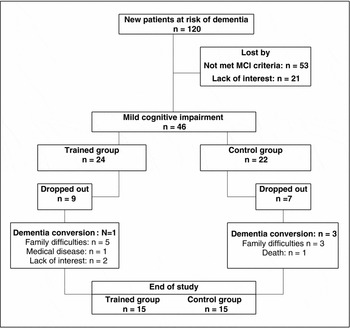
The sample was randomized in two subgroups: 24 participants (the “trained group”) underwent a six-month CIP, while 22 (control group) received no treatment. By the final follow-up, there were 30 participants (15 from each group) remaining from the initial sample. Sixteen participants dropped out and were excluded from all analyses. “Dropped out” represented dementia conversion, poor health (medical diseases), lack of time (family difficulties), or lack of interest to participate. A flow diagram of the progress of the sample through the phases of the study and reasons of exclusions is provided in Figure 1.
Patient recruitment flow.

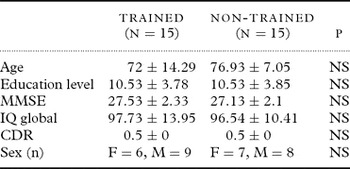
There were no significant group differences in the baseline demographic characteristics of the participants (trained and not trained). See Table 1.
Baseline characteristics of trained and non-trained groups

MMSE = Mini-Mental State Examination; IQ = intelligence quotient; CDR = Clinical Dementia Rating; F = female; M = male. Except for gender and marital status, the remaining values are expressed as means ± standard deviation. Differences between groups are by Student and Mann–Whitney for non-Gaussian data. Gender was assessed using χ2. NS = not significant.
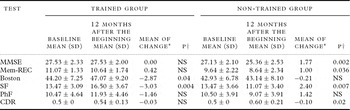
Baseline neuropsychological (memory, executive function, attention, and language) scores were similar in the two groups (all p > 0.05). The neuropsychological differences between baseline and sixth-month follow-up of both groups are shown in Table 2.
Mean change in trained and non-trained groups (pre–post-training assessment)

MMSE = Mini-Mental State Examination; CDR = Clinical Dementia Rating; Mem-REC = Memory free recall; SF = semantic fluency; PhF = phonological fluency; NS = not significant. Values are expressed as means ± standard deviation. *Values expressed as mean changes (standard deviation) from baseline to follow-up. †Differences between groups by paired test and Wilcoxon signed test for non-Gaussian data.
Performance on the primary outcome measures in the non-trained group (mean change between first and last assessments) was significant on MMSE (p < 0.002, mean change = 1.77) and CDR (p < 0.02, mean change = −0.1). Significant differences were found on recognition scores (p < 0.05, mean change = 1.29) and semantic fluency (p < 0.01, mean change = 2.40) in control MCI subjects. Conversion to dementia was seen in four patients at the 12-month follow-up, 6.66% (n = 1) trained and 26.66% (n = 3) non-trained participants.
The trained group improved (p < 0.05) on cognitive tests such as the Boston Naming Test (mean change = −2.87) and semantic fluency (mean change = −3.03). No significant differences were observed on secondary outcome measures (Neuropsychiatric Inventory, Quality of Life Scale, or Activities of Daily Living Scale) between baseline and follow-up in either group.
Discussion
The aim of this study was to assess the efficacy of a CIP in patients with MCI. MCI is characterized by memory complaints, impaired performance on memory tasks, preserved general cognition, a lack of significant functional repercussions, and no criteria for dementia. The fact that this population presents a higher risk of developing dementia than the healthy elderly (20%–50% over a period of 2–3 years), and that symptomatic drugs have proved to be ineffective (Birks and Flicker, Reference Birks and Flicker2006; Loy and Schneider, Reference Loy and Schneider2006; Chertkow et al., Reference Chertkow, Massoud, Nasreddine, Belleville, Joanette and Bocti2008), emphasizes the importance of non-pharmacologic early treatment. As a great number of studies have found that cognitively stimulating activity may help to protect against cognitive decline, these interventions may offer the possibility of maintaining or improving cognitive function, and prevent or delay progression to dementia. In addition, these persons still retain a large range of cognitive capacities that make them an ideal target for cognitive training. Thus, as stated by Clare and colleagues (Clare et al., Reference Clare, Woods, Moniz, Cook, Orrell and Spector2003), the earlier compensatory mnemonics and behavioral strategies can be introduced, the more likely it will be that memory strategies will be used effectively in everyday life (Verhaeghen et al., Reference Verhaeghen, Marcoen and Goossens1992). Furthermore, cognitive rehabilitation – providing the basis for compensation strategies that facilitate and strengthen encoding and retrieval of information – might help to diminish the impact of memory failing in everyday activities, and support continued independence and maximize quality of life of patients and their families.
Recent studies have shown that neuropsychological interventions could be useful in MCI; however, results have been mixed regarding the extent of the impact and their capacity to delay conversion to dementia (Belleville et al., Reference Belleville, Gilbert, Fontaine, Gagnon, Ménard and Gauthier2006; Reference Belleville, Chetrkow and Gauthier2007; Belleville, Reference Belleville2008). It can be argued that training effect varies according to methodological issues (Jean et al., Reference Jean, Bergeron, Thivierge and Simard2010); cognitive training may be offered individually or in group sessions, the tasks can be presented in pencil-and-paper modality or in computerized versions, and there is a wide variation in frequency and duration of training sessions. Nonetheless, these programs usually involve the teaching of strategies and skills in order to improve functional competence in everyday situations (e.g. mnemotechnics). Due to the differences among cognitive training interventions reported in the literature, the outcomes achieved in this research may be related to the chosen techniques. Our study design included cognitive training and cognitive stimulation with the provision of general information about the nature of cognitive changes, exercises covering a broad range of areas such as memory, attention, and executive control, use of external aids and instructions on how to use these strategies in everyday situations. In this research, we did not include cognitive rehabilitation or caregiver psycho-education.
Previous trials with older adults have found that objective measures of memory were enhanced after cognitive training (Verhaeghen et al., Reference Verhaeghen, Marcoen and Goossens1992). Similarly, Belleville and colleagues (Belleville et al., Reference Belleville, Chetrkow and Gauthier2007) reported that multifactorial intervention was efficient in improving the episodic memory performance of elderly persons with no cognitive decline as well as delayed free recall of lists of words in MCI participants. In addition, they suggested that younger age and a higher level of education were associated with a larger intervention effect score on delayed list recall (Belleville et al., Reference Belleville, Gilbert, Fontaine, Gagnon, Ménard and Gauthier2006). This is consistent with a meta-analysis carried out by Verhaeghen and colleagues that revealed that participant characteristics, such as higher mental status and younger age, were positively correlated with cognitive training efficacy. Furthermore, Springer and colleagues (Springer et al., Reference Springer, McIntosh, Winocur and Grady2005) found that the brain regions associated with years of education and overall memory ability differ with age, altogether with a positive correlation between brain activity during memory encoding and retrieval and years of education. In our study, the lack of improvement in memory scores of the treated group could be due to demographic characteristics, given that our patients were older and had fewer years of education than those from the previous studies (Belleville et al., Reference Belleville, Gilbert, Fontaine, Gagnon, Ménard and Gauthier2006). However, our results revealed a positive intervention effect, since significant worse scores were found on MMSE, CDR, memory recognition and semantic fluency at six-month follow-up assessment of the non-trained group. Impairments in these tasks are precisely suggestive of conversion to dementia. Moreover, the fact that only one patient of the trained group converted to dementia during the follow-up period (12 months), despite significant improvements in objective memory measures, supports the hypothesis of the long-term effect of the intervention program in cognitive functioning of MCI patients. This is consistent with a review carried out by Belleville in which she observed the enduring positive effect of training in long-term studies.
On the contrary, the absence of significant differences in self-reported everyday function (Quality of Life Scale and Activities of Daily Living Scale) could reflect impairments in metamemory (personal beliefs and self-perception related to memory functioning). Metacognition is relevant in effectively controlling higher stage of thinking and related to learning process, such as planning how to deal with a given task. Hultsch and colleagues (Hultsch et al., Reference Hultsch, Hertzog and Dixon1987) reported that older adults consistently informed less memory capacity, more decline in memory functioning, and believed that they had less control over their memory ability. Thus, personal beliefs may affect not only the way subjects perceive their cognitive status but also how they benefit and take advantage of the trained strategies (use of external aids and memory encoding).
The limitations of our study were that the sample size was limited at only 15 subjects by group but this situation is frequent in cognitive training programs where “dropped out” represented lack of time of the familial caregiver or lack of interest of patients to participate or medical intercurrences. However, the sample was representative in terms of inclusion and exclusion criteria and the assignment to both groups was randomized. Other study limitations were that the cognitive assessments were not double blind and the non-trained patients did not receive another type of intervention.
Finally, the study suggests that cognitive training in MCI may represent a treatment option in order to optimize performance, prevent cognitive decline or delay conversion to dementia. Taking into account the fact that MCI population is at a high risk of developing AD, these results may have important clinical implications. Investigations in larger samples with size power calculation, blind cognitive assessment, and another inespecific intervention (as comparator) could replicate the findings of the present study.
Conflict of interests
The authors have no conflicts of interest to declare.
Description of authors' roles
RFA conceived the project, designed the study, and supervised data collection. GJR performed statistical analysis on collected data. VV and MI performed the neuropsychological assessment and the cognitive training program. All the authors were involved in data collection, writing assistance, and approved the final manuscript.
Acknowledgments
The authors thank Dr Fabian Roman and Dr Andrea Pujol for their helpful comments on this paper. This research was jointly supported by a grant-in-aid for scientific research (CIS) from the Ministry of Health of the city of Buenos Aires, Argentina (VV, CMS, and RFA) and CONICET (RFA, and GJR).