INTRODUCTION
In his poem ‘The Last Hours of Cassiodorus’, Peter Porter has the Christian sage ask: ‘After me, what further barbarisms?’. Yet, Cassiodorus himself accepted, even valorized, at least one form of barbarism that had been rejected by earlier rhetoricians: sardismos (σαρδισμός), the mixture of multiple languages in close proximity. In its earliest attestation, Quintilian classified it as a type of solecism (Inst. 8.3.59). By contrast, five centuries later Cassiodorus in his Commentary on the Psalms used the term three times to praise the mixture of Greek, Hebrew and Latin in the Latin Psalter. This reversal, from vice to virtue of speech, illustrates some significant changes in attitudes toward language and multilingualism that developed as Christianity reshaped Roman literary culture. For one, Christian preachers, modelling themselves on the plain style of the Gospels, embraced forms of speech that had been regarded as low and stigmatized. In the words of Augustine (In psalm. 36, Serm. 3.6): ‘better you understand us in our barbarism than to have been deserted in our eloquence’ (melius in barbarismo nostro uos intelligitis, quam in nostra disertudine uos deserti eritis).Footnote 1 Secondly, Hebrew now entered the linguistic consciousness of the Roman literary elite as one of the three languages of Scripture. Even if in-depth knowledge remained rare, it was worthy of being mentioned alongside Greek and Latin, just as it had appeared with them in the inscription on Jesus’ cross (Luke 23:38, John 19:20).Footnote 2 Lastly, linguistic variety itself came to be positively valued since it reflected the diversity of a church coming together out of many peoples. Commenting on the bride's appearance in Psalm 45, both Augustine and Cassiodorus saw the variegated adornment of her robe as a reference to the diversity of Christian languages.Footnote 3
But what was sardismos as a rhetorical figure? The word occurs six times in ancient Latin works, once in Greek script and otherwise in Latin transliteration, and it has been conjecturally restored to one Greek source, but it cannot be found in standard dictionaries such as the OLD, Georges's Lexicon, and Lewis and Short; only the Revised Supplement of the LSJ (1996) offers any help. The few medieval occurrences known to me clearly depend on these ancient sources.Footnote 4 This article brings together for the first time all the evidence for the word and seeks to answer two related questions: How was sardismos defined? And to what forms of multilingual interaction was it applied? The first question turns out to bear on the relationship among three sources that discuss this figure: Cassiodorus’ Commentary on the Psalms, Eugraphius’ Commentary on Terence and the Schemata dianoeas, an ancient list of rhetorical terms. On this basis, I attempt to refine Ulrich Schindel's account of the composition and transmission of the Schemata, which sheds light on the dispersion of Cassiodorus’ library. Sardismos is not merely one more rhetorical figure that should be added to the handbooks but also an illuminating case-study, which helps to measure changing attitudes towards multilingualism and the complex and haphazard way knowledge of rhetorical figures has been transmitted from antiquity.
COMPETING DEFINITIONS: QUINTILIAN AND THE SCHEMATA
The earliest attestation was restored to the text of Quint. Inst. 8.3.59 by Karl Halm in 1863, who saw through the garbled Greek characters transmitted by the medieval manuscripts, and it has been accepted by all subsequent editors.Footnote 5 The passage appears as follows in Michael Winterbottom's edition:
σαρδισμός quoque appellatur quaedam mixta ex uaria ratione linguarum oratio, ut si Atticis Dorica ⟨et⟩ Aeolica et Iadica confundas.
σαρδισμός Halm : ΣΟΡΑΙΣΜΟΣ A : ΣΟΡΙΑΣΜΟΣ G : κοινισμός Gesner Dorica <et> Winterbottom : loricae G (ionica et a in ras.) : aeolica et iadica A (aeolica etiam dicta G) : Aeolica Iadicis U. Schindel, ‘Textkritisches zu lateinischen Figurenlehren’, Glotta 52 (1974), 95–114
There is also what is called sardismos, a style made up of a mixture of several kinds of language, for example a confusion of Attic with Doric and Aeolic and Ionic. (Translation adapted from D.A. Russell, Quintilian: The Orator's Education [Cambridge, MA, 2001], 3.374)
The passage occurs within Quintilian's discussion of soloecismi—failures of ornament that result from words in combination—as opposed to barbarismi, which affect individual words in isolation. Nearby he discusses other soloecismi such as cacemphaton, cacozelia, pleonasmus and ταπείνωσις. The use of Greek script almost certainly goes back to Quintilian, though the choice of script in each instance cannot be reconstructed with certainty.Footnote 6 Since Roman rhetorical handbooks were deeply indebted to Greek sources, some of whom Quintilian cites at Inst. 9.3.89 (Caecilius and Dionysius), it seems safe to assume that the word was not his own invention but borrowed from earlier Greek writers. The suffix -ισμός became an extremely productive suffix from the fourth century b.c. onwards, often with a corresponding verb in -ίζω, and it shows up in several grammatical terms such as ἀττικισμός (for example Alciphr. 4.19.1), δωρισμός (for instance Demetr. Eloc. 177), ἑλληνισμός (for example Diogenes of Babylon, SVF III p. 214; Str. 14.2.28) and σολοικισμός (Arist. SE 73b17).Footnote 7
Just as σολοικισμός was understood to refer to the faults committed by Greek speakers from Soli in Cilicia, the name σαρδισμός would have evoked the linguistic peculiarities of ancient Sardis.Footnote 8 Located on a major route between the Aegean coast and the interior, the city was successively the capital of the Lydian kingdom, the centre of a Persian satrapy, and a royal city in the Seleucid empire. As a result, its native Lydian mingled productively with Aramaic and Greek. Several Lydian-Aramaic and Lydian-Greek bilingual inscriptions survive, and Lydian borrowings also turn up in Hipponax (for instance καύης ‘priest’ at 4 W.), where they were identified as such by Greek lexicographers.Footnote 9 As Sardis underwent rapid Hellenization in the third and second centuries b.c., Greek speakers from the region may have gained a reputation for their unusual linguistic mélange.
Halm's correction was prompted by the rediscovery of the Schemata dianoeas, an ancient compendium of rhetorical figures, first published in 1852 by Friedrich August Eckstein. The work is preserved in two Beneventan manuscripts (Paris BN lat. 7530, s. VIII = P; Rom. Casanat. 1086 s. IX = C), which descend from an archetype that was in Monte Cassino until c.780.Footnote 10 The work in its current state consists of three parts: (i) an anonymous treatise on figures of speech (lines 1–158 in Schindel's edition); (ii) excerpts from Books 8 and 9 of the Institutio (lines 159–281); and (iii) a portion of Isidore's Etymologiae (2.21.3–48) on figures of speech (lines 282–422).Footnote 11 Following Schindel, I refer to these portions as AE I, AE II and AE III.
Although AE II contains lightly paraphrased excerpts directly from the Institutio, its definition of sardismos differs significantly from what we have just seen in Quintilian. In Schindel's edition it appears as follows (lines 197–9):
SARDISMOS dicitur quaedam mixta ex uaria ratione linguarum oratio, ut si Atticis Dorica, Aeolica Ionicis confundas. apud nos si quis sublimia humilibus, uetera nouis, poetica uulgaribus misceat.
Atticis Dorica, Aeolica Ionicis corr. Eckstein (Iacis collato schol. Hom. 2.206 Ἰακὸν ἔθος dubitans coni. Schindel) : doriae olica Iadicas P : doricae olica olio a iadicas C
Sardismos is said to be a style made up of a mixture of several kinds of language, for example a confusion of Doric with Attic or of Aeolic with Ionic and for us a mixture of elevated with humble speech, archaic with modern, poetic with colloquial.
To begin with, the excerptor has added a second ‘figurative’ interpretation of sardismos, according to which it designates a mixture of opposed linguistic registers, such as a combination of archaisms and neologisms. The author seems to view the Greek ‘dialects’ as universal styles or registers of speech, capable of being produced in Latin and presumably any language, rather than diatopic varieties peculiar to Greek alone. To my knowledge this unusual view has only one close parallel: Diomedes (Gramm. I 440.4–26 K), writing in the second half of the fourth century, associated each Greek dialect with a different stylistic register.Footnote 12 The word σαρδισμός has also been transliterated into Latin script, though it is impossible to say whether this was the excerptor's choice or a later scribal intervention.Footnote 13 There is, in addition, uncertainty here about the adjective for ‘Ionic’. Though the adjective Iadicus is otherwise unattested, it appears strikingly supported by agreement between the earliest manuscript of Quintilian (A) and the Schemata. Nevertheless, Schindel prints Eckstein's Ionicis while also proposing Iacis in the apparatus criticus, an otherwise unattested borrowing from Ἰακός, which can be found in Greek grammatical works (for instance Apoll. Dysc. Pron. 98.8).Footnote 14
Perhaps the most fundamental difference, however, involves the definition of sardismos itself. Here it is defined in an elegant chiasmus as a mixture of any two different dialects (si Atticis Dorica, Aeolica Ionicis confundas). This impression of binarism is supported by the figurative interpretation, where stylistic registers are listed in a series of incompatible pairs (sublimia humilibus, uetera nouis, poetica uulgaribus). By contrast, Quintilian's definition, as it appears in Winterbottom, describes a single example in which four dialects are involved (ut si Atticis Dorica ⟨et⟩ Aeolica et Iadica confundas). While this does not explicitly exclude bilingual mixture, it lays much greater emphasis on the number of dialects involved.Footnote 15 For convenience I will refer to this as the ‘pluralistic’ definition to distinguish it from the Schemata’s ‘binary’ version.
Since the textual difference between these interpretations is quite small—essentially a choice between Iadica and Iadicis—it is tempting to eliminate these differences altogether. Following Schindel's lead, D.A. Russell in his Loeb volume (Cambridge, MA, 2001) has printed ut si Atticis Dorica et Aeolica Iadicis confundas, which he translates: ‘for example a confusion of Attic and Doric, Aeolic with Ionic’.
Further support for this correction comes from the scholia Londinensia to Dionysius Thrax, the only Greek source known to me where σαρδισμός can plausibly be read. The Revised Supplement to LSJ (1996) proposes the following emendation (Sch. D. T. 447.23–5): [sc. βαρβαρισμὸς γίνεται] περὶ διάλεκτον, ὡς εἴ τις προαιρούμενος ἀττικίζειν ἄλλην ἐγκαταμίξει λέξιν χωρίς τινος ἀναλογίας, ὡς εἰώθασιν οἱ κωμικοί· τοῦτο δὲ σαρδισμὸν [σαρκασμὸν codd.] καλοῦσι ‘[barbarism occurs] regarding dialect: for instance, if someone preferring to speak Attic mixes in another kind of word without analogy, as the comic poets are accustomed to do, they call it sardismos.’ The passage occurs in a prefatory section of the scholia devoted to defining the virtue of ἑλληνισμός and its opposites, βαρβαρισμός and σολοικισμός. Here βαρβαρισμοί are classified by various criteria, including accent (περὶ τόνους), syllabic quantity (περὶ χρόνους), orthography (περὶ γραφήν) and in this case dialect (περὶ διάλεκτον). The restoration of σαρδισμός makes excellent sense. Hilgard attributes this section of the scholia to Heliodorus’ commentary (Σh; see 447.31 adn.), which implies a connection to ancient grammatical knowledge via Choeroboscus and Apollonius Dyscolus.Footnote 16
Though the scholium differs from Quintilian in classifying σαρδισμός as a barbarism, it does explicitly define it as a mixture of two dialects. This provides a striking parallel for the binary definition found in the Schemata and restored to Quintilian by Schindel and Russell. It is also noteworthy that the scholium explicitly distinguishes such barbarisms regarding dialect (περὶ διάλεκτον) from barbarisms regarding a foreign word (περὶ λέξιν ξένην), as an example for which it cites βαΐον ‘palm branch’, a loanword from Coptic that appears at John 12:13. Thus for the composer of the scholia, σαρδισμός was not in fact a multilingual effect at all but was confined to interaction between varieties of one language. At this point, with the evidence for a pluralistic definition resting entirely on the error-prone medieval manuscripts of Quintilian, it is very tempting to dismiss it entirely as an artifact of faulty transmission.
CASSIODORUS
The picture becomes more complicated when we turn to Cassiodorus. Three occurrences of sardismos are found in a single work of his: the Commentary on the Psalms (Explanatio in psalmos 41.8 line 202, 59.8 line 150, 107.8 line 104), a work begun after he left his praetorship in 537 and completed shortly before its dedicatee, Pope Vigilius, condemned the Three Chapters as heretical in 548. Later Cassiodorus appears to have returned to the work, making small revisions and additions probably for monastic use in the period between roughly 560 and his death around 575/80.Footnote 17 The work's high concentration of rare rhetorical terms was a consequence of its didactic function. To make consultation easier, Cassiodorus equipped his text with marginal notes, including the abbreviation  $\overline {{\rm SCHE}} $ wherever a rhetorical term was defined. Unlike Quintilian, however, Cassiodorus used sardismos as a term of approval, to express his aesthetic admiration for these passages of the Psalms. This is clearest in the word's first occurrence (41.8 line 202):
‘Iordanis’, ‘Hermoniim’,Footnote 18 ‘abyssus abyssum inuocat in uoce cataractarum tuarum’, figuram fecerunt sardismos, quae linguarum semper permixtione formatur. nam ‘Iordanis’ et ‘Hermoniim’ hebraea sunt nomina; ‘abyssus abyssum’ et ‘cataractae’ graecum est; ‘inuocat’, ‘in uoce’, latinum esse manifestum est. sic ista figura in hoc loco commixtione linguarum pulchre composita est.
‘Jordan’, ‘Hermoniim’, and ‘Abyss invoketh abyss at the voice of thy cataracts’ have together fashioned the figure of sardismos, which is always formed by a mixture of tongues. ‘Jordan’ and ‘Hermoniim’ are Hebrew names, ‘abyss’ and ‘cataracts’ Greek words, while ‘invoke’ and ‘voice’ are clearly Latin. So this figure is here splendidly fashioned by a mingling of tongues. (transl. P.G. Walsh, Cassiodorus: Explanations of the Psalms [New York, 1990], 1.420)
The rhetorical figure seems especially appropriate here for reasons Mauro Agosto has elucidated.Footnote 19 In Cassiodorus’ reading, ‘deep calling to deep’ represents the Old Testament calling out to the New, an interpretation commonly found in Christian interpretations of this passage.Footnote 20 Cassiodorus’ innovation is to see that the Old and the New Testaments are instantiated, as it were, in the text by the presence of their respective languages. Thus the two Hebrew words, Iordanis and Hermoniim, represent the Old Testament, while the two Greek words, abyssus and cataractus, stand for the New. But why does Cassiodorus insist that this is a trilingual effect? It seems gratuitous to observe that inuocat and in uoce are Latin, since this is the framing language of the entire utterance. But doing so points to an additional step in this historical process: it is not merely that the Old Testament has been fulfilled and superseded by the New; instead, both Testaments, through translation, have come to be transmitted to a Latin-speaking Empire. This transfer of the Bible from Greek to Latin was part of the translatio imperii, described in Jerome's interpretation of the Book of Daniel (see, for instance, Jer. In Dan. 2.40), by which power passed from Greece to Rome in preparation for the end times.
These manifestations of multilingualism in the Psalter seem to fall short of what linguists call code-switching, ‘the alternate use of two languages or linguistic varieties within the same utterance or during the same conversation’.Footnote 21 Since they have undergone some degree of phonological and morphological integration, it seems better to classify them as lexical borrowings with the proviso that the distinction is hardly clear-cut.Footnote 22 In this case, the borrowing abyssus appears not to have been fully integrated into Latin phonology, since, on the evidence of Roman grammarians, it continued to be accented à la grecque, in other words as a proparoxytone ábyssus (ἄβυσσος) despite its heavy penultimate syllable.Footnote 23
It is more difficult to assess how the Hebrew place-names sounded to sixth-century Latin ears. The name Iordanis (יַרְדֵּן yarden) appears in the third declension as early as Pliny (HN 5.71) and regularly thereafter.Footnote 24 It is thus an example of an integrated borrowing, which has been assimilated to the morphology and presumably the phonology of Latin. By contrast, the rarer word Hermoniim, which refers to the Mount Hermon range on the border between Syria and Lebanon, has retained its Hebrew plural morpheme.Footnote 25 In the singular, when it denotes a single peak, the word appears in Latin as an indeclinable noun Hermon, whereas in the plural, when it seems to denote the mountain range, it appears in the plural (Hermonin at Ambr. Isaac 5.47, Jer. Ep. 46.13.3; Hermonim at Jer. Ep. 108.13.3; Hermoniim at August. In psalm. 41.12 and passim). On a spectrum of assimilation, Hermoniim is clearly closer to Hebrew than Iordanis.
Whether one wants to call this a code-switch or an unassimilated borrowing, it is clear that readers such as Cassiodorus were attuned to the foreign status of the name. Indeed, Hebrew proper nouns acquired a special aesthetic status for Christian writers, as Jerome remarks in his De doctrina Christiana (4.7.17): simul etiam cum ista dicuntur locorum nominibus tamquam luminibus ornatur eloquium quae sunt Sion, Samaria, Chalanne, Emath magna et Geth Palaestinorum. Jerome's description of the ‘brilliance’ (lumina) of Hebrew vocabulary recalls the language Cicero used in his Orator to describe the ‘radiance’ (splendor) of Greek proper names and verses that were ‘illuminated’ (illuminatus) by them.Footnote 26 Where Cicero had encouraged orators to avoid these effects in their speeches, Jerome claims them as virtues. Cassiodorus in his Institutiones similarly exhorted copyists to preserve the ‘pleasing simplicity’ of Hebrew words by not assimilating them to Latin inflectional classes (Inst. 1.15.3): seruetur in eis [sc. nominibus] linguae suae decora sinceritas.
However we describe the linguistic status of these borrowings, it appears to be crucial to Cassiodorus’ notion of sardismos that three languages are involved. He says so again explicitly in his comment on a later psalm (In psalm. 59.8 line 150):
sed haec hebraea nomina, per hunc et alios tres uersus qui sequuntur mixta graecis latinisque sermonibus, figuram faciunt sardismos, quae fit diuersarum commixtione linguarum.
These Hebrew names, appearing in this and the following three verses in mingled Greek and Latin forms, embody the figure called sardismos, which is achieved by mingling different tongues.
The relevant verses of the Roman Psalter read: 8 laetabor et diuidam Sicimam et conuallem tabernaculorum metibor, 9 meus est Galaad et meus est Manasses et Effrem fortitudo capitis mei Iuda rex meus, 10 Moab olla spei meae in Idumeam extendam calciamentum meum, mihi allophili subditi sunt. Though Cassiodorus does not point out the Greek component, he may have in mind the adjective Idumeam, which derives more directly from the Greek version of the toponym (Ἰδουμαία) than the Hebrew (אֶדוֺם = ’ęḏôm) or the loanword allophylus. Another possibility is that he erroneously believed calciamentum to derive from a form of χαλκός. Though shoes at first glance have little to do with bronze, one name for shoe dye, atramentum sutorium (copper sulphate), was chalcanthum (χάλκανθον).Footnote 27 In any case, Cassiodorus says nothing about the rhetorical function of the sardismos here, and we are left to guess at its significance.
The third and last instance of sardismos in Cassiodorus adds no new information, since the text of the relevant psalm (107.8) corresponds exactly to the text of the psalm just discussed (59.8). Here Cassiodorus merely offers a cross-reference back to his earlier discussion (107.8 line 104): per hunc et alios tres uersus qui sequuntur, mixta graecis latinisque sermonibus, figuram faciunt sardismos, quae fit diuersarum commixtione linguarum, sicut iam in qunquagesimo nono psalmo dicimus.
EUGRAPHIUS Α
Whereas Cassiodorus applied sardismos to trilingual mixture, our final source uses it for bilingual mixture. In Terence's Andria, Simo mistakenly believes that Crito has just arrived from abroad to hunt after legacies. He calls him a ‘swindler’ (919): sycophanta! :: hem :: sic, Crito, est hic: mitte. :: uideat qui siet. The Greek loanword sycophanta is a single-word exclamation, followed immediately by Crito's response ‘ah!’ (hem). Commenting on this verse, the following observation appears in some manuscripts of Eugraphius’ commentary:
et est calumniator. siquidem ex tempore argumentum elicuit, ut hunc sycophantam uocaret; ubi est figura sardismos propter commixtionem linguarum.
And he [Crito] really is a trickster, even supposing he produced his argument on the spur of the moment, so that he [Simo] called him a ‘swindler’ [sycophantam]; where we have the rhetorical device sardismos on account of the mixture of languages.
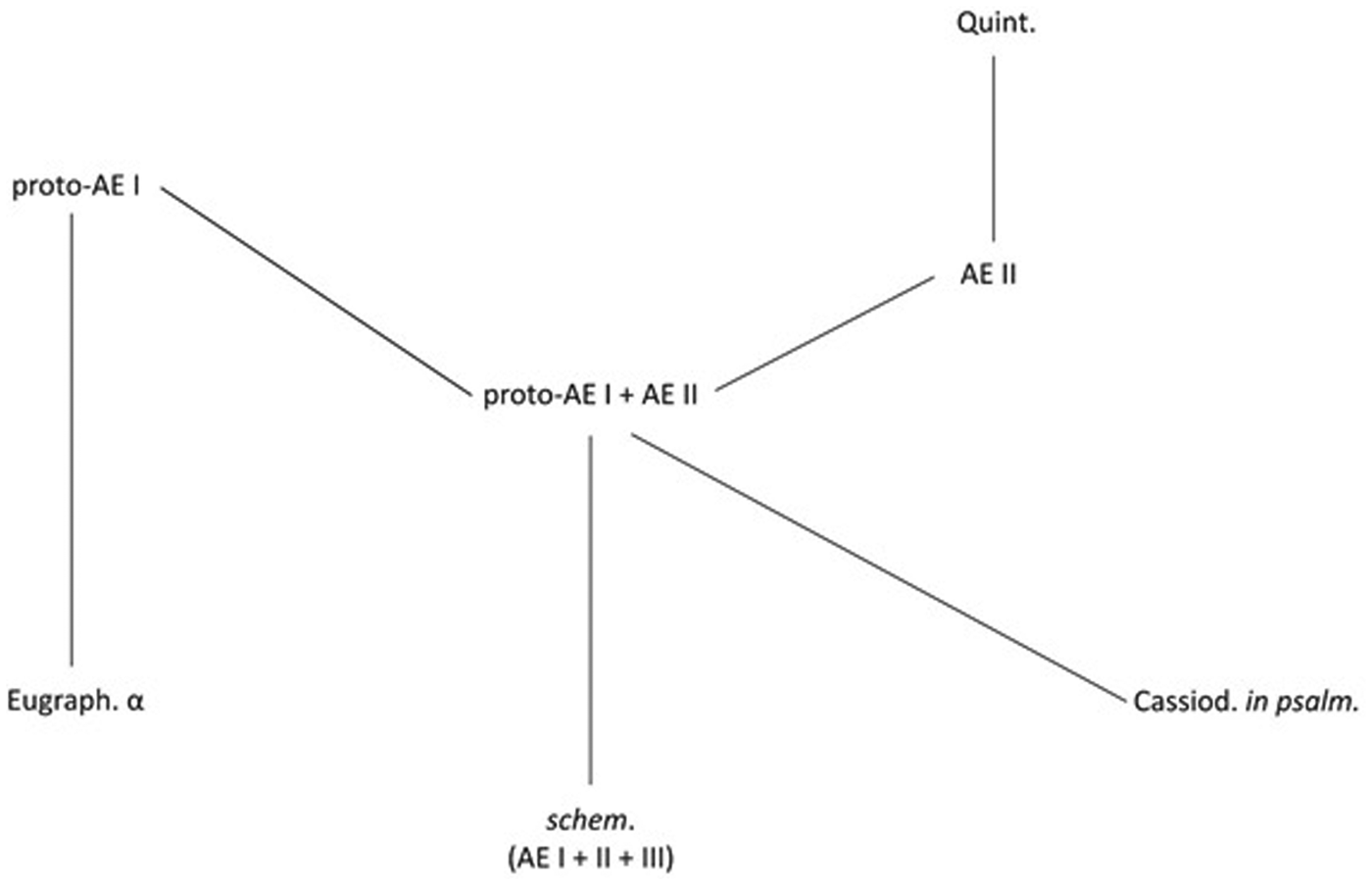
The subset of manuscripts that contain this comment and many other additions is labelled recensio α in Wessner's edition and relegated to the foot of the page in smaller print. While Wessner regarded this enlarged version as the result of ninth-century interpolation, others have taken it to be the original form of Eugraphius’ commentary before it underwent abbreviation.Footnote 28 However this may be, there is no question that Eugraphius α derives his knowledge of figures of speech from ancient rhetorical handbooks. Based on numerous verbatim parallels Schindel has concluded that both Eugraphius α and Cassiodorus in his Expositio drew on a common source, which he identifies as a slightly larger and less lacunose version of AE I in the Schemata, which I will call proto-AE I (see Figure 1).Footnote 29
Schindel's account (n. 11).

Of all the Greek loanwords in the Andria, it is puzzling that the commentator has singled out this instance of the loanword to identify as sardismos. Other very obvious loanwords found in the play are: attat (An. 125 < ἀτταταῖ), ephebus (An. 51 < ἔφηβος), eug(a)e (An. 345 < εὖγε), opsono (An. 451 < ὀψωνέω), philosophus (An. 57 < φιλόσοφος), platea (An. 796 < πλατεῖα) and symbola (An. 88 < συμβολή). A cluster of these occur in Simo's prologue, which Robert Maltby has suggested they help to establish the play's Greek setting.Footnote 30 Moreover, the very same borrowing, sycophanta, had already occurred at 815 (Crito: clamitent | me sycophantam, hereditatem persequi | mendicum), which prepares the way for its use as a direct insult at 919. Since it is an exclamation at 919, perhaps the heightened emotion caught the commentator's attention, but it is hard to see whether the use of Greek has any great significance here, whether as a device for characterization or to establish a colloquial tone of abuse.
Whatever drew the commentator's attention to sycophanta, it is striking that the situation is strictly bilingual. Contrary to Cassiodorus’ testimony, there is no third language such as Hebrew involved. It is not even a particularly memorable instance of Greco-Latin mixture: it is not an outright code-switch, as often in Plautus and arguably once in Terence (Ad. 412 phy!); nor is it a hybrid compound, such as Plautus’ pultiphagus (Mostell. 828).Footnote 31 If such a mundane borrowing counts as sardismos, it is surprising that Eugraphius α does not mention the device more often. Yet, if there is something about this instance that sets this apart from other loanwords in the play, the commentator does not say.
AGREEMENT BETWEEN QUINTILIAN AND CASSIODORUS?
To summarize, we have seen evidence for at least three different views of sardismos. In the scholia Londinensia, the only Greek source where the term can be plausibly restored, the figure is binary and monolingual, applying to the mixture of two Greek dialects, and explicitly contrasted with bilingual phenomena. The Latin sources all seem to take a broader view, applying the figure to the mixture of different languages (mixta ex uaria ratione linguarum oratio), but they differ on the particulars. On the one hand, the Schemata preserves a binary interpretation of the figure, paralleled by the scholia Londinensia. This view is reflected in the practice of Eugraphius α, who applies the term to the single Greek loanword sycophanta. On the other hand, Quintilian's definition as it has been reconstructed emphasizes plurilinguistic mixture, which accords well with Cassiodorus’ usage.
The agreement between Quintilian and Cassiodorus on this point against the rest of the tradition can be explained in several ways. One could argue that Quintilian's definition licenses both bilingual and plurilingual interpretations. By exploiting this ambiguity, it would then have been Cassiodorus’ innovation to apply the term systematically to trilingual phenomena. Yet, there are reasons to think that the plurilingual interpretation was germane to Quintilian himself. First, Latin unlike Greek already had a well-developed terminology for describing bilingual interaction. Why mention sardismos if it were equivalent to uox peregrina?Footnote 32 A term specifically for plurilingual interaction would have been useful for a Roman scholar, for instance in discussing Atellan farce, where Oscan, Greek and Latin sometimes collided to comic effect.Footnote 33 Secondly, it is hard to imagine that a Roman rhetorician of Quintilian's milieu would condemn all bilingual mixture as a stylistic fault. Though some forms of Greek were inappropriate in high registers of Latin or in formal situations, a blanket condemnation would repudiate actual Roman practice, including Quintilian's own usage.Footnote 34
For these reasons I think it likely that Quintilian or his source already understood sardismos to involve the mixture of more than two languages. The shift from a binary to a pluralist definition is understandable from the perspective of Roman scholarship. Cassiodorus would then faithfully take up Quintilian's definition, whereas the Schemata and Eugraphius α reflect the earlier, bilingual interpretation of the figure. If this view holds, it has significant consequences for the relationship among these sources and in particular the composition and early transmission of the Schemata. In the following section I explore these consequences in more detail. Though the scenario I describe is only one possible explanation, it has the advantage of accounting for some unrelated peculiarities of the Schemata as well.
TRANSMISSION OF THE SCHEMATA
As described above, the Schemata in its present form consists of three sections that originated independently, labelled by Schindel AE I, AE II and AE III. The first section, which has bequeathed its title Schemata dianoeas to the collection as a whole, is the truncated and abbreviated version of a once larger treatise on figures of speech with roots in late Hellenistic scholarship.
In its original state AE I was once somewhat larger, containing several more figures of speech and several examples that have not survived in the manuscripts.
Numerous verbatim parallels demonstrate that both Cassiodorus and Eugraphius α drew on this somewhat enlarged form of AE I, which I call proto-AE I. More precisely, as Schindel convincingly shows, Cassiodorus drew on the combination of proto-AE I and AE II. In eleven cases Cassiodorus repeats verbatim definitions that are found in AE I, including several cases where they both present the same error.Footnote 35 Moreover, when quoting from Quintilian he regularly agrees in error with AE II against the authentic text of the Institutio.Footnote 36 Some of the mistakes are the sort that characterize the activity of AE II's abbreviator; that is, they would not have come about merely in the manuscript transmission of the Institutio. On similar grounds Schindel also established that the Eugraphius α scholia drew on proto-AE I. I have represented what I take to be Schindel's view of this relationship in Figure 1.
Proposed account.

This poses a challenge to the account given so far. How can Quintilian and Cassiodorus be in agreement about a pluralist definition of sardismos when Cassiodorus’ proximate source was the Schemata, or more precisely proto-AE I and AE II? Not only does AE II in its current state offer a binary definition, but Eugraphius α’s application of the figure to a bilingual phenomenon is an independent witness. There are several ways of resolving this inconsistency, including by textual emendation or by backing away from a rigorous interpretation of the definition's wording. However, I believe it is possible to support these claims with a new theory about the Schemata that has the virtue of accounting for additional peculiarities of the text. This theory about the Schemata stands or falls independently of the sardismos issue, but if successful it strengthens the case for two incompatible definitions.
According to Schindel, Eugraphius α only drew on proto-AE I. It follows that proto-AE I must have contained an entry for sardismos, which is no longer found in the present state of the Schemata. Indeed, based on striking verbatim agreements between Cassiodorus and Eugraphius α, Schindel argues that three additional figures were once present in proto-AE I but lost at some stage of the transmission: apostropha, prosphonesis and syndyasmos.Footnote 37 At least five other entries in AE I must have undergone abbreviation, since Cassiodorus and Eugraphius α preserve identical information about these figures that you would expect to find in the Schemata’s formulaic definitions.Footnote 38 Some of the losses may have resulted from physical damage. For instance, in manuscript C, an entire quaternion has been replaced and in the process a folio (f. 214) came to be bound in the wrong order. The archetype of P and C also contained a transposition in which parts of the tapinosis and metalepsis entries traded places (Schindel [n. 10], 120).
This process of abbreviation points to a solution. If proto-AE I once contained an entry for sardismos, Schindel's stemma suggests it would have been independent of, and presumably different from, the entry found in AE II. The disagreement between Cassiodorus and Eugraphius α can now be explained. Since Eugraphius α drew on proto-AE I alone, his usage points to a bilingual definition there. By contrast, Cassiodorus, who drew on both proto-AE I and AE II, would have had access to two different definitions, and he preferred Quintilian's pluralistic interpretation, which originally stood in AE II. At a later stage, once the works were inseparably joined together, someone attempted to harmonize differences between the two originally separate collections. The wording of the plurilinguistic definition in AE II was ‘fixed’ by the change of a few case-endings in order to bring it into alignment with the bilingual interpretation in proto-AE I. The now superfluous entry in proto-AE I was then deleted or lost.
This explains several unnoticed peculiarities of AE II. To begin with, its definition of sardismos contains a detail not from Quintilian: the ‘figurative’ interpretation of sardismos as a mixture of incompatible registers. Since this describes the mixture of styles in binary terms, this can only have come from a binary definition. In fact, as we have seen, the closest parallel for its view of ‘dialect’ is to be found in the grammarian Diomedes, who was active in the second half of the fourth century. The linguistic peculiarities of AE I place it tentatively between the fourth and the fifth centuries, consistent with Diomedes’ milieu.Footnote 39 Moreover, the reasoning resembles another characteristic of AE I: it attempted to replace any Greek examples cited in its source with equivalents from Latin authors. This distinguishes it from the Schemata attributed to Rutilius Lupus, which translates Greek quotations directly into Latin. The ‘figurative’ interpretation looks like a fumbling attempt to provide a Latin equivalent by someone not very familiar with the Greek dialects. It fits AE I much more than it does its current place in AE II, and I suspect it moved there after the two treatises were stitched together.
Contamination between proto-AE I and AE II can explain additional peculiarities. In only two other entries does AE II contain supplements not found in Quintilian: emphasis and metalepsis. In his own definition of emphasis, Quintilian mentions that aposiopesis could be considered a subtype and refers to an upcoming discussion of the figure in Book 9 (8.3.85): absciditur per ἀποσιώπησιν, quae quoniam est figura reddetur suo loco. In AE II, however, Quintilian's cross-reference has been replaced by two Latin examples: absciditur per aposiopesin [Ps.-Cic. in Sall. 12] ‘<plura dicerem …> sed quid opus est uerbis?’, [Verg. Aen. 1.135] ‘<quos ego>—sed motos praestat componere fluctus’. While the quotation from Virgil might have come from Quint. Inst. 9.2.54, the pseudo-Ciceronian quotation cannot be found anywhere in Quintilian. The same passage, however, is quoted in Donatus’ commentary on Terence, to illustrate aposiopesis (An. 164): ‘sed quid opus est uerbis’ ἀποσιώπησις est grauissimam poenam ostendentis. Agreement in the omission of plura dicerem suggests that AE II and Donatus may have had a common source. In its current state, AE I only quotes one of these passages to illustrate aposiopesis (Verg. Aen. 1.135). Might it have originally contained both? If so, Ps.-Cicero must have migrated from proto-AE I to AE II and was then deleted when the former underwent abbreviation.
Another supplement can be found in AE II's entry for metalepsis. Here AE II uniquely signals a departure from Quintilian, introducing it with the adverb aliter (lines 176–9): aliter metalepsis est dictio quae per aequiuocum uniuoca significat, <ut [Verg. Aen. 1.90] ‘speluncis abdidit atris’, ab atris enim nigrae intelleguntur et ex> nigris tenebrosae <et> ex hoc in <praeceps> profundae.Footnote 40 Here the lacunae can be filled by comparison with the text of Charisius (Gramm. p. 359.21–6 B), who cites the same passage with the same comment but provides a different definition of the figure. Again it is worth considering whether AE II might have found this in proto-AE I before it underwent abbreviation.
A final example illustrates what may be contamination in both directions. The last figure discussed in AE II, dubitatio, is unique in containing what is effectively a second title or lemma (lines 280–1): DE DIAPORESI. dubitatio est, cum simulamus quaerere nos, unde incipiendum, <ubi desinendum, quid potissimum dicendum, an omnino dicendum sit>. Quintilian only calls this figure dubitatio (Inst. 9.2.19), but the supplemental lemma diap(h)oresis now occurs in AE I (lines 108–9). Its position at the end of the list—in the schemata there is no break between it and the first lemma of AE III, anadiplosis—may have made it especially vulnerable to interpolation. Moreover, Quintilian illustrated dubitatio by quoting Cic. Clu. 4. This quotation appears not in AE II, as one would expect, but rather in AE I under the lemma diaphoresis. Here it looks like AE I may have picked up a quotation that originally belonged to AE II, while AE II was harmonized by picking up an alternative title from AE I.
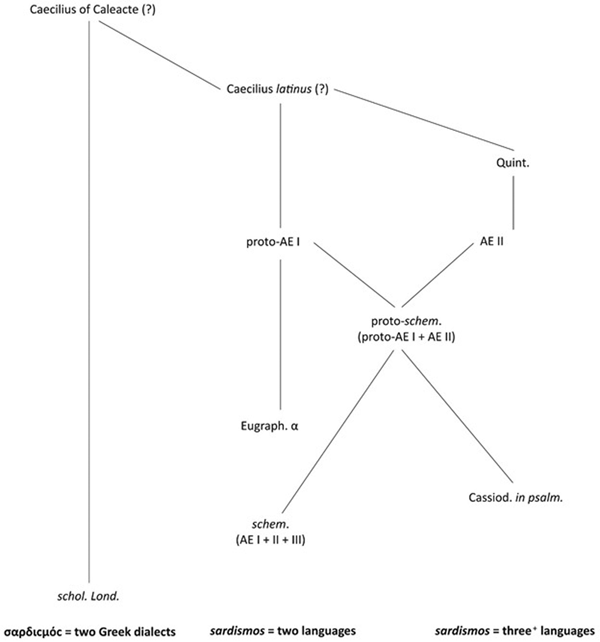
These supplements show that the text of AE II was manipulated by someone with access to an independent source of rhetorical terms and quotations. It is easiest to suppose that this source was the one already to hand: namely proto-AE I, which was eventually combined with AE II. When the two began circulating together, this was a provocation both to enlarge AE II with material originally in AE I and to consolidate both texts by deleting redundant material. Both processes were haphazard, perhaps occurring over several generations; copyists may have continued to have access to proto-AE I even after AE I and AE II were combined and abbreviated. This would explain why there is no longer any overlap in lemmata between AE I and II, but there is an overlap of ten figures between AE III, which was added later, and the two previous sections. Any redundant entries, such as sardismos, may have been deleted with or without undergoing contamination. Schindel proposed that AE II was produced expressly to remedy the losses that proto-AE I had already suffered, but the evidence of contamination suggests that fuller versions of both texts existed alongside each other and that AE II may have originated independently, possibly in the same milieu that produced the abbreviated version of Quintilian used by Julius Victor and Diomedes in the fourth century.Footnote 41 Figure 2 illustrates this proposal.
Each column presents one of the three definitions of sardismos. For simplicity's sake, I have assumed a single Greek source, which Schindel tentatively links to Caecilius of Caleacte, but several may have been involved. The upshot of this scenario is that Cassiodorus would have had access to the combination of proto-AE I and AE II in a relatively early state before it underwent consolidation. Perhaps they still circulated as separate documents. Hence he still had access to a multilingual definition. This account has the virtue of explaining additional peculiarities of the Schemata, but it is certainly not the only way of explaining the coincidence between Quintilian and Cassiodorus. Indeed, it is hazardous to rest such a complex hypothesis on the basis of a few agreements and disagreements, but I do so in the hope of prompting closer scrutiny of the Schemata. Furthermore, this scenario would refine Schindel's important proposal that the Schemata, as we possess it, descended ultimately from Cassiodorus’ own copy in Squillace, which eventually made its way to Monte Cassino along with other documents from his library.Footnote 42 If this is correct, the consolidation and abbreviation of proto-AE I must have occurred in the two centuries between Cassiodorus’ death around 575/80 and the document's reappearance in Monte Cassino by around 780.
CONCLUSIONS
I return to the questions that prompted this investigation. At least three definitions of σαρδισμός/sardismos circulated in antiquity: (i) it was a mixture of two Greek dialects (Sch. D. T. 447.23–5); (ii) it was the mixture of two languages or literary styles (schem. l.197–9); (iii) it was a mixture of multiple languages (Quint. Inst. 8.3.59). The second definition is reflected in the Eugraphius α scholia (on Ter. An. 919), where the loanword sycophanta is identified as an example. The third definition was put into practice by Cassiodorus in his Commentary on the Psalms. In these cases Cassiodorus invokes the figure when three languages interact: the host language, Latin, and two source languages, Greek and Hebrew. While it does not describe outright code-switching, several of the borrowings were not fully integrated into Latin: ábyssus probably remained proparoxytone and the Hebrew place name Hermoniim retained its Hebrew plural morpheme.
Lastly, σαρδισμός went from being explicitly labelled a fault of style—a βαρβαρισμός in the scholia Londinensia, a soloecismus for Quintilian—to being considered a neutral figura, and indeed a virtue in the context of the Latin Psalter. For Cassiodorus it is an emblem of ‘deep calling to deep’, the conversation and correspondence between the three languages of divine scripture. However, the innovation to treat sardismos as a virtue rather than a vice appears not to have been entirely his own. It was partly the by-product of the process of excerption and abbreviation that produced the lists of rhetorical figures found in proto-AE I and AE II. These lists were produced without regard to any larger systems of classification, such as the distinction between blatant faults (uitia) and metaplasmi, faults that were acceptable on the basis of poetic authority (Quint. Inst. 1.8.14). For instance, the compiler of AE II excerpted definitions for several traits that Quintilian had identified as soloecismi, such as macrologia, pleonasmos and tapinosis. Someone consulting AE II might be tempted to think that these were acceptable rhetorical figures.
This decontextualization of rhetorical figures contributed to but does not entirely explain the presence of sardismos in Cassiodorus’ Psalm commentary. To some extent, Cassiodorus’ sensitivity to linguistic interaction was a product of his own multilingual experience, as a speaker of Latin in Constantinople and an instigator of translations from Greek to Latin, including of Josephus and the Historia ecclesiastica tripertita. But it was also rooted in a distinctive Christian literary culture, where humble ways of speaking came to be valued and trilingual interaction was incorporated into religious practice. Consider the Latin Mass with its Greek kyrie eleison, punctuated by the Hebrew exclamations amen and alleluia. Cassiodorus himself, as we have seen, exhorted scribes to preserve the decora sinceritas of Hebrew proper names (Inst. 1.15.3). He was surely not the first Roman to respond aesthetically to the sound of these three languages mixing together, but he was apparently the first to valorize it with the name sardismos. In any account of Christianity's effect on ancient literary culture, the humble figure of sardismos deserves a place.