The Olympic Games have proved a highly visible stage for politics among nations. During the Cold War the competition for medals often became a proxy war between East and West, with athletes entering battle to demonstrate national prowess and ideological superiority to audiences at home and abroad. The period saw tit-for-tat boycotts in the 1980 and 1984 Summer Olympics and memorable contests such as the 1980 battle for hockey gold in Lake Placid, where the whole world seemed to hang in the balance. As Gerald Ford explained a month before being sworn in as president, “a sports triumph can be uplifting to a nation's spirit as well as a battlefield victory.” If American politicians expostulated on the importance of athletic victory, the East Germans devoted nearly two percent of GNP to their sports program. According to Erich Honnecker, “sport for sport's sake is not a goal; rather it is the means to obtaining other goals.”1
Strenk 1979, 130–31.
We analyze international political rivalries during the Cold War and afterward with what might seem to be an unusual goal and an even more unusual data source. Namely, we present a large-n quantitative analysis of a leading constructivist approach to international relations, and we do so through an examination of judge bias in Olympic figure skating competitions from 1948–2002. Like a recent study in economics by Duggan and Levitt that analyzes sumo wrestling as a “non-standard” way to study a phenomenon—corruption—that is difficult by its nature to observe, we draw from the world of sports to address an important approach in international relations that has proved difficult to analyze quantitatively in a manner that would be persuasive to non-constructivists.2
In trying to bridge constructivist and non-constructivist approaches to international relations we may run the risk of having a pox thrown upon us by both houses, but our goal is to provoke a dialogue across theoretical and methodological traditions that often are not on speaking terms.The constructivist approach is a major paradigm in international relations and in political science more generally. While “constructivism” includes a variety of different theoretical perspectives and methodologies, the approach broadly speaking is unified by the claim that interests should be treated endogenously as opposed to being taken as exogenously given.3
Constructivists emphasize that interactions among states shape collective identities, ideas, and culture, which in turn constitute the international system within which the interactions occur. While numerous empirical studies of the approach exist in a variety of areas, comprised mostly of case studies and other mainly “qualitative” investigations, large-n quantitative analyses are rare.4 Such studies are uncommon in large measure due to the fact that the principal claim of constructivists—that identities, ideas, and culture and the international system are mutually constituted—creates a problem of observational equivalence. Scholars skeptical of the constructionist approach ask if material interests and identities, ideas, and culture are mutually constitutive, how is it possible to isolate and examine their specific effects?Our contribution here is to identify an arena of international relations in which the observable effect of the identities constituted by interactions among states can be analyzed independent of those states' strategic interests, thereby overcoming the problem of observational equivalence, and then to conduct a large-n quantitative analysis of the sort more commonly associated with non-constructivist social science. Our research design does not pit a realist explanation against a constructivist one, but instead permits us to examine an aspect of constructivism on its own. We do not examine the realist approach because, in the absence of any credible connection between figure skating judging and the advancement of a country's national security goals, realism is unable to generate any predictions that judges should show differential bias toward skaters from other countries; to suggest that realism could offer such predictions is, we submit, to stretch the approach to the point of rendering it meaningless. A hypothesis of differential bias shown by judges toward skaters from other countries is, however, consistent with Wendt's influential social theory of international relations. Adopting Wendt's distinction among three “cultures of anarchy” and building on his approach to social identity in international relations, we examine the collective identities constituted by the international system during the Cold War by analyzing whether judges' evaluations of skaters systematically varied according to whether their respective states viewed one another as “friends,” “rivals,” or “enemies.”5
Finally, and largely apart from the question of theoretical approaches to international relations, our analysis of figure skating judge bias probes just how far down the Cold War went. Although bloc biases in figure skating are popularly believed to be an established fact, nurtured by Saturday Night Live skits with grim-faced Warsaw Pact judges uniformly giving egregiously high scores to Soviet skaters, in actuality no existing study establishes anything beyond a small but consistent patriotic bias by judges.6
See Fenwick and Chatterjee 1981; Whissell et al. 1993; Bring and Carling 1994; Campbell and Galbraith 1996.
Analyzing Constructivism and Collective Identity
The broad range of theoretical approaches grouped together under the label “constructivism” reveal an equally broad variety of opinions about the methods that are appropriate for investigating the claims generated by these approaches. The spectrum of opinion ranges from “critical” constructivists who claim that it is “ideas all the way down,” and who also often reject the sorts of quantitative analyses associated with more positivist approaches to social science, to “conventional” constructivists who go so far as to welcome such analyses.7
Conventional constructivists are amenable to such analyses in part because they recognize “boundaries” to what is socially constructed.8Sterling-Folker 2002.
Wendt's influential systemic constructivism is particularly notable for being open to such analysis. He takes a via media between critical constructivists on the one hand, and neorealists and neoliberals, who largely restrict their focus to national security interests, on the other.9
Wendt 1999, 38.
Ibid, 9; see Wendt 1994.
Copeland 2000, 210.
We suggest that Wendt's social theory of international relations can be extended in a way that opens up the possibility of such quantitative testing since, while arguing that identity and interests are mutually constituted, he also acknowledges that identity can in certain cases be analytically distinguished from power and interests. That is, Wendt recognizes “boundaries” to what is socially constituted. His approach is bounded from below, so to speak, since he takes biological or material needs as brute facts.12
More importantly for our purposes, it is also bounded from above, since he admits the force of the material interests and strategic concerns at the core of neorealism as causes that shape identity. For Wendt, then, it is not quite ideas all the way down.13Wendt 1999, chap. 3.
If Wendt's collectivist approach to identity is in principle capable of such empirical study, the task remains to find a suitable terrain for investigation. Wendt himself points to the Cold War as a period when the international system was a relatively stable structure in which vital national security interests forcefully constituted identities.15
Wendt 1999, 109.
Wendt 1994, 386.
Wendt 1999, 93.
The international competition of the Olympic Games provides just this promising middle ground. The Olympics lie in the penumbra of the Cold War, well outside the gloomy exigencies of security interests yet still just within the shadow cast by the East-West conflict. At issue in the Olympics are not direct national security interests, but the very collective identities constituted in part by the international system. “While Olympic officials have espoused the creed of universal participation for the betterment of mankind, the nations of the world have interpreted participation in the Games as an opportunity to express national identification.”19
Espy 1979, viii.
Figure skating judging is a promising place to examine constructivist approaches to the constitution of identity through the interactions among states. Unlike running or swimming, where the stopwatch is the arbiter, results in figure skating depend entirely upon subjective evaluations by judges. These judges are representatives of their national figure skating organizations and, indeed, their nations. Their identities are constituted in part by their role as quasi-state representatives. Yet, unlike states or their specifically political representatives, there are no national security interests or similar concerns at play in judges' scoring of skaters. The influence of identity apart from interest can be assessed, we argue below, in particular when judges as quasi-state representatives evaluate skaters from other countries. We can assess the specific influence of identity in this case because the power and interests that created Cold War identities bear no relationship to figure skating judging. Analyzing judge bias in Olympic figure skating, then, permits us to examine the role of identity distinct from interests and thereby minimize the problem of observational equivalence.
We examine whether judges' evaluations of skaters systematically varied according to whether their states viewed one another as “friends,” “rivals,” or “enemies.” If variation in judge biases toward skaters from different states is systematically correlated with the type of relation between their states, this would provide evidence for Wendt's approach to collective identity formation. To analyze this proposition, we focus on scoring bias by judges toward skaters representing states within and across the two major defense alliances of the Cold War period: NATO and the Warsaw Pact. While we focus on judge bias during the Cold War era, we also examine judging in the post-Cold War period in order to investigate the process of change in identities and interests with the end of the East-West conflict, a subject of particular interest to constructivists.20
Politics and Identity in Olympic Figure Skating Judging
The modern Olympics have been a forum for the expression of national identities and political rivalries since their founding. “Since the Olympic sport organizations are structured … to nation-states, the Olympic system itself manifests traits and actions characteristic of international organizations.”21
Espy 1979, 9.
Houlihan 1994, 70–79.
Espy 1979, 108–109.
The Olympic Games became a particularly heated arena for competition among nations with the entry of the Soviet Union in international competition at the 1952 Helsinki Summer Games. Cold War politics were evident as the Games approached. Such was the tension that Bob Hope was able to induce Bing Crosby to make his television debut on a telethon to raise money for the campaign to put American athletes on the road to Helsinki.25
Senn 1999, 100–103.
Espy 1979, 38.
Senn 1999, 106.
Figure Skating Judging as Vocation and as Politics
Figure skating judging should be no exception to the effects on identities and behavior that arose from the Cold War. As Kestnbaum suggests, figure skating competitions served as “symbolic stagings of Cold War conflict.”28
Kestnbaum 2003, 111.
For a systematic analysis of judge bias, we must understand the factors that influence judges' scoring of skaters' performances, and in particular how their identities as quasi-state representatives affect their evaluations of skaters from different states in distinct ways. We can distinguish three separate components that influence figure skating judges' scoring.
First, figure skating judges are professionally-motivated experts with shared technical knowledge and standards. Judges at the level of international competitions such as the Olympics are an elite group of volunteers who have advanced through the ranks of their national figure skating federations and received extensive training on the technical aspects of skating and judging.29
See Brennan 1996, chap. 4.
Second, because they are socialized within and operate within national skating federations, judges are subject to direct and indirect influences to exhibit patriotic bias. Judges have constant contact with skaters and other members of their respective countries' figure skating communities, both through judging competitions and especially through their role in “monitoring” skaters. “Monitoring” involves observing practice sessions and competitions in order to offer skaters and their coaches advice on their programs and then reporting back to their national figure skating federation on their progress.31
These continual interactions create personal relationships that may influence their evaluations of skaters from their own states. Furthermore, more direct pressure can be applied to judges to show patriotic bias because they are selected for high-profile assignments by the officials of their national skating federations. “Some judges are tightly controlled by the presidents of their national federations…. They know that if they don't follow orders their federation president will never throw them a good judging assignment.”32Goodwin 2004, 189–90.
Most important for our analysis is a third aspect of judges' scoring of skaters. As quasi-state representatives, judges should be influenced by whether the states those skaters represent are considered by their own nations to be “friends,” “rivals,” or “enemies.” This distinct influence on judge bias stems in part from the same source as the incentive to show patriotic bias: from the judges' identity and role as quasi-state representatives. Importantly, unlike patriotic bias, bloc-based bias does not involve any self-interested calculations. That is, while judges may receive rewards or sanctions from their home countries in reaction to their scoring of skaters, no similar incentive structure exists at the supranational level. One must also keep in mind that figure skating judges' evaluations of skaters are also not directly (or even indirectly) tied to the national security interests of their home countries. Judges can therefore be expected to show biases toward skaters from other states as a function of national identities and specifically according to whether those states are considered as “friends,” “rivals,” or “enemies.”
Finally, before turning to the predictions regarding judge bias that follow from these factors, we should note there are limits to how much bias they can exhibit. Judges whose placement of skaters diverges more than a few rankings from their fellow panelists can be asked by the International Skating Union to explain their scores, and face censure or even being banned from judging. In an especially extreme case, the entire Soviet judging corps was suspended for the 1978–79 season for showing obvious patriotic bias.33
Brennan 1996, 76.
Predictions: The Cold War on Ice?
Our first prediction is that judges as quasi-state representatives will exhibit consistent patriotic bias. Although patriotic bias does not reveal the distinct role of identity in shaping judge behavior, since such bias may be due to both national identity and self-interested calculations, finding patriotic bias provides us with a baseline for examining the bloc biases on which we focus.
More importantly, we predict that we will see systematic bloc biases during the Cold War. According to the constructivist approach concerning identity that we are examining, the politics of the Cold War should constitute identities that differ systematically across the two defense alliances, suggesting there should be judge bias along East-West lines. We have three separate predictions concerning bloc bias for this period.
First, judges from states belonging to one bloc (NATO or Warsaw Pact) should view skaters from states belonging to the opposing bloc as “enemies,” exhibiting negative bias.
Second, judges from the same bloc should view skaters from states belonging to their own bloc as “rivals,” therefore showing neither positive nor negative bias. Judges could view skaters from their own bloc as “friends” instead of “rivals,” and therefore show positive bias, but we suggest that judges should view skaters from states also belonging to their bloc as “rivals” given that the Olympics are a competition. As Nincic explains with regard to the U.S., while common values, trading possibilities, and other similarities may encourage friendships with some states, “the friends and allies of the United States, at least since World War II, have been shaped mainly by negative considerations, especially the existence of common rivals and antagonists…. The Western bloc is therefore not monolithic…. Indeed, there are areas where the allies of the United States are also its rivals.”34
Nincic 1988, 41–44.
Third, we do not expect any systematic bias by judges from Non-Aligned states (states belonging neither to NATO nor the Warsaw Pact) toward skaters from any other state, and we likewise do not expect judges from any state to exhibit bias toward skaters from Non-Aligned states. One might plausibly argue that being a “Non-Aligned” state during the Cold War (and perhaps more generally) was itself a choice based upon identities forged by the East-West conflict, and that this rival “alliance” among Non-Aligned states might exhibit the same sort of negative inter-bloc rivalries we expect to see between NATO and Warsaw Pact states. However, aside from the variety of very different reasons why states decide not to align with a major defense pact, for largely climactic (and financial) reasons major states such as India involved in the consciously non-aligned movement do not send figure skaters or judges to the Olympics, and the most important Non-Aligned state that does so, China, only enters Olympic figure skating competitions at the very end of the Cold War period. Finding no positive or negative bias regarding Non-Aligned judges and skaters would further strengthen our findings of any bloc bias, suggesting that the Cold War has the constitutive effect on identities and therefore behaviors suggested by the constructivist theory concerning identity.
Finally, as for the post-Cold war period, it is more difficult to offer predictions since constructivist approaches are not clear as to how quickly collective identities will alter due to a change in the structure of the international system. If identities that made states view one another as “enemies” during the Cold War have changed with the end of the East-West conflict, we should see any negative bloc biases that judges exhibit toward skaters from the opposing defense alliance disappear in the post-Cold War period. In other words, to the degree that identities change after the Cold War, states should increasingly view one another as “rivals,” and therefore show neither positive nor negative bias.
Analyzing Judge Bias
While anecdotal accounts of judge bias abounds, little systematic research exists. The few existing studies are generally limited to a couple of competitions, and are therefore too limited in scope for a truly systematic study of judge behavior, much less to analyze bloc bias. The consistent finding of existing studies, employing a variety of methods and examining different competitions, is a small patriotic bias of judges for skaters from their own country.35
Fenwick and Chatterjee 1981; Whissell et al. 1993; Bring and Carling 1994; Campbell and Galbraith 1996.
Campbell and Galbraith 1996, esp. 526.
The Figure Skating Scoring System
The scoring system used in figure skating is not well understood by the general public, and casual viewers are under the mistaken impression that the familiar cardinal scores for technical and artistic merit that flash across the screen are the decisive factor in a skater's placement in the event. Rather, these cardinal scores are used to determine the ordinal ranking of all the skaters in a competition by each judge independently of the other judges. Each judge could in principle use an entirely idiosyncratic metric in giving cardinal scores, although in practice their scores are usually relatively consistent. By summing the cardinal scores for the skaters, each judge independently creates a rank ordering of the skaters. The skater's placement in the competition (or portion of the competition) is then determined by summing the ordinal placement of each skater across all the judges, with the skater having the lowest number of ordinal points (i.e., highest rankings) being the winner. For example, if there are nine judges on the panel (which is almost always the case) and if all nine judges had the same rank ordering of the top three finishers, then the first-place finisher would have nine ordinal points (1 ordinal point per judge), the second-place finisher would have eighteen ordinal points, and the third-place finisher twenty-seven ordinal points. The decisive factor in the scoring system, then, is the ordinal placement of the skaters by each judge. The use of underlying cardinal scores to produce ordinal rankings of skaters by each judge is the common aspect in all competitions across the entire time period we study, and so we analyze the ordinal scores.
Aside from the use of ordinal rankings, there is otherwise wide variety during this time period in the structure of the competitions and the manner in which scores are weighted to determine the final results. First, competitions differ by the number of stages, ranging from a one-stage competition in pairs skating competitions from 1948–1964 to three-stage competitions of compulsory, short, and free skating programs for men and ladies from 1976–88. A little over two-thirds (32 of 45) of the competitions we study are two-stage competitions. Second, competitions differ in how the scores given in the various stages of a competition are weighted. The general trend during the period we study is toward weighting the free skating program more heavily and, conversely, weighting other portions of the competition less heavily, especially the compulsory program. (The compulsory program was eliminated entirely beginning in 1992, having steadily declined in importance with the growing influence of television broadcasting and the increasing athleticism of figure skating.)37
See Kestnbaum 2003, 81–91.
Data and Methods
We collected data on judges' ranking of skaters from the official reports for each Winter Olympic Games from 1948 through 2002. These reports are prepared by the Olympic committee of the host country for the International Olympic Committee, and were provided to us by the Olympic Museum in Lausanne and the United States Figure Skating Museum in Colorado Springs. The reports identify the names and nationalities of the judges and skaters for each event and the various numeric scores and ordinal placements for the different stages of the competition for each skater by each judge.
Skaters and judges come from a wide set of countries, though a much smaller set of countries accounts for the bulk of skaters who are serious contenders for a medal. Out of 407 judges for the entire period of our study, there are 29 total countries represented. Skaters also come from a wide set of countries, and our data set includes a total of 895 skaters from 42 countries. Skaters in medal contention come from a smaller number of countries, with the 312 skaters in medal contention hailing from 19 different countries. (We define medal contenders as skaters who finish in the top seven places in the stage of the competition preceding the free skating program.)38
For the single-stage pairs competition from 1948–1964, we define medal contenders as those who finished in the top seven places.
With 15 Olympic Games during the time period with three competitions each (men, ladies, and pairs), we examine a total of 45 competitions: 33 during the Cold War (1948–88) and 12 after the Cold War (1992–2002). Our data set is structured as observations of each judge's ranking of each skater in the free skating program of the competitions. We therefore have a total of 5,709 judge-skater observations during the Cold War and 2,367 observations afterward.
We focus on each judge's ordinal placement of each skater in the free skating program of competitions, where 1 equals first place and larger scores indicate an increasingly worse placement. Our dependent variable represents the degree to which each judge's ordinal placement of a particular skater varies from the average of the other judge's ordinal placements of that skater. We employ this dependent variable in part in order to compare across competitions with different structures and different weights on scores. More importantly, by examining the degree to which a judge's ordinal score deviates from the average of other judges' scores, we can consider the mean ranking as representing shared professional standards among judges and therefore systematic deviations from this mean as revealing possible judge bias. Our choice of dependent variable therefore provides a useful baseline for examining judge bias.
More technically, our dependent variable is a z-score, which indicates the number of standard deviations a judge's evaluation of a skater is from the mean ordinal placement of that skater by the other judges. We measure it as: − ((Judge J's Ordinal Placement of Skater S) − (Mean Ordinal Placement of Skater S by Judges Other than J)/Standard Deviation of the Ordinal Placement of S by Judges Other than J).39
Our results are comparable if we instead standardize each judge's deviation from the mean score by dividing by the number of skaters in a competition: − ((Judge J's Ordinal Placement of Skater S) − (Mean Ordinal Placement of Skater S by Judges Other than J)/Number of Skaters in Competition).
To test for the effect of Cold War blocs on judge bias, we use a set of mutually exclusive and exhaustive dummy variables that categorizes judges and skaters by the defense alliance to which their countries belonged during the Cold War: NATO, Warsaw Pact, or Non-Aligned. In order to test separately for superpower effects we do not include the U.S. and USSR in their respective defense alliances. Therefore, we group judges and skaters into five categories: U.S., USSR, NATO, Warsaw Pact, and Non-Aligned. Since we are interested in the change in identities formed by the East-West conflict after the Cold War, for post-Cold War period we retain countries in the same category to which they belonged during the Cold War (e.g., Poland is categorized as Warsaw Pact even though that alliance was dissolved and Poland later joined NATO).40
The exception to this categorization is East Germany, which drops out of the analysis as a separate country after reunification, after which time all judges and skaters from Germany are categorized as NATO. In addition, although East German athletes competed on a unified German team from 1956–64, we were able to discriminate between West and East German athletes since they did compete for separate national teams in other international competitions, and so we categorize West German skaters as NATO and East German skaters as Warsaw Pact.
This schema of judges and skaters according to alliance membership enables us to categorize the judge-skater dyads according to 25 mutually exclusive and exhaustive dichotomous variables during the Cold War (36 after the Cold War, with the addition of the former-USSR category). For example, the dyad of a U.S. judge evaluating a U.S. skater is placed in the US-US category, while the dyad of a (non-U.S.) NATO judge scoring a USSR skater is placed in the NATO-USSR category. In addition, to control for same-country bias, we group all judge-skater dyads where the judge and skater are from the same country (except the U.S. and USSR) under Same Country, which is coded as one if the judge is from the same country as the skater and zero otherwise.41
To ensure that the effect of the same alliance variables (U.S-U.S., Nato-Nato, Warsaw-Warsaw, and Non-Aligned-Non-Aligned) do not also reflect a same country-effect, we coded these four variables as 0 if Same Country equals 1.
Since the dependent variable is reasonably continuous and normally distributed we use Ordinary Least Squares to estimate the parameters of interest. To allow for the inclusion of all dummy variables, we execute the model without an intercept. Thus, the coefficient on each of the dummy variables indicates the extent to which a judge's evaluation of a category of skaters differs from the average evaluation of the other judges for that class of skaters after separating out any same country bias. Since we omit the U.S. and USSR from the Same Country variable, their coefficients indicate their scoring of skaters from their country relative to the average judge's scoring of those skaters. To control for possible heteroskedasticity in these data we use heteroskedastic consistent standard errors.42
White 1980.
Our results are robust to the following: (1) including fixed effects for year; (2) using robust standard errors clustered on year or skater; (3) including a variable for the skaters' ordinal placement in the stage of the competition occurring just prior to the free skating program; or (4) controlling for the number of skaters competing in an event.
Results
During the Cold War
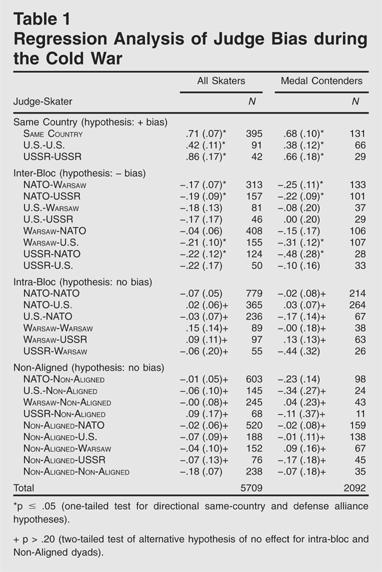
The results of our regression analysis for judge bias during the Cold War are reported in table 1. We have organized the independent variables representing the categorizations of judge-skater dyads into four broad groups that reflect our major hypotheses: same country dyads (where we expect positive bias), inter-bloc dyads (where we expect negative bias), intra-bloc dyads (where we expect no bias), and Non-Aligned dyads (where we also expect no bias).
Regression Analysis of Judge Bias during the Cold War

We predicted that, due to either national identity or self interest, judges would manifest patriotic bias toward skaters from their own countries. Our data show a statistically robust and substantively very large effect. The coefficient estimate of .71 for Same Country during the Cold War indicates that judges ranked skaters from their own country 4.6 ordinal places better than the average ordinal ranking for skaters from their country by the other judges.44
We generate the predicted values by taking the product of the coefficient for a judge-skater dyad and the standard deviation of the ordinal scores for the type of skater in that dyad from judges other than the one under consideration. For example, to calculate patriotic bias we multiply the coefficient for Same Country by the standard deviation of the ordinal scores for same country skaters (i.e., skaters who were evaluated by a judge from their home country) from the judges other than the one under consideration (.71 * 6.48 = 4.6).
Judges representing the two superpowers also manifest patriotic bias during the Cold War. U.S. judges advantaged their skaters to a lesser degree than other judges, awarding their skaters a 1.5 place advantage. The Soviet Union's judges handed its skaters a 3.8 advantage relative to the average judge's ranking of its skaters.45
Same-country bias by the U.S. is statistically significantly smaller than the average level of same-country bias manifested by other countries (p ≤ .01), while the USSR is statistically indistinguishable from other judges. In addition, the patriotic bias shown by the USSR is significantly larger than that of U.S. judges (p ≤ .05).
Since the USSR did not have any judges before the 1964 Olympics, we also investigated superpower behavior by dividing the Cold War era into two separate periods—before the Soviets had judges (1948–1960) and after they had judges (1964–1988)—and analyzed the two periods separately. We found a significant change in the behavior of U.S. judges in response to the entry of the Soviets. The U.S. judges in the earlier period showed significantly smaller patriotic bias than judges from other countries (the average same-country bias amounted to a 6.1 ordinal place advantage, while the average U.S. bias for its skaters was 0.6 places). The U.S. judges then dramatically changed behavior when the Soviets fielded judges, exhibiting about an average degree of patriotic bias.46
The coefficient for U.S.-U.S. is not statistically significant at the .05 level for the pre-1964 period (p = .16). The favoritism of U.S. judges toward their own skaters is more pronounced after 1960, doubling in magnitude, and this difference is statistically significant at p ≤ .05. Countries other than the U.S. actually show about a one ordinal place greater home-country bias before 1964 as opposed to after, and this difference is statistically significant at p ≤ .01.
We now move to the main results of interest—Did Cold War bloc politics influence judges' scoring behavior? Our first expectation was that judges from states belonging to one defense alliance would punish their “enemies,” or skaters from the opposing defense alliance. Beginning with the Soviet Union and other Warsaw Pact countries, we see that the USSR punished NATO skaters by scoring them 1.4 places worse than the average placement by the other judges. In addition, Warsaw Pact judges punished skaters from the U.S., ranking them 0.7 ordinal places behind the average judge's evaluation. Judges from NATO countries were also influenced by the Cold War environment and punished skaters from the Warsaw Pact by an average of 1.1 places. NATO judges manifested a similar bias toward skaters from the USSR, placing them 0.9 places worse. There is also evidence, albeit of marginal statistical significance, that the two superpowers punished each other's skaters. On average, U.S. judges scored USSR skaters 0.7 ordinal places worse than the other judges, while USSR judges gave U.S. skaters a 0.8 point worse placement.
When we narrow our focus to the medal contenders, we see even more pronounced effects of the Cold War. For instance, USSR judges punished NATO skaters, placing them nearly 2.0 places behind the other judges' evaluations. NATO returned the favor, punishing USSR and Warsaw Pact skaters by 0.6 ordinal places. Warsaw Pact judges also showed bias toward U.S. skaters of a similar nature, marking them 0.9 ordinal places worse. In short, the defense alliances manifest about a one-place bias against one another for medal contenders.47
We examined judge scoring for the short (or compulsory) programs and found overall similar effects as in the free skating program, with very similar same country biases but somewhat less pronounced bloc biases (though U.S. judges' punishment of Warsaw skaters and USSR punishment of U.S. skaters appears stronger here than for the free skating program).
Our results are further reinforced through an examination of the Non-Aligned judges and skaters. The politics of the Cold War should not result in any voting bias on the part of Non-Aligned judges or for judges aligned with a defense alliance toward Non-Aligned skaters. The reason is simple: Non-Aligned countries share no particular identity based on Cold War politics, and hence those judges should not be biased against skaters from a defense alliance. One should note that this hypothesis leads us to expect that the coefficients on the same-bloc dyads (e.g., NATO-NATO) will not be statistically distinguishable from zero. The null hypothesis for each of these variables is therefore that it has a nonzero coefficient and when testing for such a “no-difference” effect one must minimize Type II errors (i.e., false negatives).48
We reject the null hypothesis of a non-zero coefficient if, using a two-tailed test of statistical significance, the alpha is greater than .20. Also, we should be clear that, by testing for a null hypothesis of a nonzero coefficient, we are not violating the principle that one can draw no inference from a data analysis that fails to reject the null hypothesis (see Gill 1999, 661). That is, we posit that these coefficients will not be statistically different from zero, and if we can reject the null hypothesis that the coefficient is nonzero then we can infer that the variable has no effect (see Julnes and Mohr 1989). For discussions of such tests for no effect, see Blalock 1979, 161; Julnes and Mohr 1989; Mohr 1990, 61–64.
The above evidence generally supports the constructivist-based hypothesis that judges from one defense alliance would punish their “enemies” during the Cold War, which in this context were skaters from the other alliance. We further suggested that judges would treat skaters from countries within their own defense alliance as “rivals,” and thus neither punish nor help those skaters.49
As with the non-aligned dyads, we expect the coefficients for the same-bloc dyads to be statistically indistinguishable from zero and we thus must minimize Type II errors by choosing a relatively large alpha. Specifically, we reject the null hypothesis that each of these variables has an effect if the alpha (using a two-tailed test of statistical significance) is greater than .20.
There is only one dyad for which we can not rule out bloc bias, and we cannot reject the possibility that USSR judges punished Warsaw skaters.
After the Cold War
With the end of the Cold War and the demise of the Warsaw Pact, the international system changed and collective identities may have changed with it. Constructivists are not entirely in agreement regarding how quickly preferences or behavior will alter after a fundamental realignment such as the end of the Cold War.51
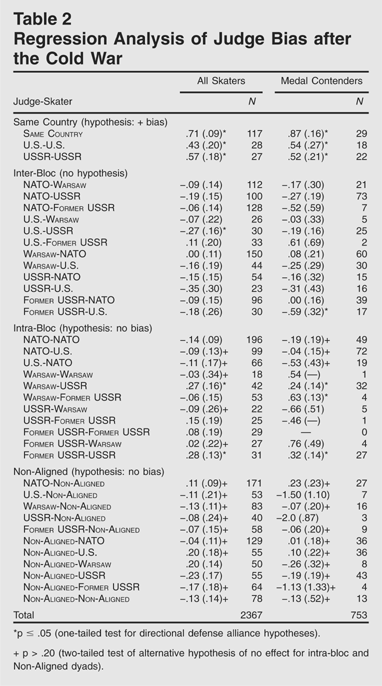
To begin to assess this issue empirically, we analyze whether the post-Cold War data reveal any bias along old defense alliance lines.As seen in table 2 (which is organized in the same manner as table 1), the punishment of “enemies” we saw during the Cold War is not evident once the Cold War ends. The punishment tactics discussed above with regard to NATO and Warsaw Pact states, in fact, disappear. Whereas USSR judges punished NATO skaters during the Cold War and NATO judges downgraded the scores of both USSR and Warsaw Pact skaters, the judges from these countries did not continue this behavior after the conclusion of the Cold War.52
The one exception to this generalization is that judges from the U.S. and Russia seemed to have punished one another's skaters, but only the USA-USSR and the Former USSR-USA coefficients are statistically significant at the .05 level.
We conducted this test by running the regression on the whole time period (1948–2002) and using all of the variables in table 1, including a set of interaction terms between each of these variables and a dummy variable coded as 1 if the observation came from a post-Cold War competition. The interaction terms therefore indicate whether the effect of a particular variable was different after the Cold War than during the Cold War.
Regression Analysis of Judge Bias after the Cold War

In addition, and not surprisingly, we continue to see that judges manifested bias in favor of skaters from their own country. This patriotic bias is on the same order of magnitude as during the Cold War era, with judges awarding skaters from their home country a 4.4 ordinal place advantage relative to the other judges' scores for those skaters (and a 3.4 place advantage for medal contenders).
Although we saw no evidence during the Cold War that judges treated skaters from states belonging to their own defense alliance more favorably, at first glance there appears to be some evidence of such helping behavior after the Cold War. We see three instances of such apparent positive bias, at least two of which turn out upon further investigation to provide dubious evidence. First, the Warsaw-USSR coefficient indicates that judges from countries who were formerly members of the Warsaw Pact scored Russian skaters better than other judges did. Second, the Former USSR-USSR variable indicates that former-USSR judges seem to help Russian skaters. We suggest, however, that this result is likely a vestigial same-country effect, especially since skaters and judges moved easily across boundaries within the former Soviet states during this period and, for example, many of the skaters representing former-Soviet states were actually Russian nationals.54
See Goodwin 2004, 69–70.
Discussion
Our analysis of judge bias in Olympic figure skating during the Cold War and afterward provides evidence for a leading constructivist approach to collective identity by demonstrating that the biases exhibited by judges as quasi-state representatives toward skaters from different countries systematically varied according to whether their respective states viewed one another as “friends,” “rivals,” or “enemies.”
In the context of the international competition of the Olympic Games, it appears from our analysis of figure skating judging that the only “friends” judges see—that is, the only skaters toward whom they show consistent positive bias—are skaters from their own country. Our finding of patriotic bias is itself not surprising, since judges as representatives of their nations have both ideational (i.e., national identity) and self-interested (i.e., rewards or sanctions from their nation) reasons for exhibiting patriotic bias. What is more interesting, especially for the Cold War era, is that such helping behavior is restricted to same-country bias, and that the relationship of “friends” does not exist for judges and skaters from states that belong to the same defense alliance. Given that these blocs are based in part on a common interest, the absence of positive bias in this case might be surprising from a neorealist or neoliberal institutional approach. In this regard, our finding that states in the same bloc viewed one another as “rivals,” generally exhibiting neither positive nor negative bias toward one another, is particularly noteworthy because it demonstrates the relevance of the distinction between “friends” and “rivals” found in many constructivist theories.
Our analysis of bloc bias during the Cold War clearly demonstrates that judges from Warsaw Pact and NATO countries viewed skaters from the opposing blocs as “enemies,” punishing the opposing alliance's skaters. While judges from the U.S. seem to have stayed above the fray to some degree, failing to show significant bias against either Soviet or Warsaw Pact skaters, Soviet judges exhibited substantially more patriotic bias than American judges and showed the highest levels of negative bias we found in our study in their consistent punishment of NATO skaters, although interestingly they did not penalize skaters from their superpower rival during the Cold War. Judges from NATO countries consistently displayed negative bias toward both Warsaw Pact and Soviet skaters, and Warsaw Pact judges exhibited strong bias against U.S. skaters.
The fact that Warsaw Pact judges did not seem to view skaters from NATO countries as “enemies” during the Cold War is intriguing, and may provide further support for the constructivist approach to collective identity. Even if they viewed one another as rivals in the Olympics, NATO states shared or developed a common identity because they had common interests and faced a common threat. By contrast, Warsaw Pact countries may have had an “enforced” identity to some extent given Soviet dominance. A vivid illustration of this possible explanation comes from the 1956 Summer Games in Melbourne (unique in being held during the Winter—the antipodal Summer). Learning of the brutal crushing of the uprising in their country by Soviet tanks in October 1956 only when they arrived in Australia aboard a Soviet ship, the Hungarian athletes asserted their national identity in a brutal semifinal waterpolo victory over the Soviets, where there was literally blood in the water.55
Senn 1999, 107–08.
We have focused on judge bias during the Cold War as a period where the identities constituted by the East-West conflict are likely to have been particularly deeply internalized, we also examined bias in the period after the Cold War in order to probe the process of changes in identity. Constructivist theories are not clear on how quickly identities will alter with a structural change in the international system, so it is difficult to derive any predictions. Our analysis reveals some change in identities as they are exhibited in the behavior of figure skating judges. Overall, we see that the bloc biases of judges across former defense alliance boundaries during the Cold War have tended to disappear after the Cold War. Extending and confirming our analysis by examining judge bias in future Olympic figure skating competitions would be interesting, but such an analysis has been rendered impossible. Due to the scandal in pairs judging in the 2002 Olympics, the figure skating scoring system was revised: beginning with the 2006 games in Torino, figure skating scores are no longer identified by judge nationality.
Conclusion
We have identified an arena of international relations where the observable effect of the identities constituted by interactions among states can be analyzed independent of those states' national security interests, and have therefore overcome the problem of observational equivalence that has beset analysis of constructivist approaches and conducted a large-n quantitative analysis. In doing so, we have attempted to provide evidence for a leading constructivist approach that will be persuasive to non-constructivists.
Our analysis of judge bias in Olympic figure skating during the Cold War and afterward provides evidence for Wendt's influential constructivist approach to identity by demonstrating that the biases exhibited by judges as quasi-state representatives toward skaters from different countries varied systematically according to whether their respective states viewed one another as “friends,” “rivals,” or “enemies.” While our results support the constructivist approach, we should note that we do not offer a critical test between constructivism and other approaches to international relations. Rather, our principal goal has been to show that constructivist theories are amenable to positivist empirical analysis, and we have done so by an admittedly unusual avenue. The task lying ahead is to identify other behaviors in the international arena where identity, ideas, and culture can be studied independent of interests in order further to explore the explanatory power of the constructivist approach. Even more imaginative routes must be pursued to discover territory hospitable to a critical test between constructivist and other approaches in political science.