1. Introduction
This exploratory study focuses on international students’ usage of digital tools in order to understand what role such tools play in students’ transition to their new academic environments, in this case, French post-secondary education, and what learning opportunities they provide when these students sojourn abroad to develop their language competence. Transition relates to the period of adjustment following international students’ departure from their home countries and their installation abroad. This transitional period is critical, as Block explains (Reference Block2007: 864): “when individuals move across geographical and psychological borders, immersing themselves in new sociocultural environments, they find that their sense of identity is destabilized and that they enter a period of struggle to reach a balance.” Digital devices are not only tools that accompany international students’ transitions but can also reveal the adjustments they face when they arrive in a new academic and social context. Among these mobile devices, smartphones hold a special place since the numerous applications that are now available have transformed “the once dedicated mobile phones into powerful, mobile personal computers” (Chan, Walker & Gleaves, Reference Chan, Walker and Gleaves2015: 96), thus potentially heightening intercultural and symbolic experience (Kukulska-Hulme, Lee & Norris, Reference Kukulska-Hulme, Lee, Norris, Chapelle and Sauro2017). Besides, smartphones can be used to document events as they occur, which makes them powerful tools “for capturing immediacy … or unexpected scenes of everyday life” (Godwin-Jones, Reference Godwin-Jones2016: 9). Yet there is still a paucity of research exploring how international students use digital devices for informal learning and how these tools can enhance their sojourn abroad. Such research is necessary, as technology has fundamentally changed the nature of study abroad (Kinginger, Reference Kinginger2013). The current study provided a group of international students (n = 16) with a multimodal diary app installed on their smartphone with which they could track what they identified as learning opportunities by taking pictures and writing texts over a five-week period. The data thus comprised their resulting diary entries, which participants shared with the researchers, as well as an end-of-project debriefing conducted to shed further light on their digital habits and their attitudes towards self-tracking. The aim of this exploratory study is twofold: (1) to examine what international students identify as digital learning opportunities outside the classroom, and (2) to determine the potential of a digital and mobile self-tracking application as a means to better understand international students’ transitions to their new environment.
2. Theoretical rationale
2.1 International students’ digital usage: A focus on out-of-class contexts
While the ownership of digital devices is rising among the international student population at large, the study of their usage involves investigating both discourses and practices in order to appreciate how individuals build a social and symbolic rapport with these tools (Guichon, Reference Guichon2015) and how they are used at an experiential level (Chan et al., Reference Chan, Walker and Gleaves2015). In the ever-changing university landscape, it is possible to think that digital literacies occupy a crucial part in the academic success of students insofar as they correspond to a strategic use of digital tools and applications involved in carrying out cognitive, collaborative, and creative activities (Lankshear & Knobel, Reference Lankshear and Knobel2011).
Although academic migration is rising internationally, to date only a few studies have been conducted on the use of digital tools by international students when they go abroad to continue their academic trajectory in another country (Shao & Crook, Reference Shao and Crook2015).
The present study thus focuses on this specific population, as it has become an essential challenge for the post-secondary sector to welcome and retain international students and accompany them in every aspect of their social and academic lives.
Following Andrade (Reference Andrade2006: 134), we define international students as “individuals enrolled in institutions of higher education who are on temporary student visas and are non-native … speakers.” Although the category “international students” is operational at an administrative level to label those students who come for one or several semesters to complete a degree abroad, it captures only imperfectly the heterogeneity of a population with important socioeconomic, cultural, linguistic, or academic variations among its members (Guichon, Reference Guichon2015). Let us add one caveat: grouping all international students under this label creates obvious distortions. Indeed, a vast majority of international students are currently from China, and studies have consistently reported that Chinese students have little contact with domestic students, face specific challenges of integration (see Ranta & Meckelborg, Reference Ranta and Meckelborg2013, for a review), and do not use the same social networks (e.g. Facebook) as their international counterparts. Yet, for lack of a better term, the present study will use this label to refer to those students who come to study in France and whose main purpose is to either concentrate on the study of French for a semester or study French while they are enrolled in a specific department (e.g. art history) at the university.
We contend that the transition to a new academic, cultural, and linguistic context, as is the case for international students, can be used as an observatory to understand what individuals bring to a new context and how the latter also transforms them. Beyond the geographic move it entails, student mobility can be defined as a significant life experience likely to leave a real imprint on individuals’ identities. As Benson, Barkhuizen, Bodycott and Brown (Reference Benson, Barkhuizen, Bodycott and Brown2012: 39) point out, “study abroad is typically an experience in which embodied identities are relocated and reflexive/imagined identities are challenged by the need to achieve recognition for identities in an unfamiliar cultural setting.” This challenge to identity may be characteristic of all study abroad experiences, but when study abroad involves a second language, it is heightened by the need to work on one’s identity in the second language, which poses particular challenges to students’ second language identities. Lahire (Reference Lahire2012) refers to this process of fabrication of dispositions and capacities as a process of socialisation in order to emphasise how lived contexts shape and transform individuals. We contend that digital practices can serve as a vantage point to understand some of the continuities and discontinuities international students experience after arriving in their new context and some of the identity work that is at play (Benson et al., Reference Benson, Barkhuizen, Bodycott and Brown2012). Indeed, international students have to both recycle and enrich the digital practices developed in their home countries in order to adjust them to the demands and potential of their new context and to facilitate linguistic, academic, cultural, and social integration (Guichon & Koné, Reference Guichon and Koné2015).
Because of the characteristics of the international students settling in a new social and academic environment, we believe that research on their digital usage has to shift focus from formal learning contexts (i.e. classrooms) to non-formal (i.e. a social activity, such as wine tasting, organised by the university for a group of international students) and informal learning contexts (anywhere but in formal contexts) (Eshach, Reference Eshach2007). As Drotner (Reference Drotner, Erstad and -Green2013) points out, out-of-school learning contexts should no longer be viewed “as marginal to the core didactic practices taking shape at school or work” (p. 47). On the contrary, studying what happens in non-formal and informal learning contexts can inform us about some of the interstices where learning occurs and some of the opportunities that are seized by international students to learn about a language and a culture beyond the classroom. The aim is thus to focus on learning opportunities that students are able to identify through and with digital tools.
Our approach is thus rooted in the sociocultural framework, as the study of digital usage in context should allow us to “interpret and understand the interrelationship between learners and the circumstances they are involved in across space and time” (Gilje & Erstad, Reference Gilje, Erstad, Gudmundsdottir and Vasbø2014: 136). This sociocultural approach attempts to delineate individuals’ “learning lives” (Sefton-Green & Erstad, Reference Sefton-Green, Erstad, -Green and Erstad2013: 1), not as a sum of skills individuals develop to face situations, but as lives in which learning is “situated intricately and intimately in a matrix of ‘transactions’: experiences, life trajectories, voluntary and involuntary learning contexts, affective frames and social groupings” (Sefton-Green & Erstad, Reference Sefton-Green, Erstad, -Green and Erstad2013: 1). Finally, in keeping with Sefton-Green and Erstad’s (Reference Sefton-Green, Erstad, -Green and Erstad2013) perspective, our approach endeavours to pay attention to how individuals make sense of their learning lives and of their digital usage and how this meaning-making process manifests itself semiotically.
We contend that while international students gradually adapt to their new environments, they produce a set of inscriptions (documents, pictures, messages) that can be envisaged as semiotic materialisations of their learning experience. Arnseth and Silseth (Reference Arnseth, Silseth, Erstad and -Green2013: 36) underline that these inscriptions can enable researchers “to study how versions of learning selves are inscribed into artefacts and transported over the different sites connected to a person’s life trajectory.”
2.2 Learning about students’ out-of-class digital usage: Methodological challenges
The theoretical stance vis-à-vis digital usage (see section 2.1) entails methodological implications that will now be presented. Educational research on digital usage offers a growing body of studies on learning that occurs out of the classroom and is generally labelled mobile learning. In the domain of language learning, for instance, Kukulska-Hulme et al. (Reference Kukulska-Hulme, Lee, Norris, Chapelle and Sauro2017) underline that mobile technologies present “the potential to promote exposure to target languages, capture communication difficulties as they occur, prompt ongoing reflection, and enable selection of affordable learning resources to suit an individual’s preferences and situation-specific needs” (p. 217). Research on mobile learning has paved the way to studying what students do outside the classroom but has mainly concentrated on the language skills practice students carry out with mobile devices as noted by Comas-Quinn, Mardomingo and Valentine (Reference Comas-Quinn, Mardomingo and Valentine2009) and has therefore failed to apprehend other aspects of their learning lives. Unsurprisingly, Crompton, Burke and Gregory’s (Reference Crompton, Burke and Gregory2017) recent synthesis of mobile learning research has concluded that most research carried out in the domain relates to formal educational contexts and relies heavily on questionnaires and pre-/post-test protocols. If digital usage is to be researched across contexts, in its situatedness and over a period of time, then questionnaires and interviews that rely on declarative and reflective information about what individuals say they do with digital devices do not appear to be the most pertinent data collection methods. Chan et al. (Reference Chan, Walker and Gleaves2015: 98) observe that “limitations arise with these types of retrospective accounts of learning as learners may have issues with accuracy of recall or rationalisation of some of their actions or thought.” Besides, researching what students do out of school poses ethical and practical concerns: it is difficult for researchers to follow individuals out of formal contexts to access their private spheres without being intrusive or modifying the behaviours of participants who might conform to what they think the researchers expect them to do or think (Beale, Reference Beale and Sharples2007; Guichon, Reference Guichon2015; Sharples, Arnedillo-Sánchez, Milrad & Vavoula, Reference Sharples, Arnedillo-Sánchez, Milrad, Vavoula, Balacheff, Ludvigsen, Jong, Lazonder and Barnes2009).
To study phenomena that occur while students are out of class, several studies have implemented participatory protocols whereby a sample of individuals is asked to keep track of a practice via some kind of mobile device. Thus, Walker et al. (Reference Walker, Whyatt, Pooley, Davies, Coulton and Bamford2009) conducted a study with thirty 12–14-year-old students at a secondary school in Britain with the aim of studying their well-being on their journeys to and from school. They adopted a mixed-methods approach that yielded three types of data: routes recorded via GPS, photographs and written comments that participants generated during their journeys, and follow-up interviews carried out with the teenagers to make sense of the data. Walker et al. (Reference Walker, Whyatt, Pooley, Davies, Coulton and Bamford2009) claimed that the methodological triangulation of the three data sets provided a research technique that captured the complexities of the school journey over time and noted that, although it was time consuming, this method was well suited to enable the inclusion of participants “with poor literacy skills and those with English as a second language” (Walker et al., Reference Walker, Whyatt, Pooley, Davies, Coulton and Bamford2009: 108).
To study time management in distance education, Tabuenca, Kalz, Drachsler and Specht (Reference Tabuenca, Kalz, Drachsler and Specht2015) asked a sample of students enrolled in online courses to use personal mobile devices to log the time they devoted to learning over four months. Using participants’ mobile phones was thought pertinent as it is “probably the only artifact co-existing with the learner in all scattered learning moments and learning contexts throughout the day” (p. 54). The researchers concluded their study by showing that recording learning time is beneficial to students as it enhances self-regulation.
Another qualitative and participatory method was devised by Wang and Burris (Reference Wang and Burris1997) with a protocol entitled photovoice that they implemented to understand women’s health issues in a Chinese rural context. Presented as a valuable research method for data collection from an emic perspective, photovoice involves providing participants with a camera and asking them to take pictures of specific practices that are particularly salient in their daily lives. Participants are then asked to use the photographs as prompts during semi-structured interviews in order to understand the meaning they build from their own photographed practices. In the field of education, Julien, Given and Opryshko (Reference Julien, Given and Opryshko2013) used photovoice to study the information practices of Canadian high school and university undergraduates while they were confronted with the transition from secondary to tertiary education. These researchers claim that this protocol gave them an understanding of students’ practices that was more centred on authentic and actual usage than on researchers’ projected or idealised usage. Julien et al. (Reference Julien, Given and Opryshko2013) also underline that the results of such a protocol could lead to the adaptation of curricula that could be more suited to students’ needs.
These studies present common features: they each focus on a sample of participants whose activity is tracked in various contexts. They require some kind of self-tracking device, whether it be a GPS tracker, a mobile phone, a camera, or a combination thereof, which is used to record traces of their practices not only in a fixed place but also across contexts. What is generated serves as a trigger for further meaning-making by individuals, which adds a semiotic layer to their in situ practices. Participants are thus associated with data generation, data collection, and to some extent data analysis. The data collection that was implemented for the current study (see section 3.2) follows such a protocol, as it was thought pertinent to follow international students’ transitions to a new cultural, social, and academic context and to study the role digital devices play in such transitions, especially from linguistic and cultural points of view.
3. Method
3.1 Context of the study and participants
The study was carried out in the Centre International d’Etudes Françaises (henceforth CIEF), a university-affiliated language centre in France that offers courses to international students. The centre offers weekly language courses with 21 contact hours per week. These courses can be followed for one or several semesters. The centre also proposes different social and cultural services to help international students socialise and maximise the potential of their stay in France.
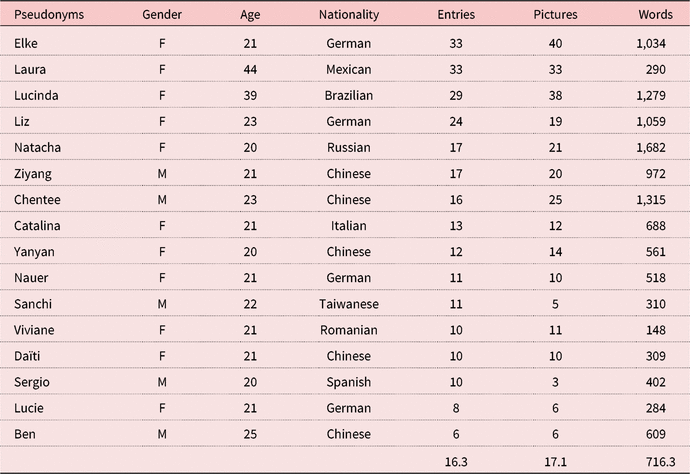
The participants, a mix of undergraduate students and graduate students, come from two groups of students from the CIEF and have an advanced level in French (CECR C1 level). The sample comprised 16 volunteer international students, five males and 11 females, aged from 20 to 39 (M age = 23.9). As is common in language centres, the sample is composed of a variety of nationalities (see Table 2 for full details).
3.2 Data collection procedure
One of the CIEF’s language instructors allowed the researchers to present the research project to two of her groups. Data collection involved three steps:
(a) Preparation and instructions: Five weeks after the beginning of the semesterFootnote 1, an introductory meeting was organised during which the researchers explained the research project by telling the participants that it aimed to understand the role digital tools played during their stay in France. The instructions were formulated in French as follows: “Please (i) collect all traces (photos, images, texts) of moments of your lives outside the classroom where you have the feeling of experiencing something that is linked to the learning of French, of French culture, or socialising with French people, and (ii) exemplify the part played by digital tools in this experience.”
To track their use of digital tools, the participants agreed to install an app on their mobile phone (Journey for Android mobile operating system and Day One for iOS). These two apps are functionally similar and were chosen because of their low price (about 5 euros) and because they enabled students to keep digital diaries (Godwin-Jones, Reference Godwin-Jones2016), thereby allowing them to produce entries in the textual and visual modes (pictures and screen captures) and to export them in PDF format. These systems also track the date, time, and localisation of each entry if the participants activate this option. The cost of the application was covered by the researchers, and students were offered a 25-euro gift voucher for their participation. Both applications were presented and time was taken for technical troubleshooting.
A consent form informed the participants that the project would involve sending a weekly report to researchers over five weeks and that they were free to choose what they wished to share with researchers. They were also reassured that this would not affect their course grades and their data would not be read by their French instructors. Sixteen out of 32 potential students agreed to participate in the data collection and agreed to have their data analysed and published for scientific purposes, as long as anonymity and confidentiality were ensured.
(b) Weekly data collection: Over five weeks, the participants sent their data to the team of researchers on a weekly basis. Most of the participants carried out this task regularly but some encountered technical problems at the outset of the data collection process. A deadline was set for the sending of the weekly records. The research assistant, a 24-year-old international student from the Ivory Coast, was in charge of liaising with the participants, helping out with technical problems, and sending notifications to ensure regularity. All of the data were stored on a server and categorised by date and participant.
(c) Group debriefing: At the end of the data collection procedure, a debriefing led by two researchers was organised with 12 voluntary participants and a group discussion addressed three major issues: (i) whether participants had become aware of certain types of digital use during the project, (ii) what difficulties they had encountered during the collection phase and examples of what they had not wanted to share with the researchers, and (iii) how the collection procedure could be improved for future research. The discussion was videotaped and transcribed.
3.3 Nature of the data and coding scheme
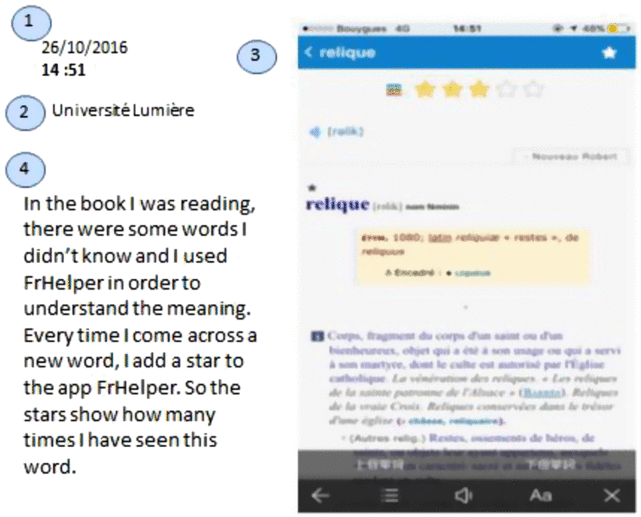
A typical entry (see Figure 1) comprised the following elements: (a) the date and time of the entry, (b) the place where the entry was written, (c) a photograph or a screen capture (here, the screen capture of a dictionary application), and (d) a text accompanying the visual element. The multimodal diary entries and extracts of interviews used in the rest of the paper are translations that are as faithful as possible to the original.
Example of an entry

An entry can be simple, as in the example (i.e. only one text or one text and one visual element), or complex (i.e. an assemblage of different textual and visual elements) associated with one date of publication.
To categorise the data, a coding scheme was devised, refined, and applied to the participants’ data by the two researchers and one research assistant in order to ensure maximum reliability for the content analysis. The resulting categorisation is presented in Table 1 along with examples. The categorisation of the images was designed to take into account their content in order to understand what students chose as the focus of their attention outside the classroom. Indeed, as the study focuses on the students’ capacity to identify learning opportunities, it was crucial to categorise how they textually recorded their various experiences. The first category (T1) includes entries that describe an activity or an event (e.g. a visit) but do not explicitly trigger reflection about learning. The second category (T2) pertains to traces of learning strategies, usually a few lexical items noted without any context other than the picture accompanying them. The third category (T3) includes entries uncovering some reflection about learning strategies.
Categorisation of visual and textual data

3.4 Research questions
The students’ diary entries and some of their remarks collected during the final debriefing were used to address three research questions:
1. What are the overall patterns concerning participants’ engagement in self-tracking their learning lives during the project?
2. What visual evidence did participants include in their entries and what does this reveal about their attitudes towards the role digital tools play in formal and informal learning?
3. What postures towards informal learning opportunities through digital means and the potential of self-tracking were uncovered thanks to the textual elements participants included in their entries?
4. Analyses
The analysis followed a three-step process: first, the data were examined quantitatively to (a) determine the differences and similarities among the 16 participants in terms of number of posts, pictures, and words published. A classification was then established with what they recorded visually and textually so as to (b) infer what this revealed about their digital usage for formal and informal learning. Then, a thorough exploration of both participants’ textual productions and verbatim extracts from the final debriefing helped (c) further our comprehension of international students’ attitudes towards self-tracking and sharing their trajectories with researchers.
4.1 Engagement patterns among the participants
We first give an overview of participants and the data they produced and we complete this with some of their comments collected during the debriefing with regard to their engagement pattern in the project. Table 2 gives the details of all participants, referred to by pseudonyms, their gender, age, nationality, number of posts produced, number of photographs, and, finally, the number of words included in the posts.
Information about the participants
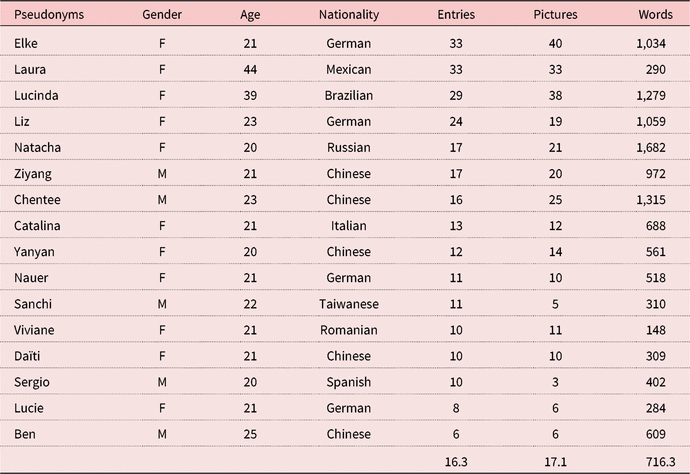
As shown in Table 2, there is a wide disparity as to how the 16 participants used the applications and approached the task of keeping track of their learning lives in France during the five-week data collection period. The production varies between Elke, who published 33 posts and used 40 pictures, and Ben, who published only six posts and used six pictures. As the debriefing confirmed, some students chose to keep their participation to a minimum, whereas others used the research project as an opportunity to write about their learning lives in their new academic context. In most cases, posts are triggered by a picture and the text usually makes a clear reference to it: “I saw this movie last night” (with the picture of the cinema poster), which indicates that the affordances of the application have shaped the participants’ inscriptions. Yet only a limited number of participants produced rich and complex entries and accompanied some of their posts with two or sometimes even up to four pictures.
It appears that a minority of students thought researchers expected more text-centred entries and felt that pictures would be too revealing. For instance, Elke says during the debriefing that before she came to France, she had a notebook that she used as a diary. She explains: “with [my notebook] I did the same as with the app, with pictures and stuff. But it was more like a personal diary because, with the app, I had to show it to others afterwards.” Another participant, Catalina, also kept a traditional diary and made a clear distinction with what she did with the app: “first, it’s something I don’t have to share. Then, in my diary, the subjects are completely different.” Yet, during the debriefing, she later adds: “I knew that, for researchers, the most important is the authenticity of the data, that you don’t want to judge our lives.” Although the app provided some insights into the international students’ learning lives, the fact that the entries would eventually be shared with researchers had an impact on their content and clearly differed from what they would have published on their social networks, which constitutes one major methodological shortcoming of the present study. Besides, participants captured their experiences by writing in French and not in their first language, which undoubtedly limited some of them to engage in deep reflection about their learning strategies. One might add that, although students are typically used to texting, having to write a long descriptive textual commentary on a mobile phone might also have played a role in the length and depth of the textual productions. Finally, usually those who were infrequent publishers underlined that self-tracking was time consuming.
4.2 Self-tracking one’s trajectory abroad in the visual mode
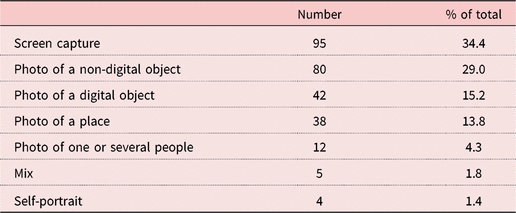
Table 3 categorises the different images taken by the participants, according to their content and the coding scheme presented previously (see Table 1).
Categorisation of entries in the visual mode
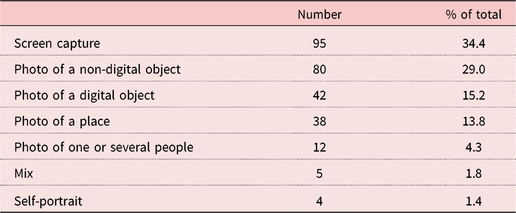
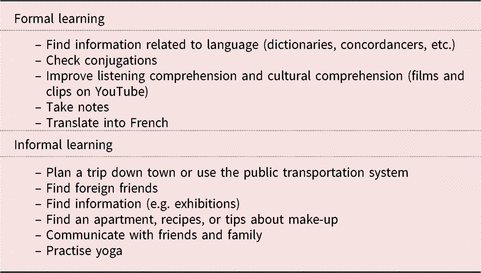
Almost two thirds of the pictures taken by the international students depicted apps and digital objects and triggered interesting reflections as to the role they play in language learning but also in dealing with everyday situations. A list was established to categorise what participants did with the digital objects and apps they included in their entries (see Table 4).
Functions of digital tools

Several observations can be made. First, it appears that smartphones, tablets, and computers play an important role both inside and outside the classroom as they are used not only for formal French learning but also for informal everyday situations in which language use is required. Even though international students use digital tools abundantly, their functions were foreseeable, thus undermining the perceptions that educators often have of students astutely and imaginatively using digital resources in all situations (Tapscott, Reference Tapscott2009).
Second, it appears that digital tools have not replaced traditional cognitive tools (paper dictionaries, written notes) but are used side by side, as is apparent in several pictures. Besides, digital tools complement offline tools in moments when their use is more practical (e.g. in the street) or more rapid (in class). On the contrary, it seems that apps used for everyday situations have almost completely replaced the different offline resources that foreign students used to use when they went abroad (paper maps, offline newspapers, etc.). So not only do international students still have to develop the linguistic skills needed to deal with social situations abroad (such as renting an apartment) but they also have to become accustomed to the digital resources to do so. This underlines the importance of developing digital literacies (see Dudeney, Hockly & Pegrum, Reference Dudeney, Hockly and Pegrum2014) in addition to linguistic skills before their arrival in order to use these resources appropriately. Paradoxically, these apps that facilitate students’ lives and mobility are also likely to replace opportunities where oral interactions are needed, thus reducing the need for contact with local people and the possibility of improving their oral skills. Still, certain participants’ decisions indicate a process of linguistic acculturation; for instance, when one participant (Lucinda) switches her yoga application from Portuguese to French and explains how “this little French voice is talking to [her] in [her] head” as she is practising yoga.
Third, it appears that the app has been used as some kind of digital scrapbook by students when they collected pictures of non-digital objects that include book covers and contents, front pages of newspapers, cinema and exhibition posters and tickets, concert brochures, paintings, and food. As the time stamps attest, pictures were often taken on the spot as some kind of reminder of an event that an individual considered to be meaningful. These pictures then served as a springboard to (sometimes) more elaborate entries when the international students were at home. As can be expected from students who are still discovering a new context, participants also behaved like tourists and took numerous pictures of city landmarks (museums, streets, parks, views) or leisure locations (restaurants, stadiums, discos, gyms). It can be speculated that the digital scrapbooking encouraged by the project apps is a practice that has been developed with social networks such as Facebook or Instagram or other social media and was reinvested by the participants, even if several of them insist that what they published for the project differed from what they would publish on Facebook (see section 4.1).
Fourth, the least numerous categories of pictures among those listed (see Table 4) pertain to pictures of people or self-portraits, something that differs from social media where these are usually most prominent (Highfield & Leaver, Reference Highfield and Leaver2016). Two hypotheses can be made: first, students might have wanted to make a clear distinction between the project and what they do with social media (see section 4.1). Second, this might also suggest that international students have limited opportunities to meet local people, as appears in one of Catalina’s posts. She describes one of the pictures as follows: “On the left, Antonin. He is a French friend of my sister’s who came to visit me for the weekend. I have been able to speak with him for the whole day.” The mere fact that this was recorded as a meaningful event perhaps attests to the rarity of such moments of socialising with local people for this student. One notable exception to this is those students who practise sports and who frequently include pictures of local students in their entries. This is in line with a survey that Lehto, Cai, Fu and Chen (Reference Lehto, Cai, Fu and Chen2014) conducted among domestic and international students on an American university campus, which found that there were very limited interactions with domestic students even if both groups engaged in similar types of activities. It is indeed striking to see that only three out of the 16 participants included pictures of other students in their posts.
Self-tracking one’s trajectory abroad in the visual mode (besides the textual mode) seems, thus, to facilitate the contextualisation of learning opportunities and may lend more saliency (and memorability) to these learning events. In the debriefing, students mentioned how careful they were when they select a picture, reframe it, and sometimes use filters before using them in their diary. Thus, Lucinda points out that “in truth, carefully choosing the best picture, this allows to keep the souvenir you want to. They become easily retrievable.” Besides, as in Walker et al.’s (Reference Walker, Whyatt, Pooley, Davies, Coulton and Bamford2009) study that provided cameras to children (see section 2.2), we can surmise that data collection was impacted by the possibility of taking pictures on the go as participants were bound to be on the lookout for things to photograph and were therefore more reflective about their surroundings and what constitutes a valuable photographic entry. Finally, this practice of inscribing oneself in a new landscape and keeping visual track of these inscriptions may help “[bring] together ‘place-making and text-making’” (Green, Reference Green2012: 379) and develop international students’ critical semiotic awareness between literacy and place in a significant way.
4.3 Identification of the nature of participants’ textual entries
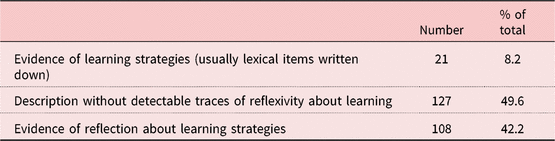
Table 5 provides a categorisation of texts produced by the participants according to their contents, in number and percentage.
Categorisation of entries in the textual mode

One interesting albeit marginal category of entry concerns lists of lexical items that were typically jotted down with the application while visiting a place or while reading. As Natacha notes, “I find it easier to think about language learning and culture on paper. [But] I have used the app to write quickly the vocabulary of something.” This noting technique using the mobile phone is further explained by Catalina, who remarks that “during the day, I take notes with my phone and then, in my bag, I take a notebook when I feel the need to write things down and memorize them in my head.” This confirms that digital and non-digital resources are interwoven in students’ learning strategies, the former being an easy way to capture a word, a moment, or a memory, and the latter remaining the favoured means for reflection and memorisation. Some students express the need to inscribe learning through handwriting, not keyboarding, and even declare that they are “a generation of transition” (Sanchi). This needs further investigation in order to determine whether this sentiment comes as a trace of a legitimised institutional (and therefore legitimate) practice or whether this attests to actual cognitive preferences.
The second category of text, by far the most frequent (49.6% of the total), includes descriptions of events and digital usage that do not explicitly mention the role they play in learning.
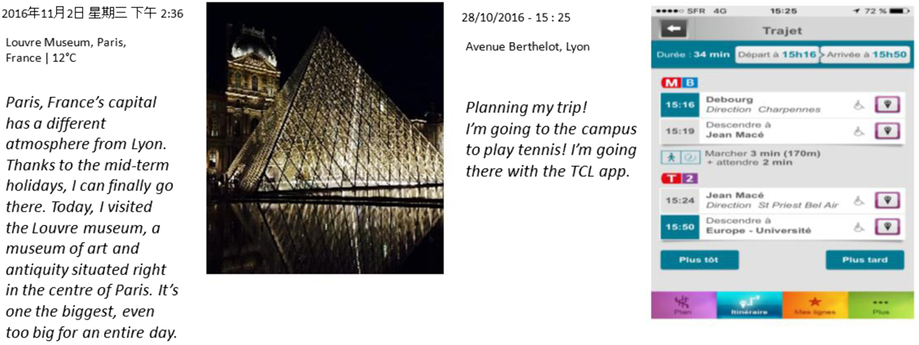
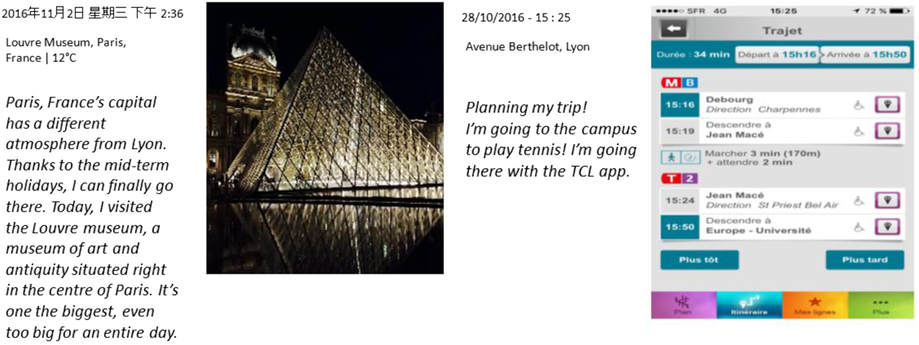
For instance, over the five weeks of the project, Ben has produced two written entries a week, each time accompanied by a picture without people, in which he describes a visit, an event, or a movie. These texts are generally descriptive and the subjectivity is kept to a minimum, which makes them akin to traditional writing assignments. In the same manner, some participants record all the tools and artefacts used during the span of the project. Elke, for instance, has scrupulously noted down her various digital habits, and the posts she has produced explain the functions each application has in her routines (see her trip to the campus, Figure 2).
Two examples of descriptions (Ben’s visit, left, and Elke’s trip to the campus, right)
In the third category of entries (situated reflection about learning strategies), students use the application of the project as a learning diary with which they chronicle their different experiences. In these, they also identify more or less explicitly when there are learning opportunities and whether or not these are digitally mediated.
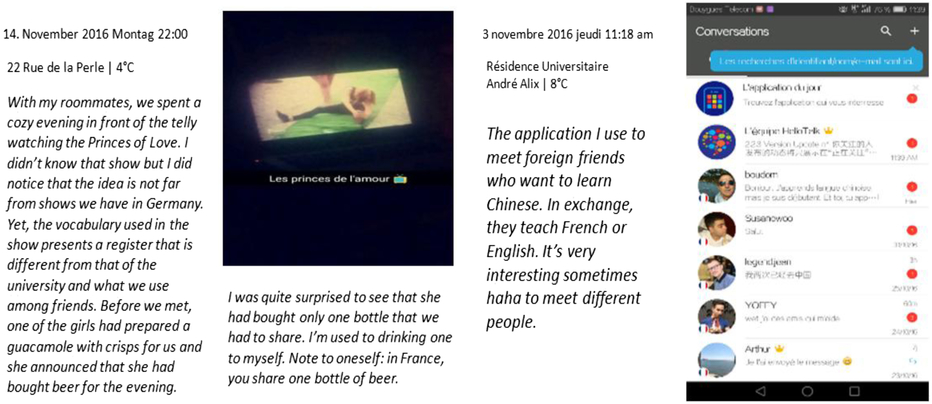
For instance, in Figure 3, Liz describes what she learned linguistically and culturally by watching a show with her roommates and Daïti explains how she exchanges conversation lessons with an application. This type of entry is frequent with the most engaged participants who not only understood the scientific aims of the project but also saw what they could gain from such a diary. Liz thus remarks:
Yes, there were moments when I thought about the app. I would say to myself, this is a moment when I can write something because I’m learning something, I’m learning French, I’m speaking French, I am with French people, I’m learning stuff about culture, they are telling me about their culture and I’m telling them about mine in exchange. We look if there are comparisons, similarities … I would think about the app when I became aware that we were talking about France and French culture.
Liz’s evening, left, and Daïti’s use of an application, right
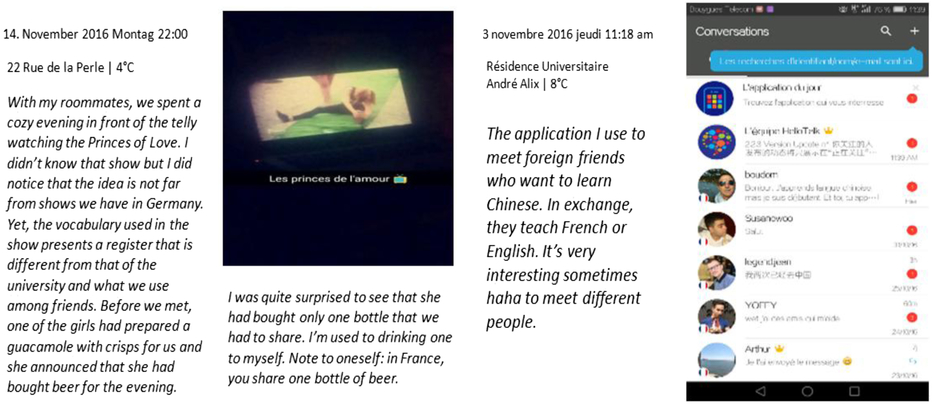
The italicised segment of Liz’s discourse underlines that, in her case, the app was instrumental to her collecting appropriate events, as always having the app at her disposal, no matter the location or the time of day, contributed to heightening her awareness with regard to learning opportunities. These written entries and the accompanying pictures, which were usually chosen with care to illustrate them, represent great interest because they show the affective load every literate practice involves (see Lemke, Reference Lemke, Erstad and -Green2013) and how a variety of experiences shape the ways individuals anchor themselves in a new context.
It is important to observe that although some students from the sample used one genre only (e.g. Ben), there was nonetheless a hybridity between genres in most participants’ output. For instance, Liz quickly made factual notes when she wrote entries on the go (e.g. in restaurants), whereas she produced longer and more detailed posts when she was at home or at the university. Two complementary functions can be assigned to these mediated practices: one that pertains to recording and storing the different events that make up one’s trajectory in a new context when they occur, the other relating to transforming an event into an object of further reflection about language, culture, and identity (Comas-Quinn et al., Reference Comas-Quinn, Mardomingo and Valentine2009).
In sum, the types of entries that are identified correspond to crucial literacies – building vocabulary, practising writing, developing strategies, and making meaning – that all partake in what international students need in their new context. Although the level of reflexivity about learning hugely varied among participants, it can be hypothesised that such self-tracking applications can prompt international students to seize opportunities outside the classroom to store meaningful events on the go and refine these recorded experiences in their learning diaries. In that sense, self-tracking applications can be instrumental, both for learners and researchers in education, in providing what Kress (Reference Kress, de Saint-Georges and Weber2013: 121) has called “means of recognition of pedagogic-semiotic work of learners and of learning.”
5. Discussion and conclusion
This last section summarises the main findings of the study by showing that self-tracking can both help to document international students’ trajectory and, with appropriate guidance, amplify their experience of mobility. After examining the present study’s limitations, we then proceed to further methodological reflection about self-tracking as an option for exploring students’ learning lives. We finally conclude this section by making the case for tracing learner digital usage outside institutional settings in order to contribute to mapping the geographies of learning.
5.1 A grounded (self-)exploration of identities and learning opportunities
Asking participants to keep track of their learning lives has produced data that give insights into what international students do in the shaping of their trajectory abroad when they arrive in their new environments. It has allowed us to identify the role digital tools can play over a period of time and across contexts, to pinpoint the strategies international students develop more or less inventively to face their new environments, and, finally, to charter “the social and semiotic hybridity of learning processes online and offline” (Drotner, Reference Drotner, Erstad and -Green2013: 47).
The data show that students develop multiple identities that are sometimes superimposed and that self-tracking technologies help document. Besides learner identity, which is the focus of much educational research (Pham & Saltmarsh, Reference Pham and Saltmarsh2013), the inscriptions international students have shared inform us about their identities as foreigners in a new culture mapping their new environments, as tourists enjoying new landscapes and novel cultural experiences, and as social beings interacting (or trying to interact) with local people or other international students. Yet we contend that there is no such thing as an international student’s identity as we see that the ways they negotiate their trajectories, what studying abroad means and how it resonates in their daily lives, what they take into account or leave unsaid, differ hugely from one individual to another. It shows that the degree of participation and the capacity to construct meaning out of these participation trajectories are certainly key elements in making the most of this experience abroad. Yet let us insist that an absence of recorded entries does not mean that students are not constructing meaning or making the most of their experience abroad.
Providing international students with such apps and instructions, as was done with this study, may help them become more acutely aware of the potential of their new context for informal learning and of the opportunities digital tools may offer in the process. The study provides various pieces of evidence collected by students that learning about language and culture is legitimately occurring outside the classroom and that students are aware of it. Although it might be spontaneous, unstructured, and depend on random opportunities, digital self-tracking might enhance international students’ intrinsic motivation and incite them to make the most of their stay abroad. Through teacher mediation, using a dedicated app, and providing relevant instructions and moments for collective reflection, such a set-up might have the potential of turning informal learning opportunities into knowledge, as advocated by the proponents of digital scrapbooking (Peters & Frankoff, Reference Peters, Frankoff, Guikema and Williams2014) or mobile cultural blogging in language education (Comas-Quinn et al., Reference Comas-Quinn, Mardomingo and Valentine2009). The experience of mobility would thus be amplified by being anchored in relevant episodes punctuating the learning progress and by being framed and reframed visually and textually to make it more emotionally grounded, salient, and memorable.
5.2 Methodological considerations
One obvious limitation of this exploratory study is the limited number of participants who were involved and the short period of time during which they were asked to track their own learning lives with a new tool that some found difficult to appropriate. Besides, the two apps used to collect the data have undoubtedly shaped how participants have faced the tracking of their learning lives, and other apps would possibly have yielded different data (i.e. less picture centred). Moreover, because of the exploratory nature of the study and the double aim of investigating students’ digital usage and their identification of learning opportunities, the instructions produced some confusion in what participants selected for publication. A new data collection phase focusing on international students’ learning lives would certainly require an ethnographic approach and entail a much more participatory design than that used for the present study. A follow-up study is being implemented with a similar population but with a larger time span and will gather more sociolinguistic data on the international students (e.g. their backgrounds, post-secondary studying experiences, and former digital habits). Future directions could also include the comparison of international students staying for a single semester and those engaged in a longer-term project, as the duration of stay and academic objectives seem to have an effect on the ways in which students make sense of their environment (Marchandise, Reference Marchandise2014: 140).
The self-tracking method implemented for the study can be qualified as soft tracking because participants selected what they shared with the researchers. It obviously leaves some blind spots about students’ actual digital practices but nevertheless constitutes a valuable ethical option among possible methods to determine the role digital technologies play in students’ lives outside the classroom and what they identify as learning opportunities and strategies. The possibility offered to the participants to take pictures and produce texts with the apps yielded complex data and enabled the researchers to determine not only the types of digital usage but also their contexts of production, their goals, and their hybridity. The self-tracking method is thus an interesting methodological alternative to other methods that have been devised to study informal mediated learning. Finally, our analytical approach has helped us to zoom in and out on our data, identifying patterns and genres, and detecting characteristics and differences among international students’ learning lives.
5.3 Conclusion: Towards delineating the “geographies of learning”
As “mobile technologies have become integrated into the fabric of people’s everyday lives” (Kukulska-Hulme et al., Reference Kukulska-Hulme, Lee, Norris, Chapelle and Sauro2017: 217), educational researchers have to continue to find methods to explore informal and non-formal digital usage in order to determine how it shapes, enriches, and sometimes impedes students’ learning trajectories abroad and accompanies their transition in terms of acculturation and socialisation. What happens in a new foreign context when starting the day, while waiting in the checkout line, or on the way back home corresponds to transitory moments when individuals are either mobile or temporarily immobilised but when learning continues to progress even though these interstices of everyday life are not immediately obvious as learning opportunities (Chan et al., Reference Chan, Walker and Gleaves2015). Our aim is not to glorify excessively these interstices occurring outside institutional settings but to nonetheless take them into account and provide a fuller picture of digital usage in a learning trajectory. By gaining access to the inscriptions students produce during their stay abroad, studies such as this can help delineate the geographies of learning (Leander, Phillips & Headrick Taylor, Reference Leander, Phillips and Headrick Taylor2010) in their symbolic dimensions.
Finally, this exploratory study has underlined that self-tracking has the potential to heighten awareness of learning opportunities, thus enabling students to make the most of their new social and linguistic contexts. The overall experience abroad is therefore enriched as the self-tracking application serves as an anchor in the foreign landscape.
Acknowledgements
The TRANSNUMED project was supported by the ASLAN project (ANR-10-LABX-0081) of the Université de Lyon, within the program “Investissements d’Avenir” (ANR-11-IDEX-0007) of the French government operated by the National Research Agency.
I am indebted to all of the international students who agreed to take part in this study, as well as to Laurence Garcia (the international students’ French teacher who agreed to welcome the team of researchers for the data collection), and Jean-François Grassin and Zoum Tou who are co-researchers in the TRANSNUMED project.
Ethical statement
A consent form informed the participants of the study that the project would involve sending a weekly report to researchers over five weeks and that they were free to choose what they wished to share with researchers. They were also reassured that this would not affect their course grades and their data would not be read by their French instructors. Sixteen students agreed to participate in the data collection and agreed to have their data analysed and published for scientific purposes, as long as anonymity and confidentiality were ensured. There was no conflict of interest.
About the author
Nicolas Guichon is a professor in language sciences and teaching French as a second language at the Université Lumière Lyon 2. He carries out his research in the ICAR (Interactions, Corpus, Apprentissages, Représentations) CNRS team. His research interests include teacher education in CALL, the study of online interaction, and digital literacies and identities.
Author ORCiD
Nicolas Guichon, https://orcid.org/0000-0003-0935-4975