




No CrossRef data available.
Article contents
Art of the Sale: Recommendations for Sharing Research With Mainstream Media and Senior Leaders
Published online by Cambridge University Press: 27 December 2018
Extract
Research collaborations are two-way streets. To obtain support from organizations, academics must communicate the value of their research projects to the stakeholders. In their focal article, Lapierre et al., (2018) described this process as the academic “sales pitch”, one that must be “short yet attention grabbing” (p.20). Academic research in industrial and organizational (I-O) psychology, however, is rooted in esoteric jargon (e.g., validity and reliability) and unconvincing evidence (e.g., r and r2) (Highhouse, Brooks, Nesnidol, & Sim, 2017; Rynes, 2009). These concepts are difficult for non-academics to understand and may even undermine the value of our work (Brooks, Dalal, & Nolan, 2014; Kuncel & Rigdon, 2012; Mattern, Kobrin, Patterson, Shaw, & Camara, 2009). CEOs and other senior leaders often have limited time, attention, and expertise to process your pitch: A bad one could effectively derail the collaboration before it even began.
Information
- Type
- Commentaries
- Information
- Copyright
- Copyright © Society for Industrial and Organizational Psychology 2018
Footnotes
1 Examples of analogies are adapted from Zhang, Highhouse, Petersen, and Rada (Reference Zhang, Highhouse, Petersen and Rada2014).
References
Brooks, M. E., Dalal, D. K., & Nolan, K. P. (2014). Are common language effect sizes easier to understand than traditional effect sizes? Journal of Applied Psychology, 99 (2), 332–40. doi:10.1037/a0034745Google Scholar
Colbert, A. E., Rynes, S. L., & Brown, K. G. (2005). Who believes us? Understanding managers’ agreement with human resource research findings. Journal of Applied Behavioral Science, 41 (3), 304–325.Google Scholar
Dal Cin, S., Zanna, M. P., & Fong, G. T. (2004). Narrative persuasion and overcoming resistance. In Knowles, E. S. & Linn, J. A. (Eds.), Resistance and persuasion (pp. 175–191). Mahwah, NJ: Erlbaum.Google Scholar
Donnelly, C. M., & McDaniel, M. A. (1993). Use of analogy in learning scientific concepts. Journal of Experimental Psychology: Learning, Memory, and Cognition, 19 (4), 975.Google Scholar
Gilliam, D. A., & Flaherty, K. E. (2015). Storytelling by the sales force and its effect on buyer–seller exchange. Industrial Marketing Management, 46, 132–142. doi:10.1016/j.indmarman.2015.01.013Google Scholar
Highhouse, S., Brooks, M. E., Nesnidol, S., & Sim, S. (2017). Is a .51 validity coefficient good? Value sensitivity for interview validity. International Journal of Selection and Assessment, 25 (4), 383–389. doi:10.1111/ijsa.12192Google Scholar
Holyoak, K. J., Gentner, D., & Kokinov, B. N. (2001). Introduction: The place of analogy in cognition. In Centner, D., Holyoak, K. J., & Kokinov, B. N. (Eds.), The Analogical Mind: Perspectives from Cognitive Science (pp. 1–19). Campbridge, MA: MIT Press.Google Scholar
Kuncel, N., & Rigdon, J. (2012). Communicating research findings. In Weiner, I. B., Schmitt, N. H., & Highhouse, S., (Eds.), Handbook of psychology: Industrial and organizational psychology (Vol. 12, pp. 43–58). Hoboken, NJ: John Wiley & Sons.Google Scholar
Lapierre, L., Matthews, R. A., Eby, L. T., Truxillo, D. M., Johnson, R. E., & Major, D. (2018). Recommended practices for academics to initiate and manage research partnerships. Industrial and Organizational Psychology: Perspectives on Science and Practice, 11 (4), 543–581.Google Scholar
Lewis, M. (2004). Moneyball: The art of winning an unfair game. New York, NY: WW Norton & Company.Google Scholar
Mattern, K., Kobrin, J., Patterson, B., Shaw, E., & Camara, W. (2009). Validity is in the eye of the beholder: Conveying SAT research findings to the general public. Lissitz, In R. W. (Ed.), The concept of validity: Revisions, new directions, and applications (pp. 213–240). Charlotte, NC: Information Age Publishing.Google Scholar
Newby, T. J., Ertmer, P. A., & Stepich, D. A. (1995). Instructional analogies and the learning of concepts. Educational Technology Research and Development, 43 (1), 5–18.Google Scholar
Okan, Y., Garcia-Retamero, R., Cokely, E. T., & Maldonado, A. (2012). Individual differences in graph literacy: Overcoming denominator neglect in risk comprehension. Journal of Behavioral Decision Making, 25 (4), 390–401.Google Scholar
Rynes, S. (2009). The research-practice gap in industrial-organizational psychology and related fields: Challenges and potential solutions. In Kozlowski, Steve, (Ed.), Oxford handbook of industrial-organizational psychology, (pp. 409–454). New York, NY: Oxford University Press.Google Scholar
Schank, R. C., & Berman, T. R. (2002). The pervasive role of stories in knowledge and action. In Green, M. C., Strange, J. J., & Brock, T. C. (Eds.), Narrative impact: Social and cognitive foundations (pp. 287–313). Mahwah, NJ: Erlbaum.Google Scholar
Schmidt, F., & Hunter, J. (1998). The validity and utility of selection methods in personnel psychology: Practical and theoretical implications of 85 years of research findings. Psychological Bulletin, 124 (2), 262–274.Google Scholar
Sinar, E. F., & Grubb, A. G. (2018, April). Storytelling with impact: Mastering the practical science of influential communication. Workshop presented at the Annual Conference of the Society for Industrial and Organizational Psychology, Chicago, IL.Google Scholar
Zhang, D. C. (In press). Utility of alternative effect size statistics and the development of a web-based calculator: Shiny-AESC. Frontiers in Psychology, 9. doi:10.3389/fpsyg.2018.01221Google Scholar
Zhang, D. C., Highhouse, S., Brooks, M. E., & Zhang, Y. (In press). Communicating the validity of structured job interviews with graphical visual aids. International Journal of Selection and Assessment.Google Scholar
Zhang, D. C., Highhouse, S., Petersen, N., & Rada, T. B. (2014, November). The use of analogies to communicate advantages of structured interviews. Poster presented at the 35th Annual Conference for the Society for Judgment and Decision Making, Long Island, CA.Google Scholar
Zhang, D. C., & Ritter, K.J. (2018, April). Are stories more persuasive than advice? Overcoming resistance against the structured interview with story-telling. Presented at the Annual Conference for the Society for Industrial and Organizational Psychology, Chicago, IL.Google Scholar
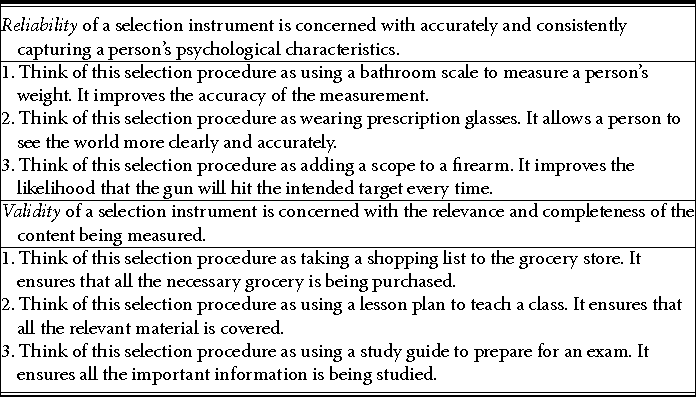
Table 1. Example Analogies for Reliability and Validity
 You have
Access
- 3
- Cited by
Research collaborations are two-way streets. To obtain support from organizations, academics must communicate the value of their research projects to the stakeholders. In their focal article, Lapierre et al., (Reference Lapierre, Matthews, Eby, Truxillo, Johnson and Major2018) described this process as the academic “sales pitch”, one that must be “short yet attention grabbing” (p.20). Academic research in industrial and organizational (I-O) psychology, however, is rooted in esoteric jargon (e.g., validity and reliability) and unconvincing evidence (e.g., r and r 2) (Highhouse, Brooks, Nesnidol, & Sim, Reference Highhouse, Brooks, Nesnidol and Sim2017; Rynes, Reference Rynes and Kozlowski2009). These concepts are difficult for non-academics to understand and may even undermine the value of our work (Brooks, Dalal, & Nolan, Reference Brooks, Dalal and Nolan2014; Kuncel & Rigdon, Reference Kuncel, Rigdon, Weiner, Schmitt and Highhouse2012; Mattern, Kobrin, Patterson, Shaw, & Camara, Reference Mattern, Kobrin, Patterson, Shaw, Camara and Lissitz2009). CEOs and other senior leaders often have limited time, attention, and expertise to process your pitch: A bad one could effectively derail the collaboration before it even began.
In this commentary, I discuss three methods (analogies, stories, and alternative validity statistics) for communicating the value of research to nonacademics and provide suggestions for best practices. These methods may be used in print (e.g., media coverage), presentations (e.g., oral presentation to stakeholders), or informal conversations (e.g., you have 30 seconds to deliver the colloquial “elevator pitch” to the CEO). I hope to provide academics with a flexible toolkit for sharing their research with popular media, organizational stakeholders, and the public.
Analogies
An analogy compares relations in a novel domain to relations in a familiar domain (Holyoak, Gentner, & Kokinov, Reference Holyoak, Gentner, Kokinov, Centner, Holyoak and Kokinov2001). For example, the analogy “memory operates like a library” relates a novel concept (memory) to a familiar concept (library). When presented with this analogy, learners use their knowledge about the properties of libraries to make inferences about how memory operates (Donnelly & McDaniel, Reference Donnelly and McDaniel1993). In education, teachers often use analogies to describe unfamiliar or difficult concepts by comparing them to familiar topics (Newby, Ertmer, & Stepich, Reference Newby, Ertmer and Stepich1995).
Analogies can be useful for communicating technical concepts such as reliability and validity, both of which are cornerstones of employee assessment and selection. However, reliability and validity may be difficult for a nonexpert to understand. As a result, the value of reliable and valid selection system may be underappreciated by organizations (Colbert, Rynes, & Brown, Reference Colbert, Rynes and Brown2005). Table 1 contains a list of analogies that researchers can use to describe – in 30 seconds or less – the enhanced reliability or validity of an evidence-based selection procedure.Footnote 1 The purpose of these analogies is to communicate the concepts of reliability and validity to someone quickly and efficiently. These analogies can be plug and play in a variety of situations such as a press release or the 30-seconds sales pitch.
Example Analogies for Reliability and Validity
Story Telling
Stories are, at the core, retellings of real-life experiences (Schank & Berman, Reference Schank, Berman, Green, Strange and Brock2002). Relatedly, Lapierre et al. (Reference Lapierre, Matthews, Eby, Truxillo, Johnson and Major2018) suggested that should “refer to any previous experience in implementing valuable change” (p. 560) as a way to indicate one's credentials and expertise. Stories are particularly useful from a sales perspective. In a study of professional sales professionals, Gilliam and Flaherty (Reference Gilliam and Flaherty2015) found that stories can be used for a variety of purposes such as to persuade, inform, and build bonds with the customer. Many salespeople also use personal stories as ice breakers when meeting with a client for the first time. Stories can also be useful for communicating—vividly—the value of organizational interventions. Zhang and Ritter (Reference Zhang and Ritter2018), for instance, found that managers were more likely to endorse the use of a structured interview when they were presented with a story about its success rather than factual advice. A more broad example can be found in Hollywood: The popular book and motion picture Moneyball (Lewis, Reference Lewis2004) told the story of the Oakland Athletics baseball manager Billy Beane, who pioneered data-driven methods and transformed the selection and assessment of professional baseball players—a field previously dominated by intuition and subjectivity (Lewis, Reference Lewis2004). Indeed, stories can be valuable tools for communicating the value of evidence-based organizational practices to nonacademic stakeholders.
However, one should consider the timing and nature of the story. Although personal stories are effective for breaking the ice in some business-to-business interactions, they are much less useful in the later stages of the discussion. Similarly, one might also not want to begin a collaborative relationship with business stories. As one veteran buyer in the study noted: “If they come in for a first meeting and start sharing their successful stories with what they have done with company xyz, I'm not with them” (Gilliam & Flaherty, Reference Gilliam and Flaherty2015). Still, success stories can be more effective than facts and evidence for the purpose of persuasion (Dal Cin, Zanna, & Fong, Reference Dal Cin, Zanna, Fong, Knowles and Linn2004), and is a valuable tool for sharing the value of your research to organizational stakeholders (Sinar & Grubb, Reference Sinar and Grubb2018).
Alternative Validity Statistics
Research evidence typically takes the form of a correlation or coefficient of determination. Although explaining 10% of the variance in counterproductivity or turnover might be impressive for the savvy academic audience, it is more likely to undersell the value of your services. In a recent conversation with a human resource professional at a large corporation, he lamented, while referring to the seminal meta-analysis by Schmidt and Hunter (Reference Schmidt and Hunter1998), that best employee selection methods have only a 50% accuracy (referring to the meta-analytic validity of General Mental Ability tests [GMAs]): a statement that reflected a poor grasp of “validity” and complete misunderstanding of the evidence.
When sharing research evidence with the mainstream media or organizational stakeholders, academics should use avoid correlations, and instead use alternative validity statistics such as the binomial effect size display, expectancy chart, or common language effect size statistics. Brooks et al. (Reference Brooks, Dalal and Nolan2014) found that lay people were willing to pay more money for a training program when its effectiveness information was presented as an alternative statistic (e.g., binomial effect size display) rather than a correlation coefficient. In another study, people judged a consulting company's selection services more favorably when its marketing brochure contained expectancy charts (Zhang, Highhouse, Brooks, & Zhang, Reference Zhang, Highhouse, Brooks and Zhangin press). Individual differences in graph literacy and numeracy, however, could affect the interpretability of alternative validity displays (Okan, Garcia-Retamero, Cokely, & Maldonado, Reference Okan, Garcia-Retamero, Cokely and Maldonado2012). To facilitate the generation of alternative validity statistics, I have developed a free-to-use web app (Zhang, Reference Zhang2018). This app allows researchers to upload their own data and generate a variety of traditional and alternative validity statistics. These displays of validity information are particularly useful in presentation decks or other print material (e.g., one-sheet).
Conclusion
Academic psychologists are not salespeople. Nonetheless, giving a successful sales pitch is a necessary step in getting your feet in the door with respect to organizational collaboration. An effective sales pitch should be efficient, understandable, and persuasive. In this article, I described several methods to improve the effectiveness of the sales pitch, and in turn, increase the odds of forging a fruitful collaboration.