INTRODUCTION
There are four lexical tones in standard Mandarin. The first tone is the high-level tone and is labeled as 1 and the second tone, 2, is the high-rising tone. The third tone, 3, is the falling-rising (or dipping), and the fourth tone, 4, is the high-falling. An alteration in the lexical tone of a syllable changes its meaning. For example, the syllable ma has four possible meanings when different tones are attached to it: ma1  ‘mother’, ma2
 ‘hemp’, ma3
 ‘horse’, ma4
 ‘scold’. Given this unique property of lexical tones, children's processing of lexical tones is essential for language development, because failure to assign a correct tone to a syllable means that the syllable will be pronounced incorrectly and possibly given an unintended meaning (Hu & Catts, Reference Hu and Catts1998; McBride-Chang, Lam, Lam, Doo, Wong & Chow, Reference McBride-Chang, Lam, Lam, Doo, Wong and Chow2008). Clearly, there is a great need for studies of the development of tone skills in young children (Burnhan & Mattock, Reference Burnham, Mattock, Munro and Bohn2007). In the present study, we sought to examine young children's ability to process lexical tones in relation to syllable segments by varying onset and rime in an oddity task. In a CVC syllable, the onset is the beginning consonant, while the rime consists of the vowel and the ending consonant. In the following sections, we will review the limited number of studies that have provided developmental data on production, perception and metalinguistic awareness of lexical tones.
A few studies have examined Mandarin-learning children's production of lexical tones (Chao, Reference Chao1951; Jeng, Reference Jeng1985; Li & Thompson, Reference Li and Thompson1977; Shiu, Reference Shiu1990). Most studies have found that the first and the fourth tones appear to be acquired earlier than the second and the third tones (but see Clumeck, Reference Clumeck1977, and Zhu, Reference Zhu2002, for a different pattern of development). In turn, children's ability to produce the second tone appears to emerge before that of the third tone (Su, Reference Su1985). Zhu (Reference Zhu2002) reported that tone production errors were rare even in toddlers aged 1 ; 6 to 2 ; 0. Only two tonal errors out of the entire speech corpus produced by the twenty-one toddlers were observed and both involved substituting the second tone for the third tone. Wong, Schwartz and Jenkin (Reference Wong, Schwartz and Jenkins2005) elicited production of monosyllabic tones by presenting pictures to two- to three-year-olds. Ten native Mandarin-speaking adults listened to the recorded productions and categorized them as either the first, second, third or fourth tone. The judges made significantly more errors in identifying the third tone than any other tones. Overall results from these production studies suggest that the third tone is the most difficult for children and is acquired relatively late.
Mattock and Burnham (Reference Mattock and Burnham2006) found that Chinese infants begin to show sensitivity to lexical tones as young as six to nine months of age. In this study, infants aged 0 ; 9 raised in Mandarin-speaking families were able to discriminate between pairs of Thai lexical tones, whereas English-learning infants at the same age failed to show such discrimination. This inability in non-native tone discrimination was also replicated with French-learning infants using the same Thai tone stimuli (Mattock, Molnar, Polka & Burnham, Reference Mattock, Molnar, Polka and Burnham2008). These results demonstrated that lexical tone perception is shaped by exposure to a tonal language and that development of lexical tone sensitivity begins early in infancy. Although the perceptual reorganization of tones may commence between ages 0 ; 6 and 0 ; 9, it is not entirely clear how tone representations change as the language learner grows.
Wong et al. (Reference Wong, Schwartz and Jenkins2005) presented Mandarin-learning children with minimal pairs of monosyllabic words that shared the same segment but differed in tones (e.g. tang1 vs. tang2). Children had to choose the word from the minimal pair that matched the corresponding picture. Results showed that three-year-old children made significantly more errors when the minimal pairs involved the second and the third tones. In addition, children had difficulties with the third tone (accuracy: 69%) although the other three tones were perceived with relatively high accuracy (90% for the first, 87% for the second, and 89% for the fourth tone). By age three, Mandarin-learning children seem to be able to perceive three of the four lexical tones in monosyllabic words.
However, it is unclear from Wong et al. (Reference Wong, Schwartz and Jenkins2005) what role the subsyllabic units, onsets and rimes, play in tone perception and processing. Some researchers have argued that tone is associated with the rime in underlying representation (Chen, Reference Chen1999; Ho & Bryant, Reference Ho and Bryant1997; Howie, Reference Howie1976; Wan & Jaeger, Reference Wan and Jaeger1998), while Duanmu (Reference Duanmu2007) considers the mora as the tone-bearing unit. The syllable nucleus represents one mora in the case of a short vowel and two moras in the case of a long vowel or diphthong. Still others have observed that tone spreads over the whole syllable (Xu, Reference Xu1998; Reference Xu2004). Using the word [mai4]  ‘sell’ as an example, the fourth tone (e.g. high-falling) is associated with mai or ai based on the syllable or the rime view, respectively. For the mora view, the high tone is associated with the first vowel [a] and the falling tone with the second vowel [i]. Phonetic analyses of production data by Xu (Reference Xu1997; Reference Xu1998; Reference Xu1999; Reference Xu2004; Xu & Wang, Reference Xu and Wang2001) have shown that fundamental frequency (F0) changes immediately at the offset of the previous syllable in anticipation of the pitch target of the next tone, suggesting that the implementation of tone starts from the onset of its host syllable and the pitch target is reached at the end of the syllable.
Tong, Francis and Gandour (Reference Tong, Francis and Gandour2008) supported the view that vowels play a more important role than consonants in tone processing. In this study, participants were asked to identify which of two syllables had the second or the fourth tone while ignoring the segmental information (e.g. consonants or vowels). In the control condition, participants judged between two syllables that had the same onset and vowel (e.g. ba2 and ba4). In the consonant condition, participants judged between two syllables that had different onsets (e.g. ba2 and da4), while in the vowel condition, participants judged between two syllables that had different vowels (e.g. ba2 and bu4). The difference in reaction times between the vowel and the control conditions was significantly larger than that between the consonant and the control conditions. Tong et al. suggested that vowels exert greater interference on tone processing and that there is greater integrality between tones and vowels than between tones and consonants. However, this does not rule out the possibility that tonal information may be partially carried on consonants. One possible explanation for why tones may appear to be associated more with vowels is that consonants are often shorter than vowels and pitch information could be interrupted in voiceless consonants (Nooteboom, Reference Nooteboom, Hardcastle and Laver1997; Xu & Xu, Reference Xu and Xu2003), resulting in the fact that the pitch target for the tone may not be reached until the end of the syllable.
Tong et al.'s (Reference Tong, Francis and Gandour2008) study was conducted with adults. It is not clear whether the same vowel interference effect would be observed in young Mandarin-speaking children. A number of studies have examined the development of lexical tone awareness in relation to literacy acquisition (Ho & Bryant, Reference Ho and Bryant1997; Shu, Peng & McBride-Chang, Reference Shu, Peng and Mc-Bride-Chang2008; Siok & Fletcher, Reference Siok and Fletcher2001). Although these studies did not directly examine the influence of segmental information on tone processing, their results still provide some insights into the contribution of awareness to onsets and rimes in the development of lexical tone sensitivity.
Ho and Bryant (Reference Ho and Bryant1997) examined phonological awareness in Cantonese-speaking children; two conditions in their detection task were particularly relevant to the current study. The detection task required children to listen to a target syllable and decide which of two choices sounded more similar to the target. In the rime/tone detection condition, the correct answer and the target shared the same rime and tone (e.g. men2: ren2 or dong4), while the distracter differed in both rime and tone. In the tone alone detection condition, the correct answer and the target shared the same rime and tone (e.g. han4: fan4 or tan2), while the distracter differed in tone only. Both detection conditions were administered to three- and five-year-olds in Study 1 (cross-sectional) and tone alone detection was also administered to seven-year-olds in Study 2 (longitudinal). Children showed above chance performance in rime/tone detection at ages three and five. In tone alone detection, above chance performance was observed only at ages five and seven. These results suggested that, at age three, children could differentiate between the correct answer and distracter based on rime and tone combined, but not based only on tone.
Siok and Fletcher (Reference Siok and Fletcher2001) also examined tone processing in relation to onset and rime using a tone oddity task with school-aged Mandarin-speaking children (Grades 1–3 and 5). Children listened to sets of four syllables and decided which syllable had a different tone than the other three. In the first condition, the syllables shared the same onset (e.g. tu3, tai4, ti4 and tui4). In the second condition, the syllables shared the same rime (e.g. ling2, ding1, jing1 and xing1). In the third condition, the syllables differed in both onsets and rimes (e.g. hu1, feng1, tao1 and shui3). Results showed that children as young as first grade (mean age=6 ; 5) performed above chance level in all three conditions. In other words, children could process tone independent of onset or rime by first grade.
In the present study, we examined five- and seven-year-old Mandarin-speaking children's processing of the four lexical tones and the relation between segmental and suprasegmental information. We used a lexical tone oddity task in which we varied onset and rime in a full factorial design (onset±rime±). This design allowed us to test the independent role of onset versus rime in lexical tone processing. We hypothesized that children would have more difficulty with the rime− conditions than the onset− conditions, consistent with previous literature that suggested tone is associated more with vowels than consonants (Repp & Lin, Reference Repp and Lin1990; Tong et al., Reference Tong, Francis and Gandour2008). We also expected that, with the development of metalinguistic awareness as well as literacy exposure, seven-year-old children would outperform their younger counterparts in processing tonal information independent of segmental information. With cognitive maturation, children may become more sensitive to the sounds in their language. Improved metalinguistic awareness may help the older children to ignore the distracting segmental differences in onset− and rime− conditions and focus on the tonal information to make the oddity judgment. In addition, the seven-year-olds were all in the first grade learning Pinyin, a Roman alphabetic system that transcribes the segmental sounds of Mandarin Chinese as well as tonal information. Although tone is not marked on written Chinese characters, in Pinyin tone is marked explicitly on the vowel using four different diacritics (i.e. – for the high-level tone, ´ for high-rising, ˘ for falling-rising, and ´ for high-falling). The tone markers may help children construct better representations of the pitch contours and improve tone awareness.
METHODS
Participants
Participants consisted of two age groups of monolingual native Mandarin speakers, including forty-three in the five-year-old group (M=5 ; 5, SD=0 ; 2·4, 19 boys and 24 girls), and forty in the seven-year-old group (M=7 ; 7, SD=0 ; 4·6, 17 boys and 23 girls). The five-year-olds were recruited from two kindergartens in Beijing while the seven-year-olds were recruited from an elementary school in Baoding, a city about one hour away from Beijing. Children in Baoding all learn and speak standard Mandarin at school and the Baoding dialect has the same lexical tone features as standard Beijing Mandarin. All of the children were from middle-class families, speaking standard Mandarin as their first language without another Chinese dialect.
Materials and procedure
In the lexical tone oddity task, children heard three syllables through a pair of headphones connected to a laptop computer. As they heard each syllable, children simultaneously saw a colored number displayed on the computer screen: 1 for the first syllable heard, 2 (in a different color) for the second, and 3 (in a third color) for the third. Children were asked to choose which one of the three syllables did not share the same tone with the other two by pressing the key labeled 1, 2 or 3 on the computer keyboard. This procedure was adapted from Wang, Perfetti and Liu (Reference Wang, Perfetti and Liu2005) and Wang, Yang and Cheng (Reference Wang, Yang and Cheng2009). There were four conditions in the current task, with twelve items in each condition (see ‘Appendix A’ for a complete list of test stimuli). In the first condition, the three syllables shared the same onset and rime (onset+rime+; e.g. hua1, hua2 and hua1). In the second condition, the three syllables had the same onset but different rimes (onset+rime−; e.g. hua4, hao3 and han4). In the third condition, the three syllables had the same rime but different onsets (onset+rime+; e.g. gua1, hua4 and kua1). In the fourth condition, the three syllables had different onsets and rimes (onset−rime−; e.g. hua1, shen1 and chi2).
This full factorial design allowed us to examine the development of tone sensitivity in relation to the segments. We hypothesized that both age groups would show the best tone judgment in onset+rime+, when segmental information was consistent across syllables, and show the lowest accuracy in onset−rime−, when segmental information varied across syllables. If vowels indeed exert greater interference on tone processing than consonants, children would have more difficulty in onset+rime− than in onset−rime+. We matched the phonemes across the four conditions. The same sets of onsets and rimes were used and combined in different ways to create the stimuli. Both the onset and rime stimuli were created by choosing a representative sample from each vowel and consonant type (Appendices B and C).
A native Mandarin-speaking female experimenter worked one-on-one with each child in a quiet room to make sure he/she understood the instructions. The instruction (translated from Chinese) was as follows: “Now, you will hear three syllables, the first one matches with the number ‘1’ labeled on the computer keyboard, the second one matches with the number ‘2’ labeled on the keyboard, the third one matches with the number ‘3’ labeled on the keyboard. Among these three syllables, two of them have the same tone, the other one has a different tone. Please pick out the syllable that has a different tone, and press the corresponding key on the keyboard. You have to listen carefully and answer as quickly and as accurately as possible. Remember, please find the syllable that has a different tone.” Children received five practice items, one from each of onset+rime+, onset+rime−, and onset−rime+ and two from onset−rime− and the practice items were excluded from analyses. Feedback was given only during practice. Children saw a smiley face after a correct response and a frowny face after an incorrect response. The experimenter did not explain the concept of lexical tones to children as our task was not a training task. However, after each incorrect response during practice, the experimenter would repeat the instruction and explain why their response was incorrect. For example, the experimenter would say “qing4, que1, qie1; que1 and qie1 share the same tone, but qing4 has a different tone, so you have to press key 1”.
All the auditory stimuli and instructions were recorded by a female native Beijing Mandarin speaker, who was naive to the study. The experiment was implemented via the E-prime software (Psychology Software Inc., Pittsburgh, PA), which randomized the trials and collected accuracy data. The correct answers were counterbalanced, with an equal number of ‘1’, ‘2’ and ‘3’ key presses.
RESULTS
For five-year-old children, there was no significant difference in performance between children from the two kindergartens (p>0·1). We combined the data from both groups for subsequent analyses. The data were missing for two seven-year-olds due to technical problems or experimenter errors. Accuracy rates were cleaned by removing data two standard deviations below or above the cell mean (2·9% of the data were removed).
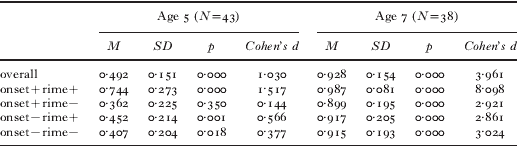
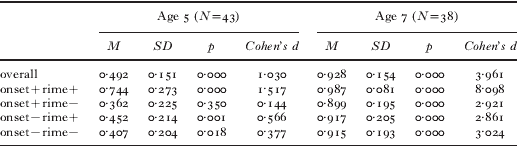
Table 1 shows the means in each condition and the chance-level comparisons. The seven-year-olds performed above chance in all four conditions (M=0·987 for onset+rime+, M=0·899 for onset+rime−, M=0·917 for onset−rime+, and M=0·915 for onset−rime−). One-sample t-tests with the test value at 0·33 indicated that the five-year-olds performed at chance level in onset+rime− (t(42)=0·945, p=0·35), and they performed significantly above chance level in the other three conditions: onset+rime+ (t(42)=9·95, p<0·001), onset−rime+ (t(42)=3·72, p=0·001), and onset−rime− (t(42)=2·47, p=0·018).
Descriptive statistics for accuracy rates in the lexical tone oddity task and one sample t-tests comparing against chance level (0·33)
A (2) age×(2) onset×(2) rime ANOVA showed a significant three-way interaction (F(1, 79)=11·23, p=0·001, ηp2=0·124). There were significant two-way interactions between onset and age, between rime and age, and between onset and rime (F(1, 79)=7·53, p<0·01, ηp2=0·087; F(1, 79)= 25·05, p<0·001, ηp2=0·241; and F(1, 79)=31·67, p<0·001, ηp2=0·286, respectively). The main effects for onset, rime and age were all significant (F(1, 79)=18·51, p<0·001, ηp2=0·190; F(1, 79)=58·97, p<0·001, ηp2=0·427; and F(1, 79)=163·00, p<0·001, ηp2=0·674, respectively).
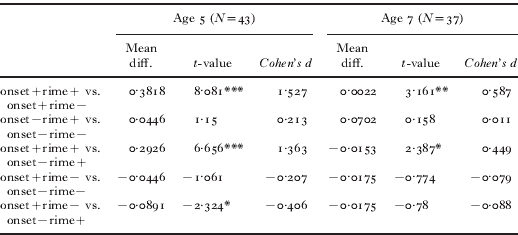
To explain the three-way interaction among age, onset and rime, we conducted planned pair-wise comparisons for each age group, and the results are shown in Table 2. For the five-year-olds, when rime was the same, accuracy was significantly higher when onset was the same than when onset was different (onset+rime+ vs. onset−rime+; t(43)=6·656, p<0·001); when rimes were different, there was no significant difference in performance whether onset was the same or not (onset+rime− vs. onset−rime−; t(43)=−1·061, p=0·295). Similarly, when onset was the same, children performed significantly better when rime was the same than when rime was different (onset+rime+ vs. onset+rime−; t(43)=8·081, p<0·001); when onset was different there was no significant difference in accuracy regardless of whether rime was the same or not (onset−rime+ vs. onset−rime+; t(43)=1·15, p=0·257). Note that although not significant, when onset was different, having the same rime increased accuracy by 4·46% whereas when rime was different, having the same onset decreased accuracy by 4·46%. More importantly, children performed significantly better in onset−rime+ than in onset+rime− (t(43)=−2·324, p=0·025), suggesting that having the same onset but different rimes across syllables makes oddity judgment more difficult than having the same rime but different onsets.
Planned pairwise t-tests comparing the individual conditions in the lexical tone oddity task
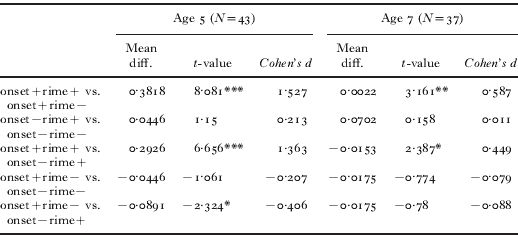
note:*** p<0·001, ** p<0·01, * p<0·05.
A similar pattern of results was observed in the seven-year-olds. When rime was the same, accuracy was significantly higher when onset was the same than when onset was different (t(37)=2·387, p=0·022); when rime was different, there was no significant difference in accuracy regardless of whether onset was the same or not (t(37)=−0·774, p=0·444). Likewise, when onset was the same, children's performance was significantly more accurate when rime was the same than when rime was different (t(37)=3·161, p=0·003); when onset was different, there was no significant difference in performance regardless of whether rime was the same or not (t(37)=0·158, p=0·444). Again, note that when onset was different, having the same rime increased accuracy by 2·19% whereas when rime was different, having the same onset lowered accuracy by 1·54%. The difference between onset+rime− and onset−rime+ was not significant for the seven-year-olds (t(37)=−0·78, p=0·44).
DISCUSSION
We examined children's lexical tone processing in relation to segmental features by manipulating onset and rime systematically across monosyllables in a lexical tone oddity task. The difference in performance across conditions reflects how children's processing of lexical tones is influenced by segmental information, suggesting that there is integrality between segment and suprasegment in tone processing. First, we found that having the same rime as well as the same onset across the syllables facilitated tone judgment for both groups of children, showing the best accuracy in the onset+rime+ condition. Surprisingly, the five-year-olds also performed above chance level in the onset−rime− condition. We speculate that having different onsets and rimes across syllables might be advantageous as children could ignore the segment entirely, and simply focus on the pitch contour to make tone judgments.
More importantly, we found that the five-year-old children performed significantly better in onset−rime+ than in onset+rime−. Furthermore, when onset was different, having the same rime increased accuracy whereas when rime was different, having the same onset decreased accuracy, and this trend is consistent for both age groups. These results together suggested that rime plays a more important role in facilitating lexical tone processing, that is, having the same rime is more helpful for perceiving distinction among tones than having the same onset. It is possible that the five-year-old children may not have a clear understanding of the concept of tone and this could partially explain their lower accuracy in onset+rime−. Yet, the above chance performance in onset−rime+ in the current study is consistent with the findings in Shu et al. (Reference Shu, Peng and Mc-Bride-Chang2008) and Ho and Bryant (Reference Ho and Bryant1997). Both groups of researchers found that five-year-olds performed above chance in a tone matching task when the target and candidate syllable shared the same rime but differed in onset (e.g. hu3: gu3 or ku4). All these results point to the strong rime facilitative effect. Note that neither of these two previous studies included an onset−rime− condition in their tone judgment task. Therefore, it remains unclear in their studies as to how children would perceive tone when segment was entirely different.
The vowel interference effect (Tong et al., Reference Tong, Francis and Gandour2008) may explain why rime is more important than onset in facilitating tone processing for young Chinese children. In the onset+rime− condition, vowels were different across the syllables. Therefore, children could not take advantage of the robustness of vowels in their working memory representation. Even though having the same onset might be beneficial in tone judgment, the magnitude of this facilitative effect is not large enough to overcome the vowel interference effect. In contrast, in the onset−rime+ condition, children could rely on the prominent and persistent cues of the vowels, and having the same rime could largely reduce the onset interference effect.
The rime interference effect was largely reduced in the seven-year-olds. This development of tone sensitivity could be a joint function of the growth of metalinguistic awareness and exposure to Pinyin. At age five, children may have some exposure to print in kindergarten but have not started learning to read systematically. The major source of language exposure is through spoken communication. In grade 1, seven-year-old children begin to learn Pinyin and characters. Since the tone diacritic is marked on top of the vowel in Pinyin, it is possible that children who could read Pinyin may associate tone more with the vowel than the onset. Indeed, we found that accuracy was the lowest in onset+rime− for the seven-year-olds. The tone diacritic in Pinyin also may facilitate children's awareness of the pitch contour of the tones. For example, the first tone is a flat tone, represented by − while the second tone is a rising tone, represented by ´. The overall better performance of the seven-year-olds may be partially attributed to their knowledge of Pinyin.
The development of lexical tone sensitivity may also be a result of the growth in general metalinguistic skills. The five-year-olds may have relatively poorer metalinguistic skills than the seven-year-olds; hence, they are more likely to be distracted by any perceived differences in the three stimuli choices rather than tuning into the tone difference. In Shu et al. (Reference Shu, Peng and Mc-Bride-Chang2008), children were presented with a target syllable and asked to select from two candidates that share the same onset, rime or tone as the target. The accuracy rates for onset, rime and tone detection were between 50–64% for children in kindergarten. In comparison, children in first grade scored above 70% accuracy in all three tasks. As a result of cognitive maturation, children have improved metalinguistic awareness to both segmental and suprasegmental information. It is also very likely that the development of tone sensitivity may in turn enhance children's awareness of the subsyllabic units.
CONCLUSION
The present study examined native Mandarin-speaking children's ability to process lexical tones independent of segmental variability in the spoken input. Vowels appear to exert greater influence on tone processing than consonants. The seven-year-old children outperformed their five-year-old counterparts across all conditions, suggesting that the growth of metalinguistic awareness as well as exposure to literacy may play a joint role in the development of tone processing skills.
APPENDIX A
Stimuli used in the lexical tone oddity task. Bold items indicate correct responses.
Practice Items

Condition 1. Same segment (onset+ rime+)
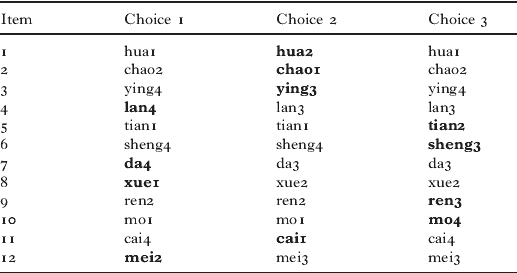
Condition 2. Same onset (onset+ rime−)

Condition 3. Same rime (onset−rime+)

Condition 4. Different segment (onset−rime−)

Appendix B
Consonant sounds included in the lexical tone oddity  task.

Appendix C
Vowel sounds included in the lexical tone oddity task.