


Introduction
When environmental effects of dominant conventional/chemical farming techniques are considered, many voices from fields of science, politics and society in general have been questioning, for some time, the medium to long-term sustainability of agriculture. Examples can be found in: Green Book of the European Commission in 19851; Brundtland Report2; Agenda 213; Rio Declaration4; Maastricht Treaty in 1992; Amsterdam Treaty in 1997; Cork Declaration5; ‘Mad Cow’ Report; ‘2000 Agenda’ CAP—Common Agricultural Policy—Reform (EU Reg 1251/99 to 1268/99); Mid-Term 2003 CAP Reform (EU Reg 1782/2003)6; among others.
In fact, conventional farming practices are causing environmental damage, which is sometimes difficult to quantify and might have irreversible consequences. Aggressive actions include the following. (1) Intensive soil management practices, related to losses of soil and therefore fertility. In southern Spanish olive groves, losses are estimated at around 80×103 kg ha−1yr−1, much higher than the average rate of soil formation7. (2) High energy consumption of primarily fossil fuels both directly, by farming activities, or indirectly by fertilizer industries. It has been estimated that fertilizer production consumes approximately 24% of the total energy requirement of Spanish agricultureReference Labrador and Guiberteau8. (3) Prevalence of single-crop farming that eliminates genetic variety of plants and increases the appearance of pests and diseases and the selective exhaustion of certain soil nutrients. (4) Massive use of chemical fertilizers that causes freshwater contamination in developed countries owing to the accumulation of nitrates in underground waters, and phosphates in surface waters. (5) Great use of phytosanitary products and chemical herbicides, which usually take a long time to break down. We know hardly anything about their effect on human health. When their levels build up in the soil and continental waters, they have devastating effects on soil microorganisms, which are the basis of soil fertility, and on higher organisms by eliminating the natural enemies of pest species. (6) Over-exploitation of underground waters, which together with excessive use of chemical substances, leads to salinization of water supplies. Moreover, the build-up of salt and heavy metals in the soil can deplete soil fertility and favor the advance of desertification. (7) Stubble burning, that leads to a significant elimination of soil organic matter, which gives rise to a substantial loss of fertility and, since it leaves the soil bare, leads to higher levels of erosion. (8) Intensive livestock raising methods using hormones, medicines and unnatural food for animals, that give rise to serious public health problems, such as mad cow disease.
Social awareness of these environmental problems, along with an increasing social demand on quality of food and sustainability of agriculture, among other factors, has given rise to the diffusion throughout 20th and 21st centuries of different alternative farming methods. Among these alternatives, two particularly stand out for their growing level of implementation in the European Union (EU) in general, and in Spain in particular: organic agriculture [Council Regulation (EEC) No 2092/91, in force in the EU with few minor modifications] and integrated farming systems (for which no specific regulation exists at EU level, but which is regulated within Spain by Real Decreto 1201/2002). Andalusia, located in the south of Spain, is the world's leading olive-growing region. In this zone, although the presence of these farming methods is still not very important (in 2000, 1.50% of the total olive area was organic and 1.07% was integrated), they have been increasingly put into practice over the past yearsReference Parra-López and Calatrava-Requena9.
In the diffusion process of these alternative farming systems, it is implicitly or explicitly assumed that they are more valuable from an environmental point of view than the conventional system and therefore their implementation is a desirable objective which will have a beneficial effect on social welfare in any socio-economic, environmental, etc., context and any cultivation. Although the number of partial studies, usually focusing on just one or few criteria, about the impact on the environment of conventional versus alternative farming techniques is increasing, little information is available from a multi-criteria and holistic perspective, especially for the case of olive cultivation in Andalusia. Thus, one of the main objectives of this paper is to provide a quantitative assessment and comparison of the relative environmental performances of the three farming systems—conventional, organic and integrated—from a multi-criteria perspective, in the average yield, climatic, environmental, etc., conditions of olive cultivation in Andalusia. The final aim of this comparison is to test the accuracy of the hypothesis stating that the two alternative farming methods are environmentally superior to the technology they hope to replace. Confirmation of this hypothesis would provide a scientific base to justify and endorse institutional support regarding the promotion and implementation of these farming systems in this region and cultivation.
Methodology: The Analytic Hierarchy Process (AHP)
In order to carry out this research, the AHPReference Saaty10–Reference Saaty12 has been implemented. This is a multi-criteria decision-making (MCDM) technique widely implemented in many scientific fields (see http://www.expertchoice.com). However, its application in environmental assessment of agricultural systems has not been found in the international literature, although it could be a very suitable and powerful tool for this purpose, as we will try to show. AHP has been used in the context of related topics such as evaluation of the sustainability of land use systems. In this field, it was applied beside Compromising Programming (CP) for a case study on an irrigation project in ThailandReference Tiwari, Loof and Paudyal13. Another study related to forest concessions, uses ranking, rating and pairwise comparisons, the latter being based on AHPReference Mendoza and Prabhu14. It has also been empirically implemented in environmental assessment and evaluation in other fields (http://www.expertchoice.com): in regional seas management; as part of a methodology for Environmental Impact Evaluations (EIEs) of big projects such as highways, classification and selection of projects in a de-pollution plan for ports; and to evaluate US environmental policies. AHP has also been integrated within a greater decision-making framework for forest planningReference Bernetti, Casini, Romano and Scotti15; it has been proposed for compiling an inventory and monitoring the management of Natural Parks in the USAReference Peterson, Silsbee and Schmoldt16; and it has been used to evaluate different mountain ecosystems, including socio-economic and environmental criteria in the analysisReference Pirazzoli and Castellini17. Moreover, it has been applied to compare the social value of the environment, agriculture and certain attributes of preserved land in Delaware (USA)Reference Duke and Aull-Hyde18. In Spain, AHP has been implemented to evaluate different protection figures of Natural AreasReference Hernández and Cardells19, and to assess natural ecosystems based on expert judgementsReference Reyna and Cardells20. Other Spanish studies have applied AHP to environmental selection and assessment mainly in basin managementReference Escobar and Jiménez21–Reference Moreno, Aguarón, Escobar and Turón23.
AHP can be placed within the MCDM framework. More specifically, AHP along with Multi-Attribute Utility Theory (MAUT) and Outranking Methods are the main discrete MCDM methodsReference Moreno, Aguarón and Escobar24, applicable when the nature of alternatives is non-continuous. Brunner and StarklReference Brunner and Starkl25 presented a critical survey and comparison of these and other decision tools. The choice of a particular method for environmental/economic decision-making must be guided by a trade-off between comprehensiveness and objectivityReference Tiwari, Loof and Paudyal13. AHP provides a good compromise between these two targets. In effect, the comprehensiveness of AHP is one of its major strengths. This is an analytical tool, supported by simple mathematics. It enables people to rank tangible and intangible factors explicitly for the purpose of resolving conflict or setting prioritiesReference Saaty11. A main aim of AHP is to be a simple way to help ordinary people make complex decisionsReference Forman and Selly26. Moreover, Expert Choice softwareReference Forman, Saaty, Selly and Waldron27 provides a user-friendly program, which facilitates its empirical implementation. On the other hand, AHP increases the transparency and objectivity of the decision-making process because when there are various involved agents, they must explicitly state their preferences, thus facilitating the detection of controversial items and increasing agreement in the process. Moreover, decision-makers are continually learning in the decision-making process proposed by AHP, it being possible and advantageous to feed-back subsequent information into the initial phases of the processReference Saaty12,Reference Forman and Selly26. As an extra added value, AHP enables the incorporation of qualitative, subjective and intangible information, in complex decision-making problems and situations with multiple criteria, stakeholders and decision-makers, high uncertainty (lack of information) and high risk (what is at stake). These properties are useful in environmental assessment and choice, as in the case of the holistic environmental evaluation of farming systems, and make AHP a potentially useful tool in this field. AHP suggests an analysis and synthesis process for decision-making that consists of a series of steps or phases. In the present research paper, we complement these steps with an extension to measure agreement and similarity of the decision-makers’ opinions, as shown in the next sections. The complete extended AHP process, explained below, is schematized in Figure 1.
Extended-AHP framework.

Analysis of the problem
The first step of AHP is to break the problem down into smaller parts, that is, its analysis, and to structure it by means of the construction of a decision hierarchy or model. First, it is necessary to define the main objective or goal. Usually the achievement of this main objective involves satisfying a set of more specific objectives and sub-objectives at lower levels of the model (Fig. 1, ‘Analysis of the problem’ section). In the literature, criteria and objectives are distinguished. A criterion is a rule to discern one thing from another. An objective is a criterion with an established improvement direction, e.g., a criterion in the selection of a car could be ‘petrol consumption’ and an objective of the decision-maker could be ‘low petrol consumption’. The alternatives will be ranked according to their respective performances with respect to the goal which depends on the satisfaction of the more specific objectives. It is very important to include just relevant and uncorrelated objectives. Moreover, according to the ‘axiom of independence of elements’ of AHPReference Forman and Selly26, the priorities or importance of the elements (objectives, sub-objectives and alternatives) in the upper levels must not be dependent on the lower level elements. If these conditions of non-correlation and independence cannot be guaranteed in a particular application, a more sophisticated elaboration of the AHP, the so-called Analytic Network Process (ANP)Reference Saaty28, which surpasses the object of this paper, could be implemented.
Assessment of nodes
The next step is to assess for each objective or, in general terms, each node of the hierarchy tree, the local priorities or weights (ωL) of the subnodes or alternatives that depend on it, in terms of importance, preference or likelihood (Fig. 1, ‘Assessment of nodes’ section). In AHP, the standardization of local priorities in each node is usually imposed, that is, 0⩽ωL(i)⩽1, and  , where ωL(i) is the local weight of an i sub-node or alternative with respect to its parent node, and n is the number of sub-nodes or alternatives depending on the parent node. AHP suggests the calculation of these priorities on the basis of ratios between them (ωL(i)/ωL(j)). These ratios are usually obtained for every node of the hierarchy from experts or decision-makers’ judgments about the relative importance, stated by simple pairwise comparisons, of the performances of the sub-nodes or alternatives depending on them. AHP enables the use of three different comparison scalesReference Saaty11: (1) numerical: e.g., sub-node i is 2.5 times more important than node j with respect to their parent node, that is, ωL(i)/ωL(j)=2.5; (2) graphical, on the basis of the length of two bars that represent the relative importance of the two sub-nodes or alternatives; or (3) verbal, in a scale ranging from equal (ωL(i)/ωL(j)=1) to extreme preference (ωL(i)/ωL(j)=9) of an element against the other. The ‘homogeneity axiom’ of AHPReference Forman and Selly26 states that the elements being compared should not differ too much, since errors in judgments tend to be larger. Based on these pairwise comparisons, a comparison matrix (Â) for each node can be constructed

 is a positive reciprocal matrix with some important properties: it is squared (n×n order, with n=number of sub-nodes or alternatives depending on the analyzed node), each element in the lower left triangle of the matrix is the inverse of its counterpart in the upper right triangle (that is, ai, j=1/aj, i, ∀i, j, i, j=1, 2, …, n, being ai, j=ωL(i)/ωL(j); this property is known as the ‘reciprocal axiom of AHPReference Forman and Selly26), and with elements in the diagonal equal to 1 (ai, j=1, ∀i). It can be demonstrated that local priorities of the components (ωL(i)) can be calculated by solving for the eigenvector of the system of equations

where ωL is the vector (ωL(1), ωL(2), … ωL(n))T and λ is the maximum eigenvalue. The consistency of decision-makers' judgments can also be calculated as the difference λ−n since always λ⩾n. An in depth explanation of the mathematical fundamentals of AHP can be found, e.g., in SaatyReference Saaty12.
Group decision-making
When decision-making involves the participation of different decision agents, in the literature about AHP the Aggregation of Individual Judgments (AIJ) method, among others, has been proposed to aggregate individual judgments into group judgmentsReference Ramanathan and Ganesh29,Reference Forman and Peniwati30. Once we have the individual comparison matrices of every decision agent in a particular node of the hierarchy (ÂInd_1, ÂInd_2, …, ÂInd_N; N being the number of individuals pertaining to the group), it is possible to calculate for this node an aggregated comparison matrix for the group (Âg) (Fig. 1, ‘Group decision-making’ section). There are different proposals of aggregation of the judgments functions although the most widespread one is the geometric mean because it satisfies some advisable properties such as unanimity, homogeneity and reciprocityReference Aczél and Saaty31. The elements of the group comparison matrix would be: , where (a i, j)Ind_n is the judgment of the individual n, which belongs to the group, about the relative importance of ωL(i) versus ωL(j). Once Âg is calculated for the node, it is possible to obtain the local priorities of sub-nodes or alternatives for the group, applying Equation (2).
In group decision-making, conflicts among judgments of individuals or groups of individuals often arise. In the AHP literature, the homogeneity of the group is usually assumed, that is, the non-variance of the judgments among decision-makersReference Saaty, Golden, Wasil and Harker32. However, some authors have questioned this assumptionReference Zahir33–Reference Yeh, Kreng and Lin38. Here, we propose some indexes and procedures to calculate the relative consensus among different groups of agents involved in the decision-making process and to measure the relative similarity of the performances of the alternatives or sub-objectives according to the mean opinion of all the groups. In short, these indexes are
1. Relative Global Agreement Index (RGA Index) among all groups of decision agents in a particular node: it is a measure of the deviation of the opinions of all the groups of decision agents with respect to the mean opinion. The greater the RGA Index in a node, the greater the consensus among opinions of all groups in the node would be. Mathematically, RGA has been defined as:
(3)where G is the number of decision groups, g is a particular decision group, ωL(i), g is the mean local priority of the sub-node or alternative ‘i’ with respect to its parent node for the ‘g’ group of agents, ωL(i), m is the mean local priority of the sub-node or alternative ‘i’ with respect to its parent node for the G groups of agents and n is the number of child sub-nodes or alternatives of the analyzed node.
2. Relative Similarity of Performance Index (RSP Index) in a node: it is a measure of the deviation of the mean opinion of all the groups of decision agents with respect to the theoretical homogeneous priorities, such as in the case that all the sub-nodes or alternatives weigh the same. It enables us to determine whether the performances are similar or not, according to the mean opinion of all the groups. The greater the RSP Index in a node, the more similar to each other the performances of the subnodes or alternatives in the node according to the mean opinion of all the decision groups. Mathematically, RSP is defined as
(4)where ωh(n)=1/n, ωh(n) being the hypothetical totally uniform priorities in the node, e.g., if the number of sub-nodes or alternatives depending on the node is 4 (n=4) then ωh(4) would be 1/4=0.250.
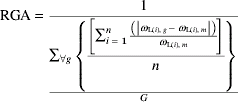
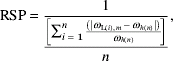
Values of both indexes are real positive numbers. However, we are more interested in the ranking of these indexes than in the values themselves. On the basis of the order of the indexes in all the nodes of a hierarchy, including aforesaid local priorities and final priorities which will be defined in the next section, it is possible to segment the relative degrees of agreement and similarity among the decision-agents' priorities in the complete hierarchy (Fig. 1, ‘Agreement and similarity calculation’ section). For example, RGA and RSP indexes can be clustered, respectively, in three sets with approximately the same number of nodes within: the first division would be nodes with the lower relative agreement (similarity) degree, the second with the medium relative agreement (similarity) degree and the third with the higher relative agreement (similarity) degree. It is very important to underline that the segmentations are exclusive and different for each AHP model and they are just used to cluster agreement and similarity in relative terms, to locate the more and less controversial elements in each particular AHP hierarchy. In accordance with the Procedural Rationality postulatesReference Moreno22, we are more interested in the improvement of the decision-making process in a particular problem by detecting the more controversial items in ‘relative’ terms than in the definition of some ‘absolute’ indexes which could be significant for some decision problems but not for others.
Synthesis of priorities
Once all nodes of the hierarchy have been assessed and, if it is the case, individual judgments have been properly aggregated, and the local priorities have been calculated, the alternatives must be prioritized, that is ranked, on the basis of their relative performances with respect to the goal or any intermediate node of the decision hierarchy. For this prioritization to take place, it is necessary to calculate the final priorities of the alternatives (ωF) with respect to the goal or any intermediate node (Fig. 1, ‘Synthesis of properties’ section). It is a question of calculating the weights of the alternatives with respect to the overall or the intermediate node on the basis of the local priorities of all the sub-objectives and alternatives depending on it, by weighted addition from the bottom to the upper level of the hierarchy (see, e.g., Forman and SellyReference Forman and Selly26). Once the final priorities in a node are obtained, it is possible to calculate the RGA and RSP Indexes for these final priorities in a similar way as for local priorities, by just substituting local priorities (ωL) by final priorities (ωF) in Equations (3) and (4). The RGA and RSP for final priorities in all the nodes of the model must be included in the definition of sets of agreement and similarity, as we suggested in the previous section.
The Case Study: Alternative Olive Systems in Andalusia, Spain
Andalusia is a region in the south of Spain placed between a latitude of 36° and 38° 44′ north and has a typical Mediterranean climate. Average annual temperatures range between 12 and 21°C, depending on the specific zone, with mild winters and very hot summers. The mean rainfall is 595 mm yr−1, although its spatial and temporal variability is very strong. According to the FAO Soil Classification (and equivalent US soil taxonomy system), around 33% of the Andalusian soil surface is Cambisol (Inceptisol), soil with incipient changes in color, structure, etc., due to meteorological factors. Twenty percent is Regosol (Ortherent, Psamment), soil with a thin effective depth, developed under unconsolidated material; it is typical of mountain regions. Thirteen percent is Luvisol (Alfisol), soil with a medium-high base saturation percentage in the argillaceous stratum; it is typical of basin terraces. The total surface area of this region is 8 759 700 ha, with 4 036 015 ha dedicated to agriculture, of which 1 503 276 ha are devoted to olive cultivation. Annual average olive yield is 3806 kg of olives ha−1, according to Junta de AndalucíaReference Junta39. The olive cultivation in Andalusia represents around 60% of the Spanish olive surface area and 80% of the Spanish olive production. The past few decades have witnessed fundamental changes in olive farmingReference Pastor, Caballero, Alvarado and Civantos40. The number of olive farmers has decreased, their average age has increased and the work is becoming more specialized. Production is sometimes excessive. Moreover, new pests appear and old pests are more numerous and have built up resistance to control methods. A drop in beneficial insect fauna has occurred. In addition, environmental pollution, including atmosphere, soil and surface and underground waters, has increased, leading to possible residual traces in the olives. Consequently, a field studyReference Parra-López and Calatrava-Requena41 has demonstrated the low rationality of the conventional practices actually implemented in the olives groves of the south of Spain.
In our application, the goal, or overall objective, is to determine which of the three analyzed alternatives (conventional, organic or integrated olive-growing systems), has a greater environmental value for society in the average yield, climatic, environmental, etc. conditions of Andalusia, and therefore is more desirable in the medium to long-term. This overall objective has been divided into different sub-objectives, which have been defined on the basis of different information and sources aiming to include the more relevant issues: (1) EU CAP and national regulations on agriculture; (2) experts' advise from a pre-test of the model to five interviewees; and (3) multiple references in the literature related to sustainable agriculture, environmentally friendly agricultural practices and responsible management of natural resources. The decision hierarchy is shown in Figure 2 and the meaning of the sub-objectives is in short:
1. Less soil erosion: erosion is a major agri-environmental problem in Spain. Increasing inputs of, for instance, fertilizers and seeds are used in an attempt to mitigate the negative effects of erosion on agronomic yield. Erosion is related with the advance of desertification and abandonment of agriculture.
2. Soil fertility: in addition to prevention of soil loss, it is also important that the agronomic quality of the soil is maximized. This quality depends on the structure of the soil and the low levels of pollution/contamination, among other factors.
3. Rational use of irrigation water: refers to the efficient use of irrigation water, which is related to the timing of irrigation, and quantity and quality of water to apply. Scarcity of water is an endemic problem of the region.
4. Less water contamination: we aim to assess the contamination levels of underground and surface waters caused by the application of inputs during farming (nitrates, manures, pesticides, etc.).
5. Less atmospheric pollution: refers to pollution associated with farming, including pollution caused by manufacturing of inputs.
6. Biodiversity: can be measured as the number and variety of different living beings present. It refers to the genetic diversity of olive trees, that is, the maintenance of native varieties, as well as wildlife, micro fauna, beneficial fauna, domestic animals and wild flora.
Proposed environmental AHP hierarchy.

In our model, better performance of the farming systems is related to an increase of soil fertility, rational use of irrigation water and biodiversity and to a reduction of soil erosion, water contamination and atmospheric pollution.
In order to assess the nodes of the hierarchy, experts' knowledge has been used because written information, in general, and ‘hard data’ (e.g., data from scientific instruments), in particular, about the environmental performances of the three analyzed olive systems in Andalusia are usually not available, are partial or are expensive to obtain, both in time and resources. Moreover, analyzed criteria here are of a complex and scientific nature. Experts, if carefully selected, have in mind information that can be characterized as quantitative and qualitative, tangible and intangible, objective and subjective. Methods such as AHP enable the capture and synthesise of this information. Moreover, information can be gathered that is targeted for the problem at hand, fitting the specific criteria defined by the decision-makers or researchers, and within a reasonable time frame. The validity of AHP is strongly founded in practice and results usually corroborate those obtained with other methods that are more time and resource consumingReference Forman and Selly26. AHP tests were conducted individually on a multi-disciplinary set of 20 experts in the three analyzed olive-growing systems, based on in-depth face-to-face interviews. Experts were prestigious scientists mainly from universities and Agricultural Research Centers of Andalusia. In any case, they were asked about the better environmental options for society as a whole in the medium to long-term and in the average conditions of the olive groves in Andalusia, and they were urged to avoid personal opinions.
The 20 interviewed experts were clustered into three groups or types—organic, integrated and conventional—according to their professional relationship closer to a particular growing technique. The objective was to test the hypothesis that opinions of experts are related to their professional field of interest, although they were urged towards objectivity, and to isolate this potential bias due to a subjective component of the judgments of the experts. The reason not to use individual judgments of each expert is that individuals are usually, single-discipline oriented, that is, specialized in some issues, and just respond to the nodes of the model to which they have reliable knowledge. Our main objective was to have judgments of at least three experts in all the nodes of the hierarchy for each type of expert, to improve reliability of results. Finally eight conventional, four organic and eight integrated olive farming experts were interviewed. Judgments of each group of decision agents (type of experts) have been aggregated using the geometric mean method. Moreover, the mean opinion of the three types of experts has been calculated using the geometric mean of the previously mentioned judgments of the three groups of experts.
Results
Relative importance of the sub-criteria
In Figure 3, local priority of each environmental sub-criterion according to the different types of experts and the mean of the three types is shown. On the other hand, Table 1 (columns under ‘Local priorities of nodes’) includes these local priorities but just for the mean of the three types of interviewees (column 1), the agreement among experts on each topic (columns 5 and 6) and the similarity degree of the mean priorities (columns 9 and 10).
Relative importance of the environmental sub-criteria according to the different groups of experts and the mean opinion of the three groups of experts. ConExp=Conventional experts; OrgExp=Organic experts; IntExp=Integrated experts; Mean=Mean of the three groups.

Priorities, agreement and similarity indicators.

1 According to the mean opinion of the three types of experts.
●●●= Higher; ●●=Medium; ●=Lower; n/a=Not applicable because there are no sub-nodes depending on this node.
Note: Sets of nodes according to (a) RGA indexes: (lower relative agreement degree: 4.59, 6.86, 8.26); (medium: 8.70, 8.70, 8.80); (higher: 10.53, 12.28). (b) RSP indexes: (lower relative similarity degree: 5.19, 5.61, 5.70); (medium: 5.78, 7.01, 7.54); (higher: 10.79, 10.91).
Priorities assigned by the organic experts usually fell in between those of the conventional and integrated ones (Figure 3). For instance, less soil erosion was the most important objective for the integrated group (ωL=0.287), whereas the conventional experts regarded it to be much less important (ωL=0.176), and the organic experts ranked its importance between these two levels (ωL=0.249). This pattern was also found for the sub-objective rational use of irrigation water, but reversed: the conventional group ranked it very highly, whereas it was not considered very important by the integrated experts, and the organic group placed its importance in the middle of the two former opinions. The most important sub-objectives for the conventional group were less water contamination and less soil erosion; for the integrated experts, less soil erosion and less water contamination; and finally for the organic experts, less soil erosion and biodiversity.
Moreover, the mean opinion of the three groups indicated that the environmental sub-objectives have not received very different weights in relative terms in comparison with all the nodes of the AHP model (medium relative similarity degree, RSP=5.78, as shown in Table 1, columns 9 and10). According to the mean opinion of the three groups, the importance of the environmental sub-objectives (Table 1, column 1) in decreasing order was: (1) less soil erosion, ωL=0.234; (2) less water contamination, ωL=0.179; (3) soil fertility, ωL=0.173; (4) biodiversity, ωL=0.162; (5) rational use of irrigation water, ωL=0.127; and (6) less atmospheric pollution, ωL=0.125. The major importance of erosion is in agreement with the statement of Spanish regulations on agri-environmental funding (e.g. ‘Real Decreto 4/2001’). The relative agreement degree about the relative importance of these sub-criteria among the three groups of experts is medium in relative terms (RGA=8.70, as shown in Table 1, columns 5 and 6).
Performances of the farming systems in the sub-criteria
Performances of the three farming alternatives in the different environmental sub-objectives, according to the mean of the three types of experts, as well as the agreement and similarity indicators for them, are shown in Table 1 (columns under ‘Final priorities of alternatives’: 2–4, 7, 8, 11 and 12). Moreover, for an easier interpretation of the results, Figure 4 has been drawn. As can be seen in this figure, for all the environmental sub-objectives, the conventional olive grove was rated with the poorest performance. On the contrary, the organic alternative represented the best option for all the issues except for less soil erosion, where it was outperformed by the integrated olive system. In the literature contradictory evidence has been found regarding the erosion issue. In one studyReference Pacini, Wossink, Giesen, Vazzana and Huirne42, organic farming performed even worse than conventional methods, whereas in other studiesReference Conacher and Conacher43,Reference Sánchez Sánchez44, the laterReference Sánchez Sánchez44 focusing on a marginal zone of olive in Andalusia, the organic alternative performs better with respect to this topic than the conventional one, thus supporting our findings.
Environmental performances of the three farming alternatives at the goal and sub-criteria according to the mean opinion of the three types of experts. Note: Local weights of the sub-criteria are represented by the vertical bars above the name of the sub-criteria, according to the left hand side scale. The final priorities of the alternatives with respect to every sub-objective are represented by the dashed lines at the top on the vertical of every sub-objective, according to the right hand side scale. The overall priorities of the alternatives are shown on the right, according to the right scale.

Previous data refer to the mean opinion of the three types of experts. If we descend to compare the assessments among groups of experts, it is possible to detect differences in relative agreement among them (Table 1, columns 7 and 8). Thus, the items with the lowest relative agreement degree are soil fertility (RGA Index=4.59), soil erosion (6.86) and water contamination (8.26).
Overall environmental performances of the farming systems
The environmental performances of the three olive-growing systems according to the mean of the three types of experts are shown in Table 1 (columns 2–4, row ‘Overall environmental performance’). From the mean opinion of the experts, we can conclude that the organic olive grove is globally superior (ωF=0.386), followed by the integrated system (ωF=0.352) and finally conventional olive farming (ωF=0.262). Thus, we can say that for average conditions of Andalusia, the values of environmental externalities associated with the organic and integrated olive-growing systems are, respectively, 47% [(0.386−0.262)/0.262] and 34% [(0.352−0.262)/0.262] higher than for the conventional system. These figures could be an approximation to the true environmental value of these olive-farming systems for society as a whole and could serve as a guide to estimate fair levels of compensation that society owes olive-farmers who cultivate these two alternative forms of farming, e.g., via environmental subsidies, in the context of CAP cross-compliance, and through market extra prices. It provides a scientific basis to the remark: ‘exponents of organic farming are arguing that support for organic farming should include maintenance rather than simply conversion payments and point to the wider benefits they believe this system provides in terms of biodiversity, …, and environmental management’Reference Rigby, Young and Burton45. Moreover, results show that, as for the overall performance of the three farming systems, there is a medium relative agreement degree among experts (RGA=8.80) (Table 1, columns 7 and 8, row ‘Overall environmental performance’).
Although the agreement degree was not low, the non-complete agreement indicated that the average opinion was not wholly accepted by all experts. Results suggest that judgments of the experts depend on which alternative they are more related to. In Figure 5, the overall relative performances of the farming systems according to each type of expert are shown. It can be observed that the organic experts valued the organic olive alternative very positively and much higher than the integrated and conventional options. The integrated group, on the other hand, ranked the integrated olive system highest, followed by the organic option and then the conventional system. The opinion expressed by the conventional experts was similar to that of the organic experts but more restrained. However, despite the differences in opinion, they all appear to consider conventional olive-growing techniques as the least appropriate option to achieve the environmental objectives set.
Overall environmental performances of the three farming systems according to the different groups of experts and the mean opinion of the three groups of experts. ConExp=Conventional experts; OrgExp=Organic experts; IntExp=Integrated experts; Mean=Mean of the three groups.

In the literature, much debate and contradictory empirical evidence exists when comparing some particular environmental consequences of organic and conventional farmingReference Hansen, Alrøe and Kristensen46,Reference Rigby, Woodhouse, Young and Burton47. However, a better overall environmental performance of the organic olive system over the conventional method is in keeping with the conclusions drawn by other studies, such as a Europe-wide studyReference Stolze, Piorr, Häring and Dabbert48, a UK studyReference Cobb, Feber, Hopkins, Stockdale, O'Riordan, Clements, Firbank, Goulding, Jarvis and Macdonald49 and research carried out on Tuscan farming systemsReference Pacini, Wossink, Giesen and Huirne50. Another studyReference Pacini, Wossink, Giesen, Vazzana and Huirne42 also demonstrated the better overall environmental performance of organic farming as opposed to integrated systems in Tuscany (Italy).
Sensitivity analysis
An important subsequent step in the assessment of the alternatives is to determine the reliability of the obtained results based on a sensitivity analysis involving an ex-post examination of the performance of the proposed AHP model. The purpose of this analysis is to determine how the variation of the experts' judgments (ωL(i)/ωL(j)) in all nodes of the model at the same time would affect the overall environmental performances of the three farming systems. The value of the judgments will be randomly simulated within an interval around the mean judgment expressed by the experts [(ωL(i)/ωL(j))mean of the three types of experts±percentage]. The literature on this subjectReference Moreno22 recommends a percentage of variation between 5 and 15% depending on the level of the node in the hierarchy: 15% in the upper levels and 5% at the level of the alternatives, since uncertainty of the answers of experts should be theoretically greater in the upper levels. However, in our study we propose to relate this percentage of variation in each node to the local relative agreement degree in the node, because it refers precisely to the degree of dispersion of the answers given by the three types of experts in this node. The lower the relative agreement degree is, the greater the amplitude of the variation intervals. Furthermore, we use larger interval amplitudes with the aim of obtaining results that are even more reliable. Specifically, the equivalence between relative agreement degrees and amplitude of the intervals of variation was established as follows: Higher, 10%; Medium, 20%; Lower, 30%. For example, in a node with the lower relative agreement degree at local level, a judgment with a value of two according to the mean of the three types of experts, would be varied by 30%, that is, between 2*(1−0.3) and 2*(1+0.3), that is, between 1.4 and 2.6.
Once the judgment intervals were fixed, judgment values were simulated at random within these intervals for all the nodes in the model, according to a homogeneous distribution in our case, although other functions are also proposed in the literature. This process was repeated 1000 times, and different final priorities of the farming alternatives were obtained each time. In order to carry out this sensitivity analysis, ‘Prior’ and ‘Estructura’ software packages were used, which were developed in the Department of Statistical and Quantitative Methods of the University of Saragossa (Spain). Table 2 shows the results of this analysis at the goal level, although it has been carried out in all the nodes of the model. This table contains two sections: (1) the upper section is a set of cross cells which counts the number of times an alternative is ranked in a specific position in the 1000 simulation process. These numbers can be interpreted as the probability of an alternative rank in a certain order; (2) the second section shows different patterns of the prioritization of the alternatives obtained in the simulation and their frequencies. These numbers can be interpreted as the probability that each pattern would actually occur. The sensitivity analysis confirms that the organic olive-growing system is perceived as environmentally more valuable than the integrated system, which is in turn better than the conventional method. This pattern ranking was the most probable, with a probability of 78.2%. However, this result can be qualified by saying that the integrated system has not got an inconsiderable probability of being considered the best from an overall environmental point of view. In fact, the integrated olive system could be the best option with a probability of 21.8%, according to our analysis.
Sensitivity analysis for the overall environmental performances.

ORG=Organic olive farming; INT=Integrated olive farming; CON=Conventional olive farming.
Ranking frequency: number of times an alternative is ranked in a specific position in the 1000 simulation process. Pattern frequency: frequencies of the obtained patterns of the prioritization of the alternatives.
We can say therefore that prioritization of the three growing methods at the overall level obtained directly via synthesis of priorities in a traditional way—direct prioritization—coincides with the prioritization obtained following the sensitivity analysis, considering the most likely pattern ranking. However, in other levels or criteria this might not occur. In this respect, both prioritizations have been compared in all nodes of the model. Table 3 shows a diagrammatic representation of this comparison, indicating whether the two arrangements do coincide or not. Prioritizations obtained were stable with the exception of the issues of soil fertility and the rational use of irrigation water, where it is unclear whether the organic olive-growing system or the integrated system achieves a better performance. This is in agreement with the literature on the subject which contains contradictory results regarding soil fertility in organic compared to conventional cropsReference Pacini, Wossink, Giesen, Vazzana and Huirne42,Reference Siegrist, Schaub, Pfiffner and Mäder51–Reference Hummel, Walgenbach, Hoyt and Kennedy53. For the other issues, it seems clear that the best alternative is either (1) organic farming, at the overall level, for less water contamination and less atmospheric pollution, in accordance with previous studiesReference Hansen, Alrøe and Kristensen46,Reference Stolze, Piorr, Häring and Dabbert48,54, and biodiversity, in agreement with othersReference Pacini, Wossink, Giesen, Vazzana and Huirne42,Reference Hansen, Alrøe and Kristensen46,Reference Pacini, Wossink, Giesen and Huirne50,Reference Stockdale, Lampkin, Hovi, Keatinge, Lennartsson, Macdonald, Padel, Tattersall, Wolfe and Watson55,Reference Freemark and Kirk56, or (2) an integrated system, for less soil erosion, in agreement with other workReference Pacini, Wossink, Giesen, Vazzana and Huirne42.
Direct and after sensitivity analysis prioritizations.

O=Organic olive farming; I=Integrated olive farming; C=Conventional olive farming.
✓/✗=Coincidence/not coincidence of direct and after sensitivity analysis prioritizations.
Conclusions
A multi-criteria comparison of the environmental performances of conventional, organic and integrated olive farming systems in the south of Spain (Andalusia) has been carried out based on experts' knowledge. For this purpose the AHP has been implemented. It has shown itself to be a powerful and flexible tool for environmental assessment from a multi-criteria and holistic point of view. The utilization of experts' knowledge may help in decision-making processes where conventional information is not available, is partial or is demanding for time and resources. The multi-criteria analysis carried out based on experts' knowledge has enabled a wide range of information concerning diverse topics to be obtained. This generated multi-criteria information is useful in a context where the decision-making cannot be delayed or where a global perspective is required, such as in political decision-making, i.e., in situations where a holistic and multi-disciplinary perspective is preferred over a very detailed but narrow vision of reality. Implementation of AHP on the basis of experts' knowledge enables an easy, intuitive and sound comparative assessment of the multifunctional environmental performances of agricultural systems. This problem can be characterized by lack of information, complex nature of the criteria, and very high importance of the evaluated items on social welfare.
With regard to the obtained results, it must be pointed out that they are, in general, in agreement with previous partial studies, when available, which use different methodologies of analysis and are usually carried out in other regions and cultivations. In our case study, an important result is that, as a mean, organic and integrated farming systems are better valued than conventional farming by experts, from an overall environmental point of view and in the average conditions of Andalusia, thus confirming our initial hypothesis. That is, both farming systems have a greater environmental value in the medium to long-term, being more sustainable in the sense that they damage the environment to a lesser degree compared to conventional agriculture. The better environmental performance of these alternative farming systems is probably related to the wider implementation, at least in the organic system, of more rational farming practices in the olive cultivation in AndalusiaReference Parra-López and Calatrava-Requena41. Quantification of the environmental performances of the three farming systems enables us to state that, in the average conditions of Andalusia, the environmental values of organic and integrated olive-growing systems are, respectively, 47 and 34% higher than that of the conventional system. These figures could approximate the fair levels of compensation that society owes to olive farmers who cultivate according to these two environmental friendly forms of agriculture. Probably, a cause of the low spread of these alternative practices could be that these levels of economic compensation are still not achieved and just the more ‘idealistic’, more environmentally concerned farmers are more inclined to adopt these methodsReference Parra-López, De Haro Giménez and Calatrava-Requena57.
Although prioritizations of the relative performances of the three farming systems are confirmed by the sensitivity analysis carried out, it is important to highlight that the environmental superiority of the two alternatives to conventional farming refers to the mean performances of these farming systems, whereas there could be a great variation in the environmental impact caused by individual farmersReference Rigby, Woodhouse, Young and Burton47. In any case, our results reflect the opinions of experts. Although experts were urged to express opinions in a way as objective as possible, an intrinsic subjective component may arise, the magnitude of which is difficult to quantify. In this sense, the proposed methodological extension of AHP along with the sensitivity analysis enabled us to detect effectively the more controversial items, and detect an ‘ideological’ subjective component in the opinions of experts. In effect, discrepancies among opinions and assessments of the three types of experts were detected in some topics, in agreement with our initial hypothesis: the organic and integrated interviewed experts showed a bias in their answers towards the alternative they are affiliated with. However, at the overall level, that is, with regard to the global environmental performances of the three farming systems, these discrepancies were not very high. Detection of the more controversial items in the model is of use to define new research areas where more in-depth knowledge is required, and subsequently to use this new knowledge to feed-back to the model with the new information and improve the decision process and the assessment of the three farming systems.
With respect to the analyzed sub-criteria the results are mixed. The organic olive farming system seems to be clearly superior over the integrated system, which is, in turn, better than the conventional method, with respect to biodiversity, less atmospheric pollution and less water contamination. The issues of erosion and soil fertility are more controversial, with the degree of relative agreement among experts being the lowest of all the topics. However, despite the polemic, integrated olive farming system seems to be a better alternative against erosion according to the sensitivity analysis. The rational use of irrigation water is also a controversial issue, being not possible to state a clear superiority of organic over integrated farming or vice versa. Finally, it is interesting to underline that for all the analyzed topics the conventional olive system received the lowest assessment from the experts.



