In the winter of 2013, Wang Junru won “China's Got Talent (CGT),” a reality television series on Dragon TV. Wang's specialty is single-hand balancing. For this intricate act, Wang gracefully places one hand then the other atop a cane. From there, she unfolds her body upward, then arcs slightly until her legs, toes pointed, form a beautiful V-shaped frame around her face. To accomplish such an act, the acrobat must develop incredible strength, flexibility, and physical control. In Chinese media, Wang was described as the “smiling girl” who could grin cheerfully at judges and audiences throughout her astounding performances. During a rehearsal before the CGT competition reached its final stage, Wang accidently injured her leg. Yet, she did not withdraw. “I want to smile upon the entire world. [I want] to show the world how strong the smiles of our Chinese people are,” said Wang in the grand finale. According to several media sources, Wang, at the age of nine, was recruited to perform on an international touring show where she honed her impressive performance style.Footnote 1 This show was one of the multimedia circus productions of the Cirque du Soleil (hereafter the Cirque), a Montreal-based entertainment company. Local news reports focused on Wang's exceptional gift but glossed over her complex migration stories. We know little about Wang's career trajectory from a Chinese acrobatic troupe to North America's circus tents, and finally back to China's most popular talent show. My research reveals that, in fact, Wang's North American work experience marks one of the latest episodes in the international recruitment of acrobats from the People's Republic of China (PRC). Her success must be understood as part of the evolving Chinese acrobatics that transformed from a popular entertainment to a socialist performing art, and finally to one of China's most profitable cultural exports to North America.
The incorporation of acrobatics from the PRC into North American entertainment began in the mid-1980s. Since then, Chinese acrobats have performed in diverse venues, including circus tents, theaters, arenas, theme parks, high-end nightclubs, and cabarets. Founded in 1984, the Cirque, currently the largest North American circus company, and one of the main employers of circus artists, started to hire Chinese acrobats around 1987. A news article in The Globe and Mail (2010) states that twenty percent of Cirque's 1,500 performers worldwide are Chinese.Footnote 2 Wang Junru worked as a child performer for the Cirque between 2004 and 2009.
Importing skilled workers from low-income countries has been a common practice in the agriculture and manufacturing sectors.Footnote 3 In recent decades, more elaborate guest worker programs continue to be created to strengthen service sectors, such as public health, domestic work, and the hospitality industry. Such recruitment practice and immigration policy correspond to the development of postindustrial economies in which the provision of health and social care, the growth of cultural industries, and the “mainstreaming” of certain adult entertainments have engendered new sites of transnational labor traffic and commodification.Footnote 4
Foreign entertainers are recruited under Canadian and US immigration laws. They are placed in the category of “high-skilled” guest workers, who are associated with certain policy exemptions. For example, Canada's Temporary Foreign Worker Program does not require employers to obtain work permits for non-Canadian artists in foreign touring productions.Footnote 5 Similarly, in the United States, the existing policy for guest cultural worker visas (P-1B) is especially flexible for recruiting non-US circus performers.Footnote 6 In other words, it is very easy for North American companies to hire foreign artists under short-term contracts. However, foreigners, especially those who work for international touring shows, have difficulty using the Canadian or US legal system to defend their labor rights. Other challenges, such as the language barrier and limited access to legal experts, can worsen the situation for foreign performers.
Furthermore, in the case of Chinese acrobats, the employment contract is traditionally signed between the Chinese government and North American companies. The majority of acrobats have not been able to directly negotiate their salaries with their North American employers.Footnote 7 I interviewed twenty-nine Chinese acrobats between the ages of twenty and sixty-eight. They participated in various overseas productions from the 1980s to 2010. All of my research participants received payment that was below minimum wage. But the violation of acrobats’ labor rights in North America was disguised through employment relationships with the Chinese troupes. Finally, difficult access to circuses’ highly transitory and mobile workplaces has created obstacles for researchers and activists in collecting evidence that would lead to an understanding of actual employment conditions. Thus, Chinese acrobats make up an important but overlooked chapter in the history of “temporary foreign” workers.
Recruiting entertainers from former socialist countries is a global phenomenon. My research suggests that China, Russia, Ukraine, and Mongolia supply the North American circus industry with skilled acrobats, contortionists, gymnasts, and other physical arts professionals. A better understanding of state-corporate interactions in these varied political contexts is relevant for artists wishing to navigate careers in this complex, often exploitative industry and for governments attempting to regulate transnational cultural productions. However, few researchers have examined policies and recruitment practices that enable the transnational flow of underpaid entertainers. As well, the ways in which performers make sense of exploitation and negotiate with state-corporate powers is little understood. This article aims to shed light on these issues by focusing on the changes in Chinese acrobats’ employment conditions from 1950 to the 2000s. In particular, I ask how the socialist workplace politics responded to the commercialization of acrobatics since the mid-1980s. Furthermore, drawing from the feminist methodologies, my approach uses acrobats’ personal stories to accentuate the links between the global and the personal.Footnote 8 In doing so, I highlight acrobats’ agency and the nuances of institutional power, regulating the value and mobility of the acrobatic bodies.
The empirical materials used in this paper are drawn from my fieldwork carried out since 2012 in China, Canada, and the United States. I have employed two main data collection strategies. First, I reviewed primary and secondary materials in several archives and libraries including the Shanghai Public Archive, the East Asian Collection at the University of Chicago, the New York City Performing Arts Archive, and the National Circus School Library in Montreal. Also, at the headquarters of the Cirque du Soleil, I reviewed seventy-five souvenir programs, through which I could record the names, numbers, and specialties of Chinese performers in Cirque's productions from 1987 to 2014. During my fieldwork, some research participants offered me access to their private collections, including photos, newspaper clippings, show programs, and newsletters published by regional acrobatics associations in China. Historical and policy literatures were used to contextualize interview data.
My second approach consisted of life history interviews with Chinese acrobats, including both retired, mid-career, and young performers. At the Cirque du Soleil, I found that, for example, in 2009, approximately eighty-five Chinese acrobats were performing simultaneously in eleven productions, including permanent and touring shows. Between 1987 and the 2000s, I estimate that various entertainment companies brought more than a thousand Chinese acrobats to North America. Since I began this research, I have established contact with more than thirty performers from six acrobatic troupes. Generally, I carried out one or two interviews with every research participant, each interview lasting approximately one and a half hours. The life stories of these acrobats reveal the patterns of the international recruitment process and also illuminate individuals’ aspirations and creativity in their engagements with state and corporate powers. I also interviewed six Canadian and US circus artistic and casting directors who collaborated with the Chinese troupes. This information helped me gain insights into the evolving relationships between Chinese institutions and North American companies.
In the following sections, I first explain my framework for analyzing acrobats’ work as a form of aesthetic labor—the making of acrobatic bodies under multiple political-economic regimes. Subsequently, I investigate why China has a large number of acrobatic troupes. Using archival materials and life stories of retired acrobats, I explain the formation in the 1950s and 1960s of state-run acrobatic troupes that facilitated the social reproduction of acrobats’ labor. I discuss the socialist politics of aesthetic labor by looking at the discourses of “class” and “body.” This analysis also examines the socialist ownership of acrobatic acts and how, in the 1970s, the ideology and practices of ownership influenced the export of acrobatics. Then, I examine the interactions during the 1980s between the Chinese acrobatics sector and the North American entertainment industries. With more than eighty state-run troupes across the country, China has the world's largest number of acrobats, a situation that attracts North American companies looking for recruitment opportunities.Footnote 9 I explain the specific logic and policies that enabled labor exportation and the ways in which state-corporate collaborations began to alter the meaning, value, and mobility of acrobats’ aesthetic labor in a rapidly transforming political-economic context. The last section, drawing upon the life stories of Wang Junru and several other young acrobats, reveals recent policy changes and their implications for new generations of acrobats amid varied neoliberal dynamics.
Aesthetic Labor of Chinese Acrobats from Socialism to Neoliberal Globalization
Feminist researchers have carried out studies in the modeling, film, and hospitality industries to demonstrate that the exchange value of “service” (including entertainment) derives from the affective consequences of employees’ emotional inputs as well as bodily performances. Likewise, acrobats perform so-called “emotional labor,” a sociological concept coined by Hochschild in her discussion of flight attendants’ service work.Footnote 10 Further, I argue that performing acrobatics involves a more complex process of “aesthetic labor,” as its value is generated not only through managing one's emotion and direct contact with an audience, but also through crafting one's physical self—an integrated long-term endeavor. The North American examples of aesthetic labor suggest that this form of work is particularly developed through recruitment, selection, and training practices.Footnote 11 To increase job prospects in a highly competitive labor market, models and actors might choose to adopt certain dietary or exercise regimes, undergo plastic surgery, and/or in other ways modify their personal appearances (e.g., hair, attire, and makeup).Footnote 12 As well, some occupations require individuals to cultivate less tangible traits, such as a pleasing voice, attitude, and networking skills beyond the workplace.Footnote 13
Acrobatic performances demand much aesthetic labor. The “staging value”Footnote 14 of circus shows largely derives from the “exceptional acrobatic bodies” that create unforgettable thrilling impressions on the audience. While an acrobatic act lasts only a few minutes, building a superb body for such an act requires many years of robust training and dietary discipline. Some acrobats take great risks in practicing gravity-defying (if not death-defying) acts that can cause severe physical injuries. Young performers, especially women, are often harassed about their weight during training. To keep their bodies light enough to carry out complex acrobatics, many eat very little. Onstage, acrobats are also required to display affective gestures, such as smiling and making eye contact with audiences. Especially in contemporary circuses, performers are increasingly required to combine physical abilities with dramatic/emotional expressions in order to communicate with audiences. Now, hoping to improve their performance skills, acrobats commonly take dance and/or acting lessons. My framework builds on the literature on aesthetic labor to examine the making of acrobatic bodies but moves beyond the literature in significant ways.
Most critics are mainly concerned with the human cost of commercialized “feelings” and how the service and cultural industries have intensified inequalities among people on the basis of gender, race, and other sociobiological features. By contrast, my research sets out to analyze the politics of aesthetic labor from two main angles. First, I analyze the political-cultural logic of producing and regulating aesthetic labor in a mixed socialist-capitalist setting from a historical perspective. Second, I look at the interaction between socialist organizations and capitalist companies and its effects on the value, mobility, and precariousness of acrobats’ work since the mid-1980s.
My framework assumes the following: first, acrobatics is both a cultural medium and a context-specific institutionFootnote 15 that regulates the supply and demand of acrobats’ labor; second, the acrobatic body is a means and an end of aesthetic labor. More specifically, I attend to the cultural discourses associated with acrobatic bodies, exploring how acrobats provided their aesthetic labor to accommodate three forms of politics in the making of socialist acrobatics for domestic or overseas audiences. First, the competition for status and prestige among acrobats gave rise to a labor hierarchy informed by socialist notions of “class” and “body.” I analyze how some acrobats used their aesthetic labor to attain social mobility within this labor hierarchy. Second, the state-run troupes claimed the ownership of “acrobatic acts,” whereas acrobats developed everyday coping techniques to resist government control over their work. Third, across the country, economic resources are unevenly distributed among large and small acrobatic troupes. Consequently, “acrobatic bodies” became troupes’ sought-after assets in competitions for overseas contracts. I argue that intensified commodification of aesthetic labor since the 1990s has taken the form of overseas contract work, challenged the socialist labor hierarchy, and finally opened space for acrobats to bargain with their troupes. Nonetheless, I conclude that acrobats lost employment security and experienced heightened senses of alienation and anxiety as a result of neoliberal cultural reforms.
Generating and Using Aesthetic Labor under Chinese Socialism
In presocialist China, there was no unified art discipline called “acrobatics” as we know it today. Skilled individuals made their living by showing various extraordinary body techniques at village festivals, market fairs, and birthday parties.Footnote 16 Some formed private troupes on the basis of kin relations. Classical writings about these performers suggest that the acrobatics trade was regarded as a lowbrow form of entertainment.Footnote 17 However, acrobats’ status in the hierarchy of Chinese culture drastically changed after the Chinese Communist Party (CCP) won the Civil War in 1949.
Overall, the new socialist government rejected commercial culture and systematically implemented policies to create a state-subsidized arts and culture sector. One of the most significant socialist cultural reforms was the formation of state-run performing arts organizations across the country.Footnote 18 Under this policy, acrobatics was established as a formal art discipline and institution. Between the 1950s and early 1960s, government administration units at different levels created approximately sixty-three acrobatic troupes of various sizes that facilitated the social reproduction of aesthetic labor.Footnote 19 Funded by different state agencies, such as municipal cultural bureaus, the Railway Bureau, or the People's Liberation Army, each troupe had its own production budget and plans, recruited and trained its own performers, and operated within specific geographical territories. This nationwide cultural policy also produced an organizational hierarchy that allocated more resources to troupes associated with central, provincial, or major municipal cultural bureaus.Footnote 20 Small county-level troupes had fewer than thirty employees, whereas large urban organizations could hire more than three hundred performers.
As a result of these institutional reforms, performers gained new professional identity and status as “socialist cultural workers,” a professional title associated with privileges as well as responsibilities. The state-run troupes provided their employees with regular wages, government housing, pensions, and free healthcare. As “cultural workers,” acrobats performed for government officials and also gave low-cost or free performances in villages, factories, army bases, and even at the front line during the Korean War.
The established repertories also underwent artistic innovations aimed to inspire and entertain a working class audience. The new acts emphasized graceful movements and eliminated acts such as fire-eating and sword-swallowing, perceived to be associated with cruelty and superstition. As well, the erotic/exotic elements were removed. Acrobats were dressed in martial arts costumes, athletic outfits, peasant clothing, and sometimes soldiers’ uniforms. These innovations were intended to convince audiences that acrobats were members of the working class and to encourage viewers to discover their own potentials, especially perseverance and valor, through hard labor.Footnote 21 From the 1950s to the mid-1960s, acrobats also played important roles in China's cultural missions to East and North Europe, Asia, and newly independent countries in Africa. As part of international exchange activities, acrobats used their agile bodies to communicate the ideas of “Chinese people” and “friendship.”Footnote 22 Thus, acrobats’ aesthetic labor was devoted to producing particular kinds of acrobatic bodies for displaying China's ideal citizen subject and national characters at home and abroad.
Early Cultural Exports to North America: The 1970s’ Cold War Diplomacy
The idea of using aesthetic labor for promoting socialist China was contested from time to time. In the mid-1960s, the radicals in power criticized performing arts as pleasing the privileged classes while poisoning the minds of the proletariat.Footnote 23 The entire arts and cultural sector was stagnant. Consequently, between 1966 and 1970, the acrobatics sector experienced serious setbacks. Along with many other artists and performers, acrobats worked on farms or in factories, and many troupes were disbanded.
The early 1970s saw a critical turn in the development of socialist acrobatics. China's admission to the United Nation in 1971 propelled the CCP leaders to revise their foreign policy, seeking to establish a wider support base in the international community. Subsequently, acrobatics was chosen by the central government as a cultural tool with which to build relationships with the West.Footnote 24 The new foreign policy allowed acrobatic troupes to resume their cultural production and to carry out diplomatic missions. Thus, throughout the 1970s, Chinese acrobatics was brought to the countries outside the orbit of the socialist world. These international tours usually lasted from a few weeks to several months; tickets were sold at noncommercial rates.
The first North American tour was part of Shenyang Acrobatic Troupe's cultural mission in 1972. Chinese acrobatic shows received rave reviews from the US and Canadian audiences. The box office success even attracted the attention of major corporations, such as Norton Simon Inc., who sponsored a video recording of the acrobatic show. In April of 1973, the American Broadcasting Company televised this documentary, along with Norton Simon's various advertisements.Footnote 25 The major US and Canadian circus companies quickly realized that socialist China had a large number of skilled acrobats and boasted many attractive numbers that could be incorporated into their own productions. Thus, China's Cold War cultural diplomacy actually helped introduce socialist acrobatics to Western audiences and, in the 1980s, laid the foundation for the export of acrobats.
Hierarchy of Aesthetic Labor and Ownership of Acrobatic Acts
The extent to which the export of acrobats drew on the existing institutional arrangements must be analyzed in the everyday context of the socialist cultural organizations. This section focuses on issues of the labor hierarchy, employment relations, and the ideology of ownership in this particular mode of cultural production. State-run acrobatic troupes, unlike North American circus companies, broke down the usual kin-based structure. Nonetheless, acrobatic troupes stabilized the social reproduction of aesthetic labor and helped the acrobat community thrive by offering lifelong employment security. From childhood to retirement, an acrobat could spend his/her entire life career within a troupe, where he/she could shift positions from performer to coach, stage worker, or party official. Meanwhile, state-run troupes operated with a particular logic regarding status and power. These political dynamics were expressed in three major forms: (1) the ranks among acrobats, (2) the tensions between acrobats and troupe officials, and (3) the institutional inequalities among troupes. These varied relations affected how troupes and individuals participated in the export of acrobatics.
Next, my analysis examines the life story of Jiang Zhenping, an acrobat who joined the Shanghai Acrobatic Troupe in 1960 when he was twelve. In the 1970s, Jiang participated in several cultural missions to Western Europe and Japan. His first North American trip was in 1980. Then, in the spring and summer of 1987, he performed for the Ringling Bros. and Barnum & Bailey Circus. Jiang's site-specific personal narratives can expose policy practices and the politics of place, bound to the mechanism of socialist cultural production in a transnational context. At the level of personal struggle and growth, my analysis stresses acrobats’ agency in the face of an authoritarian government and North American entertainment companies. Further, I use my observations from the research fieldwork to highlight certain critical aspects of Jiang's life-career trajectory under two consecutive political-economic phases: (1) socialism under Mao Zedong (1949–1978), and (2) the economic reform guided by Deng Xiaoping's leadership (1978–1992).
Founded in 1951, the Shanghai Acrobatic Troupe, consisting of more than 250 employees, is today one of the largest troupes in China. Before a local circus school was established in 1989, the troupe ran a program to recruit young trainees between the ages of nine and twelve. After completing a six-year curriculum, these young acrobats would become the troupe's permanent performers. Jiang Zhenping's family wished him to join a Peking opera troupe, but he liked acrobatics and insisted on pursuing this career. He remembered that during the admission interview, the coaches closely examined candidates’ body flexibility, reflexes, and coordination.
The troupe provided students with food, accommodations, and basic clothing. Jiang and his cohorts—thirteen boys and thirteen girls—lived together in a dormitory attached to the training rooms. Through daily practice from dawn to dusk, young trainees built acrobatic bodies for performance. The daily schedule started at six o'clock in the morning. Students first, for two hours, practiced handstands. Then, after a half hour for breakfast, they spent two hours training to strengthen their legs. The afternoon session focused on somersault techniques. In the 1960s, the curriculum also included folk and modern dance classes. Two hours of literature lessons were scheduled either in the afternoons or evenings. Students had Sundays off to visit their families. The goal of the first three years of training was to help trainees build so-called “four foundational skills”: waist (yao), legs (tui), handstand (ding), and vaulting (gentou). In the fourth year, trainees were divided into groups to learn specific acts, like hand balancing or plate spinning.
The production of acrobatic shows would involve various types of work to transform acrobatic bodies into elaborate acts. Coaches designed and created basic forms for each act. Artistic directors added choreography and music to link bodily movements together. Special staffs made costumes and props. Troupe officials had the final say on the readiness of each act for performance. Young acrobats provided their aesthetic labor but had little voice in the creation process. Jiang and others told me that not until they became established performers and coaches could they more actively participate in creating acts. Despite small variations, state-run acrobatic troupes across the country used similar training and production styles. Jiang belonged to a generation of acrobats that strongly identified with their troupes and linked their bodies with China's nationalist agenda. During our conversations, he associated the opportunity to perform overseas with personal pride as well as the understanding that he was helping promote a new China. However, such opportunities were distributed unevenly among acrobats. Jiang described himself as a hardworking performer with a troubled family background. He said:
Among my cohorts, I have the worst class background. My father owned a print workshop [in presocialist Shanghai]. He was a capitalist (chi: zi ben jia). In those days [of socialist radicalism], a person's class background was very important. Our director told me he supported my admission to the troupe. [During the admission interview,] he had good eyes, and he thought I could bring glory to our troupe.
In their day-to-day life, acrobats experienced some tension between socialist notions of “class” and “body”; this tension influenced performers’ positions in the hierarchy of aesthetic labor. Born since Liberation, Jiang himself had never lived in a wealthy household. Mostly, a “class” label was imposed on individuals to indicate their socioeconomic standings under the “old” regime. In practice, such class designations were also inheritable.Footnote 26 Young people like Jiang, identified by their fathers’ pre-Liberation class status, were subject to political discrimination. However, as Jiang revealed, the state representatives also valued his body's ability, its potential to serve the country. This attitude reflected the Maoist notion of body as an instrument of overcoming material as well as social barriers.Footnote 27 Thus, the extent to which Jiang could successfully use his body to demonstrate productivity as well as affection toward the socialist nation was critical to his survival.
In the late 1960s, the Shanghai Acrobatic Troupe, engulfed by sectarian politics, was finally closed down. When the government in early 1971 demanded that acrobats partake in diplomatic activities, Jiang and his colleagues were urged to return to work. Jiang explained: “With a ‘bad’ class background, during the Cultural Revolution, I could have been sent down to remote mountainous or rural areas. All of my brothers and sisters were sent away [by the government.] Because I learned acrobatics, I could stay in Shanghai.” A “bad” class label affected not only a person's social position but also his or her economic-geographical location. For Jiang, acrobatics offered the opportunity to demonstrate that his current behaviors—aesthetic labor—could help him transcend the inherited “bad class” position by producing an acrobatic body for the new China.
Excelling in hand balancing, Jiang performed for US diplomats during Richard Nixon's visit in 1970. Three years later, he participated in Shanghai's first diplomatic mission to West Europe. In 1985, Jiang won for his troupe the first international prize at the circus festival in Paris. He proudly told me he was one of the first two acrobats in Shanghai to receive the title of “first-rank performer.” As a young man, Jiang successfully used his aesthetic labor to link his body to socialist patriotism. “Liberated” by his work from the patriarchal family, he embraced the paternalistic care of the state-run troupe.
While Jiang Zhenping's story has a happy ending, many other artists, as a result of political assessment, were marginalized. Scrutiny of an artist's dossier determined whether or not he/she was allowed to leave China. Sometimes, upper-level officials or troupe leaders would cancel a well-rehearsed act simply because some performers’ family backgrounds were “questionable.” Jiang's coperformer, Zhu Xingbao, told me a similar story. She admitted, “Only when I was boarded on the airplane, I was certain that I was going abroad.” Thus, the socialist cultural institution engendered a hierarchy of aesthetic labor in which an individual's physical technique and class background were key differentiating factors. While patriarchal family relations solidified class position, the acrobatic body could be a tool for upward social mobility. However, the personal cost of producing an exceptional body was high. Jiang said, “If you do not have injury, then you don't learn [body] techniques. If you want to perform, then you would likely get injured.”
Socialist notions of “class” and “body” also implied a specific employment relationship between acrobats and the state. On the one hand, young acrobats were the providers of aesthetic labor that created acrobatic bodies. On the other, officials or troupe leaders, who embodied state power, were both the “owners” of acrobatic acts, and/or “caregivers” of acrobatic bodies. This socialist ideology of ownership was expressed through the government control over acrobats’ mobility. Within the troupe, acrobats completed their schooling, learned professional skills, and continued to live and work until retirement. They had little resource to look for jobs elsewhere. As well, young acrobats’ daily lives in the troupe made them dependent on the government. As several retirees acknowledged, the main attraction of acrobatics was that the troupe took care of almost every material aspect of performers’ lives, when China still used food and clothes rationing to deal with extreme shortages.
Jiang emphasized that in the 1970s, nobody ever left the troupe and defected to a Western country. He believed, people's minds were very “ge ming,” which could mean “radical” or “patriotic.” Acrobats, who were allowed to go overseas, had to have successfully passed their political assessments. These individuals, like Jiang, readily accepted the state's paternalistic control over their physical selves, thus demonstrating their loyalty to the troupe and the nation. Nonetheless, in the early 1980s, going abroad was no longer a political reward for the selected few. The increased demand for skilled acrobats from foreign companies brought employment opportunities to everyone.
Early Attempts to Commercialize Acrobats’ Labor, 1980s–1990s
The socialist cultural production began to change in the late 1970s, along with the relaxation of China's trade and economic policies. Entertainment venues first appeared in Guangzhou where investors from Hong Kong and Taiwan were allowed to live and trade goods. These business activities fostered the growth of hotels, coffee shops, bars, restaurants, and nightclubs. Gradually, some business owners started recruiting performers to enhance their venues’ appeal and profits.Footnote 28 Meanwhile, the arrival of overseas performing arts companies inspired local troupes to experiment with profit-oriented production. The most popular foreign figure remembered by my interviewees was the US magician Mark Wilson, who in 1980 staged his magic shows in major Chinese cities and towns. Because magicians and acrobats worked together within the same institution in China, Mark Wilson's commercial success—despite the fact that he worked independently—inspired local acrobatic troupes to instigate their own economic and cultural reforms.
Zhou Liangtie, a magician and former acrobat from the Shanghai Acrobatic Troupe explained:
Mark's show started like a fierce fire on a pile of dry wood. After my colleagues and I saw Mark's magic, we thought “Wow. Now we were allowed [by the government] to put on a show with disco music and young women dressed in mini skirts in front of the audience.”
Zhou's use of the term “a pile of dry wood” reveals several challenges that the Chinese troupes confronted amid the relaxed performing arts sector. First, officials and artists contested the old methods of “eating from a big rice pot.” Previously, the troupes’ revenue came from state subsidies; performers received salaries according to their seniority and rank. The emergence of commercial venues offered additional employment opportunities for artists from state-run troupes. As a result, the tensions between performers and troupe leaders started to grow.
Second, under the post-Mao leadership, glorifying peasants, workers, and soldiers was no longer a government priority. In a relaxed political-cultural atmosphere, the audience demand for alternative entertainment was on the rise. Zhou recalled that people were tired of watching revolutionary operas and films; they wanted to see shows that featured attractive costumes and fun music. Meanwhile, performers, who had discontinued their careers due to “bad class background,” could return to the stage. This group of artists was eager to restore the repertoires previously considered “bourgeois.”
Third, the import of foreign performances clearly signaled that state censorship on cultural production was loosening and commercial performance was acceptable.Footnote 29 Wilson's troupe inspired many Chinese artist-officials and acrobats to create new shows that could gain them some economic and administrative independence from upper-level government units. For instance, within the Shanghai Acrobatic Troupe, acrobats, musicians, and supporting staffs were reorganized into three groups. One group toured China while the other two pursued contracts overseas, mostly with the United States and Japan. Thus, in the 1980s and 1990s commercial acrobatic shows started to be the troupes’ main source of income.Footnote 30
The Shanghai Acrobatic Troupe's first overseas contract was jointly signed by the China Performing Arts Agency (CPAA) (incorporated in 2004, the agency was renamed China Arts and Entertainment Group) and the Columbia Artists Management Inc. (CAMI). As a result, the Shanghai team, consisting of sixty members, launched fifty-four acrobatic shows in New York City, Washington D.C., Philadelphia, and Chicago between March 18 and May 20, 1980.Footnote 31 Thus began China's profit-oriented export of acrobatics to North America, West Europe, and Japan.Footnote 32
Jiang Zhenping participated in the 1980 US tour. The troupe gave performers a monthly bonus of thirty US dollars above their regular salaries for their overseas work. Before leaving China, Jiang and his coperformers also received a stipend to purchase new outfits for the trip, including suits, jackets, pants, shoes, and even socks from a special state-run clothing store. In the United States, the Chinese cadres were in charge of show production. Jiang commented that this so-called commercial tour was actually not profitable because the contract was meant mainly as an aid in establishing diplomatic relations between Beijing and the White House. The troupe's political mission was prioritized above its economic objective. What is significant here is the formulation of a cultural export policy, since contracts did not exist previously. In the following decades, this contract model was widely applied to the export of acrobatics to North America.
The unique component of this contract model is the CPAA whose original function was representing the Chinese central government and handling diplomatic cultural exchange activities.Footnote 33 When the nonprofit cultural exchange endeavors turned profitable, the CPAA started to play a key role in representing Chinese troupes to different foreign companies. The assumption was that state-run acrobatic troupes were not commercial enterprises; therefore, they did not have authority to sign business contracts with foreign agencies. Thus, across the country, all troupes, when they received requests from foreigners, had to work with the CPAA. Under this arrangement, a significant percentage of the profits from the contract would go to both the troupe and the CPAA.Footnote 34 Individuals were not allowed to receive salaries from foreign employers. This three-party arrangement was first used to contract an entire troupe, including the CPAA representatives, who usually worked as English translators. Then, around 1986, some US and Canadian entertainment companies proposed to “borrow” individual acrobats, who would become integrated into their extensive circus tours. Similarly, the foreign companies had to discuss the deal with the CPAA in terms of length of an acrobat's stay, accommodation, food stipend, and welfare in addition to fees for the Chinese agency and for the troupe. Most performers never saw their contracts. Only one of my research participants had the opportunity to see the actual document, and that occurred when he was working as tour leader. Usually, acrobats, along with a CPAA translator, worked overseas for a few months up to two years. Jiang Zhenping was selected several times to perform in North America. His most memorable experience was working at the Ringling Bros. and Barnum & Bailey Circus. Jiang explained, “This was the first time [we] performed with a foreign circus company. In China, this was the first [international coproduction]. I was honored [to be a member of] this first team.”
Performing “Chinese-ness” at the Ringling Circus
Funded in 1919, the Ringling Bros. and Barnum & Bailey Circus (hereafter Ringling) claims to offer US audiences “The Greatest Show on Earth” and boasts about bringing the finest, most startling world attractions to America. When Beijing allowed foreign companies to hire acrobats, Ringling quickly became one of the major employers of Chinese performers. Ringling sent representatives to international circus festivals or approached large state-run troupes directly to find potentially profitable numbers.
During the 1985 to 1986 period, Ringling's executive and talent scouts spent several days with the Shanghai Acrobatic Troupe, finally choosing six acts: hoop diving, women's contortion, men's contortion, pagoda of bowls, foot juggling, and lion dance. Jiang and his colleagues were recruited especially for a Chinese-themed touring show. Kenneth Feld, Ringling's owner, explained:
America is truly the melting pot of so many ethnic and cultural flavors; in this season's show, we pay our fondest respects to that dynamic diversity, introducing artists and attractions who literally come from everywhere and who personify the international spirit of friendship, of brotherhood, that the whole world needs so desperately to understand and to encourage. … When at long last contracts were signed to bring the Shanghai Acrobatic Troupe to America, I began collaborating closely with our designers and technicians to create a lavish and unusual Chinese-themed spectacle, a huge and beautiful production in the classic Ringling Bros. and Barnum & Bailey Circus spirit of splendor. We call it ‘An Oriental Odyssey’ …the costumes are likewise exceptionally beautiful creations, painstakingly hand-painted and hand-embroidered to reflect the mystery and magic of the Orient.”Footnote 35
From Ringling's perspective, Chinese acrobatic bodies were symbols of the “oriental other,” contributing to a hegemonic cultural space through which North American audiences could cultivate a cosmopolitan identity and invest their emotional energies into forging relationships with Asian peoples. Instead of promoting a “modern China,” the acrobatic/circus bodies at Ringling were used to celebrate the United States as the land of liberty and democracy. Through cultural export, the meanings of acrobatics shifted in this new context, and consequently, affected Chinese acrobats, especially in the ways they grasped the new value and meanings of aesthetic labor.
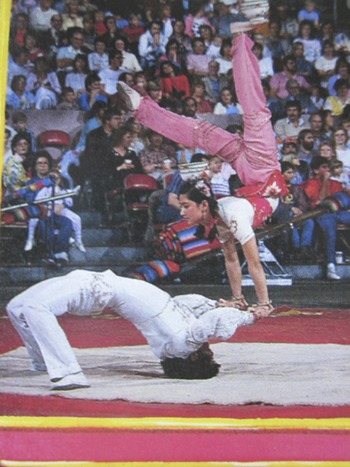
Jiang performed his award-wining pagoda of bowls, an acrobatic pas de deux. He used his body and arms to support a woman contortionist who manipulated stacks of porcelain bowls with her feet and head (see Figure 1). Surrounded by hundreds of US performers in exotic costumes and an assortment of oriental-style floats, wagons, and lanterns, Jiang stood out in subtly embroidered white silk outfits created in Shanghai. He found Americans’ ideas about Chinese culture absurd. He explained, “The foreign performers were wearing Qing Dynasty fashions! The Eight-Nation Coalition Forces saw the Qing people … They [the Americans] thought the Qing costume was Chinese traditional fashion. They [the American performers in Oriental costumes] even wore pigtails.”
Printed with permission. Jiang Zhenping and Li Yueyun performing Pagoda of Bowls at Ringling, 1987 (Ringling Bros. Barnum & Bailey Circus Souvenir Program & Magazine, 116th ed., 1987). Courtesy of Feld Entertainment, Inc. All rights reserved.

Jiang associated the term “Eight-Nation Coalition Forces” with the uses of pigtails in Ringling's production. In Chinese historical narratives, the Eight-Nation Coalition Forces refer to a combined military force of eight countries, including the United States, that invaded Beijing to suppress an antiforeign imperialism and anti-Christian movement—the so-called Boxer Uprising of 1900. For most Chinese, this event and the pigtail evoked national humiliation and was the antithesis of the new China that Jiang and his troupe had previously promoted abroad.
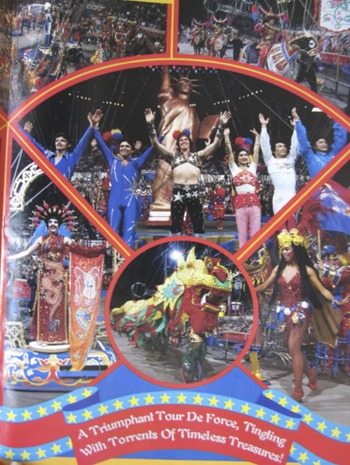
In the program book, the men with pigtails, in fact, were imitations of Fu Manchu, the most infamous oriental arch villain in North American popular culture. This image reflects racist sentiments against Chinese and Japanese coolies who built railways and settled in early twentieth century North America.Footnote 36 Although it is unclear whether Jiang knew about the cultural significance of the Fu Manchu image, he clearly articulated his frustration with the ignorant, racist culture he was encountering. Backstage, Jiang recalled, “We did some martial arts movements. Foreigners were very scared. They thought we were [like] Bruce Lee. When we walked by, [they would cry out:] Look, Chinese kungfu. Bruce Lee is coming.’ They think I know martial arts.” Jiang felt as though he was becoming part of Americans’ orientalist fantasy. (See Figure 2.)
Printed with permission. Jiang Zhenping and US performers at Ringling, 1987 (Ringling Bros. Barnum & Bailey Circus Souvenir Program & Magazine, 116th ed., 1987). Courtesy of Feld Entertainment, Inc., all rights reserved.

Since the Chinese acrobatic bodies were acquiring new cultural significance at Ringling, the economic value of acrobats’ labor had also to be renegotiated under a new production regime. Jiang and his colleagues had demanding performance schedules. They worked about ten hours a day, six days a week. On weekdays, they performed one show daily, but on weekends they performed three shows daily.
Along with other performers, Jiang slept in one of the Ringling train wagons. It took him several weeks to become accustomed to sleep in a noisy moving vehicle. To recuperate from their fatigue during this period, he and his Chinese coworkers napped on beach chairs during meal breaks. Unlike other performers at Ringling, Chinese acrobats were subject to their government contract. Despite their increased workload, they received from the CPAA a daily “food stipend” of only thirteen US dollars. Jiang explained to me how he and his coworkers responded to this policy:
At first, [the leaders told us] we had to spend all thirteen dollars on food. We could not save [money] and bring anything back to Shanghai. If you did not spend this money, aren't you stupid and you would waste it. So, from our Chinese tour leader to regular performers, we all agreed “let's eat.” We ate like crazy. We ate every dish in the local Chinese restaurants. We ate lobsters and seafood everyday. We bought different kinds of alcohol and a lot of fruits. We collected all the receipts to get reimbursement from the CPAA.
Under the North American big top, Chinese acrobats became keenly aware of the different price tags attached to their acrobatic acts. Jiang told me that Ringling paid his troupe and the CPAA a weekly fee for each act. Some acts were pricier than others. His act was worth $800 per week as it was an award winner. Since the Chinese performers could not directly profit from their overseas employment, they used “food consumption” as their daily strategy in response to labor exploitation. Later, every acrobat ignored the government rule and saved their food money to buy goods to bring back to China.
According to a survey conducted by the Chinese Acrobatic Association, twenty different troupes throughout the 1980s and 1990s offered acrobatic shows in Canada and the United States.Footnote 37 The official statistics indicate that the level of popularity of Chinese acrobatic shows had increased significantly from 1980 to 1990 in both countries. Within a decade, the total audience attendance reached 15.5 million. From 1985 to 1989, more than 140 acrobatic shows were performed annually; each show could sell more than 2000 seats.Footnote 38
These overseas commercial tours generated tremendous profits for the Chinese government and the troupes. For example, the Shanghai Acrobatic Troupe, with little financial support from the government, could renovate their training studio and theater. In 1987, income derived from overseas performances also enabled Shanghai to fund China's first circus school.Footnote 39 Even though personal economic gain was comparatively small, individual acrobats were still able to enrich their lives during an era when the standard of living in China was low. Jiang Zhenping and his colleagues admitted that acrobats were among the first few in Shanghai with money enough to buy imported appliances, such as color television sets, refrigerators, and cassette players. In addition, a large part of the revenues was reinvested in the troupe's infrastructure and facilities, which benefited all members.Footnote 40
The increased movement of Chinese acrobats to North America affected the hierarchy within the troupes as well as relationships among troupes. First, conflicts between performers and troupe officials intensified, as some individuals took advantage of their political positions to enrich themselves. My interviewees recalled incidents of bribery and economic corruption, in particular the ways in which some leaders profited from unreported cash transactions. Also, since the late 1980s, many acrobats “ran away” from their troupes. Some defected while performing in Canada or the United States. Others simply quit “cradle-to-grave” jobs to start their own businesses. A former member of the Shanghai Acrobatic Troupe who currently lives in Canada told me that marginalized acrobats and those dissatisfied with the leadership likely fled from their troupes. In response, the Chinese agency and troupes made agreements with large circus companies to restrict the hiring of “run-away” Chinese acrobats.
Second, according to Jiang, Shanghai initially signed a five-year contract with Ringling, but eventually gave the deal to troupes in neighboring provinces, particularly Jiangxi and Anhui. With fame, the Shanghai troupe could choose offers that benefited them most economically. By contrast, the smaller or less-known troupes relied on cultivating connections with large troupes as well as with the CPAA to obtain overseas contracts. Since the mid-1990s, in light of a gradual reduction of state subsidies, competition among troupes has increased. Even though the CPAA, as a government monopoly, determined overall wages and performance fees, variations occurred in the contracts passed on to different organizations. The peripheral organizations most likely accepted lower-paid contracts. In such a competitive atmosphere, troupes also began to wrangle over skilled acrobats who could attract foreign recruiters. This trend developed in parallel to the abolition of permanent jobs in the acrobatic sector.
The Millennium Generation: Contract Acrobats under the Neoliberal Cultural Reform
“[I was] nine, when I entered [the Cirque du Soleil]. I was very little and did not really understand what ‘overseas performance’ meant.”—Wang Junru, former performer at the Cirque du Soleil.
Jiang Zhenping, now the artistic director at the Shanghai Acrobatic Troupe, retired from the stage a long time ago. Currently there are few people, like him, holding permanent jobs in his troupe. The young acrobats today are “contract performers” recruited from all over China, rather than only Shanghai natives. Jiang explained that Shanghai is attractive because salaries are relatively high. More importantly, acrobats can obtain Shanghai household registrations, allowing them to access welfare benefits more easily than other places.Footnote 41 Also, the Shanghai Acrobatic Troupe has successfully tapped into a tourist market and thus provides relatively stable employment for performers.
The emergence of contract acrobats was part of an on-going enterprise reform in China's arts and cultural sector. The ideological base of this reform is largely constituted by both an economic critique and political discourse. The economic critique points to the problem of low “cultural productivity” as well as inefficiency state-run organizations. Most recently, the policy was to remove the troupes’ nonprofit status, thus requiring each troupe to register with the Industry and Commerce Bureau as a business entity. In 2011, the Shanghai Acrobatic Troupe was reconfigured as a corporate structure and converted into the Shanghai Acrobatic Troupe Ltd. Under this business model, acrobats must sign company labor contracts. This structural reform has taken place in acrobatic troupes, including army troupes, across China.
The political rationale behind this cultural enterprise reform is premised on the assumption that China's fast economic growth must go hand in hand with the cultivation of the country's “soft power,” associated with national image building.Footnote 42 For troupe leaders and policymakers, the discourse of soft power is mobilized to address the questions of finding effective business approaches and international branding strategies.Footnote 43 Recently, nationwide talent competitions, such as “China's Got Talent,” have been helping to build a domestic audience base for spectacular acrobatic shows.
Wang Junru, whom I introduced in the beginning of this paper, belongs to the generation of contract acrobats. Born in Wuhan, Hubei Province, Wang came from a family with no acrobatics background. When she turned four, Wang was sent to a private circus school due to the fact that her parents could not find cheap daycare. Subsequently, a retired acrobatics coach from Beijing convinced the family to advance Wang's training. Thus, at the age of six, Wang was brought to the capital city to begin training in another home-based private school under the agreement that she could have free lessons but would remain with the coach for six years. Under this autocratic teacher, Wang, along with four other children, underwent a highly demanding training regimen. To build arm muscles, for example, the students practiced four different types of handstand push-ups at least one thousand times a day.
After a few months, this coach started sending the child trainees to work in bars, nightclubs, and wedding parties. On holidays, Wang performed in multiple venues at night, a situation that worried her parents, who finally broke with the coach. After Wang returned home in 2002, her mother discovered that the Flag Acrobatic Troupe (hereafter the Flag) in Kunming, Yunnan Province, was recruiting young performers for a collaborative production with the Cirque du Soleil. Hoping her daughter would better benefit from her acrobatics, the mother took Wang to the Flag.
Under the People's Liberation Army, the Flag at first performed only for soldiers. In 1999, the troupe obtained a ten-year contract from the Cirque du Soleil to coproduce a touring show called Dralion. Billed as “an imaginative fusion of ancient Chinese circus tradition with the Cirque's own unique performance artistry,” the show involved thirty-five to forty Chinese acrobats. Under the CPAA contract, the entire Chinese cast had to be renewed every two years. After two rounds, the Flag, running out of qualified performers, began to recruit acrobats from other regions. Wang was immediately admitted to the Flag and assigned to practice the single-hand balancing act for Dralion.
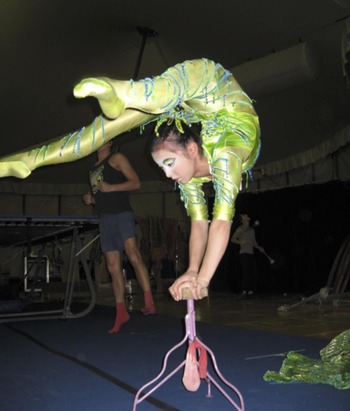
As a child, Wang vaguely remembers paying the Flag a training fee, but she never saw a contract herself. In 2004, Wang, flying directly to Europe, joined Dralion's Chinese cast. In the show, she played a water pixie and wore a sequined green and yellow leotard, headdress, and mask, conforming to the aesthetic style of the Cirque (see Figure 3). Compared with Jiang Zhenping, Wang's acrobatic body was more integrated into a North American-style fairy tale that obscures the complexity of her life and career trajectories.
Printed with permission. Wang Junru practicing her single-hand balancing act at the Cirque du Soleil, 2007. Courtesy of Wang Junru.

Compared to her work experience in China, Wang was satisfied by employment conditions at the Cirque. Every week, she performed five to six shows and had one day off. A substitute performer could replace her from time to time. English and math classes were given during the days. Once a year, she and other performers received a three-week vacation, with round-trip airplane tickets paid by the company. Thanks to her outstanding performance, Wang was able to extend her contract for additional years. However, like the previous generations of Chinese acrobats, she was paid below minimum wage in Canada and the United States. As a child performer, she earned twenty dollars per day, half of a Chinese adult performer's salary. In the end, Wang told me the Flag gave her a total of 150,000 yuan for her five years’ work at the Cirque, which equals an annual income of approximately $5,000.
Wang's relationship with the Flag and the Cirque did not end well. Before the contract terminated, Wang's mother discussed her daughter's future work with the troupe leader. The troupe was only willing to pay a monthly salary of 800 yuan (approximately $130). Disappointed by this news, Wang left Dralion. The Flag's leader, enraged by her action, threatened her: if Wang did not return, the Flag would mobilize its connections with other performing troupes to prevent her from being hired ever again in China or elsewhere. Knowing that the Flag desperately needed Wang to continue the show, Wang's mother succeeded in renegotiating with the troupe leader to increase Wang's daily stipend/salary from twenty dollars to forty dollars. As a result, Wang returned and worked for Dralion for an additional eight weeks.
Wang's story was extraordinary, but her tortuous experiences reflect the precarious conditions of contract acrobats today. I interviewed four other young performers between the ages of twenty and thirty; they are all subjected to similar employment conditions.Footnote 44 Their backgrounds are diverse. Some were trained in private schools; others are graduates of semiprivate performing arts schools while still others are former gymnastics trainees. All started practicing at a very young age and, consequently, discontinued regular schooling. However, the Chinese economy has changed rapidly. A college diploma has become the basic criteria for salaried jobs. With no formal education, these young acrobats have few alternative career options. In response to widespread exploitative practices, contract acrobats, with or without family support, struggle to negotiate with corporate-state powers. They hop from one troupe to another, seeking secure and better-paid work. To enhance their reputations and status, and subsequent employment opportunities, some create new acts and participate in popular competitions.
Wang Junru's appearance in “China's Got Talent” demonstrates one approach taken by this generation. Created in 2010 and financed by both corporate and state money, CGT aims to offer a platform for individuals like Wang to showcase their talent as well as tell stories of personal life struggles. The satellite TV network transmits “talent shows” as international spectacles, displaying China's new affluence as well as generating advertisement dollars. Winning contestants, like Wang Junru receive employment contracts from private entertainment agencies. The celebration of Wang's success also demonstrates social acceptance of a new performer subject, one who embraces an entrepreneurial self and uses aesthetic labor to harness fame and economic rewards.
Relaxed policy conditions allow contract acrobats to attain some degree of freedom and mobility. However, most have difficulties carving out meaningful career paths. During our interviews, Wang Junru revealed to me how lonely and stressed she felt as a child performer at the Cirque. She remembered being criticized for her weight as well as the challenge of making close friends in a routinized, highly self-disciplined workplace. The troupe leaders cared only that she accomplished her performance. Compared to Jiang Zhenping, Wang had a heightened sense of insecurity and alienation from her acrobatic body. However, she had to suppress these emotions and physical pains to become “the smiling girl” onstage.
Concluding Remarks
Through the lens of acrobatics, this article analyzed various relations of power associated with aesthetic labor. At the geopolitical level, acrobats’ aesthetic labor was used to produce acrobatic bodies for promoting a new modern China abroad. When other art and cultural forms were loaded with “revolutionary messages” for domestic audiences, acrobatics was chosen as a diplomacy tool to establish relationships with the West. At the national level, state-run acrobatic troupes facilitated the social reproduction of aesthetic labor and also played a role in educating/entertaining working-class citizens at home. State-subsidized cultural production ensured acrobats’ economic stability, at the same time fostering sociopolitical inequalities on the basis of class positions and acrobatic skills. Since the early 1980s, changes in state policies created conditions for foreign entertainment companies and Chinese cultural organizations to interact. Several new mechanisms have been created to transform China's socialist acrobatics. First, reduced government subsidies press state-run troupes to seek revenue-generating opportunities. Overseas contracts have proven to be the most lucrative option, in particular for troupes in peripheral regions. Throughout the 1980s and 1990s, acrobatic troupes across the country competed for overseas contracts. Second, under such state-corporate collaboration, the CPAA came to embody the state power that would extend to North America and collaborate with foreign circus companies to control acrobats’ mobility and work. Finally, at the troupe level, the preexisting hierarchy of aesthetic labor was challenged by the commercialization of acrobatics. In this process, acrobats’ aesthetic labor was no longer an effort to overcome one's class position; and its cultural meaning has gradually disassociated from socialist aspirations of modernity. Rather, acrobats’ aesthetic labor is valued as an economic input to produce spectacular circus shows for an overseas audience, and the Chinese acrobatic bodies are converted into objects of cultural consumption.
Under a state-corporate deal, acrobats receive little economic reward and have limited bargaining power. In the early years, when acrobats still had permanent jobs, they could profit from overseas work at least to some extent. The past fifteen years have witnessed a deepened commodification of aesthetic labor. Contract acrobats could attain a sense of ownership over their own acrobatic acts, as they could decide where to work. Nonetheless, their livelihoods are much more unstable and vulnerable amid the neoliberal dynamics. In parallel, the production of entrepreneurial subjects legitimatizes new hierarchies of aesthetic labor in the performing arts field.