Introduction
A growing body of research has shown that people released from prison are at higher risk of mortality than their peers in the general population. The leading causes of death are potentially preventable, external causes, including drug overdose, suicide, transport accidents, and homicide (Binswanger et al. Reference Binswanger, Stern, Deyo, Heagerty, Cheadle, Elmore and Koepsell2007, Reference Binswanger, Blatchford, Lindsay and Stern2011; Merrall et al. Reference Merrall, Kariminia, Binswanger, Hobbs, Farrell, Marsden, Hutchinson and Bird2010; Pratt et al. Reference Pratt, Appleby, Piper, Webb and Shaw2010; Kinner et al. Reference Kinner, Forsyth and Williams2013; van Dooren et al. Reference van Dooren, Kinner and Forsyth2013; Forsyth et al. Reference Forsyth, Alati, Ober, Williams and Kinner2014; Kinner & Binswanger, Reference Kinner, Binswanger, Bruinsma and Weisburd2014; Spittal et al. Reference Spittal, Forsyth, Pirkis, Alati and Kinner2014). Although this elevation in risk of death is now well established, most studies have relied on retrospective linkage of routinely collected data. As a consequence, they tend to provide very limited health and behavioural information on those at risk, severely limiting the capacity to identify modifiable risk and protective factors, and thus inform targeted prevention.
For example, in a previous study we used linked correctional and mortality records to examine the incidence and risk factors for substance-related death in a cohort of over 42 000 adults released from prison in Queensland, Australia over 14 years (Forsyth et al. Reference Forsyth, Alati, Ober, Williams and Kinner2014). With the information available to us, we found that increasing age and each additional custodial sentence was associated with increased risk of death due to overdose and other drug-related causes, whereas being married was protective. In a second study using data from the same cohort, we found that risk of suicide increased with age, and that marriage was also protective against suicide (Spittal et al. Reference Spittal, Forsyth, Pirkis, Alati and Kinner2014). A larger Australian study (n = 85 203) using a similar design found a spike in suicides in men, but not women, in the first two weeks after release from prison, and an increase in the risk of suicide among men who had been admitted to a prison psychiatric hospital (Kariminia et al. Reference Kariminia, Law, Butler, Levy, Corben, Kaldor and Grant2007). Similarly, Chang et al. (Reference Chang, Fazel, Lichtenstein, Larsson, Fazel, Chang, Lichtenstein and Larsson2015) used linked population registry data for all adults released from prison in Sweden between 2000 and 2009 (n = 47 326) and found that documented substance use disorders – but not other psychiatric disorders – independently predicted all-cause and external-cause mortality.
Like our own work, an important limitation of these studies was exclusive reliance on registry data, which may under-ascertain some psychiatric disorders and fail to record sub-clinical symptoms. There is now a substantial literature using data linkage to study mortality after release from prison, and the findings across these studies have been broadly similar (Merrall et al. Reference Merrall, Kariminia, Binswanger, Hobbs, Farrell, Marsden, Hutchinson and Bird2010; Zlodre & Fazel, Reference Zlodre and Fazel2012; Kinner et al. Reference Kinner, Forsyth and Williams2013). Unfortunately, most of these studies also suffer from similar limitations, including that they have limited capacity to identify modifiable health and behavioural factors that could be targeted to reduce external cause mortality.
One recent study in the USA used an alternative approach to identify factors associated with death after release from prison. Using a nested, case–control design, Binswanger et al. (Reference Binswanger, Stern, Yamashita, Mueller, Baggett and Blatchford2016) examined prison medical charts for 699 deaths and 699 matched controls. They identified a number of risk factors for all-cause and overdose death including homelessness, risky substance use, and mental disorder. Substance use treatment was protective. Risk factors for other preventable causes of death were not examined.
In the present study, we expand on this approach and our own earlier work by undertaking a nested case–control study within our Australian cohort. In contrast to most previous studies, this design allowed us to undertake an in-depth review of prison medical records for deceased ex-prisoners and matched controls, and gather detailed data on a variety of potential risk and protective factors, including medication history, physical and mental health status, use of alcohol and other drugs in prison and the community, and access to social supports. Our aims were to identify modifiable behavioural, psychosocial, and clinical factors for the leading causes of external cause mortality (drug overdose, suicide, transport accidents, and violence) and to explore the association between each factor and cause-specific mortality.
Method
Study setting and design
The original retrospective cohort study on which the present study was based consisted of all 42 015 adult men and women released from prisons in Queensland, Australia between 1 January 1994 and 31 December 2007. To establish fact of death and cause of death up to 31 December 2007, these data were linked to the National Death Index (NDI) by the Australian Institute of Health and Welfare (AIHW) using probabilistic matching with subsequent clerical review. Deaths recorded in the NDI were coded using the International Classification of Diseases 9th revision (ICD-9) until 1996, and using the 10th revision (ICD-10) from 1997. These data are described in more detail elsewhere (van Dooren et al. Reference van Dooren, Kinner and Forsyth2013; Forsyth et al. Reference Forsyth, Alati, Ober, Williams and Kinner2014; Spittal et al. Reference Spittal, Forsyth, Pirkis, Alati and Kinner2014). Because it was not feasible to undertake detailed coding of records for the entire sample, the present study used a subsample of cases who had died in the community from one of four external causes: drug overdose, suicide, transport accidents, or violence. These cases were matched on sex, Indigenous status, and date of release to an equal number of controls (1 : 1 matching). Ethical approval for this study was granted by the University of Queensland's Behavioural and Social Sciences Ethical Review Committee and the AIHW Ethics Committee.
Selection of cases and controls
The cases were selected from the 2158 individuals in the original cohort who died from any cause during the follow-up period in community. The controls were selected from all 42 015 individuals in the cohort by matching to cases with the same sex, Indigenous status and having a release date within 14 days of the case.
To minimise sampling bias, we prioritised the coding of records for Indigenous people (n = 454 deaths) and non-Indigenous women (n = 155 deaths), followed by a random selection of the non-Indigenous men (n = 1549 deaths). We were able to identify and code a set of 774 matched pairs. Of these pairs, 255 were Indigenous people, 114 were non-Indigenous women, and 405 were non-Indigenous men.
The complete set of cases represents those individuals who had died from any cause. Because the focus of this study was death from external causes, we selected the 286 cases (and their matched controls) for analysis where the underlying cause of death was coded as external cause mortality.
Definition of external cause mortality
Our primary outcome was death due to external causes, defined as deaths due to drug overdose, suicide, transport accidents, or violence. This definition excludes accidental deaths due to falls, firearms, drowning, smoke inhalation or fire, poisoning due to unspecified solid or liquid substances, and other external causes (where the intent is unknown). Cause of death was determined from the ICD codes for the primary (underlying) cause of death field, using the definitions proposed by Randall et al. (Reference Randall, Roxburgh, Gibson and Degenhardt2009). Drug overdoses were identified using codes 304, E850–E858 (ICD-9) and codes F11–F16, F19, F55, X40–X44 (ICD-10); suicides were identified using codes E950–E959 (ICD-9) and X60–X84, Y87.0 (ICD-10); transport accidents were identified from codes E810–E825, E929.0 (ICD-9) and V01–V04, V06, V09–V80, V81.0, V81.1, V82.0, V82.1, V84–V87, V88.0–V88.5, V88.7, V88.8, V89, V99, Y85 (ICD-10); and deaths due to violence were identified from codes E960–E969 (ICD-9) and X85–Y09, Y87.1 (ICD-10).
Data extraction
Our primary information sources were paper-based detention and case-management records collected by Queensland Corrective Services (QCS), and paper-based prison medical record data collected by Queensland Health, who are responsible for the healthcare of prisoners in Queensland. All data were routinely collected in the course of managing and treating prisoners, and were coded into a secure database, designed for this study, by two trained coders. The detention data included information on any prior detention as a juvenile or incarceration as an adult, most serious offence type (for each custodial sentence), information on any visitors in prison (personal and professional), and information on any custodial breaches. Case-management data included information on any intervention programmes started or completed while in prison; for example, cognitive behavioural programmes, substance abuse programmes, or sex offender treatment programmes.
We extracted rich data in relation to prisoners’ general and mental health from both the most recent custodial sentence and any previous custodial sentences. This included information on chronic diseases (e.g., cardiovascular disease, diabetes, and cancer), medication history, hepatitis A, B, and C status, HIV status, diagnoses of any mental disorders (cognitive disorder, personality disorder, substance use disorder, psychotic disorder, anxiety disorder, or other disorder), and documented history of admission to a psychiatric hospital. We also extracted information on risk of self-harm (from intake assessment information) and on the occurrence of self-harm or attempted suicide in prison. Finally, we extracted information on alcohol, tobacco, and other drug use during the most recent custodial sentence, ever in custody, and ever in the community. This information was routinely collected from prisoners with alcohol and drug problems and included information on the type of drug used (for example, cannabis, heroin, pharmaceutical opioids, and amphetamines), possession of drugs or drug-injecting equipment in prison, and positive urine test results in prison (indicative of drug use in prison). We also captured a number of demographic variables (e.g., age at prison release and marital status). Most variables were coded ‘Yes’ if there was documented evidence that the risk factor was present, or ‘No or unknown’ if there was no or insufficient evidence.
Statistical analysis
Informed by the literature, our analysis focused largely on behavioural, psychosocial and clinical factors for external cause mortality. We report on the distribution of each predictor variable among cases and controls, along with univariate odds ratio (OR) generated using conditional logistic regression, which accounts for the fact that each case was matched to a control. Because this was an exploratory study, we then entered all variables that were significantly associated with external cause mortality in the univariate analyses into a stepwise multivariate conditional logistic regression model. This model uses backward elimination to remove the least significant variable (i.e., the one with the highest p-value) from the model and then re-estimates all parameters. This continues until a pre-specified threshold is met. Since we wanted to include potential confounder variables in the model, we set this threshold at p = 0.25 to include those variables that may themselves have no association with mortality, but may adjust for confounding (Hosmer et al. Reference Hosmer, Lemeshow and May2008). Finally, we used the identified predictors of external cause mortality to estimate separate models for drug overdose, suicide, and transport accidents. We were unable to predict deaths due to violence because there were only three cases. All multivariate analyses controlled for age at release from prison (in years) and all analyses were undertaken in Stata version 13.1 (StataCorp, 2013).
Results
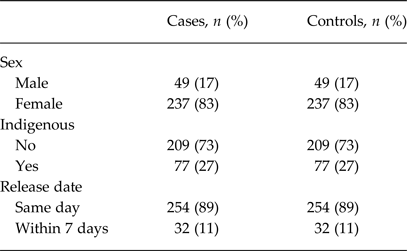
During the study period, there were 93 deaths due to drug overdose, 139 due to suicide, 51 due to transport accidents, and three due to violence. These 286 cases were well matched to the 286 controls on sex, Indigenous status, and release date (Table 1). Cases had a mean age at release from prison of 28.0 years (s.d. = 8.5); controls were older on average at release (M = 31.4 years, s.d. = 10.5, p-value for difference < 0.001).
Comparison of cases and controls on matching variables, n = 286 cases and n = 286 controls

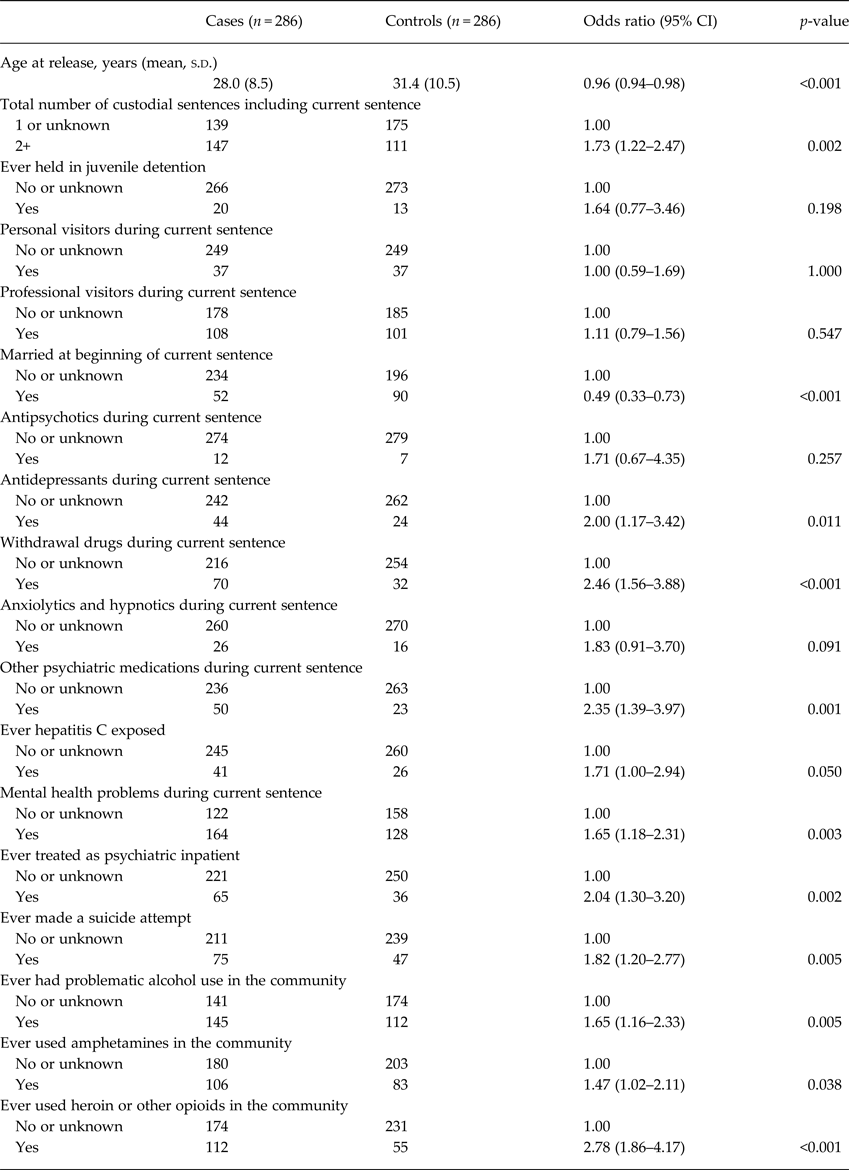
In univariate analyses (Table 2), there was evidence that cases and controls differed on a number of variables: total number of custodial sentences; being married; being treated with antidepressants or withdrawal drugs during the current sentence; being treated with other psychiatric medications during the current sentence; evidence of mental health problems during the current sentence; history of psychiatric hospitalisation; history of suicide attempt; history of problematic alcohol or other drug use in the community; and history of heroin or other opioid use in the community. Each of these variables, except being married, was associated with increased risk of external cause mortality. Being married was associated with decreased risk.
Univariate conditional logistic regression results for external causes of mortality (drug overdose, suicide, transport accidents, and violence)

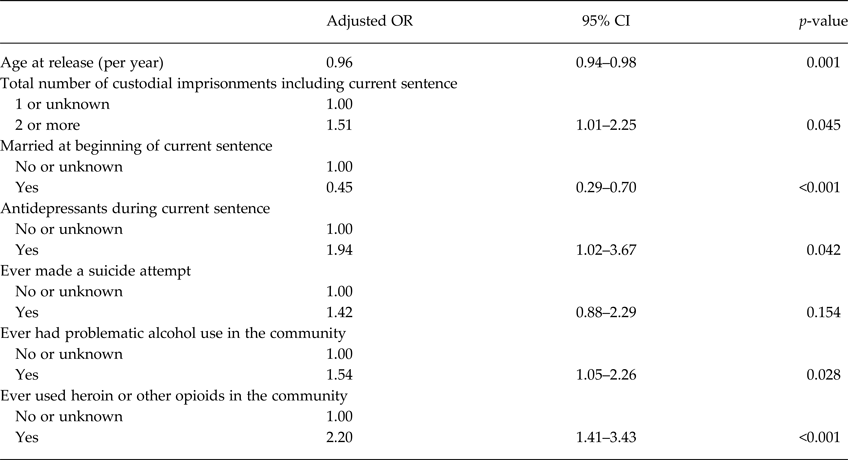
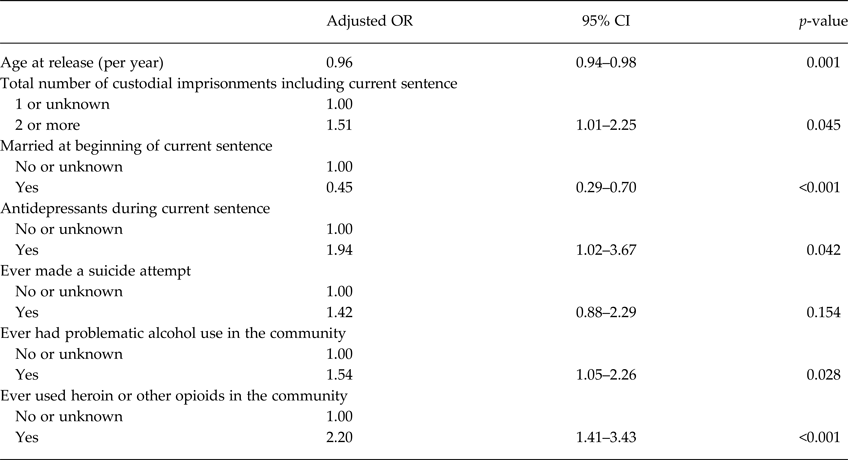
In multivariate analysis, after removing predictors with p > 0.25 and adjusting for age at release, two or more custodial sentences (OR = 1.51, 95% CI 1.01–2.25), being married (OR = 0.45, 95% CI 0.29–0.70), a prescription for antidepressants during the current sentence (OR = 1.94, 95% CI 1.02–3.67), a history of problematic alcohol use in the community (OR = 1.54, 95% CI 1.05–2.26), and use of heroin and other opioids in the community (OR = 2.20, 95% CI 1.41–3.43), were all associated with external cause mortality (Table 3). Although the OR was relatively large for a history of suicide attempt, there was insufficient evidence to conclude that it was associated with external cause mortality (OR = 1.42, 95% CI 0.88–2.29).
Multivariate conditional logistic regression results for external cause mortality (drug overdose, suicide, transport accidents, and violence), n = 572
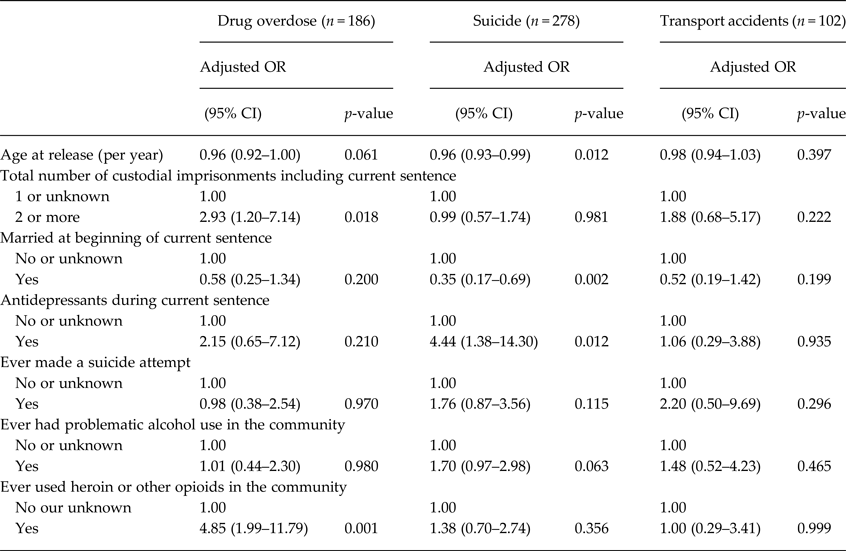
When these variables were entered into a model to predict drug overdose, and after adjustment for age at release, only two variables – use of heroin and other opioids in the community (OR = 4.85, 95% CI 1.99–11.79) and two or more custodial sentences (OR = 2.93, 95% CI 1.20–7.14) – distinguished between cases and controls. Being married (OR = 0.35, 95% CI 0.17–0.69) and a prescription for antidepressants during the current sentence (OR = 4.44, 95% CI 1.38–14.30) were associated with suicide. None of the assessed variables was associated with death due to a transport accident (Table 4). In all three models, there were predictors that had large but non-significant effect sizes.
Multivariate conditional logistic regression predicting specific-cause mortality

Discussion
The increased risk of mortality after release from prison, primarily from potentially preventable external causes, including drug overdose, suicide, transport accidents, and violence is well documented (Binswanger et al. Reference Binswanger, Stern, Deyo, Heagerty, Cheadle, Elmore and Koepsell2007; Pratt et al. Reference Pratt, Appleby, Piper, Webb and Shaw2010; Zlodre & Fazel, Reference Zlodre and Fazel2012; Haglund et al. Reference Haglund, Tidemalm, Jokinen, Långström, Lichtenstein, Fazel and Runeson2014). What is less clear is what potentially modifiable factors are associated with mortality in this population (Kinner et al. Reference Kinner, Forsyth and Williams2013; Chang et al. Reference Chang, Fazel, Lichtenstein, Larsson, Fazel, Chang, Lichtenstein and Larsson2015). An understanding of these factors could inform development of targeted strategies to reduce preventable deaths after release from prison.
In our sample, the most common external causes of death were suicide and drug overdose, although more than one in six deaths was due to transport accidents. In contrast to studies from other settings, most notably the USA (Binswanger et al. Reference Binswanger, Stern, Deyo, Heagerty, Cheadle, Elmore and Koepsell2007; Rosen et al. Reference Rosen, Schoenbach and Wohl2008), violence accounted for only a small fraction of deaths. We identified several important behavioural, psychosocial, and clinical factors associated with external cause mortality: in-prison use of antidepressants, a history of problematic alcohol use in the community, heroin or other opioid use in the community, and multiple prior incarcerations, were each independently associated with increased risk of external cause mortality after release from prison. Being married at prison release was protective. Our findings with respect to the predictors of cause-specific mortality were less consistent, although we were able to identify several large, albeit non-significant, predictors of cause-specific external mortality in which the observed association was plausible.
Interpretation and implications
A number of studies have identified being in a stable relationship as being protective against suicide and other causes of death after release from prison (Singleton et al. Reference Singleton, Pendry, Taylor, Farrell and Marsden2003; Spittal et al. Reference Spittal, Forsyth, Pirkis, Alati and Kinner2014; Graham et al. Reference Graham, Fischbacher, Stockton, Fraser, Fleming and Greig2015; Binswanger et al. Reference Binswanger, Stern, Yamashita, Mueller, Baggett and Blatchford2016). Our study adds to this body of evidence. There are at least three potential explanations for this association. First, being married is likely a marker for stable accommodation, and unstable accommodation and homelessness are both associated with increased risk of suicide, drug overdose, and other detrimental outcomes (Merrall et al. Reference Merrall, Kariminia, Binswanger, Hobbs, Farrell, Marsden, Hutchinson and Bird2010; Lim et al. Reference Lim, Seligson, Parvez, Luther, Mavinkurve, Binswanger and Kerker2012; Binswanger et al. Reference Binswanger, Stern, Yamashita, Mueller, Baggett and Blatchford2016). Second, marriage is likely to be a key source of practical, emotional, and social support, and spouses may be well placed to recognise the warning signs of deteriorating health (especially mental health) and to deter their partner from engaging in risky behaviour (Visher et al. Reference Visher, Knight, Chalfin and Roman2009). A third, related reason is that marriage is a marker for having children, which is also associated with desistance from a variety of risky behaviours (Moloney et al. Reference Moloney, MacKenzie, Hunt and Joe-Laidler2009). However, we urge caution in applying these findings to incarcerated women, whose health and social needs after release from prison may be different to those of men (Douglas et al. Reference Douglas, Plugge and Fitzpatrick2009). Nonetheless, our findings add to a growing body of literature highlighting the value of positive relationships for prisoners returning to the community. Future research could investigate how interventions such as training partners and other significant social supports in mental health first aid (Jorm & Kitchener, Reference Jorm and Kitchener2011), which teaches how to recognise and respond to signs of distress, could further enhance or support the care of people released from prison.
Prisoners, in general, have higher rates of mental health problems than their peers in the community (Zlodre & Fazel, Reference Zlodre and Fazel2012), and a large proportion take psychiatric medications (Carroll et al. Reference Carroll, Kinner and Heffernan2014). Worryingly, contact with mental health services after release from prison has been associated with elevated odds of suicide (Pratt et al. Reference Pratt, Appleby, Piper, Webb and Shaw2010), perhaps because of poor discharge planning, poor engagement, and retention in treatment, and inadequate continuity of care. To the extent that this is the case, our findings point to a pressing need for greater investment in transitional support for prisoners with mental health problems (Jarrett et al. Reference Jarrett, Thornicroft, Forrester, Harty, Senior, King, Huckle, Parrott, Dunn and Shaw2012; Thomas et al. Reference Thomas, Spittal, Heffernan, Taxman, Alati and Kinner2016). In our study, taking antidepressants in prison almost doubled the odds of external cause death after release from prison; those taking antidepressants in prison were also at increased risk of drug-related death and, in particular, death by suicide. Taking antidepressants in prison is indicative of significant mental health problems, and suggests a need for ongoing treatment after release from prison. Although we were unable to examine patterns of healthcare in this study, we have previously shown that engagement with mental health services after release from prison is typically poor in this population (Thomas et al. Reference Thomas, Spittal, Heffernan, Taxman, Alati and Kinner2016), and that soon-to-be-released prisoners typically have very poor knowledge of their psychotropic medication needs (Carroll et al. Reference Carroll, Kinner and Heffernan2014). Our findings in this regard are consistent with those of previous studies: one Australian study found that those with a history of psychiatric hospitalisation in prison were at increased risk of death by suicide (Kariminia et al. Reference Kariminia, Law, Butler, Levy, Corben, Kaldor and Grant2007), and a similar study in Sweden found that a history of diagnosed substance use disorder was an independent risk factor for all-cause and external cause death (Chang et al. Reference Chang, Fazel, Lichtenstein, Larsson, Fazel, Chang, Lichtenstein and Larsson2015). A case–control study in the USA found that use of psychiatric medications in prison was associated with both all-cause and overdose death (Binswanger et al. Reference Binswanger, Stern, Yamashita, Mueller, Baggett and Blatchford2016). The key message from all these studies is the importance of continuity of psychiatric care – including uninterrupted access to medications – after release from prison. There is also growing evidence that efforts to support early engagement with primary care after release from prison can yield multiple health benefits, including increased subsequent engagement with mental health services (Young et al. Reference Young, Arnold-Reed, Preen, Bulsara, Lennox and Kinner2015; Kinner et al. Reference Kinner, Alati, Longo, Spittal, Boyle, Williams and Lennox2016).
Our findings that problematic use of alcohol, heroin and other opioids in the community were risk factors for external cause mortality are less surprising. Risky alcohol and other drug use are key health concerns for ex-prisoners (Fazel et al. Reference Fazel, Bains and Doll2006). Alcohol use is often identified as a causal factor in transport accidents and homicide (Petridou & Moustaki, Reference Petridou and Moustaki2000; Shaw et al. Reference Shaw, Hunt, Flynn, Amos, Meehan, Robinson, Bickley, Parsons, McCann, Burns, Kapur and Appleby2006), and a prominent cause of drug-related mortality in this group is opioid overdose deaths, which occur disproportionately in the first few weeks after release from prison (Merrall et al. Reference Merrall, Kariminia, Binswanger, Hobbs, Farrell, Marsden, Hutchinson and Bird2010; Forsyth et al. Reference Forsyth, Alati, Ober, Williams and Kinner2014). In relation to opioid overdose deaths, there is now good evidence that opioid substitution therapy delivered in prison and – critically – continued after release from prison, reduces mortality (Degenhardt et al. Reference Degenhardt, Larney, Kimber, Gisev, Farrell, Dobbins, Weatherburn, Gibson, Mattick, Butler and Burns2014). There is also increasing evidence that making naloxone available on release from prison may be an effective intervention (Parmar et al. Reference Parmar, Strang, Choo, Meade and Bird2017). More generally, evidence from a number of randomised controlled trials suggests several promising interventions for reducing substance abuse (Kouyoumdjian et al. Reference Kouyoumdjian, McIsaac, Liauw, Green, Karachiwalla, Siu, Burkholder, Binswanger, Kiefer, Kinner, Korchinski, Matheson, Young and Hwang2015). These include motivational interviewing, which is designed to teach empathy, avert arguing, and develop discrepancy, self-efficacy, and personal choice (Stein et al. Reference Stein, Clair, Lebeau, Colby, Barnett, Golembeske and Monti2011a, Reference Stein, Lebeau, Colby, Barnett, Golembeske and Montib; Clarke et al. Reference Clarke, Stein, Martin, Martin, Parker, Lopes, McGovern, Simon, Roberts, Friedman and Bock2013); psychotherapy (Sullivan et al. Reference Sullivan, McKendrick, Sacks and Banks2007; Sacks et al. Reference Sacks, McKendrick and Hamilton2012; Villagra Lanza & Gonzalez Menendez, Reference Villagra Lanza and Gonzalez Menendez2013); educational and skills building programmes (Braithwaite et al. Reference Braithwaite, Stephens, Treadwell, Braithwaite and Conerly2005); pharmacological interventions such as methadone (Gordon et al. Reference Gordon, Kinlock, Schwartz and O'Grady2008); and enhanced support after release from prison (Freudenberg et al. Reference Freudenberg, Ramaswamy, Daniels, Crum, Ompad and Vlahov2010). Many of these interventions could be initiated in prison, and this highlights that the period of imprisonment is a unique opportunity to link individuals with interventions that may improve their long-term health (Kinner & Wang, Reference Kinner and Wang2014). Less is known about how to prevent suicide or deaths due to transport accidents after release from prison, despite the fact that these causes accounted for the majority of external cause deaths in our sample.
Strengths and limitations
Our study has a number of strengths. Predictor and outcome data were gathered over a long period of time (14 years). We were able to gather objective data on a wide range of modifiable behavioural, psychosocial and clinical factors across a number of settings (in the community, in past custodial sentences, in the most recent custodial sentence). Ascertainment of cause of death was based on national data and coded to a very high standard by an independent body.
Our study has eight notable limitations. First, the study appeared to be underpowered. There were a number of effect sizes that were large but non-significant. A study with more cases would be better able to tease out some of these effects, including sub-group effects. Second, we were reliant on relatively old data (deaths were only recorded up to the end of 2007), although risk factors for external cause mortality in ex-prisoners are unlikely to have changed meaningfully in the past decade. Third, we were unable to code records for controls who were in custody throughout the study. As such, we may have under-sampled young people or people more likely to re-offend. The effects of this are countered by the relatively long time-frame over which we examine mortality. Fourth, our set of risk and protective factors was based on what was known prior to release from prison. We have no data on how people's circumstances changed after release (for instance, the effect of homelessness, which is frequently identified as a risk factor for all cause-mortality (Binswanger et al. Reference Binswanger, Stern, Yamashita, Mueller, Baggett and Blatchford2016)). Fifth, and relatedly, because we were reliant on documented evidence in prison records, we likely under-ascertained some potential risk factors (e.g., treatment as a psychiatric inpatient in the community). Linkage with community health records, as Chang and colleagues have done in Sweden (Chang et al. Reference Chang, Fazel, Lichtenstein, Larsson, Fazel, Chang, Lichtenstein and Larsson2015), would overcome this problem. Sixth, the external causes of death that we examined were relatively heterogeneous, and when we examined cause-specific mortality the lack of power made it difficult to detect significant predictors. Seventh, we focused only on the four leading causes of death (based on previous findings), and excluded a number of relatively rare accidental and unclassifiable causes of death. Finally, we were not able to fit a model for deaths due to violence because of the small number of cases.
Conclusions
Our study identified a number of potentially modifiable health and behavioural factors associated with external cause mortality and cause-specific mortality after release from prison. The risk factors reflected what was known about individuals prior to release from prison, and this information could be useful for designing interventions that are delivered while in prison and/or shortly after release. To advance knowledge in this area and more directly inform prevention, further research is needed to identify the causal pathways to mortality after release from prison. For instance, how and when do mental disorder and substance misuse relapses occur, and how can we prevent them, thereby preventing deaths in people with a history of incarceration? As a starting point, this involves understanding patterns of and barriers to health service engagement after release from prison. Gradual adoption of electronic medical records in custodial settings, coupled with growing capacity for data linkage in Australia and some other countries, will provide new opportunities to replicate and build on our research with much larger numbers.
Acknowledgements
The authors would like to thank QCS for their assistance with data collection, and Glen Russell and Shannon Dias for undertaking data extraction. The views expressed herein are solely those of the authors, and in no way reflect the views or policies of QCS.
Financial Support
This study was funded by the National Health and Medical Research Council (NHMRC) project grant APP456107. Stuart Kinner is supported by NHMRC Senior Research Fellowship APP1078168. Rohan Borschmann is supported by the NHMRC Early Career Fellowship APP1104644. Jesse Young is supported by a Melbourne International Research Scholarship.
Conflicts of Interest
On behalf of all authors, the corresponding author states that there is no conflict of interest
Ethical Standards
The authors assert that all procedures contributing to this work comply with the ethical standards of the relevant national and institutional committees on human experimentation and with the Helsinki Declaration of 1975, as revised in 2008.
Author Contributions
SK initiated the overarching research question and obtained funding for the study. SF and SK designed the study and oversaw data extraction. MS refined the research question, undertook the statistical analysis, interpreted the findings, wrote the first draft, and edited the revisions to the manuscript. RB, JY and SK revised the manuscript. All authors approved the final version of the manuscript.
Availability of Data and Materials
The data that support this research are owned in part by QCS and restrictions apply to availability of the data. The authors do not have permission to share these data and, as such, they are not publically available. The Stata code used to recode variables and conduct the analyses is available to other interested parties.