Introduction
Different mental disorders frequently co-occur within individuals, and explaining this phenomenon of ‘co-morbidity’ is a major challenge of psychiatric nosology. One approach to this problem has been to examine the extent to which co-morbid disorders may reflect shared underlying dimensions of psychopathology or latent liability factors. Several studies (Krueger et al. Reference Krueger, Caspi, Moffitt and Silva1998; Krueger, Reference Krueger1999; Vollebergh et al. Reference Vollebergh, Ledema, Bijl, de Graaf, Smit and Ormel2001; Kessler et al. Reference Kessler, Ormel, Petukhova, McLaughlin, Green, Russo, Stein, Zaslavsky, Aguilar-Gaxiola, Alonso, Andrade, Benjet, de Girolamo, de Graaf, Demyttenaere, Fayyad, Haro, Hu, Karam, Lee, Lepine, Matchsinger, Mihaescu-Pintia, Posada-Villa, Sagar and Ustun2011; Kotov et al. Reference Kotov, Ruggero, Krueger, Watson, Yuan and Zimmerman2011; Roysamb et al. Reference Roysamb, Kendler, Tambs, Orstavik, Neale, Aggen, Torgersen and Reichborn-Kjennerud2011) using large datasets have found that patterns of co-morbidity are well explained by models with only a few such factors. The most consistent of these factors have been those labeled as ‘internalizing’ and ‘externalizing’ – although finer-grained patterns, involving internalizing subfactors (Krueger, Reference Krueger1999; Vollebergh et al. Reference Vollebergh, Ledema, Bijl, de Graaf, Smit and Ormel2001) or additional factors beyond internalizing and externalizing (Kendler et al. Reference Kendler, Aggen, Knudsen, Roysamb, Neale and Reichborn-Kjennerud2011a ; Kotov et al. Reference Kotov, Ruggero, Krueger, Watson, Yuan and Zimmerman2011; Roysamb et al. Reference Roysamb, Kendler, Tambs, Orstavik, Neale, Aggen, Torgersen and Reichborn-Kjennerud2011), have been proposed. Family (Kendler et al. Reference Kendler, Davis and Kessler1997) and twin (Kendler et al. Reference Kendler, Prescott, Myers and Neale2003) studies have suggested that both internalizing and externalizing factors exhibit a familial/genetic basis.
Individuals with borderline personality disorder (BPD) exhibit a very broad range of co-morbid mental disorders, including disorders characterized as internalizing, such as mood and anxiety disorders, and externalizing, including substance use disorders and other personality disorders (Zanarini et al. Reference Zanarini, Frankenburg, Hennen, Reich and Silk2004a , Reference Zanarini, Frankenburg, Vujanovic, Hennen, Reich and Silk b ; Ruocco, Reference Ruocco2005; Slade, Reference Slade2007; James & Taylor, Reference James and Taylor2008). Moreover, these same types of disorders also associate with BPD within families. Specifically, relatives of probands with BPD show an elevated risk for both internalizing disorders – including major depressive disorder (MDD; Baron et al. Reference Baron, Gruen, Asnis and Lord1985; Links et al. Reference Links, Steiner and Huxley1988; Zanarini et al. Reference Zanarini, Gunderson, Marino, Schwartz and Frankenburg1988, Reference Zanarini, Barison, Frankenburg, Reich and Hudson2009; Silverman et al. Reference Silverman, Pinkham, Horvath, Coccaro, Klar, Schear, Apter, Davidson, Mohs and Siever1991) and anxiety disorders (Zanarini et al. Reference Zanarini, Barison, Frankenburg, Reich and Hudson2009) – and externalizing disorders, including substance use disorders (Pope et al. Reference Pope, Jonas, Hudson, Cohen and Gunderson1983; Loranger & Tulis, Reference Loranger and Tulis1985; Zanarini et al. Reference Zanarini, Gunderson, Marino, Schwartz and Frankenburg1988, Reference Zanarini, Barison, Frankenburg, Reich and Hudson2009; Silverman et al. Reference Silverman, Pinkham, Horvath, Coccaro, Klar, Schear, Apter, Davidson, Mohs and Siever1991) as well as antisocial personality disorder (Pope et al. Reference Pope, Jonas, Hudson, Cohen and Gunderson1983; Links et al. Reference Links, Steiner and Huxley1988; Zanarini et al. Reference Zanarini, Gunderson, Marino, Schwartz and Frankenburg1988, Reference Zanarini, Barison, Frankenburg, Reich and Hudson2009; Silverman et al. Reference Silverman, Pinkham, Horvath, Coccaro, Klar, Schear, Apter, Davidson, Mohs and Siever1991). However, almost all of the family studies (with notable exceptions; Klein et al. Reference Klein, Riso, Donaldson, Schwartz, Anderson, Ouimette, Lizardi and Aronson1995; Riso et al. Reference Riso, Klein, Anderson and Ouimette2000) contain methodological limitations that compromise interpretation of their results, including biased sampling, reliance on information from probands to determine a diagnosis in relatives rather than direct interviews of relatives, and small sample sizes (White et al. Reference White, Gunderson, Zanarini and Hudson2003; Gunderson et al. Reference Gunderson, Zanarini, Choi-Kain, Mitchell, Jang and Hudson2011). Furthermore, no family study has examined the relationship of BPD with internalizing and externalizing disorders in a multivariate manner.
Importantly, the relationship of BPD to internalizing and externalizing factors appears to be more complex than that of most mental disorders. Clinically, BPD is characterized by prominent internalizing features, such as affective instability, as well as prominent externalizing features, such as impulsivity and unstable relationships. In factor analytic studies, most psychiatric disorders load primarily on (i.e. are strongly correlated with) just one of these two factors, whereas BPD, almost uniquely among psychiatric disorders, loads consistently on both (James & Taylor, Reference James and Taylor2008; Eaton et al. Reference Eaton, Krueger, Keyes, Skodol, Markon, Grant and Hasin2011; Kotov et al. Reference Kotov, Ruggero, Krueger, Watson, Yuan and Zimmerman2011; Roysamb et al. Reference Roysamb, Kendler, Tambs, Orstavik, Neale, Aggen, Torgersen and Reichborn-Kjennerud2011).
However, despite great interest in the internalizing and externalizing aspects of BPD and thereby in the potential association with internalizing and externalizing latent factors, the familial contributions to these patterns have not been investigated in any previous study. Thus it is important to further explore the familial relationship of BPD to internalizing and externalizing disorders. Accordingly, we sought to test the hypothesis – replicating and extending findings of previous studies – that familial contributions to internalizing and externalizing factors both also contribute to BPD.
Method
Design and participants
The design was a family study with direct interviews of probands and their parents and siblings. Three groups of female probands aged 18–35 years were recruited: (1) individuals with BPD by criteria of both the Diagnostic and Statistical Manual of Mental Disorders, fourth edition (DSM-IV) and the Revised Diagnostic Interview for Borderlines (DIB-R; Zanarini et al. Reference Zanarini, Gunderson, Frankenburg and Chauncey1989) criteria; (2) individuals with a lifetime diagnosis of MDD, regardless of the presence or absence of lifetime BPD; (3) individuals without lifetime BPD, regardless of the presence or absence of lifetime MDD. For groups 1 and 2, we recruited from the in-patient units and partial hospital program of McLean Hospital, and for all groups we recruited from the community using advertisements. Further details of recruitment are presented elsewhere (Gunderson et al. Reference Gunderson, Zanarini, Choi-Kain, Mitchell, Jang and Hudson2011). All potential probands were also required to not have a lifetime diagnosis of schizophrenia, schizo-affective disorder, bipolar I disorder, any organic condition that could cause serious psychiatric symptoms, or mental retardation. Probands supplied contact information on their parents and siblings, and these individuals were asked to participate in the study.
This study was approved by the McLean Hospital Institutional Review Board. After complete description of the study to the participants, written informed consent was obtained.
Procedures
Clinically experienced raters administered four semi-structured interviews to all participants (probands and relatives): (1) Background Information Schedule (Zanarini et al. Reference Zanarini, Frankenburg, Khera and Bleichmar2001); (2) Structured Clinical Interview for DSM-IV (First et al. Reference First, Spitzer, Gibbons and Williams1996); (3) Diagnostic Interview for DSM-IV Personality Disorders (DIPD-IV; Zanarini et al. Reference Zanarini, Frankenburg, Sickel and Yong1996); and (4) DIB-R (Zanarini et al. Reference Zanarini, Gunderson, Frankenburg and Chauncey1989). Further details of these procedures are presented elsewhere (Gunderson et al. Reference Gunderson, Zanarini, Choi-Kain, Mitchell, Jang and Hudson2011). The κ statistic for inter-rater reliability for the diagnosis of BPD, assessed on the basis of 18 interviews, was 1.0 for both the DIPD-IV and DIB-R.
Statistical analysis
To compare demographic characteristics of probands and relatives between the proband groups, we used linear regression for continuous variables and Fisher's exact test for categorical variables.
For all analyses (i.e. confirmatory factor analysis and Cholesky decomposition models), except for characteristics of the sample, we corrected for the effects of over-sampling probands with BPD and MDD compared with their representation in the source population by weighting participants proportionally to the inverse probability of their selection. Calculation of the selection probabilities requires knowing the prevalence of BPD from the source population from which our sample was drawn. To calculate the prevalence of BPD, we used a method developed for estimating prevalence from relatives of case and control probands (Javaras et al. Reference Javaras, Laird, Hudson and Ripley2010b ), and used previously (Arnold et al. Reference Arnold, Hudson, Keck, Auchenbach, Javaras and Hess2006; Hudson et al. Reference Hudson, Javaras, Laird, VanderWeele, Pope and Hernan2008; Javaras et al. Reference Javaras, Laird, Reichborn-Kjennerud, Bulik, Pope and Hudson2008a , Reference Javaras, Pope, Lalonde, Roberts, Nillni, Laird, Bulik, Crow, McElroy, Walsh, Tsuang, Rosenthal and Hudson b ; Gunderson et al. Reference Gunderson, Zanarini, Choi-Kain, Mitchell, Jang and Hudson2011). To calculate the prevalence of MDD, we used the prevalence of MDD from the weighted sample of probands and relatives from the BPD and non-BPD proband groups. The effect of these procedures was to create a pseudo-sample that is representative of families from the underlying source population.
To examine the within-person association of BPD with internalizing and externalizing disorders, we performed confirmatory factor analysis to examine the within-person association of BPD with internalizing and externalizing disorders. We based the selection of disorders that loaded on internalizing and externalizing factors on previous work (Krueger, Reference Krueger1999; Kendler et al. Reference Kendler, Prescott, Myers and Neale2003; Kessler et al. Reference Kessler, Ormel, Petukhova, McLaughlin, Green, Russo, Stein, Zaslavsky, Aguilar-Gaxiola, Alonso, Andrade, Benjet, de Girolamo, de Graaf, Demyttenaere, Fayyad, Haro, Hu, Karam, Lee, Lepine, Matchsinger, Mihaescu-Pintia, Posada-Villa, Sagar and Ustun2011). The internalizing disorders were generalized anxiety disorder, MDD, obsessive–compulsive disorders, panic disorder with or without agoraphobia, post-traumatic stress disorder, social anxiety disorder and specific phobia. The externalizing disorders were alcohol abuse or dependence, drug abuse or dependence (non-alcohol substance use disorders) and antisocial personality disorder. Note that we considered only a rather basic confirmatory model of one internalizing and one externalizing factor, rather than more elaborated models, such as those incorporating internalizing subfactors or other factors. The reason is that it was not possible to run more complicated models for the corresponding analysis of familial factors, since our dataset only barely supported the fitting of internalizing and externalizing latent factors.
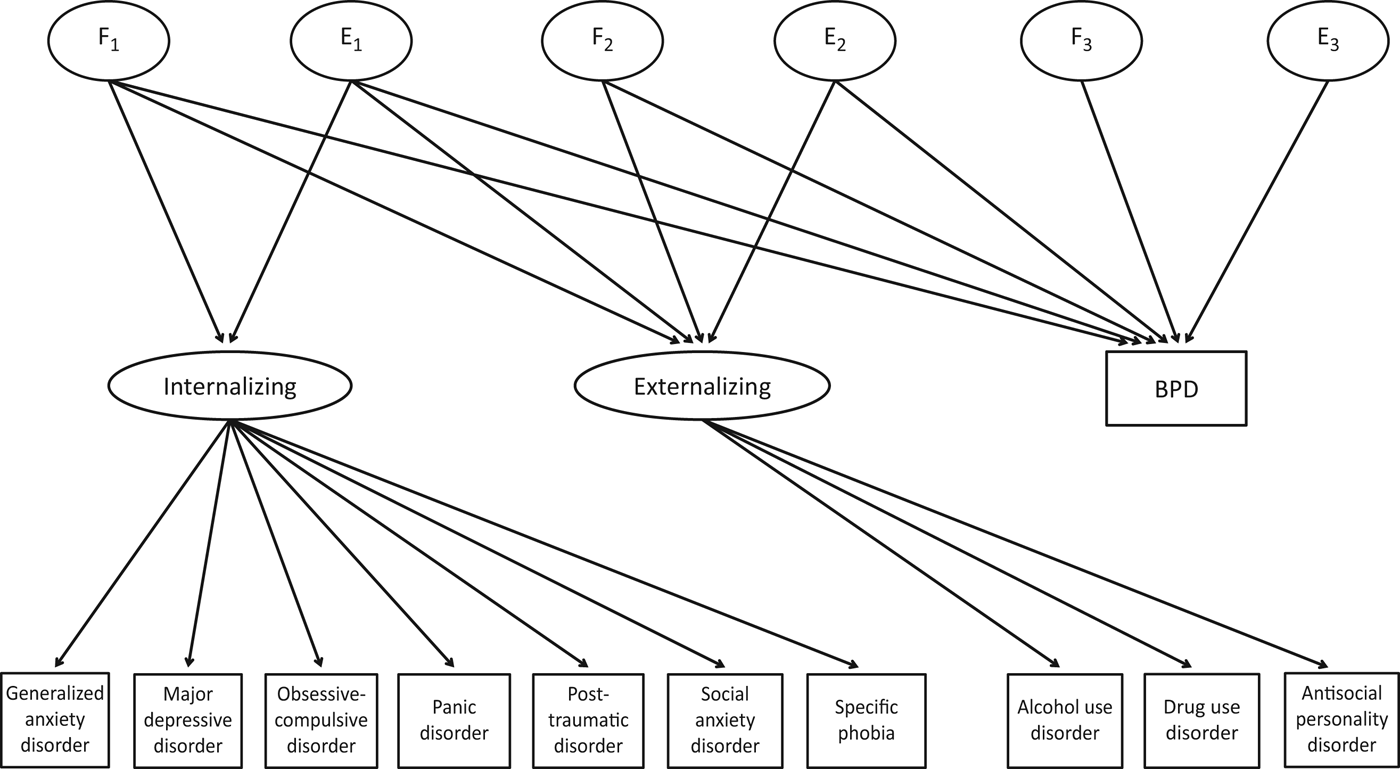
To examine the within-family association of BPD with internalizing and externalizing factors (which in turn, mediate the association of BPD with internalizing and externalizing disorders), we fitted Cholesky decomposition models, which partition the variance of BPD and the covariance between BPD and internalizing and/or externalizing factors into components reflecting familial and unique environmental causal factors. Stated differently, these models partition the variance into components that are familial and non-familial, and also whether these components are shared or not shared with other disorders. Note that we did not attempt to compare the relative fit of these saturated models with potentially more parsimonious reduced models, since the moderate amount of data available only barely allowed fitting full models and thus would be vulnerable to falsely accepting reduced models due to an inability to detect lack of relative fit. We first fit models for the association of BPD with internalizing and externalizing factors separately, and then fit a combined model for the association of BPD with both internalizing and externalizing factors (Fig. 1). Proportions of variance, e.g. the amount of variance in BPD due to familial factors, were calculated by squaring a given standardized path coefficient or summing multiple squared path coefficients and multiplying by 100. The percentage of the correlation of one variable with another variable that was accounted for by a given path (or set of paths) was calculated by dividing the squared path (or sum of paths) by the total covariance of the two variables and then multiplying by 100.
Cholesky decomposition model for relationship of borderline personality disorder (BPD) to internalizing and externalizing factors. ‘F’ variables represent familial factors; ‘E’ variables represent non-familial environmental factors.

We fitted the structural equation models under the assumption that associations between family members were attributable to genetic factors alone, based on evidence from previous studies that the effect of common family environment is negligible for BPD (Jang et al. Reference Jang, Livesley, Vernon and Jackson1996; Livesley & Jang, Reference Livesley and Jang2008; Distel et al. Reference Distel, Willemsen, Ligthart, Derom, Martin, Neale, Trull and Boomsma2010) and most internalizing and externalizing disorders (Sullivan et al. Reference Sullivan, Neale and Kendler2000; Hettema et al. Reference Hettema, Neale and Kendler2001; Kendler et al. Reference Kendler, Prescott, Myers and Neale2003; Hicks et al. Reference Hicks, Krueger, Iacono, McGue and Patrick2004; Kendler & Eaves, Reference Kendler and Eaves2005). Thus, we set the correlation of familial factors between all pairs of first-degree relatives at 0.5.
We used Stata 12.0 software (StataCorp LP, USA) for the statistical analyses except for the factor analyses and structural equation models, for which we used Mplus, version 6.0 (Muthén & Muthén, Reference Muthén and Muthén1998–2010). The standard errors for all analyses except for sample characteristics were corrected for the correlation of observations within families. We set α at 0.05, two-tailed.
The analyses reported here used data from interviewed relatives only because information about non-interviewed relatives provided by the interviewed relatives or probands is likely to be of poorer quality than information obtained from direct interviews, may depend on the informants’ outcome and thus may introduce bias (Kendler et al. Reference Kendler, Silberg, Neale, Kessler, Heath and Eaves1991; Roy et al. Reference Roy, Walsh and Kendler1996), and may differ between diagnoses in terms of quality and degree of bias (Hudson et al. Reference Hudson, Mangweth, Pope, De Col, Hausmann, Gutweniger, Laird, Biebl and Tsuang2003).
Results
Characteristics of participants
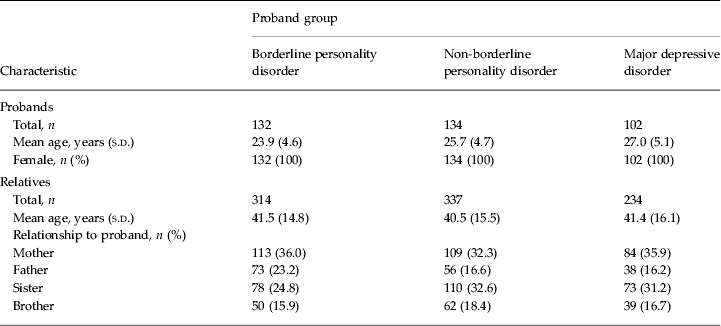
We collected data between August 2005 and July 2009. We interviewed 368 probands: BPD group (n = 132, of which 61 were patients and 71 were from the community); MDD group (n = 102, of which six were patients and 96 were from the community); and non-BPD group (n = 134, all from the community). We interviewed 885 parents and siblings of the probands. The demographic characteristics of the probands and relatives are presented in Table 1 (more detail on characteristics is presented elsewhere; Gunderson et al. Reference Gunderson, Zanarini, Choi-Kain, Mitchell, Jang and Hudson2011).
Demographic characteristics of probands and relatives

s.d., Standard deviation.
Factor analysis
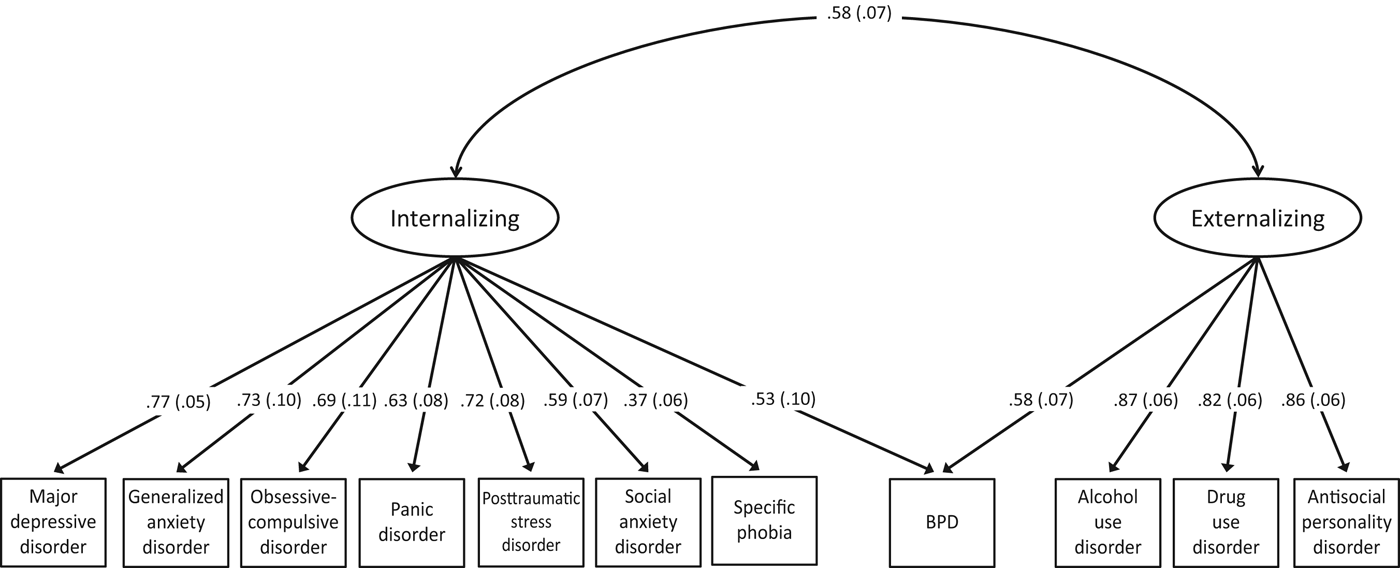
Results of confirmatory factor analysis of the association of BPD with internalizing and externalizing factors (Fig. 2) revealed that BPD loaded moderately, significantly, and approximately equally on both factors (estimate 0.53, s.e. = 0.10, p < 0.001 for internalizing, and 0.48, s.e. = 0.10, p < 0.001 for externalizing); there was also a moderate correlation (r = 0.58, s.e. = 0.07, p < 0.001) between internalizing and externalizing factors themselves. All of the internalizing disorders loaded at least moderately (>0.50) on the internalizing factor, with the exception of specific phobia (0.37); the three externalizing disorders loaded strongly (>0.75) on the externalizing factor. The fit indices showed evidence of good model fit: χ 2 = 54.4, degrees of freedom = 42, p = 0.09; comparative fit index = 0.98; root mean squared error of approximation = 0.015 (90% confidence interval 0–0.026).
Estimated loadings (standard errors) of borderline personality disorder (BPD) and other psychiatric disorders on internalizing and externalizing latent variables from confirmatory factor analysis (p < 0.05 for all loadings).

Structural equation models
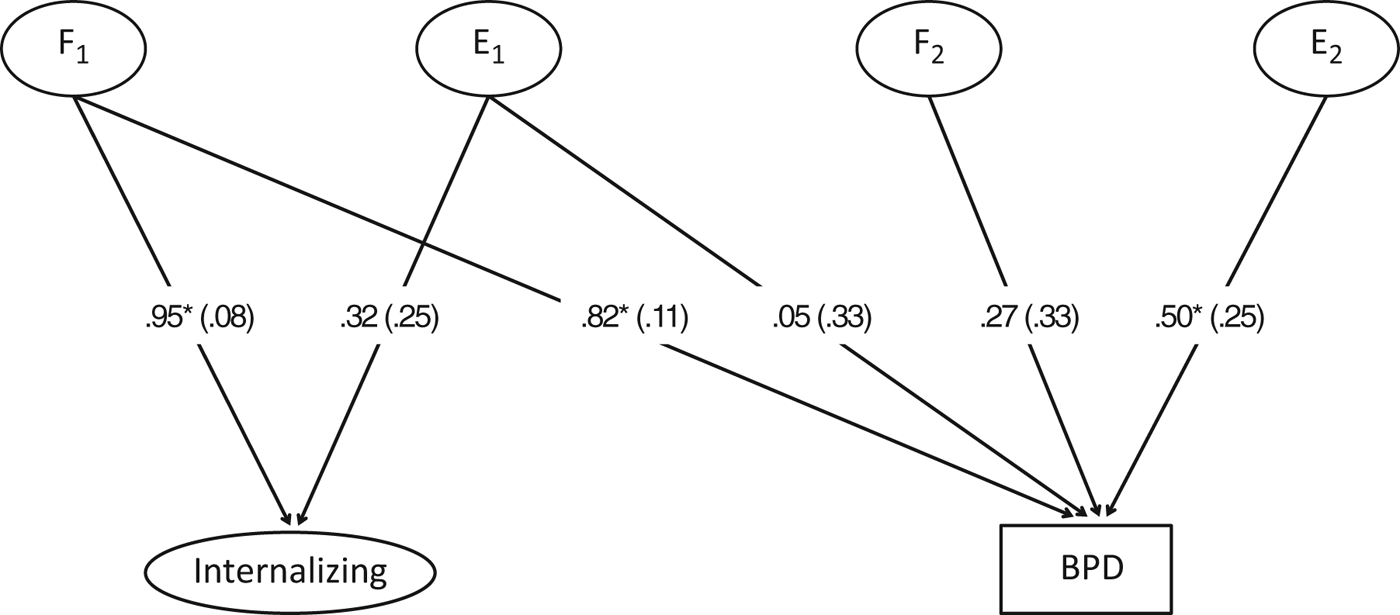
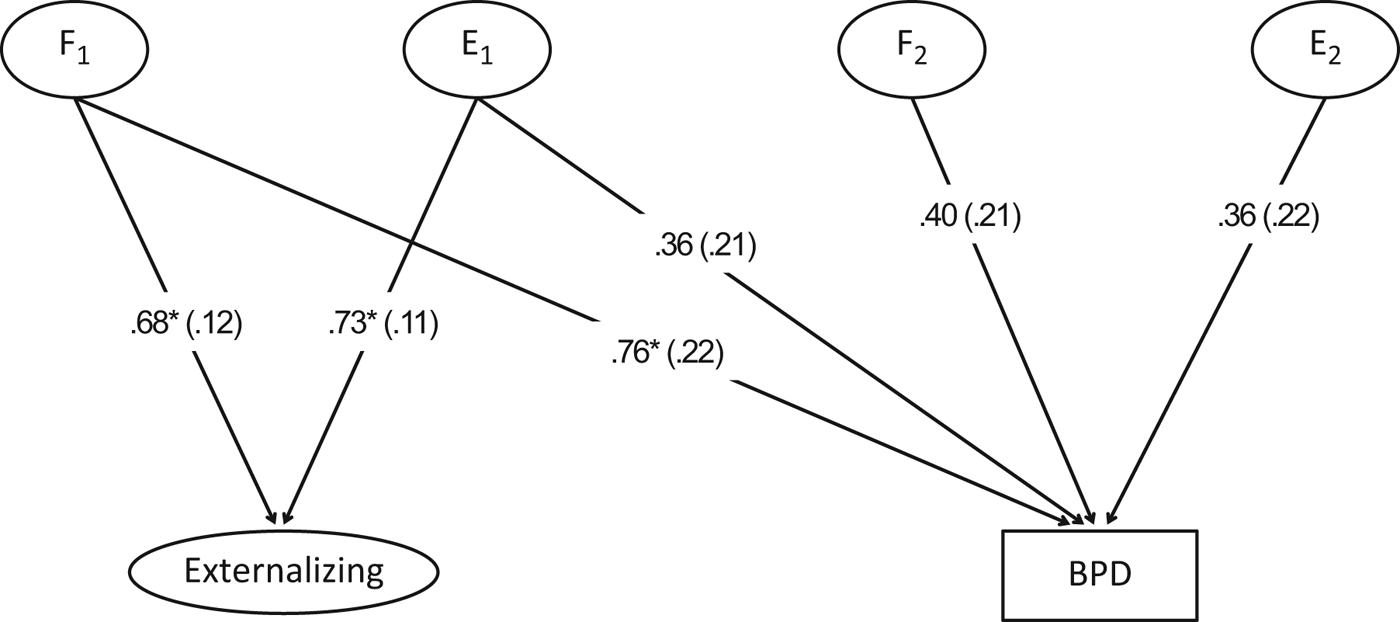
The results of Cholesky decompositions for the association of BPD with internalizing and the association of BPD with externalizing are presented in Figs. 3 and 4. The correlation of BPD and internalizing was almost exclusively due to familial influences (estimate 99%, s.e. = 0.2%, p < 0.001). Similarly, 82% (s.e. = 25%, p < 0.001) of the correlation between BPD and externalizing was due to familial influences, with the remainder due to the non-familial environment.
Estimated path coefficients (standard errors) for model with borderline personality (BPD) and internalizing latent variable. * p < 0.05. ‘F’ variables represent familial factors; ‘E’ variables represent non-familial environmental factors.

Estimated path coefficients (standard errors) for model with borderline personality (BPD) and externalizing latent variable. * p < 0.05. ‘F’ variables represent familial factors; ‘E’ variables represent non-familial environmental factors.

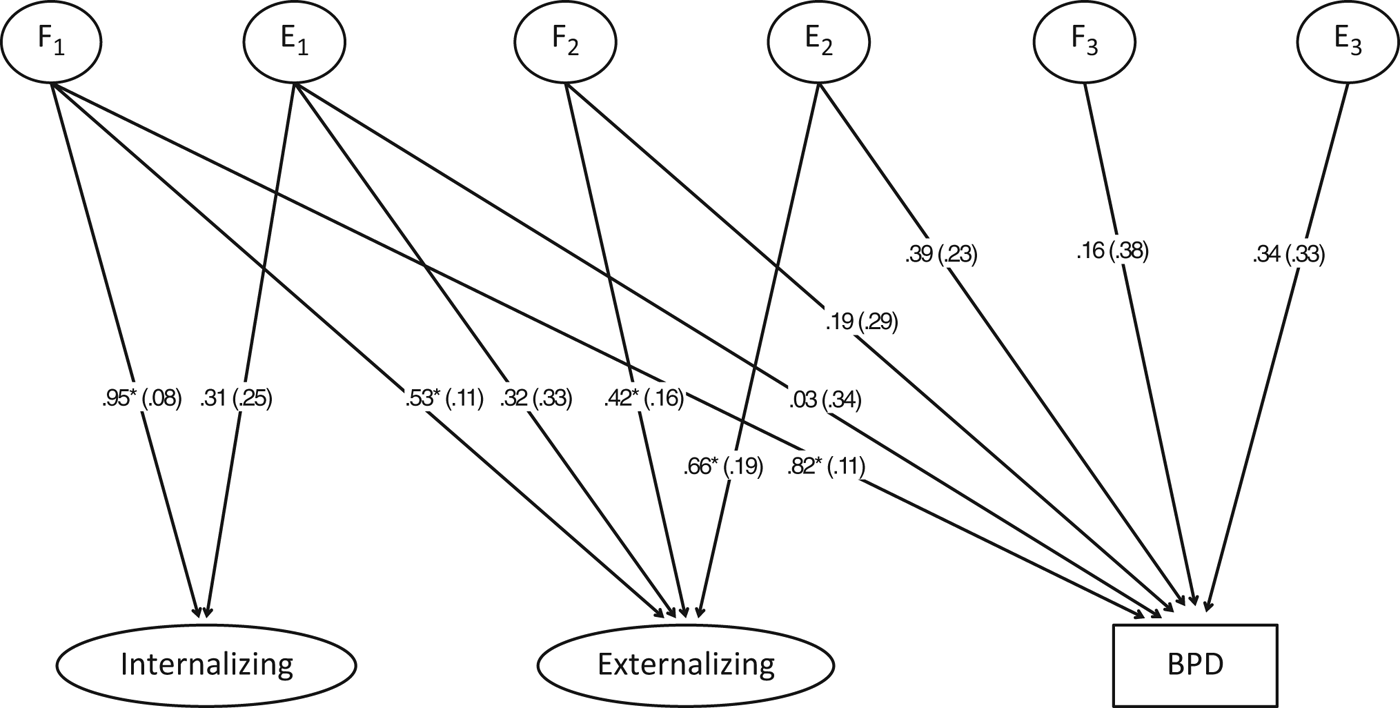
In the full Cholesky decomposition with internalizing and externalizing factors (Fig. 5), 84% (s.e. = 17%, p < 0.001) of the association of BPD with internalizing and externalizing factors was accounted for by familial influences; specifically, [((F1 – BPD)2 + (F2 – BPD)2)/((F1 – BPD)2 + (F2 – BPD)2 + (E1 – BPD)2 + (E2 – BPD)2)] × 100% = 84%. Furthermore, the total variance of BPD could be decomposed as follows: 71% (s.e. = 26%, p = 0.006) due to familial influences shared with internalizing or externalizing; 2% (s.e. = 19%, p = 0.91) due to familial influences not shared with internalizing or externalizing; 14% (s.e. = 13%, p = 0.30) due to non-familial environmental influences shared with internalizing or externalizing factors; and 14% (s.e. = 13%, p = 0.29) due to non-familial environmental influences not shared with internalizing or externalizing factors. A corollary of the second element of this decomposition is that 98% (s.e. = 19%, p < 0.001) of the familial aggregation of BPD (i.e. the correlation of BPD between family members) was accounted for by familial influences shared with internalizing or externalizing factors.
Estimated path coefficients (standard errors) for model with borderline personality (BPD), internalizing latent variable, and externalizing latent variable. * p < 0.05. ‘F’ variables represent familial factors; ‘E’ variables represent non-familial environmental factors.

Note that changing the order of the variables entered into the Cholesky decomposition models had a negligible effect on the results.
Discussion
We used data from a family interview study of BPD, involving 368 probands and 885 of their siblings and parents, to analyse the relationship of BPD with internalizing and externalizing disorders. The main finding was that familial contributions to internalizing and externalizing liability factors also mutually contributed to BPD. Moreover, these familial contributions accounted largely for the pattern of co-morbidity between BPD and the various internalizing and externalizing disorders examined in our study and explained almost all of the familiality of BPD.
Examining our results in more detail, and looking first at the within-person associations of BPD with co-morbid disorders, our finding on confirmatory factor analysis that BPD loaded substantially on internalizing and externalizing factors is broadly consistent with previous exploratory factor analytic studies (James & Taylor, Reference James and Taylor2008; Eaton et al. Reference Eaton, Krueger, Keyes, Skodol, Markon, Grant and Hasin2011; Kotov et al. Reference Kotov, Ruggero, Krueger, Watson, Yuan and Zimmerman2011; Roysamb et al. Reference Roysamb, Kendler, Tambs, Orstavik, Neale, Aggen, Torgersen and Reichborn-Kjennerud2011). For example, James & Taylor (Reference James and Taylor2008) found that BPD loaded on the externalizing factor and the distress or anxious–misery subfactor of the internalizing factor. In models with a larger number of separate factors, Roysamb et al. (Reference Roysamb, Kendler, Tambs, Orstavik, Neale, Aggen, Torgersen and Reichborn-Kjennerud2011) found loading on internalizing, externalizing, and an additional factor of cognitive-relational disturbance; and Kotov et al. (Reference Kotov, Ruggero, Krueger, Watson, Yuan and Zimmerman2011) found loading on internalizing and antagonism (but not externalizing).
Our sample size was not large enough to perform an informative exploratory factor analysis of the loading of BPD on other potential factors or subfactors. Furthermore, even if we were to specify more potential factors on the basis of either exploratory or confirmatory factor analysis of within-person associations, it would not have been possible to run more complicated models for familial factors, since our dataset only barely supported the fitting of internalizing and externalizing latent factors. Nevertheless, even though a more fine-grained analysis with respect to internalizing subfactors and potentially other factors would be desirable, as a ‘first approximation’, our data are consistent with and thereby buttress the findings of prior studies. For future work using larger samples, of particular interest would be the potential loading on subfactors related to internalizing disorders (James & Taylor, Reference James and Taylor2008; Eaton et al. 2010; Kendler et al. Reference Kendler, Myers and Reichborn-Kjennerud2011b ) or the relationship of BPD to potential latent factors associated with Axis I and Axis II psychopathology when also taking internalizing and externalizing factors into account (Kendler et al. Reference Kendler, Aggen, Knudsen, Roysamb, Neale and Reichborn-Kjennerud2011a ).
Turning to our analysis of associations between family members, three conclusions emerge. First, we found that the association of externalizing and internalizing factors with BPD was largely familial in nature, since additional shared non-familial (that is, shared unique environmental) influences were small. This result is not surprising, given that internalizing and externalizing factors themselves have been shown to have genetic bases specific for each factor and to some extent also shared across both factors (Kendler et al. Reference Kendler, Prescott, Myers and Neale2003).
Second, our findings extend the results of prior studies, including our own, showing that BPD is highly familial (discussed further elsewhere; Gunderson et al. Reference Gunderson, Zanarini, Choi-Kain, Mitchell, Jang and Hudson2011). The present analysis demonstrates further that the familial contributions to BPD are almost exclusively those shared with internalizing or externalizing factors. Thus, there is little evidence for familial influences specific to BPD or shared with another spectrum of psychopathology (for example, another cluster of disorders, such as one involving other personality disorders, that has a shared familial liability factor).
Family study data, unlike twin study data, cannot generate estimates of the proportion of familial influences caused by genetic factors and those caused by common family environment without strong additional assumptions (Javaras et al. Reference Javaras, Hudson and Laird2010a ). However, it is likely that the great preponderance of familial influences identified in our study are genetic, because twin studies of BPD (Torgersen et al. Reference Torgersen, Lygren, Oien, Skre, Onstad, Edvardsen, Tambs and Kringlen2000; Distel et al. Reference Distel, Trull, Derom, Thiery, Grimmer, Martin, Willemsen and Boomsma2008; Kendler et al. Reference Kendler, Aggen, Czajkowski, Roysamb, Tambs, Torgersen, Neale and Reichborn-Kjennerud2008; Bornovalova et al. Reference Bornovalova, Hicks, Iacono and McGue2009) and of several of the co-morbid disorders assessed in our present study (Sullivan et al. Reference Sullivan, Neale and Kendler2000; Hettema et al. Reference Hettema, Neale and Kendler2001; Kendler et al. Reference Kendler, Prescott, Myers and Neale2003; Hicks et al. Reference Hicks, Krueger, Iacono, McGue and Patrick2004; Kendler & Eaves, Reference Kendler and Eaves2005) have found little evidence for a significant contribution of common family environment.
The finding that both internalizing and externalizing factors were associated with, and therefore may contribute to, BPD suggests that BPD is, in the terminology of Roysamb et al. (Reference Roysamb, Kendler, Tambs, Orstavik, Neale, Aggen, Torgersen and Reichborn-Kjennerud2011), ‘interspectral in nature’. As discussed by others (Paris, Reference Paris2007; Eaton et al. Reference Eaton, Krueger, Keyes, Skodol, Markon, Grant and Hasin2011; Roysamb et al. Reference Roysamb, Kendler, Tambs, Orstavik, Neale, Aggen, Torgersen and Reichborn-Kjennerud2011), several possibilities might account for this interspectrality. The first, which we refer to as ‘clinical and causal heterogeneity’, is that BPD might embrace in its clinical manifestations a mixture of primarily internalizing and primarily externalizing subtypes caused by underlying largely independent internalizing and externalizing factors. The second, ‘clinical homogeneity, causal heterogeneity’, is that BPD might be homogeneous at the level of its clinical manifestations, but heterogeneous in its causality – that is, caused by different degrees of underlying internalizing and externalizing factors in different individuals. To give an oversimplified medical analogy, diabetes has a fairly homogeneous clinical presentation, but is heterogeneous in causality, with one form caused by destruction of pancreatic islet cells and the other form by insulin resistance. In favor of this second hypothesis, factor analytic studies (Sanislow et al. Reference Sanislow, Grilo, Morey, Bender, Skodol, Gunderson, Shea, Stout, Zanarini and McGlashan2002; Johansen et al. Reference Johansen, Karterud, Pedersen, Gude and Falkum2004; Aggen et al. Reference Aggen, Neale, Roysamb, Reichborn-Kjennerud and Kendler2009; Eaton et al. Reference Eaton, Krueger, Keyes, Skodol, Markon, Grant and Hasin2011) show that the diagnostic criteria for BPD load on a unitary factor. Also supportive are previously published findings from the present family study database (Gunderson et al. Reference Gunderson, Zanarini, Choi-Kain, Mitchell, Jang and Hudson2011) and from twin studies (Distel et al. Reference Distel, Willemsen, Ligthart, Derom, Martin, Neale, Trull and Boomsma2010; Kendler et al. Reference Kendler, Myers and Reichborn-Kjennerud2011b ) showing that a model with a unitary familial/heritable liability to BPD better explains the familiality of BPD than a model with multiple familial/heritable liabilities reflecting the individual sectors of BPD psychopathology (e.g. affective, interpersonal, behavioral and cognitive).
A third possible hypothesis, ‘clinical and causal homogeneity’, is that the internalizing and externalizing factors are not truly independent in the first place, and that BPD effectively arises from a single joint internalizing/externalizing factor. Lending some support for the plausibility of this ‘joint-factor’ hypothesis, Kendler et al. (Reference Kendler, Prescott, Myers and Neale2003) in a twin study found that ‘the internalizing general genetic factor consistently loads modestly on the externalizing disorders and vice versa’, and noted that a strict division between internalizing and externalizing factors may be an oversimplification. In the present study we found a substantial correlation between internalizing and externalizing factors in the within-person analyses and also strong evidence for shared familial basis for internalizing and externalizing disorders. Thus, BPD might be roughly as causally homogeneous as any of the individual internalizing or externalizing disorders, but give only the appearance of greater causal heterogeneity.
The inability of our analysis to discriminate among the above three competing hypotheses reflects to some extent the inherent limitations of using phenomenology alone to understand the causal structure of mental disorders such as BPD. Thus, further progress will probably require integration of phenomenology with a better understanding of underlying psychopathological, developmental and neurobiological processes (Insel et al. Reference Insel, Cuthbert, Garvey, Heinssen, Pine, Quinn, Sanislow and Wang2010; Kendler, Reference Kendler2012). This progress will probably include identification of relevant endophenotypes (Siever et al. Reference Siever, Torgersen, Gunderson, Livesley and Kendler2002). An example of this type of work is a recent study (Ruocco et al. Reference Ruocco, Laporte, Russell, Guttman and Paris2012) that found that a subgroup of relatives of individuals with BPD had clinically meaningful deficits of response inhibition despite not having BPD themselves. In addition, future research should explore the developmental trajectory of BPD, following the lines of recent work that have attempted to integrate the internalizing and externalizing features of BPD into a developmental framework (Crowell et al. Reference Crowell, Beauchaine and Linehan2009; Chanen & Kaess, Reference Chanen and Kaess2012; Stepp et al. Reference Stepp, Burke, Hipwell and Loeber2012).
There are several limitations of the study that should be considered. First, we did not sample probands randomly from a defined source population. Thus, our sampling method may have introduced selection (or ascertainment) bias if the probands were not representative of individuals in the source population in the three groups sampled. However, as we have discussed previously (Gunderson et al. Reference Gunderson, Zanarini, Choi-Kain, Mitchell, Jang and Hudson2011), we found no evidence in this dataset for a significant interaction between the source of BPD proband (patient v. community) and measures of the familial aggregation of BPD, suggesting that these two sources were similar, and probands from all groups were recruited without knowledge of whether they had any co-morbid mental disorders. Second, we evaluated only a certain set of co-morbid disorders, and in particular did not include some disorders of interest with respect to their relationship with BPD such as psychotic disorders and bipolar disorder because presence of these disorders was excluded in probands. However, the exclusion of these disorders is not likely to have affected our findings with respect to the relationship of BPD to internalizing and externalizing disorders. Third, all of the analyses are based on the assumption that, aside from the effects related to the outcome variables, there are no important differences in measures of familial aggregation between pairs of relatives. This assumption is difficult to test, particularly in the setting of the multivariate analyses of the present study, but we found no evidence for such effects in this dataset with respect to the familial aggregation of BPD (Gunderson et al. Reference Gunderson, Zanarini, Choi-Kain, Mitchell, Jang and Hudson2011). Fourth, we used weighting based on the inverse probability of selection using a novel estimator of the prevalence of BPD derived from the data on relatives, rather than a direct assessment of prevalence. Any additional uncertainty attributable to the use of this method is not reflected in the confidence intervals, but any such uncertainty would, in any event, be expected to be small relative to other sources. Fifth, not all eligible parents and siblings chose to participate, and thus these missing data could have introduced bias if the characteristics of the non-interviewed relatives were substantially different from those of the interviewed relatives. Sixth, lifetime diagnoses of BPD and other mental disorders are difficult to assess accurately. However, misclassification of this type would be expected to be non-differential and therefore would probably cause bias towards the null. Seventh, as mentioned above, our sample size was not large enough to perform an informative exploratory factor analysis of the loading of BPD on other potential factors or subfactors. Nor was it large enough to fit more complex confirmatory analyses in a meaningful way, especially since there is less agreement about what factors should be included in such models. However, the present study would seem to represent a reasonable first step in the direction of exploring the latent familial structure of co-morbidity with respect to BPD, and hopefully will stimulate further work along these lines using larger and richer datasets. Eighth, our sample size was also not large enough to generate sufficient power to make valid analyses regarding the potential effects of variables such as sex, age and type of relative pair (e.g. parent–sibling v. sibling–sibling). However, it is reassuring in this regard that we found no evidence for such effects in an analysis of the familial aggregation of BPD using this same dataset (Gunderson et al. Reference Gunderson, Zanarini, Choi-Kain, Mitchell, Jang and Hudson2011), and that other twin studies have found no evidence of sex effects for the heritability of BPD (Distel et al. Reference Distel, Trull, Derom, Thiery, Grimmer, Martin, Willemsen and Boomsma2008). Ninth, due to the small sample size relative to the number of disorders studied, our analysis of familiality was made under the assumption that effects attributable to shared familial environmental were negligible in comparison with those attributable to additive genetic effects. This assumption would appear reasonable on the basis of data from twin studies for the case of BPD alone (Torgersen et al. Reference Torgersen, Lygren, Oien, Skre, Onstad, Edvardsen, Tambs and Kringlen2000; Distel et al. Reference Distel, Trull, Derom, Thiery, Grimmer, Martin, Willemsen and Boomsma2008; Kendler et al. Reference Kendler, Aggen, Czajkowski, Roysamb, Tambs, Torgersen, Neale and Reichborn-Kjennerud2008; Bornovalova et al. Reference Bornovalova, Hicks, Iacono and McGue2009) and more generally for the latent structure of the familial co-morbidity of mental disorders (Kendler et al. Reference Kendler, Prescott, Myers and Neale2003). However, potential effects of shared familial environment would lower the estimates of the magnitude of association. Thus, our estimates of the magnitude of the associations may be biased upward, although this bias is likely to be small. We note further that none of the interpretations of the results of this study rest on the assumption that the familial factors identified are entirely genetic, and indeed it is quite plausible that there are not only relevant environmental familial contributions, but also that there are important gene–environment interactions (which also were assumed solely for modeling purposes to be negligible).
In conclusion, replicating and extending previous work, this study found that familial internalizing and externalizing liability factors are both associated with, and therefore may mutually contribute to, BPD, and these familial contributions account largely for the pattern of co-morbidity between BPD and internalizing and externalizing disorders.
Acknowledgements
This study was supported by the National Institute of Mental Health, grant no. MH 400130 (R01).
Declaration of Interest
None.