Introduction
According to a view that is widely shared in political science and economics, coalition cabinets encounter a common-pool problem when they make decisions with budgetary implications. Consequently, coalition cabinets tend to spend more than single-party cabinets, and coalitions of several parties tend to spend more than compact coalitions. This is because parties are separately accountable to societal groups, each with their own spending priorities, and when government power is shared by several parties, each of them is encouraged to push for spending targeted at narrow groups while neglecting most of the costs (Bawn and Rosenbluth, Reference Bawn and Rosenbluth2006; Persson et al., Reference Persson, Roland and Tabellini2007).
The plausibility of this argument depends on assumptions that have remained largely implicit. First, all parties in a coalition must have sufficient bargaining power in order to influence the composition of budgets. Second, parties must be accountable for the benefits they secure to their target groups, rather than for ideological or programmatic issues that can imply decreases as well as increases in spending. The variation that exists in both respects makes the connection between the number of parties and spending credible in some contexts but not in others.
Conditional connections between the number of government parties and spending have already been identified. Building on the work of Hallerberg et al. (Reference Hallerberg, Strauch and von Hagen2009) on budgetary rules,Footnote 1 Martin and Vanberg (Reference Martin and Vanberg2013) argue that in a sample of Western European countries, rules to reduce the influence of individual parties in the budgetary process and create incentives for parties to resist each other’s spending demands weaken the effect of the number of government parties. Likewise, based on Western European data, Bäck et al. (Reference Bäck, Müller and Nyblade2017) argue that when government parties commit themselves to a comprehensive coalition agreement, then the effect is dampened, at least in settings where the prime minister is weak.
While these arguments are plausible, they pertain to factors that are to some extent in the control of the parties themselves: how budgetary rules are interpreted and obeyed and whether parties commit themselves to comprehensive agreements is at least partly open to discretion. This study focuses on the conditioning effect of factors that are not that open to the influence of the government of the day. Those factors are bargaining power that depends on parties’ ability to turn losing coalitions into winning ones, or a priori voting power, and the extent to which the norm of impartiality is respected in the public sector, or the quality of government (Rothstein, Reference Rothstein2011). The former affects the extent to which parties can influence collective decisions, the latter the importance of distributive issues. The ‘standard argument’ about the spending consequences of multiparty decision-making should be at its most compelling where an even distribution of bargaining power is combined with partial use of public authority. Otherwise, the effect should be considerably weaker.
This study contributes not only to scholarly discussions on the consequences of multiparty government, voting power, and the quality of government, but also to practical debates on the sustainability of public finances. The dataset used in this study covers 30 European countries, many of which have faced serious fiscal problems. The results suggest that effective solutions may have to include measures that improve the credibility of the state as an impartial and efficient provider of large-scale programmes, in order to reduce pressures to channel public funds to distributive purposes.
The results also suggest that the explanatory power of the number of government parties is limited when it comes to understanding the development of public spending in the countries analysed here. No direct connection between the number of government parties and spending is discernible in the group of 30 countries. However, spending does seem to increase with the number of government parties if government parties are approximately equally powerful and the quality of government is relatively low.
Theory and empirical expectations
The number of government parties arguably affects the level of spending because parties do not fully internalize costs when they bargain over the policies to be adopted (Bawn and Rosenbluth, Reference Bawn and Rosenbluth2006). Accountability to different segments of society instead encourages parties to prioritize certain issues, the focus of each party being the narrower, the more parties there are. The mechanism was first formalized in the context of pork-barrel politics in American legislatures (Weingast et al., Reference Weingast, Shepsle and Johnsen1981), but the logic has been applied to parliamentary systems as well. This logic has two important aspects: that several actors are able to affect collective decisions and that those decisions have spending implications. Both aspects are however subject to variation, and therefore the conditions may be more or less favourable for connections to emerge between the number of government parties and spending.
Bargaining on the budget when a vote is anticipated
Weingast et al. (Reference Weingast, Shepsle and Johnsen1981) model a situation in which a legislature, composed of representatives of single-member districts, unanimously allocates sub-optimally large amounts of distributive spending to each district. In the model, the representative of each district internalizes the benefits that come to the district but only partially internalizes the costs that are diffused across all districts. An important assumption is that all districts are entitled to spending due to a universalism norm. As a result, excessively large amounts of resources are spent, and inefficiency increases with the number of represented districts as each representative neglects a larger share of total costs. Importantly, issues with spending implications are at stake and all decision-makers are capable of affecting the outcome.
In extensions of the logic to parliamentary systems, political parties, and especially government parties, rather than representatives of single-member districts, are identified as the key players and the fragmentation of the party system, instead of the number of districts, as the driver of inefficiency. Bawn and Rosenbluth (Reference Bawn and Rosenbluth2006) argue that the costs of policies targeted at parties’ constituencies are not fully internalized in interparty bargaining and that internalized benefits increasingly deviate from internalized costs as the number of parties grows because the target population of each party becomes smaller relative to the society as a whole. A visible consequence is a positive association between the number of parties in government and the overall level of spending. Bawn and Rosenbluth assume that parties draw support from certain groups, each with their own policy priorities, and that the party targeting given groups has disproportionate influence on decisions in the respective issue areas. Large parties with a number of issues on their agenda must more carefully weigh the overall costs and benefits of their actions, however; having few large parties therefore counteracts cost externalization. Persson et al. (Reference Persson, Roland and Tabellini2007) present a related argument, according to which electoral accountability encourages parties to provide goods benefitting specific recipients, rather than goods with diffuse benefits, when several parties participate in electoral competition. Consequently, countries with a high incidence of coalition governments tend to have higher spending levels than countries where single-party governments are the rule.
Not all parties in government however need to be equally capable of influencing the policy package finally adopted, which stems from the fact that the importance of parties in coalition building can vary. Even though policy proposals in parliamentary systems typically originate in the government, proposals have to be accepted by a parliamentary majority in order to become binding decisions. Parties can be more or less important for the formation of a majority, which plausibly affects their success in negotiations preceding the final, decisive stage of the decision-making process. A party that belongs to a large number of potential winning coalitions can put more pressure on others to comply with its demands, whereas a party that is necessary in few potential winning coalitions has fewer possibilities to back its demands by threatening to remain outside of a coalition. The distribution of bargaining power stemming from importance in coalition building, in turn, plausibly affects the connection between the number of parties and spending: the more equal the parties are in terms of their ability to influence collective choices, the stronger should be the connection between the number of parties and policy choices. The bargaining power of a party should affect not only its possibilities to have its preferred policies adopted, but also its possibilities to block policies others prioritize, so that a party that is more powerful than the others finds it easier to reject the demands of other parties.
The ability of a party to influence outcomes is not only a function of its size but also of the distribution of voting weights among all parties. Depending on how voting weights are distributed, the size of a party may or may not be strongly associated with the importance of the party in the building of legislative majorities. Sometimes even a large party has few possibilities to turn losing coalitions into winning ones, whereas a small party sometimes has numerous possibilities (Laver and Benoit, Reference Laver and Benoit2015).
A central notion here is the distribution of power among parties in government, that is, how much power government parties have relative to each other. The effects of multiparty government should be the clearer, the more equal the government parties are. Otherwise, the priorities of some parties have meagre chances of becoming collective choices even if there were multiple parties in government.
An established approach to measuring power in voting bodies draws on parties’ critical presence in coalitions. Indices of a priori voting power build on the notion that the more often a party is able to turn a losing coalition into a winning one or vice versa, the larger is the extent to which it can control voting outcomes (Felsenthal and Machover, Reference Felsenthal and Machover1998). A priori power only depends on the distribution of votes and the decision rule stipulating how many votes are required for any proposal to be accepted. Choices are assumed to be binary, for or against a proposal. The distribution of a priori power is generally not identical to the distribution of seat shares or electoral support (Nurmi, Reference Nurmi2014).
The aforementioned assumptions may appear restrictive because budgetary choices are more-or-less questions that tend to be settled in negotiations. Laruelle and Valenciano (Reference Laruelle and Valenciano2007, Reference Laruelle and Valenciano2009; see also Harsanyi, Reference Harsanyi1977), however, interpret a priori power indices as measures of bargaining power. Specifically, they interpret power indices as weights in a weighted bargaining solution that gives the outcome that can reasonably be expected when different issues are dealt with at different times, vote trading is possible, proposals can be modified, and proposals are subject to approval by voting. In more concrete terms, when a vote is anticipated the voting power of a party affects the extent to which it can push the bargaining outcome to the direction it desires.
An even distribution of power implies that different parties can influence decisions while the same is not true when power is distributed unequally, which leads one to expect an interaction effect between the number of government parties and the distribution of power. Even an equal distribution of power among multiple government parties does not necessarily imply that spending increases, however. Parties’ policy priorities can pertain to ideological or programmatic goals whose spending consequences are ambiguous ex ante. As those kinds of issues are likely to lose importance when the public sector is riddled with partiality, the quality of government expectedly affects the strength of the interaction between the number of government parties and the distribution of power.
Using a sample of OECD countries, Huber et al. (Reference Huber, Kocher and Sutter2003) find that coalitions with roughly equally powerful parties are more prone to run deficits than coalitions where power is unequally distributed. Otherwise, the budgetary consequences of the distribution of a priori power have scarcely been studied.
Quality of government and the prevalence of distributive issues
The quality of government has been shown to affect well-being, trust, and political behaviour in several ways. For the present purposes, a thin, procedural definition of the quality of government is desirable to avoid tautological explanations. Following Rothstein (Reference Rothstein2011: 13), a high quality of government can be defined as impartiality in the use of public authority: when public officials implement laws and policies, they do not take into account anything about the citizen or the case that is not beforehand stipulated by the law or the policy. This rules out a host of practices, such as bribery, nepotism, patronage, and clientelism. The quality of government thus defined does not refer to policy outcomes (cf. La Porta et al., Reference La Porta, Lopez-de-Silanes, Shleifer and Vishny1999). It is also distinct from the level of democracy (Norris, Reference Norris2012). The quality of government, or the lack of it, can often be considered an equilibrium state that can be deliberately influenced only to a limited extent (Persson et al., Reference Persson, Rothstein, Teorell, Holmberg and Rothstein2012; Mungiu-Pippidi, Reference Mungiu-Pippidi2015). The quality of government hence pertains to the societal environment in which representative politics takes place, not to the features or decisions of the cabinet of the day.
Practices associated with a low quality of government plausibly affect political accountability, including the kinds of issues that are emphasized. For example, corruption marks a major deviation from impartial government and violates the democratic norm of equal inclusion (Warren, Reference Warren2004). Corruption has been found to generally suppress electoral turnout, albeit factors like clientelist mobilization strategies, and clean government issues can increase turnout rates in corrupt systems (Stockemer et al., Reference Stockemer, LaMontagne and Scruggs2013; Dahlberg and Solevid, Reference Dahlberg and Solevid2016); importantly, the duplicity implied by corruption (Warren, Reference Warren2004) reduces the credibility of the aims politicians and parties publicly set. Survey-based evidence suggests that corruption weakens ideological voting motives, as voters find it difficult to identify parties’ programmatic positions, and it is uncertain that parties will implement their programmes (Burlacu, Reference Burlacu2018).
It has also been argued that how people’s attitudes translate into more concrete policy preferences depends on the quality of government (Svallfors, Reference Svallfors2013), with implications for the prospects of programmatic policy-making. Even resourceful actors may decide not to further their programmatic objectives through the state if the quality of government is low (Rothstein et al., Reference Rothstein, Samanni and Teorell2012), and people’s willingness to entrust public officials with the resources needed to implement policy programmes appears to depend on the extent to which officials are perceived as trustworthy (see Jacobs and Matthews, Reference Jacobs and Matthews2017).
Democratic systems can accommodate different kinds of linkages between parties and the rest of society (Kitschelt, Reference Kitschelt2000). While a low quality of government is likely to undermine programme- and ideology-based linkages, it is likely to increase the importance of material and distributive objectives, conducive of a strong connection between the number of parties and spending because costly and targetable policy instruments are at stake. A low quality of government implies that a host of practices ruled out by the impartiality norm can thrive. The public sector can be a source of patronage, so that the public sector is politicized as partisan criteria are applied in the recruitment of officials (e.g. Čehovin and Haček, Reference Čehovin and Haček2015; Nakrošis, Reference Nakrošis2015). Clientelist practices, centred on the exchange of benefits for support (Kitschelt, Reference Kitschelt2000), require narrow and exclusive benefits, as public goods or large-scale programmes available to everyone cannot be targeted (Kitschelt and Wilkinson, Reference Kitschelt, Wilkinson, Kitschelt and Wilkinson2007). A low quality of government breeds distrust (Rothstein, Reference Rothstein2011; Grönlund and Setälä, Reference Grönlund and Setälä2012), and the lack of popular trust in elites, as well as the lack of trust among members of elites, can favour economic populism that revolves around benefits and spending (Győrffy, Reference Győrffy2006).
Public officials that are engaged in corrupt and clientelist practices are moreover likely to have target groups that are very small relative to the society, implying that they are virtually unaffected by the costs of the favours they receive (see Olson, Reference Olson1982). This expectedly strengthens the link between the fragmentation of the decision-making process and spending further, given that the mismatch between the internalized costs and benefits is at the root of the linkage between fragmentation and spending increases. A low quality of government is also associated with inefficiencies in the use of public funds as projects are badly managed, funds are channelled into uses that benefit those that possess discretionary power, and popular projects are provided in cost-inefficient ways (e.g. Della Porta and Vannucci, Reference Della Porta and Vannucci1997; Dahlström and Lapuente, Reference Dahlström and Lapuente2017).
A low quality of government can imply diverse practices that deviate from impartiality, and hence different mechanisms can link it to budgetary decision-making. It is impossible to discriminate between specific mechanisms or channels of influence here. Importantly, however, a low quality of government is likely to make accountability based on benefits with clear spending implications more important, at the expense of accountability based on programmatic objectives that can imply either lower or higher spending levels. It expectedly strengthens the connection between the number of parties and spending, as parties are accountable for the delivery of material benefits while compromising and deliberation on programmatic grounds lose importance.
An essential part of the process is the fact that parties are separately accountable; they need not be accountable to completely different groups (Bawn and Rosenbluth, Reference Bawn and Rosenbluth2006). For example, it is conceivable that parties in a coalition seek to outbid each other if they seek support from the same groups. It is also likely that a low quality of government suppresses the provision of public goods with diffuse benefits. However, the provision of public goods is likely to remain sub-optimally low independently of the number of parties, and hence a low quality of government should contribute to a positive connection between the number of parties and the overall spending level. Specifically, it should contribute to a positive connection when parties are approximately equally powerful, as in such cases different parties can influence collective decisions while facing incentives to focus on distributive measures.
Some have argued that large public sectors are conducive of corruption because they create opportunities for officials to extract resources (Goel and Nelson, Reference Goel and Nelson1998; Alesina and Angeletos, Reference Alesina and Angeletos2005). Persson and Rothstein (Reference Persson and Rothstein2015), in contrast, argue that large public sectors create a sense of ownership among the public, encouraging people to monitor their officials more closely and hence reducing the opportunities to misuse public resources. For present purposes, however, the expected conditioning effect of the quality of government is more important than a possible direct connection to the spending level.
Empirical expectations
The preceding discussion leads one to expect that the effect of the number of government parties on spending depends on two factors, the distribution of power and the quality of government. In particular, a three-way interaction is to be expected. The strength of the interaction between the number of government parties and the distribution of power depends on the quality of government, on the one hand, and the strength of the interaction between the number of government parties and the quality of government depends on the distribution of power, on the other.
Four basic contexts can be identified. The first two are direct opposites of each other:
(1) Power is equally distributed, and the quality of government is low. Both factors favouring a connection between the number of government parties and spending are there: parties have both the incentive and the possibility to secure benefits for their target groups, and hence the number of parties expectedly has a discernible effect.
(2) Power is unequally distributed, and the quality of government is high. Not all parties have notable influence on collective decisions, and politics is more likely to revolve around programmatic questions without clear ex ante spending implications. The number of parties should have no systematic, discernible effect on spending.
Two contexts in which the expected effect of the number of government parties is at most modest fall in between the previous ones:
(3) Power is unequally distributed, and the quality of government is low. Distributive issues dominate, but not all parties have a major impact on decisions.
(4) Bargaining power is equally distributed, and the quality of government is high. Different parties can influence decisions, but the spending implications of those decisions are not clear ex ante.
Data and methods
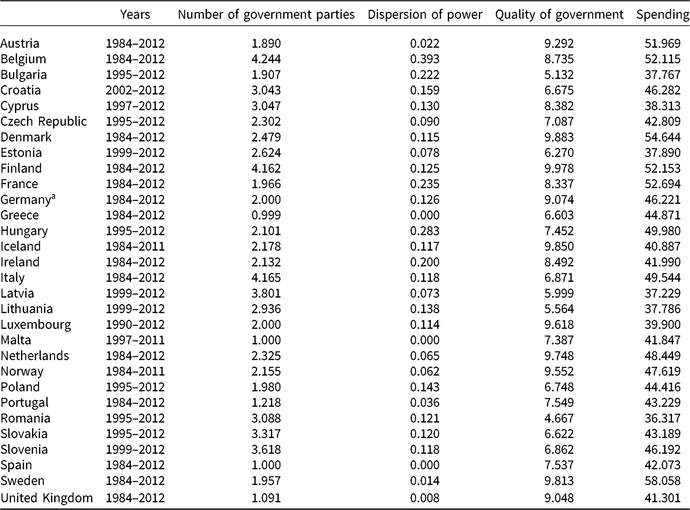
The dataset covers 30 European countries with a parliamentary system of government (Table 1). The length of the time-series varies across countries due to data availability. Data on Western European countries are generally available for a longer period than data on the so-called new EU countries. As for most Western Europe countries, data on all variables are available from the mid-1980s onwards. Data on new EU countries are generally available since the mid-1990s; quality of government scores, however, are unavailable for some countries before 1999. The study period ends in 2012 when most of the EU countries adopted the so-called Fiscal Compact.
Countries and years in the dataset

a Until 1989: West Germany.
Table 1 reports the country averages of the number of government parties, the dispersion of power, the quality of government, and the level of spending (see later for operationalizations). There are countries that have had little or no experience of coalition governments and hence a small average number of government parties. Countries with long periods of single-party government are excluded from the analysis as a robustness check.
The dependent variable is the ratio of total general government spending to GDP, obtained from OECD and AMECO databases via Armingeon et al. (Reference Armingeon, Isler, Knöpfel, Weisstanner and Engler2015).
Three explanatory variables, alongside their interactions, are of greatest interest. First, the number of government parties is the number of parties identified as cabinet parties in the ParlGov database (Döring and Manow, Reference Döring and Manow2016). Second, following Huber et al. (Reference Huber, Kocher and Sutter2003), the dispersion of power is the standard deviation of cabinet parties’ Shapley-Shubik indices.Footnote 2 The Shapley-Shubik index equates the power of a party with its share of all parties’ pivotal positions when all permutations of parties are equally likely (e.g. Felsenthal and Machover, Reference Felsenthal and Machover1998). Power indices were calculated using the Powerslave Voting Power and Power Index Website (Pajala et al., Reference Pajala, Meskanen and Kause2002). When calculating the indices, it was assumed that a simple majority in the (lower house of the) parliament is winning. The larger the standard deviation, the less equal parties are in terms of power.
Third, the quality of government is measured by an index drawing on International Country Risk Guide data, produced by the PRS Group that is specialized in the assessment of country risks. The index takes into account three aspects (see Howell, Reference Howell2012). The first is freedom from corruption, including bribery, secret party funding, suspiciously close ties between politics and business as well as nepotism and patronage. The second is law and order, measuring the strength and impartiality of the legal system and popular observance of the law. Finally, bureaucracy quality measures the autonomy of public bureaucrats from political pressures, which implies established recruitment and training mechanisms. The index is obtained from the Quality of Government Dataset (Teorell et al., Reference Teorell, Dahlberg, Holmberg, Rothstein, Hartmann and Svensson2015). For present purposes, the index was multiplied by 10 so that its theoretical minimum and maximum values are 0 and 10, in order to make regression coefficients larger and easier to interpret. Larger values indicate a higher quality of government.
The effective number of government parties is used in one specification instead of the number of government parties and the dispersion of power. It is the Laakso-Taagepera (Reference Laakso and Taagepera1979) index of party system fragmentation, where seat shares refer to parties’ shares of the total number of parliamentary seats held by the government. The variable is calculated based on Döring and Manow (Reference Döring and Manow2016).
As the level of spending reflects a host of occurrences and developments that the government can affect to varying degrees, a number of control variables are included in the regression models. Features of the cabinet and the parliament that do not go back to the variables identified earlier can also affect spending, and therefore some political variables are also controlled for. The structure of the regression models, including the set of control variables, largely follows Bawn and Rosenbluth (Reference Bawn and Rosenbluth2006), Martin and Vanberg (Reference Martin and Vanberg2013) and Bäck et al. (Reference Bäck, Müller and Nyblade2017). A model with a minimal number of controls is estimated as a robustness test.
Controls include, first, the left-right position of the cabinet or the weighted mean of government parties’ left-right scores from the Comparative Manifesto Project database (Volkens et al., Reference Volkens, Lehmann, Matthieß, Merz, Regel and Weßels2017), weights being parties’ shares of the total number of parliamentary seats held by the government. The theoretical minimum and maximum values of the variable are −100 and +100, larger values indicating more rightist positions. Rightist governments expectedly spend less (Potrafke, Reference Potrafke2017).
The second political control variable is caretaker time or the fraction of the year a caretaker cabinet, lacking the mandate for major reforms, was in office. In the case of caretaker cabinets, all other cabinet-related variables are moreover set to zero (i.e. zero parties and an exactly centrist position). The third political control variable is the effective number of parliamentary parties that measures the fractionalization of the parliamentary party system. Some studies have concluded that the effective number of parties represented in the parliament is positively associated with spending (e.g. Mukherjee, Reference Mukherjee2003). Both the effective number of parliamentary parties and caretaker time are calculated based on Döring and Manow (Reference Döring and Manow2016).
As decisions on the budget of a given year are typically made during the previous year, lagged values (those pertaining to the preceding year) of all political variables are used. If the values of political variables change during the year, the variables are weighted by the fraction of the year the respective cabinet or parliament was in office.
Four variables are intended to capture the macroeconomic and socio-economic environment. They are GDP per capita in thousands of dollars (own calculations based on Penn World Table; Feenstra et al., Reference Feenstra, Inklaar and Timmer2015), the age dependency ratio (World Bank, 2016), the unemployment rate (AMECO via Armingeon et al., Reference Armingeon, Isler, Knöpfel, Weisstanner and Engler2015) and trade openness (Penn World Table via Armingeon et al., Reference Armingeon, Isler, Knöpfel, Weisstanner and Engler2015). Both the lagged and current values of these variables are included to reflect the fact that they may have both long- and short-term effects.
Fiscal rules that set limits and targets on budgetary aggregates have become increasingly widespread in recent decades. Two variables measure the fiscal governance framework of the country. One is an index of expenditure rules that draws on data provided by the International Monetary Fund (2016). Expenditure rules refer to numerical limits on spending increases, alongside the legal and institutional arrangements that support those restrictions (see Budina et al., Reference Budina, Kinda, Schaechter and Weber2012). Larger values of the index indicate stronger rules. The calculation of the index largely follows the procedure described by Schaechter et al. (Reference Schaechter, Kinda, Budina and Weber2012), and the variable is described in detail in the supplementary material. The dummy variable Maastricht indicates whether the Maastricht treaty or any of its successors, containing basic rules on debt and deficits in the EU countries, was in force in the country.
Finally, as budgets expectedly exhibit strong continuity, the level of spending in the previous year is included as an explanatory variable.
The definitions and sources of all variables, alongside descriptive statistics, are summarized in Tables S1 and S2 in the Supplementary Material.
Models
Earlier, it was concluded that a three-way interaction between the number of government parties, the dispersion of power and the quality of government should be expected. Therefore, the regression models of main interest are of the form
 $$\eqalign{{\rm{spendin}}{{\rm{g}}_{i,t}} & = {\beta _1}{\left( {{\rm{number}}\;{\rm{of}}\;{\rm{government}}\;{\rm{parties}}} \right)_{i,t - 1}} + {\beta _2}{\left( {{\rm{dispersion}}\;{\rm{of}}\;{\rm{power}}} \right)_{i,t - 1}} \cr & \quad + {\beta _3}{\left( {{\rm{quality}}\;{\rm{of}}\;{\rm{government}}} \right)_{i,t - 1}} \cr & \quad + {\beta _4}{\left( {{\rm{number}}\;{\rm{of}}\;{\rm{government}}\;{\rm{parties}} \times {\rm{dispersion}}\;{\rm{of}}\;{\rm{power}}} \right)_{i,t - 1}} \cr & \quad + {\beta _5}{\left( {{\rm{number}}\;{\rm{of}}\;{\rm{government}}\;{\rm{parties}} \times {\rm{quality}}\;{\rm{of}}\;{\rm{government}}} \right)_{i,t - 1}} \cr & \quad + {\beta _6}{\left( {{\rm{dispersion}}\;{\rm{of}}\;{\rm{power}} \times {\rm{quality}}\;{\rm{of}}\;{\rm{government}}} \right)_{i,t - 1}} \cr & \quad + {\beta _7}{\left( {{\rm{number}}\;{\rm{of}}\;{\rm{government}}\;{\rm{parties}} \times {\rm{dispersion}}\;{\rm{of}}\;{\rm{power}} \times {\rm{quality}}\;{\rm{of}}\;{\rm{government}}} \right)_{i,t - 1}} \cr & \quad + \beta {{\bf{x}}_{i,t,t - 1}} + { \in _{i,t}},}$$
where i and t are country and year indices, respectively, and x is a vector of control variables.
Breusch–Godfrey/Wooldridge tests indicate that serial correlation is present when neither the lagged dependent variable (LDV) nor fixed effects are included. After the inclusion of the LDV, serial correlation can be rejected, albeit weakly. According to Wooldridge’s test of serial correlation in fixed effects panels, serial correlation can safely be rejected once fixed effects are introduced. Fixed effects have substantive justifications. Fixed country effects capture unobserved cultural and institutional features as well as potentially stable policy preferences among the population. Fixed year effects, in turn, capture common macroeconomic shocks. F tests indeed indicate that significant country and year effects are present. Diagnostic tests hence suggest that a two-way fixed effects model with LDV is appropriate. Panel-corrected standard errors (Beck and Katz, Reference Beck and Katz1995) are calculated to address cross-sectional dependence and heteroscedasticity, which according to Pesaran’s and Breusch–Pagan tests are present in the data. Based on augmented Dickey–Fuller tests, non-stationarity of the dependent variable can be rejected. Changes to the specification and the set of cases are used as robustness checks.
Results
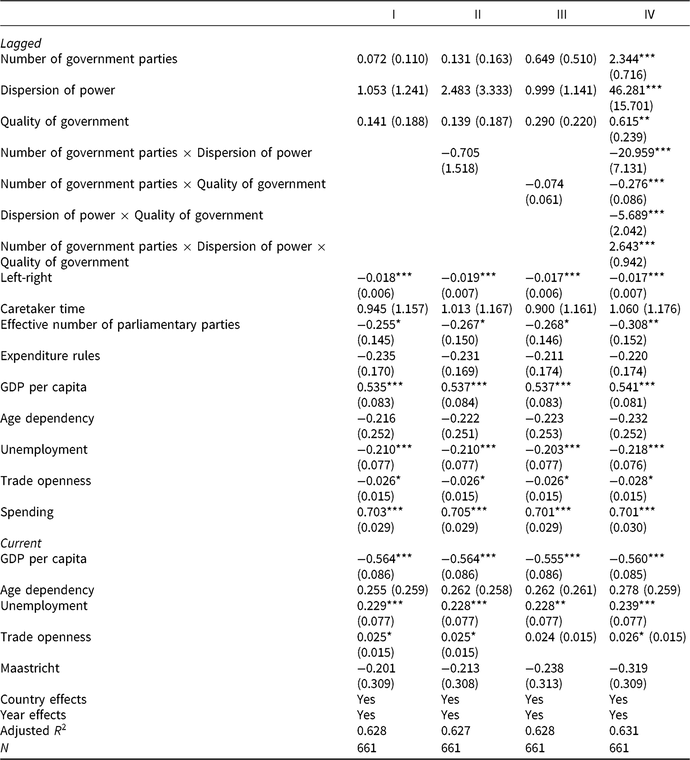
Table 2 presents the main results. The first model contains no interaction terms and tests whether the variables of interest have direct (unconditional) effects. In the following two models, the number of government parties is interacted with the dispersion of power and the quality of government, respectively. The fourth model, containing the three-way interaction, is the model of main interest.
Regression results with total general government spending (% of GDP) as the dependent variable

Significance levels: ***P < 0.01, **P < 0.05, *P < 0.10. Panel-corrected standard errors in parentheses.
In Column I of Table 2, the number of government parties has no effect, and hence the unconditional effect found in some earlier studies is not discernible. In Columns II and III, the interaction terms have negative signs, but neither the interaction terms nor their components are statistically significant. In Column IV, in contrast, the key variables are statistically significant and have the expected signs that indicate that the effect of the number of parties is strongest when the quality of government is low and the government parties are equally powerful.
The coefficient on the number of government parties shows the effect of the variable when the values of the other components of the three-way interaction term are zero. The coefficient on the two-way interaction term consisting of the number of government parties and the dispersion of power, in turn, is the estimated interaction effect when the quality of government is zero. The negative sign indicates that when the quality of government is extremely low, the effect of the number of government parties becomes smaller as parties become less equal in terms of power. Similarly, the negative coefficient on the interaction term consisting of the number of government parties and the quality of government means that when parties are equally powerful, improvements in the quality of government weaken the effect of the number of government parties. Finally, the positive coefficient on the three-way interaction term suggests that both of these interactions become weaker when either the quality of government improves or parties become more unequal in terms of power. Both changes make the connection between the number of government parties and spending weaker.
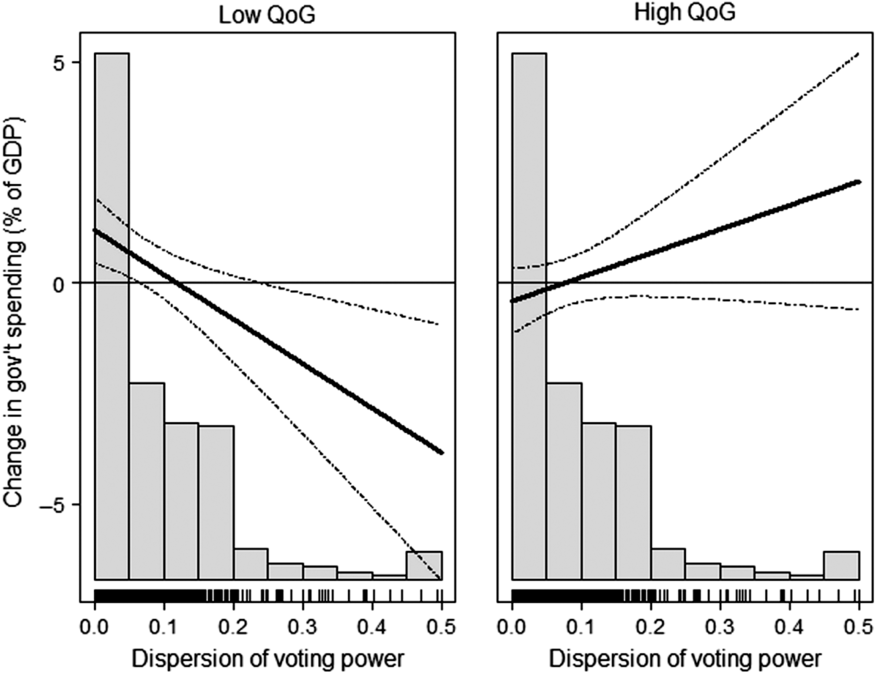
Figure 1 shows the estimated effect of the number of government parties, alongside the boundaries of the 95% confidence interval, at different values of power dispersion in two cases. The ‘Low QoG’ scenario is estimated by fixing the value of the quality of government score to 4.67, which is the lowest country average (Romania) in the dataset. When power differences between parties are small, increases in the number of government parties tend to be associated with spending increases; the effect is statistically significant at the P < 0.05 level. As the dispersion of power increases, the effect becomes statistically indiscernible from zero. However, when power is highly dispersed, the effect turns negative. The figure also displays the distribution of the power dispersion variable. As the dispersion of power is generally quite low in the data, the positively signed effect indeed appears to have empirical relevance. While large values of the power dispersion variable are rare and the negative effect therefore has probably less empirical relevance, it is nevertheless noteworthy as it runs counter to the established view.
The effect of the number of government parties on spending at different levels of the dispersion of voting power when the quality of government (QoG) is low (4.67 on a scale from 0 to 10) or high (9.98).

In the ‘High QoG’ scenario in Figure 1, the quality of government score is fixed to 9.98, which is the highest country average (Finland). The small slope of the marginal effect implies that the effect does not change much when the dispersion of power changes. Moreover, the effect is always statistically insignificant.
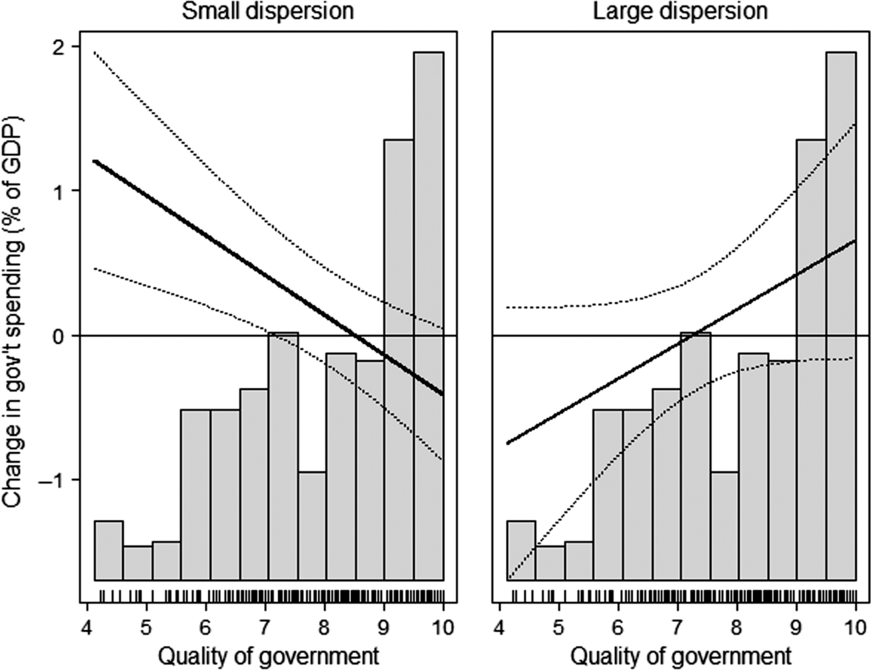
In Figure 2, the effect of the number of government parties is shown as a function of the quality of government when power differences among parties are either small or large. In the ‘Small dispersion’ setting, the dispersion of power is zero; that is, parties are equally powerful. The addition of parties to the government coalition is associated with spending increases in a statistically significant way when the quality of government score is about seven or lower. When the quality of government is very low and power is evenly distributed, the point estimate of the effect is close to 1 per cent of GDP, a notable increase.
The effect of the number of government parties on spending at different levels of the quality of government when the dispersion of power is small (zero) or large (0.195).

In the ‘Large dispersion’ scenario, the dispersion of power is 0.195, which is the mean of the variable in the dataset plus one standard deviation. The sign of the slope changes, but the estimated effect is statistically insignificant on all quality of government levels.Footnote 3
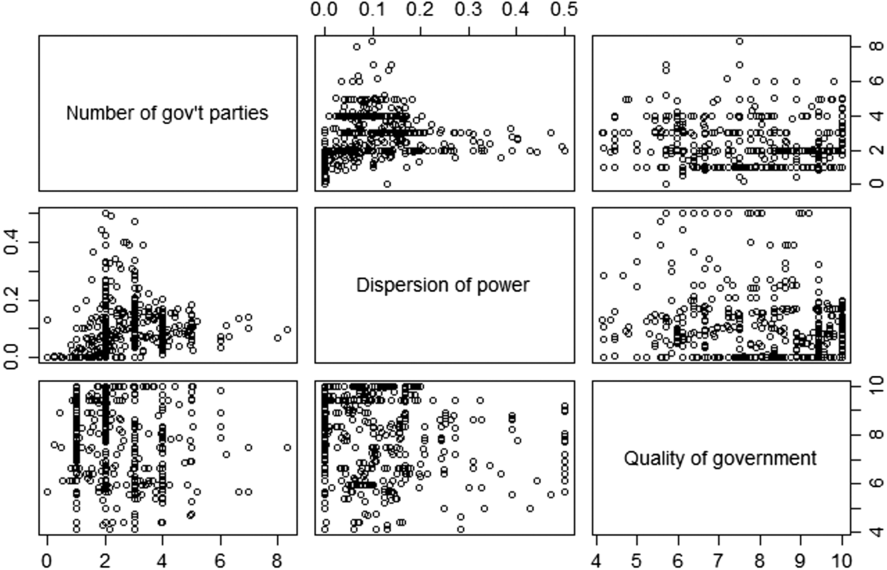
To help assess how large a share of observations is characterized by multiparty government, small dispersion of power, and low quality of government, a scatterplot matrix of the three interacted variables is shown in Figure 3. The share of observations with this combination is relatively small, as country-years are clustered towards the high end of the quality of government spectrum, and observations with a low quality of government often exhibit somewhat unequally distributed power. The number of cases in which the number of government parties affects spending is hence not very large. From the perspective of policy interventions, however, the quality of government score is perhaps the more relevant conditioning variable. Figure 2 shows that when the quality of government score is approximately seven or smaller, there is at least a risk that spending increases with the number of government parties. Thirteen out of the 30 countries have lower country averages.
The distributions of the interacted variables.

Voting power vs. voting weights
Power indices and seat shares tend to correlate. This means that voting power may bring no additional value compared to simple seat shares. For example, Volkerink and De Haan (Reference Volkerink and De Haan2001) use the effective number of government parties as an explanatory variable, pointing out that the interparty negotiation process plausibly depends on whether the parties are of equal or unequal size (p. 238, endnote 5). In what follows, the interaction between the number of government parties and the dispersion of power is replaced with the effective number of government parties.
The effective number of government parties is calculated based on parties’ shares of the total number of parliamentary seats controlled by the government. Volkerink and De Haan (Reference Volkerink and De Haan2001) use shares of ministerial posts when calculating the index. However, as the distribution of portfolios is an outcome of inter-party negotiations, it would be questionable to use it as an explanatory variable.
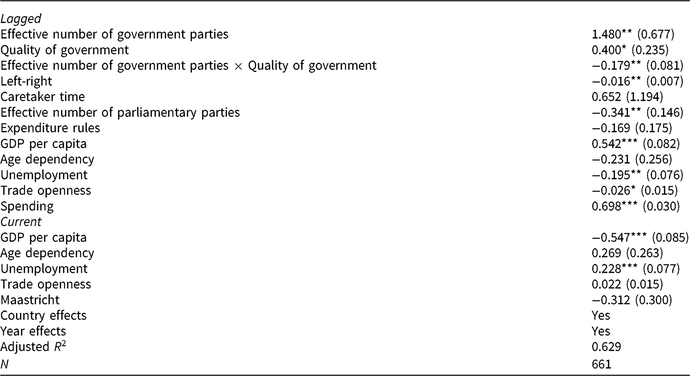
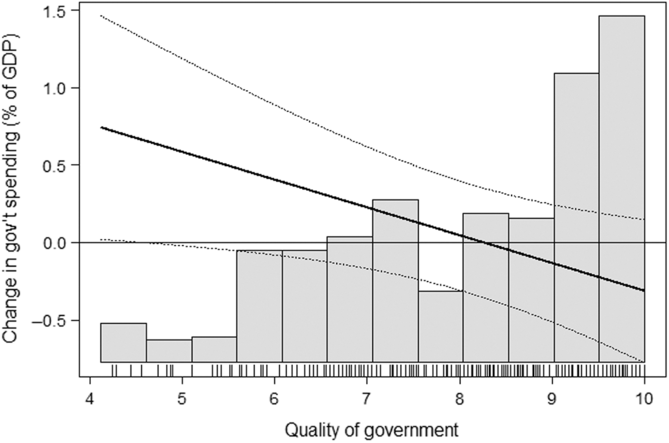
The results are reported in Table 3. The effective number of government parties does interact with the quality of government. However, an analysis of marginal effects (Figure 4) shows that the empirical relevance of this finding is very limited. The effect is statistically indiscernible from zero except in a handful of cases with the lowest quality of government scores in the dataset. Otherwise, it is accompanied by considerable uncertainty.
Regression results with the level of public spending (% of GDP) as the dependent variable

Significance levels: ***P < 0.01, **P < 0.05, *P < 0.10. Panel-corrected standard errors in parentheses.
The effect of the effective number of government parties on spending at different levels of the quality of government.

Robustness
Detailed results from robustness tests are reported in the supplementary material, and they can be summarized as follows. The first series of tests pertains to model specification and case selection (Supplementary Table S3). Dropping either country effects or year effects leads to no substantive changes in the results. Similarly, no substantive changes occur when Blundell and Bond’s (Reference Blundell and Bond1998) ‘system’ generalized method of moments estimator is used, the aim being to avoid the so-called Nickell (Reference Nickell1981) bias that comes with the lagged dependent variable. Some of the countries in the dataset have had notable experience of single-party cabinets, and in these cases there is little or no within-country variation in the interaction terms. When these countries are excluded using simple rules of thumb (i.e. dropping countries with an average number of government parties smaller than 1.5 or 2.0), the results do not change substantively. Countries were also dropped one by one to see whether the results are sensitive to the exclusion of certain countries. While other countries did not lead to notable changes, dropping Bulgaria made the absolute values of the coefficients on the interaction terms and their components smaller while the coefficients retained their signs (the results obtained after dropping other countries are available upon request). This is not, however, at odds with the main message of this study as Bulgaria has tended to have very low quality of government scores, and its country average is the second lowest in the dataset.
As the countries in the dataset have widely varying historical backgrounds, a second series of robustness tests (Supplementary Table S4) pertains to the level of democracy and the length of democratic experience (cf. Elgie and McMenamin, Reference Elgie and McMenamin2008). The level of democracy is measured by an index that draws on both Freedom House and Polity data, obtained via Teorell et al. (Reference Teorell, Dahlberg, Holmberg, Rothstein, Hartmann and Svensson2015). The variable measures the strength of political rights and civil liberties as well as institutional aspects of democracy. Controlling for the level of democracy does not lead to substantive changes in the effects of other variables. The length of democratic experience is measured by regime durability or the number of years since the latest regime change or the end of a transition period. The variable draws on Polity data and is obtained from the Quality of Government dataset (Teorell et al., Reference Teorell, Dahlberg, Holmberg, Rothstein, Hartmann and Svensson2015). The effect of the length of democratic experience can also be non-linear as it may become weaker as the regime becomes more institutionalized. Controlling for the length of democratic experience does not, however, change the substantive effects of other variables, independently of whether the effect of the length of democratic experience is assumed linear or non-linear.
The post-communist countries tend to have lower quality of government scores than most of the other countries in the dataset, and one could suspect that the results reflect this. The models reported in Table 2 were re-run on two subsets of data, one consisting of the 19 countries without communist past and the other of the 11 post-communist countries. In the 19-country group, the left-right position is the only cabinet-related variable with a statistically significant effect (Supplementary Table S5). In the post-communist countries (Supplementary Table S6), the number of government parties appears to have a clear effect on spending. However, the same three-way interaction is visible as in the group of 30 countries. The results obtained after the partitioning of the dataset must be interpreted with caution because the distributions of some variables, most importantly the quality of government scores, are different from the 30-country group in both sub-groups, and this may explain the apparent lack of effects in the non-post-communist countries.Footnote 4
The sensitivity of the results to the choice of control variables was assessed by estimating a model that contains only two controls: the level of spending in the previous year, to control for the continuity of budgets, and the annual change of real GDP, to control for the fluctuations of the business cycle (Supplementary Table S7). While the absolute values of the coefficients on the key political variables are somewhat smaller than in Table 2, they all retain their signs and are statistically significant at least at the P < 10% level.
Discussion
The effect of the number of government parties is at its clearest when small dispersion of power is combined with a relatively low quality of government. Moreover, it appears that voting power, not just seat shares, captures parties’ bargaining strength and is hence central to this finding.
The results suggest that increases in the number of parties can sometimes lead to decreases in spending. When it comes to the number of government parties, this effect seems to be present when parties that are highly unequal in terms of power are in cabinet and the quality of government is very low. A possible explanation is that a powerful party is encouraged to serve its target groups with tax reductions while it can very cheaply ‘buy’ the support of its less powerful partners. It may also demand spending reductions from its partners in exchange for other benefits associated with government posts.
The focus in this study has been on government parties, but it is noteworthy how one control variable, the effective number of parliamentary parties, is connected to spending. Whenever it is statistically significant, its coefficient is negative. It may be more difficult for governments to obtain the parliament’s approval for new spending when the party system is highly fractionalized. Tackling this issue would require more theoretical and empirical work than what is possible here, but one can note that results that are at odds with the standard view have also been obtained in some empirical studies that use within-country data (e.g. Garmann, Reference Garmann2014). At present, theoretical models that would readily explain these kinds of results do not exist, albeit some work has been done on factors that condition the ‘law of 1/n’ of Weingast et al. (Reference Weingast, Shepsle and Johnsen1981) or may even reverse it (Primo and Snyder, Reference Primo and Snyder2008).
No unconditional association between the number of government parties and spending is visible in the data at hand, at least outside the post-communist area. This runs counter to studies that have found such an association in Western Europe (e.g. Bawn and Rosenbluth, Reference Bawn and Rosenbluth2006). The discrepancy may be due to the study period, as Bawn and Rosenbluth’s data also cover the 1970s but end in the late 1990s. Even in this case, the relevance of multiparty government as an explanation for recent developments in these countries appears to be limited, especially if considered in isolation from the quality of government and the distribution of power.
The relationship between fragmented fiscal policy and the age or institutionalization of the political system is another question that should be studied in greater detail. In one of the few studies that tackle this issue, Elgie and McMenamin (Reference Elgie and McMenamin2008) argue that party system fragmentation affects budgetary outcomes in old, institutionalized democracies but not in less institutionalized ones. The robustness tests referred to earlier, however, do not support this claim.
Conclusion
This study reconsidered the widely shared view that coalition cabinets face a common-pool problem when it comes to budgetary decisions, and that therefore the level of public spending tends to increase with the number of parties in government. It was argued that the number of government parties should affect spending levels mainly in cases where parties that are equally capable of making and breaking winning coalitions share government power and corruption and other forms of partiality are prevalent. An analysis of data from 30 European countries was compatible with this reasoning.
The results point to the importance of reconsidering the factors that link the number of parties to public spending. In earlier works, emphasis has been on electoral accountability: because parties are electorally accountable to certain groups, they are encouraged to guard the interests of those groups and neglect most of the costs of doing so. A low quality of government tends to strengthen the connection between the number of parties and spending, but it is also likely to undermine political accountability, especially accountability based on large-scale programmes and ideologies. The mechanism behind budgetary common-pool problems may not be electoral accountability as such, but instead specific kinds of accountability – or perhaps the lack of accountability altogether, as in cases where rampant corruption detaches politics from popular influence. More work, perhaps in-depth case studies, is needed on the specific processes through which the quality of government conditions the effects of other variables.
The results point to yet another rationale for strengthening the impartiality of the public sector, which is more easily said than done. A low quality of government often exemplifies an inferior social equilibrium where no one has any incentive to ‘play fairly’, or in line with the impartiality norm, because that would only produce the sucker payoff (Persson et al., Reference Persson, Rothstein, Teorell, Holmberg and Rothstein2012). Attempts to root out corruption and related phenomena fail notoriously often, partly because problems are addressed in ways that are unsuitable to the specific case (Mungiu-Pippidi, Reference Mungiu-Pippidi2015). Solutions to fiscal problems need to take the characteristics of the case into account, as well. This study is not intended to explain all cases in which countries end up in fiscally unsustainable situations, but it does point to factors that should be taken into account when tracing the causes of such situations.
The approach to the ability of parties to influence the composition of budgets taken in this study complements rather than challenges the approach drawing on rules and procedures (e.g. Hallerberg et al., Reference Hallerberg, Strauch and von Hagen2009; Martin and Vanberg, Reference Martin and Vanberg2013). Whether and how a priori voting power relates to the effects of budgetary rules should be addressed in future research. Another potential connection that should be addressed is that between the quality of government and budgetary rules. A low quality of government plausibly encourages the bending of rules, but it is also conceivable that the quality of government affects the stringency of the rules that countries adopt in the first place.
Finally, much of the discussion on the sustainability of public finances centres on deficits and debt rather than spending. While spending increases translate into deficits if they are not matched with revenue increases, more research is needed on the effects of voting power, quality of government and fragmented decision-making on the budget balance, government debt and taxation.
Supplementary material
To view supplementary material for this article, please visit https://doi.org/10.1017/S1755773919000195
Acknowledgements
The author wishes to thank Mikko Mattila, Maija Setälä, Hannu Nurmi, the participants of the ‘Parliaments and Coalition Government’ panel at the ECPR General Conference 2018 and three anonymous reviewers for their comments. This work has been supported by the Academy of Finland via the Strategic Research Council project ‘Participation in Long-Term Decision-Making’ (312671) and the academy project ‘Democratic Reasoning: Deliberation, Accountability and Trust in Representative Democracies’ (274305).