Introduction
Much comparative research in the field of social policy has focused on how welfare regimes might be conceptualised. Whilst the emphasis has tended to be on social transfer payments as opposed to services, the latter are fundamentally important within the welfare state. This paper seeks to add to the literature by focusing on one particular service area – until recently rarely examined in comparative research on the welfare state – namely education.
Education is important for the distribution of life chances and in recent decades has had a high policy profile at national and supranational levels. Given its significance for later outcomes and the variation between national education systems, it has been argued that future research in social policy needs to clarify the relationship between educational investment, educational institutions and the distribution of life chances in different welfare states and education regimes (Allmendinger and Leibfried, Reference Allmendinger and Leibfried2003). We seek to contribute to this research agenda by exploring similarities and differences between education systems in Europe and the US. In short, how might education systems in Europe (and the US) be classified? Do the resulting ‘education regimes’ bear any relationship to welfare regimes identified in the literature?
Our analysis is underpinned by two key dimensions: (in)equality of opportunity, a key variable in comparative sociological and educational research; and public expenditure, frequently used in comparative research on the welfare state. The following section addresses the relationship between education and the welfare state and in so doing elaborates on these two key dimensions. The subsequent section outlines salient research relating to the classification of education systems and welfare regimes. We then present an exploratory analysis of education systems in fourteen EU countries and, for purposes of comparison, the US.Footnote 1 We focus in particular on dimensions relating to (in)equality of opportunity and expenditure on education. Four different clusters or ‘education regimes’ are identified, and narratives of one country exemplifying each are presented. The final section discusses the findings, how they relate to previous research and possible directions for future research.
Education and the welfare state
The essence of the welfare state has been succinctly summarised as ‘government-protected minimum standards of income, nutrition, health, housing and education for every citizen, assured to every citizen as a political right, not as charity’ (Wilensky, Reference Wilensky1975: 1). Two implications for social policy are, first, that the welfare state means a redistribution of income, and, second, ‘an emphasis on equality of opportunity for the young’ (Wilensky and Lebeaux, Reference Wilensky and Lebeaux1965: xii). Whilst it might be expected that education would be seen as an integral part of the welfare state, it has been viewed as distinctive and ‘special’ (Wilensky, Reference Wilensky1975: 3). Perhaps because of this, it is not always recognised as part of the policy package of the welfare state, even though education and skills are considered by some to be at its core (Iversen and Stephens, Reference Iversen and Stephens2008). There is, moreover, a disjuncture between social policy and education policy in some countries. Whilst in Scandinavia (Anttonen and Sipilä, Reference Anttonen and Sipilä1996) and the UK, education policy can be seen as part of ‘social policy’, in Germany it is separated, with education taking place in ‘a universe quite distant from social policy’ (Allmendinger and Leibfried, Reference Allmendinger and Leibfried2003: 63).
However, education has a pivotal role in the social investment strategy (Lister, Reference Lister, Lewis and Surrender2004; van Kersbergen and Hemerijck, Reference Van Kersbergen and Hemerijck2012), and, as such, social and education policies are interdependent (Nikolai, Reference Nikolai, Morel, Palier and Palme2011). At the EU level, they are part of one policy sphere (Allmendinger and Leibfried, Reference Allmendinger and Leibfried2003). Educational attainment and labour market outcomes are strongly related, with low educational attainment likely to lead to precarious positions in the labour market and high educational attainment fostering social mobility and increasing socio-economic opportunities (Hega and Hokenmaier, Reference Hega and Hokenmaier2002). Whilst educational performance and pupils’ opportunities are affected by parental background (see Breen and Jonsson, Reference Breen and Jonsson2005; OECD, 2010b), they are also determined ‘by institutions, and hence features of school systems’ (Busemeyer and Trampusch, Reference Busemeyer and Trampusch2011: 430).
The difference between education and other social policies has been related to different notions of equality, with equality of opportunity being a key goal of education not equality of condition, arguably the rationale in other welfare state arenas (see Castles, Reference Castles1989).Footnote 2 There are also differences between education and other social policies in relation to the nature of the expenditure and the beneficiaries.
Equality of condition and equality of opportunity
The concepts of ‘equality of condition’ and ‘equality of opportunity’ have been the subject of vigorous academic debate (e.g., Phillips, Reference Phillips2004; Roemer, Reference Roemer, Salverda, Nolan and Smeeding2009). ‘Equality of condition’, in its strong form, ‘calls for the eradication of all significant divisions of wealth and income’ (Phillips, Reference Phillips1977: 247), with redistributive institutions being an effective mechanism for achieving greater equality of condition (Brighouse, Reference Brighouse2004).Footnote 3 ‘Equality of opportunity’ has different meanings (e.g., Breen, Reference Breen2010; Phillips, Reference Phillips2004). In the field of education, it has been used to mean: equal input resources to schools (Coleman, Reference Coleman1975); equal access to the more advanced stages of education for all children, regardless of their sex or social origin; equal access to appropriate kinds of secondary schools, according to the child's age, aptitude and ability; or access to an appropriate education within a common comprehensive school (Silver, Reference Silver and Silver1973). A more radical interpretation is that of equality of achievement (Halsey, Reference Halsey and Silver1973). With equality of outcomeFootnote 4 as a policy goal, different treatment for those from more disadvantaged backgrounds becomes a key consideration, with primary and pre-school provision becoming a key locus for policy intervention (see Silver, Reference Silver and Silver1973).
The term equality of opportunity can thus afford confusion. Coleman (Reference Coleman1975) stresses that it is also misleading as it implies that equal educational opportunity is an achievable policy goal, which it is not: reductions in inequality are all that can reasonably be expected. Notwithstanding the multiple meanings, the concept continues to be used. It can refer to the provision of equal inputs, access to different levels of education, access to comprehensive schooling or equal educational outcomes. Research has tended to focus on inequalities in the attainment of educational qualifications and social positions – occupations and social class – and how these are associated with specific characteristics (see Breen and Jonsson, Reference Breen and Jonsson2005). In our empirical analysis, we apply three of the four definitions described: namely, all except provision of equal inputs.
Education and public expenditure
Education is universally available and compulsory between certain ages. Expenditure is thus directed towards the young, so distinguishing it from other forms of social expenditure. Public expenditure is a key dimension in comparative social policy research and is frequently the preferred dependent variable in quantitative analyses of welfare states. Not only are comparable data available, but public expenditure clearly relates to the actions of government (Castles, Reference Castles1994). It can, moreover, be seen as an indicator of the priority governments ascribe to particular areas of the welfare state.
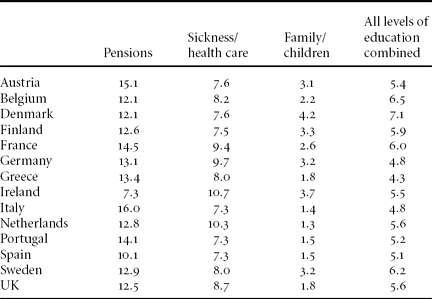
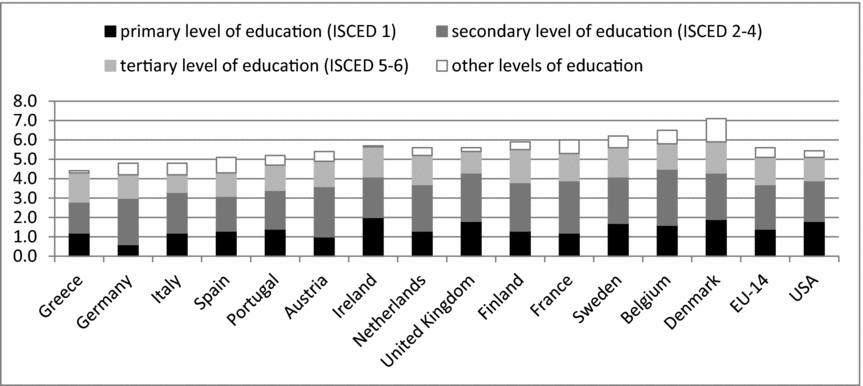
Education expenditure within the EU constitutes a significant proportion of public social expenditure, albeit less than pensions and health (see Table 1). Patterns of expenditure within education vary, with more being spent on primary and secondary education than on higher education, which is academically selective (see Figure 1).
Public expenditure for selected functions and education as a percentage of GDP (2009)

Notes:
Pensions: Part of periodic cash benefits under the disability, old-age, survivors and unemployment functions. Sum of following social benefits: disability pension, early retirement due to reduced capacity to work, old-age pension, anticipated old-age pension, partial pension, survivors’ pension, early retirement benefit for labour market reasons (Eurostat, 2008).
Sickness/health care: Income maintenance and support in cash associated with physical/mental illness, excluding disability. Health care intended to maintain, restore or improve the health of the people protected (Eurostat, 2008).
Family/children: Support in cash or kind (except health care) associated with the costs of pregnancy, childbirth and adoption, bringing up children and caring for other family members (Eurostat, 2008).
Education: Public and private, full-time and part-time education in the ordinary school and university system as defined in the international standard classification of education (Eurostat, 2012a).
Public expenditure on primary, secondary and tertiary education as a percentage of GDP (2009)
Notes: The category ‘other levels of education’ includes expenditure for pre-primary education and expenditure not allocated by level. Source: Eurostat (2012a).
In the following section, we examine research on education systems and welfare regimes and in so doing discuss institutional features and outcomes associated with certain (in)equalities of educational opportunity; we also examine associations between education systems and patterns of expenditure.
Education institutions and welfare regimes
Sociological, economic and historical research has compared features of education systems and outcomes. Educational institutions have typically been classified in terms of stratification (cf., Hopper, Reference Hopper1968) and standardisation. Allmendinger (Reference Allmendinger1989) classified institutions in this way, with standardisation being the degree to which the same standards are met nationwide (e.g., curriculum, budgets), and stratification being the proportion of a cohort that achieves the maximum number of years of schooling and the extent of differentiation within levels (i.e., tracking, with schools for higher and lower ability pupils). She found that occupational status was strongly determined by educational attainment for those educated in a stratified system but that this relationship was less strong in unstratified systems. A broad range of comparative literature has built on this work (e.g., Mueller and Shavit, Reference Mueller, Shavit, Shavit and Mueller1998; Shavit and Blossfeld, Reference Shavit and Blossfeld1993), with Kerckhoff (Reference Kerckhoff and Hallinan2000) proposing two ideal types: one being highly standardised and stratified (typified by Germany), and another being relatively unstandardised and unstratified (typified by the US).
Research continues to extend our understanding of inequalities across education systems. In contrast to studies focusing on attainment and occupational outcomes, data from the Programme for International Student Assessment (PISA) have been used to examine pupils’ educational achievement at the age of fifteen in reading, science and mathematics (OECD, 2010a). Significantly, inequalities between pupils from different social groups are accentuated by tracking (e.g., Pfeffer, Reference Pfeffer2008; van de Werfhorst and Mijs, Reference Van de Werfhorst and Mijs2010).
Green et al. (Reference Green, Preston and Janmaat2006) drawing on logical comparative analysis of education systems and outcomes, using qualitative data and descriptive statistics, found that on various measures of equality, countries cluster according to regional and cultural patterns which tend to coincide with types of educational organisation. Countries with forms of comprehensive schooling that are the most developed tend to be those with educational outcomes that are the most equal and those where social background has the least impact on attainment; countries with the most intake selection and tracking tend to be the most unequal. They propose four models: the Nordic model (Denmark, Finland, Norway, Sweden and Iceland); Germanic (Austria, Belgium, Germany, Luxembourg, Switzerland and the Netherlands); Mediterranean (France, Greece and Italy) and Anglophone (UK, US and New Zealand).
Sociological and educational studies have tended to focus on the institutional features of education systems and outcomes and have not conceived of education as an integral part of the welfare state. If, as we have argued, education is viewed as a key element of the welfare state policy package, how might different European education systems be classified?
An extensive body of research has focused on typologies of welfare states. Thus, Esping-Andersen (Reference Esping-Andersen1990), using scores of decommodificationFootnote 5 in three social programmes (pensions, sickness and unemployment cash benefits), distinguished three ‘regimes’: the liberal, typified by individualism and the primacy of the market; the conservative corporatist, typified by a moderate level of decommodification; and the social-democratic, with high decommodification and a universal, highly distributive system of benefits. Much debate and critique has followed relating to the applicability, type and number of regimes (e.g., Lewis, Reference Lewis1992; Bonoli, Reference Bonoli1997; Arts and Gelissen, Reference Arts and Gelissen2002). Limited research has addressed services (e.g., Anttonen and Sipilä, Reference Anttonen and Sipilä1996). However, Jensen (Reference Jensen2008) has proposed that welfare regimes might be conceptualised along two dimensions − transfers and services − and stressed the need for a better understanding of different sectors, in particular education (cf., Bambra, Reference Bambra2005). In a similar vein, Kasza (Reference Kasza2002), arguing that the concept of ‘welfare regime’ exaggerates the internal consistency of national welfare systems, proposed that comparative research might instead focus on particular policy areas.
Two specific policy areas, education (pre-school, primary and secondary) and pensions, were investigated by Beblavý et al. (Reference Beblavý, Thum and Veselkova2011) who explored social stratification in selected OECD countries. They found four clusters in the public system: stratification in education and pensions (e.g., Germany), stratification in education and equalisation in pensions (Belgium), equalisation in education and stratification in pensions (e.g., Sweden) and equalisation in both (e.g., UK).
Although subject to wide-ranging debate and critique, Esping-Andersen's typology has been used heuristically, specifically in relation to education. In terms of expenditure, Hega and Hokenmaier (Reference Hega and Hokenmaier2002) found a tendency for social democratic nations to invest in education at higher levels than liberal and conservative regimes, and for social democratic and liberal countries to spend more than conservative states on education as a share of total public spending. Liberal welfare states tended to be associated with greater support for general secondary education, whilst conservative states tended to provide extensive vocational education programmes. In relation to outcomes, Peter et al. (Reference Peter, Edgerton and Roberts2010) found that the between-school level of educational inequality in secondary education, utilising PISA data, was the highest in conservative and the lowest in social democratic countries.
With respect to higher education (in selected OECD countries), Pechar and Andres (Reference Pechar and Andres2011), using a range of indicators (e.g., expenditure, tuition fees and student financial support), identified three clusters of countries that align with Esping-Andersen's typology. Willemse and de Beer (Reference Willemse and de Beer2012), focusing on decommodification (public expenditure, enrolment, grants/loans and tuition fees) and stratification in higher education also found three clusters, which ‘roughly correspond’ (p. 116) to those proposed by Esping-Andersen, although three southern European states were found to belong to the liberal cluster with the Belgian system being a hybrid. Busemeyer and Nikolai (Reference Busemeyer, Nikolai, Castles, Leibfried, Lewis, Obinger and Pierson2010), focusing on higher education and vocational training, identified three clusters: Northern European; Mediterranean; English-speaking countries, except Ireland; and Japan.
Other comparative typologies have different conceptual underpinnings. Thus, Allmendinger and Leibfried (Reference Allmendinger and Leibfried2003) explored ‘educational poverty’ via the level and differentiation of competences (using PISA data); they proposed ‘four worlds of competence production’ which bear resemblances to Castles’ ‘families of nations’, with nations being defined in terms of historical, geographical, linguistic and cultural commonalities, namely English-speaking, Scandinavian, Continental Western Europe and Southern European (Castles, Reference Castles2004).
Our analysis augments and extends previous research. Our attention is focused on the education system (pre-primary, primary, secondary and tertiary) in selected EU countries and the US (for purposes of comparison). We seek to answer two main research questions: To what extent do education systems vary in terms of institutional features associated with (in)equality of educational opportunity and public expenditure? And do ‘education regimes’ underpinned by these notions bear any relationship to broader welfare regimes?
On the basis of previous research, we would expect countries to cluster in particular ways. Research focusing on expenditure, school systems and higher education suggests three clusters (social democratic, conservative and liberal), whilst research drawing on logical comparative and educational outcomes suggests four (Nordic, Germanic, Southern European, Anglophone). However, these studies have not focused on all levels of education, or used the same methods, so it is not possible to provide clear predictions of how countries might cluster.
Analysis of education systems
Methods
Our analysis uses indicators relating to primary, secondary and tertiary education in fourteen EU Member States (EU-15 excluding Luxembourg, for which no public expenditure data are available) and the US. Our classification is based on indicators broadly related to two dimensions of education systems: (in)equality of opportunity and expenditure.
In order to examine the clustering of countries, hierarchical cluster analysis is used. This enables exploratory analyses to be carried out based on combinations of variables. This method maximises the similarity of cases within each cluster: items in each cluster are thus similar in certain ways to others in the cluster and dissimilar to those in other clusters. In the analysis, the Ward method is used, applying squared Euclidean distance as the measure of similarity to determine the optimum number of clusters. The analysis is re-run with the selected number of clusters, which enables every country to be allocated to a particular cluster (Burns and Burns, Reference Burns and Burns2008). For the continuous variables, z-transformations are used (giving each variable a mean of 0 and a standard deviation of 1).Footnote 6 The raw data for the analysis are based on the most recent figures available (2009, 2010 or 2011, from Eurostat, 2012a; OECD, 2010a, b, c, 2012b).
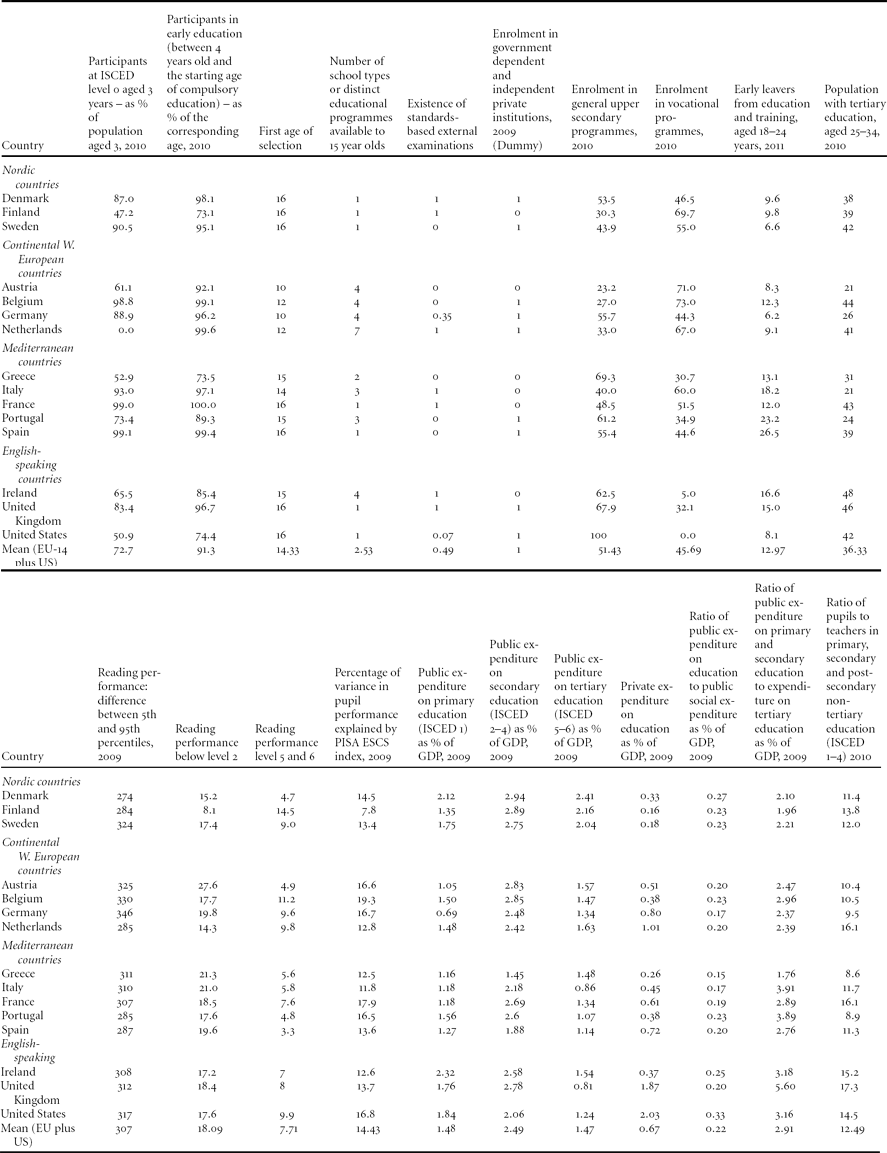
Our study is more nuanced than some previous studies in terms of the indicators used. This is due to our specific focus on (in)equality of opportunity and expenditure, and on the underlying differences in definitions and understandings of certain indicators at the level of individual countries (cf., Bonoli, Reference Bonoli1997).Footnote 7 The following dimensions and associated variables are included in our analysis (for the raw data, see Appendix, Table A1).
Equality of opportunity: access
Participants in ISCED level 0 aged three years; participants in early education between four years and the start of compulsory education (as a percentage of the corresponding age group)
Access to pre-school education is associated with higher levels of educational achievement, especially for disadvantaged children (e.g., Heckman, Reference Heckman2006). However, institutional arrangements and starting ages vary (OECD, 2012b). To capture access to pre-primary education (as opposed to childcare) at different ages, we include the percentage of three-year olds who participate in school or centre-based programmes (for children aged at least three and not older than six); these programmes require teaching staff with pedagogical qualifications (Eurostat, 2012a).Footnote 8 We also include participants in early education (pre-primary) between the age of four and the start of compulsory education.
Equality of opportunity: schooling
Age at which decisions between different school types are generally made for the first time (OECD, 2012a); number of school types or distinct educational programmes available to fifteen-year olds
Inequalities between pupils from different social groups are magnified by tracking which involves pupils being selected into different types of schools on the basis of their academic performance. Different school tracks usually vary in terms of the curriculum and school composition: children with more highly educated parents are more likely to be educated in academically selective schools than those with less well-educated parents (Dustmann, Reference Dustmann2004). We include the age of first selection and the number of school types for fifteen-year olds in our analysis to capture this variation.
Standards-based external examinations
Standards-based examinations define achievement relative to an external standard, not relative to other pupils in the class/school (Bishop, Reference Bishop2000). Such standardisation has been shown to decrease inequality (van de Werfhorst and Mijs, Reference Van de Werfhorst and Mijs2010). We thus include a variable relating to the existence of standards-based external examinations in our analysis.
Enrolment in ‘private’ institutions (government dependent or independent)
Primary and secondary education are provided in the main by public institutions, which are directly or indirectly administered by a public education authority. In some countries, a significant minority of pupils attend private institutions which are directly or indirectly administered by a non-governmental organisation (e.g., a church or private business) (Eurostat, 2011); some of these are government dependent (they receive more than half of their core funding from government agencies or their teaching staff are paid by the government, directly or indirectly), whilst others are government independent (Eurostat, 2005). Where fees are charged by private independent schools, segregation is likely to occur. Private government-dependent schools may also contribute to segregation (Jenkins et al., Reference Jenkins, Micklewright and Schnepf2008). We thus include the proportion of pupils enrolled in government dependent and independent private institutions in our analysis.
Enrolment in vocational and general education programmes
Programmes at the upper secondary level can be broadly subdivided into general and vocational (school based and combined work and school based). ‘Vocational specificity’ is an important aspect of stratification as the timing and type of tracking is related to the extent of general or vocational education (Mueller and Shavit, Reference Mueller, Shavit, Shavit and Mueller1998). We include the percentage of pupils in general and in vocational educational programmes in our analysis.
Equality of opportunity: outcomes
Difference in reading performance between 5th and 95th percentiles; reading performance below level 2; reading performance at levels 5 and 6 (highest levels)
The difference between the lowest and highest performing pupils (those at the 5th and 95th percentiles in the PISA reading assessment) represents the extent to which competence at age fifteen is distributed unevenly: the greater the gap, the greater the inequality. This variable, along with variables on the proportion of pupils with low and high levels of competence, are included to capture this aspect of inequality.
Strength of the relationship between student reading performance and of economic, social and cultural status (ESCS)
Variations in pupils’ performance are related to their socio-economic background. The relationship between performance and socio-economic group is an ‘indication of an equitable distribution of educational opportunities’ in a school system (OECD, 2010b: 30). In order to capture this relationship in our analysis, we use the percentage of the variance in pupil performance explained by the PISA economic, social and cultural (ESCS) index.Footnote 9
Early leavers from education and training
The educational outcomes of early school leavers are compromised as they have a higher risk of under- or unemployment in the labour market (Brzinsky-Fay, Reference Brzinsky-Fay2007). To take account of these unequal outcomes, we include in our analysis the proportion of eighteen- to twenty-four-year olds who leave school without completing upper secondary education.
Population with tertiary education, aged twenty-five to thirty-four
The higher the proportion of young people who have completed higher education, the less unequal the educational outcomes. In our analysis, we thus include the percentage of the population aged twenty-five to thirty-four who are graduates of tertiary education.
Expenditure
Total public expenditure on primary, secondary and tertiary education; private expenditure on education as a percentage of GDP
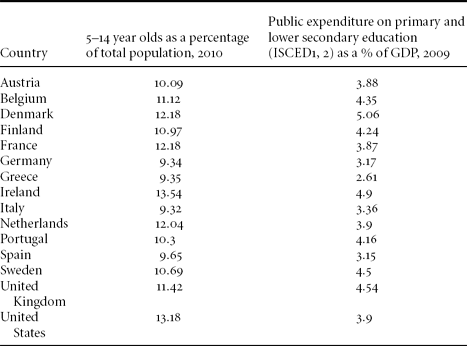
Education spending on primary and secondary education is to some extent demand-driven as it is universally available and in the main compulsory (see Appendix, Table A2).Footnote 10 However, public expenditure on different levels of education (primary, secondary and tertiary) as a percentage of GDP is the key indicator of a country's investment in education and can be viewed as a reflection of the priority the country gives to education. Private expenditure on education is likely to be associated with countries’ preferences for non-state-centred and more market-oriented solutions (see Wolf and Zohlnhoefer, Reference Wolf and Zohlnhoefer2009).
Ratio of public expenditure on primary and secondary education to tertiary education (using percentage of GDP)
Expenditure on different levels of education depends on countries’ priorities for resource allocation within the area of education. The distribution of expenditure between primary and secondary education on the one hand and tertiary education on the other is an indicator of the relative emphasis placed on education at different levels.
Ratio of public expenditure on education to public social expenditure (using percentage of GDP)
Public education expenditure is related to the level of public social expenditure (Busemeyer, Reference Busemeyer2007). There is also evidence of a trade-off between state spending for cash-based social welfare programmes and education (Nikolai, Reference Nikolai, Morel, Palier and Palme2011). We thus include public spending on education relative to social expenditure as an indicator of the importance attached to education expenditure compared with social expenditure.
Ratio of pupils to teachers in primary, secondary and post-secondary non-tertiary education
In some countries, the pupil–teacher ratio is a key determinant of the size of a country's teaching force and so provides an indication of the priority given to teaching and learning; it can also affect how much time and attention a teacher can devote to individual pupils. This variable is related to the allocation of resources in school-based education (Eurostat, 2012a).Footnote 11
Findings
The hierarchical tree diagram (dendrogram) resulting from the hierarchical cluster analysis is presented in Figure 2. This lists all the countries and indicates at what level of similarity any two clusters are joined. The y-axis is a measure of the similarity or distance at which clusters join.
Hierarchical cluster analysis of education systems: Ward method, Euclidian distance measure
Our analysis suggests the existence of four clusters of countries in the EU with respect to primary, secondary and tertiary education: the Nordic, Continental, Mediterranean and English-speaking. The dominant features distinguishing education regimes are age of first selection, the number of school types post age fifteen and expenditure.
Below, we summarise the main differentiating characteristics of each cluster in terms of features related to various dimensions of equality of opportunity and expenditure; where comparisons are made, these are to the mean score for the EU-14 countries and the US (for data see Table A1). For some variables, there is marked variation within clusters, and for this reason these are not discussed. We also provide a short narrative on one country in each cluster: we see these as exemplars not as ‘ideal’ types.
Nordic
Denmark, Finland, Sweden
All three Nordic countries have non-selective, publicly funded comprehensive school systems, covering the entire period of compulsory education (see Wiborg, Reference Wiborg2009), with no tracking until the age of sixteen. The proportion of fifteen-year olds with poor levels of reading is below average and the relationship between reading performance and social background is at or below the mean in all countries. The difference in reading scores between high and low performers is below average in Denmark and Finland.
In terms of access to different levels of education, enrolment in early years education is above average (except in Finland).Footnote 12 Participation in vocational education programmes is above average, and the percentage of early school leavers is low. The proportion of twenty-five- to thirty-four-year olds with tertiary education is above average. Levels of public expenditure on education are above average, particularly at secondary and tertiary levels,Footnote 13 and private expenditure is low.
Sweden can be seen to exemplify this cluster. For children between the ages of three and five, there is universal part-time pre-primary provision, which is free of charge (Eurydice, 2011). There is a nine-year compulsory comprehensive school system. As an ‘intergrationist skill regime’ (Busemeyer, Reference Busemeyer2009), vocational education is fully integrated into the general education system. All programmes, in principle, give access to tertiary education. Sweden thus provides a high level of equality of opportunity in terms of access to all levels of education. With respect to educational outcomes, the proportion of pupils with low levels of performance is around average and the strength of the relationship between performance and social background below average; however, the difference in reading scores between good and poor readers is above average. Significant reforms have taken place in Sweden in recent years with the introduction of independent publicly funded schools, some of which are for profit. Enrolment in these schools is comparatively high, particularly in the large urban conurbations. There have been concerns about segregation between pupil backgrounds as a result of the choice policies (Wiborg, Reference Wiborg2010): independent schools, compared with municipality schools, have a larger proportion of girls, a larger proportion of pupils with parents who have continued with education following upper secondary school and a larger proportion of pupils with a foreign background (Skolverket, 2006).
Continental
Austria, Belgium, Germany, the Netherlands
School systems in the Continental cluster are highly tracked and stratified, with selection taking place between the ages of ten and twelve. The difference in reading scores between high and low performers is at or above the mean, as is the relationship between reading performance and social background (except in the Netherlands).
In terms of access to different levels of education, enrolment in pre-primary education between four and the beginning of compulsory education is high. Beyond the age of fifteen, enrolment in vocational education programmes is high and the proportion of early school leavers is below average. The percentage of twenty-five- to thirty-four-year olds who have completed tertiary education varies between countries. Public expenditure across all levels of education is around the mean.
Germany exemplifies this cluster with a relatively low priority being given to education as measured by public expenditure on primary and higher education. Every child from three to the beginning of compulsory education (age six) has a legal right to day-care in a child day-care facility, such as a Kindergarten (Eurydice, 2011). Pupils are generally selected at the age of ten to twelve years on the basis of teachers’ recommendations to different school tracks (Gymnasium, Realschule, Hauptschule); in some Laender, parents are not entitled to choose a track other than that recommended whilst in others the track selected by the teachers may be changed following a meeting with parents (Checchi and Flabbi, Reference Checchi and Flabbi2007). There is little permeability between tracks in this differentiated skill regime (Busemeyer, Reference Busemeyer2009); thus, the school system tends to produce and replicate educational inequalities across generations. However, graduates of the ‘dual system’ – 20 per cent of nineteen-year olds and 20 per cent of nineteen- to twenty-four-year olds are in apprenticeships (Steedman, Reference Steedman2012) – have better labour market opportunities and a higher social status than young people in liberal welfare regimes who are not higher education graduates (Pechar and Andres, Reference Pechar and Andres2011). Admission to university requires the award of the upper secondary qualification, the Abitur. There are also Fachhochschulen, which offer more vocationally applied courses than universities: admission requires the qualification awarded in year 12 of the Fachoberschule (upper secondary full-time vocational school) or under certain conditions at other vocational schools.
Mediterranean
France, Greece, Italy, Portugal, Spain
The countries in this cluster have stratified education systems with the first academic selection taking place between thirteen and fifteen. The share of low-performing readers tends to be high whilst the difference in reading scores between high and low performers and the relationship between reading performance and social background varies between countries.
In terms of access to different levels of education, pre-primary enrolment is high (except in Greece), participation in vocational education programmes varies between countries, and the proportion of early school leavers is high (except in France). The proportion of twenty-five- to thirty-four-year olds with tertiary education varies. Public expenditure on education tends to be below the mean.
Italy exemplifies this cluster with public expenditure on education being slightly below average. Non-compulsory provision for children between three and six is provided in the scuoladell'infanzia. There is a stratified upper secondary school system with selection at the age of fourteen (from 2014/15, selection will take place at sixteen (Eurydice, 2011)). The three main school types comprise high schools (licei) (internally divided into four tracks − classical, scientific, linguistic and artistic), technical institutes (istituti tecnici) and vocational institutes (istituti di formazione professionale). The decision about which school pupils should attend is based on counselling of pupils and parents by teachers and sometimes psychologists, with pupils’ marks from the lower secondary school period informing their future orientation. Each of the school tracks is associated with different outcomes: nearly nine out of ten licei graduates progress to university compared with fewer than one in five graduates of istituti di formazione professionale (Checchi and Flabbi, Reference Checchi and Flabbi2007). There are also regionally organised vocational training courses that lead only to the labour market and are generally attended by pupils with low levels of academic achievement (Barone and Schizzerotto, Reference Barone, Schizzerotto and Schneider2010).
English-speaking
Ireland, UK, US
In the English-speaking cluster, academic selection normally takes place at fifteen to sixteen years of age. The difference in reading scores between high and low performers is above average, whilst the relationship between reading performance and social background varies between countries.
In terms of access to different levels of education, enrolment in pre-primary education varies. Participation in vocational education is low and the proportion of early school leavers high (except in the US). In all countries, the proportion of twenty-five- to thirty-four-year olds with tertiary education is high. Public expenditure on primary education is above average in all countries and on secondary education is above average in Ireland and the UK.
The UK, with above average expenditure on primary and secondary education exemplifies this cluster. Free part-time early years education is available for children aged three and four.Footnote 14 The school system is broadly comprehensive until the age of sixteen.Footnote 15 The introduction of a quasi-market has been a significant feature in England: parents express preferences for schools and funding follows pupils. There is a high proportion of government-dependent private schoolsFootnote 16 and their number is increasing rapidly as secondary schools in England convert to become publicly funded ‘academies’.Footnote 17 There is a clear academic track beyond sixteen. For those who wish to pursue vocational education or training, the route is less clear-cut. Vocational programmes are provided in the main in institutional settings; participation in apprenticeships is low (around 10 per cent of nineteen-year olds and 5 per cent of nineteen- to twenty-four-year olds (Steedman, Reference Steedman2012)) and employer involvement minimal (see Hoeckel, Reference Hoeckel2008). Admission to higher education institutions is generally determined on the basis of external examinations taken at the end of upper secondary education.
Discussion
Although education can be seen to be an integral part of the welfare state, debates about welfare regimes have tended to focus on cash transfers and only more recently on services, with education having received relatively little attention. In this paper, we have aimed to add to the limited research on education and welfare regimes. Our exploratory analysis of education systems in selected EU countries and the US sought to establish if distinctive ‘education regimes’, akin to those identified in the broader research on comparative welfare states, could be discerned. Our analysis was underpinned conceptually by two key dimensions: (in)equality of opportunity and the priority governments give to education in terms of public expenditure. We found variation in terms of the interplay between stratification, educational outcomes and expenditure.
Our analysis revealed four clusters of countries: the Nordic, Continental, Mediterranean and English-speaking. These clusters bear a strong resemblance to those suggested by Green et al. (Reference Green, Preston and Janmaat2006) in the education literature and to the ‘families of nations’ suggested by Castles (Reference Castles2004). This is important given that the framework for analysis and precise indicators differed in our analysis.
In the Nordic countries, public expenditure on education is high. Equality of opportunity in its various guises is high: pre-school participation is high (except in Finland) and there is comprehensive schooling during the period of compulsory education. In terms of educational outcomes, all countries have a below average proportion of poor readers at the age of fifteen and a very low proportion of early leavers from education. By way of contrast, the Continental countries can be seen to reproduce social stratification via the education system: the school system is stratified, with early academic selection. Public expenditure on education is around the mean overall but below average for primary education. Reading scores tend to be widely dispersed. In the Mediterranean countries, the education system is also stratified, but academic selection takes place later than in the Continental countries. Public expenditure on education tends to be below average. In the English-speaking cluster, public expenditure especially at primary levels is relatively high, but private expenditure is also high. In terms of educational outcomes, the difference between high and low performers in reading is above average, and the percentage of early leavers is high (except in the US). This cluster tends to be more inegalitarian than the Nordic cluster.
In conclusion, we have argued that education forms a crucial part of the welfare package. Our exploratory study has added to the continuing debates about the nature of welfare regimes. Significantly, our analysis, focusing on pre-school, primary, secondary and tertiary education, identified ‘education regimes’ with similarities to some welfare regimes in the extant literature. Our findings are in accord with those of Beblavý et al. (Reference Beblavý, Thum and Veselkova2011) who suggest that the difference between the Continental and Mediterranean countries is much more pronounced than the analysis by Esping-Andersen (Reference Esping-Andersen1990) indicates.
Our focus on education as a specific component of the welfare state and the role of (in)equality of opportunity as well as expenditure adds a new dimension to research in social policy. Given the paucity of research on education and welfare regimes, further comparative work is warranted. Detailed comparative analyses of recent education reforms and their outcomes would complement more historical perspectives.Footnote 18 The extent to which inequality of educational opportunity is transformed into social inequalities is also worth investigating. And more analysis and exploration is also required with regard to other EU and OECD countries.
Finally, given the reforms to education and training systems that are underway and the importance of education and training at the EU level, research into the dynamics of policy change is sorely needed. Our country narratives reveal that policy reforms are underway: these are likely to affect the policy mix in particular countries and the constellation of countries within clusters. Research on policies implemented might usefully explore the ways in which similar policy goals, particularly in relation to increasing equality of opportunity have been addressed in countries with different institutional designs.
Acknowledgement
We would like to thank Philip Noden, two anonymous reviewers and the editors of the Journal of Social Policy for helpful comments on earlier drafts of the paper.