Introduction
Elopement – leaving one's dwelling unescorted – among older persons with dementia not only creates stress for the family but also puts eloping persons at risk through getting lost or injured, primarily because of their impaired judgment and problem-solving ability. Previous studies report that chronic wanderers are more likely to elope and/or wander away (Ballard et al., Reference Ballard, Mohan, Bannister, Handy and Patel1991; Aud, Reference Aud2004).
The distinction between elopement and wandering has never been straightforward. Wandering is characterized as an excessive ambulatory behavior initiated by a cognitively impaired and disoriented individual, possibly to fulfill a particular need (Thomas, Reference Thomas1995). Several possible reasons such as cognitive impairment, agitation, spatial disorientation, reactions to environmental stress, past lifestyle patterns and unmet personal needs have been proposed to explain wandering (Algase Reference Algase1999; Hope et al., Reference Hope, Keene, McShane, Fairburn, Gedling and Jacoby2001; Aud, Reference Aud2004). To a certain extent, wandering within a safe environment is considered beneficial as it engages individuals with dementia in some form of physical activities for exercising and is possibly stress-alleviating (Cohen-Mansfield et al., Reference Cohen-Mansfield, Werner, Marx and Freedman1991; Coltharp et al., Reference Coltharp, Richie and Kaas1996). Nonetheless, wandering away from a safe place – elopement – and getting lost are considered dangerous for cognitively impaired older adults.
Although chronic wanderers and those who manifest exit-seeking behaviors and elopement attempts are more likely to elope, the act of elopement is mostly unpredictable (Rowe and Glover, Reference Rowe and Glover2001; Lucero, Reference Lucero2002). A desire to go home or to a particular place, an urge to leave the current environment and its stressors, and persistent walking are some possible reasons for elopement (McShane et al., Reference McShane, Gedling, Keene, Fairburn, Jacoby and Hope1998a; Detweiler et al., Reference Detweiler, Trinkle and Anderso2002; Algase et al., Reference Algase, Son, Beattie, Song, Leitsch and Yao2004). Conceptually, elopement can be considered as an aspect of wandering or as an outcome of it (Algase et al., Reference Algase, Son, Beattie, Song, Leitsch and Yao2004).
Previous safe return studies have identified three characteristics of elopement patterns among individuals with dementia: (1) elopers do not travel far and can be found within one mile from the point last seen, (2) elopers seldom leave clues, cry out for help or respond to shouts, and (3) elopers are often found a short distance from the road if they are not seen on the road (Koester and Stooksbury, Reference Koester and Stooksbury1995; Rowe and Glover, Reference Rowe and Glover2001). Immediate and comprehensive search within the first 24 hours is critical because the chances of survival decrease on account of impaired knowledge and skills about personal safety. Previous studies report that one-fifth of eloped individuals were at risk of traffic accidents (McShane et al., Reference McShane, Gedling, Kenward, Kenward, Hope and Jacoby1998b) and about one-third of elopement incidents resulted in injuries related to falls and hypothermia (Aud, Reference Aud2004). Additionally, caregivers experience psychological distress and anxiety in cases of elopement (Rowe and Glover, Reference Rowe and Glover2001).
Restricted mobility, a locked-door policy and institutionalization are some forceful preventive strategies adopted following elopement incidents (Hope et al., Reference Hope, Keene, Gedling, Fairburn and Jacoby1998; Armstrong, Reference Armstrong2000). Nonetheless, negative consequences associated with these strategies – for example, increased falls, agitation and disruptive behaviors, and excessive disability – have been reported (Maas, Reference Maas1988; Algase et al., Reference Algase, Beel-Bates and Beattie2003). Moreover, these strategies greatly undermine a person's dignity and right to autonomy. Hence, family caregivers are faced with the tension between safety precautions and respecting autonomy. Other strategies such as walking programs, wandering path (Holmberg, Reference Holmberg1997; Detweiler et al., Reference Detweiler, Trinkle and Anderso2002) and environmental modifications (Coltharp et al., Reference Coltharp, Richie and Kaas1996; Price et al., Reference Price, Hermans and Grimley-Evans2001) are less intrusive but require additional supervision and physical resources. Strategies incorporating information and communication technologies, such as electronic tracking devices, may facilitate the search and rescue process (McShane et al., Reference McShane, Gedling, Kenward, Kenward, Hope and Jacoby1998b; Miskelly, Reference Miskelly2005) but ethical considerations regarding personal privacy remain controversial (Hughes and Louw, Reference Hughes and Louw2002).
While elopement is acknowledged as dangerous among individuals with dementia, the current understanding of elopement among community-dwellers with dementia is limited. Most previous studies on elopement were conducted in long-term care settings (Detweiler et al., Reference Detweiler, Trinkle and Anderso2002; Aud, Reference Aud2004). Compared to long-term care settings, the levels of security and manpower resources are generally lower in community/home dwellings, thus making prevention and search increasingly challenging. Little is also known about whether individuals with dementia who elope possess characteristics (e.g. demographics, clinical profiles and lifestyle patterns) that are distinct from those who do not elope. This study aimed to elucidate the phenomenon of elopement occurring in community-dwelling settings. Specific objectives of this study were to examine the pattern and occurrence of elopement incidents, the process of searching and subsequent prevention strategies, and to explore whether demographic characteristics, clinical factors and lifestyle patterns predict elopement among community-dwellers with dementia.
Methods
Subjects
Two groups of older individuals with dementia, one with a recent incident of elopement and the other without any history of elopement, were recruited to the study. Inclusion criteria common to both groups were: aged 60 years and/or above, diagnosed as suffering from dementia, independent ambulation with or without aids, community-dwelling, and having a family informant who agreed to be interviewed. Potential subjects were excluded if they had a history of major neurological disorders such as stroke and Parkinson's disease and psychiatric disorders such as mood disorders and psychosis. One selection criterion specific to the eloped group was a recent record of elopement over the previous three months. Both groups of subjects were recruited from three community agencies providing services to elderly people. In addition, subjects of the eloped group were recruited from the Missing Person Unit of the Hong Kong Police Force.
All study subjects and their family informants participated voluntarily in the study. Informed consent was obtained from the family informants. Ethics approval was obtained from the Human Subjects Ethics Committee of The Hong Kong Polytechnic University.
Instruments
The global mental state and severity of dementia of the study subjects were evaluated using the Chinese version of the Mini-mental State Examination (CMMSE; Chiu et al., Reference Chiu1998) and the Clinical Dementia Rating scale (CDR; Morris, Reference Morris1993), respectively. The CMMSE measures global cognitive performance of older people in areas of orientation, memory, calculation, language and comprehension, and visual spatial function. Its score ranges from 0 to 30, with higher scores indicating better global cognitive status. Satisfactory psychometric properties and education-adjusted cut-off scores were established for CMMSE (Chiu et al., Reference Chiu1998). The CDR evaluates the severity of impairment in six domains: memory, orientation, judgment and problem solving, community affairs, home and hobbies, and personal care. Each domain is rated on a five-point scale indicating the levels of impairment (0 = none, 0.5 = questionable, 1 = mild, 2 = moderate, and 3 = severe). An overall CDR score is derived from the subscores of the six domains based on the scoring rules (Morris, Reference Morris1993).
The Chinese validated version of Cohen-Mansfield Agitation Inventory (C-CMAI; Lai and Chung, Reference Lai, Chung, Lou and Boey2008) was used to assess the nature and frequency of behaviors. Consisting of 23 items, the C-CMAI (community version) evaluates agitated behaviors in two broad categories: verbal (aggressive and non-aggressive) and physical (aggressive and non-aggressive). Each item is rated on a frequency scale ranging from 1 (never) to 7 (several times per hour). Satisfactory psychometric properties including a content validity index of 0.86, an inter-rater reliability of 0.819 (κ statistics), and a Cronbach's α of 0.83 were established for C-CMAI (Lai and Chung, Reference Lai, Chung, Lou and Boey2008).
A questionnaire was used to collect information regarding demographic characteristics, medical history, caring pattern, lifestyle, and history of elopement, if any, of the study subjects. Demographic variables included age, sex, education, and past occupation. Medical history included year of dementia onset and presence of other chronic diseases. Caring pattern variables included number of primary caregivers and use of community-based services. Lifestyle variables included frequency, hours and types of outdoor activities, wake-up time and bed-time. Elopement history included the number of missing incidents occurring prior to the study (only for the eloped group). Demographic characteristics of family informants included age, sex, education, kin relationship and marital status.
Regarding the elopement incidents, family informants of the eloped group were interviewed using a questionnaire. Questions about the antecedents included behavioral clues prior to elopement, whether the study subjects were alone or with the others when they got lost, and the place last seen. Questions about the search process and strategies included how the elopement incidents were noticed, how the search process was conducted and by whom, who discovered the eloped individual, the duration of the search, and the condition of the eloped individual when found. Family informants were also asked about the strategies they used to prevent future elopement incidents.
Procedures
Upon receiving referrals from the community agencies and the police force, a research assistant contacted the families, explained the study objectives and obtained consent for participation. Study subjects of the consenting families were screened for eligibility. For subjects fulfilling the inclusion criteria, a data collection session was then arranged and conducted either in subjects’ homes or at the referring agency. During the session, subjects’ cognitive status and dementia severity were evaluated. Family informants were interviewed with regard to the demographic characteristics, lifestyle, caring patterns, and the elopement incidents (only for the eloped group). The average length of the data collection session was two hours. Telephone follow-up was undertaken where clarifications were needed.
Data analysis
Descriptive statistics were used to summarize the demographic characteristics of the eloped subjects and non-eloped subjects, the nature and patterns of elopement, and the search and preventive strategies adopted. Independent-samples t test, Pearson χ2 test, and Mann-Whitney U test were used as appropriate to compare demographic characteristics, caring arrangements, lifestyles, medical history, and cognitive status of elopers and non-elopers. Logistic regression analysis, using block design, was performed to predict elopement from caring and lifestyle variables (numbers of caregivers, use of community services, and frequency of out-of-home activities) and clinical variables (years of dementia diagnosis, cognitive status, agitated behaviors). Demographic variables including age, gender, marital status and past employment were controlled for the regression analysis. Data were analyzed using SPSS 17.0 for Windows, and the level of significance for all statistical tests was set at 0.05.
Results
Thirty-one eloped cases and 41 non-eloped cases were referred to the research team. Of these, 11 eloped cases and 16 non-eloped cases failed to meet the selection criteria (n = 19), could not be contacted (n = 5), and refused to participate (n = 3). Consequently, 20 eloped subjects and 25 subjects without a history of elopement completed the study.
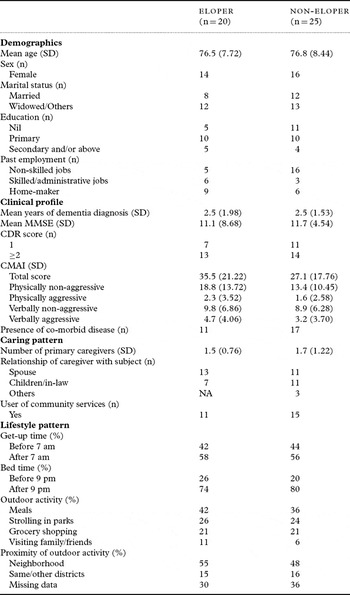
The mean age of all subjects was 77 years (SD = 8.04) and the mean years since diagnosis was 2.5 (SD = 1.73). Two-thirds of the study subjects (n = 30) were female. Demographically, the eloped subjects did not significantly differ from the non-eloped ones in age, gender distribution, educational level, and marital status (Table 1). The two groups, however, differed in their previous occupation (χ2 = 6.89, p = 0.032). Significantly more subjects in the non-eloper group performed non-skilled jobs, such as construction site workers and factory workers, than in the eloper group. Regarding the clinical profiles, the two groups did not differ significantly in CDR score (dementia severity), MMSE score (global cognitive status), CMAI score (manifestation of agitated behaviors) and the presence of comorbid diseases (Table 1).
Demographics, clinical profile, caring and lifestyle patterns of elopers and non-elopers

CDR = Clinical Dementia rating score; CMAI = Cohen-Mansfield Agitation Inventory; MMSE = Mini-mental State Examination.
Regarding the caring patterns, the two groups did not differ significantly in the number of primary caregivers and the use of community care services (Table 1). Overall, the subjects had an average of two primary family caregivers, whose mean age was 52.0 years (SD = 13.03). The majority of caregivers were female (60%), married (70%), adult children (75%), and with secondary education (65%). In addition to family caregiving, about two-thirds of the subjects used community services such as day-care services and meals-on-wheel services.
When lifestyle patterns were examined, again the two groups did not differ significantly in wake-up time, bed-time, and frequency, length and types of outdoor activities (Table 1). A vast majority of the subjects (92%) had out-of-home activities more than twice a week. Popular out-of-home activities included morning tea and/or lunch (39%) and strolling in parks (25%). Most out-of-home activities were carried out in the neighborhood (52%) and accompanied by family caregivers (69%).
Predictors of elopement
Logistic regression analysis was performed to predict elopement from demographic variables, clinical variables, caring and lifestyle variables. Demographic variables (age, gender, marital status, past employment) were entered into the regression model as the first block; caring and lifestyle variables (number of caregivers, user of community service, frequency of out-of-home activities) as the second block, and clinical variables (years of diagnosis, MMSE, CMAI) as the last block. The final regression model showed that only the CMAI total score was a significant predictor of elopement. The adjusted odds ratios for agitated behavior was 1.410 (p = 0.042). The demographic variables, caring and lifestyle variables and clinical variables other than CMAI were not significant factors predicting for elopement.
Occurrence and patterns of elopement incidents
Eighty percent of the eloped subjects (n = 16) had a history of elopement prior to this study. The mean number of previous elopement incidents was 3.6 (SD = 4.48), with a range from 1 to 21. Elopement incidents occurred more often in afternoons (45%) and mornings (31%). Regarding how the elopement incident occurred, two main patterns were identified: (1) subjects left home alone and unnoticed (68%); and (2) subjects left their family caregivers and got lost during out-of-home activities (32%). Only one subject showed obvious emotional and/or behavioral symptoms prior to elopement. This subject presented delusional behavior and thought that someone asked her out for meals.
Among the 68 reported elopement incidents, the places from which the subjects eloped unnoticed were home (62%), markets (38%), restaurants (31%), and shopping malls (26%). Only in less than 10% of the elopement incidents could the eloped return home by themselves. In most incidents, the elopers were found by family caregivers (51%), the police (21%), security guards of housing estates or shopping malls (12%), and good Samaritans (including taxi and minibus drivers) (6%). Two-thirds of the elopers were found close to the point last seen or within the same district, while one-third were found further away in another district. All eloped subjects were found and/or returned home by themselves within one and a half days (mean duration 6 hours) and did not suffer from any major injuries. According to family informants, very limited information could be obtained from the elopers regarding where they had been and what they had done while they were lost.
Search process and subsequent preventive strategies
All family informants reported that an immediate search was conducted as soon as their relative with dementia was found to be missing. Multiple search strategies were used. A majority of caregivers searched for the eloper in nearby environments (85%). In addition, some caregivers sought the assistance from other family members (50%) and housing estate or shopping mall patrol staff (20%) to strengthen the search process. In cases where the eloped individual had a cell phone, caregivers made contact and tried to locate him/her. A successful search using cell phones was reported by two family informants.
In cases where searches of the neighborhood and likely places were not successful within the first few hours, more than half of the family informants (65%) reported the elopement incident to the police. Informants pointed out that the police could conduct a more extensive search in case the eloper had used public transport. Two other strategies used for a more extensive search were (1) to solicit assistance from taxi and/or mini-bus companies who asked their drivers to watch out for people wandering aimlessly on streets, and (2) to put up ‘lost’ posters around the neighborhood.
All family informants said they introduced some sorts of preventive strategies to avoid future occurrence of elopement. Commonly used strategies were to provide the eloped individuals with identification bracelets/necklaces (75%), to keep a watchful eye on eloped individuals at home and during every out-of-home activity (60%), to lock the door to prevent eloped individuals from leaving the home (50%) and to use some environmental modification strategies such as installing complicated locks and alarms (35%). Other reported strategies included giving the eloped individual a cell phone, using physical restraint at home, arranging for the eloped individuals to attend day-care programs, and hiring a maid to look after the eloped individual. Nonetheless, family informants noted that some strategies were not practical (e.g. difficulty in operating cell phones) while some would provoke undesirable consequences (e.g. becoming agitated and restless when putting on physical restraints). Interestingly, 20% of family informants still allowed their eloped relatives to go out on their own because they did not want to stop them doing what they wanted. Only one family informant declared that she would consider placing her mother in long-term care.
Discussion
One notable finding that concurs with previous studies is that repeated elopers are at higher risk of elopement (Aud, Reference Aud2004; Wick and Zanni, Reference Wick and Zanni2006). Nonetheless, the finding that 80% of elopers had a prior history of elopement should be interpreted with caution because of a selective recruitment methodology. Apart from a history of elopement, the elopers and the non-elopers do not differ significantly in terms of demographic characteristics (except past employment), clinical profile, caregiving and lifestyle patterns. The similarity between the profiles of the two groups highlights the unpredictability of elopement and getting lost (McShane et al., Reference McShane, Gedling, Kenward, Kenward, Hope and Jacoby1998b; Rowe and Glover, Reference Rowe and Glover2001; Rowe, Reference Rowe2003). Findings of the regression analyses further suggest that demographics (including past employment), caring and lifestyle patterns, comorbidity and cognitive status do not predict elopement. The only variable that may possibly predict elopement is the manifestation of behavioral symptoms, primarily physically non-aggressive behaviors such as pacing, aimless wandering and constant searching (Rolland et al., Reference Rolland2007). Demented individuals presenting with behavioral symptoms such as having had agitated or angry encounters with caregivers are more likely to elope than those who have not (Rowe and Glover, Reference Rowe and Glover2001).
Nonetheless, only one family informant reported recognizing the behavioral clues (delusional thought) presented by her mother before the elopement incident. It is apparent that many family caregivers are not attuned to the behavioral/emotional clues such as repeatedly looking out of windows and doors, testing locked doors, putting on a coat, or removing a coat from places next to exits that may hint of an intention to elope (Aud, Reference Aud2004). Thus, caregivers may fail to take timely actions to prevent the occurrence of elopement. The two elopement patterns identified in this study – leaving home alone and unnoticed and wandering away when accompanied on out-of-home activities – raises a question about caregivers’ knowledge of elopement and unattended wandering. Undeniably, most family caregivers acknowledge the importance of providing round-the-clock watchful supervision to their relatives with dementia. However, they have to attend to other family chores and responsibilities, which may give their relative an opportunity to leave the house unnoticed (Aud, Reference Aud2004). Similarly, even when individuals with dementia are being accompanied on out-of-home activities, they are still at risk of wandering away and getting lost during the brief periods when caregivers attend to other matters such as paying for groceries. Caregivers of ambulatory individuals with dementia who wander are reported to experience much greater burden than those of non-ambulatory demented individuals (Miyamoto et al., Reference Miyamoto, Ito, Otsuka and Kurita2002).
Although the literature reported that institutional placement was one of the consequences following elopement (McShane et al., Reference McShane, Gedling, Keene, Fairburn, Jacoby and Hope1998a), only one family informant in this study planned to place her eloped family member with dementia in long-term care. This suggests that most family caregivers are keen to keep their relatives at home as long as possible. Hence, being able to maintain a safe lifestyle while remaining in the community is a high priority among family caregivers. Given that maintaining a vigilant watch round the clock is not always feasible while also being mentally and physically exhausting (Gaugler et al., Reference Gaugler, Kane, Kane and Newcomer2005), family caregivers need to be taught about the possible antecedents and behavioral/emotional clues for elopement and more effective precautionary measures against elopement.
This study suggests that most preventive strategies adopted by family caregivers are conventional and conservative – such as providing identification bracelet/necklaces, locking doors and keeping a watchful eye on the individuals with dementia. A lack of effective measures to prevent elopement among those individuals with a history elopement has been identified as one of the possible reasons for the repeated occurrence of elopement incidents (Aud, Reference Aud2004). More proactive strategies, such as adapting the home environment (e.g. installing complicated lock/door alarms and camouflaging the door to make unattended exit less feasible) should be introduced to family caregivers. Moreover, advances in information and communication technologies have made the use of cell phones and less intrusive tracking devices suitable for finding missing persons. In this study, caregivers simply used cell phones as a communication tool to ask the missing person where he/she was. This, of course, was of limited use if the person with dementia could not communicate. Miskelly (Reference Miskelly2005) used mobile phones enabled with global positioning system (GPS) technology as a tracking device and reported its reliability and accuracy to locate missing persons. Family caregivers have also been receptive to the use of tracking devices to enhance personal safety of their loved ones (Landau et al., Reference Landau, Werner, Auslander, Shoval and Heinik2009).
Regarding the elopement incidents, the study findings support previous studies that eloped individuals do not travel far (Rowe and Glover, Reference Rowe and Glover2001). A vast majority of the elopers are found by caregivers and others such as the police, security guards and good Samaritans (including lay people, taxi drivers and minibus drivers). It is apparent that the good Samaritans and security guards represent a useful search and rescue resource (Aud, Reference Aud2004). To better tap into this resource, there is a need to enhance the public's knowledge of dementia and related behavioral manifestations including wandering and elopement.
There are three inherent study limitations that warrant caution when interpreting the findings. First, the study sample was small, thus limiting the representativeness and generalization of the study findings to other groups of community-dwelling older individuals with and without cognitive impairment. The eloped subjects recruited to the study were referred from community centers and by the police. This selective recruitment method might have led to an over-estimation of the getting lost behaviors among the elopers. Additionally, the use of a cross-sectional design in this study meant that such behaviors cannot be studied over the natural course of the disease. It is recommended that future studies use a prospective and longitudinal methodology to minimize selection bias (Scarmeas et al., Reference Scarmeas2007; Savva et al., Reference Savva, Zaccai, Matthew, Davidson, McKeith and Brayne2009). Second, the behavioral symptoms reported in this study mostly represented the dimension of agitation and aggression. Future studies are suggested to perform a comprehensive evaluation with regards to behavioral and psychological symptoms to further elucidate the phenomenon of elopement with regards to behavioral and emotional manifestation. Third, this study would have been further enhanced if a home visit was carried out to examine whether possible environmental factors (e.g. unlocked doors, poor surveillance) contributed to the elopement incidents.
Despite the limitations, the present study adds knowledge to the elopement literature, particularly in relation to community-dwellers with dementia. Family caregivers assume a primary role as guardian angels upholding the safety of their loved ones with dementia at home and in the community. Caregiver education is therefore deemed necessary to enhance caregivers’ understanding of the phenomenon of elopement and to increase their sensitivity towards possible behavioral and emotional clues for elopement/wandering. Additionally, family caregivers should be taught about effective measures to prevent unaccompanied wandering and elopement. On a similar note, promoting public knowledge and awareness on wandering and elopement in older individuals with cognitive impairment has an added value of sensitizing this enormous source of informal manpower to expedite the search and recovery process.
Conflict of interest
None.
Description of authors' roles
J.C.C. Chung was involved in the design of the study, data analysis, and writing of the paper. C.K.Y. Lai designed the study, supervised data collection, data management and data analysis, and was involved in writing the paper.
Acknowledgments
We thank Ms. Liam Lau who assisted with the process of data collection, data management, and drafting the paper. This project was funded by School of Nursing, The Hong Kong Polytechnic University (# 4-Z030).