Introduction
Finland faces a sharper increase in the share of the population that is 65 or older than will be the case in the EU-15 during the next 25 years. The same will be true for the share of the population aged 80 or over. This implies that the demand for long-term care in all its possible forms will increase considerably in the future, not only in Finland but also in the European Union (EU) as a whole.
In Finland, a clearly stated official policy objective of long-term care has been to increase the opportunities for old adults to live in their own homes for as long as possible (Ministry of Social Affairs and Health 2008). At the same time, the number of places in the public-sector old-age institutions has decreased (Stakes 2008). Obviously, one reason for this has been cost savings, as institutional care is very costly. Second, there is a widely held perception among policy makers and the general public, not unfounded, that living in an institution is associated with lower subjective wellbeing (SWB) of life than living in one's own home. An obvious implication of this is that old adults should live at home for as long as possible.
There is, however, a possibility that policy makers confuse correlation with causation. Most people want to live in their own homes for as long as possible, given that their health permits them to do so. Thus, policy makers may confuse old adults' wishes to live in their own home with individuals' wishes to have good enough health to be able to live at home. A more cynical interpretation of the situation would be that policy makers say that the switch to more home care constitutes an improvement in SWB for the old adults, whereas the true reason for this particular policy, in fact, is cost-cutting associated with living at home. This issue is highly policy-relevant, not only in Finland, but also in other developed countries. Correctly identifying the individuals who can benefit most from living in an institution will only increase in importance in the future.
This paper represents a quantitative cross-sectional study of a Finnish survey, encompassing old adults in three different living situations: at home, in a ‘service home’ or in an institution. We examine the influence of various factors, particularly health and residence, on SWB, and argue against the usual assumptions and research findings that those who are living in institutions necessarily have a lower level of SWB. Thus, in this paper we set out to test empirically whether old adults are better off in terms of SWB if they live in institutions compared with whether they live at home, given their health and functional status, measured by the standard metrics of health-related quality of life (HRQoL). We argue that it is essential to control for HRQoL, because health is an important determinant of SWB at older ages (e.g. Webb et al. Reference Webb, Blane, McMunn and Netuveli2011). Furthermore, functional capacity is a necessity for living independently at home.
It is also very important to identify the persons who should live in old-age homes. A natural starting point of a coherent policy is to select the persons who would benefit from it most. One potential measure of this benefit is SWB. In psychology and economics, the pursuit of determining what makes individuals happy or satisfied with their lives has been done by means of quantitative research, using representative data sets with answers to questions on SWB (e.g. Ferrer-i-Carbonell and van Praag Reference Ferrer-i-Carbonell and van Praag2002; Oswald Reference Oswald1997; Powdthavee and van den Berg Reference Powdthavee and van den Berg2011). There is plenty of evidence to support the view that subjective responses of individuals in surveys are correlated with several objective wellbeing criteria (e.g. Oswald Reference Oswald2010). It is evident that HRQoL measures and SWB focus, at least partly, on different aspects of overall human wellbeing. HRQoL measures, such as the 15D used in this study, stress the state of health and functional capacity strongly, while SWB puts more weight on the personal feeling of wellbeing. Therefore, SWB arguably also captures the important non-health aspects of individual wellbeing. Hence, SWB is a much broader measure of individual wellbeing than HRQoL. Prominent economists and social scientists have advocated recently that advanced societies should put much more emphasis on the improvement of SWB and even use SWB as the ultimate metric of social progress (e.g. Stiglitz, Sen and Fitoussi Reference Stiglitz, Sen and Fitoussi2009).
The research question may seem somewhat puzzling: why shouldn't every old adult with a health or functional capacity that is below a certain threshold be living in an institution? However, this is not necessarily the case in Finland (or in other countries), because in Finland's mostly public long-term care system, it is the municipalities that decide who gets a place in an institution and who does not. Furthermore, municipalities have a vast autonomy in deciding which criteria to apply when they admit people to institutions, and it is by no means self-evident that two individuals who have the same limitations of functional status and health but live in different municipalities will be admitted to an institution at the same time. Therefore, municipalities may have a different set of criteria for those they admit to institutions.
There is also a more fundamental reason for hypothesising that admission to an institution may actually increase SWB. In Finland, old-age homes are heavily subsidised through the tax system, so that most of the inhabitants actually pay less than the true cost of living there. Thus, access to old-age homes is rationed, and there are queues for that particular mode of living. This implies that, at any given point of time, there are some old adults who are queuing for a place in an institution and whose health is just as fragile as some of those already living in institutions. Then, obtaining a place in an institution is likely to increase utility, because the old adult is, in fact, getting an extra subsidy from the public sector. Consequently, it is perfectly plausible that SWB could increase when an old adult enters an old-age institution if one is able to control for both health and income level correctly.
On the other hand, there are many other important factors that matter for SWB, and simple financial considerations may not be the most important driver of SWB. Living in an institution means that an old adult is receiving 24-hour care and support that should improve SWB, other things being equal. However, living in a care home evidently also causes considerable losses of privacy and personal autonomy that are essential components of SWB. Further, a loss of familiar surroundings and possessions can also occur, as well as separation from a spouse or carer. In particular, Pinquart and Sörensen (Reference Pinquart and Sörensen2000) show in their meta-analysis of the literature that the quality of social contacts, especially, is a highly important determinant of SWB amongst old adults. Thus, it is an empirical question as to what happens to the level of SWB after the old person obtains a place in the institution.
A short description of the Finnish long-term care system
The basic principle of the Finnish long-term care (LTC) system is that it is a publicly funded, universal system which is open to every resident. The Finnish public administration system consists of three levels: state, province and municipality. There are two laws that govern the provision of LTC services in Finland. These are the Primary Health Care Act and the Social Welfare Act. The laws prescribe that the municipalities are those authorities that are ultimately responsible for the public-sector production of health care and social services, including LTC. However, municipalities in Finland enjoy a very broad autonomy, and state-level regulations and guidance in the health-care sector in general are not very detailed. Thus, the legislation regarding how the duties of municipalities are to be implemented in practice is not very specific. Indeed, it has been argued that public responsibility for health care and social services is decentralised in Finland to a greater extent than in any other country (Häkkinen and Lehto Reference Häkkinen and Lehto2005).
When the needs have been assessed, several forms of LTC are available. In Finland these forms can be classified according to the intensity and coverage of care (Stakes 2006). The basic level of service is home-based care. This type of service consists both of services that have a personal or social focus and, to some extent, also of home nursing care, as many municipalities have merged departments for health services and social services. On the other side of the spectrum there is institutional care. Institutional care is provided both in nursing homes and in the inpatient departments of health-care centres. The difference between medical care and long-term care may, in this case, be somewhat blurred. There may be individuals in the inpatient departments of health-care centres that do not require medical care and individuals that live in nursing homes that require medical care from time to time. This medical care could be in the form of either an inpatient period at a hospital or medical care given at the nursing home.
During the last 10–15 years a new type of service that lies between nursing homes and inpatient departments at health-care centres has been developed – the provision of the so-called ‘service homes’. This type of service can, in turn, be divided into two categories, ordinary sheltered housing and sheltered housing with 24-hour service. Care and medical facilities in 24-hour sheltered housing are available around the clock. Therefore, the distinction between this type of ‘service home’ and a nursing home is arguably difficult.
In Finland, the entitlement to LTC services is based solely on residence. Consequently, if an individual is in need of LTC services, he or she or some relative or friend should contact the local municipality. From that point onwards, the municipality, together with the old adult, decides on which services should be provided.
Previous Finnish research
As populations across the Western world age, research on the determinants of why people become institutionalised, i.e. move to an institution offering LTC for old adults, is expanding rapidly. At the international level, there exists a substantial body of research on this issue, exemplified by several surveys and meta-analyses, e.g. Gaugler et al. (Reference Gaugler, Duval, Anderson and Kane2007) and Luppa et al. (Reference Luppa, Luck, Weyerer, Konig, Brahler and Riedel-Heller2010).
Perhaps the first proper quantitative study regarding institutionalisation in Finland deals with the effects of urge incontinence and other disabilities on the individual probability of ending up in institutional care (Nuotio et al. Reference Nuotio, Tammela, Luukkaala and Jylhä2003). In this study a population-based prospective survey involving 366 men and 409 women aged 60 years or more was used. These individuals were followed for a 13-year period. Age-adjusted and multivariate Cox proportional hazard models were used to examine the predictive association of urge incontinence, living arrangements, neurological, cardiovascular, musculoskeletal, and other chronic diseases, activities of daily living (ADL) disability, and depressive symptoms with institutionalisation separately for both men and women. Adjusted for age, ADL disability and other chronic diseases clearly predicted institutionalisation for both men and women. Urge incontinence was also found to have a significant independent effect on institutionalisation.
Utilising data from the administrative registers, a research group from the University of Helsinki has published several papers on the determinants of institutionalisation since this. Their basic data consisted of a 40 per cent random sample of everybody residing in Finland that was 65 and older at the end of 1997, drawn from the comprehensive population register of Statistics Finland. The data set also contains detailed socio-economic information. This baseline sample was then linked to the causes of death register and with the register data on institutional care and prior hospital diagnoses, as well as to the data on medication. In Finland, the Social Security Institution (KELA) reimburses expensive prescription drugs, and that information can also be collected from the registers. The effective study sample, representative of the total Finnish community-living older population, consisted of 280,700 persons. These persons were then followed until death or institutionalisation.
The first published paper stemming from this project dealt with household income and other socio-economic determinants of institutionalisation (Nihtilä and Martikainen Reference Nihtilä and Martikainen2007). Using the above-mentioned data set, it was found that the probability of admission to LTC is inversely associated with household income, so that women belonging to the lowest household income quintile are 35 per cent more likely to enter LTC than those from the highest income quintile. For men, the corresponding figure was 58 per cent. Controlling for other socio-economic differences and medical conditions reduces these differences by 59 per cent for women and 78 per cent for men.
Using the same data set, the focus of the next paper was on chronic conditions (Nihtilä et al. Reference Nihtilä, Martikainen, Koskinen, Reunanen, Noro and Häkkinen2008). It was shown that dementia, Parkinson's disease, stroke, depressive symptoms, other mental health problems, hip fracture, and diabetes increased the risk of entering LTC by 50 per cent or more. Parkinson's disease, stroke, and mental health problems were also more strongly associated with the risk of institutionalisation than with the risk of death without institutionalisation.
A somewhat more exotic topic was analysed in the next paper (Nihtilä and Martikainen Reference Nihtilä and Martikainen2008a). Here, the risk of entering LTC after the death of a spouse in relation to the duration of widowhood was investigated. It was also examined as to whether a high level of education or household income buffeted the effects of bereavement on institutionalisation. The results of the study reveal that the risk of institutionalisation is highest during the first month following a spouse's death and then decreases over time. The relative effect of the duration of widowhood on institutionalisation did not significantly vary according to the level of education or income.
Next in line in this research programme was a paper on why those living with a spouse were less likely to be institutionalised (Nihtilä and Martikainen Reference Nihtilä and Martikainen2008b). Among men, it was found that those living alone had a 70 per cent higher probability of becoming institutionalised, independently of age and the region of residence. The corresponding figure for women was 29 per cent. The lower risk of institutionalisation was partly explained by a higher educational level, an occupation-based social status, household income, house ownership, house type, better housing conditions, and a lower likelihood of having depressive symptoms. However, having a spouse still seemed to have a major independent role in preventing and delaying institutionalisation among older men and women.
A more technical paper is, so far, the latest paper to emerge from this research group (Martikainen et al. Reference Martikainen, Moustgaard, Murphy, Einiö, Koskinen, Martelin and Noro2009). In this paper, both entry into and exit from LTC were considered. The results show that being female, old, living alone, and of low socio-economic status increases the risk of entering LTC. The same factors affect exit, but the associations were weaker and go in the opposite direction. In summary, it is fair to say that the Finnish research has come up with the risk factors for institutionalisation that are similar to those found for other countries (e.g. Brown and Abdelhafiz Reference Brown and Abdelhafiz2011).
Materials and methods
The survey
The study is based on the Health 2000 Survey, which comprehensively represents the Finnish population aged 30 years and over. The methods and base results of the survey have been previously described in detail (Heistaro Reference Heistaro2008), and they are available at http://www.terveys2000.fi/. Briefly, the survey had a two-stage, stratified cluster sampling design, with double sampling of people over 80 years of age (Aromaa and Koskinen Reference Aromaa and Koskinen2004). Training sessions for Statistics Finland interviewers and a three-week training course for the health examination personnel were organised in August 2000 (Heistaro Reference Heistaro2008: 16). Data were collected between August 2000 and July 2001. Of the original sample of 8,028 people, 93 per cent participated in at least one part of the study.
The sample that is used in this paper consists of those who are aged 60 or more. If the person was unable to attend the health examination proper, they were visited at home or in an institution and a less extensive health examination was carried out. This ensured that even among those who were aged 60 or more, more than 80 per cent took part either in the shorter home-visit examination or in the health examination proper (Heistaro Reference Heistaro2008: 142–3). However, a small proportion of all interviewees (2%) were unable to answer the questions by themselves, for example because they suffer from mild dementia. In these cases proxies were used (Heistaro Reference Heistaro2008: 37). Proxy respondents were typically either the respondent's spouse or children. Therefore, those who suffer from mild dementia were not excluded. Unfortunately there is no separate response rate available for those who suffer from mild dementia. However, those with serious dementia are obviously excluded from the data, because it is self-evident that SWB is not a valid concept for them, by definition.
Socio-demographic factors and diagnostics
Data on socio-demographic factors and somatic diseases were collected, using structured interviews at home or in an institution, with a participation rate of 88 per cent. Participants were asked whether they had ever been diagnosed by a physician for any of 43 specified diseases and conditions. If they answered ‘yes’, detailed condition-specific questions were asked. Twenty-five somatic conditions were included in this analysis, based on their public health importance, chronic nature, and the reliability of self-report diagnostic classification (Saarni et al. Reference Saarni, Härkänen, Sintonen, Suvisaari, Koskinen, Aromaa and Lönnqvist2006). The conditions were grouped in clinically relevant International Classification of Diseases (ICD)-10-based categories (Saarni et al. Reference Saarni, Suvisaari, Sintonen, Koskinen, Härkänen and Lönnqvist2007). Chronic obstructive pulmonary disease, chronic bronchitis, and asthma were classified as pulmonary disorders. Heart failure, myocardial infarction, coronary heart disease, and hypertension were classified as cardiovascular disorders. Rheumatoid arthritis, osteoarthritis, and problems of the back or neck requiring a visit to a physician in the last 12 months were classified as musculoskeletal disorders. Hearing loss and disturbing tinnitus were classified as problems of hearing. Unoperated cataract, glaucoma, and macular degeneration were classified as problems of vision. Migraine, Parkinson's disease, and stroke (as the only exception from the ICD-10, due to its mostly neurological sequela) were classified as neurological disorders. Diabetes, any disturbing allergy requiring a visit to a physician in the last 12 months, psoriasis, inflammatory bowel disease, cancer, and urinary incontinence were grouped as other disorders.
As psychiatric disorders cannot be reliably diagnosed with self-report, a structured interview, the Munich version of the Composite International Diagnostic Interview (M-CIDI) (Wittchen et al. Reference Wittchen, Lachner, Wunderlich and Pfister1998), was used to collect data on psychiatric disorders. Of the sample, 75 per cent participated in the CIDI, which lasted 23 minutes, on average, and was used to assess a 12-month prevalence of depressive, alcohol-use and anxiety disorders with DSM-IV criteria. Psychotic disorders were included if they were self-reported or if the physician conducting the health examination made a diagnosis of a probable psychotic disorder. Note that dementia is not included in psychiatric disorders.
Health-related quality-of-life and subjective wellbeing
We also use an established HRQoL measure: the 15D. HRQoL tries to capture the parts of QoL that health and health care can influence. In practice, HRQoL measures often emphasise the individuals' subjective functioning status. 15D, available at www.15d-instrument.net, includes 15 dimensions: mobility, vision, hearing, breathing, sleeping, eating, speech, elimination, usual activities, mental function, discomfort and symptoms, depression, distress, vitality, and sexual activity (Sintonen Reference Sintonen1994, Reference Sintonen1995, Reference Sintonen2001). Each dimension has five grades of severity. In calculating the 15D score, valuations elicited from the Finnish population using the multi-attribute utility method were used (Sintonen Reference Sintonen1995). The 15D values range between 1 (full health) and 0 (dead). 15D compares favourably with similar instruments in most of the important properties (Hawthorne, Richardson and Day Reference Hawthorne, Richardson and Day2001; Sintonen Reference Sintonen1994, Reference Sintonen1995, Reference Sintonen2001; Stavem, Bjornaes and Lossius Reference Stavem, Bjornaes and Lossius2001). Subjects with 12 or more completed 15D dimensions were included, and missing values were predicted with linear regression analysis using the other 15D dimensions, age and sex, as independent variables (Sintonen Reference Sintonen1994). Note that 15D is based on the well-established definition of health by the World Health Organization (1946). This definition of health includes mental and social wellbeing in addition to physical wellbeing.
SWB was measured by asking the following question: ‘All things considered, how satisfied have you been with your life as a whole during the past 30 days?’ on a scale from 0 to 10, where 0 is anchored as the poorest possible and 10 as the best possible quality of life. This is the type of question that is typically used in psychology and economics to capture SWB.
Methods
We estimate SWB regressions where the main independent variable of interest is a dummy indicating whether the individual is living in an old-age institution or not. The reference category in all specifications consists of those who live at home. The independent variables include rigorous controls for health status as well as for income level. Health status is controlled for by including a comprehensive list of chronic conditions and/or 15D among the explanatory variables. Household income (€/month) is the logarithm of tax-based family income adjusted for family size, following the Organisation for Economic Co-operation and Development (1982). The use of the logarithm of household income normalises the data (the original distribution of household income is considerably skewed to the left) and diminishes the influence of outliers.
We use Stata version 10.1 (Stata Corp, College Station, Texas) to estimate the models. The estimated specifications are ordered probit regressions, because the dependent variable (SWB) of the models is ordinal, on a scale 0–10, not a continuous variable (Greene Reference Greene2003). On the other hand, the OLS specification would treat the SWB scores as continuous variables. It is likely, however, that the respondents do not treat the SWB level of 3, for example, as three times as good as level 1. Note that there is no easy interpretation for the coefficients of ordered probit models. The stratified sampling framework of the data is accounted for in the empirical analyses, as we use survey data methods and appropriate weights in all estimations.
Results
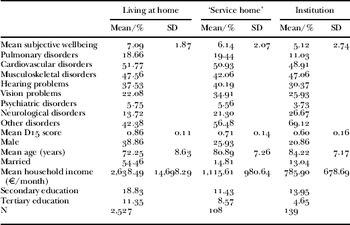
Table 1 provides descriptive statistics for the sample used, divided by institutionalisation status. The raw data reveal that SWB seems to be significantly higher for those who live at home. However, there are important differences between the groups in terms of chronic conditions. Some chronic conditions are clearly more common among those who live at home, while other chronic conditions are more common among those who live in ‘service homes’ or in institutions. For example, neurological disorders are clearly most common among those who live in institutions. Roughly 27 per cent of all individuals who live in institutions suffer from neurological conditions, while the corresponding share is only 14 per cent among those who live at home. The 15D score is also at a lower level among those who are living in institutions. The fact that the income level is lower for those who are living in institutions is in accordance with the results in Nihtilä and Martikainen (Reference Nihtilä and Martikainen2007).
Descriptive statistics of the variables

Note: SD: standard deviation.
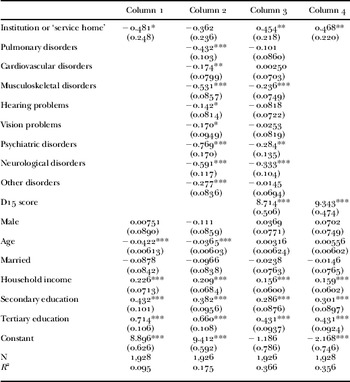
In Table 2 we present the estimation results of ordered probit regressions where the dependent variable is the stated SWB for individuals. In the tables we report coefficients from ordered probit regressions; standard errors for the estimates are shown in parentheses. In column 1, the main explanatory variable is a dummy variable taking the value of 1 if the individual resides in an institution or a ‘service home’. Otherwise, the regression contains the usual socio-economic controls (gender, age, marital status, income and education) that are the standard explanatory variables in the SWB literature. Looking first at the results in column 1, we find that the coefficient of the institutionalisation dummy is negative and statistically significant at the 10 per cent level. Therefore, those who are living at home have, on average, a higher level of SWB, given the control variables included in the specification. This is the pattern that seems to be on policy makers' minds, and it would as such give support to policies that decrease the incidence of institutional living if the ultimate aim were to maximise the level of SWB in the population. Regarding the demographic and education variables, they are generally consistent with the existing knowledge of the determinants of SWB. The age coefficient is negative and highly statistically significant, indicating that younger people are happier. Household income has a positive coefficient, and the more education one has, the higher the level of SWB.
Determinants of subjective wellbeing among the population aged 60 or over

Notes: The reference category consists of those living at home. The columns report the coefficients of four different specifications from ordered probit regressions, as explained in the text. Standard errors are shown in parentheses.
Significance levels:
* p<0.1,
** p<0.05,
*** p<0.01.
In column 2, the set of eight chronic diseases is added to the specification. Judging from this specification, it is clear that suffering from a chronic disease is very detrimental to an individual's SWB. The largest negative coefficient can be found for psychiatric disorders. Turning then to the main explanatory variable, the institutionalisation dummy, we can see that the negative effect of living in an institution from column 1 has shrunk considerably. However, the demographic and education controls are relatively robust to the inclusion of the variables that describe the prevalence of chronic conditions.
In column 3 of Table 2 we add the 15D score to the model in order to control for health and functional status as comprehensively as possible. This has an interesting effect on the sign of the institutionalisation dummy, which now turns from negative to positive. This finding means that if one controls for health and functional status in a rigorous way individuals actually report significantly higher levels of SWB if they live in institutions. The estimates for other control variables are more or less similar to what they were in column 2. There is a potential multicollinearity problem in the specification of column 3. However, the correlation structure of the independent variables (i.e. 15D score and separate chronic conditions) reveals that multicollinearity is not a serious problem in our context. The highest correlation coefficient (−0.28) prevails between 15D and other disorders. It is also interesting to note that although the 15D should control for HRQoL very broadly, the coefficients for neurological and psychiatric diseases (along with musculoskeletal disorders) are still negative and statistically significant in the SWB regression of column 3. This finding is similar to that of Böckerman, Johansson and Saarni (Reference Böckerman, Johansson and Saarni2011). Note that emotional wellbeing is an important component of health, as defined by the World Health Organization (1946). It is a common notion that anxiety and depression are generally at a higher level amongst older people who are living in institutions. Controlling for both mental and physical wellbeing (as we do by using 15D) would imply the existence of the zero effect of the institutionalisation dummy for SWB. However, in contrast to this we observe a significant positive effect on the level of SWB.
Column 4 of Table 2 reports the results of a regression where the only health control is the 15D measure. We find that the 15D score is the one that actually drives the positive coefficient for the institution dummy in column 3. This is an interesting finding, because it implies that HRQoL seems to predict which individuals have increased their subjective wellbeing while living in institutions, whereas having chronic conditions does not.
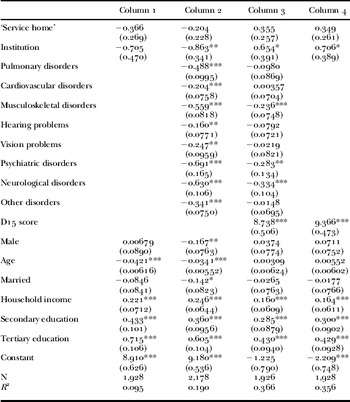
Table 3 presents the results from regressions identical to those presented in Table 2, but this time the residential status is specified as two dummies, one for those living in a ‘service home’ and one for those living in an old-age institution. The results of these regressions show that the result in Table 2 is actually driven by those who are living in old-age institutions. Compared with the reference category, which is living at home, living in ‘service homes’ is not different to living at home, statistically speaking. However, the old-age institution dummy is negative and significant at the 5 per cent level, when controlling for health status in column 2 of Table 3. Also, it is useful to note that the coefficient is considerably larger than the coefficient of living in any institution in Table 2. The old-age institution dummy obtains a significant positive coefficient in columns 3 and 4 of Table 3.
Determinants of subjective wellbeing among the population aged 60 or over

Notes: The reference category consists of those living at home. The columns report the coefficients of four different specifications from ordered probit regressions, as explained in the text. Standard errors are shown in parentheses.
Significance levels:
* p <0.1,
** p <0.05,
*** p <0.01.
Conclusions
In this paper we examine whether there are systematic differences in the quality of life, depending on whether an individual is institutionalised or not, holding health status and income level constant. In doing this we use a nationally representative data set, the Health 2000 in Finland. We focus on those persons who are aged 60 or more. The issue is highly policy-relevant, because the population is ageing rapidly in Finland and other developed countries.
Investigation of potential differences in the quality of life between various modes of living for old adults revealed some very interesting results. The most important finding is that when controlling for health and functional status, demographics and income level, we discover that individuals who are living in old-age homes actually report higher levels of SWB than those who are living at home. This result is in contrast with the widely held view among policy makers and the general public that living at home is associated with the highest level of SWB. The finding is also in disagreement with some of the earlier empirical research. For example, Donnenwerth and Petersen (Reference Donnenwerth and Petersen1992) observe that institutionalisation among old adults leads to a significant decline in SWB, because institutionalisation is associated with decreased residence satisfaction.
While using cross-sectional data it is quite difficult to ascertain in great detail what causes the improvement of SWB associated with institutionalisation among old adults in the Finnish context, but one plausible possibility is the queuing argument pointed out in the introduction. According to this explanation, it is perfectly possible that there are individuals living at home who are so frail that they should really be living in an old-age institution, but because of the queues for that mode of living, they are forced to live at home with a decreased quality of life as a consequence. The results also suggest that HRQoL measures such as 15D can be much better predictors than chronic conditions of who benefits subjectively from living in an institution. This finding carries an important policy lesson, because it implies that the 15D scores could be used to construct criteria to allocate individuals to old-age institutions.
The most important strength of the study was the use of large representative general population data with a high response rate, allowing the estimation of the effects of institutionalisation on SWB. This contrasts with clinical studies where patients are somehow selected and usually more severely ill. It is particularly important to analyse representative data in the Finnish context, because the access to social care varies a lot across municipalities. In a representative data set such as Health 2000 in Finland these differences are averaged out. One essential limitation of the approach was that the data were cross-sectional. Thus, it is very difficult to fully establish causal relationships from the data. The results also open up important avenues for further research. It would be useful to examine the issue in other institutional contexts. This is important, because our findings may be partly related to the specific institutional characteristics of the Finnish system of long-term care. In particular, the relevance of the queuing argument is clearly dependent on the institutional framework that shapes the incentives for the optimal choice of different types of living. An essential requirement for the relevance of the queuing argument is that the public sector subsidises accommodation in old-age homes. However, this is a rather loose requirement that is generally fulfilled, at least in the European context.
Ackowledgement
This paper has benefited from financing from the EU-funded ANCIEN (Assessing Needs of Care in European Nations) project (grant No. 223483).