Introduction
Many of the world's naturally occurring ecosystems, such as grasslands, savannahs and shrublands are considered fire dependentReference Bond and Keeley 1 and are important for livestock production. The designation as a fire-dependent ecosystem is because regularly occurring fires create a frequent disturbance that regulates ecological patterns and processes. In many fire-dependent ecosystems, this disturbance pattern included the response of large herbivores that were attracted to the nutritious regrowth of recently burned areas after fires removed old standing plant materialReference Yadava 2 – Reference Murphy and Bowman 7 . This ecological interaction of fire and grazing, termed pyric-herbivory or fire-driven grazing, results in a shifting mosaic of landscape patterns which increases broad-scale heterogeneityReference Fuhlendorf, Engle, Kerby and Hamilton 8 . The fire regime and the spatio-temporal variability of disturbance patterns maintained grassland by stimulating perennial grasses, shifting competitive interactions and preventing woody plant encroachment. For these reasons, the coupled interaction of fire and grazing has been suggested as an equally important driver of central North American grasslands as climate and soil processesReference Anderson 6 . This fire-grazing phenomena is not unique to North America only, as evidence suggests many vegetation types and organisms of Africa, Asia and Australia are also highly dependent on this ecological interaction as wellReference Yadava 2 , Reference Kramer, Groen and van Wieren 4 – Reference Murphy and Bowman 7 .
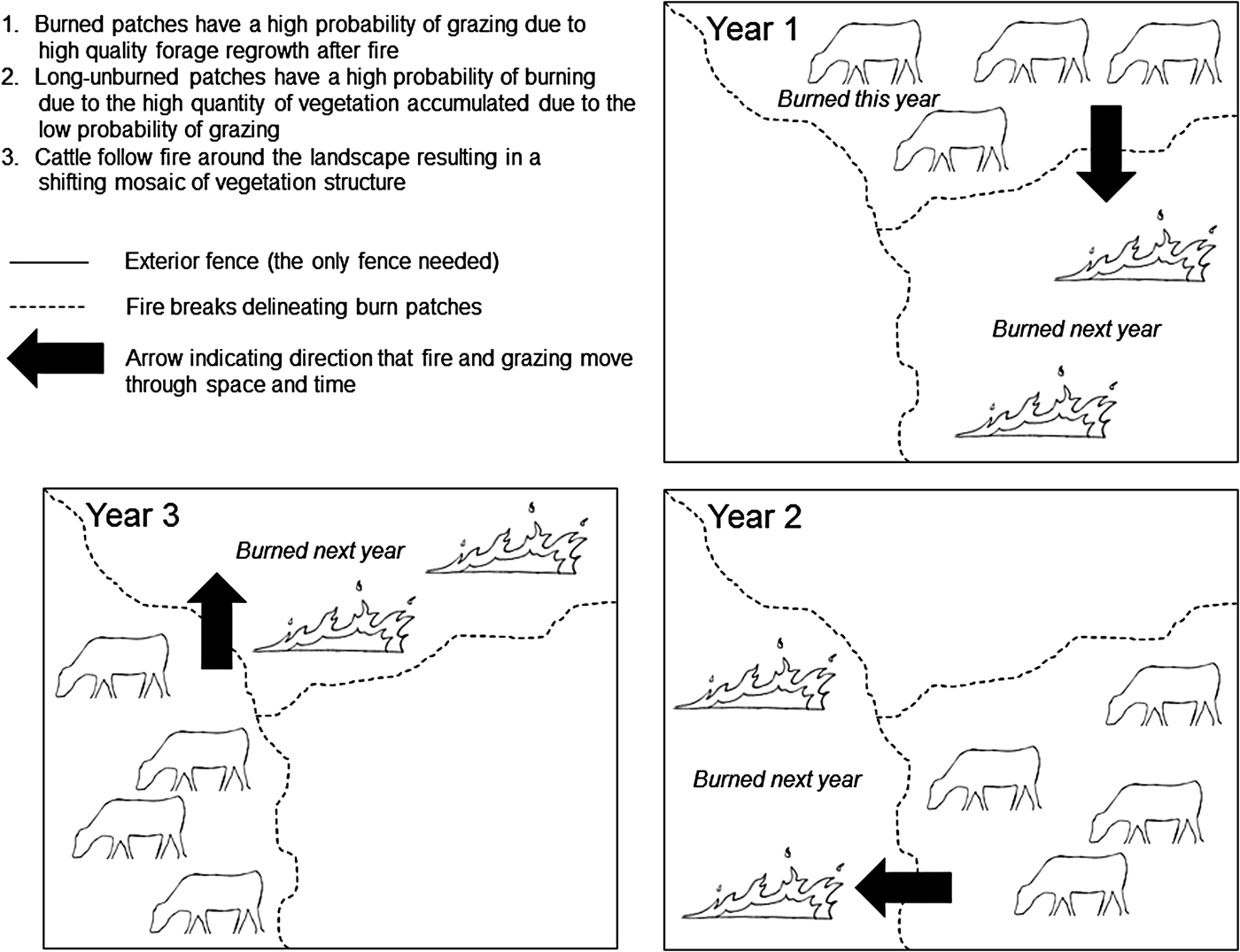
Unique to North America though, is that over the last two decades, ecologists and conservation-focused organizations such as The Nature Conservancy have tried to restore the interaction of fire and grazing through the use of patch-burn grazing or PBGReference Fuhlendorf, Harrell, Engle, Hamilton, Davis and Leslie 9 – Reference Hamilton, Masters and Galley 12 (Fig. 1). Settlement patterns by non-indigenous people had led to the suppression of fire and extirpation of bison, effectively removing these disturbances from the landscapeReference Pyne 13 . Settlers were drawn to the vast expanses of productive forages that could be the foundation of a burgeoning livestock industry in the western USA. Conventional livestock production in these fire-dependent ecosystems has replaced bison with cattle and sought uniformity in grazing patterns and plant communities. Incidentally, suppressing fire and managing for uniform domestic cattle grazing has been to the detriment of many wildlife species, especially grassland birds as a result of the homogenization of vegetation structure and compositionReference Fuhlendorf, Harrell, Engle, Hamilton, Davis and Leslie 9 .
Functional diagram of pyric-herbivory using a 3 yr fire return interval (it does not have to be 3 yr and would likely to be variable depending on site productivity and vegetation). Note the movement of fire and grazing through space and time as cattle follow fire to the most recently burned patches.
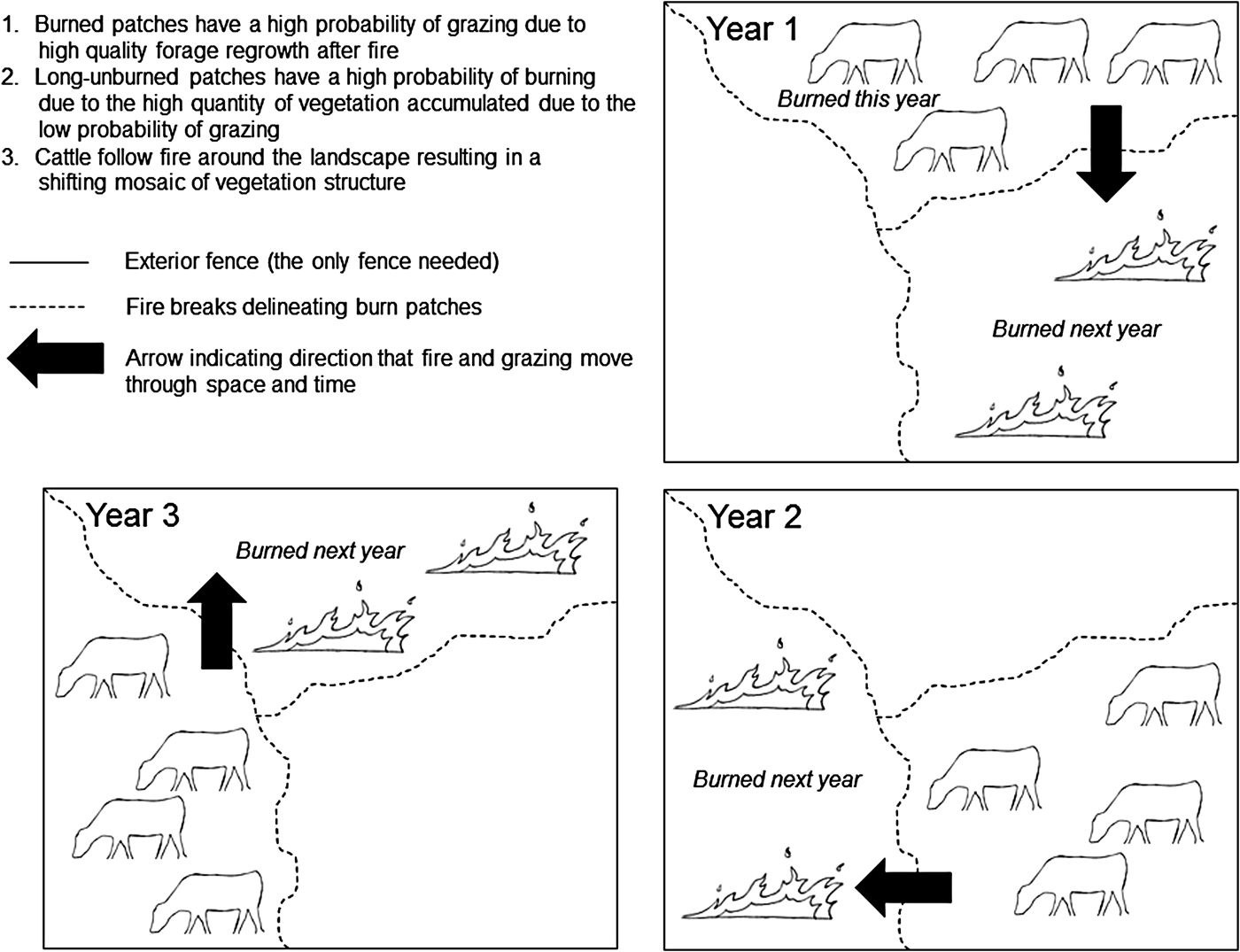
PBG uses prescribed burning a patch within a fenced pasture and free access grazing allows bison and cattle to choose burned or unburned areas and moves fire and grazing disturbances around the landscape causing vegetation patterns to shift through space and timeReference Fuhlendorf, Engle, Kerby and Hamilton 8 , Reference Vermeire, Mitchell, Fuhlendorf and Gillen 14 . Depending upon the elapsed time-since-fire of a given patch, the probability of grazing or burning of that patch varies due to the resulting vegetation structureReference Fuhlendorf and Engle 11 , Reference Fuhlendorf and Engle 15 , Reference Wiens, Hutchings, Juhn and Stewart 16 . Moreover, PBG is different from conventional approaches to grazing management because it attempts to integrate conservation of biodiversity with livestock production which is becoming increasingly important in many rangeland landscapes. PBG also differs because it does not require additional fencing to manipulate grazer movements which is common amongst other grazing management practices.
The impetus for PBG research was out of concern for natural resource conservation, with a major focus on wildlife population ecology, native plant conservation and soil processes, etc. More recently, implications for sustaining beef cattle production have been emerging in the literature. Our objectives for this review were to examine the literature for effects of PBG in two areas: (1) livestock production and inputs, and (2) maintaining or improving ecosystem function and biodiversity as necessary for supporting sustainable livestock production. We place this information within the context of North America relative to the promotion of PBG as an alternative for livestock management. We also identify gaps in the knowledge base and recommend areas for additional study.
Materials and Methods
For this review, we defined PBG as the free interaction of native wildlife and domestic livestock with burned and unburned areas on the landscape through space and time. By assessing studies that considered native wildlife, we identified potential benefits to livestock. We defined PBG as the applied managerial approach to restore the interaction of fire and grazing as an ecological process that uses pyric-herbivory or fire-driven grazingReference Fuhlendorf and Engle 11 . We searched the literature using Google Scholar and Web of Science academic search platforms for the following terms: ‘patch-burn grazing’, ‘fire–grazing interaction’, ‘pyric herbivory’ and combinations of ‘fire’, ‘grazing’, ‘livestock’, ‘wildlife’, ‘plants’, ‘birds’, ‘composition’ and ‘structure’. In a few instances, we included information from the non-technical literature including extension bulletins, theses/dissertations and agency reports. We recognized that such information has not always been vetted by the peer-review process, but since these reports may be the only results available regionally, they provided a perspective of where research has occurred and provided ideas for additional empirical inquiry (Fig. 2).
Study locations assessing the interaction of fire and grazing in North America.

To understand the effects of PBG across environmental gradients, we then examined the identified literature for consistent livestock-production response variables suitable for meta-analyses and the calculation of effect sizes. Seven studies had consistent measures of cattle weight gains (i.e., calf weaning weight or stocker cattle gains) and three studies had consistent comparative measures of forage quality in burned and unburned areas. Only two studies had consistent resource selection functions for fire and were not suitable for meta-analytic statistics. We calculated the effect size of calf weight gains, yearling weight gains compared with not burning, yearling weight gains compared with burning, and forage quality data using an estimate of the standard mean difference for a measure of effect size using Hedges’ d. Hedges’ d is more suitable for unequal sampling variances in the experimental and control groups than Cohen's d and accounts for small sample sizes with a correction termReference Gurevitch, Hedges, Scheiner and Gurevitch 17 – Reference Rosenberg, Adams and Gurevitch 19 . Effect sizes were compared by assessing the variance in the effect and relative magnitude.
We begin by reviewing the effects of PBG on livestock production and inputs and then move to maintaining ecosystem function and biodiversity. We present the results of effect size calculations and then summarize constraints and limitations to PBG knowledge currently.
Livestock Production and Inputs
Feed costs
The largest input cost of cattle production is supplemental feed, which exceeds more than half of the direct cost in cow-calf operations but is less in stocker operationsReference Short 20 . Feeding strategies attempt to overcome seasonal periods of inadequate forage quality such as the winter in perennial C4 grasslands of North America and/or periods of inadequate forage quantity such as periods of droughtReference Waterman, Geary, Paterson and Lipsey 21 . Reports on the value of patchy fires for cattle production in native fire-dependent ecosystems date back to the 1960s. A study in native longleaf pine—bluestem rangeland reported that patchy fires every 3 yr increased forage palatability, nutritive value, herbaceous plant dominance and cow and calf weight gainsReference Duvall and Whitaker 22 . Patchy fires also increased cattle gains, crude protein content of forage plants and utilization of wiregrasses (Aristida spp. and Sporobolus spp.)Reference Hilmon and Hughes 23 . In coastal prairies, patchy fires in gulf cordgrass (Spartina spartinae (Trin.) Merr. ex Hitchc.) increased dietary crude protein content and in vitro organic matter digestibility sustaining or increasing steer gainsReference Angell, Stuth and Drawe 24 . Forage quality of burned patches in tallgrass prairie exceeded unburned patches by a factor of four with 18 and 4% crude protein, respectivelyReference Allred, Fuhlendorf, Engle and Elmore 25 . Accordingly, cattle use of the recently burned patch is greatly disproportionate to the area of the patch. For example, 75% of grazing time has been in the most recently burned patch in tallgrass prairieReference Fuhlendorf and Engle 15 .
PBG optimizes forage quantity in patches that have not been burned for an extended period of time – and subsequently have not been grazed – and have accumulated forage that could be considered as stockpiled forage or standing hayReference McGranahan, Henderson, Hill, Raicovich, Wilson and Smith 26 . Late winter fires in shortgrass steppe did not affect herbaceous plant production but did increase in vitro dry matter digestibility of the dominant C4 grass [Bouteloua gracilis (Willd. ex Kunth) Lag. ex Griffiths], providing a neutral effect on forage quantity and a short-term enhancement of forage qualityReference Augustine, Derner and Milchunas 27 . In addition, some studies have reported an increase in productivity for both C3 and C4 perennial grasses, specifically [Pascopyrum smithii (Rydb.)Reference Vermeire, Crowder and Wester 28 A. Love and Schizachrium scoparium (Michx.) Nash]Reference Limb, Fuhlendorf, Engle and Kerby 29 . As a result, PBG can be strategically used to optimize forage quality and quantity, potentially mediating feed costs by providing both high quality forage (low quantity) and high quantity forage (low quality).
In the southern Great Plains of the USA, both cow-calf and stocker cattle enterprises reported that PBG did not decrease production and at times maximized production over multiple years, compared with the regionally common grazing practices which did not include fire or burned entire pastures every few yearsReference Jamison and Underwood 30 , Reference Limb, Fuhlendorf, Engle, Weir, Elmore and Bidwell 31 . In the northern Great Plains of the USA, PBG has maintained or increased weaning weights of calves and maintained body condition of mature cowsReference Baumann 32 , Reference Winter, Fuhlendorf and Goes 33 . Managers have also reported delaying winter supplemental feeding due to the extension of higher forage quality in the fall in pastures managed with PBGReference Weir, Fuhlendorf, Engle, Bidwell, Chad Cummings, Elmore, Limb, Allred, Scasta and Winter 34 . Lastly, a recent multi-year study compared PBG with the practice of annually burning the entire pasture and seasonally grazing stocker cattle, a common practice in the Flint Hills region of the USA. This study reported that PBG had nearly similar animal gain during dry years providing a risk management strategy against droughtReference Allred, Scasta, Hovick, Fuhlendorf and Hamilton 35 .
Parasites and disease
Parasites constitute another major source of potential economic loss and input costs for cattle enterprises. A 4 yr study comparing PBG with traditional management significantly reduced ticks (Amblyomma americanum L.) on both cows and calves, regardless if the control pastures were completely burned or not burned at allReference Polito, Baum, Payton, Little, Fuhlendorf and Reichard 36 . PBG also reduced horn flies (Haematobia irritans L.) 41% compared with no burning, reducing fly levels below the economic threshold for insecticidal treatmentsReference Scasta, Engle, Talley, Weir, Stansberry, Fuhlendorf and Harr 37 . Reductions in face flies (Musca autumnalis DeGeer) have also been reported and reductions of these flies is in part due to combustion of fecal resources, but PBG reductions of flies can be limited during droughtReference Scasta, Weir, Engle and Carlson 38 , Reference Scasta 39 . Although no studies have reported the effects of fire on cattle gastro-intestinal parasites, Stone's sheep (Ovis dalli stonei Nelson) with access to burned areas had ~10% lungworm (Protostrongylus spp.) infection as those grazing unburned areas onlyReference Seip and Bunnell 40 .
Both horn flies and ticks serve as vectors for many diseases resulting in additional input costs for medicine and veterinary services. Conventional insecticidal management is expensive and variable in efficacy because of rapidly developing genetic resistanceReference Birkett, Agelopoulos, Jensen, Jespersen, Pickett, Prijs, Thomas, Trapman, Wadhams and Woodcock 41 – Reference Oyarzún, Quiroz and Birkett 44 . Ticks serve as vectors for bacterial, viral and protozoal disease agents that can also lead to paralysis, toxicosis, irritation and allergyReference de la Fuente, Almazan, Canales, Perez de la Lastra, Kocan and Willadsen 42 . Horn flies have been implicated in the transmission of bovine leukosis virus, helminths of the skin and moreReference Buxton, Hinkle and Schultz 45 . Animal health related costs account for 7–13% of operating costsReference Short 20 , so reducing ecto-parasite pressure with PBG, or any effective cultural approach for that matter, will lead to a reduction in animal health costs by reducing exposure to diseasesReference Polito, Baum, Payton, Little, Fuhlendorf and Reichard 36 , Reference Scasta, Engle, Talley, Weir, Stansberry, Fuhlendorf and Harr 37 . Furthermore, the lack of fire leads to the encroachment of Juniperus virginiana (L.) that is positively correlated with Culex tarsalis (Coquillett), a mosquito vectoring West Nile virus, a threat to animals and humansReference O'Brien and Reiskind 46 .
Physical dermatitis
Many rangeland plants have physical defense mechanisms that deter grazing including thorns and pointed leaves that can injure upon contactReference dos Reis 47 . A well-known example is prickly pear cactus (Opuntia spp.) which has spines that reduce forage consumption, and cause physical damage to the mouth and upper GI tract of sheep, goats and cattleReference Migaki, Hinson, Imes and Garner 48 , Reference McMillan, Scott, Taylor and Huston 49 . Fire can offer a practical and economical strategy to remove the spines and reduce contact dermatitisReference McMillan, Scott, Taylor and Huston 49 . PBG in semiarid grassland also attracted pronghorn antelope (Antilocapra americana Ord) at densities 7–26 times greater in spring and winter burned patches than unburned patches, resulting in a 5x increase of bitten or uprooted cactus cladodes in burn patches and a 54–71% reduction of cactus during the first year of burningReference Augustine and Derner 50 . This reduction in cactus density attributed to the interaction of fire and pronghorn grazing was maintained for at least 6 yr after burning.
Resource selection
PBG allows grazing animals to make resource selection decisions without forcing that is applied with other grazing management strategies such as cross-fencingReference Fuhlendorf and Engle 15 , Reference Allred, Fuhlendorf, Engle and Elmore 25 . However, cross-fencing can be useful to divide large pastures into multiple paddocks to assist in locating and managing cattle. Patchy fires increase forage utilization in burn patches compared with unburned areas but still allows animals to select locations without restricting animals to a fenced paddockReference Vermeire, Mitchell, Fuhlendorf and Gillen 14 . Herding could affect resource selection decisions in a low-stress scenario but human resources are increasingly difficult to find and herding would only achieve one of the many other benefits that PBG realizes.
Diet diversity, inter-animal competition and reproduction
Dietary diversity has positive associative effects for herbivores but constructing species mixtures that complement one another in nutrient content and secondary compounds is not well understoodReference Provenza, Villalba, Haskell, MacAdam, Griggs and Wiedmeier 51 . PBG allows cattle to respond to burned patches and shifts the grazing decision from the plant scale to the patch scale, so consumption of a greater variety of plants is expected. This change in dietary selection is demonstrated by studies reporting PBG causing cattle to graze plant species that they typically avoid without fireReference Hilmon and Hughes 23 , Reference Coppedge, Engle, Toepfer and Shaw 52 – Reference Cummings, Engle and Fuhlendorf 54 . At The Nature Conservancy's Tallgrass Prairie Preserve in Osage County, Oklahoma, USA, fire and grazing have been recoupled at the landscape scale. This has allowed fire and bison grazing to freely interact, resulting in high bison reproductive rates without nutritional supplementationReference Fuhlendorf and Engle 11 . The direct benefits to animal welfare may be the least understood benefit of PBG.
Herbicides for invasive weed management
Another threat to sustainable livestock enterprises is the encroachment and dominance of unpalatable exotic or native herbaceous plants that are often combatted with herbicides. In the southern Great Plains and Midwestern USA, an exotic legume, sericea lespedeza or Chinese bushclover [Lespedeza cuneata (Dum.Cours.) G.Don], is a threat and management challenge to cattle producers. As L. cuneata invades it creates monocultures that displace native grasses, alters structure and composition of plant communities and decreases overall grazable forageReference Price and Weltzin 55 . Ranchers and conservation organizations have reported allocating a substantial portion of their operating budget spraying for L. cuneata, often with only marginal successReference Palmer 56 , Reference Cook and Hickman 57 .
A primary mechanism facilitating L. cuneata invasion and dominance over native plant communities is the high tannin levels that deter grazingReference Allred, Fuhlendorf, Monaco and Will 58 . The application of PBG overcomes the tannin grazing deterrent and increases herbivory. This slows the rate of invasion—three times slower than in traditionally managed pasturesReference Cummings, Engle and Fuhlendorf 54 . Functionally, PBG results in focal grazing that begins at an early plant growth stage after fire and grazing continues to perpetuate an earlier phenological stage.
Restoring the fire disturbance alone can be applied to manage other problematic weeds on North America rangelands. For example, fire reduced broom snakeweed [Gutierrezia sarothrae (Pursh) Britton & Rusby], prickly pear cactus (Opuntia polyacantha Haw.), and purple threeawn (Aristida purpurea Nutt.)Reference McDaniel, Hart and Carroll 59 – Reference Strong, Ganguli and Vermeire 61 . Fire may also restore the C4 grass component in areas dominated by C3 annual grassesReference Ansley, Boutton, Mirik, Castellano and Kramp 62 . Fire has also been effectively restored in areas that are invaded by naturalized C3 grasses but additional information is currently lacking on if or how fire may reduce exotic C3 grassesReference Scasta 39 . Ultimately, PBG and the restoration of regular fire has the potential to slow exotic or invasive plant encroachment and dominance, reduce herbicide application costs and minimize losses to the grazable forage base.
Mechanical tree and brush control management
Woody plant encroachment is another threat to livestock production. Species such as eastern redcedar (J. virginiana) convert open grassland to closed woodland in as little as 40 yrReference Briggs, Hoch and Johnson 63 . Historically, fires relegated these non-sprouting and fire sensitive trees to shallow soils and topography where fire was unlikely to spread. The low growing canopy of J. virginiana reduces herbaceous plant production and grazing capacityReference Engle, Stritzke and Claypool 64 , Reference Limb, Engle, Alford and Hellgren 65 . Other Juniperus species, such as Juniperus ashei (J. Buchholz) and Juniperus pinchotii (Sudw.) are similarly problematic in other regions of the USAReference Ansley and Rasmussen 66 .
Ranchers have applied a variety of costly and temporary mechanical brush control practices (mowing, hand cutting, bulldozing, roller chopping) but fire may be the most economical and effective for non-resprouting and resprouting woody plantsReference Teague, Borchardt, Ansley, Pinchak, Cox, Foy and McGrann 67 , Reference Bidwell, Weir and Engle 68 . PBG offers a practical framework for applying regular fire to reduce the need for costly mechanical brush control costs. PBG has the potential to be more effective at reducing woody plant encroachment than complete burning pastures. The burned areas draw grazing animals from unburned areas which then can accumulate adequate fuel for the next successful fire and creates fire breaks by focusing grazing and removing fine fuels in other areasReference Kerby, Fuhlendorf and Engle 69 . This pattern of fuel accumulation driven by fire-grazing patterns enhances the potential success of prescribed fires for brush control because continuous grazing and burning pastures completely may not support the frequency of burning neededReference Weir, Fuhlendorf, Engle, Bidwell, Chad Cummings, Elmore, Limb, Allred, Scasta and Winter 34 , Reference Teague, Borchardt, Ansley, Pinchak, Cox, Foy and McGrann 67 , Reference Ansley, Pinchak, Teague, Kramp, Jones and Barnett 70 .
Encroachment by resprouting shrubs is also a concern in fire-dependent ecosystems. These shrub species are able to resprout basally and/or epicormatically, and are not killed by fire. Fire, however, can alter the structure of these shrubs benefitting the herbaceous plant community important for cattle grazingReference Heisler, Briggs, Knapp, Blair and Seery 71 . PBG with summer fires reduced cover of honey mesquite (Prosopis glandulosa Torr.) and other resprouting shrubs facilitating herbaceous plant recoveryReference Teague, Duke, Waggoner, Dowhower and Gerrard 72 . Therefore, regular fire has the potential to slow the invasion of undesirable plants that can reduce forage available for cattle and offset the need for expensive and temporary mechanical brush control costs.
Nitrogen (N) availability
Net primary productivity of most terrestrial ecosystems is N limited and this leads to additional input costs for livestock productionReference LeBauer and Treseder 73 . Functionally, N is critical for plant growth and microbial breakdown of cellulosic material in the rumen of cattleReference Belasco 74 . In tallgrass prairie, PBG enhances N availability by interactively cycling nutrients rapidly with fire followed by focal grazingReference Anderson, Fuhlendorf and Engle 75 . The authors explicitly stated this interaction between fire and grazing and the resulting increase in plant available N may offer a strategic management approach for sustaining livestock production; likely because N content is used to calculate crude protein, the primary measure of feed quality. Furthermore, the disturbance of fire in tallgrass prairie removes litter, increasing productivity, nutrient cycling and plant available NReference Knapp and Seastedt 76 , Reference Blair 77 . In shortgrass steppe, PBG with March burns created a pulse of N with enhanced soil N availability in June and JulyReference Augustine, Derner and Milchunas 27 . Considering the different inputs managers use in the attempt to distribute/increase N across the landscape (supplemental feed high in N content, fertilizer, establish exotic legumes, etc.), the accelerated nutrient cycling associated with PBG could offset these inputs. However, the short-term N pulse post-fire needs to be understood in context with potential net volatile loss of N and subsequent N:carbon dynamics relative to ecosystem stability.
Grazing distribution
Grazing distribution continues to be a major challenge for livestock production in North AmericaReference Holechek, Pieper and Herbel 78 . Managers have used a variety of inputs to manipulate grazing distribution across the landscape, including cross-fencing, mobile feeders, low moisture blocks, herding, water and moreReference Bailey 79 . Cross-fencing, in particular, is expensive for the initial construction and the required maintenance. A 2011 study estimated the cost of construction to exceed US$5000 per kilometer, with 8% of the initial cost needed annually for maintenanceReference Knight, Toombs and Derner 80 . PBG distributes grazing by manipulating forage quality with fire as opposed to cross-fencing, developing water, moving feeds, etc. The attraction to the recently burned areas tends to override topography, distance to water or shade even in semi-arid areas and result in cattle spending a majority of time grazing in recently burned patchesReference Fuhlendorf and Engle 15 , Reference Allred, Fuhlendorf, Engle and Elmore 25 , Reference Clark, Jaechoul, Kyungduk, Nielson, Johnson, Ganskopp, Chigbrow, Pierson and Hardegree 81 , Reference Clark, Jaechoul, Kyungduk, Nielson, Johnson, Ganskopp, Pierson and Hardegree 82 . A 3 yr study reported economic returns from PBG on tallgrass prairie could exceed those of management intensive grazing on endophyte infected tall fescue [Schedonorus arundinaceus (Schreb.) Dumort., nom. cons.] pasture due to almost ten times greater input cost primarily from fencing and water developmentReference Jamison and Underwood 30 , Reference Davit and Alleger 83 .
Ecological costs and risks associated with cross-fencing rangeland can affect woody plant encroachment and wildlife movements. Cross-fencing increases perches for birds and serves as a recruitment pathway for bird-dispersed seeds of woody plants especially J. virginiana, a major threat to North American grasslandsReference McDonnell 84 , Reference Coppedge, Engle, Fuhlendorf, Masters and Gregory 85 . Cross-fences increase collisions of Lesser Prairie-Chicken (Tympanuchus pallidicinctus Ridgway) and Greater Sage-Grouse (Centrocercus urophasianus Bonaparte)Reference Stevens, Reese, Connelly and Musil 86 and inhibit migrating ungulates such as pronghorn antelope, which typically go through fences as opposed to jumping themReference Scott 87 . The use of spatially and temporally discrete fires could serve as an ecological proxy for cross-fencing while reducing overhead, financial risks and ecological risks.
Ecosystem Function and Biodiversity
Plant composition and structure
The most common approaches to cattle production either completely exclude fire or burn everything, with the former being most predominant in North America with a few exceptions such as the Flint Hills in Kansas and Oklahoma USA. These two common approaches may only benefit certain segments of the plant community. For example, the interaction of fire and grazing in PBG stimulates below- and above-ground biomass of one of the most common perennial C4 grasses in mixed and tallgrass prairies, little bluestem [Schizachrium scoparium (Michx.) Nash]Reference Limb, Fuhlendorf, Engle and Kerby 29 . The interaction of fire and grazing can also improve plant root tissue quality and initiate faster cycling of NReference Johnson and Matchett 88 . In tallgrass prairie, the interactive disturbance of fire and grazing increases plant diversity due to the release of forbs that are often inhibited by the structurally dominating tallgrass speciesReference Vermeire, Mitchell, Fuhlendorf and Gillen 14 , Reference Coppedge, Engle, Toepfer and Shaw 52 , Reference Helzer and Steuter 53 . Thus, PBG integrates fire and grazing disturbances that optimize native grasses that are critical for ruminant livestock and can increase floristic diversity of fire-dependent ecosystems.
The primary intent of PBG has been to restore patterns of landscape heterogeneity because heterogeneity is the root of biological diversity at all levels of ecological organization and scalesReference Fuhlendorf and Engle 11 , Reference Wiens 89 . Many studies have reported that PBG increased heterogeneity of vegetation visual obstruction, or contrast between patches, at the patch scale as opposed to methods that promote homogeneity through annual burning and grazing or not burning at allReference Fuhlendorf and Engle 15 , Reference Winter, Fuhlendorf, Goad, Davis, Hickman and Leslie 90 – Reference McGranahan, Raicovich, Wilson and Smith 92 . In ecosystems with a dominant shrub component, such as sand sagebrush (Artemisia filifolia Torr.), PBG restored heterogeneous vegetation patterns and maintained herbaceous plant dominance and plant successionReference Winter, Fuhlendorf, Goad, Davis, Hickman and Leslie 90 .
However, not all studies have resulted in the desired level of heterogeneityReference McGranahan, Engle, Fuhlendorf, Winter, Miller and Debinski 93 . Constraints to heterogeneity management include overgrazing prior to attempting to burn, exotic species and stocking rateReference Scasta 39 . These constraints modify the fuel bed and limit fire spread. Furthermore, the interactive effects of fire and grazing on structural heterogeneity are scale dependent and in some areas may also be constrained by topographyReference Collins and Smith 94 , Reference Augustine and Derner 95 . In desert grasslands, the interaction of fire and grazing can lead to a decrease in perennial grass cover but an increase in species diversity; tradeoffs that warrant further examinationReference Drewa and Havstad 96 . The lack of structural heterogeneity in highly disturbed plant communities, potentially negative effects on the plant community in arid environments and variability in plant–herbivore interactions across a gradient of precipitation and evolutionary histories continues to be a gap in the literatureReference Milchunas, Sala and Lauenroth 97 .
Soil and water resources
The shifting mosaic of vegetation patterns and attraction of animals to recently burned areas overrides other resource selection criteria for cattle and has been hypothesized to potentially reduce animal preference for riparian areas. A study in semi-arid rangeland reported PBG led cattle to select riparian areas five times less than cattle in traditionally managed pastures, effectively reducing the impact of disturbance due to grazingReference Hiatt 98 . Given the preference of cattle for both shade and water, along with predictions for a warming climate, PBG can strategically mitigate the risk to riparian areas being overutilized and degradedReference Allred, Fuhlendorf, Hovick, Elmore, Engle and Joern 99 . PBG also creates a shifting pattern of vegetation structures that varies through space and time and reduces or eliminates ‘sacrifice’ areas where animals congregate resulting in degradationReference Teague, Duke, Waggoner, Dowhower and Gerrard 72 .
A study on PBG in coarse textured sandy soils found an increased rate of erosion on burned patches although no drifting or blowouts were observedReference Vermeire, Wester, Mitchell and Fuhlendorf 100 . In the same study, when spring weather promoted early plant growth, erosion was similar between burned and unburned patchesReference Vermeire, Wester, Mitchell and Fuhlendorf 100 . This study also found soil water content and plant productivity were unaffected by PBG but soils in burned patches were 1–3°C warmer than unburned plots. A study on silty clay loam soils also resulted in warmer soil surface, more bare ground, less litter, greater runoff depth and greater sediment loss in recently burned patches but no difference in soil compaction, soil C, or total NReference Ozaslan, Parlak, Blanco-Canqui, Schacht, Guretzky and Mamo 101 .
Invertebrates
The subsequent effects of the interaction of fire and grazing span many trophic levels of wildlife, including invertebrates. A mesic prairie study reported 50% greater total invertebrate biomass and greater abundance of multiple invertebrate orders in the patch that was burned and focally grazed the previous year compared with traditionally managed pasturesReference Engle, Fuhlendorf, Roper and Leslie 102 . A similar study in semi-arid sagebrush communities reported that Araneae needs unburned areas, Hemiptera needs burned areas, and Orthoptera equally use areas that are both burned and unburnedReference Doxon, Winter, Davis and Fuhlendorf 103 .
Pollinators may also benefit from PBG as Monarch butterflies (Danaus plexippus L.) increased concurrently with increases in the host plant green antelopehorn milkweed (Asclepias viridis Walter) in patch-burned pastures that used summer firesReference Baum and Sharber 104 . Other butterfly studies have reported variable responses to fire and grazing with different species having different sensitivities to elapsed time since fire and grazingReference Moranz 105 , Reference Moranz, Debinski, McGranahan, Engle and Miller 106 . However, it is evident from these studies that butterflies are sensitive to changes in the herbaceous plant community. The risk of not burning at all is a potential shift to a woodland state and alternatively, burning entire areas can reduce larvae and potentially eliminate populations that inhabit isolated grassland fragmentsReference Debinski, Vogel, Koford and Miller 107 , Reference Vogel, Debinski, Koford and Miller 108 .
Many of the native nectar plants that pollinators depend on are forbs which increase with PBGReference Vermeire, Mitchell, Fuhlendorf and Gillen 14 , Reference Coppedge, Engle, Toepfer and Shaw 52 . Another example is the need to maintain native vegetation by using fire to combat cedar (Juniperus spp.) encroachment to conserve the federally endangered American Burying Beetle (Nicrophorus americanus Olivier) and other grassland obligate detritivoresReference Walker and Hoback 109 . The spatio–temporal interaction of fire and grazing has important implications for invertebrate biodiversity.
Grassland birds
Grassland birds have been declining over the last several decades and PBG restores structural and compositional heterogeneity to the benefit of grassland bird speciesReference Fuhlendorf, Harrell, Engle, Hamilton, Davis and Leslie 9 , Reference Wiens 89 , Reference Powell 110 , Reference Pillsbury, Miller, Debinski and Engle 111 . Increased landscape heterogeneity from PBG creates greater diversity and abundance of grassland obligate birds by offering a broader range of habitat structures that benefit all life phases and help moderate thermal extremesReference Fuhlendorf, Harrell, Engle, Hamilton, Davis and Leslie 9 , Reference Coppedge, Fuhlendorf, Harrell and Engle 112 . Species reported to be declining across their historical range tend to occur at the extreme ends of the spectrum of vegetation structure; Upland sandpipers (Bartramia longicauda Bechstein) prefer recently burned and heavily grazed patches while Henslow's sparrows (Ammodramus henslowii Audubon) require patches not recently burned or grazedReference Fuhlendorf, Harrell, Engle, Hamilton, Davis and Leslie 9 . Similar research reported increased bird species richness and greater abundance of Horned Larks (Eremophila alpestris L.) in PBG pastures in comparison with control pasturesReference Jamison and Underwood 30 . Additionally, bird demographic studies reported increased nest survival for Dickcissels (Spiza americana Gmelin) and Grasshopper Sparrows (Ammodramus savannarum Gmelin) in PBG pastures compared with pastures with homogenous vegetative structureReference Churchwell, Davis, Fuhlendorf and Engle 113 , Reference Hovick, Miller, Dinsmore, Engle, Debinski and Fuhlendorf 114 . The heterogeneity created by PBG increases diversity and stability in breeding and non-breeding grassland bird communitiesReference Hovick, Elmore, Fuhlendorf, Engle and Hamilton 115 , Reference Hovick, Elmore and Fuhlendorf 116 .
A long-term assessment of grassland birds over two decades suggests that fire and grazing must be variable in intensity of disturbance and restore heterogeneity if grassland birds are to be conservedReference Powell 110 . In the western USA, Mountain plovers (Charadrius montanus Townsend) are also tightly coupled with the fire-grazing disturbance that creates low statured and bare ground habitat they requireReference Augustine and Derner 95 . Patchy fires are also required by Northern Bobwhite quail (Colinus virginianus L.) to provide the suite of vegetation structure needed for all life phases and PBG has been suggested as the best strategy for providing this habitat mosaicReference Hernández and Guthery 117 , Reference Bidwell, Masters, Sams and Tully 118 . Finally, a patchy application of disturbance to tallgrass prairie has consistently been recommended to prevent the continued decline of Greater Prairie-Chickens throughout the Flint Hills of Kansas and Oklahoma, USAReference Robbins, Peterson and Ortega-Huerta 119 , Reference McNew, Preby and Sandercock 120 . These results support the role of PBG in integrating grazing and biological conservation by restoring critical disturbance processes that shape grassland environments for birds obligated to this type of habitatReference Griebel, Winter and Steuter 121 . These results indicate that PBG provides an alternative to homogeneous management on rangelands or the idea of managing towards the middle which are common practices across most rangelands in North AmericaReference Fuhlendorf and Engle 15 , Reference Holechek, Pieper and Herbel 78 .
Mammals
PBG creates a mosaic of patches with different amounts of vegetation biomass, forage quality and structure, whereby different patches may be used differently by different wildlife species. For example, deer mice (Peromyscus maniculatus Wagner) were ten times more abundant on burned patches, but hispid pocket mice (Chaetodipus hispidus Baird) were ten times more abundant on intermediate patches. Hispid cotton rat (Sigmodon hispidus Say & Ord), prairie vole (Microtus ochrogaster Wagner) and fulvous harvest mice (Reithrodontomys fulvescens J. A. Allen) all dominated patches not burned in >2 yrReference Fuhlendorf, Townsend, Elmore and Engle 122 . Patchy fires that are focally grazed also influenced black-tailed prairie dogs (Cynomys ludovicianus Ord) with colonies expanding two times faster into burned areas compared with unburned areas in shortgrass steppeReference Augustine, Cully and Johnson 123 , Reference Breland 124 .
Large mammals also require diversity in habitat. White-tailed deer (Odocoileus virginianus Zimmermann) grazed summer burned areas with peak use occurring within the first 2 months after fireReference Meek, Cooper, Owens, Cooper and Wappel 125 . In sagebrush communities, elk (Cervus elaphus L.) had greater herbivory of burn patches the first 2 yr after fireReference Dyke and Darragh 126 . Similar long-term effects were reported for the winter nutritional plane of C. canadensis and mule deer (Odocoileus hemionus Rafinesque) with positive associative effects lasting up to 2 yrReference Hobbs and Spowart 127 . The value of burned areas may be increasingly important for winter habitat and nutrition as elk and bison used burned patches more than expected especially during mid to late winterReference Pearson, Turner, Wallace and Romme 128 . From a conservation standpoint, the use of patchy fire has also been suggested as a habitat restoration tool for bighorn sheep (Ovis canadensis Shaw)Reference Bleich, Johnson, Holl, Konde, Torres and Krausman 129 , Reference Holl, Bleich, Callenberger and Bahro 130 . Stone's sheep (O. dalli stonei) in sub-alpine and alpine ranges also benefit from patchy fires due to greater forage quantity on burned range that resulted in lower internal parasite loads and greater lamb crops than sheep on unburned rangeReference Seip and Bunnell 40 .
Data Analyses: Effect Size of Livestock Production Variables across Gradients
Calf weaning weight: PBG versus burning entire pasture every third year
Only two studies presented suitable data for meta-analyses of calf weaning weights under PBG managementReference Limb, Fuhlendorf, Engle, Weir, Elmore and Bidwell 31 , Reference Winter, Fuhlendorf and Goes 33 . Both studies compared PBG with burning entire pastures every third year and the studies were located in southeastern Nebraska, USAReference Winter, Fuhlendorf and Goes 33 and north-central Oklahoma, USAReference Limb, Fuhlendorf, Engle, Weir, Elmore and Bidwell 31 . The Nebraska study had an effect size and variance of 0.51 ± 0.69 and the Oklahoma study had an effect size of −0.10 ± 0.50. Overall calf weaning weights under PBG did not differ from those pastures managed with fire every third year (effect size = 0.16 ± 0.60; Fig. 3A).
Patch-burn grazing (PBG) effect sizes along precipitation gradients for (A) calf weaning weights versus burning entire pastures every third year, (B) yearling cattle weight gains versus burning entire pastures every third year or burning annually, and (C) yearling cattle weight gains versus not burning at all.

Yearling cattle weight gain: PBG versus burning entire pasture every third year or burning annually
Only two studies presented suitable data for meta-analyses of yearling cattle weight gains under PBG management compared with management from different spatio-temporal applications of fireReference Limb, Fuhlendorf, Engle, Weir, Elmore and Bidwell 31 , Reference Allred, Scasta, Hovick, Fuhlendorf and Hamilton 35 . Both studies compared PBG with burning entire pastures every third year and both studies were located in north-central Oklahoma, USAReference Limb, Fuhlendorf, Engle, Weir, Elmore and Bidwell 31 , Reference Allred, Scasta, Hovick, Fuhlendorf and Hamilton 35 . The effect size of −0.36 ± 0.51 and −0.25 ± 0.34 (Stillwater and Pawhuska, respectively) did not differ. Overall, yearling cattle weight gain under PBG did not differ from those pastures managed with fire every third year (effect size = −0.29 ± 0.42; Fig. 3B).
Yearling cattle weight gain: PBG versus not burning at all
Three studies presented suitable data for meta-analyses of yearling cattle weight gains under PBG management compared with not burning at allReference Angell, Stuth and Drawe 24 , Reference Limb, Fuhlendorf, Engle, Weir, Elmore and Bidwell 31 , Reference Augustine and Derner 131 . Studies were located across an annual precipitation gradient ranging from 339 mm in the shortgrass steppe near Nunn, Colorado, USAReference Augustine and Derner 131 , 725 mm in the mixed grass prairie near Bessie, Oklahoma, USAReference Limb, Fuhlendorf, Engle, Weir, Elmore and Bidwell 31 , and 877 mm in the coastal prairie near Sinton, Texas, USAReference Angell, Stuth and Drawe 24 . The effect size was 0.36 ± 0.51 in the shortgrass steppe location, 0.81 ± 0.20 in the mixed grass prairie location and 1.49 ± 0.86 in the coastal prairie location, with error bars that only overlapped zero in the shortgrass steppe location. Overall, yearling cattle weight gain with PBG was greater than when not burned (effect size = 0.80 ± 0.52; Fig. 3C). Furthermore, this limited data set suggests the possibility for increasing yearling cattle weight gains as annual precipitation increases with patchy fires.
Forage quality
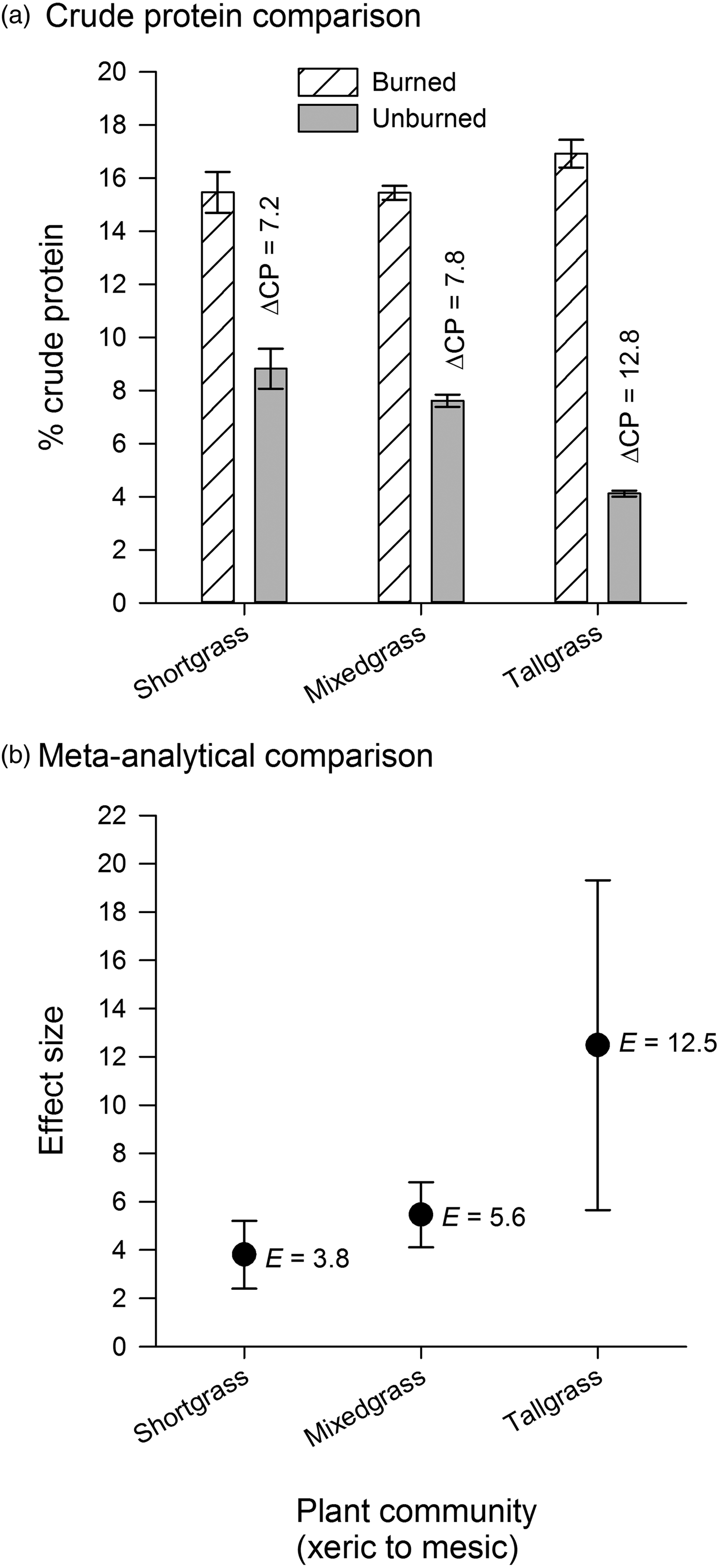
Three studies presented suitable data for meta-analyses of forage quality with and without fireReference Allred, Fuhlendorf, Engle and Elmore 25 , Reference Hiatt 98 , Reference Augustine and Derner 131 . Studies were located across an annual precipitation gradient ranging from 339 mm in the shortgrass steppe near Nunn, Colorado, USAReference Augustine and Derner 131 , 725 mm in the mixed grass prairie near Bessie, Oklahoma, USAReference Hiatt 98 , and 1,005 mm in the tallgrass prairie near Pawhuska, Oklahoma, USAReference Allred, Fuhlendorf, Engle and Elmore 25 . Crude protein was 15.5% ± 0.8 in burned patches and 8.8% ± 0.8 in unburned patches in the shortgrass steppe location, 15.5% ± 0.3 and 7.6% ± 0.2, respectively, in the mixed grass prairie location, and 16.9% ± 0.5 and 4.1% ± 0.1, respectively, in the tallgrass prairie location (Fig. 4A). The effect size was 3.8 ± 1.4 in the shortgrass steppe location, 5.5 ± 1.4 in the mixed grass prairie location and 12.5 ± 6.9 in the tallgrass prairie location, with error bars that never overlapped zero (Fig. 4B).
Crude protein comparison along the precipitation gradient for burned and unburned sites. (A) Presents the mean and (B) presents the effect size.

Overall forage quality with fire was greater than forage quality without fire (effect size = 5.4 ± 3.2; error bars did not overlap zero; Fig. 4B). Furthermore, this limited data set suggests the strength of attraction to burned areas increases with precipitation. The up-side potential of forage quality post-fire only had a range of 1.4% but the down-side consequence of forage quality without fire had a range of 4.7%, indicating that as you move across the precipitation gradient the attraction to burned areas may be greater in higher precipitation zones due to a greater feedback, and potential negative consequence, driven by low-forage quality in unburned areas. This corresponds to 75% of grazing time spent in burned patches in tallgrass prairieReference Fuhlendorf and Engle 15 compared with only 31% in mixed grass prairieReference Augustine and Derner 131 .
Discussion and Conclusions
Discussion
This review has examined PBG as a livestock management alternative for fire-prone ecosystems in North America, a unique approach to grazing management on this continent with potential international applicationReference Yadava 2 , Reference Kramer, Groen and van Wieren 4 – Reference Murphy and Bowman 7 , Reference Pyne 13 Reference Vinton, Hartnett, Finck and Briggs 3 – Reference Pyne 13 Reference Archibald, Bond, Stock and Fairbanks 5 . This review has been restricted to a single continent, and the majority of recent research has come from the Great Plains of North America. However, empirical studies span temperature and precipitation gradients (Fig. 2). The literature supports PBG as an alternative management strategy to sustain production by sustaining or optimizing cattle gains, optimizing forage quality and quantity, mitigating the negative effects of drought, reducing parasite pressure and insecticide treatments, reducing chemical and mechanical weed and brush control inputs, reducing N additions and offering an alternative to expensive cross-fencing and water development to overcome grazing distribution constraints (Table 1). Globally, low-input pasture based livestock production systems are essential for meeting societal demands for goods and services but additional strategies that potentially mitigate climate and market fluctuations will enhance sustainabilityReference Pyne 13 Reference Anderson 6 , Reference Pyne 13 Reference Murphy and Bowman 7 . Because input costs and drought threaten the sustainability of livestock production, realizing the potential benefits of PBG to offset these threats is a potential sustainability strategy for fire-prone ecosystems of North AmericaReference Pyne 13 Reference Fuhlendorf, Engle, Kerby and Hamilton 8 .
Summary of potential benefits of patch-burn grazing (PBG) for animal production.

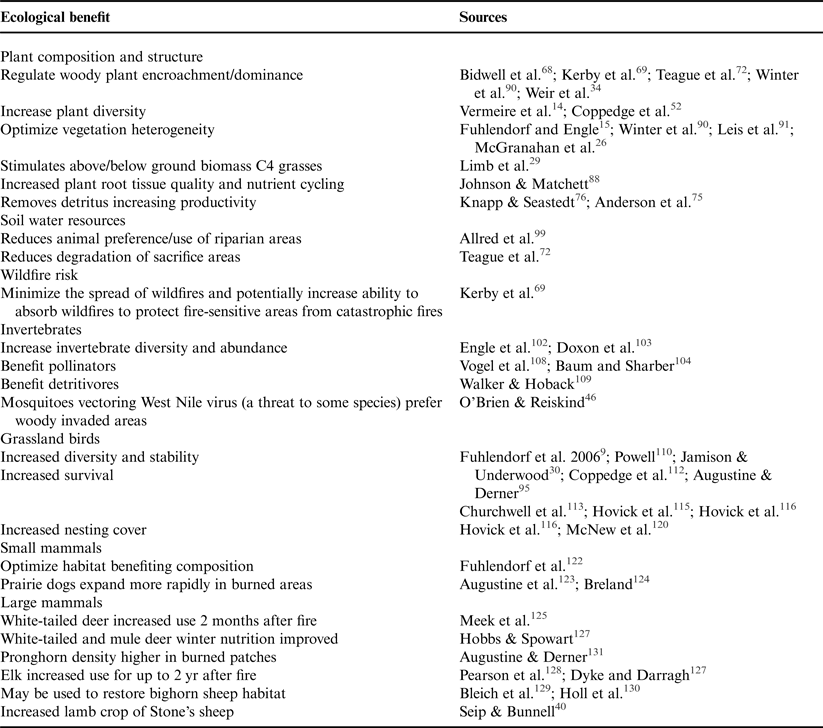
A critical benefit of the PBG process driven approach is the ability to integrate livestock production and natural resource conservation in multifunctional working landscapes by restoring critical ecological functions and maintaining perennial herbaceous vegetation; features that should be considered part of a renewable agriculture and food systemReference Pyne 13 Reference Fuhlendorf, Harrell, Engle, Hamilton, Davis and Leslie 9 – Reference Vermeire, Mitchell, Fuhlendorf and Gillen 14 Reference Bond and Keeley 1 (Table 2). Land managers should not have to choose one over the other but rather should be able to integrate the two in a complementary approach. Many of the native insects, birds and mammals are dependent on fire-grazing processes to increase suitability for breeding habitats, thermal regulation and foraging opportunitiesReference Moranz, Debinski, McGranahan, Engle and Miller 106 , Reference Churchwell, Davis, Fuhlendorf and Engle 113 , Reference Fuhlendorf, Townsend, Elmore and Engle 122 . The resulting patterns and vegetation succession optimize the variable habitat and foraging needs of a wide spectrum of speciesReference Wiens 89 . Furthermore, native plant species and communities are maintained and woody plant encroachment is minimized. Native wildlife species that are of concern can be managed in concert with cattle production and potentially enhancedReference Vermeire, Mitchell, Fuhlendorf and Gillen 14 Reference Yadava 2 .
Summary of potential ecological benefits associated with the interaction of fire and grazing applied as patch-burn grazing (PBG).

Potential negative impacts and limitations
The application of PBG is not without limitations or knowledge gaps. Some ecosystems may be so constrained by moisture that fire did not occur very often and large ungulate grazing was not a prevalent disturbance; for example, the four major North American deserts, and some ecosystems, such as the Palouse prairieReference Holechek, Pieper and Herbel 78 (Fig. 2). Some ecosystems have fire sensitive species that are critical to conservation, such as big sagebrush communities (Artemisia tridentata Nutt.) and patchy fires may need to be reconsidered and modified in terms of spatial scale, temporal scale and seasonalityReference Pyne 13 Reference Anderson 6 . However, sagebrush communities are threatened not only by the encroachment of woody shrubs such as Juniperus spp. and Pinus spp., but are also threatened by wildfire that could cause rapid and expansive mortality due to the intense fire behavior and extentReference Shindler, Gordon, Brunson and Olsen 137 . Thus, additional research is needed on how patchy fires can be applied in a sustainable manner to optimize non-sprouting Artemisia spp. and minimize woody plant encroachment and wildfire threats. Regarding semi-arid rangelands, a recent PBG study using a 4 yr fire return interval reported grazing preference for the most recently burn patch, however, the preference was lower than the reports from mesic ecosystemsReference Augustine and Derner 131 . Another study in sagebrush steppe showed that patchy fires altered cattle resource selection and overcame limitations of slope, sagebrush dominance and distance to upland water and lasted for 2–3 yrReference Clark, Jaechoul, Kyungduk, Nielson, Johnson, Ganskopp, Chigbrow, Pierson and Hardegree 81 . Drought also has confounded the effects of PBG on grassland birds and livestock parasites and if climate forecasts continue, additional research on the efficacy under precipitation extremes is neededReference Bond and Keeley 1 Reference Vinton, Hartnett, Finck and Briggs 3 Reference Yadava 2 , Reference Scasta, Engle, Talley, Weir, Fuhlendorf and Debinski 143 . Therefore, we suggest additional research is needed on the controls of the strength and timing of the fire–grazing interaction in more arid ecosystems and how to apply prescribed fire to mimic historical fire return intervals across broad temperature and precipitation gradients. This type of information will broaden our understanding of how herbivores respond to fire across a precipitation gradient and assist managers in tailoring the spatial and temporal prescription for fire–grazing interactions accordingly. Further research is also needed on the additional cost-benefit analyses of diet optimization, the livestock effects from burning in different seasons of the year and potential effects on gastrointestinal parasites of livestock. Lastly, while not all studies have resulted in the desired level of structural heterogeneity, the potential constraint of grazing management decisions and the time required for fire to effectively drive grazing patterns needs additional researchReference Scasta 39 , Reference McGranahan, Engle, Fuhlendorf, Winter, Miller and Debinski 93 .
Conclusions
Ultimately, the data from numerous studies are the evidence that PBG can benefit cattle production, ecosystem function and rural citizens over the long-term and is a renewable livestock system in fire prone plant communities. The broad geographical range of studies in North America indicates that the attraction of herbivores to recently burned patches spans both precipitation and temperature gradients (Fig. 2). While some of the studies discussed here are not strictly PBG with livestock, they do express the need for frequent fire to control woody plants. Consequently, fire is critical and PBG is a method that re-incorporates fire while integrating grazing. PBG is a bottom-up approach to grazing management that is ecologically process-based and low-input allowing animals to behave and respond to heterogeneity. Conversely, most other grazing strategies, such as rotational grazing, are top-down approaches that impose command-and-control and are high-inputReference Holling and Meffe 144 , Reference Teague, Dowhower, Baker, Ansley, Kreuter, Conover and Waggoner 145 . High-input command-and-control approaches do not always result in increases in production and often result in lower animal performance and lower long-term sustainabilityReference Coppedge, Engle, Fuhlendorf, Masters and Gregory 85 .
Perhaps the greatest importance of PBG to livestock production and fire management is using patchy fires to drive grazing and vegetation patterns to overcome the forage versus fuel paradox in a fenced off landscape. In other words, when entire pastures are burned, all forage was consumed as fuel by fire and livestock have low forage availability until adequate moisture is availableReference Allred, Scasta, Hovick, Fuhlendorf and Hamilton 35 . PBG overcomes that relationship by optimizing fuel accumulation in unburned patches to increase fire intensity and mortality on woody plants or serve as a forage reserve during drought. PBG integrates fire and grazing without having to sacrifice one or the other; deferring grazing to accumulate enough fuel to burn and to woody plant invasion or grazing and not being able to burn at all.
Restoration of fire and grazing with PBG fundamentally embraces variation through space and time, a diametric opposite to the utilitarian model of uniform utilization promoted by conventional managementReference Briske, Derner, Brown, Fuhlendorf, Teague, Havstad, Gillen, Ash and Willms 146 . Embracing variation and disturbances has been suggested to increase resilience and sustainability of livestock production systemsReference Fuhlendorf, Engle, Elmore, Limb and Bidwell 147 . The value of PBG for sustaining ecosystem goods and services is clearly evident in the studies evaluated in this review and is driving its application beyond the core area of the Great Plains where the majority of research has been conducted. With fragmentation of the landscape, woody plants often encroach and alter herbaceous plant communities. Restoring fire to portions of these landscapes has the potential to mitigate many of the unintended consequences of fire suppressionReference Johnson and Matchett 88 .
Acknowledgements
The authors thank many researchers who have developed the foundation of solid research that this review stands on. This review and meta-analysis was supported by the Iowa Department of Natural Resources, Iowa Agricultural and Home Economics Experiment Station, Oklahoma Agricultural Experiment Station, the Iowa State Wildlife Grants program grant #-U-2-R-1 in cooperation with the U.S. Fish and Wildlife Service, Wildlife and Sport Fish Restoration Program (#-U-2-R-1), and the University of Wyoming Department of Ecosystem Science and Management within the College of Agriculture and Natural Resources.