Implications
Animal products make a major contribution to the intake of dietary fatty acids within the human diet. As our understanding of the role of specific fatty acids in the development of human disease has developed, this has informed research into manipulating the fatty acid composition of meat and milk. This review summarizes the outcome of a number of recent meta-analyses of human cohort and intervention studies aimed at elucidating the relationship between the intake of specific dietary fatty acids and cardiovascular morbidity and mortality. The conclusions should help inform future research into improving the nutritional quality of animal products.
Introduction
Cardiovascular disease (CVD) represents a major cause of mortality throughout the developed world. In most cases, the underlying cause is atherosclerosis, a progressive thickening and loss of elasticity of the artery wall due to the accumulation of lipids (primarily cholesterol ester), connective tissue and, in the latter stages, calcium (Mangiapane and Salter, Reference Mangiapane and Salter1999). As the artery narrows and impedes blood flow, it can lead to tissue ischaemia resulting in conditions such as angina, when the coronary arteries are affected, or intermittent claudication, when peripheral arteries supplying the legs are affected. The most common acute clinical manifestations of CVD are myocardial infarction (heart attack) or stroke. Myocardial infarction can occur when a coronary artery gets blocked by a thrombosis occurring over the site of an atherosclerotic lesion. This often occurs when part of the lesion breaks away revealing the underlying tissue. Similarly, a stroke may occur when a carotid artery becomes blocked leading to loss of blood supply to the brain. Alternatively, the carotid artery may become weakened and may burst leading to a ‘hemorrhagic’ stroke. Atherosclerosis is a multi-factorial disease with both genetic and lifestyle risk factors, a complete discussion of which is beyond the scope of this review. The primary ‘modifiable’ risk factors have been identified as plasma cholesterol (increased low density lipoprotein (LDL) and/or decreased high density lipoprotein (HDL) cholesterol), hypertension and smoking. It is the relationship between dietary fat intake, plasma lipoproteins and cardiovascular morbidity and mortality that is the focus of this review. LDL represents the primary source of cholesterol that accumulates in the artery wall, whereas HDL can actually function to remove cholesterol from the developing atherosclerotic plaque (Mangiapane and Salter, Reference Mangiapane and Salter1999).
In the early 1970s, death from CVD had reached record levels in many parts of the developed world. In England, approximately 265 people per 100 000 of the population were dying as a result of coronary heart disease (CHD), stroke and other diseases of the circulatory system (Scarborough et al., Reference Scarborough, Bhatnagar, Wickramasinghe, Smolina, Mitchell and Rayner2010a). By 2006, this figure had dropped to less than 80 per 100 000. Why were levels so high and why have they subsequently dropped consistently year on year? Certainly, one factor has been considerable improvements in treatment of people suffering from CVD. It has been estimated that approximately 42% of the decline between 1981 and 2000 was the result of changes to treatment of individuals once they developed the disease (Unal et al., Reference Unal, Critchley and Capewell2004). The remaining 58% was attributed to changes in the primary modifiable CVD risk factors, smoking (48%), hypertension (9.5%) and plasma cholesterol (9.5%). It should be noted that this data largely pre-dates the widespread availability of the cholesterol-lowering Statin drugs, and reflects the lack of impact of advice directed toward altering dietary fat intakes. These beneficial changes have been partly offset by increases in some other risk factors, including obesity (−3.4%), diabetes (−4.7%) and reduced physical activity (−4.3%; Unal et al., Reference Unal, Critchley and Capewell2004).
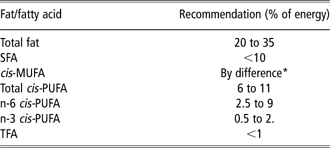
In 1991, the Report of the Panel on Dietary Reference Values of the Committee on Medical Aspects of Food Policy produced recommendations for dietary fat intake for the UK population. These were largely based on the growing evidence base of a link between the amount and type of fat in the diet, plasma cholesterol concentrations and cardiovascular risk (Department of Health, 1991). These recommendations suggested that: saturated fatty acids (SFA) should provide an average for the population of 10% of total dietary energy (inclusive of alcohol); cis-monounsaturated fatty acids (MUFA) should continue to provide an average of approximately 12% of dietary energy; cis-polyunsaturated fatty acids (PUFA) should continue to provide an average of 6% of dietary energy and should be derived from a mixture of n-6 and n-3 PUFA; trans fatty acids (TFA) should not increase beyond the then estimated intake of 2% of dietary energy; and total fat should average 33% of dietary energy intake. Subsequently, a specific recommendation to double the intake of long chain n-3 PUFA (i.e. those with 20 or 22 carbon atoms) from 0.1 to 0.2 g/day was also introduced (Department of Health, 1994). The recommendation for n-3 PUFA intake was further increased to 0.45 g/day by the Standing Advisory Committee on Nutrition (SACN, 2004). SACN also recently reviewed the evidence for further reducing recommendations on TFA intake; however, in view of the fact that average intakes in the United Kingdom are already less than 1% of energy, they decided that any further change was unnecessary (SACN, 2007). Such recommendations have remained the cornerstones of the UK public health nutrition policy ever since, and are closely reflected in more recent guidelines produced as a result of the recent FAO/WHO Expert Consultation on Fats and Fatty Acids in Human Nutrition (Table 1). This paper will review recent evidence as to the validity of such recommendations focusing particularly on meta-analysis and systematic reviews of CVD morbidity and mortality.
Food and Agriculture Organisation/World Health Organisation recommended intakes for total fat and fatty acids
SFA = saturated fatty acids; MUFA = monounsaturated fatty acids; PUFA = polyunsaturated fatty acids; TFA = trans fatty acids.
Adapted from Food and Agriculture Organization of the United Nations (FAO, 2010).
Values quoted are acceptable macronutrient distribution ranges apart from SFA, which represents the upper acceptable macronutrient distribution range.
*Total fat – SFA–PUFA–TFA.
Diet–heart hypothesis
The link between intake of dietary fat, plasma cholesterol and risk of CVD is frequently referred to as the Diet–heart hypothesis. Although its origins lie in animal experimentation undertaken over a century ago, the Seven Countries Study, led by Ancel Keys, is frequently credited as one of the earliest human epidemiological studies to support this link in humans (Keys et al., Reference Keys, Aravanis, Blackburn, Van Buchem, Buzina, Djordjević, Dontas, Fidanza, Karvonen, Kimura, Lekos, Monti, Puddu and Taylor1966). This ongoing longitudinal prospective study of risk factors for CVD, started in 1958, included 12 763 men aged between 40 and 59 years from 16 cohorts in seven countries: Finland, Greece, Italy, the Netherlands, former Yugoslavia (Serbia and Croatia), Japan and the United States. Although frequently criticized, and certainly lacking some of the sophistication of more recent epidemiological studies, the strong inter-correlations between dietary SFA intake, plasma cholesterol and CVD mortality were sufficient to persuade many health professionals that high intakes of SFA were responsible for the burgeoning levels of cardiovascular mortality of the 1960s and 1970s across North America, parts of Western Europe and other ‘industrialized’ countries. Keys was also one of the first to demonstrate the quantitative relationship between plasma cholesterol and the amount and type of fat in the diet (Keys et al., Reference Keys, Andrerson and Grande1965). In a series of metabolic ward studies, he described the mathematical relationships between the intake of SFA, PUFA and dietary cholesterol and changes in plasma cholesterol. Contemporaneously, Hegsted et al. (Reference Hegsted, McGandy, Myers and Stare1965) conducted similar studies, which, although exhibiting minor quantitative differences, arrived at the same basic conclusions, namely: (1) dietary cholesterol has a relatively modest plasma cholesterol-raising effect, (2) dietary SFA have potent plasma cholesterol-raising effects, (3) dietary PUFA have a plasma cholesterol-lowering effect and (4) the cholesterol-raising effect of dietary SFA is more potent than the lowering effect of PUFA. Reducing dietary SFA intake has remained the cornerstone of public heath nutrition policy for reducing risk of CVD ever since.
Dietary fatty acids and plasma lipoprotein cholesterol concentrations
Although the equations of Keys and Hegsted have stood the test of time remarkably well, they tell us nothing about the impact of individual fatty acids on cholesterol associated with specific lipoprotein fractions. With the recognition that high concentrations of LDL cholesterol are associated with increased CVD risk, whereas high concentrations of HDL cholesterol are protective, interest turned to the effects of dietary fatty acids on individual lipoprotein fractions. This has been addressed in a multitude of human feeding trials. In the early 1990s, a number of meta-analyses attempted to pull together information arising from such studies (Mensink and Katan, Reference Mensink and Katan1992; Hegsted et al., Reference Hegsted, Ausman, Johnson and Dallal1993; Yu et al., Reference Yu, Derr, Etherton and Kris-Etherton1995) and their findings have been summarized elsewhere (Salter and White, Reference Salter and White1996). Overall, there was broad agreement that SFA increased both LDL and HDL cholesterol, but the effect on the former was substantially greater. Thus, the association of diets rich in SFA with increased CVD risk was likely to be as a result of its LDL cholesterol-raising properties. The study by Yu et al. (Reference Yu, Derr, Etherton and Kris-Etherton1995) showed that these effects were associated with SFAs between 12 and 16 carbon atom (namely lauric, myristic and palmitic acids), whereas stearic acid (c18:0) did not increase LDL cholesterol. Increasing PUFA intake was shown to reduce LDL cholesterol, whereas slightly increasing HDL cholesterol. Two of these analyses (Mensink and Katan, Reference Mensink and Katan1992; Yu et al., Reference Yu, Derr, Etherton and Kris-Etherton1995) suggested that dietary MUFA decrease LDL cholesterol, but not as much as PUFA, whereas the study by Hegsted et al. (Reference Hegsted, Ausman, Johnson and Dallal1993) suggested no effect of MUFA on LDL cholesterol. All three studies suggested an HDL cholesterol-raising effect of MUFA.
In 2003, Mensink et al. (Reference Mensink, Zock, Kester and Katan2003) published a further meta-analysis of the impact of dietary fatty acids on plasma cholesterol. This confirmed the previous suggestions that SFAs increased LDL cholesterol, whereas PUFA and MUFA both reduced it, with PUFA being more potent than MUFA. All three fatty acid types had modest HDL cholesterol-raising properties. This analysis also includes dietary TFA and confirmed increasing concerns that they have the most deleterious effect on lipoproteins, raising LDL cholesterol to a greater extent than SFAs, whereas not increasing HDL cholesterol. They also confirmed previous suggestions that, although lauric, myristic and palmitic acids all had LDL-raising properties, stearic acid was essentially neutral. However, their paper also argued that the ratio of total plasma cholesterol to HDL cholesterol (presumably as a surrogate for LDL-to-HDL ratio) is a better marker of CVD risk than LDL cholesterol alone. When the impact of fatty acids on this ratio was considered, the conclusions were somewhat different. Overall, the SFAs had similar effects on this ratio relative to carbohydrates, although some differences were seen between different fatty acids. Lauric acid was found to actually lower the ratio, whereas myristic and palmitic acids had no significant effect. Cis-MUFA and -PUFA decreased the ratio, whereas TFA was the only class to significantly increase this ratio relative to dietary carbohydrate. If this ratio is indeed a better predictor of risk, then these results suggest, somewhat controversially, that increasing the amount of cis-MUFA or -PUFA in the diet is more beneficial than decreasing the amount of SFA. However, the authors quite rightly concluded that their results should be confirmed by prospective observational studies or clinical trials of CVD risk.
Recent systematic reviews of the impact of the major dietary fatty acids on cardiovascular morbidity and mortality
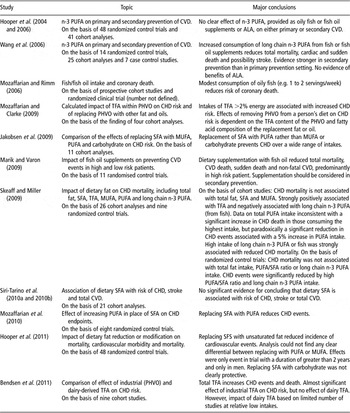
Although it is generally accepted that the quantity and composition of dietary fat can impact on plasma lipoprotein cholesterol concentrations, the impact of dietary fat on actual CVD morbidity and mortality has continued to be a topic of debate. In the past 2 to 3 years, a number of meta-analyses and systematic reviews addressed this problem. Details of some of these, together with their general conclusions, are listed in Table 2.
Selected recent meta-analyses of the impact of dietary fatty acids on cardiovascular risk

PUFA = polyunsaturated fatty acids; CVD = cardiovascular disease; ALA = alpha linoleic acid; TFA = trans fatty acids; PHVO = partially hydrogenated vegetable oil; CHD = coronary heart disease; SFA = saturated fatty acids; MUFA = monounsaturated fatty acids.
Jakobsen et al. (Reference Jakobsen, O'Reilly, Heitmann, Pereira, Bälter, Fraser, Goldbourt, Hallmans, Knekt, Liu, Speigelman, Stevens, Virtamo, Willett and Ascherio2009) used data from 11 European and American cohort studies to try to clarify whether energy from unsaturated fatty acids or carbohydrates should replace that from SFA to prevent CHD. Combined data from 344 696 people followed-up for 4 to 10 years yielded 5249 coronary events and 2155 coronary deaths. The models developed from these data suggested that replacing 5% of energy intake as saturated fat with PUFA resulted in significantly reduced hazard ratios for both coronary events and mortality. By contrast, no significant benefit was seen if saturated fat was replaced with MUFA, and replacement with carbohydrates actually produced a modest, but significant, increase in CHD events.
On reviewing 28 individual cohort studies relating dietary fat, Skeaff and Miller (Reference Skeaff and Miller2009) failed to demonstrate a relationship between, either dietary SFA or MUFA intake and CHD mortality. The relationship with n-6 PUFA intake was complicated in that the relative risk of those individuals with the highest intake was significantly increased over those with the lowest intake. However, increasing PUFA intake was associated with a significant decrease in risk. In attempting to explain these apparently opposing results, the authors stress the unreliability of observational trials.
Of all these recent analyses, analysis of Siri-Tarino et al. (Reference Siri-Tarino, Sun, Hu and Krauss2010a) has perhaps provoked the most controversy. The analysis of 21 prospective epidemiological studies was specifically aimed at assessing the association between dietary saturated fat intake and risk of CHD and stroke. The overall analysis included 347 747 subjects of whom 11 006 developed CHD or stroke over a 2 to 23 years follow-up. The study concluded that dietary SFA intake was not significantly associated with CVD risk. A number of major criticisms have been directed at this study. Firstly, almost half of the studies in their multi-variate analysis included adjustment for serum cholesterol concentrations. It has been argued that, as serum cholesterol concentrations ‘lie on a causal chain between saturated fat intake and CHD and CVD’, the data fails to support the authors conclusion (Scarborough et al., Reference Scarborough, Rayner, van Dis and Norum2010b). However, in reply to this criticism, Siri-Tarino et al. (Reference Siri-Tarino, Sun and Hu2010b) provided additional analysis, excluding those studies adjusted for serum cholesterol, suggesting that the results of the overall meta-analysis are still valid. The authors have also been criticized for the fact that about half of the studies used 1-day diet diaries or other ‘unvalidated’ methods to estimate dietary intakes (Katan et al., Reference Katan, Brouwer, Clarke, Geleijnse and Mensink2010). In their rebuttal for this criticism, Siri-Tarino et al. (Reference Siri-Tarino, Sun, Hi and Krauss2010c) argue that this was accounted for by deriving quality scores for the component studies (thus weighting the evidence toward the best performed studies), and that such evaluation did not change their findings. In the same response, the authors also reemphasize that the main conclusion of their meta-analysis was a lack of effect of saturated fats on CVD outcomes in relation to dietary carbohydrate (as opposed to unsaturated fatty acids).
A third systematic review and meta-analysis specifically addressed the value of replacing saturated fat with PUFA (Mozaffarian et al., Reference Mozaffarian, Micha and Wallace2010). The eight randomized control trials included 13 614 participants and 1042 CHD events. They estimated a 10% reduction in CHD risk for each 5% of energy of increased PUFA. Thus, in line with the findings of Jakobsen et al. (Reference Jakobsen, O'Reilly, Heitmann, Pereira, Bälter, Fraser, Goldbourt, Hallmans, Knekt, Liu, Speigelman, Stevens, Virtamo, Willett and Ascherio2009) they concluded that replacing saturated fat with PUFA would significantly reduce rates of CHD.
A further review of the impact of reducing or modifying dietary fat was recently published by Hooper et al. (Reference Hooper, Summerbell, Thompson, Sills, Roberts, Moore and Davey Smith2011). This included 65 508 participants from 48 randomly controlled trials and looked at the impact of altering dietary total fat, SFA, MUFA, PUFA and TFA intake on cardiovascular morbidity and mortality. Their primary conclusion was that long-term (greater than 2 years) reduction of SFA intake was associated with a significantly (14%) reduced cardiovascular risk. Further analysis suggested that this was specifically associated with substitution of SFA with unsaturated fatty acids rather than replacement with carbohydrates, and that this reduced risk was associated with a reduction in total and/or LDL cholesterol. Their analysis was unable to distinguish whether MUFA or PUFA were more beneficial. Although such a relationship was demonstrated for cardiovascular morbidity, it did not translate into a significant difference in mortality.
The conflicting outcome of these analyses, which frequently include many of the same primary studies, highlights the difficulties associated with performing and interpreting prospective cohort studies of human populations. The multi-factorial nature of CVD makes this particularly challenging. By contrast, randomized controlled trials are more likely to produce more conclusive data. However, although these may show clearer relationships with CVD risk factors, or even morbidity, few have had the necessary sample size or duration to show clear associations with mortality. Despite these limitations, some general conclusions appear to be emerging. There is growing doubt as to the value of replacing dietary SFA with carbohydrates. However, both in terms of impact on plasma cholesterol and CVD outcomes, apart from the somewhat confusing outcome of the review by Skeaff and Miller (Reference Skeaff and Miller2009), there is considerable evidence in support of specifically increasing PUFA intakes at the expense of SFA. In North American, and most European, populations, this primarily refers to intake of the n-6 fatty acid, linoleic acid (LA, c18:2). As discussed below, this is set against a recent trend to suggest that our intakes of LA are too high, particularly in comparison with n-3 PUFAs (Simopoulos, Reference Simopoulos2008). Recent public health messages have suggested that we should actually reduce LA intakes, replacing it with either n-3 PUFA or MUFA (primarily oleic acid, c18:1). The latter has found particular favor as it represents a major component of the Mediterranean diet consumed by many countries exhibiting low levels of CVD. Although there are a number of potential components of the Mediterranean diet that may be associated with protection from CVD, the meta-analysis described have produced somewhat conflicting results over the relative efficacy of MUFA, with Jakobsen et al. (Reference Jakobsen, O'Reilly, Heitmann, Pereira, Bälter, Fraser, Goldbourt, Hallmans, Knekt, Liu, Speigelman, Stevens, Virtamo, Willett and Ascherio2009) suggesting no significant effects and Hooper et al. (Reference Hooper, Summerbell, Thompson, Sills, Roberts, Moore and Davey Smith2011) failing to distinguish between MUFA and PUFA.
TFA and cardiovascular risk
As already discussed above in the section on Dietary fatty acids and plasma lipoprotein cholesterol concentrations, TFA have been identified as having the greatest adverse effects on plasma lipoproteins. A number of systematic reviews have indicated that this also translates into an impact on CVD mortality and morbidity. Skeaff and Miller (Reference Skeaff and Miller2009) reported a highly significant association between CHD mortality and total CHD events and TFA intake in a meta-analysis of cohort studies. A similar result (based largely on the same cohort trials) was reported by Mozaffarian and Clarke (Reference Mozaffarian and Clarke2009). This was also the outcome of an analysis based on causation score, taking into account four criteria: strength, consistency, temporality and coherence (Mente et al., Reference Mente, de Koning, Sannon and Anand2009). Mozaffarian and Clarke (Reference Mozaffarian and Clarke2009) also analyzed the results of a number of short-term intervention trials, which looked at the impact of replacing partially hydrogenated vegetable oil (PHVO), with a range of other dietary fats, on blood lipids and lipoproteins and other risk factors. They then used these data to estimate the possible impact of such substitutions on CHD risk. Taking into account total cholesterol : HDL cholesterol ratio, Lp(a), apolipoprotein B : A1 ratio and plasma C-reactive protein, even replacing PHVO with SFA-rich fats such as palm oil, butter and lard reduced predicted CHD risk substantially. The recent analysis of randomized controlled trials by Hooper et al. (Reference Hooper, Summerbell, Thompson, Sills, Roberts, Moore and Davey Smith2011) failed to demonstrate a specific effect of TFA on cardiovascular morbidity or mortality, but cautioned that this may be a result of insufficient data.
Continuing concern over the impact of TFA in the diet has led to concerted efforts to reduce the consumption of PHVO in many countries around the world. In the United Kingdom, voluntary action by the food industry has reduced TFA intake to less than 1% of total dietary energy intake. However, PHVO is not the only source of TFA in our diet. The meat and milk of ruminant animals also contain TFA, and, with the use of PHVO falling, they have become a more significant source. It has been estimated that approximately 40% to 50% of TFA in the UK diet now comes from ruminant dairy products and meat (Wyness et al., Reference Wyness, Weichselbaum, O'Connor, Williams, Benelam, Riley and Stanner2011). Considerable debate exists as to whether TFA from such ‘natural’ sources have the same impact on CVD risk as that from PHVO. This is largely based on the isomer distribution as, PHVO normally contain a wide range of trans isomers of MUFA, which differ in the position along the carbon chain of the double bond (Bauman et al., Reference Bauman, Lock, Corl, Ip, Salter and Parodi2006). By contrast, one isomer (vaccenic acid, VA, t11-c18:1) predominates in ruminant products. VA has been shown to be a precursor for the production of the c9, t11 conjugated linoleic acid isomer, which, largely based on animal model data, has been suggested to have anti-atherosclerotic properties (Bauman et al., Reference Bauman, Lock, Corl, Ip, Salter and Parodi2006). However, in a recent quantitative review of the effect of TFA on HDL and LDL levels, Brouwer et al. (Reference Brouwer, Wanders and Katan2010) concluded that all fatty acids with a double bond in the trans configuration (including those from ruminant products) raise the ratio of plasma LDL cholesterol to HDL cholesterol. However, their analysis clearly shows that, although many studies have been carried out investigating the impact of high intakes of PHVO (>5% of energy from TFA), the vast majority of studies of ‘natural’ sources of TFA have looked at intakes <2% of energy. This conclusion would be more persuasive if data could be produced which directly compares equivalent intakes of TFA from PHVO and ruminant sources. Such a comparison was attempted in the ‘Transfact’ trial, which fed healthy human volunteers diets containing 5% of energy as TFA from either PHVO or dairy fat. Somewhat surprisingly, only minor changes were seen in plasma lipoproteins with both sources of TFA compared with baseline diet, and the authors concluded that no conclusions could be drawn ‘about the effect of TFAs from either source on absolute CVD risk in these normolipidemic subjects’ (Chardigny et al., Reference Chardigny, Destaillats, Malpuech-Brugère, Moulin, Bauman, Lock, Barbano, Mensink, Bezelgues, Chaumont, Combe, Cristiani, Joffre, German, Dionisi, Boirie and Sébédio2008). In a recent meta-analysis, Bendsen et al (Reference Bendsen, Christensen, Bartels and Astrup2011) compared the impact of industrial (PHVO) and ruminant TFA on risk of CHD. The review of nine prospective cohort studies concluded that, although high intakes of total TFA were associated with increased CHD events and mortality, there were no significant effects of either industrial or ruminant sources (although the impact of the former on CHD risk was close to significant, P = 0.09). Although the study appears to suggest no adverse effects of ruminant TFA, the authors express caution over the relatively small number of studies available, and suggest that the lack of effect of ruminant TFA may be due to the lower intake levels.
Long chain n-3 PUFA and CVD
Of all the classes of dietary fatty acids, n-3 PUFA have probably received the most attention in recent years. Although both health professionals and the general public appear to have accepted the positive impacts these fatty acids can have on health, including reduced CVD risk, UK dietary intakes (excluding supplements) remain relatively low at approximately 244 mg/day (Givens and Gibbs, Reference Givens and Gibbs2008), only 54% of that recommended. Health claims largely originate from studies comparing disease risk in populations that traditionally consumed large quantities of marine fish and/or mammals with those with much lower fish intakes. Most notably, observations of low incidences of CVD in traditional-living Greenland Eskimos were attributed to high, very long chain n-3 PUFA intake, specifically, eicosapentaenoic acid (EPA, c20:5) and docosahexaenoic acid (DHA, c22:6; Bang and Dyerberg, Reference Bang and Dyerberg1972 and Reference Bang and Dyerberg1980). Subsequent research has suggested a whole range of potential mechanisms by which these very long chain PUFA exert their protective effects, including: lowering blood pressure, reduced serum triacylglycerol, anti-thrombogenic effects, anti-inflammatory effects, anti-arrhythmic effects, improved vascular function, increased plaque stability and improved insulin sensitivity (Breslow, Reference Breslow2006). Such findings have spawned a large number of cohort and interventional studies aimed at evaluating the possible benefits of consuming very long chain n-3 PUFA (either through consuming fish or fish oil supplements) on CVD mortality and morbidity. Hooper et al. (Reference Hooper, Harrison, Summerbell, Moore, Worthington, Ness, Capps, Davey Smith, Riemersma and Ebrahim2004 and Reference Hooper, Thompson, Harrison, Summerbell, Ness, Moore, Worthington, Durrington, Higgins, Capps, Riemersma, Ebrahim and Davey Smith2006) carried out a systematic review of 48 randomized control trials and 41 cohort studies investigating the impact of n-3 PUFA on total mortality and CVD events. Their somewhat surprising conclusion was that there was no clear evidence that dietary or supplemental n-3 PUFA altered total mortality or combined CVD events either in people with, or at high risk of, CVD or in the general population. Although their initial analysis included shorter chain n-3 PUFA (alpha-linolenic acid, ALA, c18:3), restricting it to fish-based very long n-3 PUFA failed to demonstrate any positive results. They also failed to distinguish any specific effects of consuming oily fish or fish oil supplements. The outcome of this analysis has sparked considerable debate, especially the concern regarding the inclusion of the Diet and Angina Randomized Trial (DART-2) by Burr et al. (Reference Burr, Ashfield-Watt, Dunstan, Fehily, Breay, Ashton, Zotos, Haboubi and Elwood2003), which reported adverse effects of increasing oily fish consumption/fish oil supplements in patients suffering from angina. This trial has been criticized as being unblinded and for the nature of the EPA-rich fish oil (Marik and Varon, Reference Marik and Varon2009). Hooper et al. (Reference Hooper, Harrison, Summerbell, Moore, Worthington, Ness, Capps, Davey Smith, Riemersma and Ebrahim2004) note that excluding this one trial alters the conclusions of the analysis and supports a beneficial effect of n-3 PUFA. A contemporary systematic review by Wang et al. (Reference Wang, Harris, Chung, Lichtenstein, Balk, Kupelnick, Jordan and Lau2006) concluded that consumption of very long chain n-3 PUFA from fish or fish oil reduces overall mortality, cardiac mortality and sudden death, with the evidence being considerably stronger for secondary prevention (in subjects who have already suffered a CVD event) rather than primary prevention. In the same year, Mozaffarian and Rimm (Reference Mozaffarian and Rimm2006) concluded, from a review of cohort and randomized control trials, that modest consumption of fish (e.g. one to two servings/week) may reduce coronary death by as much as 36%. Two more recent systematic reviews appear to support the findings of Wang et al. (Reference Wang, Harris, Chung, Lichtenstein, Balk, Kupelnick, Jordan and Lau2006). Marik and Varon (Reference Marik and Varon2009) reviewing the impact of very long chain n-3 PUFA supplements, also concluded that this was of particular benefit in the secondary prevention of CVD. Skeaff and Miller (Reference Skeaff and Miller2009) presented evidence from cohort studies that consumption of fish is associated with reduced risk of fatal and non-fatal CHD. However, this was not supported by their analysis of randomized control trials, although again exclusion of the DART-2 trial altered the results such that CHD mortality was significantly reduced by very long chain n-3 PUFA intake. Overall, there does appear to be reasonable evidence to suggest cardio-protective effects of EPA/DHA-rich fat whether consumed as oily fish or fish oil supplements. Evidence of a protective effect in people who have already suffered a cardiovascular event appears somewhat better than that for primary prevention. Many countries, and the World Health Organization, have adopted public health policies that recommend population increases in consumption of oily fish. However, with increasing concerns about the sustainability of wild-fish stocks, it may be argued that we should be identifying more clearly those individuals who are most likely to benefit from this diminishing resource. To this end, it has recently been suggested that the ‘Omega-3 Index’ (EPA+DHA content of erythrocytes expressed as a percent of total identified fatty acids) might be a useful marker of cardiovascular risk (Harris, Reference Harris2010). Although alternative non-marine sources of DHA are becoming more widely available, this is not the case for EPA. Thus, it is also important to try and establish the relative efficacy of these two fatty acids.
ALA and the n-6 : n-3 PUFA ratio
It is currently unclear whether dietary intakes of ALA impact on CVD risk. As humans are capable of synthesizing EPA and DHA from ALA, it might be assumed to be cardio-protective. It is also possible that ALA has cardio-protective properties in its own right. A large cohort study, following 45 722 men over a period of 14 years, concluded that consumption of plant-derived n-3 PUFA (largely ALA) reduced CHD risk, particularly when intake of marine-derived n-3 PUFA is low (Mozaffarian et al., Reference Mozaffarian, Ascherio, Hu, Stampfer, Willett, Siscovck and Rimm2005). However, neither the systematic review of Hooper et al. (Reference Hooper, Harrison, Summerbell, Moore, Worthington, Ness, Capps, Davey Smith, Riemersma and Ebrahim2004 and Reference Hooper, Thompson, Harrison, Summerbell, Ness, Moore, Worthington, Durrington, Higgins, Capps, Riemersma, Ebrahim and Davey Smith2006) nor that of Wang et al. (Reference Wang, Harris, Chung, Lichtenstein, Balk, Kupelnick, Jordan and Lau2006) found any specific benefit of ALA consumption. A further recent cohort study of 20 069 men and women, followed between 8 and 13 years, has also failed to demonstrate any relationship between ALA intake and CHD risk (de Goede et al., Reference De Goede, Verschuren, Boer, Kromhout and Geleijnse2011).
Most estimates of the efficiency of conversion of ALA to longer chain derivatives suggest that efficiency is very low in humans, with that of ALA to EPA being in the region of 0.2% to 6% and ALA to DHA possibly as low as 0.05% (Burdge and Calder, Reference Burdge and Calder2005). Pre-menopausal women are considerably more efficient in these conversions than men (Burdge and Calder, Reference Burdge and Calder2005), and evidence is also emerging to suggest that polymorphisms in desaturases and elongase enzymes, associated with the conversion of ALA to very long chain n-3 PUFA, can also influence the efficiency of the process (Tanaka et al., Reference Tanaka, Shen, Abecasis, Kisialiou, Ordovas, Guralnik, Singleton, Bandinelli, Cherubini, Arnett, Tsai and Ferrucci2009). It is noteworthy that even in vegans, consuming no long chain n-3 PUFA, at least some individuals clearly attain blood levels similar to those of fish eaters (Welch et al., Reference Welch, Shakya-Shrestha, Lentjes, Wareham and Khaw2010). Further study of the regulation of the synthesis of long chain n-3 PUFA, and the impact of genetic and other dietary factors, may help identify those most in need of increased fish/fish oil consumption. Fatty acids of the n-3 and n-6 classes compete for the desaturase/elongase enzymes associated with the production of their longer chain derivatives (Harris, Reference Harris2006). In recent years, there has been much debate about the ratio of n-6 to n-3 PUFA in our diets, and its possible impact on health. In the diet of our paleolithic ancestors, this ratio may have been less than 1, whereas in many modern ‘Western’ diets it can exceed 15 (Simopoulos, Reference Simopoulos2008). It has been suggested that this could directly impact on the ability of ALA to compete for the first delta-6 desaturation, and thereby reduce our ability to produce very long chain n-3 PUFA. However, there appears to be little direct evidence that the n-6 : n-3 PUFA ratio does, in fact, impact on CVD risk, and its value as a clinically relevant risk factor has been challenged (Harris, Reference Harris2006; Stanley et al., Reference Stanley, Elsom, Calder, Griffin, Harris, Jebb, Lovegrove, Moore, Riemersma and Sander2007). One problem in focusing on reducing this ratio lies in the fact that it could be achieved in one of the two ways, reducing n-6 PUFA intake or increasing n-3 PUFA intake. The evidence reviewed above clearly suggests that replacing SFA with PUFA is cardio-protective. Although this does not specifically differentiate between classes of PUFA, the abundance of LA in the diet would suggest that it is responsible for these beneficial effects. Whether ALA has similar, more or less beneficial effects remains to be demonstrated. Thus, it would appear imprudent to suggest reducing LA intakes simply to achieve a numerical change in this ratio. As already suggested, it may be much more valuable to determine an individual's ‘Omega-3 Index’ (red blood cell levels of EPA + DHA) and supplement with marine-derived very long chain n-3 PUFA if particularly low levels are indicated (Harris, Reference Harris2010).
Meat and milk intake and CVD
The primary aim of this review has been to reevaluate the evidence relating to the impact of different classes of dietary fatty acids on CVD, with reference to a number of recently published systematic reviews. However, it is important to recognize that fatty acids are consumed as complex mixtures depending on the specific food types selected by the individual. Animal products undoubtedly contribute a significant proportion of total SFA intake in an omnivorous diet. It is therefore worth briefly addressing the question as to whether consumption of meat, milk or other dairy products is associated with CVD risk. The impact of meat consumption was recently addressed in an analysis of 17 prospective cohort and three case–control studies (Micha et al., Reference Micha, Wallace and Mozaffarian2010). They concluded that intake of processed, but not red, meat was associated with an increased incidence of CHD. Only three studies specifically investigated the relationship between meat intake and stroke, and no significant association was found within this limited data. The authors speculate that the higher sodium and nitrate content of processed meat might contribute to their impact on CVD.
The impact of milk and/or dairy products on CVD risk has also been the topic of a recent systematic review (Elwood et al., Reference Elwood, Pickering, Givens and Gallacher2010). Meta-analysis of 38 cohort studies suggested that high dairy food consumption was actually protective from CHD and stroke. Data were most robust for milk consumption; however, although acknowledging the limited evidence available concerning other dairy products, they conclude that there is no convincing evidence of harm from consumption of separate dairy fat-containing food items. This conclusion is supported by another recent meta-analyses of 17 cohort studies, which concluded that milk intake is not associated with total mortality and may actually be inversely related to overall CVD risk (Soedamah-Muthu et al., Reference Soedamah-Muthu, Ding, Al-Delaimy, Hu, Engberink, Willett and Geleijnse2011).
Taken together, the evidence described above suggests that the consumption of animal products, per se, is not necessarily associated with increased CVD risk. A more global analysis of the impact of dietary factors on CHD risk recently concluded that overall dietary patterns may be more important (Mente et al., Reference Mente, de Koning, Sannon and Anand2009). They demonstrate ‘strong’ evidence that, although a Mediterranean diet (rich in vegetables, legumes, fruits, nuts, whole grains, cheese or yoghurt, fish and MUFA relative to PUFA) or ‘prudent’ diet (characterized by high intake of vegetables, fruit, legumes, whole grain, fish and other sea food) were protective from CHD, a ‘Western’ diet (characterized by high intake of processed meat, red meat, butter, high-fat dairy products, eggs and refined grains) substantially increased risk.
Conclusions
The outcomes of both epidemiological and experimental studies by Ancel Keys have stood the test of time remarkably well. Now, as then, the balance of evidence appears to suggest that replacing dietary SFA with PUFA is the best way to minimize CVD risk. In the meantime, we have identified that the introduction of PHVO into the human food chain, and the associated increase in intake of TFA, may well have contributed significantly to the high levels of CVD mortality and morbidity in much of the ‘Western’ world in the post-war era. Fortunately, having identified this problem, many countries have taken significant steps toward reducing, or even eliminating, human consumption of PHVO. The impact of natural TFA, derived from ruminant meat and milk, requires further investigation. Intensive study of the role of dietary n-3 PUFA-rich fish oil in CVD risk, has suggested protective effects in at least some individuals. As long as marine fish/mammals remain the primary source of these fatty acids, we should perhaps question the advisability of pursuing an increase in universal consumption of this diminishing natural resource and instead concentrate on identifying those individuals who are most likely to benefit (such as those who have already suffered a cardiac event or with a low n-3 Index). There is less evidence that ALA has any specific benefit and, coupled with the reaffirmation of the beneficial effects of n-6 PUFA in risk reduction, the recent focus on the n-6-to-n-3 PUFA ratio may have been misguided.