Looking back, I can't quite believe that it is nearly thirty years since I joined the Inner Temple as Librarian and Keeper of Manuscripts. I still clearly recall my two interviews for the post, which took place on a Saturday morning and a Friday evening in 1990. The Master of the Library, Sir Michael Morland, chaired the first interview panel, which consisted of three members of the Library Committee. I remember being asked if, were I to be appointed, I would stay until I retired. I thought this highly unlikely, but time has shown how wrong I could be. At my second interview, members of the panel (chaired by the Treasurer for that year, Sir Ian Percival QC) were seated round a table in the Committee Room enjoying tea and sandwiches. The only other woman present was the Deputy Sub-Treasurer, Jean Morris, who was sitting at a separate table taking notes. At the time I didn't know very much about the Inn and its ways of working and was somewhat surprised when confronted with this scene. I recall that one of the Benchers present fell asleep and had to be prodded awake when it was his turn to ask questions. (‘Benchers’, or more properly Masters of the Bench, are the senior members of the Inn who make up its governing body.)
Having survived both interviews, I was pleased to accept the post when it was offered to me, and this is a decision I have never regretted. From the outset I felt the Inn would be a very interesting and unusual place to work – as it has turned out to be. My first work experience had been in a university library; I then worked with housebound library users in Tower Hamlets and with patients at St Thomas's Hospital. There followed a 10-year stint in the libraries of the Home Office and the Department of Health and Social Security, where my posts involved enquiry and acquisitions work. Enquiries were very wide-ranging, especially at the Home Office, where I could at one moment be preparing reading lists on police powers for the Royal Commission on Criminal Procedure before moving on to consulting texts on capital punishment in order to respond to a question from an outside researcher about preparations for a hanging. My experience of library automation in the Civil Service was probably one of the deciding factors in my appointment, as the Inn was very keen to introduce automation to the Library and to develop online services for members. At this time the Inter-Inn Libraries Liaison Committee had just been set up at the instigation of the Master of the Library, and the Inn Libraries were being encouraged to collaborate, especially on automation. From my time in government libraries I already knew the Librarian and Keeper of Records at the Middle Temple, who had worked at the Treasury and CCTA (Central Computer and Telecommunications Agency) before being appointed. With the help of the Middle Temple's Systems Librarian, we began to put together an operational requirement that would enable us to select an online library system for both Inns.
Three months after I was appointed, I found myself required to make a case to the Executive Committee (with costings) for library automation. This was a daunting experience, rather like being cross-examined in court. Unfortunately, the case I put forward was not convincing enough the first time around. So Middle Temple's Librarian and I decided to enlist the help of a (male) consultant who specialised in library systems to review our recommendations and produce a report. He endorsed our proposals, which (gratifyingly) the Executive Committee then accepted. Eventually we selected SIRSI's Unicorn system for both Inns, and this is still in use today.
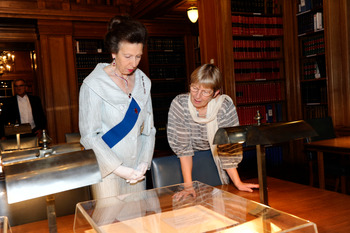
HRH The Princess Royal and Margaret Clay at Grand Day 2011.

Just after I became Librarian the Inn decided that the space occupied by the Library in the basement of the Treasury Building should be converted into a bar and common room for students. This was the first Pegasus bar, later converted again to provide office accommodation for the Education and Training Department. The Library had 1.8 linear miles of compact mobile shelving in the basement, which held books from the legal and parliamentary collections. To avoid sending these collections into storage, the non-law collections (housed in the Library Gallery and available for Benchers to browse and borrow) all went into storage and were replaced by the parliamentary collections and some of the old editions of textbooks, which were and still are in constant use. We had only two months to organise the packing and removal of all the books. This seemed a major project at the time, though it was as nothing compared with the decant of the entire Library and the setting up of a temporary Library in Fetter Lane, which we carried out in 2019.
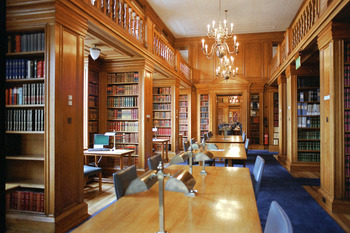
The Inner Temple Library, Room C (14).

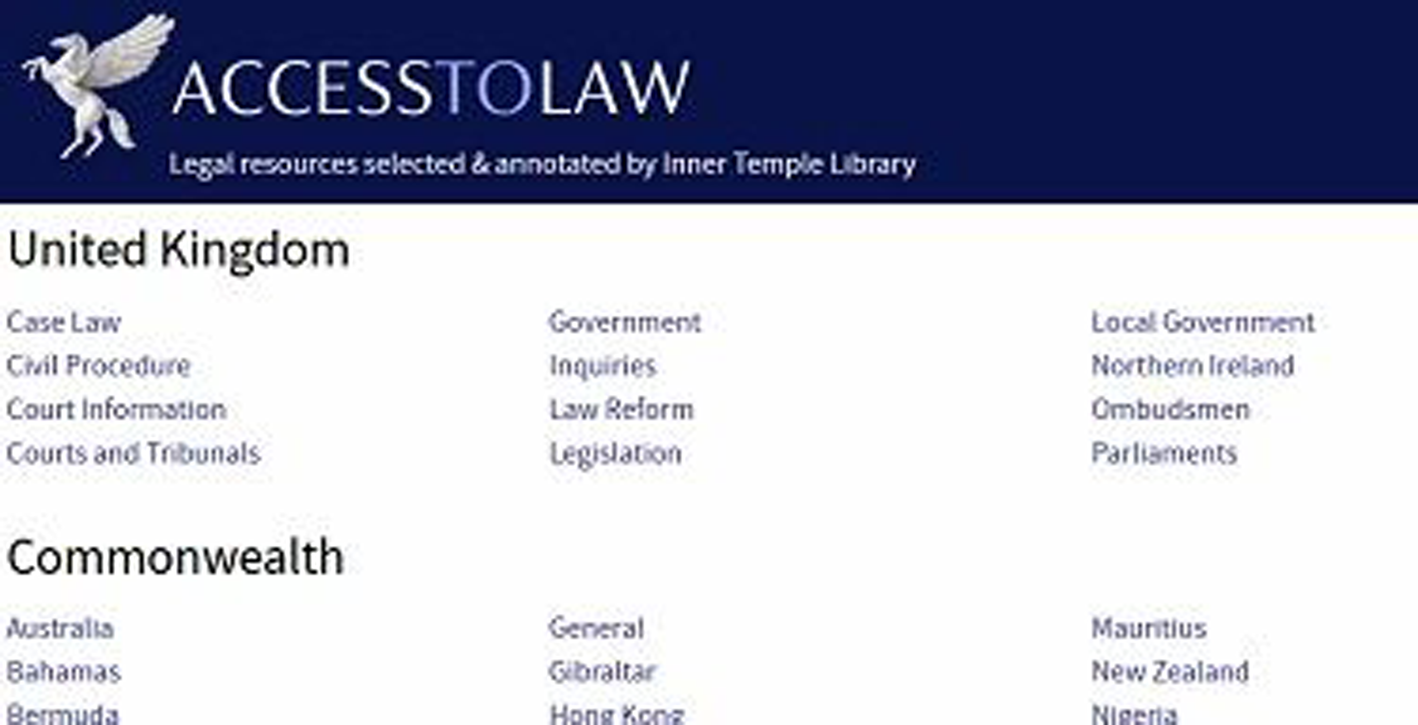
ACCESSTOLAW.

At the time of the Library basement move Captain Sheehan, who was then Sub-Treasurer (the chief executive officer of the Inn), suggested that perhaps the whole of the non-law collection should be sold, and this led to lively discussions and strong opposition from many Benchers and other members of the Inn. Eventually a limited number of books, selected by the then Master of the Library, Jonathan Sumption QC (now Lord Sumption), with assistance from Sotheby's, were sold. They were mainly works on natural sciences, foreign history, art and literature, most of which were in very poor condition. It was 1997 before the legal and non-law books in storage were returned to their new home in the basement of the refurbished Littleton Building (formerly Niblett Hall). When Project Pegasus (a large-scale reconfiguration and renovation of the Treasury Building, including the Library) is completed in 2021 the Library will once again have some space in the basement of the Treasury Building, though not nearly as much as it had in 1991. This new basement space and part of the Littleton basement will be used to house the legal and parliamentary collections which have been displaced from the main Library. The future of the non-law collections, which can no longer be accommodated permanently in the Littleton basement, has yet to be decided.
During the 1990s Inner and Middle Temple Library staff continued to collaborate closely on the automation project. A kilostream line was installed between the two Inns, formats for cataloguing were agreed, and catalogue records for certain collections were exchanged in order to save time and avoid duplication of effort. In addition to creating online catalogue records for the collections at Inner and Middle, records from Gray's Inn and Lincoln's Inn were converted and loaded onto our server, as well as data from three Sweet and Maxwell services (Current Law Cases, Legal Journals Index and BADGER). So, in the days before the Internet was well established, our members with PCs and a modem were able to dial in to the Library server from chambers or home to access these catalogues and databases remotely. Over the next few years we endeavoured to keep pace with the rapid changes in technology, moving from legal databases on compact disc to web-based services. In 1996 we were the first Inn Library to provide general on-site Internet access for barristers; this was followed in 1998/99 by access to web-based subscription services, such as Lawtel and All England Direct. The range of online law reports, journals and commentary sources available for legal research within the Library still continues to grow, and complements the impressive print collections. Unfortunately, with the exception of Bloomsbury Online and Lexis PSL, the online publishers will not allow us to provide these services to members remotely.
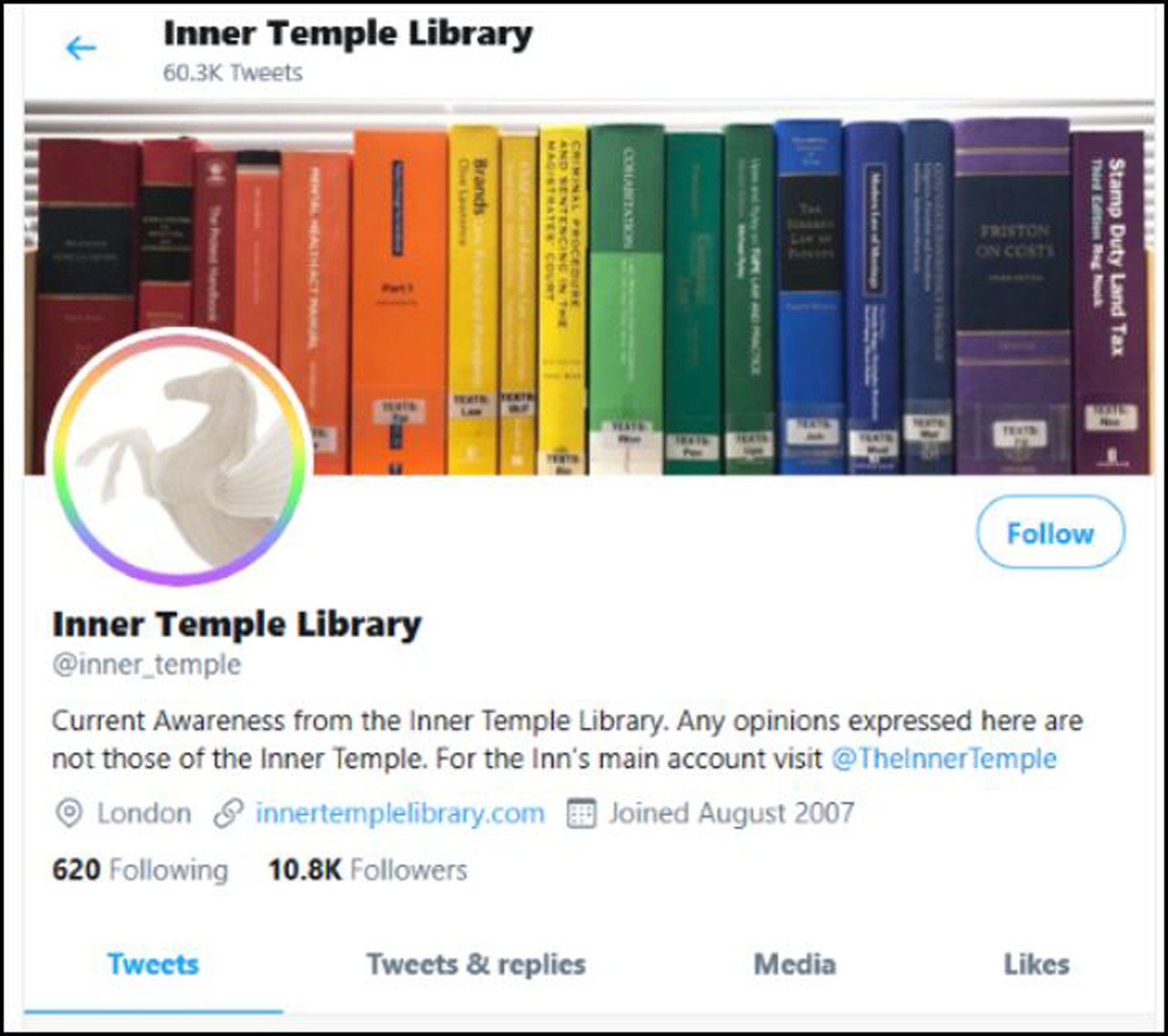
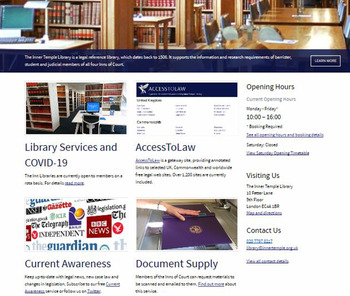
As web-based legal subscription services proliferated, I was also aware of the growing Free the Law movement and the Legal Information Institute databases, such as BAILII, that were starting to appear. Library staff thought it would be a good idea to create a Library website to publicise our in-house services and to develop our own online services in order to raise awareness of the free legal resources available on the web. We hoped this would assist members of the Inns who could not use the Library in person and who might not be able to afford to subscribe to online databases. We launched the Library website in 1997, our legal gateway site, AccessToLaw, in 2001, and a quarterly electronic Newsletter in 2005. This was followed by our Current Awareness blog (the brainchild of Assistant Librarian, Sally McLaren), which was launched in 2007. The daily blog, which provides up-to-date information on new case law, changes in legislation and legal news, had over 112,000 visitors last year and currently has about 19,000 subscribers via Twitter, email and RSS feed. We also engaged with social media at an early stage to promote our services and communicate more directly with our users, launching a Library Facebook page and establishing a Twitter account in 2007.
The Inner Temple Library on Twitter.

Some of these initiatives have been recognised by the wider legal information profession: the Library team won a Halsbury Award for the Best Legal Information Service (Non-Commercial Sector) in October 2007, and the BIALL Wallace Breem Award in 2012 for our “considerable contribution to the legal information profession”. I myself was named Wildy-BIALL Librarian of the Year in 2017 for making a “significant contribution to the legal information world”. I was very honoured to receive this award, although I feel that any “contribution” I might have made should be attributed to the efforts of my entire team rather than to me personally.
Over the years, as we have been developing our own online services, we have of course been active (indeed pro-active) in other areas; to give some examples, we also:
• set up an enquiry and document supply service,
• extended opening hours and introduced Saturday opening (on a rota basis with the other Inns),
• installed a PC network and Wi-Fi,
• introduced overnight loans,
• carried out tours and legal research training for pupils and bar students and outreach activities for school students and prospective new members,
• produced a range of guides to library and online services, including one to sources of transcripts,
• conserved the print collections,
• began collaborating with LLMC on a manuscript digitisation project,
• responded to historical enquiries,
• carried out regular user surveys,
• organised exhibitions of manuscripts and rare books both for internal events (“Grand Days”) and for the Inn's Open Weekends, and
• created a succession of memorable library displays and timelines.
Our surveys have consistently indicated a high level of user satisfaction with the services, collections and “environment conducive to research” provided. Although the majority of our users have always been barristers, in my early years at the Inn we had a much larger student contingent, since the sole Bar course provider, the Inns of Court School of Law, did not have a library of its own. This occasionally led to problems over reader places and access to practitioner texts. It will be interesting to see what use students on the new course run by the Inns of Court College of Advocacy make of the Library's space and collections.
Since 2008 the Library has faced a number of challenging reviews and proposals. These have included a feasibility study to consider the merger of Inner and Middle Temple Libraries; the Inn's proposal to partition off a number of Library rooms; the Library Committee's review of Library services; the Inn's strategic review; and the Project Pegasus proposals. The current Coronavirus pandemic can also be added to the list of challenges. Members of my team have shown themselves to be very resilient and have always been prepared to rise to a challenge. We have been prepared to argue the case for the Library's space, collections, services and funding. Our focus has been on providing the best service possible for our users, whether this is in the permanent Library, the temporary Library setting at Fetter Lane, or via a home-based enquiry and document supply service during lockdown.
The Inner Temple Library's website.

In my years at the Inn I have had the freedom (and the budget) to develop services and maintain one of the best legal libraries in the country. I have always tried to do this in consultation with my team and with our library users. It has been a privilege to have the responsibility for looking after the manuscript as well as the print collections. These collections should be treasured. They will be needed for future legal and historical research. I have been lucky in having an extremely supportive Library Committee, exceptional Masters of the Library (Sir Michael Morland, Lord Sumption, Sir Stephen Sedley, Sir Jack Beatson, Dame Victoria Sharp and Sally Smith QC) and fantastic Library users, but most of all I have benefited from always having a wonderful, talented Library and IT team. My views about Project Pegasus are well known and, although I appreciate that the Inn has to adapt for the future, the changes that are now being made to the Library will always sadden me. It is a matter of particular regret that these will involve the loss of the Library's gallery level. That said, when the move back to the permanent Library takes place this year, I am confident that, under the guidance of my successor, Robert Hodgson, my team (as I still think of them) will be ready to respond to new challenges and will continue to provide a really first-rate legal information service.
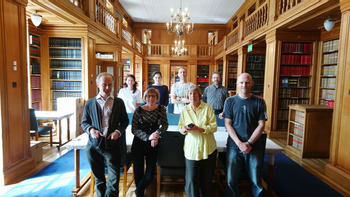
Library and IT staff in 2019.