Introduction
The time between two subsequent live births (birth interval) is an important family planning indicator (Conde-Agudelo et al., Reference Conde-Agudelo, Rosas-Bermúdez and Kafury-Goeta2007; CSA, 2012; Mahmood et al., Reference Mahmood, Zainab and Latif2013; Davis et al., Reference Davis, Babineau, Wang, Zyzanski, Abrams, Bodnar and Horwitz2014; Yohannes et al., Reference Yohannes, Wondafrash, Abera and Girma2011). The World Health Organization’s recommended birth interval is 2–3 years, but the United States Agency for International Development suggests a longer birth interval of 3–5 years (World Health Organization, 2006; Abdel-Tawab et al., Reference Abdel-Tawab, Lūzā and Zaki2008).
The undesired consequences of short and long birth spacing have been investigated in many different studies (Conde-Agudelo et al., Reference Conde-Agudelo, Rosas-Bermúdez and Kafury-Goeta2006, Reference Conde-Agudelo, Rosas-Bermúdez and Kafury-Goeta2007, Reference Conde-Agudelo, Rosas-Bermudez, Castaño and Norton2012; Wendt et al., Reference Wendt, Gibbs, Peters and Hogue2012; Asgharpour et al., Reference Asgharpour, Villarreal, Schummers, Hutcheon, Shaw and Norman2017). Erfani et al. (Reference Erfani2017) reported that increasing the interval between marriage and first birth can have undesirable consequences for the mother and child. Timing of birth as a fertility behaviour has a major influence on population growth (Mansoorian, Reference Mansoorian2008), so the study of birth intervals can give a better understand this (Chowdhury & Karim, Reference Chowdhury and Karim2013).
Currently, rapid decline in fertility rates is a serious demographic concern in many countries, including Iran (Erfani & McQuillan, Reference Erfani and McQuillan2008). Patterns of fertility and birth intervals have changed over the past 50 years. The population of Iran was 33.7 million in 1976 (Aghajanian, Reference Aghajanian1995), but following the Iranian Revolution it reached 49.4 million in 1986 with an annual population growth rate of 3.2% (Vahidnia, Reference Vahidnia2007; Salehi-Isfahani et al., Reference Salehi-Isfahani, Abbasi-Shavazi and Hosseini-Chavoshi2010). Thereafter, because of the family planning policy implemented by the Iranian Government, the fertility rate reduced to 1.85, with a population of 75,149,669 in 2010 (Aghajanian & Merhyar, Reference Aghajanian and Merhyar1999; Salehi-Isfahani et al., Reference Salehi-Isfahani, Abbasi-Shavazi and Hosseini-Chavoshi2010; Noroozian, Reference Noroozian2012; McDonald et al., Reference McDonald, Hosseini-Chavoshi, Abbasi-Shavazi and Rashidian2015).
Due to a decline in women’s fertility rates in recent years in Iran, some changes were made with a view towards increasing the population. One of these changes was to end the population control policies at the call of the Iranian leader in 2012 (Khamenei, Reference Khamenei2014; Erfani, Reference Erfani, Nojomi and Hosseini2017). Thereafter, the Minister of Health declared that the direction of family planning be changed towards reproductive health, with an emphasis on recommended birth intervals and tackling infertility (Erfani, Reference Erfani2017).
Therefore, investigating the fertility behaviour of Iranian women and birth interval patterns for achieving reasonable population growth is of interest. The factors affecting birth intervals have been studied using survival analysis methods (Mansoorian, Reference Mansoorian2008; Singh et al., Reference Singh, Singh and Narendra2011). Mahmood et al. (Reference Mahmood, Zainab and Latif2013) applied frailty modelling to clustered survival data for birth intervals in Bangladesh. They adopted this approach in order to account for the heterogeneity due to cluster sampling of the women in different parts of the country. Erfani and McQuillan (Reference Erfani and McQuillan2014) used survival analysis with an unshared frailty component on a 2000 survey in order to study successive birth intervals in Iran. Since then, no comprehensive study using a survival frailty model has been conducted on the patterns and factors affecting birth intervals in Iran. The structure of the data used in the present study allowed the method of Mahmood et al. (Reference Mahmood, Zainab and Latif2013) to be used. On the other hand, Wang et al. (Reference Wang, Yau, Lee and McLachlan2007) applied a three-level survival frailty model in a recurrent event in different clusters (Wang et al., Reference Wang, Yau, Lee and McLachlan2007). This study investigated the patterns of birth intervals among Iranian women, as well as factors influencing them.
Methods
Source of data
Data were taken from the Iranian Multiple Indicators Demographic and Health Survey (IrMIDHS) conducted in Iran by the Iranian National Institute of Health Research, Ministry of Health and Medical Education, during 2010–2011. The survey was cross-sectional, and included a sample of Iranian households from different cities and provinces. More details on the sample are available in Rashidian et al. (Reference Rashidian, Karimi-Shahanjarini, Khosravi, Elahi, Beheshtian and Shakibazadeh2014). Only married women aged 15–54 years and who had been married for more than 5 years were included in the study. The total sample comprised 20,093 women with complete information for the selected variables.
Data analysis
Because the reproductive period had not been completed for some women at the time of the survey, the survival method was applied for data analysis. Birth intervals as time-to-event data can be considered either closed- or open-ended intervals (Singh, Reference Singh2016). When the interval is defined as the time between two successive live births, the closed birth interval is considered. The length of time between the birth of the last child and the interview is also considered an open birth interval.
Mahmood et al. (Reference Mahmood, Zainab and Latif2013) indicated that Cox’s proportional hazards model is often used to investigate the effect of different factors on birth intervals. In this type of model, the response variable is the birth interval. The first birth interval is the time between first marriage and first live birth. The second and third birth intervals are the durations from the first to second birth, and from the second to third birth, respectively, and so on for other birth intervals. The concept of censored data is referred to as an open birth interval, as a birth may occur after the time of the interview. Thus, in this study, to analyse data for the first live birth, the time between the first marriage and the interview was considered the censored time for the women who had not yet had a child. The time between the first marriage and the first live birth was considered an event time for the women who had had their first child. Furthermore, for the second live birth, the time between the first live birth and the interview was considered the censored time for women who had not yet had a second child. The time between the first live birth and the second live birth was considered an event time for the women who had had their second child, and the same conditions were applied for the third birth interval. Birth intervals were measured in months.
The Kaplan–Meier method was used to estimate the median duration of the different birth intervals. A multilevel version of Cox’s proportional hazards model was used to estimate factors having an effect on birth intervals, while considering the capture heterogeneity of unobserved factors (Wang et al., Reference Wang, Yau, Lee and McLachlan2007). Based on the nature of the data gathered in different cities and provinces, a three-level survival model was employed to analyse the data through shared frailty.
The first, i.e. woman, level was nested within the second-level unit, i.e. city, and each city nested within the third-level unit, namely province. The multilevel survival frailty model was applied for the first, second and third birth intervals separately.
The hazard model (h) of birth intervals is as follows:
 $$h\left( {t;i,j,k} \right) = \lambda \left( t \right)\exp \left( {{\eta _{ijk}}} \right),{\mkern 1mu} {\mkern 1mu} {\eta _{ijk}} = x_{ijk}^\prime \beta + {u_i} + {v_{ij}},$$
where λ(t) is the baseline hazard. The term x′ ijk refers to the covariates vector for the k th woman in the j th city that nested within the i th province and β is the regression coefficient vector. The parameters u i and v ij are frailty components ‘province’ and ‘city’ respectively, where frailty is ‘a random component designed to account for variability due to unobserved individual-level factors that are otherwise unaccounted for by the other predictors in the model’ (Kleinbaum & Klein, Reference Kleinbaum and Klein2010).
Another type of frailty model is the shared frailty model, wherein clusters of subjects are assumed to share the same frailty. Similarities in cities and also in provinces lead to greater variability in survival times than might be expected under the model without the frailty component. Therefore, shared frailty was used in the model due to the correlation between women in one city or one province (Gutierrez, Reference Gutierrez2002; Kleinbaum & Klein Reference Kleinbaum and Klein2010).
Considering these data were collected through a national survey, the present study did not have any influence on the implementation of the data – the available data were considered a random sample. However, the model used, which was suggested by Mahmood et al. (Reference Mahmood, Zainab and Latif2013), can adjust the heterogeneity due to the sampling design to more accurate standard errors of the estimated parameters. An advanced computer program was written during using R software (version 3.4). The Newton–Raphson algorithm was used to estimate the parameters and shared frailty components (u i and v ij). A significance level of 0.05 was considered for testing parameters.
Information on reproductive behaviour, including abortion, age of first marriage, contraceptive use and timing of all live births, as well as a number of socio-demographic variables related to the women, such as age, employment status, education, monthly family income, were extracted in the survey at the time of interview. Based on the time of the survey and the available data for families’ income, three levels of income were considered: less than US$600 (Low), US$600–1100 (Middle) and more than US$1100 (High). Two variables – the child’s sex and the type of delivery in each childbearing – were used to analyse the next birth
The basic assumption in survival analysis is that the covariates must follow a temporal order; that is to say, the independent variables need to occur before a given order of the birth interval. Meanwhile, the independent variables in the study did not have this feature. Since the survey was not designed for this study, with the exception of child sex and delivery type of the previous birth, the covariates in the three models were measured at the time of the interview, and hence did not having a temporal order. Therefore, a prospective conceptual model was suggested to overcome this limitation.
Conceptual model
The lengths of birth interval for the first three births were measured and their association with various factors assessed. According to previously studies, there are two types of fertility models: one that deals with a specific event such as a live birth, and a second that uses data on the interval between consequent events, namely the birth interval. Both models have limitations and advantages (Singh, Reference Singh2016). Various biological, demographic and socioeconomic factors affect birth intervals and fertility (Mansoorian, Reference Mansoorian2008; Mahmood et al., Reference Mahmood, Zainab and Latif2013; Singh, Reference Singh2016; Erfani et al., Reference Erfani2017). In this study, women’s socio-demographic factors, and some biological factors, including age at first marriage, contraceptive use and abortion, were included in the previously mentioned model (the second type). The importance of these variables has been established in earlier studies. Among the variables used in this paper, only type of delivery and the sex of the child were recorded at each birth, and other factors (such as women’s education, women’s occupation and family income, as well as having previously had an abortion and contraceptive use) were recorded at the time of the survey. However, given the fact that the fertility period of Iranian women usually starts after completing education or obtaining the right job, the lack of information on these two factors for each birth may be somewhat ignored (Erfani & McQuillan, Reference Erfani and McQuillan2014).
Socioeconomic status, which is measured indirectly by educational level, employment status, income or other variables, is one of the main factors affecting birth interval and its consequences (Conde-Agudelo et al., Reference Conde-Agudelo, Rosas-Bermúdez and Kafury-Goeta2006). Typically, higher education has a negative influence on fertility (Vahidnia, Reference Vahidnia2007; Erfani & McQuillan, Reference Erfani and McQuillan2008). Moreover, some characteristics of women, such as having an academic education and suitable job opportunities, make it possible for them to marry at older ages and use contraceptives in order to increase their birth intervals (Akter & Rahman, Reference Akter and Rahman2010; Erfani & McQuillan, Reference Erfani and McQuillan2014). Thus, age at first marriage as the main biological factor is of great importance in studies of birth intervals. The mean age at first marriage for Iranian women increased from 19.7 years in 1976 to 23.4 years in 2001 (Office of the Deputy for Social Affairs, 2004). Marriage at older ages will increase the chance of fertility in a shorter time (Singh et al., Reference Singh, Singh and Narendra2011). On the other hand, women with a higher level of contraceptive use have less risky reproductive behaviour, leading to increased birth intervals and reduced fertility (Adhikari, Reference Adhikari2010; Singh et al., Reference Singh, Singh and Narendra2011; Biks et al., Reference Biks, Berhane, Worku and Gete2015).
Around 60% of the fertility decline in Iran is due to the use of contraceptive methods by women (Erfani & McQuillan, Reference Erfani and McQuillan2008). Based on the Iranian Demographic and Health Survey (2000), 74% of married women have used at least one kind of contraceptive method (Vahidnia, Reference Vahidnia2007). Therefore, paying attention to contraceptive use is necessary for assessing the interval between live births. Psychological disorders such as symptoms of depression, distress and panic following an abortion are other notable aspects that have been reported in some studies (Swanson et al., Reference Swanson, Karmali, Powell and Pulvermakher2003; Hutti, Reference Hutti2005). Despite the fact that abortion in Iran is mostly spontaneous or performed medically only in order to protect the mother (Mansoorian, Reference Mansoorian2008), it may be a factor that can be evaluated in relation to the length of the birth interval.
The role of mass media in fertility change has been demonstrated in previous studies (Hornik & McAnany, Reference Hornik and McAnany2001). Its influence on the prevention of fertility is evident (Cheng, Reference Cheng2011; Rabbi, Reference Rabbi2012). Knowledge of family planning programmes, familiarity with contraceptive methods, awareness of the appropriate age for fertility, changing reproductive behaviour and familiarity with antenatal care visits are among the factors shown to be connected the influence of mass media on fertility (Vahidnia, Reference Vahidnia2007; Zamawe et al., Reference Zamawe, Banda and Dube2016; Gautam & Jeong, Reference Gautam and Jeong2019).
The study also investigated the type of delivery for each birth. Previous studies have shown that women undergoing a Caesarean delivery are less likely to experience subsequent gestations or are more likely to have a longer birth interval for further births (Porter et al., Reference Porter, Bhattacharya, van Teijlingen and Templeton2003; Smith et al., Reference Smith, Wood, Pell and Dobbie2006). Although factors such as age and smoking status differ between women who had a Caesarean section and a natural delivery, and biological factors can be the main cause of a longer time to next birth (Pandian et al., Reference Pandian, Bhattacharya and Templeton2001; Smith et al., Reference Smith, Pell and Bobbie2003). These studies found that the likelihood of having a second child during the next 5 years after the first birth was less (around 11% to 13%) among women who had undergone a Caesarean section than for women who had a vaginal delivery (Hemminki et al., Reference Hemminki, Graubard, Hoffman, Mosher and Fetterly1985). Therefore, type of delivery may play an important role in the reproductive process and length of birth intervals. Place of residence can affect birth interval patterns (Antai & Moradi, Reference Antai and Moradi2010; Chowdhury & Karim, Reference Chowdhury and Karim2013). Higher-educated or employed women are more likely to live in urban areas, so living in these areas may indirectly affect birth intervals (Mahmood et al., Reference Mahmood, Zainab and Latif2013).
Finally, sex preference, or the tendency to have a child of a particular sex, has been found to be a significant factor in birth intervals (Clark, Reference Clark2000; Mansoorian, Reference Mansoorian2008), so this was investigated in the study. To take account of the effect of other factors that were not measured in this study, a correct estimation of parameters was calculated based on the proposed model (Wang et al., Reference Wang, Yau, Lee and McLachlan2007; Austin, Reference Austin2017). Therefore, two frailty components were used to create a robust estimation by adjusting the variability and heterogeneity caused by unobserved factors.
Results
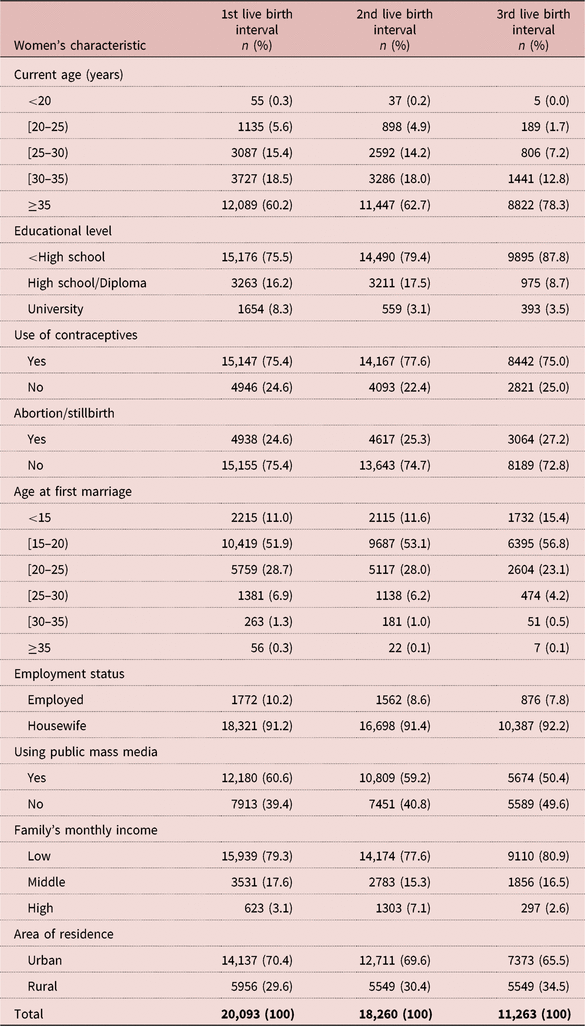
The mean (SD) number of live births for the Iranian women in rural areas was 3.20 (2.12), and for those in urban areas it was 2.65 (1.70). Nearly 70% of the women lived in urban areas. (Table 1). Of the total women, 0.3% were below the age of 20 years and 60.2% were over 35 years of age. The percentages of women with an academic education for the first three births were 8.3%, 3.1% and 3.5%, respectively. It was found that 39.4% of the women did not use any public mass media such as newspapers, magazines or radio, while the majority (60.6%) used at least one of these either daily or weekly. Among the women who had had at least two live births, 27.2% had had at least one abortion or stillbirth. The first marriage for most women took place between 15 and 20 years of age (51.9%), followed by 20–25 years of age (28.7%). Only 10.2% of the women were employed, 3% of whom lived in rural areas. Nearly 25% of women stated that they had used no contraceptive methods. Around 66.3% of childbirths were delivered through a normal vaginal delivery, the rest being by Caesarean section. Of all the live births, 51.5% were boys and 48.5% were girls.
Percentage and frequency distribution of Iranian women by birth interval and background characteristics (N = 20,093)

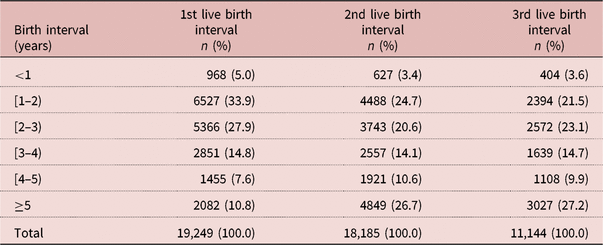
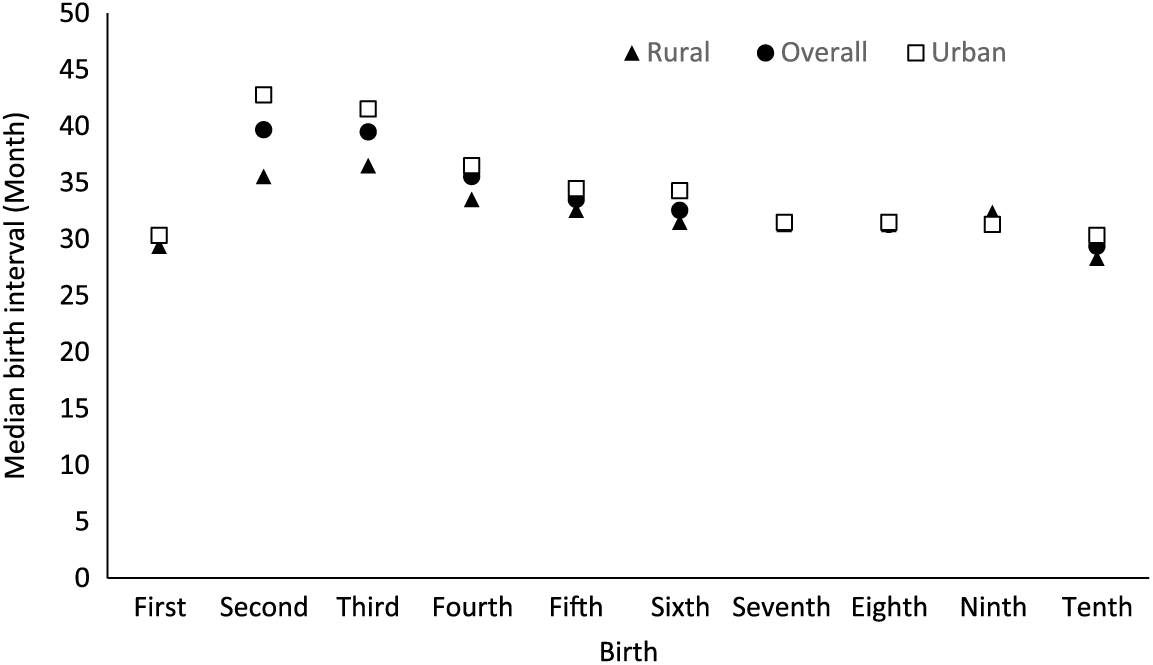
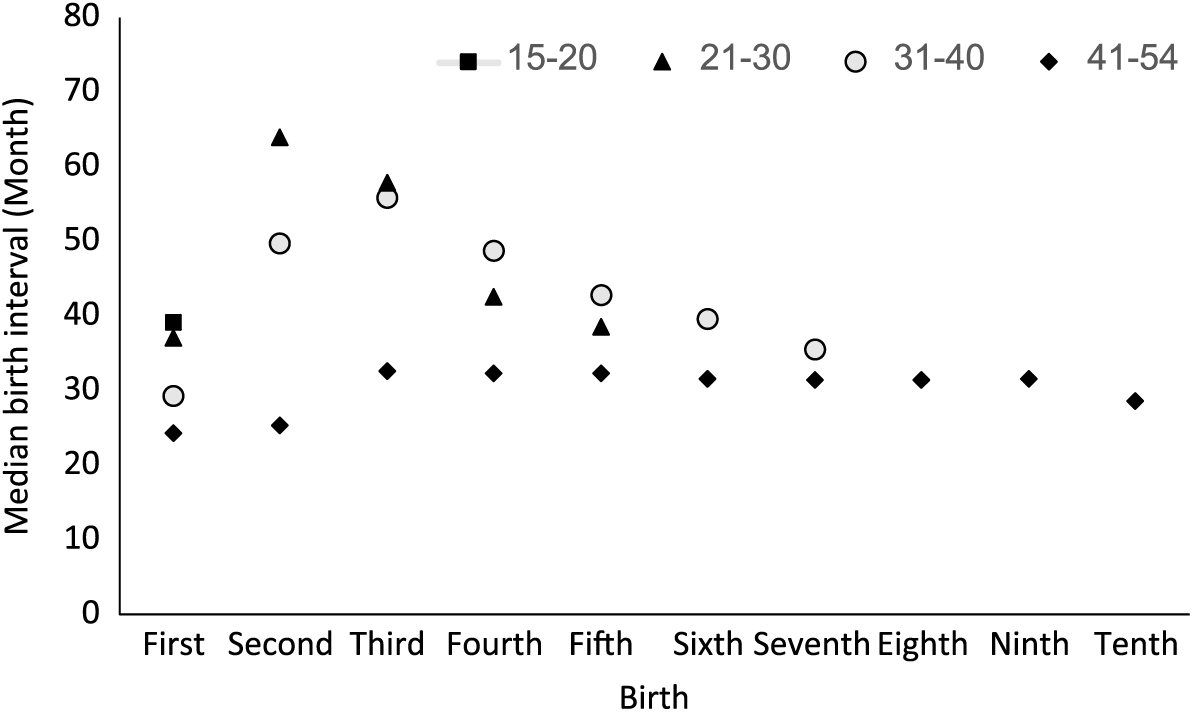
Table 2 shows that nearly 40% of first births occurred less than 2 years after marriage. Twenty-eight per cent and 25% of second and third births, respectively, occurred less than 2 years after the previous birth. Although the median duration of the birth interval for the first birth was roughly the same in urban (30.3 months) and rural (29.3 months) areas, these values differed for subsequent birth intervals. The overall median birth intervals were 30.3, 39.7 and 39.5 months for the first, second and third births, respectively. The median time was calculated for the first ten births in urban and rural areas as well as in the whole country (Figure 1). Taking into account the age of women at the time of the survey, the median times for the different births (length of birth interval) for women over 40 years of age were close to each other (around 24 to 32 months), but for younger women, the median lengths of birth intervals changed. For women below 20 years of age, the median length for the first birth was 39 months. The median times of each birth are shown by women’s age group in Figure 2.
Frequency distribution of birth intervals of live births of Iranian children

Median birth intervals for women aged 15–54 by birth order and rural–urban area of residence, Iran.

Median birth intervals for women by birth order and age group, Iran.

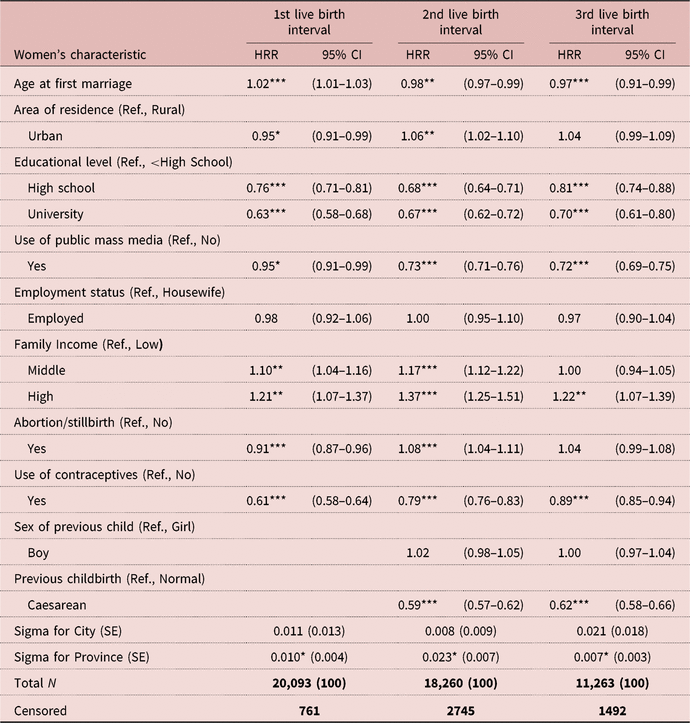
The adjusted estimates of hazard risk ratios (HRRs) for different factors for each birth interval are shown in Table 3. Women’s education, contraceptive use, type of previous delivery and use of public mass media decreased the HRR of all three births. Furthermore, women’s education had a significant effect on first, second and third birth intervals. In other words, women with higher education had a lower risk of birth. Another important factor was age at first marriage, which was found to be associated with birth interval. A higher age at first marriage was associated with an increased risk of first birth. Meanwhile, for the second birth, the risk of birth decreased.
Results of multilevel semi-parametric survival frailty analysis for the first three birth intervals

*p < 0.05; **p < 0.01; ***p < 0.001.
HRR, hazard rate ratio; CI, confidence interval; Ref., reference category.
The HRRs of live births among women who did not use contraceptives were greater than among those who did use them. What is more, the history of having had an abortion or stillbirth was related to first and second birth intervals. Caesarean delivery for first and second births was associated with a decrease in the risk of having a further birth. The risk of birth for women who had used public mass media was lower than that of women who did not have access to these. A higher monthly income was associated with an increase in the risk of birth. Table 3 also shows that there was no significant unobserved heterogeneity affecting birth intervals in each city. Meanwhile, there were some unobserved factors in different provinces that affected different birth intervals.
Discussion
This study evaluated the main factors affecting birth intervals in Iranian women using a multilevel survival frailty model. The results indicate that certain socio-demographic characteristics of women, and some biological factors, are important factors influencing the timing of births. Since having a child is a physiological, social and emotional event in the life of a family (Toohill et al., Reference Toohill, Fenwick, Gamble and Creedy2014), the recommended interval between births should be considered in family planning.
The study found that around a quarter of live births had occurred with an ‘appropriate’ time interval (2–3 years) after the previous childbirth or time of marriage (Conde-Agudelo et al., Reference Conde-Agudelo, Rosas-Bermúdez and Kafury-Goeta2006). Among the factors affecting birth interval, women’s education was found to be most influential. Many previous studies have demonstrated the importance of education in fertility and birth intervals (Breierova & Duflo, Reference Breierova and Duflo2004; McCrary & Royer, Reference McCrary and Royer2011; Sonfield et al., Reference Sonfield, Hasstedt, Kavanaugh and Anderson2013; Erfani & McQuillan, Reference Erfani and McQuillan2014). Many studies have shown that higher women’s education increases birth intervals, as confirmed in the present study (Mahmood et al., Reference Mahmood, Zainab and Latif2013). Najafi-Vosough et al. (Reference Najafi-Vosough, Soltanian and Fayyazi2017) studied the factors affecting birth intervals in Hamadan Province, Iran, using a recurrent survival model. They found that women’s education had a significant effect on second, third and fourth birth intervals. Furthermore, Mohammadi Farrokhran et al. (Reference Mohammadi Farrokhran, Mahmoodi, Mohammad, Rahimi, Majlesi and Parsaeian2013), using a modified Gompertz curve model, showed that the only variable that had an effect on the first birth interval was women’s education.
Another important finding of this study was that a history of contraceptive use decreased the risk of giving birth. A systematic review by Pine Yeakey et al. (Reference Pine Yeakey, Muntifering, Ramachandran, Myint, Creanga and Tsui2009) has shown that contraceptive use was effective in preventing short birth intervals. In developing countries, women tend to desire more children, so they avoid using contraception and thus have a higher probability of becoming pregnant immediately after childbirth (Abdel-Tawab et al., Reference Abdel-Tawab, Lūzā and Zaki2008; Yohannes et al., Reference Yohannes, Wondafrash, Abera and Girma2011; Higgins et al., Reference Higgins, Popkin and Santelli2012; Saha & van Soest, Reference Saha and van Soest2013).
Type of delivery is an important factor in fertility issues. This study showed that undergoing a Caesarean delivery for a woman’s first or second childbirth was associated with a decrease in the risk of having a next birth. Usually, Caesarean childbirth, especially for the first birth, has implications for future reproductive behaviour and subsequent pregnancies (Solheim et al., Reference Solheim, Esakoff, Little, Cheng, Sparks and Caughey2011; Spong et al., Reference Spong, Berghella, Wenstrom, Mercer and Saade2012). Smith et al. (Reference Smith, Wood, Pell and Dobbie2006) showed that the likelihood of not having a second birth was greater for women who had undergone a Caesarean section compared with those who had a vaginal delivery (Smith et al., Reference Smith, Wood, Pell and Dobbie2006). Caesarean section is therefore a risk factor for reduced fertility. The decrease may be due to physical difficulties in having subsequent children after Caesarean section (Hemminki et al., Reference Hemminki, Graubard, Hoffman, Mosher and Fetterly1985). On the other hand, concern over problems such as incomplete pregnancy, i.e. ectopic pregnancy or abortion, placental problems or perinatal death of the next infant, can lead women who have undergone a Caesarean section to postpone their next pregnancy (Hemminki, Reference Hemminki1996).
The study found that women’s age at first marriage affected their fertility and birth intervals. A higher age at first marriage was associated with a shorter first birth interval, or higher risk of birth, as observed in other studies (Erfani & McQuillan Reference Erfani and McQuillan2014; Dietl et al., Reference Dietl, Cupisti, Beckmann, Schwab and Zollner2015). This could be due to the cultural pressure on women to prove their ability to have a child in countries such as Iran (Mansoorian, Reference Mansoorian2008). Moreover, a higher age at first marriage reduces the chance of fertility and increases the risk of abortion/stillbirth (Erfani et al., Reference Erfani2017).
The effect of an abortion/stillbirth on a birth interval varied for first and second births. This could be due to women’s different reactions during each type of birth. Fear about the occurrence of a subsequent abortion may be one of the reasons for women undergoing at least one abortion.
The important role of public mass media in maintaining ‘appropriate’ intervals between births, so improving the health of mother and child, reported in this study has been observed in previous studies (Babalola & Fatusi, Reference Babalola and Fatusi2009; Cheng, Reference Cheng2011; Tarekegn et al., Reference Tarekegn, Lieberman and Giedraitis2014). Barber and Axinn (Reference Barber and Axinn2004) indicated that there was a relation between exposure to public mass media and childbearing behaviour. Hornik and McAnany (Reference Hornik and McAnany2001) observed a strong correlation between level of fertility and access to public media in a country.
Socioeconomic status also affects the family and childbearing (Klebanoff, Reference Klebanoff1999; Conde-Agudelo et al., Reference Conde-Agudelo, Rosas-Bermúdez and Kafury-Goeta2007). Household income has been seen to have an influence on the interval between two births (Mills et al., Reference Mills, Rindfuss, McDonald and Te Velde2011). It has also been shown that high income is associated with an increase in the risk of the first two births for Iranian women. The present study also found that area of residence had an effect on birth intervals. However, the effect was different for the first two birth intervals. Thus, it could be that women in urban areas usually marry at an older age, so the hazard of having a first child is higher for them. On the other hand, the desire to have fewer children (Kulu, Reference Kulu2013), and greater access to contraceptives (Dodoo & Tempenis, Reference Dodoo and Tempenis2002), in urban areas compared with rural areas may lead to a decreased risk of a second birth. It is noteworthy that among the variables used in this study, only women’s employment status and child’s sex did not show any relationship with birth intervals. Though the sex of each childbirth was not related to the next birth interval, a strong desire to have boys has been observed in most societies (Puri et al., Reference Puri, Adams, Ivey and Nachtigall2011; Erfani et al., Reference Erfani2017). According to studies conducted in East Asia, South Asia, India and China, for economic and social issues, continuation of the family name, and responsibility for the care of parents, the birth of a son is more satisfactory and leads to the desire for another pregnancy in a shorter time (Das Gupta et al., Reference Das Gupta, Zhenghua, Bohua, Zhenming, Chung and Hwa-Ok2003; Hesketh et al., Reference Hesketh, Lu and Xing2011, Altindag, Reference Altindag2016).
Identifying the factors affecting birth intervals can help inform strategies to help women maintain ‘appropriate’ intervals between their pregnancies. The results of this study suggest that mass media has a significant effect in encouraging young women to undergo natural childbearing.
Acknowledgments
The authors are grateful to the Iranian National Institute for Health Research for providing the data for this article.
Funding
This manuscript formed part of the PhD thesis of MS Maryam Seyedtabib (No. 9602261248) in Biostatistics, supported by Hamadan University of Medical Sciences.
Conflicts of Interest
The authors declare that they have no potential conflicts of interest concerning the research, authorship and publication of this article.
Ethical Approval
This research was approved by the Ethics Committee of Hamadan University of Medical Sciences, with the approval number IR.UMSHA.REC.1396.122, in 2017. The authors assert that all procedures contributing to this work comply with the ethical standards of the relevant national and institutional committees on human experimentation and with the Helsinki Declaration of 1975, as revised in 2008.