Introduction
The bird cherry-oat aphid, Rhopalosiphum padi (L.) (Hemiptera: Aphididae), is a significant pest with a wide distribution across wheat-growing regions worldwide. It reduces wheat yield by extracting substantial quantities of liquid and nutrients from the phloem and by transmitting plant viruses (Blackman and Eastop, Reference Blackman and Eastop2000; Duan et al., Reference Duan, Peng, Qiao and Chen2017). For instance, R. padi is a primary vector of Barley Yellow Dwarf Virus (BYDV). While other aphids can transmit BYDV, R. padi is a key vector in the spread of this plant disease, particularly in cereal crops (Blackman and Eastop, Reference Blackman and Eastop2000). Although R. padi is primarily regarded as a major pest of wheat, it possesses a broad host range and is also capable of damaging other crops (Peng et al., Reference Peng, Liu, Guo, Wang, Song, Su, Fang and Chen2019). However, its host plant associations before and after the wheat harvest remain poorly understood.
In most areas of northern China, winter wheat and maize are cultivated in rotation throughout the year. In these regions, wheat is typically sown in October or November, overwinters during the colder months, and undergoes rapid growth in spring (Dong et al., Reference Dong, Pang, Fu, Peng, Li and Yuan2024), with harvest taking place in early June of the following year. During this interval, both spring and summer maize can be cultivated. Spring maize is generally sown in April or May, enters the tasselling stage between June and July, and is harvested between August and September (Sheng et al., Reference Sheng, Zhu, Rossiter and Liu2019). Summer maize, sown in June, has a shorter growth cycle and is harvested between September and October (Dong et al., Reference Dong, Zhao, Qin and Wan2019; Huifang et al., Reference Huifang, Jiayin, Dandan and Quanqi2011). Because there is some level of overlap between the growing seasons of maize and wheat then there is an opportunity for aphids to move between these crops. For instance, Rhopalosiphum maidis (Fitch) (Hemiptera: Aphididae) is an aphid that damages maize (Chung and Jander, Reference Chung and Jander2022; Tzin et al., Reference Tzin, Fernandez-Pozo, Richter, Schmelz, Schoettner, Schäfer and Jander2015).
While R. padi is generally considered a serious pest of wheat, investigations have found that R. padi can also infest maize alongside R. maidis (Luo et al., Reference Luo, Hu, Shang, He and Guo2024; Schmidt et al., Reference Schmidt, Will, Ruckwied, Habekuß and Stich2025). However, R. padi is often mistaken for R. maidis due to their extreme morphological similarities. To date, little is known about R. padi post-wheat harvest host associations. Information about this aphid species on other crops is scarce. Previous demographic studies with R. padi have primarily focused on its population dynamics on small grains and grasses, particularly under varying environmental conditions. For example, Park et al. (Reference Park, Choi, Cho, Kim and Ahn2017) analysed life table parameters of R. padi on barley, showing significant impacts of temperature on development and reproduction. Similarly, Asin and Pons (Reference Asin and Pons2001) investigated the effect of temperature on R. padi life cycles, demonstrating accelerated development at moderate temperatures but reduced survival at extremes. Studies have also assessed the performance of R. padi on different cereal hosts (Leather et al., Reference Leather, Wellings and Dixon1983), providing important insights into host plant suitability. However, demographic information on R. padi as it relates to potential colonisation of maize remains scarce despite its potential role as a virus vector in maize agroecosystems.
This study sought to investigate R. padi’s ability to survive on maize leaves and husks under laboratory conditions. To accomplish the main goal, we collected R. padi from wheat, and reared the aphids on wheat seedlings, maize leaves, and maize husks. Using life table methods, we then examined the growth and development of R. padi feeding on the different host treatment combinations. Various life history parameters related to growth and reproduction were calculated to assess the fitness of R. padi on wheat seedlings and maize husks.
Materials and methods
Insect rearing
A population of R. padi was collected from a wheat field in Xianyang, Shaanxi Province, China (34°09ʹN, 107°38ʹE, 430 m elevation). Winged parthenogenetic individuals were brought to the laboratory and reared on a susceptible wheat cultivar (‘Xiaoyan 22’; Peng et al., Reference Peng, Liu, Guo, Wang, Song, Su, Fang and Chen2019). Three wheat seedlings were planted per plastic cup (6 cm diameter) containing a 1:1 (v:v) mixture of nutrient medium and sterile soil. The seedlings were used only after reaching the stage where the second true leaf had unfolded and the third true leaf was unfolding (BBCH 12-13 according to Biologische Bundesanstalt, Bundessortenamt und Chemische Industrie scale) (Meier et al., Reference Meier, Bleiholder, Buhr, Feller, Hack, Hess, Lancashire, Schnock, Stauss, van den Boom, Weber and Zwerger2009).
Plants and aphids were maintained in cages (35 × 35 × 35 cm) with nylon mesh sides and zipper openings, housed inside temperature-controlled incubators at 24 ± 1 °C, 70 ± 5% relative humidity, and 16:8 h light:dark photoperiod.
The susceptible maize cultivar ‘Xi Nong 233’ was used for the experiments. Plants were grown in 20 cm-diameter pots filled with the aforementioned soil mixture and kept in cages (35 × 35 × 60 cm) until reaching the R3 (milk) stage.
Population dynamics of R. padi on wheat and maize
The growth stages of wheat and maize during the 9-week experiment were as follows: For wheat: 0–7 days corresponded to the three-leaf stage, 7–21 days to the tillering stage, 21–27 days to the jointing stage, 27–35 days to the booting stage, 36–49 days to the heading stage, 49–56 days to the flowering stage, and 56–63 days to the grain-filling stage. For maize: 0–7 days represented the R3 stage, 7–21 days the dough stage (R4), 21–42 days the dent stage (R5), and 43–63 days the physiological maturity stage (R6 stage).
Based on preliminary field surveys showing R. padi colonisation of both maize leaves and husks after wheat harvest, we compared aphid dynamics on three substrates: maize leaves (R3 stage), maize husks (R3 stage), and wheat seedlings (BBCH 12-13). Each maize or wheat seedling was enclosed individually. Maize plants were placed in polyester mesh cages (80-mesh, 35 × 35 × 60 cm). For wheat seedlings, each was grown in a plastic cup and enclosed with a cylindrical transparent cover (5.5 cm diameter, 28 cm height) topped with an 80-mesh net for ventilation. All the maize plants and wheat seedlings were planted in nutrient-rich soil (Linke Company, Yangling, China). The experimental groups were designated as follows: W group: aphids on wheat; L group: aphids on maize leaves; H group: aphids on maize husks. Six biological replicates were established per group. Aphid numbers were counted every 7 days over a total duration of 9 weeks, all under the same environmental conditions described above.
Life table studies of R. padi on wheat and maize
Aphids originating from wheat
Life tables were constructed following methods adapted from Maia et al. (Reference Maia, Luiz and Campanhola2000) and Peng et al. (Reference Peng, Liu, Guo, Wang, Song, Su, Fang and Chen2019). Winged R. padi adults collected from wheat fields were placed in cages containing wheat to obtain synchronized nymphs. After 12 h, neonate nymphs were individually transferred to one of three plant types: (1) wheat seedlings (BBCH 12-13), (2) maize husks (R3 stage, with leaves removed), (3) maize leaves (R3 stage, with husks removed). Given this particular sequence, these groups were termed W-W, W-H, and W-L, respectively, with at least 30 replicates per treatment.
Aphids originating from maize husks
Due to the near extinction of aphids on maize leaves after 63 days but persistence on husks, winged adults from the maize husk (H) cohorts were used to produce synchronised nymphs. These nymphs were transferred to one of three plant types: (1) wheat seedlings (BBCH 12-13), (2) maize husks (R6 stage), and (3) maize leaves (R6 stage). These groups were termed H-W, H-H, and H-L, respectively, with 30 replicates per treatment.
For both experiments, aphids were observed daily for development, molting, survival, and fecundity. Adult mortality and reproduction were recorded twice daily. Life table parameters were calculated, including net reproductive rate (R0), intrinsic rate of increase (r m), finite rate of increase (λ), and mean generation time following standard procedures (Maia et al., Reference Maia, Luiz and Campanhola2000; Peng et al., Reference Peng, Liu, Guo, Wang, Song, Su, Fang and Chen2019).
Statistical analysis
Data on population dynamics of R. padi on wheat seedlings and maize (leaves and husks) were compared among treatments with repeated measures analysis of variance (ANOVA) using treatment as a factor repeated over the nine weekly assessments that were conducted. The development period and total longevity of R. padi under different treatments were analysed using one-way ANOVA, performed with SPSS 17.0 software (SPSS, Chicago, IL, USA). Data were log-transformed if needed to meet the assumptions of normality and homoscedasticity required for these analyses. The means were compared using the Tukey’s honestly significant difference (HSD) test (P < 0.05) when the overall variation in ANOVA was significant. A two-tailed Student’s t-test at the significant level 0.05 was used to test the difference of life table parameters between two treatments (SPSS, Chicago, IL, USA). Relative fitness (rf) values were calculated by dividing the intrinsic rate of increase (r m) values of W-H and W-L populations by the r m value of W-W population and dividing the r m values of H-W and H-L populations by the r m value of H-H population. The standard errors of r m, finite rate of increase (λ), net reproductive rate (R 0), mean generation time (T), fecundity (F), and gross reproductive rate (GRR) were estimated by the jackknife method, and their means were compared using ANOVA (Maia et al., Reference Maia, Luiz and Campanhola2000). Life table data were analysed using a SAS program developed by Maia et al. (Reference Maia, Luiz and Campanhola2000). Graphs were generated using GraphPad Prism 8.0 software.
Results
Population dynamics of R. padi on wheat and maize
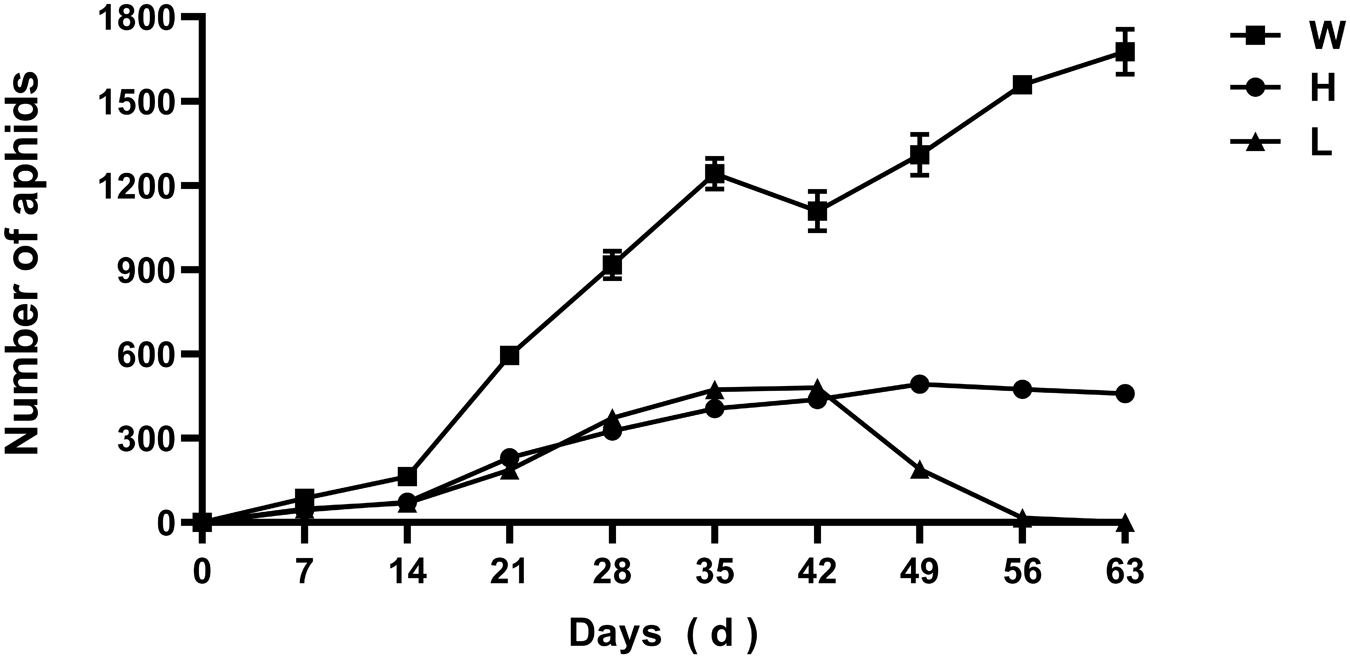
The repeated measures ANOVA revealed a significant effect of treatment (F = 492.0; df = 2, 48; P < 0.001), week (F = 147.8; df = 8, 48; P < 0.001), and significant interaction treatment × week (F = 65.5; df = 16, 48; P < 0.001) indicating differential abundance responses by R. padi to the treatments over time. For each stage of wheat growth and development, the number of aphids on wheat seedlings (W) gradually increased, reaching a maximum of 1,676.67 ± 80.37 aphids (fig. 1). The number of R. padi on the maize husks (H) peaked at 492.17 ± 30.23 aphids at 49 days (R6 stage). The aphids on the maize leaves (L) reached a maximum of 480.33 ± 17.96 aphids at 42 days (R5 stage) but decreased 2.5 times to 190.00 ± 15.03 aphids at 49 days (R6 stage). By 63 days, there were almost no R. padi on maize leaves (fig. 1).
Population growth of R. padi (mean ± SE) in three food treatments under laboratory conditions. The data points indicate the number of aphids summed across all plants in each treatment. W = aphids reared on wheat seedlings; H = aphids reared on maize husks; and L = aphids reared on maize leaves.

Life table studies of R. padi on wheat and maize
The developmental periods of different instar nymphs of R. padi varied significantly among treatments (table 1). For wheat-collected first-instar nymphs, the developmental time was significantly reduced when transferred to wheat (W-W) compared to nymphs that were transferred to maize husks (W-H) and leaves (W-L) (F = 6.71; df = 2, 147; P < 0.05). The similar pattern of response was found for third-instar (F = 3.66; df = 2, 139; P < 0.05) and fourth instar (F = 10.45; df = 2, 125; P < 0.05) nymphs, whereas for second-instar nymphs no significant differences were detected (F = 1.71; df = 2, 147; P = 0.19). Significant differences were also observed during the adult stage (F = 9.15; df = 2, 125; P < 0.05). Aphids from the W-W treatment exhibited the longest total longevity (27.89 ± 1.20 days), which was significantly higher than the aphids from W-H and W-L treatments. In contrast, R. padi from W-L had the shortest lifespan (19.62 ± 1.16 days) (F = 10.42; df = 2, 147; P < 0.05). The total longevity of aphids in the W-H and W-L treatments showed no significant difference. The fecundity of the aphids from the three treatments was significantly different (table 1).
The development period and total longevity (days) of R. padi in different treatments

W-W, W-H, and W-L indicate that the aphids were collected from the field and subsequently transferred to wheat seedlings, maize husks, and maize leaves, respectively, in an artificial climate room. H-H, H-W, and H-L refer to aphids reared on maize husks in an artificial climate room and then transferred to maize husks, wheat seedlings, and maize leaves, respectively, within the same controlled environment. The data in the table are represented as mean ± SE; Data with different letters within a column are significantly different based on Tukey’s HSD test (P < 0.05). Uppercase and lowercase letters were used to indicate differences among treatments in the two host shift experiments, respectively.
The fecundity of R. padi of the W-W treatment (98.59 ± 5.61) was significantly higher than that of the W-H treatment (30.36 ± 3.31) (P < 0.05) and W-L (33.55 ± 2.47) (P < 0.05). The lowest nymphal mortality rate was recorded in aphids from W-W (2.56%), followed by aphids from W-H (13.46%), while the highest mortality rate was observed in aphids from W-L (23.73%).
For the comparison of the H-H, H-W, and H-L treatments, no significant differences were found in the developmental times of the first instar (F = 1.64; df = 2, 86; P = 0.20) and second instar nymphs (F = 0.99; df = 2, 83; P = 0.38). However, significant differences were observed in the third instar (F = 8.82; df = 2, 76; P < 0.05) and fourth instar nymphs (F = 9.73; df = 2, 70; P < 0.05). The total nymphal developmental time was longest in R. padi associated with the H-L treatment (5.50 ± 0.29 days), followed by H-H (5.12 ± 0.18 days). The shortest R. padi developmental time was recorded in H-W (4.43 ± 0.09 days). Significant differences were also found in the adult stage (F = 6.36; df = 2, 70; P < 0.05). Aphid groups assigned the H-W treatment exhibited the longest total longevity (26.43 ± 1.01 days), followed by H-H (20.58 ± 1.41 days), while R. padi associated with H-L had the shortest lifespan (15.00 ± 1.86 days). Total longevity differed significantly among the three treatments (F = 15.30; df = 2, 86; P < 0.05). The fecundity of R. padi H-H (59.32 ± 4.77) was significantly different from the H-W (73.35 ± 4.03) (P < 0.05) and H-L treatments (36.95 ± 7.15) (P < 0.05). The lowest R. padi nymphal mortality rate was observed for the H-W treatment, while the highest nymphal mortality rate was found in the H-L treatment.
Results for the intrinsic rate of increase (r m), and finite rate of increase (λ) are shown in fig. 2A–D, whereas the net reproductive rate (R 0), mean generation time (T), and GRR are presented in fig. 3A–F. For W-W, W-H, and W-L, r m, λ, R 0, T, and GRR all parameter values for the W-W population were significantly higher than those recorded for both the W-H and W-L treatments (P < 0.05). Aphids collected from wheat and subsequently reared on maize leaves (W-L) consistently showed the lowest intrinsic (r m) and finite (λ) rates of increase (fig. 2A, C). R. padi reared first on maize husk and then transferred to wheat seedlings (H-W) showed the highest intrinsic (r m) and finite (λ) rates of increase (fig. 2B, D).
Intrinsic rates of increase (r m) of A. padi reared on (A) wheat seedlings (W) and then transferred to one of three plant types: wheat seedlings (W), maize husks (H), and maize leaves (L), or reared on (B) maize husks (H) and then transferred to the same three plant types. The finite rate of increase (λ) for the same treatment combinations is shown in (C) for wheat seedlings (W), or (D) maize husks (H). Values are presented as mean ± SE. Different lowercase letters indicate significant differences based on ANOVA (P < 0.05).

Net reproductive rates (R 0) of A. padi reared on (A) wheat seedlings (W) and then transferred to one of three plant types: wheat seedlings (W), maize husks (H), and maize leaves (L), or reared on (B) maize husks (H) and then transferred to the same three plant types. The mean generation times (T) for the same treatment combinations is shown in (C) for wheat seedlings (W), or (D) maize husks (H). Gross reproductive rate (GRR) for the same treatment combinations is shown in (E) for wheat seedlings (W), or (F) maize husks (H). Values are presented as mean ± SE. Different lowercase letters indicate significant differences based on ANOVA (P < 0.05).

The mean net and GRRs and generational time were consistently significantly higher for the W-W treatment compared to W-H and W-L (P < 0.05). When comparing aphids that were reared on maize husk (H) first, significant differences were observed in all parameters (r m, λ, R 0, T, and GRR) (P < 0.05).
The age-stage-specific survival rate (Sxj) of R. padi at a specific age (x) and developmental stage (j) is presented in fig. 4. The probability of a newly emerged R. padi nymph surviving to adulthood was 97.44%, 86.54%, and 76.27% for aphids of W-W, W-H, W-L, respectively. When comparing the characteristic age survival curves for aphids of the H-W, H-H, and H-L treatments, the probability of a newly emerged nymph surviving to adulthood was 100%, 86.21%, and 60% for aphids of H-W, H-H, H-L, respectively.
Age-stage-specific survival rate (Sxj) for R. padi reared on different hosts. W-W, W-H, and W-L indicate that the aphids were collected from the field and subsequently transferred to wheat seedlings, maize husks, and maize leaves, respectively, in an artificial climate room. H-H, H-W, and H-L refer to aphids reared on maize husks in an artificial climate room and then transferred to maize husks, wheat seedlings, and maize leaves, respectively. L1 to L4 refer to the first instar through the fourth instar of R. Padi, and A refers to the adult stage. The y-axis represents the proportion of individuals surviving to each age.

The highest life expectancy of R. padi W-W (24.47 days) was greater than that recorded for W-H (19.51 days) and W-H (19.78 days) (fig. 5A). The life expectancy was highest for R. padi H-W (22.43 days), followed by H-H (18.92 days) and H-L (17.61 days) (fig. 5B).
Age-stage life expectancy (exj) (A and B) and age-stage reproductive value (Vxj) (C and D) of R. Padi reared on different hosts. W-W, W-H, and W-L indicate that the aphids were collected from the field and subsequently transferred to wheat seedlings, maize husks, and maize leaves, respectively, in an artificial climate room. H-H, H-W, and H-L refer to aphids reared on maize husks in an artificial climate room and then transferred to maize husks, wheat seedlings, and maize leaves, respectively. Asterisks at the right side of the boxes show that the values were significantly different based on Student’s t-test (P < 0.05) (ns = P > 0.05, **P < 0.01, ***P < 0.001).

The age-stage reproductive values (Vxj) are shown in fig. 5C–D. The reproductive value for R. padi W-W was significantly higher than W-H (P < 0.001) and W-L (P < 0.01). Regardless of whether R. padi was reared on wheat (W) or maize husk (H), the peak values on wheat were higher. However, when compared to aphids from the H-H treatment, no significant differences in reproductive values were observed between R. padi from the H-W and H-L treatments, indicating relatively good aphid performance on maize husk.
The age-specific survival rate results are presented in fig. 6A–B. R. padi associated with the W-W treatment had significantly higher survival compared to the aphids of W-H (P < 0.05), though no significant differences were observed between R. padi W-W and W-L (P = 0.06), again demonstrating relatively good R. padi performance on maize husk. The age-specific survival rate of R. padi H-W was significantly higher than that for aphids of H-H and H-L (fig. 6B).
Age-specific survival rate (lx) (A and B) and age-specific fecundity (mx) (C and D) of R. padi reared on different hosts. W-W, W-H, and W-L indicate that the aphids were collected from the field and subsequently transferred to wheat seedlings, maize husks, and maize leaves, respectively, in an artificial climate room. H-H, H-W, and H-L refer to aphids reared on maize husks in an artificial climate room and then transferred to maize husks, wheat seedlings, and maize leaves, respectively. Asterisks at the right side of the boxes show that the values were significantly different based on Student’s t-test (ns = P > 0.05, *P < 0.05, **P < 0.01, ***P < 0.001).

The peak R. padi fecundity for W-W, W-H, and W-L occurred on the 13th, 7th, and 8th days, with rates of 6.25, 3.27, and 3.71 nymphs/day, respectively (fig. 6C). The age-specific fecundity (mx) of W-W was significantly higher than that of the W-H treatment (P < 0.001) and W-L (P < 0.001). For the H-H, H-W, and H-L comparisons, the peak fecundity occurred on the 8th, 6th, and 7th days, with rates of 6.51, 8.07, and 2.80 nymphs/day, respectively (fig. 6D). The age-specific fecundity (mx) of R. padi was significantly higher for H-W than for H-L (P < 0.01). Since R. padi is parthenogenetic, the mx curve largely overlaps with its corresponding fxj curve. The age-stage-specific fecundity (fxj) for the aphid of W-W was significantly higher than that for the aphids of W-H (P < 0.001) and W-L (P < 0.01) treatments. When compared to the H-H treatment, no significant differences in fxj values were observed in aphids from the H-W (P = 0.51) and H-L treatments (P = 0.33) (fig. 7A–B).
Age-stage-specific fecundity (fxj) (A and B) and age-specific maternity (lxmx) (C and D) for R. padi reared on different hosts. W-W, W-H, and W-L indicate that the aphids were collected from the field and subsequently transferred to wheat seedlings, maize husks, and maize leaves, respectively, in an artificial climate room. H-H, H-W, and H-L refer to aphids reared on maize husks in an artificial climate room and then transferred to maize husks, wheat seedlings, and maize leaves, respectively. Asterisks at the right side for the boxes show that the values were significantly different based on Student’s t-test (ns = P > 0.05, *P < 0.05, **P < 0.01, ***P < 0.001).

The age-specific fecundity (lxmx) of R. padi was significantly higher for W-W than for W-H (P < 0.001) and W-L (P < 0.001). For the husk treatments, no significant differences in lxmx values were observed between R. padi H-W (P = 0.30) and H-L (P = 0.40) (fig. 7C–D). The lx, fxj, mx, and lxmx curves indicated that R. padi had higher fecundity on wheat compared to maize husks and maize leaves. The lowest fecundity was recorded when R. padi fed on maize leaves.
Fitness cost of R. padi when transfer between wheat and maize
When field-collected R. padi were transferred to wheat, maize leaves, and maize husks, the respective r f values were r f = 1 for the W-W, r f = 0.84 for the W-H, and r f = 0.77 for the W-L treatments, indicating a fitness cost incurred when aphids were transferred from wheat to maize leaves and maize husks. When aphids reared on maize husks were transferred to wheat, maize leaves, and maize husks, the respective rf values were rf = 1 for the H-H, rf = 1.16 for the H-W, and rf = 0.71 for the H-L, indicating that the reproductive rate increased when aphids were transferred from maize to wheat.
Discussion
Rhopalosiphum padi is one of the most serious pests of wheat, particularly damaging crops in winter wheat-growing regions from early spring to early summer (late February to early June) and occasionally appearing on wheat seedlings of the next season in early winter (October to November). However, the host plants that R. padi migrates to before and after the wheat harvest in early June have remained unclear. In this study, we found that R. padi can survive relatively well on maize leaves, suggesting that maize may serve as both an alternative and a bridge host for this pest, which primarily targets wheat.
Because R. padi depends on plant tissues rich in nitrogen compounds and soluble carbohydrates for successful feeding (Duan et al., Reference Duan, Peng, Qiao and Chen2017; Liu et al., Reference Liu, Xb, Zhang, Bai, He, Zhang, Francis and Wang2024), changes in nutrient availability can significantly affect its survival. In this study, we observed a significant decline in the number of R. padi on maize leaves during later developmental stages. Some studies have found that husks, as key nutrient storage organs, accumulate higher amounts of soluble sugars (such as sucrose, glucose, and fructose) during maize ear development to support grain growth (Shen et al., Reference Shen, Ma, Chen, Yi, BB, Xg, Chen, Wang, Wang, YF, Lyu, Luo and Wu2022; Xu et al., Reference Xu, Song, Zhu and Tong2010). In contrast, old leaves experience a decline in photosynthetic capacity as they age, and sugars are gradually transferred to the grain and other active tissues, resulting in a significant decrease in their sugar content (Ning et al., Reference Ning, Liao, Li, Yu, Zhang, Li and Li2012; Xu et al., Reference Xu, Song, Tong and Zhu2008). Furthermore, as leaves age, their fibre content increases, enhancing their resistance to stress but also reducing their suitability as a food source for pests such as aphids (Chen et al., Reference Chen, Zhou and Zhang2004; Horst et al., Reference Horst, Bumbieris Junior, Neumann and López2021).
The life table, fitness cost value, and population dynamics results suggest that R. padi is, as expected, better adapted to wheat than to maize. The transfer of R. padi from wheat to maize incurs a fitness cost, whereas there is no fitness cost and better performance when it shifts back from maize to wheat. Various factors influence the adaptability of aphids, including the physical structure of the host plant, nutrient availability, and chemical composition (Goundoudaki et al., Reference Goundoudaki, Tsitsipis, Margaritopoulos, Zarpas and Divanidis2003; Jahan et al., Reference Jahan, Abbasipour, Askarianzadeh, Hassanshahi and Saeedizadeh2014). In this study, structural and nutritional differences (to be determined) between wheat and maize appeared to affect the growth and reproduction of R. padi. Our population dynamics results showed that R. padi populations declined as maize leaves aged, suggesting that decreasing nutrient content in older leaves may significantly impact aphid survival. However, further analysis is needed to fully characterise these physiological changes.
R. padi has developed resistance to various chemical insecticides (Liu et al., Reference Liu, Wang, Zuo, Zhang, Peng, Wang and Chen2023; Wang et al., Reference Wang, Zhao, Bai, Shang, Zhang, Hou, Chen and Han2021), underscoring the need for alternative management strategies. Agricultural practices such as crop rotation play a key role in reducing pest damage. Our findings suggest that after the winter wheat harvest, when spring maize reaches the tasseling stage (mid-June to early July) and husks begin developing. After the harvest of spring maize, summer maize is often at the middle- to late-growth stages (R3-R4), when aging leaves and maturing husks become the primary feeding sites. If spring and summer maize are interplanted or grown close together, the continuous availability of maize at different developmental stages may facilitate R. padi migration and reproduction, amplifying the risk of outbreaks.
Although R. padi is recognised as a direct pest of wheat, its greatest economic significance lies not in direct feeding damage, but in its role as a highly efficient vector of viruses, particularly BYDV (Gray and Gildow, Reference Gray and Gildow2003; Irwin and Thresh, Reference Irwin and Thresh1990; Perry et al., Reference Perry, Kolb, Sammons, Lawson, Cisar and Ohm2000). Feeding injury by R. padi alone rarely leads to serious yield loss unless populations are exceptionally high. Instead, the transmission of BYDV and related viruses can cause widespread stunting, leaf discoloration, and significant yield reductions in cereal crops, especially wheat, barley, and oats. The epidemiology of these viruses is complex and involves a range of grasses and cereal crops that act as virus reservoirs and intermediate hosts, highlighting the importance of understanding aphid movement across different crops (McKirdy et al., Reference McKirdy, Jones and FW2002; Perry et al., Reference Perry, Kolb, Sammons, Lawson, Cisar and Ohm2000).
In this context, our findings that maize can serve as a bridge host for R. padi have important implications not only for aphid population dynamics but also for virus epidemiology. Although maize itself is not a major host for BYDV, its capacity to sustain R. padi populations during critical periods between wheat harvest and the next wheat sowing season could maintain aphid populations that subsequently infect emerging wheat seedlings with BYDV. Therefore, maize cultivation near winter wheat fields may indirectly exacerbate BYDV outbreaks by facilitating aphid survival and virus transmission cycles.
Rhopalosiphum padi has been reported as one of the aphid species capable of damaging maize (Lumbierres et al., Reference Lumbierres, Albajes and Pons2004; Sytykiewicz et al., Reference Sytykiewicz, Czerniewicz, Sprawka and Krzyzanowski2013; Zhang et al., Reference Zhang, Zhao, Cheng, Liu and Yuan2020). In Northeast China, where the winter climate is harsh, spring maize and spring wheat are primarily cultivated. The growing periods of these two crops overlap, allowing R. padi to impact both (Sun et al., Reference Sun, Pan, He, Zhou and Gao2025). Our previous research showed that R. padi can survive on a wide variety of host plants, and we hypothesise that it may migrate to these hosts when wheat is unavailable. Drawing from the laboratory findings of the current study and previous reports, it is possible that when winter wheat is absent but maize remains, R. padi can damage maize and survive on other non-primary hosts, but this needs to be confirmed in the field. In the next phase of our research, we will monitor the population dynamics of R. padi in wheat–maize rotation areas to test this hypothesis, which could lead to more effective pest control strategies. We believe that the rotation strategies to suppress aphid populations should be reframed in the broader context of integrated virus management. While crop rotation alone is unlikely to eliminate R. padi due to its wide host range and mobility, strategic management practices (such as avoiding overlap of susceptible crops, managing volunteer cereals and grassy weeds, and considering the spatial and temporal arrangement of maize and wheat plantings) may help disrupt the ‘green bridge’ that sustains aphid populations and virus reservoirs (McKirdy et al., Reference McKirdy, Jones and FW2002; Thackray et al., Reference Thackray, Diggle and Jones2009). Thus, rather than focusing solely on aphid suppression through rotation, a holistic approach that integrates vector ecology, virus epidemiology, and landscape-level management is necessary to mitigate the impacts of R. padi and BYDV in wheat production systems.
In conclusion, this study suggests that maize can serve as both a bridge and alternative host for R. padi. Mix-planting of spring and summer maize in winter wheat-growing regions can increase the damage caused by R. padi to wheat. Optimising host planting and rotation strategies is crucial for reducing the reproduction and spread of the aphid. Strategically alternating maize planting with other crops can help lower R. padi population density, minimise crop damage, and protect the yield and quality of both maize and wheat.
Acknowledgements
We thank to the support of the funds from the National Natural Science Foundation of China (Grants No. 32472556, 32272541 and 32172407) and the National Key R&D Program of China (Grants No. 2022YFD1400900 and 2023YFD1600800).
Author contributions
MC and XP conceived the study. WH designed the experiments. WH, LX, and XY performed the experiments. WH and JCP analysed data. WH wrote the manuscript. JCP, XP and MC contributed with and revised the manuscript. All authors read and approved the final manuscript.
Competing interests
The authors declare that they have no conflicts of interest.