Introduction
Cognitive theories of depression have proposed that biased attention for negative information plays a pivotal and causal role in the development and maintenance of the illness (Beck, Reference Beck1976, Reference Beck2008). Considerable empirical research has demonstrated that not only depressed patients but also individuals at risk for depression selectively attend to negative information (De Raedt & Koster, Reference De Raedt and Koster2010; Gotlib et al. Reference Gotlib, Joormann and Foland-Ross2014). This suggests that negative attentional bias may act as a risk factor for depression and that it may thus be regarded as a target for preventive interventions (Browning et al. Reference Browning, Holmes, Charles, Cowen and Harmer2012; Yang et al. Reference Yang, Ding, Dai, Peng and Zhang2014). Attentional bias modification (ABM), which is a computerized procedure that targets negative bias in attention (MacLeod et al. Reference MacLeod, Rutherford, Campbell, Ebsworthy and Holker2002), is a promising intervention for a variety of psychiatric disorders including depression (e.g. Hakamata et al. Reference Hakamata, Lissek, Bar-Haim, Britton, Fox, Leibenluft, Ernst and Pine2010; Hallion & Ruscio, Reference Hallion and Ruscio2011; MacLeod & Mathews, Reference MacLeod and Mathews2012; Mogoaşe et al. Reference Mogoaşe, David and Koster2014). Although inconsistent findings concerning the effects of ABM intervention on depression have been reported (e.g. Hallion & Ruscio, Reference Hallion and Ruscio2011; Mogoaşe et al. Reference Mogoaşe, David and Koster2014; Pennant et al. Reference Pennant, Loucas, Whittington, Creswell, Fonagy, Fuggle, Kelvinf, Naqvia, Stocktona and Kendall2015), a number of studies have found that ABM is an effective tool in reducing depressive symptoms (Baert et al. Reference Baert, De Raedt, Schacht and Koster2010; Browning et al. Reference Browning, Holmes and Harmer2010a , Reference Browning, Holmes, Charles, Cowen and Harmer2012; Wells & Beevers, Reference Wells and Beevers2010).
Previous neuroimaging studies have been conducted on patients with depression, before and after psychological interventions. Taken together, these studies suggest a normalization of abnormal brain activity after treatment in the amygdala, insula, dorsolateral prefrontal cortex (DLPFC), ventrolateral prefrontal cortex (VLPFC), medial prefrontal cortex (MPFC), anterior cingulate cortex (ACC), and the posterior cingulate/precuneus (Brody et al. Reference Brody, Saxena, Stoessel, Gillies, Fairbanks, Alborzian, Phelps, Huang, Wu, Ho, Ho, Au, Maidment and Baxter2001; Goldapple et al. Reference Goldapple, Segal, Garson, Lau, Bieling, Kennedy and Mayberg2004; Frewen et al. Reference Frewen, Dozois and Lanius2008; Disner et al. Reference Disner, Beevers, Haigh and Beck2011; Hamilton et al. Reference Hamilton, Etkin, Furman, Lemus, Johnson and Gotlib2012; Ma, Reference Ma2015). Brody et al. (Reference Brody, Saxena, Stoessel, Gillies, Fairbanks, Alborzian, Phelps, Huang, Wu, Ho, Ho, Au, Maidment and Baxter2001) examined metabolic changes from before to after interpersonal psychotherapy in patients with major depressive disorders (MDD) using resting-state positron emission tomography (PET). Results found that interpersonal psychotherapy normalized activity in ACC, DLPFC, VLPFC, insula and temporal lobe (Brody et al. Reference Brody, Saxena, Stoessel, Gillies, Fairbanks, Alborzian, Phelps, Huang, Wu, Ho, Ho, Au, Maidment and Baxter2001). Another study investigated neural changes underlying response to cognitive behavior therapy in patients with MDD using resting-state PET (Goldapple et al. Reference Goldapple, Segal, Garson, Lau, Bieling, Kennedy and Mayberg2004). The results showed pre- to post-treatment decreases in metabolic activity in DLPFC, VLPFC, orbital frontal regions, the posterior cingulate, and the inferior parietal regions. Increases were found in hippocampus gyrus and dorsal ACC. More recently, a resting-state PET study on patients with MDD also found that activity of anterior insula (AI) and amygdala can be used to predict differential response to medication or psychotherapy (McGrath et al. Reference McGrath, Kelley, Holtzheimer, Dunlop, Craighead, Franco, Craddock and Mayberg2013).
Task-related functional magnetic resonance imaging (fMRI) has also been used to explore neural changes attributable to ABM in anxious or healthy participants with altered function of the amygdala, insula and lateral PFC being reported (Browning et al. Reference Browning, Holmes, Murphy, Goodwin and Harmer2010b ; Månsson et al. Reference Månsson, Carlbring, Frick, Engman, Olsson, Bodlund, Furmark and Andersson2013; Taylor et al. Reference Taylor, Aupperle, Flagan, Simmons, Amir, Stein and Paulus2014; Britton et al. Reference Britton, Suway, Clementi, Fox, Pine and Bar-Haim2015). For instance, Browning et al. (Reference Browning, Holmes, Murphy, Goodwin and Harmer2010b ) used selective attention tasks to assess the neural changes associated with ABM and found greater activation in the lateral PFC (DLPFC and VLPFC) and rostral ACC under the conditions in which the direction of participants’ attention conflicted with their training (Browning et al. Reference Browning, Holmes, Murphy, Goodwin and Harmer2010b ). The lateral PFC (DLPFC and VLPFC) is thought to play a role in modulating attention bias toward emotional cues. When shifting attention away from negative stimuli, high depressive individuals showed smaller activation in lateral PFC (DLPFC and VLPFC) than low depressive individuals (Beevers et al. Reference Beevers, Clasen, Stice and Schnyer2010).
An outstanding question regarding the effects of ABM is how it influences neural function specifically in participants at risk for depression. While there is initial evidence that ABM may be useful in reducing the risk of depression in high-risk individuals (Browning et al. Reference Browning, Holmes, Charles, Cowen and Harmer2012), the neural effects of the procedure in such participants is unclear. In the present study, we explored this question among young women with subthreshold depression (SubD), which is known to be a risk factor for developing the illness, using ABM and resting-state fMRI. Resting-state fMRI provides not only regional amplitude of low-frequency fluctuations (ALFF) but also data about functional connectivity. Where ALFF analysis measures the intensity of regional spontaneous brain activity (Zang et al. Reference Zang, He, Zhu, Cao, Sui, Liang, Tian, Jiang and Wang2007), functional connectivity detects the synchronization of spatially remote regions within a network and thus provides a complementary measure of network function (Biswal et al. Reference Biswal, Zerrin Yetkin, Haughton and Hyde1995). SubD is regarded as the prodromal phase of MDD and can predict the occurrence of depressive disorders 2 years later (Cuijpers et al. Reference Cuijpers, Smit and Van Straten2007; Karsten et al. Reference Karsten, Hartman, Smit, Zitman, Beekman, Cuijpers, van der Does, Ormel, Nolen and Penninx2011). SubD, therefore, provides an ideal model for assessing the neural effects of ABM relevant to the prevention of depression.
Thus, the aim of the present study was to explore the effects of ABM on SubD and corresponding spontaneous brain activity (both regional activity and functional connectivity patterns) changes among young women with SubD using resting-state fMRI. Based on previous studies found that depressive disorders are associated with impaired function and connectivity of neural circuitry considered to be important for several domains of mental functioning such as attentional control (e.g. VLPFC and inferior parietal cortex), emotional regulation (DLPFC, VLPFC and MPFC), and salience detection (amygdala and insula), and therapies (e.g. cognitive behavior therapy and interpersonal therapy) outcomes were primarily associated with normalized functioning in the cortical and subcortical regions cited above. We further hypothesized that ABM training would reduce individuals’ depressive symptoms over time to a greater extent than participants in placebo training group and neural changes associated with ABM training would be observed in regions considered to be important for attentional control, emotional regulation and salience detection.
Materials and method
Participants
The participants were 41 female undergraduates aged 18–24 years, screened for SubD and 26 matched non-depressed control female participants (Supplementary Table S1). SubD participants had a Beck Depression Inventory (BDI) score of ⩾14 and non-depressed controls had a BDI score of ⩽6 at the two-stage assessment. All participants were interviewed using the Structured Clinical Interview for the DSM-IV (First et al. Reference First, Spitzer, Gibbon and Williams2001) to exclude potential affective disorders and other current Axis I disorders. SubD participants were randomly assigned to receive either ABM or active control (AC) placebo training (n = 24 in the ABM group, n = 17 in the AC group), the ABM and AC groups did not differ in general intelligence, depression, state and trait anxiety (Supplementary Table S1, Supplementary Fig. S2). The study was approved by the Southwest University Brain Imaging Center Institutional Review Board, and informed consent was obtained from all participants. More details are provided in the Supplementary material.
Procedure
SubD participants underwent a battery of neuropsychological assessments [Beck Depression Inventory – II (BDI; Beck et al. Reference Beck, Steer and Brown1996); Spielberger state-trait anxiety inventory (Spielberger et al. Reference Spielberger, Gorsuch, Lushene, Vagg and Jacobs1983) and Combined Raven test (Sun et al. Reference Sun, Wu, Wu and Xu1994)], dot-probe task and resting-state fMRI scans before and after training on days 1 and 30. Non-depressed controls only completed the neuropsychological assessments and underwent resting-state fMRI scans on day 1. Between days 1 and 30, each participant in the ABM and AC groups completed the training or control training task every day for 4 weeks (days 2–29) at the laboratory. All participants in the ABM and AC groups were unaware of the study's real purposes and were not informed of their experimental condition until they were debriefed at the end of the experiment.
Training task
The ABM task was developed to train participants’ attention toward relatively positive information using a computerized, modified dot-probe procedure (MacLeod et al. Reference MacLeod, Rutherford, Campbell, Ebsworthy and Holker2002). In this task, positive, neutral and negative faces (positive: happy faces; neutral: neutral faces; negative: sad and angry faces) were selected from the NimStim Face Stimulus Set (Tottenham et al. Reference Tottenham, Tanaka, Leon, McCarry, Nurse, Hare, Marcus, Westerlund, Casey and Nelson2009) to create positive-neutral and negative-neutral pairs. Participants were instructed to press one of two buttons to indicate the type of dot probe (i.e. horizontal or vertical) as quickly and as accurately as possible. In the ABM group, the probe appeared in the location of the relatively positive face on 87.5% of the trials. In the AC group, the probe appeared in the location of the positive and negative face with equal probability (50%). In both groups, the positive and negative faces appeared randomly and equally on either the upper or lower location of the screen. More details are provided in the Supplementary material.
Dot-probe task
A standard dot-probe task was used to measure attentional bias (MacLeod et al. Reference MacLeod, Rutherford, Campbell, Ebsworthy and Holker2002) both before and after training. The task was similar to the AC training task with the exception that novel facial stimuli were presented. A measure of attentional bias toward emotional stimuli was calculated separately for positive and negative stimuli by subtracting the mean reaction time on congruent (e.g. negative congruent) trials from incongruent (e.g. negative incongruent) trials. Positive scores reflect a biased attention towards emotional stimuli and negative scores reflect a biased attention away from emotional stimuli.
Regional analysis: ALFF calculation
Following previous calculation procedures (Zang et al. Reference Zang, He, Zhu, Cao, Sui, Liang, Tian, Jiang and Wang2007), the preprocessed time-series was transformed into the frequency domain in order to estimate the power spectrum for each voxel. The averaged square root of the power spectrum calculated within 0.01–0.08 Hz at each voxel was taken as ALFF. For standardization purposes, the ALFF of each voxel was divided by the global mean ALFF values within the gray-matter mask.
Network analysis: functional connectivity analysis
We investigated the connectivity between the regions [right inferior frontal gyrus (IFG), right AI, right middle frontal gyrus (MFG), left IFG, left precentral cortex and postcentral cortex, see Results section) in which ABM influenced ALFF and a broader network of regions throughout the brain, following ABM training. The rationale was to first use the observed region(s) in which ALFF was modified by ABM as seed(s) to perform functional connectivity analyses and thus to map out the regions which were functionally connected with the seeds as a network. Next, we examined whether the connectivity within this network changed following ABM treatment and whether these changes were able to predict symptoms improvement.
Statistical analysis
An initial group analysis was performed on ALFF maps before training to determine whether SubD participants (combined ABM and AC groups) differed from non-depressed controls when under resting state. In order to obtain a relative full-scale result which can comprehensively reflect the differences between SubD participants and non-depressed controls, two-sample t test were conducted in SPM8 with a liberal threshold (voxel level p < 0.005, uncorrected and a cluster size >540 mm3).
The ALFF maps and functional connectivity z maps of participants in the ABM and AC groups before and after training were compared using a two-sample t test in SPM8. To investigate regions that showed ALFF and connectivity strength changes following training, paired t tests were used on ALFF maps and functional connectivity z maps of pre-training and post-training in the ABM and AC groups. To explore whether spontaneous brain activity changes was associated with depressive symptom reductions after training, mean ALFF and functional connectivity strength changes (post-training minus pre-training) from each subject were extracted from clusters identified as significant in the analysis to determine whether these results correlated with the improvement of depressive symptoms.
All analyses were corrected for multiple comparisons using topological false discovery rate (FDR) correction (Chumbley et al. Reference Chumbley, Worsley, Flandin and Friston2010) except where noted above. Overall significance was achieved with a FDR-corrected threshold of p < 0.05 with an underlying voxel level threshold of p < 0.001, uncorrected.
Results
Behavioral data
Group characteristics and baseline measures
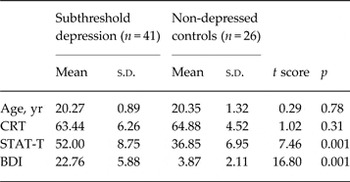
Characteristics of SubD participants and non-depressed controls are presented in Table 1. SubD participants and non-depressed controls did not differ in age (p = 0.78) and scores in the Combined Raven test (p = 0.31), but they differed in severity of depression (p < 0.001) and trait anxiety (p < 0.001).
Characteristics for individuals with subthreshold depression and non-depressed controls

CRT, Combined Raven Test; STAT-T, Spielberger State-Trait Anxiety Inventory – Trait; BDI, Beck Depression Inventory – II.
The effect of ABM on symptom changes
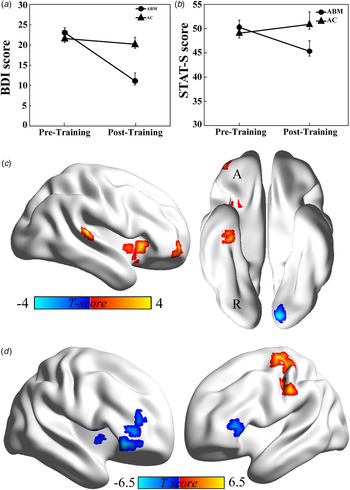
Results from a time (pre-training, post-training) × group (ABM, AC) repeated-measures ANOVA on BDI score revealed a significant main effect of time (F 1,39 = 33.67, p < 0.001), depressive symptoms significantly reduced from pre- to post-training. Importantly, we found a significant time × group interaction (F 1,39 = 20.91, p < 0.001; Fig. 1a ). Post-hoc comparisons revealed that there was significant reduction of depression in the ABM group (p < 0.001) but no significant improvement was observed in the AC group (p = 0.45). The depression of participants in the ABM group was significantly smaller than participants in the AC group at post-training (p < 0.01).
The effects of attentional bias modification training on (a) depressive and (b) anxious symptoms changes. (c) Group comparison between individuals with subthreshold depression and non-depressed controls on amplitude of low-frequency fluctuations (ALFF); (d) ALFF activity changes after 4 weeks of attentional bias modification (ABM) training (displayed at p corrected < 0.05).

Results from state anxious symptoms demonstrated the same training effects as that observed for BDI (F 1,39 = 4.18, p < 0.05; Fig. 1b ). There were significant reductions of anxious symptoms in the ABM group (p < 0.05) but no significant improvement was observed in the AC group (p > 0.1).
The effect of ABM on attentional bias
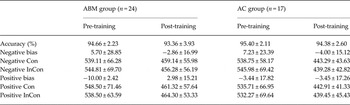
A repeated-measures ANOVA on time (pre-training, post-training) × group (ABM, AC) × bias score (negative, positive) revealed that the three-way interaction was not significant. However, a significant interaction of time × bias (F 1,39 = 6.26, p < 0.05) was found. Participants showed a tendency of decreased attention away from positive stimuli and increased attention away from negative stimuli (p = 0.05) after training. When conducting repeated-measures ANOVA on time × bias score for ABM and AC groups separately a significant time × bias interaction was found for individuals in the ABM group (F 1,23 = 5.54, p < 0.05) but not for those in AC group (F 1,16 = 1.69, p > 0.1). Participants in ABM group displayed an increased attention toward positive stimuli (p < 0.05) and a tendency to shift attention away from negative stimuli over time (Supplementary Table S2).
Resting-state fMRI data
The effect of SubD on ALFF
Before training, an initial group analysis was conducted on ALFF maps to explore the differences in regional activity between SubD participants and the non-depressed control group. The results indicate that SubD subjects showed greater ALFF in the right AI, right MFG, right superior temporal gyrus, and right fusiform gyrus and less ALFF in the lingual gyrus than non-depressed controls (Fig. 1c ; Supplementary Table S3).
The effect of ABM on regional ALFF
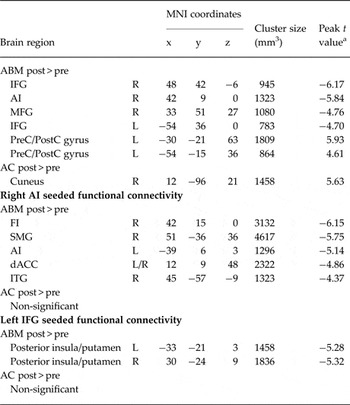
Analyses of ALFF maps before and after training revealed significantly decreased ALFF in the right AI, right MFG, and bilateral IFG and increased ALFF in the left precentral and postcentral cortex within the ABM group (p corrected < 0.05, Fig. 1d ; Table 2), but no significant change was observed in the AC training group except significantly increased ALFF in the right occipital lobe (p corrected < 0.05). No other significant results were observed (Table 3).
Dot-probe performance (reaction time: ms) from pre-training to post-training among participants in the ABM and AC groups

ABM, Attentional bias modification; AC, active control; Con, Congruent; InCon, incongruent; ABM, attentional bias modification; AC, active control.
ALFF and functional connectivity strength changes among individuals with subthreshold depression in the ABM and AC group at pre-training and post-training

ALFF, Amplitude of low-frequency fluctuations; ABM, attentional bias modification; AC, active control; AI, anterior insula; dACC, dorsal anterior cingulate cortex; FC, functional connectivity; FI, frontoinsular; IFG, inferior frontal gyrus; ITG, inferior temporal gyrus; L, left; MFG, middle frontal gyrus; MNI, Montreal Neurological Institute; R, right; SMG, supramarginal gyrus.
a A positive t value indicates increased activity. A negative t value indicates decreased activity.
The effect of ABM on functional connectivity
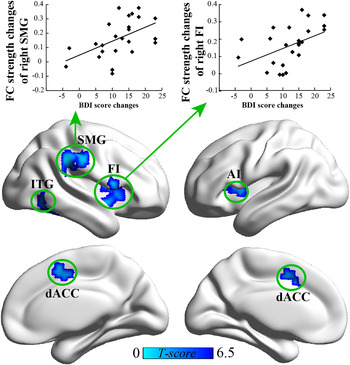
The ABM group showed a significantly greater connectivity strength reduction from pre- to post-training between the seed of right AI and the right frontoinsula (FI), right supramarginal gyrus (SMG), left AI, bilateral dorsal ACC and right IFG (p corrected < 0.05, Fig. 2; Table 2), but no significant connectivity strength change was found in the AC group. The ABM group also showed a significantly larger reduction of connectivity strength after training between the seed of left IFG and the bilateral posterior insula and putamen (p corrected < 0.05; Table 2, Supplementary Fig. S1), but no significant connectivity strength change was observed in the AC group. No other significant results were found from pre- to post-training in functional connectivity when seeded at other regions (right IFG, right MFG, left precentral or left postcentral cortex) among both the ABM and AC groups.
The effects of attentional bias modification training on functional connectivity strength changes seeded in the right anterior insula (AI, displayed at p corrected < 0.05). Scatter plots above showed that connectivity strength reductions between right AI and frontoinsular (FI) and right supramarginal gyrus (SMG) significantly correlated with depressive symptoms reduction. For display purposes, the change values of depression and connectivity strength multiplied −1 such that higher scores indicate more depression and connectivity strength changes. ITG, inferior temporal gyrus; dACC, dorsal anterior cingulate cortex.

Brain-behavior correlation analyses
We then investigated whether changes in ALFF and connectivity strengths contribute to depressive symptoms reduction. Despite significant decreases in ALFF being found in several regions within the ABM group, changes in ALFF were not associated with symptoms improvements in depression and anxiety.
Rather, the reduction of symptoms in the ABM group were significantly related to the connectivity strength changes identified in the above connectivity analysis. The improvement of depressive symptoms following training in the ABM group were significantly correlated with the reduction of right AI connectivity with right FI (r = 0.51, p Bonferroni corrected = 0.05; Fig. 2) and right SMG (r = 0.56, p Bonferroni corrected < 0.05; Fig. 2). No other significant associations were found between symptoms reduction and functional connectivity changes when seeded at other regions.
Discussion
To the best of our knowledge, this is the first study to investigate the effect of ABM on improving depressive symptoms and corresponding spontaneous brain activity changes (both regional activity and functional connectivity patterns) among young women with SubD using resting-state fMRI. ABM changed the measure of attentional bias in the expected direction – increased attention toward positive stimuli and decreased attention toward negative stimuli – although the difference between the ABM and AC training groups was not significant. More importantly, ABM, relative to the AC group, significantly reduced symptoms of depression and anxiety.
Analysis of the resting-state data revealed that ABM training normalized increased ALFF in the regions of right anterior insula (AI), right MFG and bilateral IFG within the ABM group. Moreover, functional connectivity strength between (1) right AI and the right FI, right SMG, left AI and bilateral dorsal anterior cingulate cortex (dACC); (2) left IFG and bilateral posterior insula and putamen significantly decreased after training within the ABM group. Finally, the improvements of depressive symptoms within the ABM group significantly and positively correlated with the strength reduction of right AI connectivity with right FI and right SMG. These results suggest that ABM might have the potential to reshape the abnormal patterns of spontaneous brain activity in relevant neural circuits which are thought to be associated with a predisposition for depression.
Cognitive theories of depression argue that negative attentional bias are causally associated with the development and maintenance of the illness (Beck, Reference Beck2008; Disner et al. Reference Disner, Beevers, Haigh and Beck2011). Consistent with this, previous studies have found that modifying biased attention through ABM tasks can reduce the severity of depressive symptoms among healthy individuals with elevated depression (Wells & Beevers, Reference Wells and Beevers2010; Yang et al. Reference Yang, Ding, Dai, Peng and Zhang2014) and patients with recurrent depression (Browning et al. Reference Browning, Holmes, Charles, Cowen and Harmer2012). Our finding that ABM also reduces symptoms in a sub-syndromal population is consistent with these results and suggests that ABM may be an efficacious tool for the treatment and prevention of depression. In other words, the present study provides initial empirical evidence that ABM training may represent an alternative method for preventing the progress of the illness. Application of ABM may help protect against the development of subsequent psychopathology in at risk subjects (Cuijpers et al. Reference Cuijpers, Smit and Van Straten2007; Browning et al. Reference Browning, Holmes, Charles, Cowen and Harmer2012).
Individuals with SubD displayed greater ALFF in the right AI and right MFG at pre-training that seemed to change in the direction of normalization with ABM training. These findings are consistent with previous studies which have observed that depressed individuals displayed increased ALFF in several regions (Liu et al. Reference Liu, Li, Li, Wang, Tie, Wu, Zhou, Zhang, Dong, Yang and Wang2012, Reference Liu, Ma, Wu, Fan, Zhang, Zhou, Li, Li, Tie, Li, Zhang, Zhou, Dong, Wang, Yao and Wang2013) and psychological or pharmacological therapy could change these abnormal brain activity in the direction of normalization (Brody et al. Reference Brody, Saxena, Stoessel, Gillies, Fairbanks, Alborzian, Phelps, Huang, Wu, Ho, Ho, Au, Maidment and Baxter2001; Goldapple et al. Reference Goldapple, Segal, Garson, Lau, Bieling, Kennedy and Mayberg2004; Kennedy et al. Reference Kennedy, Konarski, Segal, Lau, Bieling, McIntyre and Mayberg2007). For example, resting-state studies found that patients with MDD displayed increased ALFF (Liu et al. Reference Liu, Ma, Wu, Fan, Zhang, Zhou, Li, Li, Tie, Li, Zhang, Zhou, Dong, Wang, Yao and Wang2013; Chen et al. Reference Chen, Lv, Fang, Yu, Sui, Fan, Li, Hong, Wang, Wang and Jiang2015) and regional homogeneity (an index that measures the synchronization of spontaneous BOLD signal oscillations within spatially neighboring voxels; Zang et al. Reference Zang, He, Zhu, Cao, Sui, Liang, Tian, Jiang and Wang2007; Wu et al. Reference Wu, Li, Kuang, Zhang, Lui, Huang, Chan, Kemp and Gong2011) in the AI. Moreover, resting-state PET studies of MDD treatment found that the increased insula metabolism can be significantly reduced after pharmacological therapy (Goldapple et al. Reference Goldapple, Segal, Garson, Lau, Bieling, Kennedy and Mayberg2004) and psychological therapy (Kennedy et al. Reference Kennedy, Konarski, Segal, Lau, Bieling, McIntyre and Mayberg2007). AI activity changes have also been reported in various treatments for MDD, including antidepressant medication (McGrath et al. Reference McGrath, Kelley, Holtzheimer, Dunlop, Craighead, Franco, Craddock and Mayberg2013), mindfulness training (Farb et al. Reference Farb, Anderson and Segal2012), and deep brain stimulation (Mayberg et al. Reference Mayberg, Lozano, Voon, McNeely, Seminowicz, Hamani, Schwalb and Kennedy2005), suggesting its important role in mediating response to antidepressants and remission in the treatment of depression (Fu et al. Reference Fu, Steiner and Costafreda2013; McGrath et al. Reference McGrath, Kelley, Holtzheimer, Dunlop, Craighead, Franco, Craddock and Mayberg2013). Additional analyses on baseline predictors of response in the current data also found that pre-training functional connectivity between right AI and left insular and inferior parietal lobule significantly correlated with depressive symptoms improvement, and these findings will be published in a separate paper devoted wholly to the baseline predictors. A recent meta-analysis reported that negative stimuli evoked greater insula activation among depressed patients (Hamilton et al. Reference Hamilton, Etkin, Furman, Lemus, Johnson and Gotlib2012), and this is regarded as reflecting more marked negative cognitive biases (Herwig et al. Reference Herwig, Kaffenberger, Baumgartner and Jäncke2007). The current study observed that ABM reduced activity in the AI suggesting that it may act to normalize the function of the salience detection and attentional control systems in SubD participants. This is consistent with prior task-evoked fMRI studies (Browning et al. Reference Browning, Holmes, Murphy, Goodwin and Harmer2010b ; Taylor et al. Reference Taylor, Aupperle, Flagan, Simmons, Amir, Stein and Paulus2014) suggesting that ABM training modulated the activity in the top-down emotion control brain regions (AI and lateral PFC).
Functional connectivity strength between right AI and right FI, right SMG, left AI and bilateral dACC decreased significantly after training within ABM group. These regions were regarded as mainly constituting key nodes of two brain network, the ventral attention network (i.e. SMG; Corbetta & Shulman, Reference Corbetta and Shulman2002; Vossel et al. Reference Vossel, Geng and Fink2014) and the salience network (i.e. dACC, AI; Seeley et al. Reference Seeley, Menon, Schatzberg, Keller, Glover, Kenna, Reiss and Greicius2007; Menon & Uddin, Reference Menon and Uddin2010), which have a pivotal role in attentional control, and salience monitoring and detection, and the dysregulation of these networks in MDD may explain the negative bias and abnormal cognitive control common in MDD (Disner et al. Reference Disner, Beevers, Haigh and Beck2011; Roiser et al. Reference Roiser, Elliott and Sahakian2011; Hamilton et al. Reference Hamilton, Etkin, Furman, Lemus, Johnson and Gotlib2012; Foland-Ross et al. Reference Foland-Ross, Hamilton, Joormann, Berman, Jonides and Gotlib2013). Previous studies on depression have proposed that depression is a disorder of functional brain network (Sheline et al. Reference Sheline, Price, Yan and Mintun2010; Menon, Reference Menon2011) such as aberrant spontaneous brain activity in salience network (Zhou et al. Reference Zhou, Yu, Zheng, Liu, Song, Qin, Li and Jiang2010; Avery et al. Reference Avery, Drevets, Moseman, Bodurka, Barcalow and Simmons2014; Pannekoek et al. Reference Pannekoek, Werff, Meens, Bulk, Jolles, Veer, van Lang, Rombouts, van der Wee and Vermeiren2014) and ventral attentional network (Sylvester et al. Reference Sylvester, Barch, Corbetta, Power, Schlaggar and Luby2013) among depressed individuals. A previous review proposed that psychotherapy treatments for depression may modulate networks that are dysfunctional in depression (Weingarten & Strauman, Reference Weingarten and Strauman2015) with a recent study reporting that patients with non-refractory MDD showed distributed decrease in connectivity than patients with refractory MDD in the bilateral insula, ACC and other limbic regions (Lui et al. Reference Lui, Wu, Qiu, Yang, Kuang, Chan, Huang, Kemp, Mechelli and Gong2011). This suggests that effective treatment of depressive individuals may show decreased connectivity in insula and ACC. In the current study, decreased functional connectivity strength between right AI and right FI, right SMG, left AI and bilateral dACC following ABM and its association with depressive symptoms reductions may conceivable reflect a more efficient functioning of these regions. That is, improvement in the attribution of salience to stimuli that are related to negative attention and affective bias in depression (Disner et al. Reference Disner, Beevers, Haigh and Beck2011), and improvement of attentional control resulting in the allocation of more attentional resources to positive emotional stimuli (Roiser et al. Reference Roiser, Elliott and Sahakian2011).
Notwithstanding its potential implications, some limitations of this study should be acknowledged. Although we found differences in ALFF across training when the groups were analyzed separately, a significant time × group interaction was not found. This reduces our ability determine whether the changes in spontaneous brain activity were specifically induced by ABM. While brain-behavior correlation analysis found a significant change in spontaneous brain activity associated with improvement in depressive symptoms, which supports the contention that the ABM procedure did induce changes in spontaneous brain activity (Thomas & Baker, Reference Thomas and Baker2013), it would have been reassuring to demonstrate this relationship in the overall analysis of ALFF data. The significant effect of ABM on depressive symptoms, and the relationship between the ALFF measure and change in these symptoms, suggests that it would be possible to detect this relationship in a larger sample of individuals. Second, only young women were recruited in the present study, which may limit the generalizability of the findings to men. However, previous studies have reported that both depression and anxiety disorders are more prevalent among women than among men (Kessler, Reference Kessler1994). In addition, little is known about possible gender differences in spontaneous brain activity in depression, thus, we decided to recruit only female participants to reduce the heterogeneity of our sample. Future work needs to explore the gender differences in spontaneous brain activity among depression. Third, we have framed the effect of ABM in terms of its intended impact on negative bias in attention (MacLeod et al. Reference MacLeod, Rutherford, Campbell, Ebsworthy and Holker2002) and on activity in the lateral prefrontal attention control system (Browning et al. Reference Browning, Holmes, Murphy, Goodwin and Harmer2010b ). However, we cannot exclude the possibility that ABM training may influence other cognitive or emotional processes related to affective states among individuals with SubD. Future studies should explore whether ABM training may target other processes related to affective state, such as rumination which was found associated with introspective focus on negative thoughts and feelings and attentional deployment (Johnson, Reference Johnson2009; Arditte & Joormann, Reference Arditte and Joormann2014). Fourth, the current study did not explore aberrant connectivity within the default mode network and between the default and other network node linked to depressive symptoms which were reported in previous studies (Sheline et al. Reference Sheline, Barch, Price, Rundle, Vaishnavi, Snyder, Mintuna, Wanga, Coalson and Raichle2009; Kaiser et al. Reference Kaiser, Andrews-Hanna, Wager and Pizzagalli2015). However, the current study took a different approach to analysis of the data. Specifically we explored ABM training effects on regional spontaneous neural activity (i.e. ALFF) among individuals with SubD using a whole-brain survey analysis. Then, based on the results of this ALFF analysis, functional connectivity changes were explored. Examining the connectivity changes within the default mode network among individuals with SubD is extremely interesting, we therefore propose to explore the changes within canonical functional networks, including the default mode network, the executive control network, and the salience network induced by ABM training in a separate paper.
In conclusion, the current study is the first to find that individuals with SubD displayed reduced symptoms after ABM training corresponding to a significant reduction in pre-training hyperactivity within neural regions implicated in salience detection and attentional control using resting-state fMRI. The results highlight the promise of ABM as an effective intervention to improve depression through reshaping abnormal patterns of spontaneous brain activity. Finally, the findings may provide potential neural biomarkers for future neurostimulation studies on depression.
Supplementary material
For supplementary material accompanying this paper visit http://dx.doi.org/10.1017/S003329171500238X.
Acknowledgements
This research was supported by the National Natural Science Foundation of China (31271087; 31470981; 31571137; 31500885), National Outstanding young people plan, the Program for the Top Young Talents by Chongqing, the Fundamental Research Funds for the Central Universities (SWU1509383), Natural Science Foundation of Chongqing (cstc2015jcyjA10106), General Financial Grant from the China Postdoctoral Science Foundation (2015M572423).
Declaration of Interest
None.