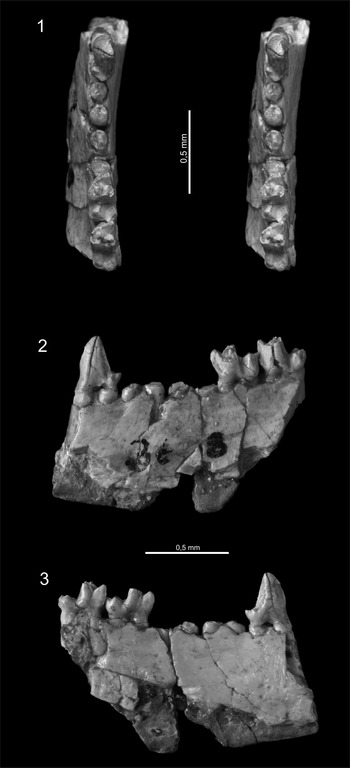
Estelestes ensis Novaceck et al., Reference Novaceck, Ferrusquía-Villafranca, Flynn, Wyss and Norell1991 is a curious Paleogene metatherian mammal recognized on the basis of a single specimen from Baja California (Mexico) in southern North America. It comes from early Eocene (Wasatchian age) levels of the Las Tetas de Cabra Formation at “Marsupial Hill” in the Lomas Las Tetas de Cabra site (also known as Punta Prieta; see Novaceck et al., Reference Novaceck, Ferrusquía-Villafranca, Flynn, Wyss and Norell1991). The specimen consists of a fragmentary left mandible with the last premolar, the roots of the first two molars, and almost complete last two molars (Fig. 1). It was referred to the Didelphini (Marsupialia, Didelphimorphia, Didelphidae, Didelphinae) even though Novaceck et al. (Reference Novaceck, Ferrusquía-Villafranca, Flynn, Wyss and Norell1991) stated that the overall morphology of the type specimen poses intriguing problems regarding its relationships. For example, the very deep, robust jaw of Estelestes distinguishes it from any other Holarctic “didelphine” (at the time Novaceck et al., Reference Novaceck, Ferrusquía-Villafranca, Flynn, Wyss and Norell1991 published their work, both the concept and extent of Didelphidae and Didelphinae were much broader than today). Interestingly, they concluded that Estelestes had close affinities with “Mirandotherium” (lapsus calami for Mirandatherium), from the early Eocene of Itaboraí, in southeastern Brazil. “Resemblance between the two taxa is nevertheless striking, once again raising the possibility of close relationships among certain early members of the Northern Hemisphere and South American Didelphinae” (Novaceck et al., Reference Novaceck, Ferrusquía-Villafranca, Flynn, Wyss and Norell1991, p. 16). The affinities of Mirandatherium are contested, having been regarded as part of the Didelphimorphia (e.g., de Paula Couto, Reference de Paula Couto1952a) or Microbiotheria (e.g., Marshall, Reference Marshall and Archer1987; McKenna and Bell, Reference McKenna and Bell1997; Oliveira and Goin, Reference Oliveira and Goin2011), or even as an alphadontian (Carneiro, Reference Carneiro2019).
Estelestes ensis Novaceck et al., Reference Novaceck, Ferrusquía-Villafranca, Flynn, Wyss and Norell1991. (1) Photographic stereopair of IGM 3688 (type) showing p3, roots of m1–2, and m3–4 in occlusal view. (2) IGM 3688 in labial view. (3) IGM 3688 in lingual view.

After its original description, Estelestes was rarely mentioned in the literature (e.g., Ferrusquía-Villafranca et al., Reference Ferrusquía-Villafranca, Jiménez-Hidalgo, Ortiz-Mendieta, Bravo-Cuevas, Montellano-Ballesteros and Arroyo-Cabrales2002; Montellano-Ballesteros and Jiménez-Hidalgo, Reference Montellano-Ballesteros, Jiménez-Hidalgo, Vega, Nyborg, Perrilliat, Montellano-Ballesteros, Cevallos and Quiroz2006), and no further speculation on its possible affinities was made. The purpose of this note is to discuss the affinities of Estelestes ensis; in our opinion, the Baja California taxon is not referable to the Didelphinae or to any other Didelphimorphia. On the contrary, we emphasize the affinities between Estelestes ensis and Bobbschaefferia fluminensis de Paula Couto, Reference de Paula Couto1952 (de Paula Couto, Reference de Paula Couto1952a), the latter from the early Eocene of Itaboraí in southeastern Brazil. The similarities with Bobbschaefferia are particularly interesting, as (1) this taxon was previously referred to a basal group of Polydolopimorphia (Marsupialia, Australidelphia; Oliveira and Goin, Reference Oliveira and Goin2011); (2) several morphological matches are noticeable among Estelestes, Bobbschaefferia, and Glasbius (Glasbiidae), the latter two also previously considered to be basal groups of Polydolopimorphia (Goin et al., Reference Goin, Woodburne, Zimicz, Martin and Chornogubsky2016; see a summary by Boyd et al., Reference Boyd, Person and Barnes2017 on the proposed affinities of Glasbius); and (3) Bobbschaefferia has been related to Tingamarra porterorum Godthelp et al., Reference Godthelp, Archer, Cifelli, Hand and Gilkeson1992, from the earliest Eocene of Murgon, Australia, and thus to the Australasian metatherian radiation (Woodburne and Case, Reference Woodburne and Case1996). If that is the case, Estelestes could also be related to this radiation.
Abbreviations and conventions
DGM, Divisão de Geologia e Mineralogia, Departamento Nacional de Produção Mineral, Rio de Janeiro, Brazil; MNRJ, Museu Nacional, Rio de Janeiro, Brazil. The ordinal and family arrangement of Metatheria follows Goin (Reference Goin, Alderton and Elias2021, table 1). Molar nomenclature and anatomy follows Goin et al. (Reference Goin, Woodburne, Zimicz, Martin and Chornogubsky2016). We follow Hershkovitz (Reference Hershkovitz1982) in naming the four lower incisors of the generalized metatherian dental formula as i2, i3, i4, and i5, with i3 being the “staggered” lower incisor of many metatherians (see also O'Leary et al., Reference O'Leary, Bloch, Flynn, Gaudin, Giallombardo and Giannini2013).
Systematic paleontology
Class Mammalia Linnaeus, Reference Linnaeus1758
Infraclass Metatheria Huxley, Reference Huxley1880
Order Polydolopimorphia Archer, Reference Archer, Archer and Clayton1984
Family ?Glasbiidae Clemens, Reference Clemens1966
Genus Estelestes Novaceck et al., Reference Novaceck, Ferrusquía-Villafranca, Flynn, Wyss and Norell1991
Type species
Estelestes ensis Novaceck et al., Reference Novaceck, Ferrusquía-Villafranca, Flynn, Wyss and Norell1991.
Other species
The type species only.
Occurrence
Lomas Las Tetas de Cabra (or Punta Prieta), Baja California, Mexico. Las Tetas de Cabra Formation, early Eocene (Wasatchian age).
Diagnosis
See Novaceck et al. (Reference Novaceck, Ferrusquía-Villafranca, Flynn, Wyss and Norell1991, p. 14).
Comparisons and remarks
Estelestes ensis shares with Glasbius, and other taxa referable to Glasbiidae and/or basal Polydolopimorphia, the possession of a tall and robust dentary (see Table 1 in online supporting material). This feature is not exclusive to glasbiids but is also observed in other metatherians such as Caroloameghinidae (Caroloameghinia mater Ameghino, Reference Ameghino1901; ?Didelphimorphia), a few derived microbiotherians (Pachybiotherium acclinum Ameghino, Reference Ameghino1902), some palaeothentoid paucituberculatans (e.g., Palaeothentes, Abderites), and, in general, metatherians with carnivorous feeding habits (e.g., Sparassodonta). However, in none of these taxa is apparent a peculiarity unique to Glasbius and other polydolopimophians: the alveolar plane ascends toward the coronoid branch at the level of the last two molars. This derived feature is observable not only in Glasbius, one of the few glasbiids that have preserved mandibular remains (see the following), but also in several groups of Polydolopimorphia (e.g., Roberthoffstetteria [Sillustanidae], Salamancatherium and Epidolops [Bonapartheriidae], Punadolops [Prepidolopidae], and Argyrolagus [Argyrolagidae]). It also appears in Bobbschaefferia, referred to in several studies as a generalized Polydolopimorphia (e.g., Oliveira and Goin, Reference Oliveira and Goin2011) or even as a Glasbiidae (Goin et al., Reference Goin, Woodburne, Zimicz, Martin and Chornogubsky2016). In some cases (e.g., Glasbius), the robustness of the horizontal ramus and the ascent of the alveolar plane are accompanied by a significant reduction of the m4; this is not the case of Estelestes, which has its m4 almost the same length as the m3. Another feature in common between Estelestes and Glasbius is the persistence of a posterior cingulid on the molars, a feature of relative importance as it is regarded as plesiomorphic among Metatheria. At least the m3 of Estelestes shows some pairing of the metaconid with the paraconid, such that the metaconid is oriented slightly forward with respect to the protoconid. This feature is much more accentuated in Glasbius, although not in other taxa referred to the Glasbiidae (e.g., Palangania, Pujatodon). This derived feature is opposite to the condition seen in more basal marsupialiformes, where the metaconid is slightly backward with respect to the protoconid (e. g., Kokopellia, Alphadon, Turgidodon). Also in common between Estelestes and glasbiids whose referenced materials have preserved lower molars is that the entoconid is taller than the hypoconid. The entoconid has, in turn, a massive appearance and in several cases is somewhat labiolingually compressed. Finally, both Estelestes and Glasbius share a complex talonid for the p3, in which two or more descending ridges are visible from the main cusp of the tooth. This last feature is, however, variable among species of Glasbius (cf. Clemens, Reference Clemens1966 with Boyd et al., Reference Boyd, Person and Barnes2017). Despite the already noted similarities with Glasbius, Estelestes differs from this taxon in several significant features: it is approximately 100% larger, the m4 is not reduced, the p3 is proportionally higher, and it lacks a buccal cingulid communicating with the anterior cingulid. Finally, the molars are less bunoid and the metaconid, and paraconid are farther apart from each other. In all these features except size, Estelestes is more generalized than Glasbius.
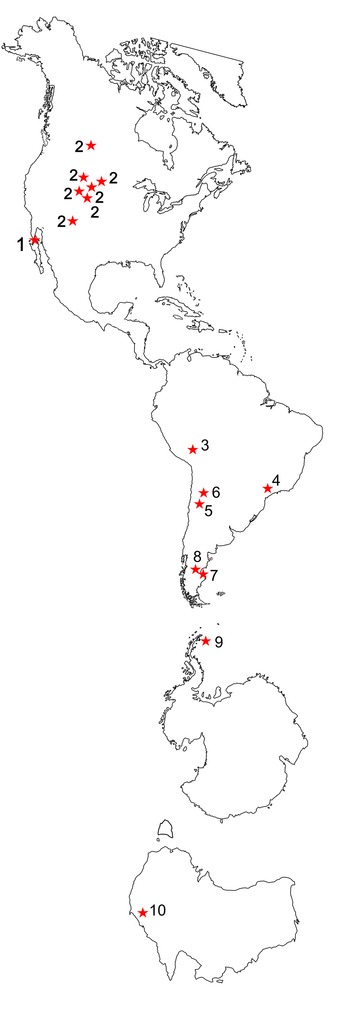
Several Late Cretaceous–Paleogene taxa have been referred to the Glasbiidae or have been suggested to have affinities with this family, namely, Glasbius spp. from the Late Cretaceous of North America (see Boyd et al., Reference Boyd, Person and Barnes2017 and literature cited), Chulpasia mattaueri Crochet and Sigé, Reference Crochet and Sigé1993 from the late Paleocene–early Eocene of Peru (Sigé et al., Reference Sigé, Archer, Crochet, Godthelp, Hand and Beck2009), Mirandatherium alipioi de Paula Couto, Reference de Paula Couto1952 (de Paula Couto, Reference de Paula Couto1952a) and Bobbschaefferia fluminensis from the early Eocene of southeastern Brazil (Oliveira and Goin, Reference Oliveira, Goin and Cáceres2012), Thylacotinga bartholomaii Archer, Godthelp, and Hand, 1993 from the early Eocene of Australia (Archer et al., Reference Archer, Godthelp and Hand1993), Palangania brandmayri Goin et al., Reference Goin, Candela, Bond, Pascual and Escribano1998 from the early–middle Eocene of Patagonia (Goin et al., Reference Goin, Candela, Bond, Pascual and Escribano1998), Pujatodon ektopos Goin et al., Reference Goin, Vieytes, Gelfo, Chornogubsky, Zimicz and Reguero2020 from the early–middle Eocene of the Antarctic Peninsula (Goin et al., Reference Goin, Vieytes, Gelfo, Chornogubsky, Zimicz and Reguero2020), Reigia punae Pascual, Reference Pascual1983 from the middle Eocene of northwestern Argentina (Pascual, Reference Pascual1983), Apeirodon sorianoi Babot et al., Reference Babot, Rougier, García-Lopez and Davis2020 from the late Eocene of northwestern Argentina (Babot et al., Reference Babot, Rougier, García-Lopez and Davis2020), and Periakros ambiguus Goin, Abello, and Chornogubsky, Reference Goin, Abello, Chornogubsky, Madden, Carlini, Vucetich and Kay2010 from the early Oligocene of Patagonia (Goin et al., Reference Goin, Abello, Chornogubsky, Madden, Carlini, Vucetich and Kay2010) (Fig. 2). A comparative analysis between Estelestes ensis and all these taxa follows; although half of them are known only from isolated upper molars, it is possible to make a few comparisons based on size and general appearance of their (inferred) occlusal lower counterparts.
Map of the Americas, Antarctica, and Australia showing localities where glasbiids, or taxa related to Glasbiidae, come from. 1: Estelestes ensis, early Eocene, Mexico (Novaceck et al., Reference Novaceck, Ferrusquía-Villafranca, Flynn, Wyss and Norell1991). 2: Glasbius spp., latest Cretaceous, various localities in North America (see Boyd et al., Reference Boyd, Person and Barnes2017 and literature cited). 3: Chulpasia mattaueri, late Paleocene–early Eocene of Perú (Sigé et al., Reference Sigé, Archer, Crochet, Godthelp, Hand and Beck2009). 4: Mirandatherium alipioi and Bobbschaefferia fluminensis, early Eocene, southeastern Brazil (de Paula Couto, Reference de Paula Couto1952a). 5: Reigia punae, ?middle Eocene, northwestern Argentina (Pascual, Reference Pascual1983). 6: Apeirodon sorianoi, late Eocene, northwestern Argentina (Babot et al., Reference Babot, Rougier, García-Lopez and Davis2020). 7: Palangania brandmayri, early–middle Eocene, Patagonia (Goin et al., Reference Goin, Candela, Bond, Pascual and Escribano1998). 8: Periakros ambiguus, early Oligocene, Patagonia (Goin et al., Reference Goin, Abello, Chornogubsky, Madden, Carlini, Vucetich and Kay2010). 9: Pujatodon ektopos, early–middle Eocene, Antarctic Peninsula (Goin et al., Reference Goin, Vieytes, Gelfo, Chornogubsky, Zimicz and Reguero2020). 10: Thylacotinga bartholomaii, early Eocene, Australia (Archer et al., Reference Archer, Godthelp and Hand1993).

Besides being 50% smaller than Thylacotinga bartholomaii, Estelestes ensis is less bunoid; it has a postcingulid; the hypoconulid is more distinct, set away from the entoconid (i.e., it is more labially placed); and the cristida obliqua ends anteriorly closer to a point below the notch of the metacristid. It differs from Apeirodon sorianoi by its larger size (30% larger) and less bunoid aspect. Estelestes ensis is 30% smaller than Periakros ambiguus, and its molars are less bunoid and have proportionally larger crests. It is 20% larger than Pujatodon ektopos, the molars are less bunoid, the cristid obliqua ends closer to a point below the metacristid notch, the metaconid is anteriorly placed with respect to the protoconid, the trigonid basin is narrower, and the entoconid is less laterally compressed. It is 20% smaller than Palangania brandmayri, the talonid basin is narrower and bears a postcingulid, the entoconid is less close to the metaconid, the hypoconulid is more distinct and posteriorly projected, and the metaconid is more anteriorly placed with respect to the protoconid. Estelestes ensis is 20% larger than Chulpasia mattaueri, its molars are less bunoid, the postcingulid is more developed, the hypoconulid is more distinct and set farther from the entoconid, the hypoconid is more salient, and the cristida obliqua ends anteriorly at a point below the notch of the metacristid. It is 20% larger than Reigia punae, and its molars are less bunoid. It is 25% larger than Mirandatherium alipioi; it lacks a labial cingulid; the metaconid of m3 is not located more posteriorly than the protoconid; the pre-entocristid is less developed; and the posthypocristid of m4 is more perpendicular to the dentary axis.
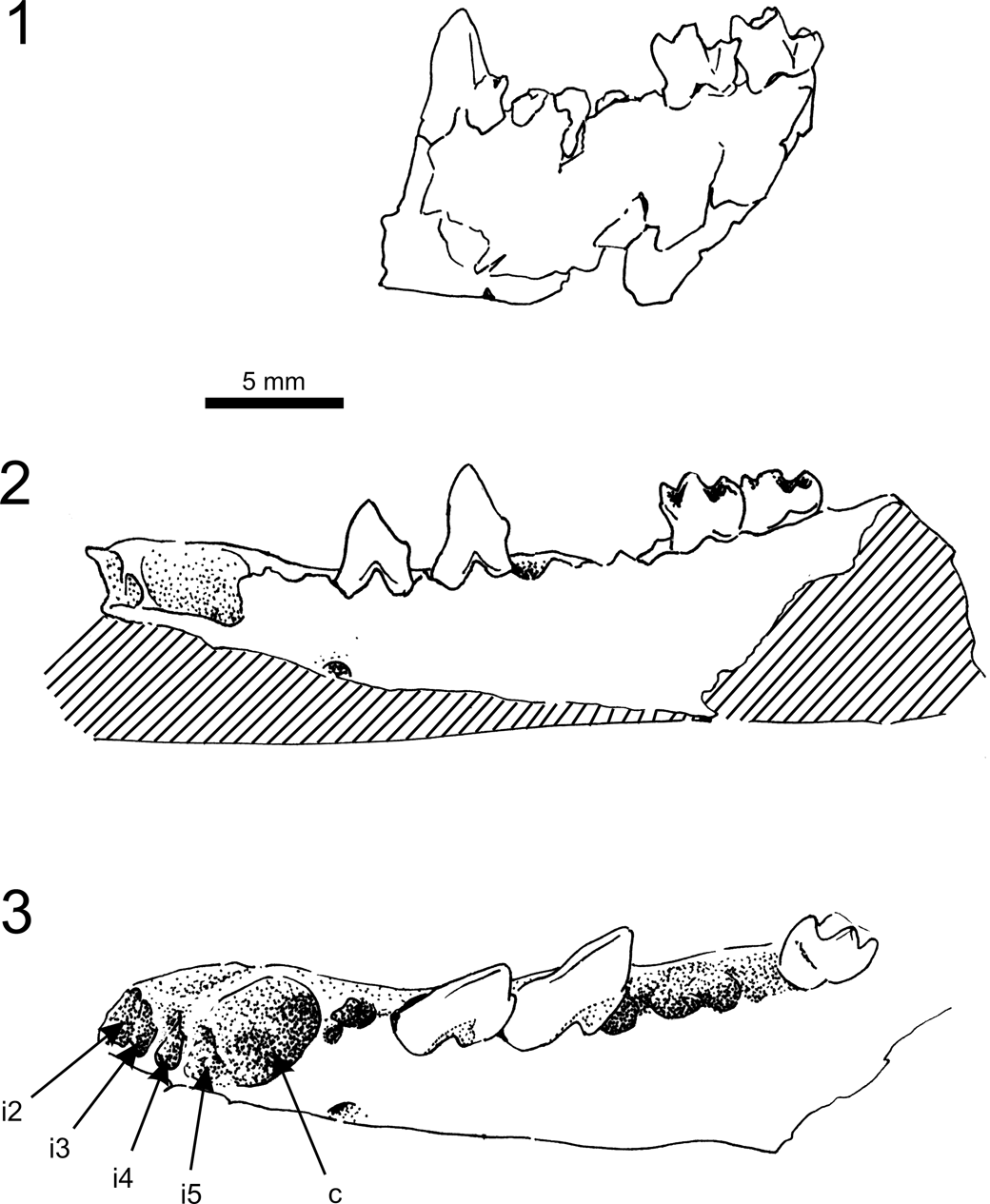
Despite the morphological coincidences between Estelestes ensis and species of Glasbius, the Mexican taxon shows its greatest similarities with Bobbschaefferia fluminensis from the early Eocene of Itaboraí, Brazil. The size ratio between p3 and m3 is the same (p3 is much taller), molars are very similar in shape, and in both, the metaconid of m4 is slightly posterior with respect to the protoconid. Regarding the dentary, it was already noted that in both taxa this bone is very high and that the alveolar plane ascends posteriorly (below m3–4) toward the masseteric crest (Fig. 3). Similarities between the p3 of Bobbschaefferia and that of Estelestes are also significant; both show a vertically oriented major cusp, an anterior ridge that does not end in a cusp, and a relatively well-developed posterior talonid with a labial and a posterior cuspule. Although the p3 of Bobbschaefferia fluminensis shows a wear facet on its posterolabial edge, a labial salience coincident with the position of the labial cusp in Estelestes ensis is evident. Finally, they are almost identical in size.
(1, 2) Labial view of dentaries: (1) Estelestes ensis; (2) Bobbschaefferia fluminensis. (3) Occlusal-labial view of the dentary of B. fluminensis indicating the alveoli for the incisors (i2–5) and canine (c).

To Oliveira and Goin (Reference Oliveira and Goin2011), a combination of generalized and derived features warranted the inclusion of Bobbschaefferia in the Polydolopimorphia. Regarding the lower dentition, most of these features are also present in Estelestes: relatively large size, posthypocristid extending far lingually, about equal width of trigonid relative to talonid, paraconid subequal in size to metaconid, and hypoconulid terminal in position, not twinned with the entoconid. The first three features were regarded as synapomorphic, the last two as plesiomorphic. Only one feature does not agree with this scheme: in Estelestes, the paraconid is not placed anteromedially but anterolingually, thus retaining the generalized condition. We can name two additional derived features already mentioned: there is a tall and robust dentary, and the alveolar plane of this bone ascends toward the coronoid branch at the level of the last two molars.
In summary, (1) Estelestes ensis shows more similarities with Bobbschaefferia fluminensis than with any other metatherian. A few differences justify their generic separation: the postcingulid is more developed in Estelestes (in Bobbschaefferia, it is vestigial in the m3 and absent in the m4), the metaconid of its m3 is slightly more anteriorly placed, m2–3 hypoconulids are larger, and the talonid of the m4 is more quadrangular in shape. (2) Pending a phylogenetic analysis of Estelestes, Bobbschaefferia, and several additional taxa previously referred or related to glasbiids (outside the scope of this note), we tentatively regard Estelestes as a ?Glasbiidae within the Order Polydolopimorphia.
Results and discussion
The similarities between Bobbschaefferia and Estelestes are informative in relation to the suprageneric assignment of the Mexican taxon. Although the affinities of Bobbschaefferia have been debated in the past century (cf. de Paula Couto, Reference de Paula Couto1952a; Tedford, Reference Tedford1974; Marshall, Reference Marshall and Archer1987; Woodburne and Case, Reference Woodburne and Case1996; Oliveira, Reference Oliveira1998), a more recent phylogenetic analysis argued for the placement of Bobbschaefferia as a basal group within Polydolopimorphia (Oliveira and Goin, Reference Oliveira and Goin2011). Bobbschaefferia, originally nominated as Schaefferia fluminensis (de Paula Couto, Reference de Paula Couto1952a; see also de Paula Couto, Reference de Paula Couto1962), was described on the basis of the type (MNRJ 1350-V) and two paratypes (DGM 314-M and DGM 315-M). Subsequently, de Paula Couto (Reference de Paula Couto1970) added specimens MNRJ 2899-V, DGM 651-M, and DGM 652-M to the hypodigm of this species (see also Marshall, Reference Marshall and Archer1987). Tedford (Reference Tedford1974) only recognized the holotype as referable to B. fluminensis, as did Oliveira (Reference Oliveira1998) and Oliveira and Goin (Reference Oliveira and Goin2011). Unfortunately, the type specimen was lost in the fire at the National Museum in 2018 (L. Carvalho, personal communication, 2022). In summary, of the holotype of Bobbschaefferia fluminensis there remain only a few resin casts and illustrations provided by de Paula Couto (Reference de Paula Couto1952a, fig. 4B), Marshall (Reference Marshall and Archer1987, fig. 3; see also Woodburne and Case, Reference Woodburne and Case1996, fig. 11A–C), Oliveira (Reference Oliveira1998, figs. 23–25), and this paper (Fig. 3). They allow us, however, to appreciate the striking similarities between it and the type of Estelestes, which also argues in favor of both belonging to the Polydolopimorphia.
One of the most interesting features of Bobbschaefferia fluminensis is the preservation of the alveoli of the incisor and canine series, which allows us to state the following: (1) the incisors and canine were anteriorly oriented, with at least the first two incisors being set almost horizontally; (2) the first lower incisor (i2) is much larger than the second one (i3), and (3) there is no “staggered” incisor (the second lower incisor or i3 in the nomenclature of Hershkovitz, Reference Hershkovitz1982; see Fig. 3 and Fig. 1 in online supplementary material). All these features suggest the exclusion of Bobbschaefferia (and, by extension, possibly Estelestes as well) from the Didelphimorphia or even the “Ameridelphia” while they are congruent with polydolopimorphian affinities. In addition, they indicate that polydolopimorphians may have derived from the Microbiotheria, a group that also lacks the “staggered” condition in the lower incisor series. In fact, in the phylogenetic analysis of Oliveira and Goin (Reference Oliveira and Goin2011, fig. 5B), Microbiotheria and Polydolopimorphia appear as sister groups. In this same analysis, Bobbschaefferia stands out as a plesiomorphic sister group to the rest of the Polydolopimorphia. Recently, Beck (Reference Beck2017) tentatively proposed the existence of a “staggered” lower incisor in specimen MNRJ 2880-V of Epidolops ameghinoi de Paula Couto, 1952 (de Paula Couto, Reference de Paula Couto1952b) on the basis of a single alveolar space (see Beck et al., Reference Beck, Voss and Jansa2022 for a discussion on the staggered condition among marsupials). On the contrary, we suggest that the condition of Epidolops resembles more that of Bobbschaefferia as well as that of other basal polydolopimorphians; that is, that the lower incisors are aligned rather than one of them being staggered. When the staggered condition is present, this feature is very obvious in that the alveolus of the i3 is set clearly posterodorsally regarding the alveoli of the remaining incisors and in that there is no merging of one alveolus into another one. In addition, the staggered lower incisor is always placed (posterodorsally) between i2 and i4. This is not what happens in Epidolops (see Beck, Reference Beck2017, fig. 7). The difference in Epidolops and other Bonapartheriiformes lies in the loss of one incisor in the former, so that the lower incisor formula of these metatherians is reduced to three. From Beck (Reference Beck2017, fig. 7) it would seem that, if we disregard the supposedly staggered i3 directly above i4, there would be only two incisors, not three. However, we think that what happened in Epidolops ameghinoi resembles what can be observed in the preserved casts of Bobbschaefferia fluminensis: the distal wall of the last incisor (i5) is very thin and close to the canine alveolus (see Fig. 1 in online supporting material). Such thin walls are frequently lost postmortem, and the last incisor alveolus converges with that of the canine in such a way that it is not recognizable as an incisor alveolus but instead as part of the canine one.
Tingamarra porterorum, from the earliest Eocene of southeastern Queensland, Australia, was originally referred to a placental condylarth (Godthelp et al., Reference Godthelp, Archer, Cifelli, Hand and Gilkeson1992) on the basis of its single known specimen, a lower molar referred to by them as an m2 or m3. Later, Woodburne and Case (Reference Woodburne and Case1996) argued in favor of its metatherian affinities and noted overall similarities between it and Bobbschaefferia fluminensis (regarded by them as a generalized Protodidelphidae). In being one of the oldest Cenozoic mammalian taxa known from that continent, Tingamarra is valuable in understanding metatherian radiations in Australasia. Due to the scarcity of materials referable to these taxa (Estelestes, Bobbschaefferia, Tingamarra), we restrain from further speculation; notwithstanding, we do note the interesting derivations of this preliminary study: polydolopimorphians, derivable from a common stock with microbiotherians, may have been part of the Australasian radiation of metatherians. Among polydolopimorphians, both Bonapartheriiformes (Pujatodon, Perrodelphys) and Polydolopiformes (Antarctodolops) were already present by early–middle Eocene times in the Antarctic continent. Antarctica, in turn, was a mandatory intermediate step in the migration of South American metatherians to Australasia (see, e.g., Woodburne and Case, Reference Woodburne and Case1996; Goin et al., Reference Goin, Woodburne, Zimicz, Martin and Chornogubsky2016).
A final comment in relation to Estelestes ensis and (the rest of?) the Glasbiidae is related to the apparent paradox that this taxon, despite being younger in time, is clearly more generalized than Glasbius from the Late Cretaceous of the same North American continent. Probably, the lower latitude of Lomas las Tetas de Cabra with respect to the localities bearing Glasbius remains has played a role among other paleoenvironmental and biogeographical factors (but see Lucas et al., Reference Lucas, Sullivan, Lichtig, Dalman and Jasinski2016). Humid tropical areas tend to function both as “cradles” (areas of radiation of taxa) and as “museums” (areas of persistence of generalized taxa). This could have been the environmental situation of Baja California in relation to other more northern regions of North America. Estrada-Ruiz et al. (Reference Estrada-Ruiz, Martínez-Cabrera, Callejas-Moreno and Upchurch2013) stated that warm and wet forests were present in northern Mexico and the south–central United States during the Late Cretaceous (late Campanian onward). We suggest that Estelestes ensis could well have been a survivor of an earlier Neotropical radiation that persisted in southern North America under the “museum” conditions of Baja California to early Paleogene times.
Acknowledgments
We thank J. Meng, S. Goldberg, and N. Wong of the AMNH for the photos that illustrate Estelestes in Fig. 1. L. Rasia took the photos that are displayed in the online supporting material. M. Tomeo designed the figures. Drawings in Fig. 3 were made by J. Yañez. We thank editors H.-D. Sues and J. Calede, as well as reviewers D.A. García-López and an anonymous one for their valuable suggestions and comments. We thank Agencia (Foncyt, Mincyt, Argentina; PICT 2019-03283) and CONICET (PIP 0150, Argentina) for financial support. V.D.C. thanks the Stimulus of Scientific Employment, Individual Support – 2021 Call grant by the Fundação para a Ciência e a Tecnologia (Portugal, 2021.03080.CEECIND) and GeoBioTec.
Competing interests
The authors declare none.
Data availability statement
Data available from the Dryad Digital Repository: https://doi.org/10.5061/dryad.5tb2rbp7b