INTRODUCTION
The kinetoplastid parasite Trypanosoma cruzi causes an important tropical disease, Chagas disease, which affects about 18–20 million people (WHO, 2002). Current drugs recommended for treatment have important restrictions, which justifies the screening of new natural and synthetic compounds (Coura and de Castro, 2002). Aromatic diamidines represent an important class of DNA minor groove binders, which have high therapeutic interest as anti-parasitic agents, being effective against protozoan parasites (Soeiro et al. 2005). Due to their lack of oral bioavailability and their associated host toxicity, many related compounds have been developed, and one of the best-known is DB75 (bis-amidine diphenylfuran derivative), commonly referred to furamidine. Since (i) DB75 and its phenyl-substituted analogue DB569 display anti-parasitic activity against a broad spectrum of microorganisms (Lanteri et al. 2004) including trypanosomatids (De Souza et al. 2004), and (ii) many parasitic agents have been reported to induce apoptotic-like death, our present aim was to investigate if these two compounds could induce apoptosis in T. cruzi.
MATERIALS AND METHODS
Trypanosoma cruzi bloodstream trypomastigotes (Y strain) were harvested by heart puncture from infected Swiss mice at peak parasitaemia (Meirelles et al. 1982). Diamidine activity was evaluated by treating the parasites for 2–24 h with 1–32 μM DB75 and DB569, followed by determination of parasite viability and death rates by light microscopy using a Neubauer chamber (De Souza et al. 2004). For transmission electron microscopy (TEM), parasites were treated for 2–24 h with 4 μM DB 569 or 16 μM DB75, washed with phosphate-buffered saline (PBS), fixed with 2·5% glutaraldehyde, and routinely processed for TEM (Zeiss EM 10 C transmission electron microscope).
For flow cytometry, 106-treated and 106-untreated parasites were evaluated for (i) phosphatidylserine exposure (PS) by Annexin V-CY3 labelling (Sigma Chemical Co., St Louis, MO, USA); (ii) DNA fragmentation by the terminal deoxynucleotidyltransferase-mediated fluorescein dUTP nick end-labelling technique (TUNEL, Boehringer Mannheim, Mannheim, Germany); (iii) mitochondrial membrane potential alteration by 3,3-dihexyloxacarbocyanine iodide labelling (DiOC6, Molecular Probes Inc); and (iv) for 7-amino actinomycin D staining (7AAD, Sigma Chemical Co., St Louis, MO, USA), as recommended by their respective manufacturers. Data acquisition and analysis were performed using a FACSCalibur flow cytometer (Becton Dickinson, San Jose, CA, USA) equipped with Cell Quest software (Joseph Trotter, Scripps Research Institute, San Diego, CA, USA). All procedures were carried out in accordance with the guidelines established by the FIOCRUZ Committee of Ethics for the Use of Animals, resolution 242/99. All assays were run 3–5 times, at least in triplicate, and Student's t-test was applied to ascertain the statistical significance of the observed differences (P<0·1).
RESULTS
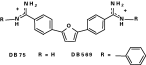
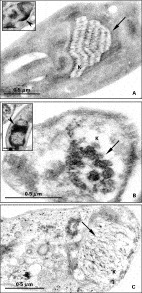
DB75 and its N-phenyl-substituted analogue DB569 (Fig. 1) exert anti-parasitic activity against T. cruzi. As reported (De Souza et al. 2004), quantification of the number of highly motile parasites by light microscopy showed that DB569 displays higher anti-parasitic activity as compared to DB75, showing after 2 and 24 h of treatment an IC50 of 4·0 and 2·2 micromolar, respectively (data not shown). Since ultrastructural analysis showed important alterations in the mitochondria and kinetoplast, as well as condensation of the nuclear chromatin after treatment with both DB75 and DB569 (Fig. 2), we wondered if these diamidines could interfere with the mitochondrial membrane potential of the parasites, as reported after treatment of S. cerevisiae with DB75 (Lanteri et al. 2004).

Fig. 1. Structures of DB75 and DB569.

Fig. 2. Transmission electron micrographs of untreated (A), 16 μM DB75 (B) and 4 μM DB569 (C) treated bloodstream trypomastigotes of Trypanosoma cruzi. Note the alterations in the mitochondria and kinetoplast (arrow) as well as condensation of the nuclear chromatin (inset, arrowhead) of the treated parasites (B–C) as compared to untreated forms that displayed characteristic structures such as nucleus with a centrally located nucleolus (inset, arrowhead) and mitochondrion containing a large condensation of DNA, the kinetoplast (k) (A).
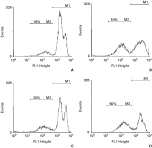
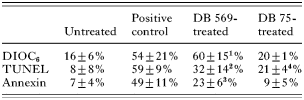
Treatment of T. cruzi with DB569 resulted in an important statistically significant (P<0·017) decrease of mitochondrial membrane potential (MMP). The treatment reduced the MMP in about 60±15% of the bloodstream forms, contrasting with the untreated group, in which only about 16±6% of the parasites displayed decreased MMP (Fig. 3, Table 1). Incubation of untreated parasites for 24 h at 37 °C with 4 μM staurosporin (Sigma Chemical Co.), an apoptotic stimulus, resulted in 54% of the bloodstream parasites (positive control) exhibiting decreased MMP (Fig. 3, Table 1).

Fig. 3. Analysis of the mitochondrial membrane potential of trypomastigotes of Trypanosoma cruzi by FACS. Histograms show the fluorescence intensity of untreated (A), staurosporin (B), 16 μM DB75-treated parasites (C) and 4 μM DB569-treated parasites (D) after their incubation with DIOC6. The high fluorescence intensity peaks are marked as M1, whereas the low fluorescence intensity peaks are marked as M2.
Table 1. Flow cytometry assays showing the percentage of positive bloodstream parasites for DIOC6, TUNEL and annexin labelling (The results shown are the mean of at least 3 independent assays. Positive controls were performed as cited in the Results section. Statistical analysis: 1P<0·017; 2P<0·076; 3P<0·074; 4P<0·15.)

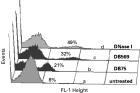
Since the treated parasites displayed mitochondrial and nuclear alterations (Fig. 2) as well as loss of their mitochondrial membrane potential (Fig. 3), we next investigated the possibility of apoptosis-like death induced by these diamidine compounds. Flow cytometry analysis revealed that the percentage of TUNEL-positive parasites, which is an indicator of DNA nicking, increased after drug treatment: and increased from 8% in the untreated parasites to 21% (P<0·15) and 32% (P<0·07) after exposure to DB75 and DB 569, respectively (Fig. 4, Table 1). Incubation of untreated parasites for 30 min at 37 °C with 1 μg/ml DNAse I (Sigma Chemical Co.) prior to the TUNEL procedure, induced fragmentation of DNA in 49±9% of the parasites (positive control, Fig. 4, Table 1).

Fig. 4. Flow cytometry analysis of fragmented DNA by TUNEL reaction of untreated (A), 16 μM DB75 (B), and 4 μM DB569 (C) and DNAse (D), treated bloodstream trypomastigotes of Trypanosoma cruzi.
After treatment with DB 569, the bloodstream parasites also demonstrated exposure of higher levels of PS residues: 23±6% of the treated parasites were annexin positive, while in the untreated group only about 7±4% displayed positive labelling (P<0·07; Table 1). Incubation of untreated parasites with 0·02% saponin resulted in 49±11% of parasites positive for annexin labelling (positive control, Table 1).
We further analysed the percentage of apoptotic, necrotic and live DB569-treated and untreated parasites through the 7AAD technique; a stain currently used to discriminate the type of cell death (Telford et al. 2004). Our data showed that the drug-treated parasites presented apoptotic-like characteristics (data not shown). In DB569-treated parasites, the percentage of apoptotic and necrotic cells increased from 6% and 0·5% in the untreated group to 75% and 2·5% for DB569-treated T. cruzi. The positive control performed with untreated parasites, heated for 10 min at 56 °C to induce cell death, resulted in 15% and 72% of the parasites with apoptotic and necrotic characteristics, respectively (data not shown).
DISCUSSION
Apoptosis is a gene-regulated and energy-requiring process leading to the degradation of single cells that are aged, dysfunctional, infected or damaged by external stimuli (Barcinski and DosReis, 1999; Ameisen et al. 1995). It is associated with distinctive morphological changes, including aberrant exposure of phosphatidylserine (PS) residues at the outer plasma membrane, chromatin condensation and marginalization in the nucleus, DNA cleavage into nucleosome-sized fragments, alteration in the mitochondrial membrane permeability, cellular shrinkage, karyorrhexis and packing of cellular constituents into apoptotic vesicles, which are then removed by macrophages and/or by other non-professional phagocytic cells (Ameisen, 2002). Apoptosis-like death has already been reported in trypanosomatids (Mittra et al. 2000), including T. cruzi (De Souza et al. 2003; Vercesi and Docampo, 1992) and could be implicated in the maximization of their biological fitness, facilitating the parasite adaptation to their digenetic life-cycle (Nguewa et al. 2004). It has been proposed that apoptotic-like death represents an efficient adaptive strategy during the establishment of host-parasite relationships, where the parasite death is not the necessary outcome, but rather could represent a mechanism of cell invasion. In fact, viable Leishmania amastigotes use PS residues to invade phagocytes (Barcinski et al. 2003). Another hypothesis is that apoptosis-like death in trypanosomatids could be a remnant process derived from ancestral death machinery over the course of eukaryotic evolution, lacking a defined function until triggered in response to diverse stimuli and stress conditions (Nguewa et al. 2004). Apoptosis in these unicellular microorganisms could also be involved in the equilibrium of the host-parasite relationship by regulating the size of parasite populations as well as contributing to the down-regulation of the host immune response and thus avoid an intense inflammatory reaction (Barcinski and DosReis, 1999).
Many parasitic agents have been reported to induce apoptotic-like death. Miltefosine, an alkylphosphocholine, exhibits anti-leishmanial activity and induces apoptosis-like death in promastigotes of Leishmania donovani (Paris et al. 2004). A pentacyclic triterpenoid, dihydrobetulinic acid is a compound, which also induces apoptosis in L. donovani amastigotes and promastigotes by targeting DNA topoisomerase I and II (Chowdhury et al. 2003). Apoptosis induced by other anti-leishmanial drugs such as pentostam and amphotericin B began with depolarization of mitochondrial membrane potential followed by induction of a caspase-like activity (Lee et al. 2002). Plant-derived flavonoids such as luteolin and quercetin inhibit the growth of L. donovani promastigotes arresting their cell cycle and leading to apoptosis (Mittra et al. 2000).
Regarding T. cruzi, apoptosis-like death has been shown to be involved in the control of its proliferation in vitro (Ameisen et al. 1995), as well as being induced by human serum (Piacenza et al. 2001) and following treatment of the parasites with Bothrops jararaca venom (Deolindo et al. 2005). This snake venom that inhibits the growth of T. cruzi epimastigotes in vitro causes mitochondrial swelling, kinetoplast disorganization and loss of its membrane potential, suggesting the involvement of the mitochondrion cell death machinery (Deolindo et al. 2005).
The exact mechanism of action of the aromatic diamidines has not been fully clarified and it seems likely that there are multiple modes of action (Soeiro et al. 2005; Wilson et al. 2005). In the present study we reported for the first time that the treatment of T. cruzi with the aromatic diamidines, DB75 and DB569, induced loss of the mitochondrial membrane potential, PS exposure, kinetoplast disorganization and DNA fragmentation, which are characteristics of apoptosis-like death. Our present data corroborated and extended previous reports that showed the collapse of the mitochondrial inner membrane potential (Lee et al. 2002; Paris et al. 2004) as well as morphological alterations in the kinetoplast and mitochondria in diamidine-treated trypanosomatids (Croft and Brazil, 1982; De Souza et al. 2004). We found that the N-phenyl-substituted diamidine, DB569, displayed a higher ability to induce apoptosis-like death in treated parasites, which may explain its superior trypanocidal activity as compared to furamidine (De Souza et al. 2004).
In conclusion, our present data demonstrated that after exposure to DB75 and DB569, T. cruzi dies showing characteristics of apoptosis-like death. The present results make important contributions to the understanding of the activity mechanisms of the aromatic diamidines, which may be useful in future drug design for new therapeutic approaches.
The present study was supported by grants from Fundação Carlos Chagas Filho de Amparo a Pesquisa do Estado do Rio de Janeiro (FAPERJ), Conselho Nacional Desenvolvimento científico e Tecnológico (CNPq) and PAPES IV/FIOCRUZ. Funding to D.W.B. by the Bill and Melinda Gates Foundation is gratefully acknowledged.