The success of contentious events depends on whether they favorably affect public opinion. Nonviolent resistance is among the most effective types of contentious action because of its effects on others' beliefs (Aytac, Schiumerini and Stokes Reference Aytac, Schiumerini and Stokes2017; Mazumder Reference Mazumder2018; Pearlman Reference Pearlman2018; Stephan and Chenoweth Reference Stephan and Chenoweth2008). Nonviolence is asserted to have a special moral character that distinguishes it from violent resistance: when the state represses nonviolent protests, public support for the resistance campaign increases while support for the state decreases. However, public support depends on whether the event is perceived as nonviolent. If it is not, then the public perceives repression and retaliatory violence as justified. U.S. President Donald Trump perhaps had this in mind when he framed the 2017 Unite the Right rally and counterprotests in Charlottesville, Virginia as ‘violence on many sides’. He sought to convince the public that counterprotesters were violent in order to build a case for repressing the Antifa movement (Meyer et al. Reference Meyer2019). Does framing events as threatening harm and armed increase public perceptions that the actions are violent, and increase support for repressive response?
In this article, we explore the link between the framing of contentious action, public perception of the action, and public support for state repression. We argue that public opinion is influenced by how a contentious event is framed. We specify three dimensions along which events may be framed. The first two address the type of tactics used in contentious events: the threat of immediate harm and the bearing of arms by contentious actors. Events that involve the threat of harm or the bearing of arms are more likely to be perceived as violent and deserving of a repressive state response. The third dimension draws on the terrorism literature to address the identity of the actors in contentious events. We consider how framing contentious actors as members of an out-group causes the event to be perceived as more violent and deserving of a repressive response.
To demonstrate the effects of framing on public opinion, we selected two liberal democracies that fit the scope of the argument: Israel and the United States. We fielded a survey experiment in both countries in which respondents read a news article describing a contentious domestic event. Respondents were randomly exposed to one of four possible action frames and three possible identity frames of the contentious actors. Events may be unarmed and nonthreatening, armed and nonthreatening, unarmed and threatening, or armed and threatening. Contentious actors may either have no stated group affiliation, be a member of an in-group, or be a member of an out-group relative to the respondent. The news articles about Israel describe protests over building permit policies in the West Bank. The news articles for the United States describe protests at a Confederate monument in the American Southeast. The articles also describe police use of force to break up the protests.
We find three consistent patterns testing our hypotheses in the two survey experiments. First, the framing effects of threat of harm on perceptions of violence and justification of repression are much larger than the corresponding framing effects of the presence of firearms. Secondly, the effect of firearms has mixed results across the two survey experiments, suggesting that the findings may be conditional on the context of the survey: civil conflict in Israel–Palestine and domestic politics in the United States. Thirdly, out-group protesters are not perceived as more violent, yet respondents are significantly more supportive of increased repression of protesters from an out-group. The framing effects of out-group status on support for repression are larger in magnitude than those of the threat of physical harm.
The results suggest that the type of protest, particularly if it presents threats of harm such as rock throwing, strongly influences perceptions of violence and support for repression. Counter to our expectations, group identity does not affect perceptions of observable facts; instead, it only affects the normative evaluation of whether repression in response to the protests was justified. Additionally, while there are some differences in baseline perceptions of violence and support for repression between the Israeli and American survey experiments, the direction and size of the treatment effects are almost the same across both contexts. This finding suggests that differences between civil conflict and contentious domestic politics are not as broad as expected in the literature.
This article adds to the literature in three ways. First, we contribute to the study of tactics used by contentious campaigns (Chenoweth and Stephan Reference Chenoweth and Stephan2011; Dahlum 2018). We study the link between a contentious event and how it is perceived by the public. This link is an essential but understudied feature of theories of contentious politics. Our proposed framework contributes to the literature on the contrasting effects of nonviolent protest and violent protest (McAdam and Su Reference McAdam and Su2002; Wasow Reference Wasow2017; Madestam et al. Reference Madestam2013; Mazumder Reference Mazumder2018), and extends work that explores the determinants of support for repression (Lupu and Wallace Reference Lupu and Wallace2019). Secondly, we contribute to the literature on identity and contentious events by extending it from terrorism (D'Orazio and Salehyan Reference D'Orazio and Salehyan2018; Huff and Kertzer Reference Huff and Kertzer2018) to the setting of nonviolent and violent events. We show that the identity of an actor affects the public's willingness to justify a repressive state response. Thirdly, we contribute to the study of the Israeli–Palestinian conflict and political violence in the United States, a highly salient issue in both cases in which the causes and effects of contentious events are debated (Canetti et al. Reference Canetti2017; Pressman Reference Pressman2017; Zeira Reference Zeira2018). Our framework offers a lens with which to interpret these events, framing effects and how these effects vary across contexts.
Framing contentious events
In their influential work on the success of nonviolent resistance, Chenoweth and Stephan (Reference Chenoweth and Stephan2011, 32) argue that ‘once mobilization begins, a nonviolent resistance campaign has wider appeal than a violent one.’ Wide appeal is the key mechanism that distinguishes nonviolent resistance, such as peaceful protests, sit-ins and strikes, from violent resistance, such as campaigns of bombing and sabotage. This wider appeal begins with the lower physical and moral barriers to participation in nonviolence that motivate support from bystanders (Pearlman Reference Pearlman2018). Nonviolence also influences the regime and mass public in three important ways: the military is less willing to repress nonviolent protesters, repression increases mass public sympathy for the protesters, and international actors apply greater pressure to a regime that represses nonviolent protesters (Chenoweth and Stephan Reference Chenoweth and Stephan2011).
Given the advantages of nonviolent resistance campaigns, it is in the interest of an opposition movement to present their actions as nonviolent to favorably affect the behavior of the regime and mass public: preventing the military from cracking down and persuading the public of the justness of the movement's cause. Nonviolent protest has a lasting effect on opinion, increasing sympathy for the ideological position the protesters represent (Madestam et al. Reference Madestam2013; Mazumder Reference Mazumder2019). Wasow (Reference Wasow2017) shows how dissenters create bottom-up influence on perceptions of their actions. However, this relationship is conditional: nonviolent protest increases public support, but violent protest decreases it (Lupu and Wallace Reference Lupu and Wallace2019; McAdam and Su Reference McAdam and Su2002).
Regimes attempt to counter these effects of protest. While repression is a common response, which involves cracking down on protesters to increase the costs of collective action (Young Reference Young2019), regimes may rhetorically portray dissenters as violent to justify repression. In the United States, the president arguably decried ‘violence on many sides’ after a right-wing paramilitary member killed a counter-protester in Charlottesville, Virginia in order to diminish the killing (Merica Reference Merica2017). The regime can portray dissenters as members of a social out-group for the same purpose. Huff and Kertzer (Reference Huff and Kertzer2018) demonstrate that the public is more likely to perceive actions as terrorism when they are committed by an out-group. Opinion about protest and repression matters: if the domestic audience unifies against dissenters, then the regime has a greater chance of surviving.
This article focuses on a particular strategic process: the effects of framing contentious political events on public perceptions and evaluations of those events. Druckman (Reference Druckman2001, 1042) defines framing effects as ‘…when, in the course of describing an issue or event, a speaker's emphasis on a subset of potentially relevant considerations causes individuals to focus on these considerations when constructing their opinions’. Political elites – including politicians and the media – frame events to suit their self-interest (Druckman Reference Druckman2001; Druckman Reference Druckman2004). For instance, elites may frame contentious events involving multiple tactics and types of participants by focusing on a subset of the actions or participants.Footnote 1 Information about the event may highlight a ‘subset of potentially relevant considerations’ such as its most or least violent tactics, or its most or least sympathetic participants. For example, the American Civil Rights Movement involved nonviolent tactics (McAdam, Tarrow and Tilly Reference McAdam, Tarrow and Tilly2001) as well as violent riots (Eisinger Reference Eisinger1973). Participants in the movement were also geographically, religiously and racially diverse (Hogan Reference Hogan2007). Exploiting this variation, pro-segregation elites framed civil rights protests in the American South as instigated by ‘outside agitators’ to delegitimize and discredit protests (Feinberg and Johnson Reference Feinberg and Johnson1988). Note that framing is a distinct process from labeling, in which elites go beyond calling attention to a certain aspect of a contentious event and explicitly categorize the event as terrorism, for example. Labeling examples include Bashar al-Assad's regime describing nonviolent protesters as ‘criminals’ during the Arab Spring (Black Reference Black2012) and the 1976–1983 Argentine military regime referring to leftists as terrorists ‘so as to not confer any legitimacy on those so named’ (Pion-Berlin Reference Pion-Berlin1988, 401).
Individuals' perceptions and evaluations of contentious events should change based on the frame in which they observe the event. Druckman (Reference Druckman2001, 1045) argues that ‘citizens delegate to ostensibly credible elites to help them sort through many possible frames’. In other words, individuals respond to specific frames to process information about political events.Footnote 2 Yet we know little about how frames of a contentious event's tactics and participants affect individuals' perceptions and evaluations of these events. The study of conflict and terrorism does investigate framing of participants' identity: individuals are more likely to discriminate against out-group participants and are less altruistic after being cued to perceive a violent event with anger (Zeitzoff Reference Zeitzoff2018). Additionally, framing an event as committed by an out-group dehumanizes the out-group and increases support for retaliatory violence (Maoz and McCauley Reference Maoz and McCauley2008) and repression (Piazza Reference Piazza2015). Casting resistance as part of an out-group is reinforced by individuals' interactions with their in-group, since the opinion of peers has a stronger influence than elite opinion (Kertzer and Zeitzoff Reference Kertzer and Zeitzoff2017).
Dimensions of contentious events
In this section, we specify three different content-based frames of contentious events that we expect to have an effect on individuals' perceptions and evaluations of that event. We then experimentally manipulate these three dimensions in a fictional vignette about protest. The first two dimensions of framing address the type of tactics used in a contentious event, based on a widely used scholarly definition. The third dimension of framing addresses the identity of participants in a contentious event, which is consistent with such a focus of the study of terrorism (Huff and Kertzer Reference Huff and Kertzer2018; Piazza Reference Piazza2015). These three dimensions are salient for the framing of protest events. However, other dimensions would also be relevant for different classes of events. Terrorist events, for example, are carried out by different types of organizations (or lack thereof) than protest events (Phillips Reference Phillips2017; Spaaij Reference Spaaij2010).
Type of Tactics: Threat of Harm and Use of Arms
Chenoweth and Lewis (Reference Chenoweth and Lewis2013) define violent contention as ‘[a campaign] prosecuted by armed persons or otherwise involving the regular and deliberate use of violence by civilian or guerrilla challengers’. This definition suggests two conditions, either of which characterize a violent event: (1) armed persons or (2) the regular and deliberate use of violence.Footnote 3 We use these conditions from the definition to define the first two dimensions along which a contentious event can be framed: intent to cause immediate physical harm and instrumental means.
The Israeli–Palestinian conflict illustrates both of these dimensions related to the type of tactics used in a contentious event. Pressman (Reference Pressman2017) considers rock-throwing events in the First Palestinian Intifada to be violent since they involve an intentionally harmful, threatening act. He categorizes rock throwing as unarmed violence because it is capable of causing physical harm to others. Yet according to Chenoweth and Lewis’ (Reference Chenoweth and Lewis2013) definition, these rock-throwing events are not violent since they did not involve weapons of war. In each case, the intentional threat and presence of arms are considered sufficient to classify an event as violent.
The first dimension along which a contentious event can be framed is intent to cause immediate physical harm. When there is no such intention, individuals do not fire weapons, throw rocks, throw punches, or initiate any kind of behavior designed to damage the physical integrity or private property of another individual. We argue in Hypothesis 1 that framing contentious events as intending to cause harm has two important effects.
Hypothesis 1a Contentious political events framed as threatening harm are more likely to be perceived as violent than contentious events framed as not threatening immediate harm.
Hypothesis 1b Contentious political events framed as threatening harm are more likely to be perceived as justifying a repressive state response than contentious events framed as not threatening immediate harm.
The second dimension for framing a contentious event is instrumental means –whether an event was conducted with arms or without arms. An armed action is one that uses a weapon of war as a means. Rocks are not a modern weapon of war and therefore throwing rocks is not an armed action. The presence of firearms, homemade bombs or Molotov cocktails, even if those weapons are not used, classify events as armed. Not all armed events intend to cause immediate physical harm; there is a distinct category of armed but nonthreatening events. Some events are armed and threaten immediate harm. Regardless of the threat, we expect the following effects for arms:
Hypothesis 2a Contentious political events framed as involving the use of arms are more likely to be perceived as violent than contentious events framed as not involving the use of arms.
Hypothesis 2b Contentious political events framed as involving the use of arms are more likely to be perceived as justifying a repressive state response than contentious events framed as not involving the use of arms.
Participant: Identity and Group Affiliation
Events may also be framed as committed by participants with different identities. The effects of identity-based framing vary based on the identity of the event participant relative to the observer. For example, perceptions of what is considered terrorism change based on the ethnic identity and group affiliation of the participant (Huff and Kertzer Reference Huff and Kertzer2018). The participants’ identity and group affiliations should also matter for public perceptions of violence and justification of repression. We base our argument on the assumption that since an individual has a more proximate relationship with the participant's identity or group affiliation, the action will be perceived more favorably. Favorable perception of an in-group corresponds to humanizing in-group actions, a process that involves seeing them as less violent and less deserving of repression (Maoz and McCauley Reference Maoz and McCauley2008).
We argue that framing of group affiliation affects observers’ perceptions of contentious action by defining their in-group or out-group status relative to the participant. Observers of contentious events can either share a salient group affiliation (in-group status) or not share a salient group affiliation (out-group status) with event participants. Between-group hostility is likely to increase as the in-group and out-group become more differentiated, which causes the in-group to become more similar and competition between groups to increase (Brewer Reference Brewer1979). Applying these insights to violence and nonviolence, in-group members should be more willing to justify each others' actions and be more permissive when judging intent to cause harm compared to the actions of an out-group. Such asymmetric judgments could be driven by either a sense of shared grievance with the in-group – a feeling of solidarity with in-group members participating in a contentious event – or attribution bias – systematically assigning negative motivations to out-group members (Chatman and Von Hippel Reference Chatman and Von Hippel2001). This leads to the following hypotheses:
Hypothesis 3a Contentious political events framed as perpetrated by an out-group member are more likely to be perceived as violent than contentious events framed as perpetrated by an in-group member, or by a participant whose group is not identified.
Hypothesis 3b Contentious political events which are framed as perpetrated by an out-group member are more likely to be perceived as justifying a repressive state response than contentious events framed as perpetrated by an in-group member, or by a participant whose group is not identified.
Each hypothesis predicts that frames are sufficient to induce two different responses in individuals. First, each frame increases an individual's perception that a contentious event is violent. Secondly, each frame changes an individual's evaluation of the event such that s/he believes it warrants greater repression. We expect that increased perceptions of violence are necessary for increased justification of repression: individuals should follow a ‘threat–response’ logic, and believe that repression is justified only if it is proportional to the degree of perceived violence in a contentious event (Earl, Soule and McCarthy Reference Earl, Soule and McCarthy2003).
Contentious events in Israel and the United States
The Israeli–Palestinian conflict and American political protest movements illustrate contentious events with varying tactics and identities of participants which exist simultaneously. In both Israel and the United States, political elites and journalists frame events in a way that highlights particular tactics and group identities. Both countries are also liberal democracies, in which public opinion about protests is consequential for policy outcomes such as police responses to protests. However, there are also important differences between Israel and the United States. For example, protest events occur in the context of protracted civil conflict in Israel, while in the United States they take place as part of routine contentious politics. Nonetheless, we expect the similarities between the two cases to be sufficient for framing to produce observable changes in public opinion. In the discussion we return to the issue of how differences between the cases might affect the results.
We discuss three examples to anchor the empirical setting: the framing of the 2018 March of Return in Gaza as threatening by Israeli elites and nonthreatening by Palestinian elites; the framing of Black Lives Matter (BLM) protests as armed by American right-wing elites and unarmed by American left-wing elites; and the framing of West Bank rock-throwing incidents differently by elites and the Israeli media when the identity of the assailant changes from Jewish to Palestinian.Footnote 4
The first and third events were framed differently by Israeli- and Palestinian-sympathizing media, each highlighting different aspects of the same event. During the March of Return, the Israeli media emphasized Hamas' role in the protests, giving prominent coverage to a claim by a Hamas senior official that most Palestinians slain in a casualty-heavy day of protests were members of the terrorist organization. Particular coverage was also dedicated to what Israelis called ‘terror balloons’, in which Palestinians launched helium balloons with small incendiary devices designed to ignite fields on the Israeli side of the border fence. However, Palestinian media and international civil society organizations lauded the protests as ‘a new trend in Palestinian society that attempts to expand the notions of resistance and nonviolence’ (Kuttab Reference Kuttab2018).
The BLM movement in the United States – protesting police violence against African Americans specifically and racial injustice generally – became politically divisive, with the American left and right responding differently to protest events. In summer 2017, the BLM protested around the country at Confederate monuments, decrying that the statues reflect a legacy of white supremacy in the United States. The week after protests in Charlottesville, Virginia, a BLM-backed group called ‘Destroy the Confederacy’ staged a protest around a monument in Houston, Texas. The Houston Chronicle reported that ‘more than 400 socialists, liberals and Black Lives Matter activists showed up to demand the monument's removal, while a few dozen counter-protesters – some carrying Confederate flags – showed up in opposition. In between, scores of baton-wielding police corralled crowds with barricades and officers on horseback’ (Blakinger and Barned-Smith Reference Blakinger and Barned-Smith2017). The right-wing news site Breitbart framed the BLM-backed protests as armed, highlighting pictures of several protesters with rifles. The site stated, ‘Destroy the Confederacy organizers said that none of their protesters needed to be armed but [a protester] and some of his communist comrades were armed with handguns and semi-automatic rifles’ (Shadwick Reference Shadwick2017).
The third dimension in the classification scheme for both the Israeli and American cases is the group identity of contentious actors. In recent years rocks have been thrown during contentious events against Israeli security forces by multiple actors including Palestinians, Jewish settlers, Ultra-Orthodox Jews and Ethiopian Jews. The Israeli media usually classifies such events as clashes or riots, but Palestinian participants are often called terrorists. In the empirical tests which follow, we do not address elites’ incentives and strategies to frame. Rather, we manipulate information about a contentious event similarly to the above examples in which political and media elites highlight different tactics and participants in reference to same contentious event.
Research design
Two Survey Experiments
We test our hypotheses about framing effects on perceptions of contentious action and support for repression using two survey experiments pre-registered through Evidence in Governance and Politics in August 2018. The first survey was administered to 1,024 Jewish respondents from Israel from 7–11 November 2018 through the Midgam Panel, an Israeli online panel data collection project designed for social psychology research. Midgam Panel survey respondents are representative of the Israeli Jewish population in terms of age, gender and political ideology.Footnote 5 The second survey was implemented on Amazon Mechanical Turk (MTurk) in the United States from 17–22 October 2018. The respondents (n = 1,137) were compensated for their participation. MTurk has been shown to be cost effective and a more reliable survey method than convenience samples (Buhrmester, Kwang and Gosling Reference Buhrmester, Kwang and Gosling2011; Coppock, Leeper and Mullinix Reference Coppock, Leeper and Mullinix2018; Huff and Tingley Reference Huff and Tingley2015). Respondents in both surveys were asked to answer a series of pretreatment questions, and then were exposed to the treatment: a vignette describing a contentious political event in the country in which the survey is taken.
The content of the vignette was randomly assigned for each respondent; the twelve possible treatment conditions are described below. Outside the treatment conditions, the content of the vignette was consistent across treatment arms. The Israeli survey described a fictitious protest around building and demolition policies in the West Bank. In recent years building permits have become politicized: the Israeli government often restricts permits and actively demolishes the houses of both Palestinians and Jewish settlers who are considered to be illegal. Protests of such policies have involved a range of nonviolent and violent tactics and are carried out by both Israelis and Palestinians, depending on the target of the demolition or restriction.
The US survey describes a fictitious protest around Confederate monuments in Savannah, Georgia, a salient issue in contemporary American politics. The choice of Confederate monuments improves internal validity: protests around monuments have spanned types of action and identity groups, ranging from nonviolent to violent and carried out across the ideological spectrum.
The hypothetical nature of the treatment vignettes raises potential concerns about respondents' ability to relate or form perceptions and evaluations about the protest event. To this end, using house demolitions in the Israeli context and monument protests in the US context has three advantages. First, while the vignette describes a fictitious event, it is embedded within a plausible and relatable context for respondents.Footnote 6 The description of the event in the vignette is broad enough to lead respondents to believe that either side of the political spectrum could be engaged in the contentious actions. When the treatment manipulates the identity of the actor, it does not detract from the plausibility of the event. This is why we chose these cases: Israeli building policies in the West Bank have been protested both violently and nonviolently by Israeli Jews and Palestinians,Footnote 7 and Confederate monuments have been protested by ‘both sides’ and have included multiple dimensions of contentious action.Footnote 8 The second advantage is that these cases have received heavy news coverage in prominent outlets. Thirdly, by selecting a similar event for both the Israeli and American contexts, we can compare treatment effects between a civil conflict setting and a domestic political setting.
We randomize the treatment in the vignette along three dimensions – intent of immediate harm, arms and group status – which correspond to Hypotheses 1–3, respectively. The treatment arms each represent a particular framing of the contentious event in which many tactics besides the one presented could have been used but are not presented to the respondent.Footnote 9 Consistent with the definition of framing in Druckman (Reference Druckman2001), respondents are given only a ‘subset of potentially relevant considerations’ about the event.Footnote 10 All manipulations in both surveys are presented below. The Appendix includes a table showing all treatment arms, an example of a complete vignette and survey questions.
Type of Action Manipulations
The following vignettes were provided to both US and Israeli respondents.
-
Unarmed, No Threat. Despite orders, the protesters sat in a human chain, also chaining themselves to the [monument (US)/building (Israel)]. The suspects were forcefully removed by police while protesters chanted slogans demanding their civil rights be respected. No injuries were reported to the police or protesters.
-
Unarmed, Threat. The suspect engaged in rock throwing at police during the protest, after which the protest was terminated and suspects were arrested. The protesters set fire to a nearby field and burned tires on the road. No injuries were reported to the security forces or protesters.
-
Armed, No Threat. The suspect was armed with a handgun and was yelling inflammatory slogans throughout the protest. The protest organizers maintained that the protest was nonviolent despite the presence of a handgun and cited no disorderly conduct such as rock throwing or clashes with security forces. No injuries were reported to the security forces or protesters.
-
Armed, Threat. The suspect was armed with a handgun. During the protest several youths and the suspect engaged in rock-throwing and clashed with police, including lighting fire to nearby fields and burning tires. A Molotov cocktail (a small incendiary device) was thrown at police during the protest. Police reported one officer injured during the clashes, while protesters reported police used excessive force.
Group Status Manipulations
-
No Group: a 28-year-old male (does not mention the affiliation of the protesters)
-
In-Group
-
US political right: Hugh M. Cooper, a 28-year-old white male from the Sons of Confederate Veterans group.
-
Israel: Elnatan Gutplitz, a 28-year-old settler from the Yair Farm, a nearby outpost.
-
Out-Group
-
US political right: Kesean Malone, a 28-year-old African-American male from the BLM group.
-
Israel: Mahmoud Omaeir, a 28-year-old Palestinian from Salfit, a nearby village.
Note how each of the dimensions is operationalized in the vignette. Intent to cause immediate harm is operationalized by presenting the actors' use of instrumental means to cause harm vs. peaceful protesting. Means are operationalized as either rock throwing (for unarmed with harm threatened), no weapons mentioned (for unarmed with no harm threatened) or firearms (for armed with harm threatened and armed with no harm threatened).
In-group status is operationalized differently depending on the case. For the Israeli survey experiment, the in-group is defined as Israeli settlers from a nearby settlement. Relative to Israeli Jews, however, Palestinians would be considered members of an out-group. For the American survey experiment, the in-group and out-group depend on the partisan identification of the respondent. Right-wing Sons of Confederate Veterans actions would be an in-group classification for Republicans and an out-group classification for Democrats. Left-wing BLM actions would be an out-group classification for Republicans and an in-group classification for Democrats. The ‘No group framing’ treatment arm does not mention the affiliation of the protesters. It is important to note that in the Israeli experiment we define in- and out-group status based on nationality/ethnicity, while in the United States case status is defined by partisan affiliation. We select these manipulations based on salient cleavages within each society, rather than comparing either partisan affiliation or nationality across both settings.Footnote 11
After reading the vignette, respondents first answered a factual manipulation check, which also checked for attention (Kane and Barabas Reference Kane and Barabas2019). They then answered a series of questions about their beliefs in response to what they read. First, they answered whether they classify the event in question as violent or nonviolent, creating the variable Violence. The levels of this response variable on classification are intentionally restricted to a dichotomous classification option to retain the scholarly and popular universe of terms used to describe contentious action. We expect from Hypothesis 1a that threatening actions will be classified as more violent than non-threatening actions, and from Hypothesis 2a that armed actions will be classified as more violent than unarmed actions. We expect from Hypothesis 3a that out-group actions will be classified more often as violent than in-group or no-group actions.
Secondly, respondents answered whether they support future repressive policies against similar protesters, including the arrest and prosecution of all participants in the protest. This variable, Repression Support, is a three-point scale ranging from ‘this was a legitimate protest to which police responded with excessive force’ to ‘police should continue active investigation to arrest all protesters engaged in illicit activity during the protest’. While the first outcome measure of classifying an event as violent or nonviolent measures perceptions, the second outcome measure of repression support measures the normative evaluations of police use of force. We expect support for repression to increase when actions are threatening (by Hypothesis 1b), armed (by Hypothesis 2b) and committed by the out-group (by Hypothesis 3b).
In addition to the treatment vignettes and outcome measures, we also collect data on potentially predictive covariates which allow us to assess the effectiveness of the randomization procedure.Footnote 12 The covariates include age, gender, ideology as measured by party affiliation, and military service. Ideology is measured by party affiliation in two ways. For the American survey experiment, it is measured using the traditional seven-point Party ID scale (1 = the most Democratic, 7 = the most Republican). For the Israeli experiment, ideology is measured on a nine-point right to left scale.Footnote 13 We also expect variation in the military service variable even under Israel's compulsory military service laws, since there are notable exceptions to service. Military service predicts attitudes toward the use of force (Wallace Reference Wallace2014). We also collect data on respondents' primary news source, including television, print, online, radio or podcasts.
Estimation strategy
We test the hypotheses in two different ways. First, we use a simple difference in means to test Hypotheses 1 and 2. That is, we take the expected difference in classification of violence and justification of state force between those who received the threatening and nonthreatening conditions (for Hypotheses 1a, 1b) and between those who received the armed and unarmed conditions (for Hypotheses 2a, 2b).Footnote 14 Standard errors for the distribution of estimated average treatment effects (ATEs) are computed analytically and verified through randomization inference with 1,000 repetitions. Secondly, we separately regress the classification of violence and justification of state force on a treatment indicator for the threatened condition (Hypothesis 1) and the armed condition (Hypothesis 2). Each of these procedures produces an unbiased estimate of the same causal quantity: the ATE. The linear regression estimation takes the form of:
 $$Outcome_i = \alpha _1 + \beta _1Treatment_i + \zeta _1X_i{\rm \bond} + {\rm \epsilon} _i$$
where Outcome i is either Violence or Repression Support by respondent i, Treatment i is assignment status for either Threat, Arms or Outgroup for respondent i, and X i is a vector of pre-treatment control variables.
Tests of Hypothesis 3 vary based on the survey experiment. In the Israeli survey experiment, we replicate the same procedures used to estimate the ATE for Hypotheses 1 and 2. We take the expected difference in the classification of violence and justification of state force between those who received the out-group (Palestinians) and in-group (Israeli settlers) conditions. We also separately regress those outcome measures on a treatment indicator for out-group status. In the US survey experiment, we do not have a causal manipulation for out-group status since this status depends on the respondent's partisan identification. We instead estimate the conditional average treatment effect (CATE) by interacting the left-wing/right-wing treatment with the respondent's partisan identification. We expect Democrats who receive the right-wing treatment and Republicans who receive the left-wing treatment to have a higher CATE than Democrats who receive the left-wing treatment and Republicans who receive the right-wing treatment. The estimation for Hypothesis 3 in the US survey takes the form:
 $$\eqalign{Outcome_i = & \alpha _2 + \beta _2Treatment_i + \gamma _2GOPID_i \cr & + \delta _2Treatment_i \times GOPID_i + \zeta _2X_i{\rm \bond} + v_i} $$
where GOPID i denotes the party identification of subject i, taking a value of 1 for Republican and 0 for Democrat. The interaction term coefficient δ 2 estimates heterogeneous treatment effects by party, specifically the change in effect from Democrats to Republicans. The treatment coefficient β 2 is the total effect of out-group treatment among Democrats.
Plots from balance tests are included in the Appendix. The only concern is that significantly more Democrats received the out-group treatment in the American survey, and more left-wing Israelis received the out-group treatment in the Israeli survey. Yet we control for party identification and ideology, respectively, to address this concern. We also address potential bias from attrition in the Appendix, but find plausible evidence of unbiasedness in the Israeli survey and missingness independent of treatment assignment in the American survey. Descriptive statistics are in the Appendix.
A concern about interpreting the estimates of treatment effects is that the wording of a particular vignette may explicitly cue respondents to a certain answer in an outcome measure, such as indicating the event was nonviolent or evaluating repression more or less favorably. To address this concern, all results are presented with estimates based on the entire sample, and then with estimates based on subsamples. For example, the effect of threat is reported among all respondents, then among only respondents who received armed treatments, and finally among respondents who received unarmed treatments. If these three estimates are consistent, then this increases confidence that the results are not driven by idiosyncratic elements of a vignette cuing a particular response.
Results: Israel survey experiment
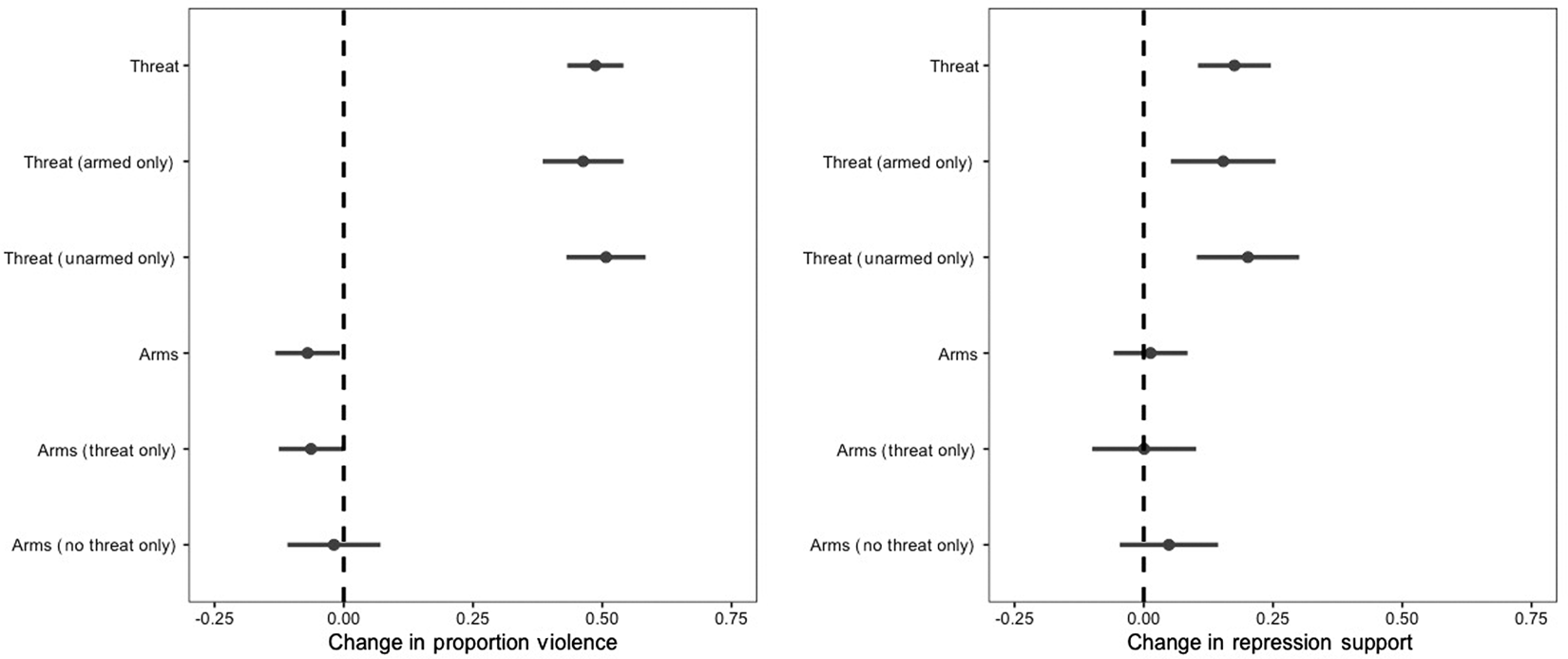
We begin our analysis with the Israeli survey experiment. The effects of the threat of harm on perceptions of violence and justification of repression are much larger than the corresponding effects of the presence of firearms. Of the respondents who received the vignette with no threat of harm, 38 per cent still classified the protest as violent. The high baseline perceptions of violence are consistent with the well-documented ‘ethos of conflict’ among Israeli Jews (Canetti et al. Reference Canetti2017) and lack of political tolerance, especially among the Israeli right (Peffley, Hutchison and Shamir Reference Peffley, Hutchison and Shamir2015). When the threat of harm was introduced, 86.7 per cent characterized the event as violent, for an estimated ATE of 48.7 per cent – more than one standard deviation of the outcome variable. Support for repressive policies on a three-point scale was 1.833 in the control condition and 2.008 in the threat treatment for an estimated ATE of 0.175. These effects are statistically significant and robust to the inclusion of controls.
The presence of firearms has a small negative or null effect on perceptions of violence and support for repression, which suggests that threat is the more influential aspect of contentious action. To test Hypothesis 1, we compared all respondents who received the threat treatment and those who did not, as well as comparisons within subsets of treatments. In particular, we estimated treatment effects of threat among those who received armed treatments only and those who received unarmed treatments only. Similarly, in testing Hypothesis 2, we estimated the treatment effect of arms among the whole sample, among the subset of respondents who received the threatening treatment only, and among the subset of respondents with the nonthreatening treatment only. The results are consistent across subsets of treatments for both Hypotheses 1 and 2 on outcome measures of perception of violence and support for future repressive policies.
Figure 1 displays the results of the difference-of-means tests of Hypotheses 1 and 2. Each panel in the figure depicts a different outcome measure. The left panel depicts estimated effects on the dichotomous variable Violence, interpreted as the change in the proportion of respondents who classified the event as violent between the treatment and control groups. The right panel depicts estimated effects on the outcome variable Repression Support, interpreted as the change in support for increased repressive policies on a three-point scale between the treatment and control groups. The labels in parentheses denote the subsets of treatments in which the hypothesis test was conducted.Footnote 15 Coefficient estimates and standard errors are consistent with regression estimates, and their substantive and statistical significance is unchanged with the inclusion of covariates. All regression tables are in the Appendix.
Effects of threat and arms (Israel)
Note: Midgam panel sample (n = 917). Subgroup estimates are also reported: armed only (n = 466), unarmed only (n = 451), threat only (n = 467), no threat only (n = 450). Dashed vertical line indicates the null hypothesis of no treatment effect. Point estimates are estimated average treatment effects (ATEs) and are displayed with 95 per cent confidence intervals. Left facet: Dependent variable is a dichotomous indicator of whether the respondent perceived the event to be nonviolent or violent. Right facet: Dependent variable is a three-point ordinal scale measuring support for repression of the protest.

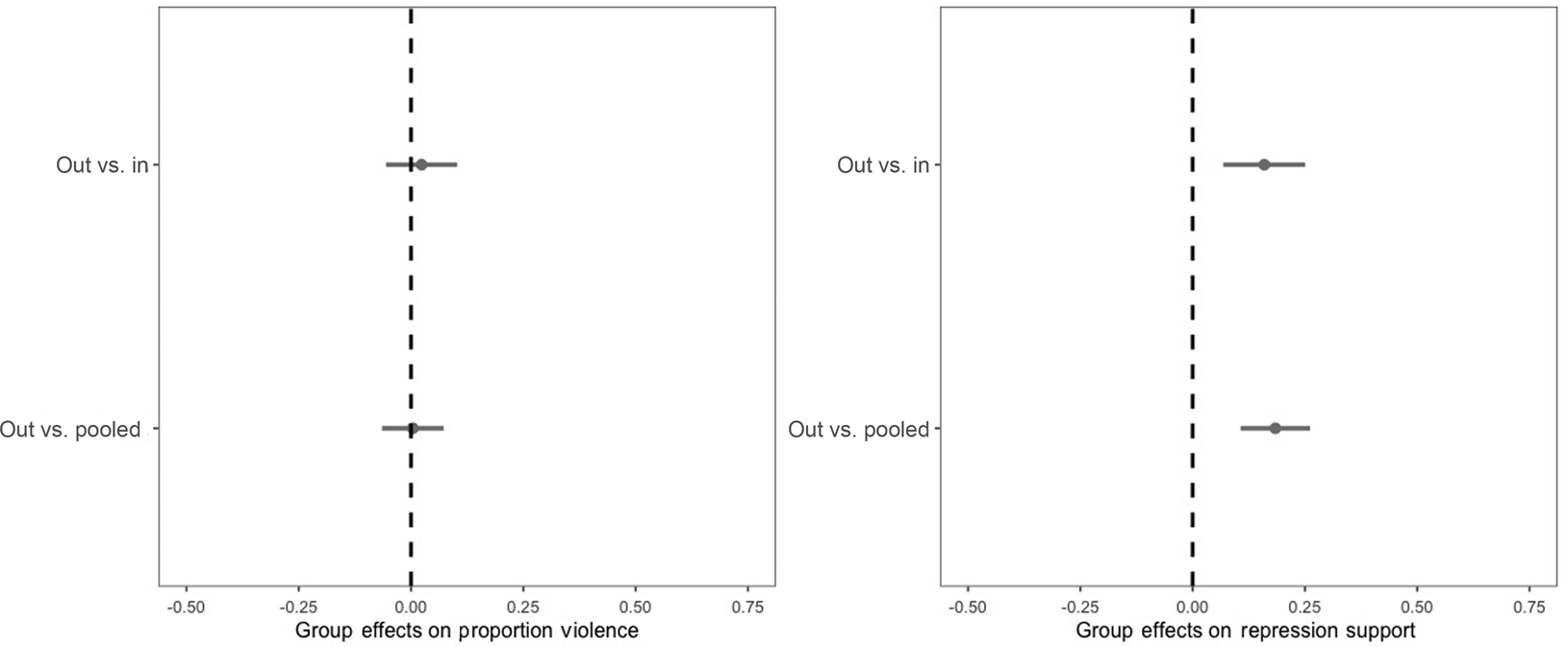
In the Israeli survey, tests of Hypothesis 3 yield findings with a causal interpretation.Footnote 16 Contrary to our expectations, manipulating the out-group status generates no estimated effect on perceptions of violence; thus Hypothesis 3a is not supported. However, respondents do increase support for repressive policies against protesters and express greater support for police action breaking up the protest when the protesters are Palestinians instead of Israeli settlers, which supports Hypothesis 3b. The estimated ATE for repressive policies is 0.18, which is at least as large as the effect of threat on support for repression. This effect is robust to the inclusion of covariates as well as to comparison subsets of Israeli settlers only and pooled Israeli settlers and unidentified protesters. The results are displayed in Figure 2. While we did not pre-register the following test, we estimate conditional ATEs by political ideology for symmetry with the US survey.Footnote 17 We find that left-leaning Israelis are less likely to perceive Palestinians as violent and deserving of a repressive response compared with settlers, while right-leaning Israelis are more likely to perceive Palestinians as violent and deserving a repressive response.
Effects of out-group status (Israel)
Note: Midgam panel sample (n = 917). Subgroup estimates are also reported: out vs. in (n = 582). Dashed vertical line indicates the null hypothesis of no treatment effect. Point estimates are estimated average treatment effects and are displayed with 95 per cent confidence intervals. Left facet: Dependent variable is a dichotomous indicator of whether the respondent perceived the event to be nonviolent or violent. Right facet: Dependent variable is a three-point ordinal scale measuring support for repression of the protest.

Figure 2 displays the results of the tests of Hypothesis 3. As with Figure 1, each panel depicts a different outcome measure: Violence and Repression Support. The top point estimates compare the out-group treatment only to the explicit in-group treatment – that is, a Palestinian protester compared to a settler. The bottom point estimate compares a Palestinian (out-group) protester to the pooled group of both not-identified and settler protesters. In the regression analysis we find very few consistent correlations between covariates and perceptions of violence or support for repressive policies in multiple regression models. More religious Israelis are less likely to support repression and less likely to perceive protest events as violent, but this relationship is present only in some specifications.
Finally, there could be a concern that the effect of the vignettes is not based on idiosyncratic wording, but rather unintended manipulation among respondents. To address this concern, we report the results from a factual manipulation check and an auxiliary outcome test using responses collected on the perceived motive of protests. All but six participants (99.7 per cent) correctly responded to the factual manipulation check. Consistent with Coppock (Reference Coppock2019), we do not condition our analysis on the manipulation check in order to avoid post-treatment bias. As an auxiliary outcome test, we report the effect of each treatment on the proportion of respondents who describe the event as having a criminal or hate-based motive, as opposed to one based on politics or religion. The results are reported in the Appendix. Coefficients for threat are in the expected direction, while coefficients for arms are consistent with the findings on perceptions of violence: respondents are slightly less likely to ascribe criminal or hate-based motives to armed protests. We return to this point in the discussion.
We now replicate the analysis for the American survey. Recall that due to the different contexts of Israeli civil conflict and American domestic contention, we might expect weaker treatment effects in the American context.
Results: US survey experiment
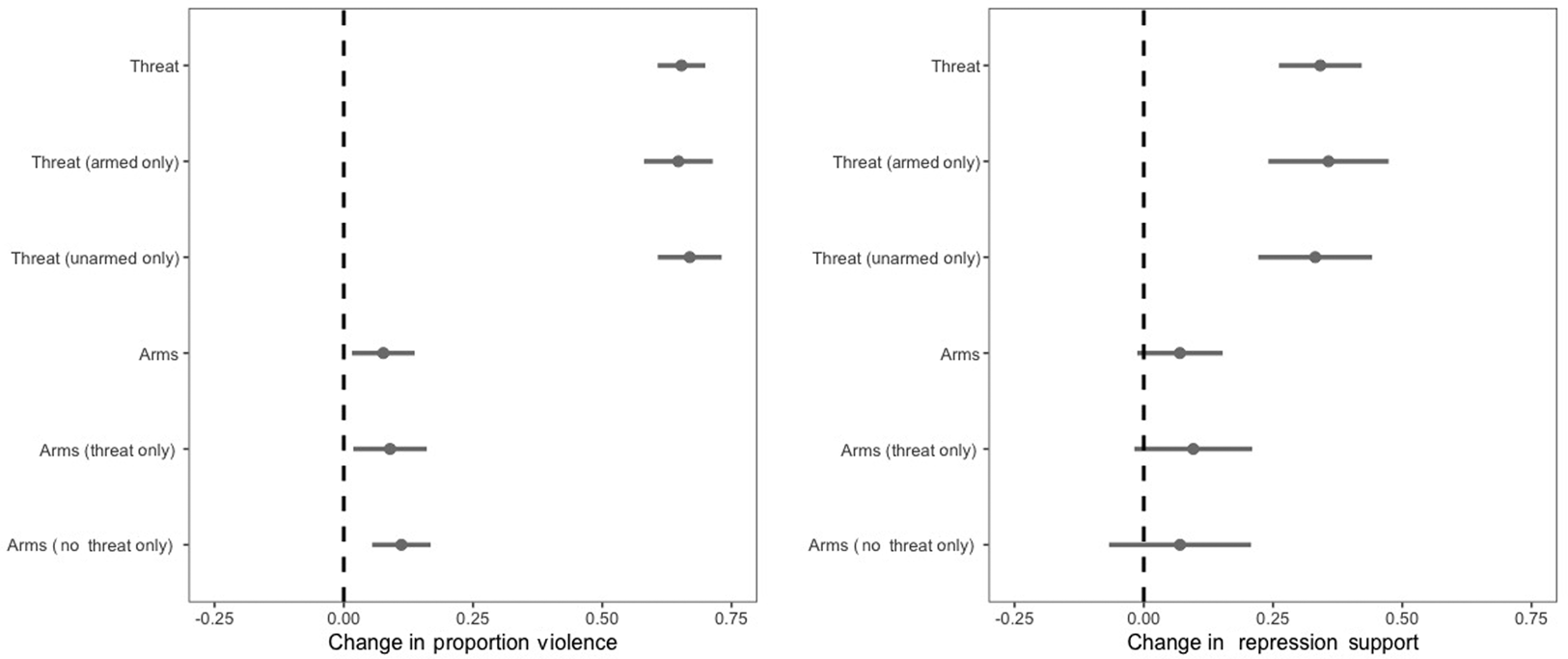
Two key patterns emerge from testing Hypotheses 1 and 2 in the United States. First, and similar to the finding in the Israeli survey, the effects of the threat of harm on perceptions of violence and justification of repression are much larger than the corresponding effects of the presence of firearms. Among respondents with a vignette including no threat of harm, 13.4 per cent classified the protest as violent. This contrasts with the Israeli baseline of 38 per cent who classified the event as violent even in the absence of any threat, suggesting a principal difference between a conflict setting and domestic politics setting. When Americans were presented with a vignette that included the threat of harm, 78.7 per cent of respondents classified the protest as violent, producing an estimated ATE of 65.3 per cent. Notice that the treatment effect of harm is larger for Americans than for Israelis, due to the different baselines. These effects are almost identical when comparisons are made between subsets of respondents exposed to armed protests and subsets exposed to unarmed protests.
Similarly, the threat of harm increases support for repressive policies from an average of 1.79 to 2.13 on a three-point scale, for an estimated ATE of 0.34. These effects are all highly statistically and substantively significant. The presence of firearms has a much smaller effect, increasing perceptions of violence by 7.6 per cent on average, and support for repressive policies by a statistically insignificant 0.07. The results are displayed in Figure 3 in the same manner as the Israeli survey. The coefficient estimates and standard errors are consistent with the regression estimates, and their substantive and statistical significance is unchanged by including covariates. All regression tables are in the Appendix.
Effects of threat of harm and use of arms (US)
Note: MTurk survey sample (n = 1,087). Subgroup estimates are also reported: armed only (n = 533), unarmed only (n = 554), threat only (n = 530), no threat only (n = 557). Dashed vertical line indicates the null hypothesis of no treatment effect. Point estimates are estimated average treatment effects and are displayed with 95 per cent confidence intervals. Left facet: Dependent variable is a dichotomous indicator of whether the respondent perceived the event to be nonviolent or violent. Right facet: Dependent variable is a three-point ordinal scale measuring support for repression of the protest.

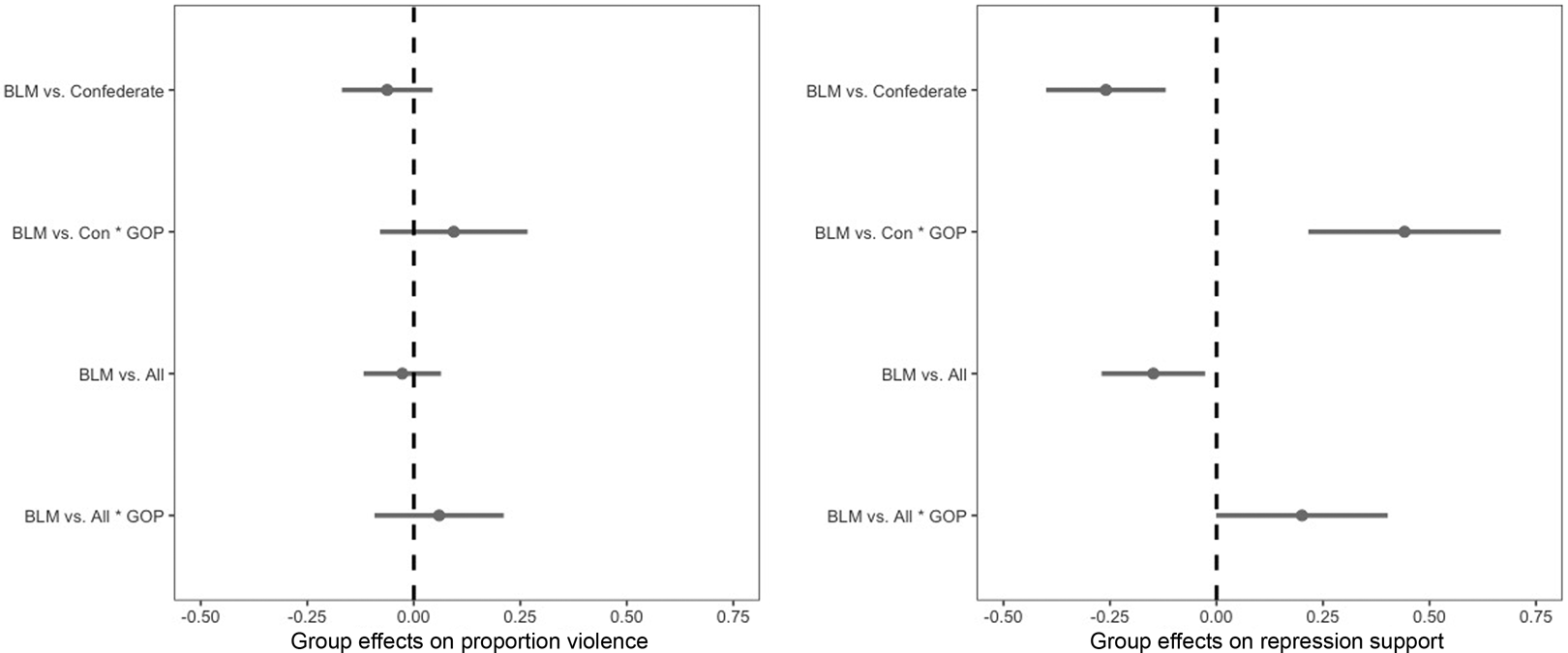
Secondly, tests of Hypothesis 3 in the American case yield the same surprising result as in the Israeli survey: there is support for Hypothesis 3b but not for Hypothesis 3a. In particular, out-group protesters are not perceived as more violent than in-group protesters and protesters whose group is not identified. This is true for both Democrats in response to perceptions of Sons of Confederate Veterans protesters and for Republicans in response to BLM protesters. However, and similar to the Israeli findings, respondents are significantly more supportive of the increased repression of protesters from an out-group. The effect on support for repression of changing protester identity from Sons of Confederate Veterans to BLM among Democrats is −0.26, while the effect among Republicans is 0.18.Footnote 18 That is, the heterogeneous treatment effect between Democrats and Republicans is 0.44. This result is highly statistically significant and the magnitude of this effect is larger than the threat treatment. While not a causal claim, since partisan identification is not randomly assigned, this result suggests that Democrats support less repression against BLM compared with Sons of Confederate Veterans, while Republicans support more repression against BLM compared with Sons of Confederate Veterans. The same results hold when protesters with no group affiliation are added to the control group, and when including controls.
Figure 4 displays the results of the tests of Hypothesis 3, similarly to previous figures. The first and third point estimates in each panel are the baseline regression coefficients without interactions, interpreted as the effect of a change of protester group identity to BLM on Democrats. The second and fourth point estimates are the coefficients of the interaction of Republican Party status and BLM identity, interpreted as the difference in treatment effects between Republicans and Democrats. The results in the figure correspond to the foregoing discussion: while neither party changes their perceptions about the violence of protests when the group changes, partisans increase support for repression when the protesters are from an out-group.
Effects of out-group status (US)
Note: MTurk survey sample (n = 1,087). Subgroup estimates are also reported: BLM vs. Confederate (n = 725). Dashed vertical line indicates the null hypothesis of no treatment effect. Point estimates are estimated average treatment effects for the first and third points, and estimated conditional average treatment effects for the second and fourth points and are displayed with 95 per cent confidence intervals. Left facet: Dependent variable is a dichotomous indicator of whether the respondent perceived the event to be nonviolent or violent. Right facet: Dependent variable is a three-point ordinal scale measuring support for repression of the protest.

As with the Israeli survey, we report the results from factual manipulation checks and auxiliary outcome tests with perceived motive of the protests to increase confidence that respondents received the treatment in the intended way.Footnote 19 First, 97 per cent of respondents in the American survey correctly answered the factual manipulation check about the content of the vignette (selecting protest from a list of other topics). Secondly, respondents consistently assigned more criminal or hate-based motives to actions that threatened harm or involved arms.
Finally, there are several correlations in linear regression models with covariates which merit discussion. Respondents with higher levels of educational attainment are less supportive of repressive policies than those with lower levels of education. Given that the contemporary social movement originated in elite activist networks (Tilly Reference Tilly2008), the finding that the more educated have a propensity to view events as nonviolent suggests sympathy with protest tactics. Another result is that Republicans consistently support a repressive response more than Democrats. This finding comports with the psychology of conservatism, which emphasizes order (Carney et al. Reference Carney2008).
Discussion
What is the relationship between protest, repression and public opinion? In our analysis of the American and Israeli survey experiments, we find that framing a protest as threatening harm increases perceptions of the event as violent and increases support for repression against protesters. Framing a protest as armed only has small positive effects on perceptions of violence, and effects on support for repression which are statistically indistinguishable from zero. Framing a protest as carried out by an out-group does not increase perceptions of violence but does increase support for repression. While Israeli baseline perceptions of violence and support for repression are higher than in the United States – consistent with an ‘ethos of conflict’ – the direction and sizes of effects are very similar between experiments.
The surveys simulate a realistic setting in which selective information about a protest is presented to the public. Politicians and elected leaders of democratic states attempt to reduce support for opposition movements by describing them as threatening, armed mobs composed of outside agitators. We test whether these actions have the intended effect on public opinion. The results suggest that opposition to repression of protest is conditional on (1) the belief that the protest is nonviolent and (2) the identity of the protesters. Estimates, except those related to differing partisan responses to protests in the United States, have a causal interpretation: framing protests as threatening and armed causes shifts in public opinion consistent with the direction of the frame.
Perhaps most normatively alarming is the finding that the causal effect of framing protesters as from an out-group has a larger effect than the threat of physical harm on support for repression. Yet it is not necessary for out-groups to be perceived as more violent in order for support for repression to increase, breaking the ‘threat–response’ logic we expected. This finding is novel in experimental research on repression and dissent (Lupu and Wallace Reference Lupu and Wallace2019) but consistent with recent experimental findings in terrorism scholarship (Huff and Kertzer Reference Huff and Kertzer2018; Piazza Reference Piazza2015).
The similarity of the surveys in two different contexts also allows us to highlight the main differences (or lack thereof) between the results. In the Israeli context of a civil conflict, we would expect respondents to discriminate against an out-group and support a more repressive response (Canetti et al. Reference Canetti2017; Peffley, Hutchison and Shamir Reference Peffley, Hutchison and Shamir2015). Indeed, we find that the out-group treatment has at least as large of an effect on support for repression as the threat of harm. Simply put, Israelis support repression against a nonthreatening, unarmed event with Palestinians at least as much as they support repression against a threatening Israeli event.
In the American context we might expect the treatment effects to be smaller. Instead we find that varying the identity of the protester yields a treatment effect, when interacted with political ideology, that is at least as large as changing the protest from nonthreatening to threatening. Though not a causal claim in the American context, this similarity of treatment effects suggests parallels between partisan polarization in the United States and perceptions of actors on both sides of a conflict (Iyengar and Westwood Reference Iyengar and Westwood2015). However, the partisan polarization in the United States and polarization between sides of the Israeli–Palestinian conflict may be extreme cases. The results demonstrate identity-framing effects across different types of cleavages such as party and nationality, but leave open the question of whether similar effects would be found in cases in which such cleavages are less pronounced.
A puzzling aspect of the findings is the lack of effects for arms on perceptions of violence and support for repression. In the Israeli experiment, these effects are either null or occasionally negative. In the US experiment, these effects are positive but small and not consistently significant.Footnote 20 One possible explanation for the null results is that in both cases, weapons are so prevalent in society that they are not a useful marker for respondents in distinguishing the level of violence of a protest and evaluating an appropriate state response. In the Israeli–Palestinian conflict, the bearing of arms in contention may even slightly increase the belief that protesters are nonviolent political actors. Because the results for arms in the main hypothesis tests are consistent across the threat and no-threat subsamples, we are confident that idiosyncratic wording of a particular vignette does not drive the results. More broadly, then, this finding raises concerns that scholars consider the presence of armed persons sufficient to code contentious events as violent in their data (Chenoweth and Lewis Reference Chenoweth and Lewis2013). At least in the cases here, arms and threat are asymmetric dimensions of protest tactics (Pressman Reference Pressman2017).
We contribute to the literature on repression and dissent by linking contentious events by dissenters with the opinions of observers. However, our design and findings are unable to answer at least two important questions. First, the study differs from previous work on framing (Druckman Reference Druckman2001; Druckman Reference Druckman2004) in that we do not manipulate who frames the event. Rather, we manipulate the content framing of the protest. As a preliminary test we explored the descriptive relationship between respondents' typical source of news and outcome measures, including interactions of news source with ideology. We found no consistent patterns. The causal effect of source and the interaction of that effect with the content framing of protests is an important question for future research.
Secondly, the study does not make behavioral predictions about whether opposition to repression leads to participation in ‘backlash’ protests (Aytac, Schiumerini and Stokes Reference Aytac, Schiumerini and Stokes2017). However, since a belief that repression is unjustified is a necessary condition to choose to protest that repression, our estimates represent an upper bound on any behavioral response to protest and repression.
Future work could build on these findings by connecting them more directly to real events. For example, scholars could experimentally recreate a situation like the one in November 2018, in which President Donald Trump framed the caravan of Central American migrants moving toward the United States as armed. He instructed security forces to ‘consider [a rock] a rifle’ in the event the migrants demonstrated upon arriving at the US southern border and engaged in rock throwing (Hesson, Morin and Restuccia Reference Hesson, Morin and Restuccia2018).
Do such statements, which contradict observed facts, also escalate perceptions of violence and increase support for a repressive response? This study does not distinguish between true and fabricated statements about protests. Another route for future research is thus to explore the effect of labeling contentious events compared to framing them. Does calling protesters terrorists have a larger effect than just emphasizing armed and threatening actions or out-group participants? This project suggests it is not just the label of terrorism that makes actors ‘not merely a problem to be managed, but one to be destroyed’ (Huff and Kertzer Reference Huff and Kertzer2018, 56). Rather, protests can be framed to increase public support for their destruction.
Supplementary material
Data replication sets are available in Harvard Dataverse at: and https://doi.org/10.7910/DVN/IJNZWK and online appendices at: http://doi.org/10.1017/S0007123419000413.
Acknowledgements
The authors thank Steven Arves, Natalia Bueno, Travis Curtice, Danielle Jung, Sara Mitchell, Jeremy Pressman, Dan Reiter, Emily Ritter, Yael Zeira, participants at the 2018 International Studies Association-Midwest meeting, and three anonymous reviewers for their helpful comments and suggestions. Pre-Analysis Plan registered with Evidence in Governance and Politics (ID: 20180829AA). The study was approved by Emory University's Institutional Review Board: (IRB00106432). The data, replication instructions and the data's codebook can be found at https://doi.org/10.7910/DVN/IJNZWK.
Funding
Support for this research was provided by Emory University Professional Development Support.