Introduction
Reproduction is a basic function of a family through which society maintains itself against the hazards of mortality (Rele, Reference Rele1962). Thus, the desire for children is rather obligatory to sustain the family name. In developing countries like India, children are presumed to be important also because they are expected to support their families financially when they grow up. Individuals in such societies also harbour a strong preference for sons. When it comes to sex preference, couples have varying choices of sex composition, and they continue bearing children until they reach their desired sex composition. Level of spousal agreement on fertility preference, as well as degree of spousal communication, could affect a couple’s use of contraceptives. Populations that prefer a large number of children could receive a setback from factors such as marital disruption, which causes an increase in birth intervals and thereby increases the impact of involuntary fertility limitation, thus reducing the wanted total fertility rate. In such conditions, perfect birth control, for both quantity and timing of wanted fertility, could produce a significantly greater reduction in fertility than would have been the case with unchanged birth spacing (Bongaarts, Reference Bongaarts1990). As contraception becomes more readily available to people across the globe, studies on reproductive preferences and subsequent fertility are gaining increasing importance (Coombs, Reference Coombs1979; Foreit & Suh, Reference Foreit and Suh1980).
With the onset of ‘fertility preference transition’, the gap between observed and desired fertility has reversed. The burden of unwanted children is an uncommon phenomenon in pre-transitional societies as fertility preferences are tilted towards having more children. In post-transitional societies, replacement of deceased children is a rare event due to very low infant and child mortality. In India, an upshot of the fertility transition has been that couples have been settling for fewer children. Factors such as rising age at marriage and childbearing, involuntary infertility and competing preferences depress fertility relative to desired family size (Dharmalingam et al., Reference Dharmalingam, Rajan and Morgan2014). Bongaarts (Reference Bongaarts1992, Reference Bongaarts2001 and Reference Bongaarts2002) noted that the trend in family sizes desired by couples is the most critical determinant of future fertility.
Demographers have attempted to explore various dimensions of fertility preference of couples, but the paucity of reliable and valid measures has limited their studies as the use of different indicators has often made the different studies incomparable. Many demographers have argued that the desire for children can be used as a predictor of subsequent fertility (Bankole, Reference Bankole1995; Razzaque, Reference Razzaque2000). Most surveys include questions such as ‘Would you like to have another child or would you prefer not to have any more children?’ These are considered to yield more valid and reliable results than questions that merely require a retrospective recalling of the ‘wantedness’ status of the recent births or questions that aim to ask about the ‘ideal number of children’ desired by a couple (Casterline & El-Zeini, Reference Casterline and El-Zeini2007). Such questions are mainly directed towards ‘eligible’ women who are in their reproductive period and ever-married. As for husband’s preference, women report their own perception of this in most surveys (proxy reporting). In most developing countries, dimensions of fertility such as fertility preferences and contraception use are women-centric.
Until recently, the majority of studies have focused on women in order to establish the factors influencing their reproductive behaviours. Such attempts have ignored the role of men in fertility decision-making. These studies also underestimated the importance of spousal differences in reproductive preferences and motivations as determinants of actual reproductive behaviours (Bankole, Reference Bankole1995). The 1994 International Conference on Population and Development (ICPD) directed incorporating the role played by men in fertility decisions such as the wanted number of children and fertility regulation (Isiugo-Abanihe, Reference Isiugo-Abanihe1994; Feyisetan, et al., Reference Feyisetan, Oyediran and Ishola1998; Odusola, et al., Reference Odusola, Oyediran, Bogunjoko and Adeyemo1998; Zulu, Reference Zulu1998). Bankole (Reference Bankole1995) noted that the fertility desires of both men and women are important predictors of marital fertility. While the reproductive goals of the wife and her spouse may differ – say in terms of desired number of children, preferred method of contraception, sex composition of children and timing of pregnancy and children – there should be effective communication between marital partners (Oyediran et al., Reference Oyediran, Isiugo-Abanihe and Bankole2006). But the debate persists regarding the appropriateness of only taking the preferences of women into account or also including the fertility decisions of their husbands (Gipson & Hindin, Reference Gipson and Hindin2009). Some argue that the inclusion of a husband’s preferences does not improve the predictions of subsequent fertility (Williams & Thomson, Reference Williams and Thomson1985). Such ideas might be prompted by studies based on data from developed countries where most of the fertility decisions and outcomes are well planned and executed. However, in developing and under-developed countries, the importance of considering men’s views on fertility might prove beneficial for research and planning purposes. Men in such societies have different childbearing motivations and intentions, which might prompt them to exercise greater reproductive decision-making than their wives (Mason & Taj, Reference Mason and Taj1987; Bankole & Singh, Reference Bankole and Singh1998; Mason & Smith, Reference Mason and Smith2000; Blanc, Reference Blanc2001).
Marital fertility decision-making is a complex process and its outcome depends very much on the extent to which spouses co-operate in handling issues pertinent to reproductive choices. The fertility desires of couples may be influenced by many socioeconomic and cultural factors. Therefore, fertility preferences need not be constant over a period of time. The death of a child or improvement in economic status, for instance, may cause couples to go for an additional childbirth. While previous studies suggest that males enjoy dominance of power in the Indian setting, little is known about their dominance in fertility decisions. Even though studies have focused on how the power relations between women and their husbands can have important implications for fertility level (Cain et al., Reference Cain, Khanam and Nahar1979; Caldwell, Reference Caldwell1981; Dyson & Moore, Reference Dyson and Moore1983; Mason & Taj, Reference Mason and Taj1987; Ezeh, Reference Ezeh1993; Wolff et al., Reference Wolff, Blanc and Ssekamatte‐Ssebuliba2000; Miller et al., Reference Miller, Severy and Pasta2004; Oyediran et al., Reference Oyediran, Isiugo-Abanihe and Bankole2006; Stephenson et al., Reference Stephenson, Bartel and Rubardt2012; Bauer & Kneip, 2012; Tilahon et al., Reference Tilahun, Coene, Temmerman and Degomme2014, Odimegwu, Reference Odimegwu, Adedini, Ononokpono and Imasiku2014), the pathways through which gender relations influence reproductive and contraceptive decision-making in the context of India remain relatively unexplored.
The primary objective of this paper was to determine the extent to which Indian couples practise their fertility preferences in reality. This paper, to the authors’ knowledge, is the first to capture the effects of sex composition of living children and fertility desires of marital partners on their subsequent fertility behaviour in India through panel data. Thus, the specific objective was to understand the relative importance of husbands’ and wives’ desired fertility in predicting their subsequent fertility behaviour based on the sex composition of their living children. Studies have shown that men are the major decision-makers in most family matters in India, even when it comes to family planning decisions. However, there are studies that have shown that women enjoy an upper hand in these matters. Women have been questioned in lieu of their spouses regarding their reproductive choices in most fertility surveys, leading many researchers to disregard the responses stated by the women on the grounds that these were unlikely to be independent of their own views. So, the acceptance of women as proxies for their husbands is questionable (Williams & Thomson, Reference Williams and Thomson1985; Becker, Reference Becker1996; Ratcliffe et al., Reference Ratcliffe, Hill, Harrington and Walraven2002; Kulczycki, Reference Kulczycki2008; Yadav et al., Reference Yadav, Singh and Goswami2010; Diro & Afework, Reference Diro and Afework2013; Tilahun et al., Reference Tilahun, Coene, Temmerman and Degomme2014). Thus, this study also examined the effect of spousal concordance/discordance on a couple’s fertility preferences.
Methods
The study used panel data from the IHDS-I (2005) and IHDS-II (2011–12). The IHDS-I was a nationally representative survey of 41,554 urban and rural households, covering all states and union territories of India, and included 215,754 individuals. Around 83% of the wives interviewed in IHDS-I were re-interviewed in IHDS-II; some new individuals were interviewed too. The sample size for IHDS-II was 42,152 households, which covered 204,569 individuals. The IHDS is the first nationally representative panel survey in India to provide comprehensive information on the fertility behaviour of couples.
With particular reference to the the IHDS, an ‘eligible’ woman is any ever-married woman in the age group 15–49 years. This study sample included matched cases of eligible women in the age group 15–49 years in IHDS-I and those in the age group 22–56 years in IHDS-II. Questions on women’s fertility preferences, their spouses’ fertility preferences and their fertility outcomes at both time points were used. The study sample size consisted of 28,239 eligible women.
The fertility desires of the sample wives and their spouses, based on their responses in IHDS-I and their subsequent fertility outcomes in IHDS-II, were examined, along with the gap between their fertility desires and their respective fertility outcomes over a period of 7 years.
The wives were asked about their (and their spouses’) desire for having more children over time. The replies were split into three categories: ‘no’ if they didn’t intend to have more children, ‘yes’ if they intended to have more children and ‘unsure’ if they were not certain about having more children. Thus, the desire for having children was studied independently for the wives and their husbands in IHDS-I. The spouses’ joint fertility desire was also studied based on their replies, which were categorized as: neither wanted more children; both wanted more children; husband wanted more children but wife did not want more children; and wife wanted more children but husband did not want more children. Based on their individual and joint desires, the study aimed to determine whether any gaps existed between their desire for children and the actual number of children they gave birth to or conceived between the two successive surveys in 2005 and 2011–12. The outcomes of the wives’ pregnancies were not taken into account, and the focus was more on examining whether or not they had conceived in the 7-year period. Whether wives had given birth to any child (dead or alive) after the first round of the survey, or whether they had conceived in the aforesaid time interval, was taken into consideration. Women who reported being ‘currently pregnant’ at the time of the second survey were also included. Since no direct question was asked about conception within the time gap, the study took into account all cases of miscarriages or wasted pregnancies, including abortion (induced or DNC) and still-births, that had not been reported in IHDS-I but were reported in IHDS-II. The number of children alive in IHDS-I was categorized as 0–2, 3 and 4+ children. The idea behind splitting the number of living children into these categories lay in the concept of replacement level fertility (i.e. total fertility rate=2.1) and India’s declining total fertility rates in 2005 and 2011–12, which stood at between 2.1 and 3.
The age of the wives was categorized as 15–19 years, 20–24 years, 25–29 years, 30–34 years, 35–39 years, 40–44 years and 45–49 years in IHDS-I. Early childbearing and adolescent motherhood is high in India, so 15–19 years was included as a category. These peak in the age group 20–29 years, with slight variations, and start to decrease from age 30 years onwards. After the 7-year period, the matched cases of wives ranged between 22 and 56 years, based on which the age groups were categorized as 22–26, 27–31, 32–36, 37–41, 42–46, 47–51 and 52–56 years. Based on their level of education, the women were classified as: not educated, up to primary, up to secondary, up to higher secondary and bachelor’s degree or above (graduate). Women’s economic condition, based on consumption expenditure of their household, was classified as: poorest, poorer, middle, richer and richest. For religious beliefs, women were classified as: Hindu, Muslim or Other, with the latter consisting of Christians, Sikhs, Buddhists, Jains, Tribals, Other and None. Caste comprised Scheduled Castes (SC), Scheduled Tribes (ST), Other Backward Castes (OBC) and Other, with the latter comprising Brahmins and Other Forward Castes. The duration of marriage was classified as 0–5, 6–10, 11–20 and 21+ years. The wives were also categorized into those using some kind of contraception and those not using any kind of contraception. The spousal age gap was divided into: <4 years, 5–7 years and 8+ years.
The sex composition of living children was categorized as: 0 sons and 0 daughters; 1 son and 0 daughters; 2 sons and 0 daughters; 3+ sons and 0 daughters; 1 son and 1 daughter; 1 son and 2 daughters; 1 son and 3+ daughters; 2 sons and 1 daughter; 2 sons and 2 daughters; 2 sons and 3+ daughters; 3+ sons and 1 daughter; 3+ sons and 2 daughters; 3+ sons and 3+ daughters; 0 sons and 1 daughter; 0 sons and 2 daughters; and 0 sons and 3+ daughters.
For the analyses, bivariate and multivariate techniques were employed. The Kappa statistic was employed to assess the level of agreement between the couples when women acted as proxies for their husbands. Logistic regression analysis was carried out to understand which factors contributed to the additional burden of another child in the second round of the IHDS. The predictors were age groups of women, desire of women for additional children, desire of women’s husbands for additional children, contraceptive use, years of marriage, spousal age gap, sex composition, religion, caste, education, place of residence and economic status.
Results
The desire for subsequent fertility diminished both for women and their spouses between IHDS-I and IHDS-II. However, the differences between women’s desired fertility and that reported by them on behalf of their spouses were found to be negligible at both time points. Sixty-eight per cent of couples mutually did not want any more children, while 29% desired to have an additional birth (figures not shown).
Couples’ desired fertility and their subsequent pregnancy
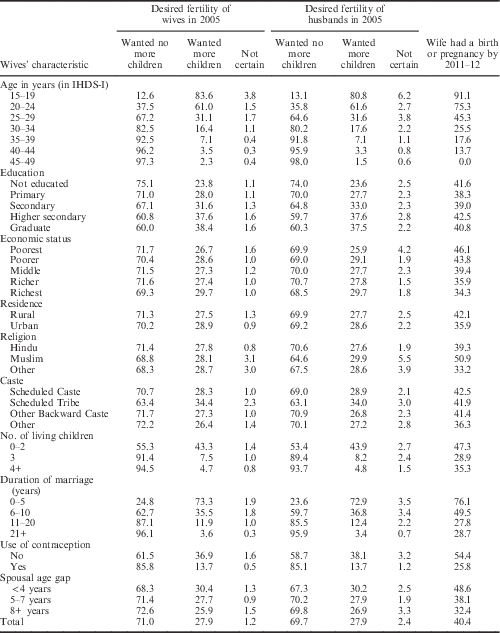
Table 1 represents the wives’ desire for more children in IHDS-I (2005) and whether they had undergone any pregnancy or childbirth over time, based on their background characteristics. The overall statistics show that 71% of the wives (and 69.7% of their spouses) desired no more children. Around 28% of the couples wanted more children. Of these, around 40% of the wives underwent pregnancies or had childbirths in the period between IHDS-I (2005) and IHDS-II (2011–12). Around 84% of the women (and 81% of their husbands) in the age group 15–19 years wanted more children in IHDS-I; however, 91% of them had a subsequent pregnancy in IHDS-II. None of the wives in the age group 45–49 years (in IHDS-I) had undergone pregnancies or childbirths. More than 93% of the wives (and 92% of their spouses) in the age group 30–49 years wanted to avoid pregnancy and childbirth. Higher education was inversely related to wanting more children over time, whereas no such difference was noted in going for childbirth or conceiving among the uneducated wives or those with up to higher secondary- or graduate-level education. Around 72% of the women (and 70% of their husbands) in the poorest category did not want to have more children. On the other hand, around 69% of the women and their husbands in the richest quintile wanted no more children. Only 34% of the wives in the richest section experienced pregnancies or childbirths compared with 46% of wives in the poorest section. Not much difference in having more children was observed between wives residing in rural and urban areas. Forty-two per cent of the wives in rural areas were observed to have had a pregnancy or childbirth by 2011–12; 36% of those residing in urban areas did so. Among the religious groups, the desire to stop childbearing was the highest among the Hindus (71%). Among the Muslim couples, a difference of 4% was observed between the wives and the husbands in wanting to stop fertility. Muslims also reported the highest subsequent pregnancy (51%). The desire to continue childbearing among the women and their spouses (34%) was highest among the Scheduled Tribes, and lowest for the ‘Other’ category (26% for the wives and 27% for their husbands). About 95% of the wives (and 94% of their spouses) with 4+ living children desired no more children, while 43% of the wives (and 44% of their husbands) who had 0–2 living children desired more children. The lowest number of pregnancies or childbirths was observed among the wives with 3 children (29%) and the highest was observed among women with 0–2 children (47%). With increasing years of marriage, the desire to bear more children reduced substantially. The pregnancies or childbirths in the time period between IHDS-I and IHDS-II were mainly concentrated among the wives who had been married for 0–5 years. Around 86% of the wives (and their husbands) using any kind of contraception wanted to stop further childbearing; however, 26% of them experienced a subsequent pregnancy. Wives with a spousal age gap of <4 years differed little in their desire for more children than wives with higher spousal age gaps (5–7 years or 8+ years). However, they reported the highest number of pregnancies or childbirths.
Percentage distribution couples by the desired fertility of wives and husbands in 2005 (IHDS-I) and their subsequent fertility in 2011–12 (IHDS-II)

Association between family size, couples’ fertility desire and subsequent pregnancy
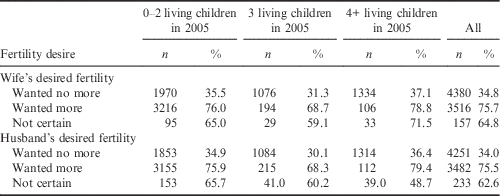
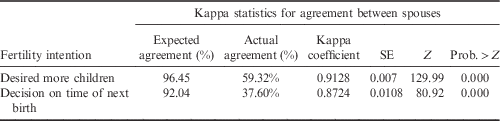
Table 2 shows the association between an individual spouse’s desired fertility and their subsequent fertility behaviour after 7 years by number of living children. A positive association was expected between the wives and their spouses’ desire for any additional birth and the subsequent birth of a child. The desire to have an additional birth was higher among couples with fewer children. Around 35.5% of the wives (and 34.9% of their spouses) with 0–2 children, who wanted to stop any further childbearing, failed to avoid childbirth or pregnancy. About 76% of the wives (or their spouses) with 0–2 children, and who wanted to have more children, had undergone pregnancy or childbirth. Around 65% of the wives (and 65.7% of their husbands) who were not sure about wanting more children gave birth to children or conceived during the 7-year period. Here again, at each level of number of living children, not much discrepancy was found between the desired fertility of the couples and their subsequent fertility. The Kappa coefficients shown in Table 3 suggest a great amount of agreement between the women and their husbands (when women reported on behalf of their husbands) in terms of desire for more children and time to wait for the next birth.
Percentage of couples who had a subsequent birth by 2011–12 by wives’ and husbands’ fertility desires and number of living children in 2005 (IHDS-I)

Level of agreement between spouses on fertility intentions using Kappa statistics

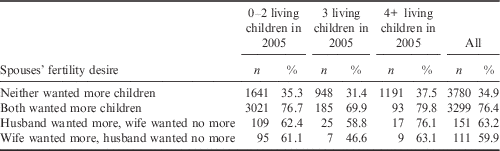
Table 4 shows the joint fertility desires of the married partners and their subsequent behaviours. The results imply that in cases where the spouses agreed upon whether or not to have any children, their fertility outcomes over time followed the expected patterns. About 35% of the couples wanting to limit children had undergone pregnancies or childbirths; 76% of the couples where both spouses wanted more children conceived or gave birth; and 63% of the wives who did not want more children, but whose husbands did, experienced pregnancies or childbirths. Around 60% of the wives wanted more children, whereas their husbands did not. Among couples with more than 4 children, around 76% of the wives reported childbirth or pregnancy when the husbands wanted more children in 2005, but only 63% of women reported childbirth or pregnancy when they themselves wanted more children in 2005. In instances where both spouses wanted more children, 23% of the wives with 0–2 children failed to have more children compared with 30% of the wives with 3 children and 20% of the wives with 4+ children. The study also assessed the joint fertility decisions of spouses in IHDS-I by their number of surviving children and subsequent fertility in IHDS-II.
Percentage of couples who had a subsequent birth by 2011–12 by joint fertility desire and number of living children in 2005

Association between sex composition of living children, couples’ fertility desire and subsequent pregnancy
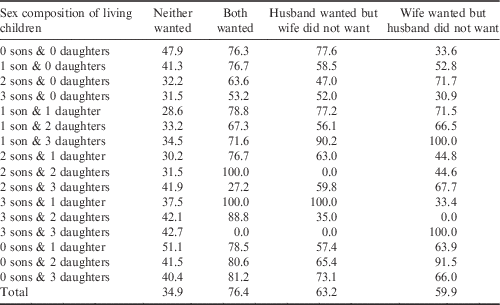
Table 5 shows the percentages of respondents who underwent an additional pregnancy in IHDS-II on the basis of mutual desire with their spouses for subsequent fertility based on the sex composition of their living children in IHDS-I. The chance of having an additional pregnancy was higher among the daughters-only families compared with the sons-only families, irrespective of the spouses’ mutual desire for additional children. For example, for 80% of the couples with only daughters in IHDS-I, both spouses mutually wanted to have additional children, whereas the subsequent pregnancy was inversely associated with the higher number of sons-only families. Interestingly, wives in families with only two sons or only two daughters seemed to have a greater say on additional pregnancy than their husbands. Among couples with no children, 76% of those who desired to have children went for conception or childbirth, but 48% of those who didn’t want children had to go through it. Interestingly, 51% of the wives with 1 daughter, and who had mutual agreement with their husbands on limiting their children, went for an additional childbirth or pregnancy, compared with 41% of the wives with 1 son and a consensus with their husbands on limiting fertility. Fifty-three per cent of the wives with a son went for an additional pregnancy or childbirth, compared with 64% of the wives with a single daughter when the wives favoured continuing childbirth and their husbands did not. Ninety-two per cent of the women with 2 daughters had undergone pregnancy or childbirth over time compared with 72% of the women with 2 sons in instances when the wives wanted more children. None of the wives with 4 sons were at risk of pregnancy or childbirth when their husbands preferred to continue fertility. Eighty-five per cent of the wives with 5+ daughters and a mutual desire with their husbands for more children went for childbirth or pregnancy. However, none of the women with 5+ sons went for childbirth or pregnancy, even if they jointly desired to go for more children over time (figures not shown in the table).
Percentage of wives experiencing pregnancy or childbirth by joint fertility desires of spouses based on the sex composition of their living children in 2005 (IHDS-I)

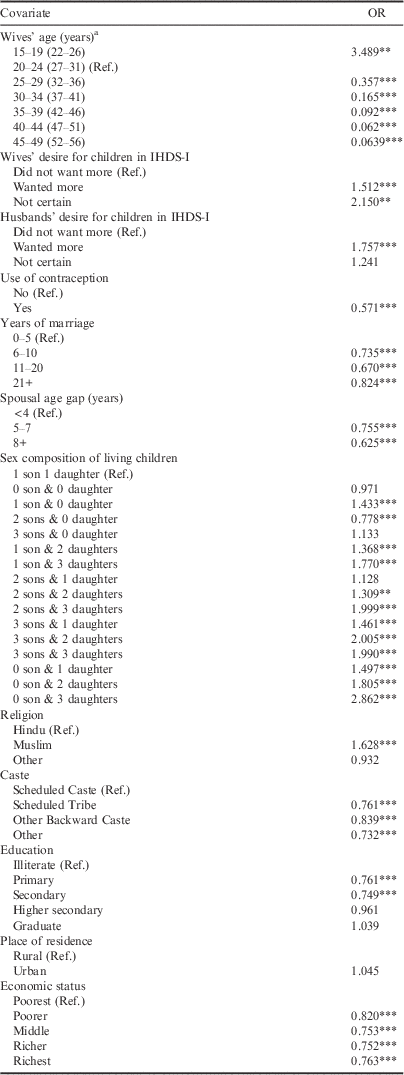
Table 6 shows the results of the multivariate analysis of having an additional birth or getting pregnant in the time period between IHDS-I and IHDS-II. Wives in the age group 22–26 years in IHDS-II (15–19 years in IHDS-I) were 3.5 times more likely to have experienced a pregnancy or childbirth compared with wives in the age group 27–31 years in IHDS-II (20–24 years in IHDS-I). Furthermore, wives in the age group 32–36 years in IHDS-II (25–29 years in IHDS-I) were 65% less likely to have undergone the same. As such, the odds of having an additional pregnancy decreased significantly with increasing age (p<0.01). The likelihood of bearing a child or getting pregnant within the 7-year period was 76% more when the husbands desired to have more children and 51% more when the wives themselves desired to have more children than when they independently wanted to avoid doing so. In addition, the likelihood of subsequent pregnancy or childbirth was two times higher if the wives were not certain about their desire for the next child. The use of contraception in the first round of the IHDS was negatively associated with the event of childbirth or conception during IHDS-II. A negative relationship was also established between higher number of years of marriage and the risk of having an additional child (p<0.01). Greater spousal age gaps resulted in lower risks of childbirth or conception. Women with more daughters in IHDS-I were found to be inclined towards going for a subsequent birth. Furthermore, the odds of having an additional birth or pregnancy were significantly higher among the daughters-only families in the first round of the survey. For example, the likelihood of an additional childbirth or pregnancy was about three times higher among women who had no sons and 3 daughters in IHDS-I compared with women who had 1 son and 1 daughter. Women with 2 sons and no daughters were less likely to have an additional childbirth or pregnancy (p<0.01). The odds of having a subsequent childbirth or pregnancy were 60% higher among Muslim women than Hindus. Compared with the Scheduled Caste women, women in all other castes groups were less likely to have an additional childbirth or pregnancy. Women who had primary- and secondary-level education were 25% less likely to go for an additional childbirth or pregnancy than uneducated women. Also, the odds of having an additional childbirth or pregnancy were significantly lower among women of higher economic status.
Multivariate analyses showing odds ratios (OR) of the effects of different factors on the chances of couple having an additional pregnancy or childbirth in 2011–12 (IHDS-II)

a Age ranges in parentheses are for IHDS-2 (2011–12). Wives who were in the 15–19 age group in 2005 were in the 22–26 age group in 2011–12 (after a span of 7 years).
Ref. represents the reference category.
***p<0.01; **p<0.05; *p<0.1.
Discussion
The persistence of both low and high fertility in different regions of India calls for further investigation of the mechanisms of fertility and reproductive decision-making among couples. Institutional arrangements of ancestry, lineage, sex preference and expectations from their offspring, along with other socioeconomic factors such as education, occupation and place of residence, have an impact on a couple’s fertility decision-making and reproductive goals (Bauer & Kneip, Reference Bauer and Kneip2012; Caldwell & Caldwell, Reference Caldwell and Caldwell1987; Caldwell, Reference Caldwell1981; Coombs & Chang, Reference Coombs and Chang1981; De Rose & Ezeh, Reference De Rose and Ezeh2005; Ezeh et al., Reference Ezeh, Mberu and Emina2009; Hannum, Reference Hannum2005; Jansen & Liefbroer, Reference Jansen and Liefbroer2006; Hossain et al., Reference Hossain, Phillips and Mozumder2007). With this backdrop, this study aimed to explore the association between the desired fertility of women (and their spouses) and their actual fertility levels over time. The study endeavoured to explore to what extent spouses concord or discord regarding fertility desire and how this affects a couple’s subsequent fertility behaviour. The major objective of the paper was to determine whether level of desired fertility is a predictor of subsequent fertility (Dharmalingam et al., Reference Dharmalingam, Rajan and Morgan2014). The fertility desires of a couple may not remain consistent over time. Moreover, in most surveys, the responses of women are taken as proxies for their husbands’ views on fertility preferences. This paper broadly studied whether there were any significant differences when women responded on behalf of their husbands.
On the whole, the descriptive statistics demonstrated that 71% of the sample women (and 69.7% of their husbands) were against the idea of continuing with further childbirth in IHDS-I. Yet, 40.4% of them underwent either pregnancy or childbirth. For different background characteristics, the study assessed the association between the desired fertility of women (and their spouses) in IHDS-1 and actual pregnancy or childbirth. In the first round of the IHDS, the desire for more children was higher among those women (and their husbands) who had a higher level of education. The same trait was noticed in the case of women (and their husbands) belonging to the richest section of the sample. Higher education was in general positively related to age at marriage. Thus, late entry into marriage was often accompanied by the desire to have more children. Among those who were illiterate or less educated, the quick attainment of their desired number of children abated the desire to have more children.
This paper assessed the number of surviving children and the levels of desired fertility by women and their spouses. With increasing number of children, the desire to have more children was found to be reduced. Joint desire to continue fertility at parity 4+ children was greater than at parity 0–2 children. The discordance when husbands wanted more children (and their wives wanted to stop) and when wives wanted more children (and their husbands did not) was also low at parity 0–2 children. However, at parity 4+ children, the desire for more children was higher among husbands (whose wives did not want more) than among wives (whose husbands did not want).
Is the desire to continue fertility at higher parities the result of gender bias? In societies that exhibit a strong son preference, it is not clear how declining fertility alters discrimination against girls. Two kinds of effects operate in such situations, viz. the ‘parity effect’ and ‘intensification effect’. The former manifests itself in a reduction in sex bias. The latter refers to the situation in which the total number of children desired by couples falls more rapidly than the number of sons desired (Das Gupta & Bhat, 1997).
The next step was to identify desired fertility and subsequent fertility in the light of sex composition of existing children. For women with only sons, at higher parities the joint desire to continue childbearing trickled down, whereas for women with only daughters, at higher parities the joint desire to continue rose slightly. Also, women with more sons were more likely to stop further childbearing. It was found that there was a higher inclination towards going for the additional burden of childbearing when women had a higher number of girls. This shows that the preference for boys still persists in the country (Edlund, Reference Edlund1999; Pande & Astone, Reference Pande and Astone2007; Gaudin, Reference Gaudin2011).
There are ongoing debates on whose fertility preferences and desires should be focused on more when predicting future births. The results of this study affirm that the fertility desires of both spouses could be taken as important predictors of a couple’s fertility. Interestingly, fertility outcome did not appear to depend on which partner wanted an additional child, but the desires of both spouses had an equal impact. Around 36% of the wives had gone for a subsequent childbirth or pregnancy in the second round even though they had wanted to avoid it. The more interesting finding was that 25% of the couples who wanted to continue childbearing failed to do so. Whether primary or secondary sterility could emerge as a future threat is an important finding from this study.
It was found that the desire for children among wives differed only slightly by spousal age gap. Wives in the higher age groups (<40 years) could be presumed to be married to husbands with higher spousal age gaps when fertility levels were high in India. With the latest trends, spousal age gaps have decreased substantially (Bhagat, Reference Bhagat2016). Fertility transition culminates in the depletion of fertility levels. Thus, wives who have mostly completed their fertility typically desire no more children. Additionally, young women want to stick to a small family size from the very beginning.
Demographic and health researchers have mostly focused on the determinants of women’s fertility preference and behaviour. This is further prompted by the focus of attention on women as they are the ones who carry or bear the physical and psychological hazards of frequent childbirths. Such studies have neglected men’s role in decision-making, especially on reproductive health issues, when their subtle role as a key decision-maker in the household could be pivotal in the light of fertility transition (Oyediran et al., Reference Oyediran, Isiugo-Abanihe and Bankole2006). From this study, it can be concluded that fertility desires of both spouses are important in determining the risks of subsequent fertility. In cases of discordance, subsequent fertility was found to remain intermediate between those agreeing to continue childbirth and those wanting to limit it. Most couples in the study were found to bear the burden of additional children as their actual family size exceeded their desired number of children, showing that son preference still persists in India. Apart from that, there were cases where couples wanted to have additional children but the wives could not conceive, indicating primary or secondary infertility at some point of time. Though the study found a strong agreement between the fertility desires of both marital partners (in the case of desire for more children and time for next child), a weaker association was found when taking into account the number of living children. Furthermore, when segregated by the sex composition of their living children, a moderate association was found between couples’ fertility desire.
It has been already discussed that most family planning policies and approaches in developing countries are women-centric. Recent studies, however, have demonstrated the importance of both spouses in making fertility decisions. As has rightly been pointed out by Bankole (Reference Bankole1995), men who believe family planning affects only women may be reluctant to adopt contraception. Hence, it is crucial to involve husbands in family planning programmes because they play a pivotal role in a couple’s decision to use contraception.
The results of the present study show that the desire for children by Indian women and their spouses in IHDS-I varied very little. Thus, most of their replies regarding their husbands’ perception had concordance with their own thinking. One limitation of the study could be the exclusion of unmarried couples or those who are cohabiting. Their desire for children could be different from that of couples who are united through marital ties. Since fertility is mainly confined to married couples, this paper did not take into account the desires and preferences of the unmarried people. Also, the study could not account for social desirability bias and recall bias. Failure of contraception, unmet need for contraception and the death of surviving children could all be reasons for having the additional burden of pregnancies or children.
Ethical Approval. The authors assert that all procedures contributing to this work comply with the ethical standards of the relevant national and institutional committees on human experimentation and with the Helsinki Declaration of 1975, as revised in 2008.
Conflicts of Interest. The authors have no conflicts of interest to declare.
Funding. This research received no specific grant from any funding agency, commercial entity or not-for-profit organization.