INTRODUCTION
Eledone cirrhosa (Lamarck, 1798) is a benthic, medium-sized octopus widely distributed over the north-eastern Atlantic and Mediterranean Sea (Boyle, Reference Boyle and Boyle1983). The Atlantic distribution of this species extends from 66–67°N (Grieg, Reference Grieg1933; Massy, Reference Massy1928) to the Moroccan coast (Guerra, Reference Guerra1992). Several studies have focused on reproductive aspects of this species, especially on populations inhabiting the Mediterranean Sea (Mangold-Wirz, Reference Mangold-Wirz1963; Moriyasu, Reference Moriyasu1988; Lefkaditou & Papaconstantinou, Reference Lefkaditou and Papaconstantinou1995), where E. cirrhosa has high commercial importance, and Scottish waters (Boyle & Knobloch, Reference Boyle and Knobloch1982a; Kelly, Reference Kelly1993). However, their populations off the Atlantic Iberian coasts have hardly been studied.
Eledone cirrhosa in north-western Iberian waters is a by-catch of trawling fishery, mainly focused on other species like hake, monkfish, mackerel or Norway lobster. Despite this, E. cirrhosa is a species with increasing commercial interest, whose landings during the period 1997–2010 ranged between 545 and 2100 metric tons only in Galicia (north-west Spain) (www.pescadegalicia.com) and there are no previous studies about the populations dynamics of the species in this area. Catches in the Portuguese waters reached some 179 metric tons from 2006 to 2010.
Western coasts of the Iberian Peninsula represent the northern boundary of the north-west Africa coastal upwelling system that associates with the Canary Current (Alvarez-Salgado et al., Reference Alvarez-Salgado, Gago, Miguez, Gilcoto and Perez2000), driven by prevailing winds from the north in summer (upwelling) and southerly winds during the rest of the year (downwelling). Summer upwelling drives to the coast colder nutrient-rich deeper water known as Eastern North Atlantic Central Water (ENACW). This phenomenon results in a seasonal and geographical fluctuation in ocean-climatic conditions, which may influence over spawning, embryonic development, hatching, growth, recruitment, maturation and migration of cephalopods, and especially during their critical early life stages (González et al., Reference González, Otero, Guerra, Prego, Rocha and Dale2005; Otero et al., Reference Otero, Alvarez-Salgado, González, Miranda, Groom, Cabanas, Casas, Wheatley and Guerra2008, Reference Otero, Alvarez-Salgado, González, Gilcoto and Guerra2009; Pierce et al., Reference Pierce, Valavanis, Guerra, Jereb, Orsi-Relini, Bellido, Katara, Piatkowski, Pereira, Balguerias, Sobrino, Lefkaditou, Wang, Santurtun, Boyle, Hastie, MacLeod, Smith, Viana, González and Zuur2008).
Previous publications indicated that E. cirrhosa shows appreciable differences throughout its distribution range, both from morphometric and reproductive biology perspectives. Specimens from the Mediterranean Sea reach almost half the sizes of their conspecifics in the North Atlantic (Boyle et al., Reference Boyle, Mangold and Ngoile1988). Bathymetric distribution is also different, since the species displays a wide bathymetric distribution in the Mediterranean basin, generally inhabiting waters over 700 m (Belcari et al., Reference Belcari, Tserpes, González, Lefkaditou, Piccinetti and Souplet2002), occurring most abundantly between 60 and 120 m (Mangold-Wirz, Reference Mangold-Wirz1963). On the contrary, E. cirrhosa from the North Sea lives from shoreline of rocky coasts down to 200 m (Boyle, Reference Boyle and Boyle1983), although it has been recorded in the Faeroes at 770 m (Massy, Reference Massy1928), its deeper register. Size differences do not only refer to its range, but also to sexual dimorphism, with females reaching larger sizes than males.
Sexual maturation takes place at a wide range of body sizes. Previous publications pointed out that a range of oocytes lengths are usually present in maturing and mature ovaries, and that mean oocyte length is well correlated with ovary weight and ovary index (Boyle & Knobloch, Reference Boyle and Knobloch1983). Weight of male reproductive organs is strongly correlated with body size (Boyle & Knobloch, Reference Boyle and Knobloch1982a). Experiences by Boyle & Knobloch (Reference Boyle and Knobloch1983) with females from the north-eastern Atlantic showed an ovary enlargement at almost any time of the year but mean ovary index of the population had a pronounced seasonal fluctuation with a period of major occurrence of mature females from July to September. In the western Mediterranean, breeding season extends between May and August (Mangold-Wirz, Reference Mangold-Wirz1963). Estimates of oocytes number in mature ovaries also showed differences between Atlantic and Mediterranean populations. Thus, potential fecundity in the Mediterranean Sea ranged from 1250 to 5600 oocytes (Mangold-Wirz, Reference Mangold-Wirz1963), while the potential fecundity of E. cirrhosa in the Atlantic ranged from 2200 to 55,000 oocytes, with a mean of almost 11,000 (Boyle & Knobloch, Reference Boyle and Knobloch1983).
The aim of this paper is to fulfill the existing gap in biological studies on the reproductive biology of E. cirrhosa in north-west Iberian populations. Data on the length–weight relationship, sex-ratio, maturity patterns, spawning season, length and weight at first maturity, reproductive outputs and gonadic and condition indices for the species in that area are also presented herein for the first time.
MATERIALS AND METHODS
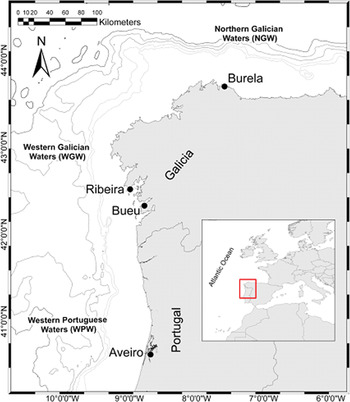
Commercial lots of specimens of E. cirrhosa from bottom trawler commercial vessels were monthly collected from February 2009 to January 2011 in Burela (northern Galician Waters, NGW) and Bueu or Ribeira, (western Galician waters, WGW). Moreover, animals sampled in Aveiro (western Portuguese waters, WPW) were caught from March 2010 to July 2011 (Figure 1). A total of 4127 animals were studied.
North-west Iberian waters showing the sampling sites in north Galician waters (NGW), west Galician waters (WGW) and west Portuguese waters (WPW).

All animals were kept frozen at −20°C until further examination. After being defrosted at room temperature, all individuals were weighed, measured and sexed. Total length (TL) and dorsal mantle length (ML) were measured to the nearest 0.01 cm, and body weight (BW) and eviscerated body weight (EBW) were taken to the nearest 0.1 g. Macroscopic maturity scale of Inejih (Reference Inejih2000) was adapted to assign a specific maturity stage to each individual. For males this scale was as follows: I: immature, II: maturing, III: pre-spawning, with some spermatophores in Needham's sac, and IV: mature, fully developed spermatophore, and for females: I: immature, II: maturing, III: pre-spawning, IV: mature and V: post-spawning.
Whenever possible, a subsample of 30 individuals of each sex and sample site were randomly selected every month for detailed analysis of reproductive cycle. Gonad weight (GW), testis weight (TW), Needham complex weight (NCW) and spermatophoric sac weight (SSW) were recorded for males. Gonad weight (GW), ovary weight (OW), oviducal complex weight (OCW) and oviducal glands diameter (OGD) were obtained from females. All weights were taken to the nearest 0.001 g and OGD was measured to the nearest 0.1 mm.
Mature males (stage IV) and pre-spawning/mature females (stages III and IV) gonads were stored in 70% ethanol and 4% formalin, respectively. These samples were used to assess fecundity. Potential fecundity (PF) in stages III and IV females was estimated by counting the number of vitellogenic oocytes of all sizes present in a known mass of ovary taken from ovary surface, from the ovary core and from intermediate layer, according to Laptikhovsky (2000), and extrapolating to the whole ovary mass. Average length of oocytes was inferred by taking a random sample of 25 oocytes from the ovary and then measuring to the nearest 0.01 mm. Relative fecundity was calculated as the ratio of PF and BW. Concerning males, all the spermatophores present inside the Needham sac were counted in mature ones. The length of all spermatophores was measured to the nearest 0.01 mm.
Digestive gland weight (DGW) was obtained to the nearest 0.01 g in order to calculate the digestive gland index (DGI = (DGW/(BW–DGW)) × 100) for assessing condition state (Castro et al., Reference Castro, Garrido and Sotelo1992). With the purpose of checking if energy for gonadic maturation comes from feeding or from somatic tissue, three regressions were performed for males and females in each coastal side, using ML as independent variable and GW, EBW and DGW as the dependent variables, following methodology described by McGrath & Jackson (Reference McGrath and Jackson2002). Relationships between standardized residuals were analysed, so that if, for example, energy for gonad growth would be obtained at the expense of muscle tissues, a negative correlation between ML–GW and ML–EBW residual pairs would be expected.
Length–weight relationships were performed for males and females in different seasons and maturity stages by fitting the data to the equation BW = a × MLb using the ordinary least square method. The value of b expresses the allometry level. Significant differences from 3 (isometry) were evaluated by linear transformation of the potential equation (y = a × x b→ log y = log a + b × log x), calculating confidence interval of b and then checking whether value 3 was within the range.
Reproductive cycle was assessed by monthly progression of sex-ratio (females:males), macroscopic maturity stages and also by the variation of the following indices: gonadosomatic index (GSI): GSIm = (TW/BW–TW) × 100; GSIf = (OW/(BW–OW) × 100, and Hayashi index following Guerra (Reference Guerra1975): HIm = NCW/(NCW + TW); HIf OCW/(OCW + OW). The GSI indicates the relative weight of the gonad on the total weight of the individual and the HI indicates the relative weight of NCW and OCW on the gonad weight of males and females, respectively.
Mature males and females (stage IV) were used to calculate the size-at-maturity (ML50%) and the percentage of mature individuals per month. ML50% was estimated by fitting relative length–frequency distribution for 10 mm mantle length–classes to a logistic curve with the formula: P i = 1/(1 + exp[−α + βMLi]), where ML50% = −α/β (Sifner & Vrgoc, Reference Sifner and Vrgoc2009). Non-linear least squares fitting method was used. Weight at 50% maturity (BW50%) was calculated following the same method.
Pearson (r) and Spearman-rank correlation (Sr), in the case of non-normal data, were used for evaluating covariation between variables. Differences in variables among categorical predictors were tested using non-parametric Kruskal–Wallis test for multiple comparisons and Mann–Whitney for paired comparisons, because assumptions of normality and homocedasticity were not fulfilled. Follow-up tests were conducted to evaluate pairwise differences among the three groups, controlling for Type I error across tests by adjusting of alpha using the Bonferroni approach (αt). All data were treated with the statistical software STATISTICA 6.0.
RESULTS
A total of 4127 individuals (1042 males, 3079 females and six indeterminate) were analysed during the present study. The specimens sampled were geographically distributed as follows: 1271 individuals (885 females, 383 males and three undetermined) in NGW; 2072 individuals (1482 females, 588 males and two undetermined) in WGW, and 783 individuals (712 females, 71 males and one indeterminate) in WPW. Due to the high predominance of females in all sampled sites and samples, the number of males in certain months did not reach the intended 30 individuals. In these cases, all available males were analysed.
Length–weight relationships
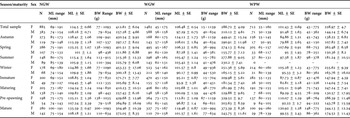
Size and weight data of individuals sampled by sex, season, maturity stage and sampling sites are shown in Table 1. Kruskal–Wallis tests showed differences in size comparing separately males and females through all three sites (P < 0.05). Mann–Whitney U-tests showed in each site significant differences in BW and ML between males and females (P < αt).
Number, size and weight data of individuals sampled by sex, season and maturity stage by sampling site.

For abbreviations, see text.
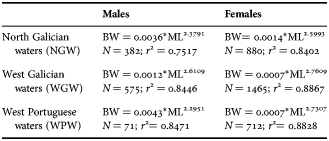
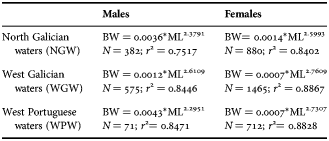
Given the size differences between males and females, equations were calculated for each sex and sampling area (Table 2). Values of b ranged from 2.29 to 2.76 and were always significantly lower than 3 for these fittings and also for both sexes in all seasons and maturity stage (data not shown), indicating overall negative allometric growth. Highest values of b were obtained for females in all cases.
Length–weight fitting adjustment for males and females in NGW, WGW and WPW.
Sex-ratio
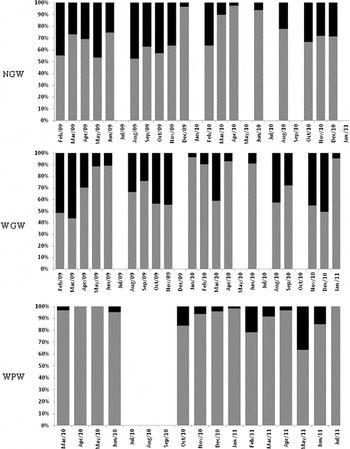
Overall sex-ratio (females: males) was significantly biased to females, representing 74.71% of the whole sample. Sex-ratio was also biased to females through sampling zones. Sex-ratio was 2.31:1, 2.52:1, and 10.02:1, for NGW, WGW and WPW, respectively. Comparison between sex-ratio through sampling location showed significant differences between Galician and Portuguese samples (P < αt). General percentages of males and females are shown in Figure 2. Females predominated over males in all samples with the exception of February–March 2009 and December 2010 in WGW. Nevertheless, in these cases the ratio was close to 1:1 and there was not found a predominance of males over females.
Sex-ratio temporal variation in north Galician waters (NGW) (performed from February 2009 until December 2010), west Galician waters (WGW) (performed from February 2009 until January 2011) and west Portuguese waters (WPW) (performed from March 2010 until July 2011). Black and grey areas show proportion of males and females, respectively.

Maturity stages, spawning season and size and weight at first maturity
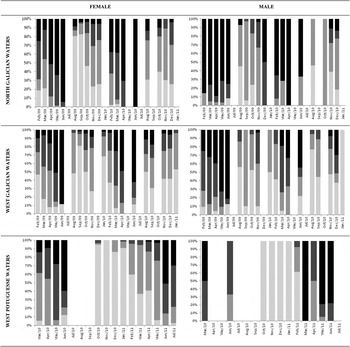
A total of 2576 specimens (833 males and 1743 females) were used for these analyses. Size and weight of mature males (stage IV) varied from 70 to 158 mm ML and 77 to 634 g BW, respectively. ML and BW in females (stages III and IV) ranged from 73 to 191 mm and BW from 67 to 1159 g, respectively. Monthly evolution of the maturity stages percentage for males and females in sampling sites are shown in Figure 3. Fully mature females were present in NGW and WGW almost throughout the year. However, they disappeared from September to March in WPW. A peak of mature females appeared in May–June. Immature females appeared immediately after mature peak and were present during winter in all sites and increasing their proportion to the south. In WPW the predominance of immature specimens extends from August to February. Post-spawning females were not found in any of the sampled locations.
Temporal variation in maturity stages for males and females for north Galician waters (February 2009 until December 2010), west Galician waters (February 2009 until January 2010) and west Portuguese waters (March 2010 until July 2011). Increasing grey scale shows maturity stages. Lighter grey, stage I (immature); intermediate grey, stage II (maturing); dark grey, stage III (pre-spawning); black, stage IV (mature individuals).

Mature males were present from early winter to late summer, exhibiting a wider maturation season, with a peak in spring. Males matured at smaller sizes than females. Concerning WPW males, data are clearly biased in April 2010, due to the scarce number of males found in this sample (N = 2), but seem to follow the same seasonal pattern as in northern samples. As in females, proportion of immature males increased towards the south.
After reaching the peak of abundance of mature individuals, stages II and III specimens almost disappear for one or two months in which the population consists in a decreasing proportion of mature individuals and a sudden growing proportion of immature.
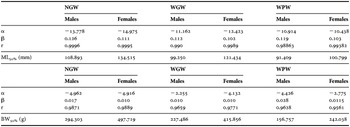
Logistic fit coefficients and estimations of ML50% and BW50% for each sex and sampling site are shown in Table 3. Both ML50% and BW50% increase from the south towards northern waters, for both males and females.
Logistic fit parameters and ML50% and BW50% for males and females in NGW, WGW and WPW.

Reproductive outputs and potential/relative fecundity
Mantle length (ML) and gonad weight showed a significant correlation in both males (rs: 0.73; P < 0.05) and females (rs: 0.63; P < 0.05).
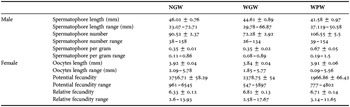
Overall number of spermatophores for mature males ranged from 26 to 158, with an average of 86.55 ± 1.89 (mean ± standard error.). Spermatophore length ranged from 23.07 to 72.71 mm, with an average of 44.97 ± 0.29 mm. The overall number of spermatophores per gram of BW in males ranged from 0.08 to 1.5, with a mean of 0.39 ± 0.22 spermatophores g−1. Table 4 shows the overall number of spermatophores and their sizes, as well as the number of spermatophores per gram of BW in each sampling location.
Overall reproductive outputs and potential/relative fecundity for males and females in each sampling location.

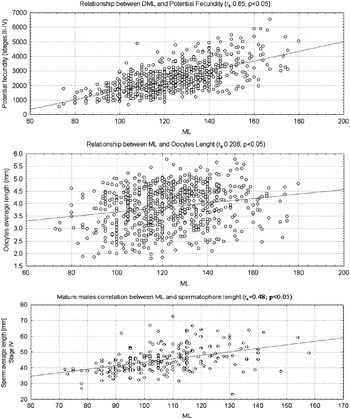
Significant differences were found (Mann–Whitney U-tests; P < αt) in the number of spermatophores among the three sampled zones, and also concerning their size, except among WGW and WPW. A positive correlation was found between ML and spermatophore length in mature males (rs: 0.48; P < 0.05; see Figure 4), but not between ML and spermatophore number (P > 0.05).
Relationships between potential fecundity (PF), oocytes size and spermatophores size versus mantle length (ML).

Potential fecundity in pre-spawning and mature females ranged from 547 to 6545 oocytes per ovary, with an average of 2453 ± 36. Length of oocytes ranged from 0.09 to 5.78 mm with a mean of 3.89 ± 0.03 mm. Overall relative fecundity (RF) in whole sampled females ranged from 2.57 to 17.67 oocytes/g, with a mean of 6.58 ± 0.13 oocytes/g. PF, RF and oocytes sizes in each sampling site are shown in Table 4.
Positive correlation between PF and ML (rs: 0.63; P < 0.05) was found, and also between oocytes length and ML, although it was quite weak (rs: 0.21; P < 0.05) (Figure 4). PF increased with latitude, showing significant differences (Mann–Whitney U-tests; P < 0.05) among sampling sites, but oocytes sizes did not.
Eight females (0.26% of total females) were fertilized, presenting spermatangia inside the ovary. Six of them were mature individuals (stage IV), captured in winter and late spring, but two were pre-spawning animals (stage III) caught in late spring and late summer.
Gonadal and condition indices (GSI and HI)
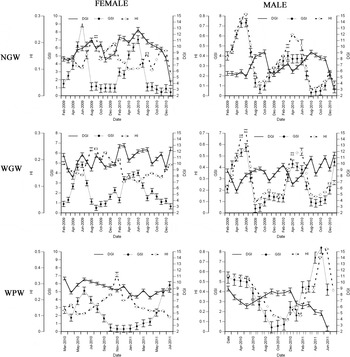
Monthly evolution of GSI, HI and DGI by sex are showed in Figure 5. Gonadic indices trends in females were similar in NGW, WGW and WPW, showing a negative overall correlation between GSI and HI (rs = −0.54; P < 0.05). Lower values of HI correspond with high maturity and vice versa. GSI reach higher values in NGW than in WGW or WPW females.
Temporal variation of gonadal (GSI and HI) and condition (DGI) indices for males and females in north Galician waters (NGW), west Galician waters (WGW) and west Portuguese waters (WPW).

Digestive gland index (DGI) in females had an annual maximum during the spring and summer, showing significant positive correlation with GSI (rs = 0,12; P < 0.05), and also with ML, BW, and maturity stage; and negative correlation with HI (rs = −0.10; P < 0.05).
Temporal evolution of male gonadic indices (GSI and HI) followed a parallel pattern, showing significant positive correlation (rs = 0.96, P < 0.05) and negative with DGI (rs = −0.60 and rs = −0.55, respectively) (P < 0.05). Males DGI also showed negative correlation with ML, BW and maturity stage (P < 0.05).
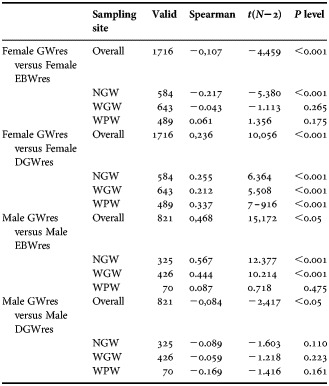
Overall standardized residual analysis parameters are shown in Table 5. Correlation between GW–ML residuals and DGW–ML residuals was significant and positive for females of each coastal side, suggesting that increment of gonad condition was not acquired at the expense of digestive gland reserves. Results for the analysis between GW–ML residuals and EBW–ML residuals showed weak negative correlation for NGW specimens and no correlation in WGW and WPW. Concerning males, no significant correlation was found between GW–ML residuals and DGW–ML residuals. Analysis between GW–ML and EBW–ML standardized residuals showed positive correlation in NGW and WGW sampling sites. WPW data analysis showed no correlation.
Standardized residual correlations parameters.

DISCUSSION
Comparing geographical areas, males and females of E. cirrhosa inhabiting north-western Iberian waters were of intermediate body size on average when compared with their conspecifics of the same sex of Scottish waters, where females reach up to 2 kg BW, being the smaller animals from the western Mediterranean (Boyle et al., Reference Boyle, Mangold and Ngoile1988). This gradient was also observed in our study, where Portuguese individuals reached smaller sizes than their northern neighbours. Sampling bias, due to some differences in gears selectivity and fishing techniques, may influence the explanation of that gradient. However, as indicated by Boyle et al. (Reference Boyle, Mangold and Ngoile1988) when Aberdeen (Scotland) and Banyuls (western Mediterranean) populations are compared, it is highly unlikely that these differences result from selective sampling. In our case (Galician and Portuguese waters), it is also more plausible because fishing operations are undertaken in a very similar manner in both geographical zones, since several trawlers fished in a wide area of comparable bottom topography and depths, and with the same mesh size. Size differences between animals of the same cephalopod species from different geographical areas were presented in several occasions. Thus, the squid Loligo forbesii from Azores differs markedly from those collected in continental shelf European waters (Pierce et al., Reference Pierce, Thorpe, Hastie, Brierley, Guerra, Boyle, Jamieson and Avila1994). Although body dimensions were correlated with average sea-surface, these authors indicate that it is unlikely that size differences can be accounted for simply in terms of the effect of water temperature and that it remains possible that the response to environmental factors is under genetic control. On the other hand, distinct and significant geographical clines in microsatellite allele frequencies (Perez-Losada et al., Reference Perez-Losada, Guerra, Carvalho, Sanjuan and Shaw2002) and allozyme alleles (Perez-Losada et al., Reference Perez-Losada, Guerra and Sanjuan1999) were observed extending between the Atlantic and Mediterranean regions sampled within the range of Sepia officinalis. The most commonly proposed causes of clinal patterns in gene frequencies are selection across an environmental gradient, random genetic drift with isolation-by distance effects, and secondary contact and introgression between previously isolated and genetically divergent populations (Perez-Losada et al., Reference Perez-Losada, Guerra, Carvalho, Sanjuan and Shaw2002).
Values of b coefficient in length–weight relationship fitted were significantly lower than 3, indicating an overall negative allometric growth for males and females through all the sampling sites. Our results agreed with those observed by Marano (Reference Marano1993, Reference Marano1996) for E. cirrhosa and were similar to those found in Eledone moschata by Sifner & Vrgoc (Reference Sifner and Vrgoc2009), both of them with animals from the Adriatic Sea.
Bias in sex-ratio similar to that found in this study, mightily biased towards females, was previously reported for this species in Scottish (Boyle & Knobloch, Reference Boyle and Knobloch1982b) and western Mediterranean populations (Mangold-Wirz, Reference Mangold-Wirz1963; Moriyasu, Reference Moriyasu1981) and in a simultaneous comparison undertaken in both areas (Boyle et al., Reference Boyle, Mangold and Ngoile1988). Since E. cirrhosa distribution in the western Mediterranean shows a spatially segregated pattern by sex and maturity stages (Mangold et al., Reference Mangold, Boletzky and Frösch1971), population structure found in any samples could be biased for the area inhabited by the individuals. Thus, Mangold-Wirz (Reference Mangold-Wirz1963) found that males dominated over females during the reproduction period. Eledone moschata also showed male dominance in Tunisian waters (Ezzedine-Najai, Reference Ezzedine-Najai1997) as well as in the Adriatic Sea during summer time (Sifner & Vrgoc, Reference Sifner and Vrgoc2009). However, Silva et al. (Reference Silva, Ramos and Sobrino2004) found that females of this species dominated significantly throughout a sampling period of one year in the Gulf of Cádiz. Fishing ground selection by commercial trawlers, which varies throughout the year depending on target species, depth, substrate composition and distance from the coastline, could account for the variation in sex-ratio found. Furthermore, the smaller size of males would naturally cause them to be under-represented in trawl-caught samples (Boyle et al., Reference Boyle, Mangold and Ngoile1988). In any case, the lack of detailed data on the specific catch location of commercial trawlers prevents a plausible explanation of this imbalance. On the other hand, sex-ratio differences throughout the year are deeply supported if bias toward one sex occurs in all sampled areas at the same time and, in consequence, occasional differences on this matter should be considered less important to obtain an accurate pattern of sex-ratio.
The evolution of maturity stages as well as the condition and gonadic indices of E. cirrhosa females suggest that the spawning season of the species in Atlantic Iberian waters is concentrated in late spring and early summer. Also there were no clear differences in the reproductive season between different sampling areas. This pattern of seasonality is comparable to that described in the Mediterranean (Mangold-Wirz, Reference Mangold-Wirz1963; Moriyasu, Reference Moriyasu1988; Lefkaditou & Papaconstantinou, Reference Lefkaditou and Papaconstantinou1995), but occurs more earlier than the spawning season found in Scottish waters (Boyle & Knobloch, Reference Boyle and Knobloch1983), where it extends from July to September. Data about the spawning season of the congener E. moschata in the Gulf of Cádiz (Silva et al., Reference Silva, Ramos and Sobrino2004) and the Adriatic Sea (Sifner & Vrgoc, Reference Sifner and Vrgoc2009), covering from March to August, suggests that latitude, through day – night duration, is an important parameter influencing sexual maturation. Furthermore, a previous publication points to a relationship between optic glands enlargement and female gonad maturation in E. cirrhosa (Boyle & Thorpe, Reference Boyle and Thorpe1984), suggesting that light perception might be involved in maturation process. Our data shows an increasing proportion of immature individuals southward in all sampling sites and for both males and females, suggesting a latitudinal effect over life-cycle, as has been suggested for other cephalopods in the eastern Atlantic like Loligo forbesii (Boyle et al., Reference Boyle, Pierce, Hastie, Wang, Santos, Robin and Jereb2004; Thomas et al., Reference Thomas, Challier, Santos, Pierce, Moreno, Pereira, Cunha, Porteiro, Gonçalves and Robin2004) or Ilex coindetii (Arvanitidis et al., Reference Arvanitidis, Koutsoubas, Robin, Pereira, Moreno, Cunha, Valavanis and Eleftheriou2002).
This is the first time that size and weight at first maturity is determined for E. cirrhosa in Atlantic waters. Samples from NGW and WGW showed larger sizes at first maturity than WPW. Portuguese samples showed a ML50% similar to those reported by Soro & Piccinetti (Reference Soro and Piccinetti1989) in the Adriatic Sea. These results also match a general scenario of latitudinal gradient of variation.
In terms of reproductive parameters, previous literature indicated important differences in the number of oocytes in mature females from Atlantic and Mediterranean samplings (Boyle et al., Reference Boyle, Mangold and Ngoile1988). In North Atlantic populations, ovaries from mature females have more and larger oocytes than those belonging to Mediterranean samples, although Boyle (Reference Boyle and Boyle1983) suggested that those differences could be due to real differences in populations or to the methods of estimation. Concerning males, the number of spermatophores is also higher in populations from northern Europe. However, their size-range is similar and even larger in individuals from the Mediterranean (Boyle & Knobloch, Reference Boyle and Knobloch1984). Differences found in spermatophore number and size studied herein, as well as the positive correlation found between ML and spermatophore length, agreed with previous publications for this species (Boyle & Knobloch, Reference Boyle and Knobloch1982a, Reference Boyle and Knobloch1984). No correlation was found between ML and spermatophore number (P > 0.05).
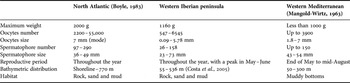
The range of the number of oocytes (potential fecundity) given by Boyle & Knobloch (Reference Boyle and Knobloch1983) was 5 times higher than that estimated in the present paper. Nevertheless, it seems that PF in Scotland is higher than that in Iberian waters, as shown in Table 6.
General reproductive and ecological traits of Eledone cirrhosa from three different studied areas.

Since GSI represents the percentage of ovary weight on the total weight of the individual, higher values in northern samples (Figure 3) might be due to a higher percentage of mature individuals northwards, unbalancing the average.
Considerable debate exists over the role of the digestive gland as a storage organ and its use for ripeness in cephalopods. Available information on this subject is often sketchy and even opposite. Somatic tissues have been found to show structural–biochemical changes. Octopus mimus shows decreased weight of the digestive gland and muscle mass during the spawning and egg care phases (Zamora & Olivares, Reference Zamora and Olivares2004). However the absence of post-spawning data in E. cirrhosa prevents us discussing this subject. Obtained data on the relationships between the gonadosomatic and Hayashi indices versus DGI indicate that the energy needed for the gonad ripeness in females comes from the diet instead of from endogenous reserves, suggesting that digestive gland would not act as a storage organ in this species. Our data are inconclusive about the use of muscle tissues for gonadic ripeness in females; nevertheless, relationships between standardized residuals from regressions suggest no gonadic growth at the expense of digestive gland tissues. This conclusion agrees with Rosa et al. (Reference Rosa, Costa, Pereira and Numes2004b) for E. cirrhosa and E. moschata and also with reports on other octopods, like O. vulgaris and O. defilippi, that use energy from food rather than from stored products for egg production (Rosa et al., Reference Rosa, Costa and Numes2004a). This model contrasts with that proposed by O'Dor & Wells (Reference O'Dor and Wells1978), according to which O. vulgaris body musculature would be the energy supplier for final stages of maturation. Other publications support the hypothesis that digestive gland would not act as a storage organ, like Castro et al. (Reference Castro, Guerra, Jardon and Boucaud-Camou1991) in Sepia officinalis or Semmens (Reference Semmens1998) in loliginid squids Sepioteuthis lessoniana and Photololigo sp.
Females DGI annual maximum during spring and summer observed in our data was also found in Octopus vulgaris off the Galician coasts (Otero et al., Reference Otero, González, Sieiro and Guerra2007) matching with the reproduction period and with the seasonal upwelling phenomenon occurring during the summer months. The negative correlation found between GSI and HI versus DGI in males seems to indicate an opposite scenario. However, further and more detailed analyses are needed to clarify that issue, on which very few data exist in the literature.
ACKNOWLEDGEMENTS
We thank M. Ferreira and J.V. Vingada for their help to get Portuguese samples and M.T. Fernández and M.E. García for technical assistance during the sampling. We also acknowledge the improvements made by the editor and the two referees, which largely improved the paper. This research was supported by the project ‘Impacto do ambiente sobre o polbo Eledone cirrhosa no sistema de afloramento costeiro das augas de Galicia’ (INCITE08PXIB402074PR), funded by Xunta de Galicia. Marcos Regueira was supported by a FCT grant.