


1. INTRODUCTION
Intense laser pulse propagation through plasma channels (Esarey et al., Reference Esarey, Sprangle, Krall and Ting1997) has many application, including x-ray lasers (Korobkin et al., Reference Korobkin, Nam, Suckewer and Goltsov1996), high harmonic generation (Milchberg et al., Reference Milchberg, Durfee III and McIlrath1995) and laser-plasma accelerators (Esarey et al., Reference Esarey, Schroeder and Leemans2009). This has been experimentally demonstrated using plasma channels generated by hydrodynamic expansion (Durfee et al., Reference Durfee and Milchberg1993; Durfee et al., Reference Durfee, Lynch and Milchberg1995; Nikitin et al., Reference Nikitin, Antonsen, Clark, Yuelin and Milchberg1997) or capillary discharges (Ehrlich et al., Reference Ehrlich, Cohen, Zigler, Krall, Sprangle and Esarey1996; Spence et al., Reference Spence, Butler and Hooker2001) created the channel by a twin pulse scheme utilizing the cumulative effects of femtosecond pulse ignition and longer pulse assisted heating. Furthermore, plasma channels have been used to guide intense (>1018 W/cm2) laser pulses for laser-plasma accelerator experiments (Geddes et al., Reference Geddes, Toth, van Tilborg, Esarey, Schroeder, Bruhwiler, Nieter, Cary and Leemans2004; Leemans et al., Reference Leemans, Nieter, Gonsalves, Tth, Nakamura, Geddes, Esarey, Schroeder and Hooker2006). Verma and Sharma (Reference Verma and Sharma2009) studied the prolongation of a gaseous plasma channel formed by a two-pulse technique for laser intensities below the tunnel ionization threshold. Kumar et al. (Reference Kumar, Dahiya and Sharma2011) developed a formalism for the formation of a parabolic radial density profile, n(r) = (1 + n 2r 2/r 02) by a sequence of two pulses and examined the focusing of a third intense pulse of spot size r 0 in the low laser intensity limit, where n 2 and r 2 are related to prepulses. Zhang et al. (Reference Zhang, Xie, Hong, Wu and Zhao2011) investigated the differential equation of the spot size of a Gaussian laser pulse in a preformed plasma channel including the effects of relativistic self-focusing, ponderomotive self-channeling, and preformed channel focusing. The existence of electromagnetic solitary waves should be helpful to enhance charged particle acceleration involving laser-plasma channel interaction.
Plasma channel, produced by radial expulsion of plasma electrons due to the large ponderomotive force of laser, introduces significant nonlocal effects on stimulated Raman scattering. Liu and Tripathi (Reference Liu and Tripathi1996) studied the stimulated Raman forward scattering (SRFS) of a non-relativistic laser pump in a performed cold plasma channel. Shvets and Li (Reference Shvets and Li2001) studied the Raman forward scattering in shallow plasma channels arising due to the radial shear of the plasma frequency and the existence of the weakly damped hybrid (electrostatic/electromagnetic) modes of the radially inhomogeneous plasma. The interplay of these two effects produces double-peaked spectra for the direct forward scattering in a channel. Panwar et al. (Reference Panwar, Kumar and Ryu2012) investigated stimulated Raman forward scattering (SRFS) of an intense short pulse laser in a plasma channel formed by two pre-laser pulses. Normalized growth rate of SRFS increase with density nonuniformity of plasma channels. However, in the presense of a deep plasma channel the focusing is ineffective to laser intensities, but growth rate increases with intensity of main laser pulse.
Linearly, polarized laser in a uniform plasma produces odd harmonics with power peaking at the third harmonic. The energy conversion efficiency is low as the wave number of the third harmonic k 3 does not match three times the wave number of the laser k 0 (k 3 > 3k 0), making it a nonresonant process. Introduction of a density ripple or a magnetic wiggler (Rax et al., (Reference Rax and Fisch1992; Reference Rax and Fisch1993; Liu et al., Reference Liu and Tripathi2008) of wave number k q = (k 3 – 3k 0) can turn the third harmonic generation into a resonant process, greatly enhancing the efficiency. Phase-matched relativistic harmonic generation in a plasma has observed experimentally for the first time by Chen et al. (Reference Chen, Maksimchuk, Esarey and Um- stadter2000). Third harmonic light is detected in forward direction by varying the temporal delay and the energy of the laser pulse. Shibu and Tripathi (Reference Shibu and Tripathi1998) have studied the phase-matched third harmonic generation of a laser beam propagating through a plasma channel without non-uniformity and showed that the presence of a background density perturbation can account for phase-matching. Liu and Triapthi (Reference Liu and Tripathi2008) studied the resonant third harmonic generation of a Gaussian laser pulse in rippled density plasma created by a machining beam. The energy conversion efficiency scales as the square of plasma density and square of depth of density ripple. Kuo et al. (Reference Kuo, Pai, Lin, Lee, Lin, Wang and Chen2007) have reported the enhancement of relativistic third harmonic generation by using an optically preformed periodic plasma waveguide. Resonant dependence of harmonic intensity on plasma density and density modulation parameters was also observed. Deepak et al. (Reference Dahiya, Sajal and Sharma2007) have carried out particel in cell (PIC) simulations of harmonic generation in a plasma density ripple and their scaling of efficiency with laser intensity, ripple amplitude, and plasma density. Sodha et al. (Reference Sodha, Faisal and Verma2009) investigated third harmonic generation caused by the self-focusing of a Gaussian electromagnetic beam in collisional plasmas. Self-focusing of the fundamental beam enhances the power of the third harmonic output indicating that the region of third harmonic generation is localized near the axis of the beam.
In the present work, we show that the effect of plasma channel non-uniformity on resonant third harmonic generation. A laser pulse can be successfully self-focused and compressed in underdense plasma due to relativistic mass nonlinearity and plasma channel non-uniformity. Here we consider a non-uniform plasma channel with a density ripple n q = n q0e ik qz, where  $ \vec k _{q} \Vert \vec k _{0} $. A linearly polarized main laser pulse
 $\vec E _{0 } \lpar {\rm \omega} _0 \comma \; \vec k _{0} \rpar $ induces an oscillatory velocity
 $\vec {\rm \upsilon}_{0 } \lpar {\rm \omega} _0 \comma \; \vec k _{0} \rpar $ to the electrons and exerts a non-linear ponderomotive force
 $\lpar \vec {\rm \upsilon} _{0 } \times \vec B _{0} \rpar $. Ponderomotive force producing oscillatory velocity
 $\vec {\rm \upsilon} _{2{\rm \omega} _0 \comma 2k_0 } $ and beats with n q to produce a density oscillation
 $ n_{2w_{0},\;2k_{0}+k_{q}} $. This density beats with
 $\vec {\rm \upsilon} _{0 } \lpar {\rm \omega} _0 \comma \; \vec k _{0} \rpar $ to produce a nonlinear current, resonantly driving the third harmonic when (3k 0 + k q) equals the third harmonic wave number.
We study the laser pulse self-focusing and compression through the non-uniform rippled plasma channel in Section 2. In Section 3, we analyze the resonant third harmonic generation including self-focusing and compression effects. The results are discussed in Section 4.
2. LASER PULSE COMPRESSION AND SELF-FOCUSING THROUGH A PRE-FORMED RIPPLED PLASMA CHANNEL
Consider a plasma channel with density ripple 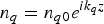 $ n_q = n_{q0}e^{ik_{q}z}$ (Shibu & Tripathi, Reference Shibu and Tripathi1998), the equilibrium electron density becomes,
 $$n\lpar r\comma \; z\rpar = \lpar n_{e0} + n_{q0} e^{ik_q z} \rpar \left({1 + \displaystyle{{n_2 } \over {n_{e0} }}\displaystyle{{r^2 } \over {r{}_2^2 }}} \right)\comma \;$$
where the electron density on channel axis n e0 ≫ n q0, plasma channel non-uniformity n 2/n e0, and spot size r 2 are related to the properties of channel (Ashok et al., 2011). The laser pulse propagates through rippled plasma channel with electric field,
 $$\vec E _0 = \widehat x A_0 \lpar r\comma \; z\comma \; t\rpar e^{ - i\lpar {\rm \omega} _0 t - k_0 z\rpar } \comma \;$$
where k 0 = (ω0/c)η0, η0 is the refractive index of the plasma, and A 0(r, z, t) is the slowly varying complex amplitude of the laser. At z = 0,
 $$A_0 \vert _{z = 0}^2 = A_{00}^2 e^{ - r^2 /r_0^2 } e^{ - t^2 /{\rm \tau} _0^2 } \comma \; $$
where r 0 and τ0 are the beam radius (in cylindrical coordinates) and pulse width (in time), respectively. And A 00 is the amplitude of the beam at axis. At z > 0, laser beam amplitude is modified as,
 $$\vert A_0 \vert ^2 = \displaystyle{{A_{00}^2 } \over {g{\rm }f^2 }}e^{ - r^2 /r_0^2 f^2 } e^{ - t^2 /{\rm \tau} _0^2 g^2 } \comma \;$$
where f and g represent the beam width parameter (in space) and pulse width parameter (in time), respectively. The electron response to laser pulse from momentum equation becomes,
 $$m_e {\rm \gamma} \displaystyle{{\partial \vec {\rm \upsilon} _0 } \over {\partial t}} = - e\vec E _0 \comma \; $$
where −e and m e are electronic charge and mass, respectively, and relativistic gamma factor  $ \gamma=(1 + (a^{2}_{00}e^{-r^{2}/r_{0}^{2}\,f^{\,2}/}e^{-t^{2}/\tau_{0}^{2}g^{2}})/2g\,f^{2})^{1/2} $ is described in terms of noramalized laser amplitude a 002 = |e A 00/m eω0c|2. Here we also have neglected
 $\lpar \vec {\rm \upsilon} _{0} \times \vec B _{0} \rpar $, because of its twice high frequency. The electron current density at the main laser frequency
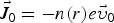 $\vec J_0 = -n\lpar r\rpar e\vec {\rm \upsilon} _0$ gives,
 $$\partial _t \vec J _0 = - n\lpar r\rpar e\partial _t \vec {\rm \upsilon} _0 = n\lpar r\comma \; z\rpar \displaystyle{{e^2 \vec E _0 } \over {m_e {\rm \gamma} }}.$$
The wave equation governing the electric field of the pump laser beam in plasma can be drived from Maxwell's equations. Using Maxwell's equations in MKS units,
 $$\nabla ^2 \vec E _0 - \nabla \lpar \nabla \cdot \vec E _0 \rpar - {\rm \mu} _0 \displaystyle{{\partial \vec J _0 } \over {\partial t}} - \displaystyle{1 \over {c^2 }}\displaystyle{{\partial ^2 \vec E _0 } \over {\partial t^2 }} = 0 $$
where  $c = 1/\sqrt {{\rm \mu} _0 {\rm \varepsilon} _0 } $ is the speed of light in free space. For a transverse electromagnetic fields (such as linear polarized)
 $\nabla \cdot \vec E _0 = 0$. Using Eq. (1) and Eq. (6) into wave equation Eq. (7).
 $$\eqalign{& 2ik_0\displaystyle{\partial \over {\partial z^\prime }}A_0 + \nabla _ \bot ^2 A_0 + {\rm \beta} \displaystyle{\partial \over {\partial {\rm \tau} ^2 }}A_0 \cr &\quad - \left[{k_0^2 - \displaystyle{{{\rm \omega} _0^2 } \over {c^2 }}\left({1 - \displaystyle{{{\rm \omega} _{\,p0}^2 /{\rm \gamma} } \over {{\rm \omega} _0^2 }}\left({1 + \displaystyle{{n_2 } \over {n_{e0} }}\displaystyle{{r^2 } \over {r_2^2 }}} \right)} \right)} \right]A_0 = 0\comma} $$
where  ${\rm \beta} = \left({1/c^2 } \right)\sqrt {1 - {\rm \varepsilon} _{e f f0}/{\rm \varepsilon} _{e f f0}} $, and transforming the variables z and t to z = z and τ = (t − z/υg), respectively. Here the parallel variation of the amplitude A 0 in terms of z is assumed to be slower than the transverse one (in r), therefore terms in ∂2/∂z′∂τ and ∂2/∂z′2 can be neglected. The third term in Eq. (8) is known as the group velocity dispersion (GVD) term and it results in pulse compression when combined with (balanced by) nonlinearity. One can expand γ by using Taylor's expansion,
 $$\displaystyle{1 \over {\rm \gamma} }\lpar r\comma \; t\rpar = \displaystyle{1 \over {{\rm \gamma} _0 }}\left({1 + \displaystyle{{a_{00}^2 r^2 /4r_0^2 g{\rm }f^{\rm 4} } \over {1 + a_{00}^2 /2g{\rm }f^{\rm 2} }} + \displaystyle{{a_{00}^2 t^2 /4{\rm \tau} _0^2 g^3 {\rm }f^{\rm 2} } \over {1 + a_{00}^2 /2g{\rm }f^{\rm 2} }}} \right)\comma \; $$
where γ0 = (1 + a 002/2)1/2 is the value of γ on the axis. We get the total dielectric constatnt,
 $${\rm \varepsilon} \lpar r\comma \; z\comma \; t\rpar = {\rm \varepsilon} _{ef\,{\rm }f0} + {\rm \varepsilon} _{2r} r^2 + {\rm \varepsilon} _{2t} t^2 \comma \;$$
where
 $$\eqalign{& {\rm \varepsilon} _{2r} = \displaystyle{{ - {\rm \omega} _p^2 } \over {{\rm \omega} _0^2 r_0^2 {\rm \gamma} _0 }}\Phi _{2r} \comma \; \Phi _{2r} = \left({\displaystyle{{n_2 } \over {n_{e0} }}\displaystyle{{r_0^2 } \over {r_2^2 }} + \displaystyle{{a_{00}^2 } \over {4g{\rm }f^4 \left({1 + a_{00}^2 /2g{\rm }f^{\rm 2} } \right)}}} \right)\comma \; \cr & {\rm \varepsilon} _{2t} = - \displaystyle{{{\rm \omega} _p^2 } \over {{\rm \omega} _0^2 {\rm \tau} _0^2 {\rm \gamma} _0 }}\Phi _{2t} \comma \; \, \, \, \Phi _{2t} = \displaystyle{{a_0^2 } \over {4g^3 {\rm }f^2 \left({1 + a_{00}^2 /2g{\rm }f^{\rm 2} } \right)}}.} $$
and
And using  $k_0 = \left({{\rm \omega} _0 /c} \right)\sqrt {{\rm \varepsilon} _{ef f 0}} $, we get the wave equation Eq. (9),
 $$\left({2ik_0 \displaystyle{\partial \over {\partial z^\prime }} + \nabla _ \bot ^2 + {\rm \beta} \displaystyle{{\partial ^2 } \over {\partial {\rm \tau} ^2 }}} \right)A_0 + \displaystyle{{{\rm \omega} _0^2 } \over {c^2 }}\left({{\rm \varepsilon} _{2r} r^2 + {\rm \varepsilon} _{2t} t^2 } \right)A_0 = 0.$$
This equation describes the propagation of laser pulse through the plasma with relativistic mass nonlinearity and plasma channel non-uniformity. In the simplified analytical model, we take into account the nonlinearity by relativistic mass and plasma channel non-uniformity, and neglect electron density perturbation. Eq, (12) is a nonlinear Schrödinger equation, where third term in the first bracket representing the dispersion broadening and second bracket term representing the nonlinear compression. When the two effects balance each other, one obtains a coherent structure in the form of a solitary wave. Now, following Akhmanov et al. (1996) and Sodha et al. (Reference Sodha, Ghatak and Tripathi1974) to evaluate the pulse evolution we introduce an eikonal approximation, A 0 = A 00exp(iS), where A 00(r, z′, τ) and S(r, z′, τ) are real functions and separate out the real and imaginary parts of the resulting equations,
 $$\eqalign{& - 2k_0 \left({\displaystyle{{\partial S} \over {\partial z^\prime }}A_{00} } \right)+ \left[{\displaystyle{1 \over r}\left({\displaystyle{{\partial A_{00} } \over {\partial r}}} \right)+ \displaystyle{{\partial ^2 A_{00} } \over {\partial r^2 }} - A_{00} \left({\displaystyle{{\partial S} \over {\partial r}}} \right)^2 } \right]\cr & + {\rm \beta} \left[{\displaystyle{{\partial ^2 A_{00} } \over {\partial {\rm \tau} ^2 }} - A_{00} \left({\displaystyle{{\partial S} \over {\partial {\rm \tau} }}} \right)^2 } \right]+ \displaystyle{{{\rm \omega} _0^2 } \over {c^2 }}\left({{\rm \varepsilon} _{2r} r^2 + {\rm \varepsilon} _{2{\rm \tau} } {\rm \tau} ^2 } \right)A_{00} = 0\comma \; }$$
and
 $$\eqalign{& k_0 \displaystyle{{\partial {\rm }A_{00}^2 } \over {\partial z^\prime }} + \left({\displaystyle{{\partial ^2 S} \over {\partial r^2 }} + \displaystyle{1 \over r}\displaystyle{{\partial S} \over {\partial r}}} \right)A_{00}^2 + \displaystyle{{\partial A_{00}^2 } \over {\partial r}}\displaystyle{{\partial S} \over {\partial r}} \cr & + {\rm \beta} \left[{\displaystyle{{\partial A_{00}^2 } \over {\partial {\rm \tau} }}\displaystyle{{\partial S} \over {\partial {\rm \tau} }} + A_{00}^2 \displaystyle{{\partial ^2 S} \over {\partial r^2 }}} \right]= 0.} $$
The coupled set of equations for A 002 and S are solved in the paraxial approximation by expanding S only to the first power of r 2 and r 2 such as,
 $$S\lpar r\comma \; z^\prime \comma \; {\rm \tau} \rpar = S_0 \lpar z^\prime \rpar + S_{2r} \lpar z^\prime \rpar \displaystyle{{r^2 } \over {r_0^2 }} + S_{2r} \lpar z^\prime \rpar \displaystyle{{{\rm \tau} ^2 } \over {{\rm \tau} _0^2 }}\comma \; $$
where function f(z′) and g(z′) are,
 $$S_{2r} \lpar z^\prime \rpar = \displaystyle{1 \over {2f}}\displaystyle{{\partial f} \over {\partial z^\prime }}\quad {\rm and}\quad S_{2r} \lpar z^\prime \rpar = \displaystyle{1 \over {2g}}\displaystyle{{\partial f} \over {\partial z^\prime }}\comma \; $$
and S 0(z′) is the axial phase. We obtain the beam width and pulse width parameter equations by collecting coefficient of r 2 and r 2 in terms of dimensionless distance ξ = z/R d,
 $$\displaystyle{{\partial ^2 f} \over {\partial {\rm \xi} ^2 }}{\rm = }\displaystyle{1 \over {\,f^3 }} - \displaystyle{{{\rm \omega} _{\,p0}^2 \Phi _{2r} } \over {{\rm \gamma} _0 {\rm \omega} _0^2 }}\displaystyle{{R_d^2 } \over {r_0^2 }} f\comma \; $$
and
 $$\displaystyle{{\partial ^2 g} \over {\partial {\rm \xi} ^2 }}{\rm = }\displaystyle{{{\rm \beta} ^2 } \over {g^3 }}\displaystyle{{r_0^4 } \over {r_0^4 }} - {\rm \beta} \displaystyle{{{\rm \omega} _{\,p0}^2 \Phi _{2 t} } \over {{\rm \gamma} _0 {\rm \omega} _0^2 }}\displaystyle{{R_d^2 } \over {r_0^2 }}g\comma \;$$
where R d = k 0r 02 is the diffraction length, the first and second term in the right-hand side of above Eq. (17) contribute to the the diffraction divergence and nonlinear self-focusing, respectively. Coupled equations contain nonlinear corrections by relativistic mass and plasma channel non-uniformity. So the self-focusing and compression of main pulse can be controlled by the plasma channel non-uniformity and laser intensity. The boundary conditions at ξ = z′ = 0 for an initially plane wavefront are f = g = 1, ∂f/∂ξ = ∂g/∂ξ = 0 and S 0 = 0. In Figures 1 and 2, we plotted the variation of f and g with respect to ξ for main laser pulse frequency ω0 = 2.8195 × 10¹⁴/s.−1, spot size r 0 = 14 µm, τ0 = 10 ps and normalized pump amplitude a 00 = e |E00|/m eω0c = 0.3. The other parameters are n e0 = 0.85 × 1024 m−3, ωp0/ω0 = 0.18, and the spot size of second laser beam, r 2(>r 0) = 16 µm. The main laser pulse shows the periodic focusing (Fig. 1) and compression (Fig. 2) inside the plasma channels, it increases with increasing density non-uniformity of the plasma channels with n 2/n e0 = 0.1, 0.2, and 0.3. For the main laser pulse with different intensities, a 00 = 0.65, 0.75, 0.85, and 0.95 through a deep plasma channel with non-uniformity n 2/n e0 = 0.3, the variation of f and g with respect to ξ is plotted in Figures 3 and 4, and other plasma paremeters are the same as (Fig. 1). The Self-focusing behavior for different intensities show a similarity due to the ineffectiveness of intensity dependent nonlinearity (Fig. 3), however, pulse compression increases with the main laser intensity (Fig. 4).
(Color online) Variation of beam width parameter f with respect to the normalized propagation distance ξ = z′/R d for a normalized laser amplitude a 00 = 0.3 through different plasma channels with non-uniformities n 2/n e0 = 0, 0.1, 0.2 and 0.3. The other parameters are ω0 = 2.8195 × 10¹⁴ s.−1, r 0 = 14 µm, n e0 = 0.85 × 1024 m−3, τ0 = 10 ps and r 2 = 16 μm.

(Color online) Variation of temporal parameter g with the normalized propagation distance ξ = z/R d for a normalized laser amplitude a 00 = 0.3 in different plasma channels for the parameters same as in Figure 1.
(Color online) Variation of beam width parameter f with the normalized propagation distance ξ = z/R d for different laser amplitudes a 00 = 0.65, 0.75, 0.85, and 0.95 through a deep plasmas channel with non-uniformity n 2/n e0 = 0.3. The other parameters are ω0 = 2.8195 × 10¹⁴ s.−1, r 0 = 14 µm, n e0 = 0.85 × 1024 m−3, τ0 = 10ps and r 2 = 16 µm.
(Color online) Variation of temporal parameter g with the normalized propagation distance ξ = z/R d for different laser amplitudes a 00 = 0.65, 0.75, 0.85, and 0.95through a deep plasma channel with non-uniformity n 2/n e0 = 0.3 for the same parameters same as in Figure 3.
3. THIRD HARMONIC GENERATION
Laser pulse exerts a pondermotive force on electrons at second harmonic (2ω0, 2k 0),
 $$\vec F _{2{\rm \omega} _0 \comma 2k_0} = - \displaystyle{e \over 2}\left({\vec {\rm \upsilon} _0 \times \vec {\rm \beta} _0 } \right)= \displaystyle{{e^2 } \over {2m_e i{\rm \gamma} {\rm \omega} _0 c}}\hat z {\rm \eta} _0 A_0^2 \left({r\comma \; z\comma \; t} \right)e^{ - 2i\Psi } \comma \; $$
where Ψ = (ω0t − k 0z). Ponderomotive force  $\vec F _{2{\rm \omega} _0 \comma 2k_0} $ is primarily along
 $\hat z$ direction and its electron response will be only in the z-direction. The electron oscillatory velocity due to ponderomotive force becomes,
 $$\vec {\rm \upsilon} _{_{2{\rm \omega} _0 } }^{NL} = \displaystyle{{a_{00}^2 c} \over {4{\rm \gamma} }}\hat z {\rm \eta} _0 e^{ - 2i\Psi } .$$
This oscillatory velocity couples with ripple density n q, through the equation of continuity to produce a density perturbation at (2ω, 2k 0 + k q),
 $$n_{2{\rm \omega} _0 \comma 2k_0 + k_q } = \displaystyle{1 \over 2}n\lpar r\rpar \lpar 2\vec k _0 + k_q \rpar \cdot \displaystyle{{\vec {\rm \upsilon} _{2{\rm \omega} _0 \comma 2k_0 } } \over {2{\rm \omega} _0 }} $$
 $$\approx - n_{q0} \left({1 + \displaystyle{{n_2 } \over {n_{e0} }}\displaystyle{{r^2 } \over {r_2^2 }}} \right)\displaystyle{{a_{00}^2 } \over {8{\rm \gamma} }}{\rm \eta} _0 e^{ - i\lsqb 2{\rm \omega} _0 t - \lpar 2k_0 + k_q \rpar z\rsqb } .$$
The perturbation Eq. (22) beats with electron velocity Eq. (5) to give the third harmonic nonlinear current density at (3ω0, 3k 0 + k q),
 $$\eqalign{ \vec J _{3{\rm \omega} _0 \comma 3k_0 + k_q }^{NL} & = - \displaystyle{e \over 2}n_{2{\rm \omega} _0 \comma 2k_0 + k_q } \vec {\rm \upsilon} _{{\rm \omega} _0 \comma k_0 } \cr & = - \hat x \displaystyle{i \over {16{\rm \gamma} ^2 }}n_{q0} eca_{00}^3 {\rm \eta} _0 e^{ - i\lpar 3{\rm \omega} _0 t - \lpar 3k{}_0 + k_q \rpar z\rpar } .} $$
The linear current density due to the self-consistent second harmonic field,  $\vec E _{3{\rm \omega} _0 } $ is
 $$\vec J _{3{\rm \omega} _0 }^L = - \displaystyle{{n\lpar r\rpar e^2 \vec E _{3{\rm \omega}_{0} } } \over {3im_e {\rm \omega} _0 }} \approx - n_{e0} \left({1 + \displaystyle{{n_2 } \over {n_{e0} }}\displaystyle{{r^2 } \over {r_2^2 }}} \right)\displaystyle{{e^2 \vec E _{3{\rm \omega} _0 } } \over {3im_e {\rm \omega} _0 }}\comma \;$$
and the wave equation for third harmonic field,
 $$\nabla ^2 \vec E _{3{\rm \omega} _0 } - \nabla \left({\nabla \cdot \vec E _{3{\rm \omega} _0 } } \right)- {\rm \mu} _0 \displaystyle{{\partial \vec J _{_{3{\rm \omega} _0 } }^L } \over {\partial t}} - \displaystyle{1 \over {c^2 }}\displaystyle{{\partial ^2 \vec E _{3{\rm \omega} _0 } } \over {\partial t^2 }} = {\rm \mu} _0 \displaystyle{{\partial \vec J _{_{3{\rm \omega} _0 } }^{NL} } \over {\partial t}}. $$
Using Eq. (22) and Eq. (24) into Eq. (22) wave equation becomes,
 $$\eqalign{& \nabla ^2 \vec E _{3{\rm \omega} _0 } + \displaystyle{{{\rm \omega} _{\,p0}^2 } \over {c^2 }}\left({1 + \displaystyle{{n_2 } \over {n_{e0} }}\displaystyle{{r^2 } \over {r_2^2 }}} \right)\vec E _{3{\rm \omega} _0 } - \displaystyle{1 \over {c^2 }}\displaystyle{{\partial ^2 \vec E _{3{\rm \omega} _0 } } \over {\partial t^2 }} \cr &\quad = \widehat x S_3 e^{ - i\lpar 3{\rm \omega} _0 t - \lpar 3k_0 + k_q \rpar z\rpar } \comma \; }$$
where S 3 = −3n q0eω0a 003η0/16ɛ0cγ2. We may write  $\vec E _{3{\rm \omega} _0 } = \widehat x A_{3{\rm \omega} _0 } \lpar r\comma \; z\comma \; t\rpar e^{ - \lpar 3{\rm \omega} _0 t - k_3 z\rpar } $ and in terms of slowly varying laser amplitude by using the WKB approximation. Transforming the variables z and t to z and t′ = (t − z/υg3ω0), respectively, and using third harmonic group velocity, υg3ω0 = k 3c 2/3ω0,
 $$\eqalign{& 2ik_3 \displaystyle{{\partial A_{3{\rm \omega} _0 } } \over {\partial z^\prime }} + \nabla _{^ \bot }^2 A_{3{\rm \omega} _0 } + \left({\displaystyle{{9{\rm \omega} _{^0 }^2 - {\rm \omega} _{^{\,p0} }^2 /{\rm \gamma} _0 } \over {c^2 }} - k_3^2 } \right)A_{3{\rm \omega} _0 } \cr & - \displaystyle{{{\rm \omega} _{^{\,p0} }^2 } \over {c^2 }}\displaystyle{{n_2 } \over {n_{e0} }}\displaystyle{{r^2 } \over {r_2^2 }}A_{3{\rm \omega} _0 } = S_3 e^{ - i\Delta z^\prime } \comma \; } $$
where Δ = (k 3 − 3k 0 − k q). We can also write the above equation as,
 $$2ik_3 r_3^2 \displaystyle{{\partial A_{3{\rm \omega} _0 } } \over {\partial z^{\prime} }} + \displaystyle{{\partial ^2 A_{3{\rm \omega} _0 } } \over {\partial {\rm \rho} _3^2 }} + \displaystyle{1 \over {{\rm \rho} _3 }}\displaystyle{{\partial A_{3{\rm \omega} _0 } } \over {\partial {\rm \rho} _3 }} + \left({{\rm \lambda} _3 - {\rm \rho} _3^2 } \right)A_{3{\rm \omega} _0 } = S_3 r_3^2 e^{ - i\Delta z^\prime } \comma \; $$
where r 32 = ((c 2r 22n e0)/n 2ωp02)1/2 and ρ3 = r/r 3. To solve the above equation, we express A 3ω0 as,
 $$A_{3{\rm \omega} _0 } = A_{3{\rm \omega} _0 } \lpar z^\prime \rpar \Psi _n \lpar {\rm \rho} _3 \rpar \comma \; $$
where Ψn (ρ3) are the eigen-functions satisfying,
 $$\displaystyle{{\partial ^2 \Psi _n } \over {\partial {\rm \rho} _3^2 }} + \displaystyle{1 \over {{\rm \rho} {}_3}}\displaystyle{{\partial \Psi _n } \over {\partial {\rm \rho} _3 }} + \left({{\rm \lambda} _3 - {\rm \rho} _3^2 } \right)\Psi _n = 0\comma \; $$
with λ3 = (2n + 1). This equation gives an eigen function, 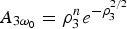 $ A_{{3\omega}_{0}} = \rho_3^n e^{- \rho_3^{2/2}}$. For n = 0 mode, the eigen function
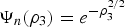 $ \Psi_n (\rho_3) = e^{- \rho_3^{2/2}}$ is Gaussian and eigen value λ3 = 1,
 $$k_3^2 = \displaystyle{1 \over {c^2 }}\left({9{\rm \omega} _0^2 - \displaystyle{{{\rm \omega} _{\,p0}^2 } \over {{\rm \gamma} _0 }} - \displaystyle{{c^2 } \over {r_{{}_3}^2 }}} \right).$$
Now substituting the above solution to the third harmonic wave equation and multiplying the resulting equation by Ψ* and integrating from −∞ to ∞ one obtains,
 $$\displaystyle{{\partial A_{3{\rm \omega} _0 } } \over {\partial z^\prime }} = \displaystyle{{S_3 } \over {2ik_3 }}e^{ - i\Delta z^\prime } . $$
For a Gaussian pulse A 02 = (A 002/2g f 2)e −r 2/r 20f 2e −τ2/τ02g 2 and γ = [1 + (a 002/2g f 2)e −r 2/r 02f 2e −τ2/τ02g 2]1/2 are functions of r and t. For a given k q, one cannot have phase matching (Δ = 0) for third harmonic generation all r and t (Liu & Tripathi, Reference Liu and Tripathi2008). If one matches the ripple wave number at the peak of the laser pulse at ‘r = 0’ and ‘t = 0’ i.e.,
 $$k_q = \lpar k_3 - 3k_0 \rpar = \displaystyle{4 \over 3}\displaystyle{{{\rm \omega} _{\,p0}^2 } \over {{\rm \omega} _0^2 {\rm \gamma} _0 }}\displaystyle{{{\rm \omega} _0 } \over c}\comma \; $$
where γ0 = (1 + a 002/2)1/2, then at other r and t,
 $$\Delta = k_q \left({\displaystyle{{{\rm \gamma} _0 } \over {{\rm \gamma} \lpar r\comma \; t\rpar }}\displaystyle{{{\rm \omega} _p^2 \lpar r\comma \; t\rpar } \over {{\rm \omega} _{\,p0}^2 }} - 1} \right). $$
Using Eq. (34) into Eq. (32) and after integrating with perfect to z′, we get a third harmonic amplitude,
 $$\eqalign{\vert a_{3{\rm \omega} _0 } \vert ^2 & = \left({\displaystyle{1 \over {32}}\displaystyle{{n_{q0} } \over {n_{e0} }}\displaystyle{{{\rm \omega} _0 } \over {k_3 c}}\displaystyle{{{\rm \omega} _{\,p0}^2 } \over {{\rm \omega} _0^2 }}\displaystyle{{a_{00}^3 } \over {{\rm \gamma} ^2 }}} \right)^2 k_0^2 \cr &\quad \times \displaystyle{{Sin^2 \left[{\displaystyle{{k_q } \over 2}\left({\displaystyle{{r_0 } \over {r\lpar r\comma \; t\rpar }}\displaystyle{{{\rm \omega} _p^2 \lpar r\comma \; t\rpar } \over {{\rm \omega} _{\,p0}^2 }} - 1} \right)z^\prime} \right]} \over {\left[{\displaystyle{{k_q } \over 2}\left({\displaystyle{{r_0 } \over {r\lpar r\comma \; t\rpar }}\displaystyle{{{\rm \omega} _p^2 \lpar r\comma \; t\rpar } \over {{\rm \omega} _{\,p0}^2 }} - 1} \right)} \right]^2 }}\comma \; } $$
where the third harmonic normalized amplitude is normalized as, |a 3ω0|2 = |eA 3ω0/3m eω0c|2. For
 $$z^\prime < \displaystyle{2 \over {k_q \left({\displaystyle{{{\rm \gamma} _0 } \over {{\rm \gamma} \lpar r\comma \; t\rpar }}\displaystyle{{{\rm \omega} _p^2 \lpar r\comma \; t\rpar } \over {{\rm \omega} _{\,p0}^2 }} - 1} \right)}}\comma \;$$
we get the normalized third harmonic amplitude,
 $$\vert a_{3{\rm \omega} _0 } \vert ^2 \approx \left({\displaystyle{1 \over {32}}\displaystyle{{n_{q0} } \over {n_{e0} }}\displaystyle{{{\rm \omega} _0 } \over {k_3 c}}\displaystyle{{{\rm \omega} _{\,p0}^2 } \over {{\rm \omega} _0^2 }}k_0 z^\prime} \right)^2 \displaystyle{{a_{00}^6 } \over {{\rm \gamma} ^4 }}. $$
The total power P 3ω0 of the third harmonic across the transverse cross section at any value of z′ can be obtained by integrating a 3ω0a 3ω0* over r from ‘0’ to ∞ (Sodha et al., Reference Sodha, Faisal and Verma2009) and t from −∞ to ∞ (Liu & Tripathi, Reference Liu and Tripathi2008) i.e.,
 $$P_{3{\rm \omega} _0 } = \displaystyle{{c{\rm \eta} _{3{\rm \omega} _0 } {\rm \varepsilon} _0 } \over 2}\vint_0^\infty {} \vint_{ - \infty }^\infty {} a_{3{\rm \omega} _{\rm 0} } a_{_{3{\rm \omega} _{\rm 0} } }^{\ast} 2{\rm \pi} rdrdt\comma \;$$
and initialy pump power at z = 0 and t = 0, P ω0 = (ηω0/2)πr 02a 002. So we get the conversion efficiency of third harmonic across the transverse cross section,
 $$\eqalign{ \displaystyle{{P_{3{\rm \omega} _0 } } \over {P_{{\rm \omega} _0 } }} & = \left({\displaystyle{1 \over {96}}\displaystyle{{n_{q0} } \over {n_{e0} }}\displaystyle{{{\rm \omega} _{\,p0}^2 } \over {{\rm \omega} _0^2 }}k_0 R_d } \right)^2 a_{00}^4 {\rm \xi} ^2 \cr &\quad \times \left({\displaystyle{1 \over {{\rm \gamma} _0^4 }} + \displaystyle{{a_{00}^2 /4g{\rm }f^4 } \over {{\rm \gamma} _0 \left({1 + a_{00}^2 /2g{\rm }f^2 } \right)^{5/2} }} + \displaystyle{{a_{00}^2 /8g^5 {\rm }f^2 } \over {{\rm \gamma} _0 \left({1 + a_{00}^2 /2g{\rm }f^2 } \right)^{5/2} }}} \right).}$$
One can straight forwardly obtain from the dependence of the third harmonic power on beam width parameter f, pulse width parameter g and intensity of the fundamental laser beam, and other plasma parameters.
We numerically plotted the energy conversion ratio P 3ω0/P 1ω0 with respect to the normalized propagation distance ξ = z′/R d in different plasma channels in Figure 5. The presence of plasma channel nor-uniformity guide the main laser pulse and increase the self-focusing in Figure 1 and compression Figure 2, which further increase the energy conversion ratio P 3ω0/P 1ω0 with distances of propagation. In Figure 6, the presense of a nonuniform deep plasma channel n 2/n e0 = 0.3 focusing is independent of the laser intensity. However, the pulse compression and the energy conversion ratio increase with the intensity of the main laser pulse.
(Color online) Variation of energy conversion ratio ‘η = P 3ω0/P 1ω0’ with respect to the normalized propagation distance ‘ξ = z′/R d’ for a normalized laser amplitude a 00 = 0.3 through different plasma channels with non-uniformities n 2/n e0 = 0, 0.2 and 0.3. The other parameters are ω0 = 2.8195 × 10¹⁴Sec−1, r 0 = 14μm, n e0 = 0.85 × 1024 m−3, τ0 = 10ps and r 2 = 16μm.
(Color online) Variation of energy conversion ratio ‘P 3ω0/P 1ω0’ with respect to the normalized propagation distance ‘ξ = z′/R d’ for different laser amplitudes a 00 = 0.65, 0.85 and 0.95 through a deep plasma channels with non-uniformity n 2/n e0 = 0.3. The other parameters are ω0 = 2.8195 × 10¹⁴Sec−1, r 0 = 14μm, n e0 = 0.85 × 1024 m−3, τ0 = 10ps and r 2 = 16μm.
4. CONCLUSIONS
We have carried out an analysis to understand the effect of plasma channel non-uniformity on resonant third harmonic generation due to self-focusing effect. Two pre-laser pulses produce an axially non-uniform rippled plasma channel. After ns, main pulse of intensity a 00 = 0.30 shows a periodic focusing and compression in non-uniform plasma channels. Self-focusing and pulse compression increase with the increase in non-uniformity of the plasma channel with n 2/n e0 = 0.1, 0.2, and 0.3 in Fig. 1 and Fig. 2 respectively. Self-focusing is independent of main laser intensities in a deep plasma channel with nouniformity n 2/ne = 0 in Figure 3, however pulse compression increases due to laser intensity Figure 4. The effect of the density ripple of wave number k q = 4ωp2/3m eω0cγ0, makes the laser third harmonic generation a resonant process. Since the beam width parameter keeps on changing in a periodic manner and pulse width parameter decreases with the dimensionless distance of propagation ξ, the power of the third harmonic also shows a periodic behavior. As the beam width parameter attains a minimum value, the irradiance of the fundamental beam and consequently the power of the third harmonic power gets enhanced. In Figure 5, in the presence of plasma channel, the third harmonic power increases with non-uniformity n 2/n e0 = 0.1, 0.2, and 0.3. In the presence of deep cavitation n 2/n e0 = 0.3, the third harmonic power has less self-focusing periodic character and increases with the intensity of the main laser pulse in Figure 6.
ACKNOWLEDGMENTS
The work is supported by R&D Program through the National Fusion Research Institute of Korea (NFRI) and the grants NRF-2011-0026107 from the National Research Foundation of Korea.



