INTRODUCTION
“The Persians say, ‘The Americans have a factory in Tehran where they manufacture men.’”Footnote 1 So wrote the American correspondent E. Alexander Powell in his 1923 compendium of reports from Iran.Footnote 2 Given that the First World War saw Iran invaded by the armies of the British, Russian, and Ottoman empires, and that just a few years earlier the Anglo-Persian Agreement of 1919 had sought to render it a British protectorate, why was it Americans who were suddenly the talk of Tehran?Footnote 3 And why, only a decade after Henry Ford's first deployment of the assembly line, did Iranian urban legend already associate America with factories? Part of the answer perhaps lies in the bias of our informant: Powell patriotically commended the “agile little Ford” that he drove across Iran.Footnote 4 But there was far more to the matter than this. For in pointing to America's presence in Iran as both commodity and imaginary, Powell captures the conjunction of tropes about America and technologies of American provenance that defined the Iranian relationship with the United States during its formative decade. To answer these questions—and address the more substantive issue of the semantics and mechanics of Iran's connection to America—requires us to unravel this interplay between ideas and infrastructure, between information and transportation. To do so, the following pages turn not to Powell's travelogue but to that of his Iranian counterpart, ‘Abdullah Bahrami, who in 1926 published an account of a parallel journey from his homeland to the United States. Like Powell's By Camel and Car to the Peacock Throne, Bahrami's Az Tihran ta Niyu Yurk (From Tehran to New York) had much to say about motoring across the Middle East and even more about American factories.Footnote 5 Bahrami's previously unstudied account of the United States allows us to extricate a transitional period during which new geographies of connection enabled Iranian officials to directly engage with America and to use its industrialized cities as eulogized inspirations for building a modern nation of their own.
Since the revolution of 1979, the U.S.-Iran relationship has been seen retrospectively through a rancorous narrative that links the toppling of Riza Khan in 1941, the coup against Mossadeq in 1953, and support for the oppressive Pahlavi regime in the 1960s and 1970s. Yet earlier in the twentieth century, Iranian nationalists enthusiastically engaged America as part of a third-power strategy intended to negate a century of imperial Russian and British influence. It was an audacious attempt to outmaneuver both physical and political geography.Footnote 6 The 1910s and 1920s marked the beginning of a new Iranian geopolitics centered on the United States that soon succeeded the much older geopolitics generated by British domination of India (and the Indian Ocean) and Russian domination of Central Asia (and the Caspian). Travelling as Bahrami did in the transitional period between Riza Khan's seizure of power in 1921 and his coronation as shah in 1926, he expressly wrote with an eye to what the new nation-state should learn from the United States. Travel was hardly a new tool of Persian state development: the nineteenth century had seen many Qajar officials journey to European nations in pursuit of empowering alliances and technologies. Bahrami's tour of America, sponsored as it was by the new nationalist government of Riza Khan, was both an extension and rejection of that prior Qajar engagement with Europe. But the fact that he was able to reach America in this period cannot be taken for granted. Conditional as it was, it is that accessibility, and the “Fordist” conception of America that it generated, which is the subject of this essay.Footnote 7
In focusing on the interplay between infrastructure and information, between travel and its reportage, the following pages build on the growing literature on Middle Eastern globalization that has recently expanded its focus to examine the emergence of motorized transportation in the region.Footnote 8 Against a globalization historiography that has emphasized mobility and integration, in what follows I take into account the limitations and tenuousness of global exchange through focusing on not only Bahrami's time in America but also the difficulties of his journey there.Footnote 9 By tracing his overland travels through the emerging motor routes across Iraq and Syria that connected Iran to the ports of the Mediterranean, I will show just how novel these interactions were and why they became possible at a conjunctural moment that coincided with Riza Khan's seizure of power in 1925.
Here it is important to recognize the isolation of Iran in infrastructural terms up until the 1920s. Though gradually succeeded by international air travel from the 1940s, it was the introduction of motorized transport to the Middle East during the 1910s and 1920s that enabled Iranians such as Bahrami to reach the United States by way of access to the transportational hub of Beirut, whence tens of thousands of Arabs had already migrated to America. Though collapsed under the rubric of the “Middle East,” Iran and the Ottoman Empire were shaped by quite distinct geographies of interaction that become all the more clear in the case of interactions with the United States.Footnote 10 Having no modern roads or railroads, into the early 1920s, the predominantly inland cities of Iran remained more isolated than those of the late Ottoman Empire, India, and even the old khanate cities of Central Asia, which by the 1900s were all integrated into the international rail system. As the American economic advisor in Tehran, Arthur Millspaugh, wrote in 1925, the year of Bahrami's departure, Iran “has been an isolated country. When the tide of the world's commerce, industry and civilization moved westward, it was left, figuratively and literally, high and dry.”Footnote 11
Millspaugh's insight allows us to see how remarkable (and indeed, tenuous) a development the new interactions between Iran and the United States were in the 1920s. A deep and varied Levantine encounter with both North and South America from the 1870s produced Arab settler populations as far apart as Detroit and Buenos Aires, and the Arabic literature of the mahjar (emigration), but the Iranian encounter with the United States was later and more limited.Footnote 12 When Bahrami left Tehran, Iran possessed nothing to compare with Levantine Ottoman networks of informational, diplomatic, or mercantile contact with the United States. His was truly a pioneer journey and his published journal is a record of exploration that reveals the early semantic contours of what would become Iran's dominant political relationship.
Because Iran had no railway links to the outside world, or even a major steamship port, it was the cheaper new infrastructure of the road and motor car that speeded up its connections to the Mediterranean and thence to America.Footnote 13 And although it was the old imperial powers of Britain and Russia that built her first motorable roads during the First World War, their traffic consisted mainly of the mass-produced vehicles of American factories. As the war correspondent Powell noted, “Fully nine-tenths of the cars used in the Mesopotamian and Persian fronts were manufactured in Detroit.”Footnote 14 As we will see, the travelogue of ‘Abdullah Bahrami ratifies the American automobile's importance in linking Iran to a world beyond its older geographical confines. I will use Az Tihran ta Niyu Yurk to trace the Iranian side of this new global encounter and reveal the transportational and informational basis of the Iranian relationship with the land that later revolutionaries came to reject as “the Great Satan” (shaitan-i buzurg).
THE ORIGINS OF PERSO-AMERICAN INTERACTION
Due to the institutional strength of American Christian missionary networks, the early chapters of Irano-American exchange were weighted towards the presence of Americans in Iran (and the corresponding flow of information about Iran to the United States) rather than vice-versa. From 1834, it was thus the transnational Protestant networks rather than the international apparatus of American diplomacy that brokered the first half-century of Irano-American contacts, and the first U.S. legation in Tehran did not open until 1883.Footnote 15 The missionaries were particularly influential as educators, most famously through the foundation in 1873 of the American College of Tehran (later Alborz College).Footnote 16 In Tehran and Tabriz, in particular, the education offered at the schools brought a greater awareness of America to their several hundred students (half of whom were Muslim by the 1890s).Footnote 17 However, as Christian institutions, the schools' syllabi were devoted to moral, sporting, and to some extent scientific education.Footnote 18 They sought to inculcate what they understood as the highest values of American Christian civilization, and thus were no substitute for direct observation of the United States.
By the early twentieth century, the long-established missionary presence in northwestern Iran elevated America's status in the eyes of the modernizers, particularly when Howard Baskerville, a young teacher from Nebraska working at the Presbyterian school in Tabriz, died helping the constitutionalists defend the city. Between 1905 and 1911, the constitutional period in general was a time of increasing (albeit still very limited) American involvement in Persia, most tangibly through the nine-month tenure of the American lawyer Morgan Shuster as treasurer-general of Iran in 1911. A growing awareness of American antipathy to European imperial ambitions led to a failed attempt by the Iranian delegation to the Paris Peace Conference in 1919 to gain American support for their anti-British and anti-Russian demands.Footnote 19 In the early 1920s, Riza Khan (later Riza Shah) tried to evade the Anglo-Persian Oil Company by offering a concession to the Standard Oil Company of New York.Footnote 20 By 1922, this new turn to America saw the U.S. State Department official Millspaugh hired to reorganize Iran's Finance Ministry, a post he retained until 1927.Footnote 21 After returning home, both Shuster and Millspaugh published books on Persia, furthering the flow to America of information about Iran.Footnote 22 Shuster's 1912 Strangling of Persia, which was widely read, had sought to shape American political opinion in favor of Iran as a young democratic nation threatened by rapacious imperial powers, an easily recognizable narrative for American readers. Shuster was also president of Century Company, the publisher of his own book, and in 1925 he also oversaw the publication of Millspaugh's similarly sympathetic book, The American Task in Persia. Yet if all this represented a deepening connection, the dominant flow of movement was of Americans into Iran, and Iranians still knew little about America.
Although Husayn Quli-Khan Mu‘tamad al-Dawla had been appointed Iran's first ambassador to the United States in 1888 and wrote laudatory letters to Tehran about its political system and social life, these were never published for a wider home audience.Footnote 23 Similarly, while in the following decade the merchants Mirza Muhammad-‘Ali Mu‘in al-Saltana and Ibrahim Sahhafbashi wrote admiring accounts of the United States, their travelogues were published only recently.Footnote 24 One rare published account of America was Tarikh-i Inkishaf-i Yanki Dunya (History of the discovery of the New World), issued from Tehran in 1871,Footnote 25 but like its Ottoman Turkish predecessor it focused on the European discovery of the Americas rather than contemporary conditions in the United States.Footnote 26 By the early twentieth century more reports on American current affairs were appearing in Iranian newspapers, but they appear to have been mainly translations from the European press rather than direct reportage.
Nonetheless, by the 1900s and 1910s such incremental flows of information about the United States were increasing the curiosity of Iranian reformists and spurring some of them to travel there, principally to its great steamship port of New York. The reformist future prime minister, Mihdi Quli Hidayat, traversed the whole of the United States by train as part of his round-the-world steam journey of 1904–1905, though his account of the journey was not published until the 1940s.Footnote 27 Similarly, between May 1913 and November 1914, the constitutionalist modernizer Hasan Taqizadah (1878–1970) resided in New York before turning, and travelling, to Germany as a more likely ally against Russia and Britain; his memoir, too, remained unpublished until much later.Footnote 28 Against this background, early in 1925 ‘Abdullah Bahrami was appointed as the Iranian representative to the International Police Conference being held in New York City (along with the Qazvin police chief Colonel ‘Abdullah Sayf).Footnote 29 Within months of his return home he published a detailed, first-hand account of America, and this 141-page travelogue represented an important breakthrough as a direct, Persian-language description of the United States. Though Iranian travelers were rare, Bahrami was part of a larger traffic across the Atlantic, and what Daniel Rodgers has written of European travelers in the Fordist 1920s could equally be written of Bahrami's journey: “To see the land of machine production for themselves, a new cadre of reporters steamed their way across the Atlantic.”Footnote 30 We will see that, like them, Bahrami's book displayed a fascination with “automobiles, city life, factories, department stores … and the Ford factories in Highland Park.”Footnote 31
Az Tihran ta Niyu Yurk represented only a small portion of the flow of direct information about the United States that was published in Arabic as a result of the migration of tens of thousands of late Ottoman merchants and laborers. Yet this very fact highlights the stark difference between the Iranian and Levantine encounters with America that is obscured by the geographical rubric of the “Middle East.”Footnote 32 Since Iran lacked any port or rail access to the Mediterranean and thence the Atlantic, it was only when motor transport began to offer a relatively cheap, safe, and easy route across the Iraqi and Syrian deserts that such journeys became more feasible for Iranians. Before that, the journey to America involved crossing Iran by pack animal before embarking at its borders on long detours via either steamship through Bombay, Aden, and Suez or train across the length of the Russian and European rail networks. The national story of Iran's place in the petroleum revolution has usually been framed in terms of the extractive history of the Anglo-Persian Oil Company, but the history of individual Iranian involvements with automobile transport offers a more nuanced picture, one that harmonizes with Kristin Monroe's recent work on the enthusiastic culture of motoring that developed in Lebanese Arabic magazines of the 1920s.Footnote 33
Although the official reason for Bahrami's journey was the New York police conference, his travelogue did not focus on that. Instead, he highlighted the novel infrastructure of his journey and what he had seen in America that would be useful for Iran as it embarked on decades of intense but as yet open-ended modernization. In these respects, his book both resembled and diverged from the scores of Persian travelogues published in Iran and India during the “age of steam and print.”Footnote 34 Products of the steam age as they were, such travelogues typically dwelt on the mechanics of travel by way of detailed accounts of trains, railway stations, dockyards, steamships, and timetables. When Mihdi Quli Hidayat went around the world by train and steamship in 1904, his journal detailed the infrastructure of travel, including, for example, long descriptions of the building of the Trans-Siberian railway.Footnote 35 Even Iranian pilgrims such as Muhammad Riza Tabataba'i and ‘Abd al-Husayn Khan Afshar filled their accounts of the hajj with shipping timetables, cabin comforts, ticket costs, conditions on the Suez Canal, and countless other details.Footnote 36 Given that Iran lacked any such infrastructure, these many depictions of trains and steamships were entirely understandable. Where Bahrami's book differed from these other accounts was its attention to his journey by car.
‘Abdullah Bahrami was born in Tehran in 1889 to a family with a history of several generations of service to the Qajar court, and he received a transitional education that ranged between the study of Arabic and the “new syllabus” (sabk-i jadid), which included the study of French and German.Footnote 37 After attending a school run by Baha‘is, he took up the study of medicine at Tehran's Dar al-Funun polytechnic, before making his first trip abroad (via the Russian and Austro-Hungarian rail networks) to spend a month at an international school in Paris.Footnote 38 As a young man, he also visited London, before joining the police force under the supervision of Swedish officers in 1911 and serving as chief of the Azerbaijan police for two years between 1915 and 1917.Footnote 39 In 1916 he made an official trip to Sweden as part of his police work, then returned to Iran to be stationed in Gilan province before being appointed first deputy and then chief of the Tehran police force.Footnote 40 As this brief résumé makes clear, the sequence of Bahrami's travels—to Russia, Austria, France, Britain, Sweden, and finally the United States—maps the expanding horizons of the Iranian state as it moved from early engagements with the imperial powers toward the third-power strategy that led it to turn to Sweden and finally the United States.
MOTORING OUT OF IRAN
By the late Qajar period, a few short railroads had been constructed in Iran, such as the nine-mile route connecting Tehran with the shrine of Shah ‘Abd al-‘Azim and the timber-export line joining Rasht with Selki Sar in the north.Footnote 41 But aside from this pilgrim train, these routes were not passenger lines and did nothing to connect Iranian travelers with the outside world. Just before the First World War, Russia constructed a railroad linking Julfa in the Russian Caucasus with the northwestern Iranian city of Tabriz.Footnote 42 However, the terrible condition of the locomotives meant that “the trains ran a poor second to the camel caravans on the highway” and it remained under Russian control until 1921, by which time Russia was in sufficient turmoil to deter Iranian passengers from heading there.Footnote 43 Bahrami's memoirs describe his first trip abroad in some detail and provide a vivid sense of how difficult travel even to Europe was as late as the 1900s. As he recalled, there was no such thing as a passport (guzarnama) and the only official documents available to travelers were paper passes bearing just their names and basic information and valid only for travel to Russia.Footnote 44 To journey beyond Iran Bahrami, like other travelers of the period, had to travel from Tehran by an animal-drawn carriage (darushka) as far as the port of Anzali on the Caspian, from where he caught a ship to Baku in Russian territory, whence the Russian then European railroad systems carried him to Vienna and then Paris.Footnote 45 Since the first Qajar embassies to Western Europe in the early nineteenth century, this vastly circuitous Russian route had served as Iran's chief corridor of contact with the wider world, affording itineraries as distinctive as the hajj to Mecca and inspection tours of Japan.Footnote 46 It also reinforced the Iranian dependence on the Russian (and then Soviet) Empire that its constitutionalist and nationalist reformers sought to ameliorate through their outreach to America.
The rise of motorized transport offered an opportunity to break Russia's infrastructural monopoly over industrial transport to Europe and beyond. Shortly before the First World War, a Russian company opened a motor-bus service along a Russian-built road between Tehran and the port of Anzali, maintaining Russia's stranglehold on movement out of Iran and Russia rather than furthering Iranian political and commercial agendas.Footnote 47 Then, during the war, British and Indian soldiers constructed motorable roads from the Iraqi frontier to Qazvin and from the Indian frontier to Mashhad,Footnote 48 but these were built to protect British imperial borders and were of little relevance to the citizens or government of Tehran. By the war's end in 1918, the only metaled road ran between Hamadan and the Caspian, reflecting the strategic geography of the Russo-British military effort.Footnote 49 Moreover, by the early 1920s, these war roads had already fallen into a poor state of repair, a situation worsened by the lack of arrangements for road maintenance in the tumultuous last years of the Qajar dynasty.Footnote 50 Since Iran's first major railroad and modern roads would not be constructed until the late 1920s and 1930s, this was the parlous situation Bahrami faced when planning his journey to New York in 1925. As I have said, the implications of Iran's transportational isolation were considerable, for while the multiple steamship and rail links between the Ottoman Empire and Europe enabled tens of thousands of Ottoman subjects to emigrate to America via such transit ports as Liverpool and Cherbourg, no comparable population of Iranians had been able to reach the United States: there was no Iranian diaspora to assist travelers like Bahrami.Footnote 51 As he observed, Iranian labor migrants tended to travel only as far as the Russian oil fields around Baku.Footnote 52 It is no coincidence that the adjacent northwestern corner of Iran had the country's only railroad and the best roads.
The steamship and railroad revolutions had therefore largely bypassed Iran, and the emergence of the motor car rapidly opened alternative routes in and out.Footnote 53 Iran's first automobile was owned by the ruler Muzaffar al-Din Shah (r. 1896–1907), and another early car was acquired by the world-traveling merchant Muhammad Hasan Amin al-Zarb (1834–1898).Footnote 54 Motor transport allowed outsiders to more easily enter Iran, including the American advisors Shuster and Millspaugh. A parallel situation was developing in neighboring and similarly isolated Afghanistan, where the automobile made inbound and outbound travel practicable for the first time.
Although the war effort brought a short burst of road-building to Iran between 1916 and 1918, for the most part it was private enterprise that introduced Iranians to the new motor-transport revolution. Before the war, the earliest motor travelers were privately funded, individual visitors. Among the very first automobile visitors was a glamorous international party accompanying the French sportsman Jean Schopfer (1868–1931), who in 1905 drove through the Caucasus in two 1904 Mercedes and a Fiat.Footnote 55 But after taking the Russian-built highway from Anzali to Tehran, they found the roads unusable much beyond Kashan and had to abandon their cars for more traditional forms of transport. “It is impossible,” Schopfer warned future motorists, “to go beyond Ispahan in a motor-car.”Footnote 56 When the American economist Morgan Shuster left Iran in 1911, he borrowed the ruler Ahmad Shah Qajar's car, which was apparently the only functioning motor vehicle in the country at the time.Footnote 57
As in Afghanistan, the “horseless carriages” initially required European experts to drive them, and Ahmad Shah Qajar's was chauffeured by a Frenchman named Varnet.Footnote 58 But after the war cars quickly grew in importance in Iran, easing and increasing its connections with the wider world. Yet by the early 1920s there were still very few functioning cars there. This was ironic given the presence of “at least a dozen great motor cemeteries” across the country's west, filled with remnants of the thousands of American cars and trucks used by British forces in the Mesopotamian and Persian campaigns.Footnote 59 But with so little Iranian expertise with cars, these vehicles were left as unsalvaged, mechanical monuments to the destruction of war.
In the short period between 1923 and Bahrami's departure from Tehran in 1925, the situation changed rapidly due to the combined effect of the mass production of reliable American automobiles and the efforts of a handful of Lebanese and New Zealander entrepreneurs. Imperial states continued to dominate railways, but although roads required state investment, the relatively minimal financing required to establish automobile-based transport companies created an opening for small investors both local and foreign. Furthermore, the desert flats between Baghdad and Damascus, combined with robust American vehicles, obviated the need for any road at all. Consequently, in 1923 foreign entrepreneurs introduced a new motorized means for Iranians to travel abroad without relying on the traditional detour through Russia, which was in any case closed due to the Bolshevik civil war. This new route was cross-desert motor travel that connected the port of Beirut with Damascus, Baghdad, and by extension the cities of inland Iran via the Iraqi border town of Khanaqin.
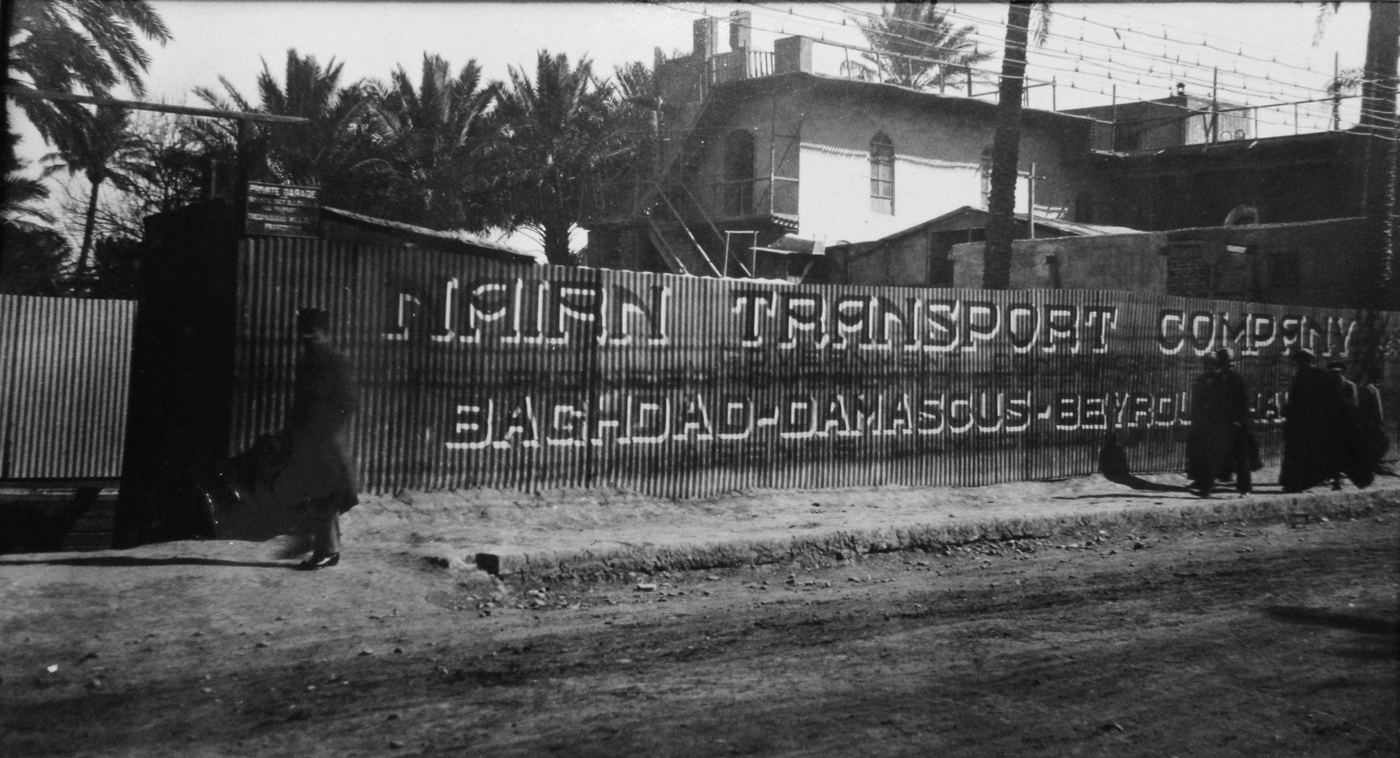
The main actors behind the opening of this route were two New Zealanders, brothers Gerald and Norman Nairn, who after serving in the Middle East in the First World War stayed on in the region to introduce the skills they had learned running a motorcycle dealership in their homeland.Footnote 60 After failing to establish a similar dealership in Beirut, they decided instead to seize on the new demand for rapid and reliable transport brought about by the French and British mandates over Syria and Iraq. For local guidance the brothers relied on the advice of the Ruwala Bedouin merchant Hajji Muhammad Ibn Bassam, who was already experimenting with motoring between the Syrian towns of Deir ez-Zor and Rutbah as part of his smuggling business.Footnote 61 After investigating several potential routes, they chose the one Ibn Bassam recommended. Launched in October 1923, the Nairns' desert transport service soon slashed the two-week camel journey between Baghdad and Damascus to a mere twenty hours. Norman Nairn explained in an interview with the New York Times during a car-buying visit to Detroit in 1923 that the new automobile route would bring Baghdad within fifteen days of New York, and Tehran within thirteen days of London.Footnote 62 As Major McCallum, an early passenger on what was soon being called the “Nairn Way,” wrote the following year, all this had been achieved “without any financial help from either the British or French governments.”Footnote 63
“Motoring Mesopotamia: The Nairn Company Depot in Baghdad, ca. 1925” (Source: “Iraq: Album of Images” (NBP~4493), Archives of the Heritage Motor Center, Gaydon, UK”).

The impact of the Nairn brothers connecting of Iran to the Mediterranean can be gauged by the fact that the year before they launched their service Arthur Millspaugh had taken a circuitous six weeks to reach Tehran, since “the only practicable [route] at that time was by way of the Red Sea, Bombay, and the Persian Gulf to Basra, thence by rail via Baghdad to Quaratu on the Persian Iraq frontier.”Footnote 64 The newly motorized desert road pioneered by the Nairns, which they based on earlier Bedouin routes, avoided these massive Russian or Indian Ocean detours to bring Iran's borders within a few days' drive of the chief port of the eastern Mediterranean. As McCallum explained the matter in the year of Bahrami's journey, “Travelers going to Iraq, Persia or even India should … utilize such a motor service in preference to the long voyage by steamer through the Suez Canal, the Red Sea and the Persian Gulf” since “with the motor service at present run by the Nairn Transport Company, Baghdad has been brought within nine days of London.”Footnote 65 “From Baghdad,” he added, “this land route is being further developed into Persia as far as Tehran, and the journey to that place is now done comfortably by motor in three or four days.”Footnote 66 It was this revolutionary route, which finally connected the Iranian capital to the industrialized transport network of the Mediterranean, that Bahrami took, and he published his travelogue to bring it to his countrymen's attention.
The first cars to ply the desert route were in fact steam-powered, though the Nairn Transport Company soon traded in its American “Stanley Steamers” for more reliable Cadillacs, Buicks, and eventually American Safeway buses.Footnote 67 Especially successful were the Cadillacs, which could carry seven passengers in comfort.Footnote 68 The American profile of the vehicles used on what was now being championed as “the New Land Route to the East” was no coincidence.Footnote 69 It was an outcome of the cheapness of Fordist mass-production methods combined with the suitability for desert terrain of cars designed for the rough farm roads of middle America. McCallum repeatedly praised the durability and toughness of American vehicles (and patriotically regretted the poor performance of British ones): “The two main obstacles to the adoption of British cars for the desert service are, firstly, financial cost, and secondly, that British cars are built too low in the chassis to avoid the many stones and boulders which the higher-built American cars pass over without risk to engine or axle.”Footnote 70 As Bahrami underscores by his travelogue's dominant themes, the twin forces of the American factory and the American motor car were transforming the world and connecting Iran to it.
In a period that saw American car manufacturers expand rapidly into the global marketplace, the Nairns' success led General Motors to publish a brochure celebrating the reliability of their vehicles in the world's harshest conditions.Footnote 71 In Iran, as in Afghanistan, such American products opened up the last regions of Muslim Eurasia that had remained isolated from the worldwide steamship and railroad networks of the previous century. In 1923, as noted earlier, the American war correspondent Alexander Powell drove across Iran in an “agile little Ford,”Footnote 72 and that same year the British officer A. C. Bailward repeatedly remarked on “the preponderance of Fords” he observed on his motor journey between Baghdad and Beirut.Footnote 73
Yet it was not only foreign entrepreneurs who took advantage of the relatively small investments needed for commercial automobile transport. At the same time that the Nairns were building their business, Jerusalem-born Lebanese merchant Francis Kettaneh (1897–1976) opened a rival motor route between Baghdad and Beirut. Instead of the subsequently celebrated “Nairn Way” that headed directly east from Beirut, Kettaneh's route took a northerly detour via the splendid ruins (and water sources) of Palmyra.Footnote 74 His initial venture failed and was taken over by a consortium of Lebanese and British investors who renamed it the Eastern Company Ltd., and sought to outdo their New Zealand rivals by constructing a comfortable modern hotel in Palmyra and importing Dodge limousines. The company also expanded its route as far as Tehran, helped by a contract to carry Iran's diplomatic mail.Footnote 75 By September 1926 the Eastern Company was bankrupt and the Nairns bought them out, but it had nonetheless pioneered the motor route out of Iran.
Aside from Kettaneh, many other Arabs were employed in the new motor-transport business as drivers, guards, and guides, and also as individual taxi owners. In 1923, Bailward saw “large numbers of Ford cars on the road [across Syria] full of Arabs.”Footnote 76 Travelling through Syria and Palestine in 1926, the American Harry Franck described local Arabs “paying as high as six Egyptian pounds a day for Fords,” adding that he had haggled “only twenty-five per cent more than that for two and a half days' use of a Dodge, whose unlucky driver had failed to pick up a Moslem job.”Footnote 77 Clearly, within the space of a few years, a motoring market had emerged. As Robert Fletcher has recently argued, Bedouins also entered this market by deploying their pre-industrial knowledge as guides and protectors along the motor “corridor” through the Syrian Desert.Footnote 78 As for Kettaneh, he remained in the automobile business after selling his company; he began importing and selling American vehicles. A 1930 advertisement in the Persian newspaper Ittila‘at shows him as the Tehran distributor of Dodge motor cars. In the 1940s, like many Lebanese before him, Kettaneh emigrated to New York, following the trail of his imports.Footnote 79
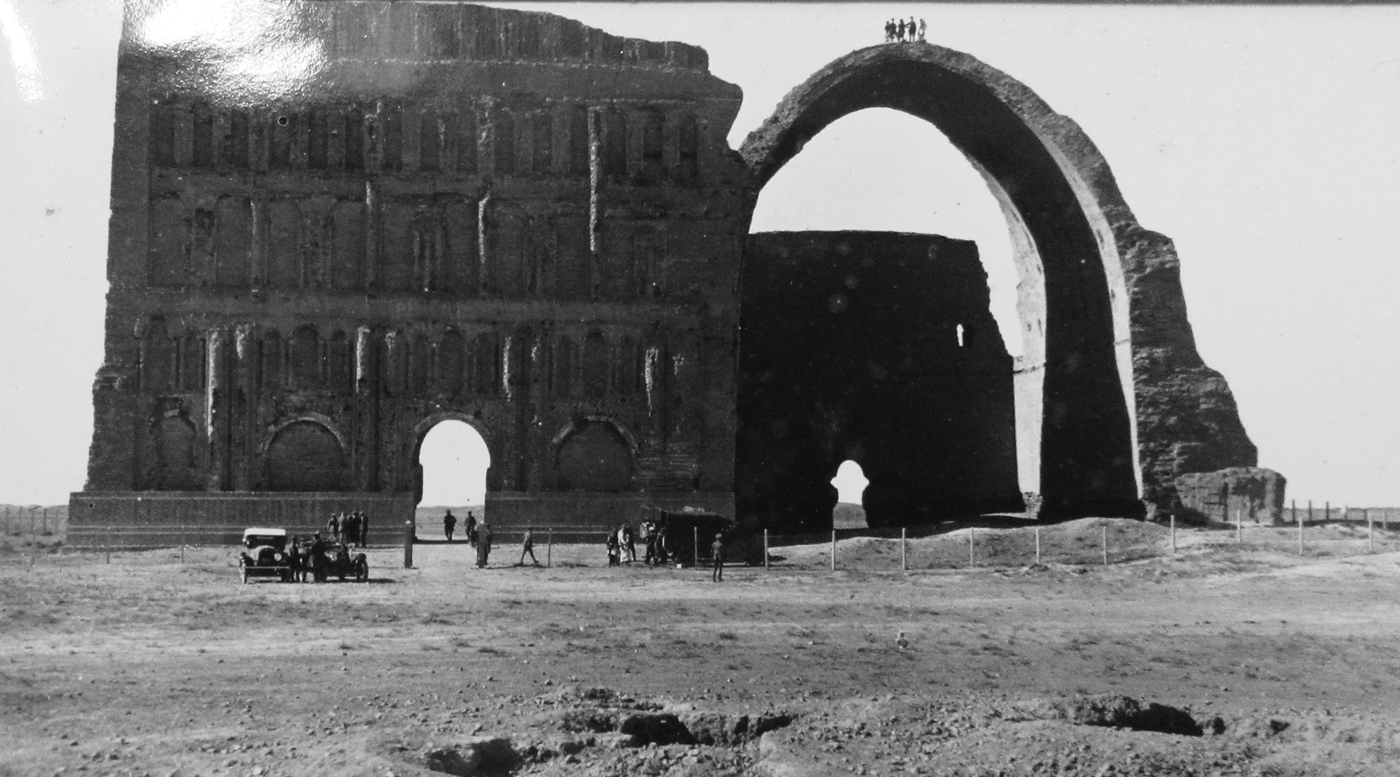
“Curiosity by Car: Nairn Passengers Inspect the Great Arch at Ctesiphon, ca. 1925” (Source: “Iraq: Album of Images” (NBP~4493), Archives of the Heritage Motor Center, Gaydon, UK”).
In making his own journey to America, Bahrami took the new motor route out of Iran forged by private enterprise: American automobiles, New Zealand entrepreneurs, and Lebanese businessmen. Materials held at the Ford Motor Company archives help fill out the picture of how American car products penetrated and integrated the Middle East. Motor cars were already expanding into French North Africa in the early 1900s, in part through colonial road-building policies but more successfully through the publicity garnered by the same kinds of sponsored rallies used to raise the popular profile of motoring in America and Europe.Footnote 80 For example, 1905 brought the “first endurance test held in northern Africa” over a 120-mile route around Oran, Algeria.Footnote 81 By 1915, Cairo's populace was moving more quickly with the help of Ford-owning taxi drivers, such as the Armenian Lazare Kalendarian, who reported still driving the same car twelve years and 400,000 miles later.Footnote 82 What brought the wider dissemination of American cars, however, was the establishment of commercial dealerships. Alexandria and Istanbul, where local Ford franchises were established in 1926 and 1928, respectively, became the main points of entry for Michigan's motor products into the eastern Mediterranean, although in the same decade local Ford dealerships opened in Cairo and Ismailiyya.Footnote 83 According to Ford sources, at least, by the 1920s its vehicles were favored by the Egyptian aristocracy.Footnote 84 The archival evidence of American exports to the Levant is borne out by the fact that the Eastern Company used Dodge vehicles while the Nairn Transport Company used first Buicks and then Cadillacs.
Ford's archives also provide glimpses into how its products penetrated Iran. In 1924, the Swedish police officer Captain de Bronikowsky described for Ford's in-house newsletter how “before the war travelers in Persia were limited to horse or camel conveyance. Now Ford automobiles are common sights.”Footnote 85 In a sign that Ford was expanding its business in Iran, in 1926—the year Bahrami's travelogue was published in Tehran—a group of Iranian mechanics arrived at the Ford Service School in Detroit.Footnote 86 Here again, Iranians were following a trail laid by the many earlier Arab migrants to Detroit: as early as 1916 more than 550 Syrian settlers were employed as regular workers at the Ford factories there.Footnote 87 According to other Ford materials, by the late 1920s more and more of their cars were being sold in Iran, including, in 1928, a Lincoln limousine “delivered to His Imperial Majesty Riza Shah Pahlavi.”Footnote 88 By 1929, Ford had gone so far as to open an assembly plant in Istanbul, resulting in the publication of manuals in such regional languages as Turkish.Footnote 89
As part of the new literature of the motor age, Bahrami's travelogue described both his outward and return car journeys through Iraq and Syria to Beirut, whence he was able to follow the shipping networks established by earlier Arab emigrants to the Americas.Footnote 90 Pointing explicitly to the importance of the new, desert motor route, Bahrami stressed how before the war Iranian travelers (like himself as a young man) had to travel west via Russia, but now automobiles made it possible to follow a direct route via Baghdad to the Mediterranean at Beirut.Footnote 91 Even within Iran itself, he noted, the use of “an American automobile by the name of Dodge” made the journey from Tehran to the border at Khanaqin a comfortable one.Footnote 92 The topic of transportation is a major theme of his book from the moment of his departure. Traveling from a country that in 1925 still had only a few miles of railway track, he described the rail system of neighboring Iraq in detail, though he noted that the same journey a train covered in ten hours took only four hours in a motor car.Footnote 93 In just a few years in the mid-1920s motorized transport spread throughout the Middle East, connecting the inland cities to the flourishing steam ports that had rapidly expanded in the second half of the nineteenth century. In 1926, for example, the Société Auto-Routière Beyrouth-Alep opened a public bus service that connected the Syrian city of Aleppo with the port of Beirut.Footnote 94
“Machines into Words: Ford ‘Model A’ Users' Manual in Turkish, 1928[?]” (Source: Benson Ford Research Center, Dearborn, Michigan). From the collections of the Henry Ford, copy and reuse restrictions apply; http://TheHenryFord.org/copyright.aspx.
Bahrami left Baghdad in a small caravan of three cars and a small bus.Footnote 95 For this outbound journey he was travelling with the Eastern Company Ltd. (which he called the Shirkat-i Sharq Da'ir), his car driven by an Englishman.Footnote 96 On his journey home in September 1925 he took the same route through Beirut and Baghdad, but his account of an ambush by Bedouin in the Syrian Desert, which left a driver dead, tells us that he was travelling with the Nairn convoy that was attacked at this time.Footnote 97 The attack, which Bahrami describes in frightening detail, was one of several on Nairn convoys in the rebellious Syria of the 1920s, and the company was ultimately forced to abandon the more direct desert route in favor of the safer but much longer detour via Transjordania and Palestine. Even as late as the 1920s Iran's connections to places beyond its borders remained tenuous and unstable, hedged in between a Russian rail network in the throes of civil war and a Syrian motor route disrupted by bandits. Indeed, such were the challenges of motoring on bad roads over the Zagros mountains that by 1927 the Nairn Transport Company had discontinued the Tehran-Baghdad service it had inherited from the Eastern Company.
The Levant Express Transport Company, a joint enterprise of an Armenian and a Russian, stepped in to continue the young but already crucial motor route.Footnote 98 This vital link to the non-Soviet west had been used from the outset for Iran's diplomatic mail, and this was the route Bahrami traveled from Tehran through the Iraqi and Syrian deserts to the ports of the Mediterranean on his way to the United States. The same route would soon bring Americans to Iran, and in recounting his return journey Bahrami noted that with him in the Nairn convoy were three Americans, including the economist Dr. Millspaugh.Footnote 99 In travelling with the Nairns, Bahrami was following noble Iranian precedent, for in 1923 the last Qajar ruler, Ahmad Shah, had used the Nairn Transport Company to accompany his own Cadillac as he drove toward a holiday that became an exile.Footnote 100
Through such imports and exports of human personnel, the young nation of Riza Khan relied on this motor bridge in its quest for a new future.Footnote 101 The motor route was the fruit of the private enterprise of Lebanese and New Zealanders and the influx of cheap American cars. Bahrami was now traveling to the source of those mass-produced conveyances. His travelogue described, not simply a trip to America per se, but a journey to the land of mobility, mass production, and the newfound speed of the urban citizen. For Bahrami, New York—Niyu Yurk—was its synecdoche.
AN IRANIAN MAHJAR
When Bahrami finally reached New York aboard the Cunard Line's Mauretania in 1925, he was far from the first Middle Easterner to visit the city. By the early 1900s, the mahjar (emigration) from the late Ottoman Levant had fueled the emergence of Manhattan's “Little Syria,” which in the year before Bahrami's arrival the pioneering Arab-American historian Philip Khuri Hitti had described in his community history, Syrians in America.Footnote 102 In 1924, Hitti had also published an Arabic account of his eight years in the United States, which parallels Bahrami's 1926 Persian travelogue.Footnote 103 Hitti was a Maronite Christian with broadly secular interests, but New York also hosted a range of Muslim activists, such as the Sudanese Arab Satti Majid (1883–1963), who between 1904 and 1929 launched a series of Muslim organizations in the United States.Footnote 104 Bahrami in his account displayed no interest in Islamic causes, however, and made no mention of a Muslim or Arab community in New York. His lack of reference to or apparently even awareness of the Arab émigré sons of the mahjar in itself exposes the distinctness and lateness of this Iranian encounter with the United States.
In contrast to the massive Arabic literature of Levantine emigration, no first-hand Persian accounts of America had been published, and Bahrami struggled both to conceive America in his own terms and to construct the terms through which his Iranian readers should conceive it. He depicted New York and the other industrial cities he visited as a land of cars, trains, and factories. He bypassed the Christian moral agendas promoted by the American College in Tehran and presented a Fordist America of industrially-driven order. As such, it could be studied to envisage and guide the emergence of an Iran much different from that imagined by the missionaries who had directed the terms of Irano-American exchange for almost a century.
Bahrami spent around four weeks in America. As an official delegate at the International Police Conference he was shown both the worst and the best of American life. Disembarking from the Mauretania, Bahrami was met by two officials who drove him by car to his erstwhile residence at the Waldorf-Astoria, which he twice pointed out to his readers as “one of the city's first-class hotels.” Here again was a new infrastructure of travel to which he had been introduced by the Eastern Company's “cement” and “electric” hotel in Palmyra.Footnote 105 The new, direct connection with Iran that his arrival represented was also noticed in the American public sphere: an article in the New York Times celebrated the feat of his journey “by automobile, rail and steamship for thirty-two days” which included “two days across Persia to Kermanshah, two days more to Baghdad and again across the desert and the mountains of Lebanon, via Damascus, which occupied two days and a night without stop for food.”Footnote 106
From his own travels Bahrami knew all too well the underdeveloped state of Iran's transport infrastructure both domestic and international, and a central theme of Az Tihran ta Niyu Yurk is America's travel system. He had ample opportunity to observe it when, after the conference, a specially chartered train took Bahrami and other delegates on an official tour to Toronto, Chicago, Atlantic City, Pittsburgh, Philadelphia, Baltimore, and Washington, D.C.Footnote 107 This journey within a journey gave Bahrami ample opportunity to witness and describe an America that he understood to be nationally tied together by rail and road.
THE AMERICAN WAY OF TRAVEL
Throughout Bahrami's account of his travels to and in America he emphasized new motorized forms of transportation. He was in fact attentive to all of the forms of transportation that his journey involved and, from the moment he left Iran, made notes on every transport system he encountered. For example, he observed that the trains across Iraq had small and ill-furnished carriages but tickets for them were so expensive that pilgrims to the Iraq's holy Shi‘ite cities had to travel in filthy third- and fourth-class bogies.Footnote 108 The Egyptian-owned mail ship that carried him from Beirut to Alexandria was also small and uncomfortable, while the British-owned Mauretania that he boarded at Cherbourg was like “a little city afloat on the ocean,” with hot and cold water, electric appliances, a library, and endless musical concerts.Footnote 109
Yet he depicted modern transport as having developed most fully in the United States, and there Bahrami began to systematically scrutinize the organization and effects of transportation on society as a whole. Using America as a point of comparison to Iran's absence of a modern transport infrastructure, he reiterated his case for seeing the United States as the homeland of speed by examining the social and even moral value of industrialized transport. One basic point that he sought to explain was how central railways were to “progress and civilization” (taraqqi va tamaddun).Footnote 110 He was confident that the system could be emulated in Iran; no doubt thinking of the recent disastrous history of monopolistic concessions there, he explained how the American rail system had developed through rival companies, whose “competition” (raqabat) served the interests of both passengers and merchants.Footnote 111
Since as far back as the 1860s taraqqi and tamaddun had been key terms for Ottoman, Indian, and Iranian reformists alike. But Bahrami's lexicon also made way for certain newer concerns that tie him more firmly to the “streamline” decade of the 1920s. Throughout his depiction of the United States he turned over and again to the notion of “speed” (sur‘at) as the defining characteristic of the American achievement. As On Barak has recently shown, speed was a major topic of debate among Egyptians at this time, who dubbed it the “age of speed” (Arabic: ‘asr al-sur‘ah); for many Arab reformists, speed seemed to be the manifestation of the progress (taqaddum) they desired for their country.Footnote 112 As Barak notes, speed “was becoming a political category.”Footnote 113 Bahrami echoed these sentiments and seems to have regarded America as the birthplace of speed. In a section of his book devoted to America's transport system, he explained that people in America said that time is what really mattered in life, so that one had to make good use of every day, hour, and minute. To do so, one had to hurry about one's tasks in order to complete them promptly and not waste time.Footnote 114 Indeed, the transport systems in American cities were deliberately arranged so that people could move from one side of the city to the other in the least possible time (kamtarin vaqt).Footnote 115 This was the reason the automobile was invented, he explained, a point which led him to an excursus on the factory system as perfected by Henry Ford. By making several thousand parts at a time for the same car, he said, Ford ensured that wherever they were found in the world American cars were always the cheapest. One result was that one in seven New York residents owned a car, which implied that every family had a car, which even women were allowed to drive freely into the countryside.Footnote 116 Having left Iran by car, Bahrami was eager to explain the new technology's industrial origins and social impacts in the land that he saw as its homeland.
He clearly understood the need for wider investment back home, and explained that cars could not be taken as an excuse for not providing a supporting infrastructure, since garages for repairs had to be laid out with regularity. Nor was the car to be seen as having superseded other forms of transport. Many large American cities also had electric trains running underground, with every avenue providing access for passengers to get on and off.Footnote 117 Speed was again the basis of the entire system, for these electric trains arrived every five minutes, providing less than a minute for passengers to board before they departed again. With comfortable, spacious interiors—except during the morning and evening rush hours for which Bahrami gave estimates of passenger numbers—these underground trains enabled passengers “to travel several farsangs for between four and eight shahis” (the switch to Persian quantifiers allowed his readers to make positive comparisons for themselves). The metro companies also generated vast additional revenues by printing advertisements on the backs of tickets. Bahrami continued his account of America's transport infrastructure by describing the “large automobiles called bus” which competed for passengers and arrived every two or three minutes, the suburban trains that offered fine views from the windows, and the Pullman Company's trains, with restaurants and sleeping compartments, which connected distant cities.Footnote 118
Throughout his travelogue Bahrami continued to remark on the importance of rapid, organized transportation, which he seems to have regarded as the acme of the progress he was so keen to delineate. In so thinking he resembled Millspaugh, whom he knew personally and who in his own book, published shortly before Bahrami's, wrote in detail of the primary developmental importance a transport system would have for Iran.Footnote 119 Millspaugh recognized Iranians' passion for modernized transport, and he could have been depicting his erstwhile fellow-passenger Bahrami when he described them as: “alert not merely to the economic advantages of railroads but also to their social and political benefits. They feel that railroads will stir, educate, and modernize the people, and will contribute, more than any other procurable influence, to the unification and better administration of the country.”Footnote 120 Motor roads too.
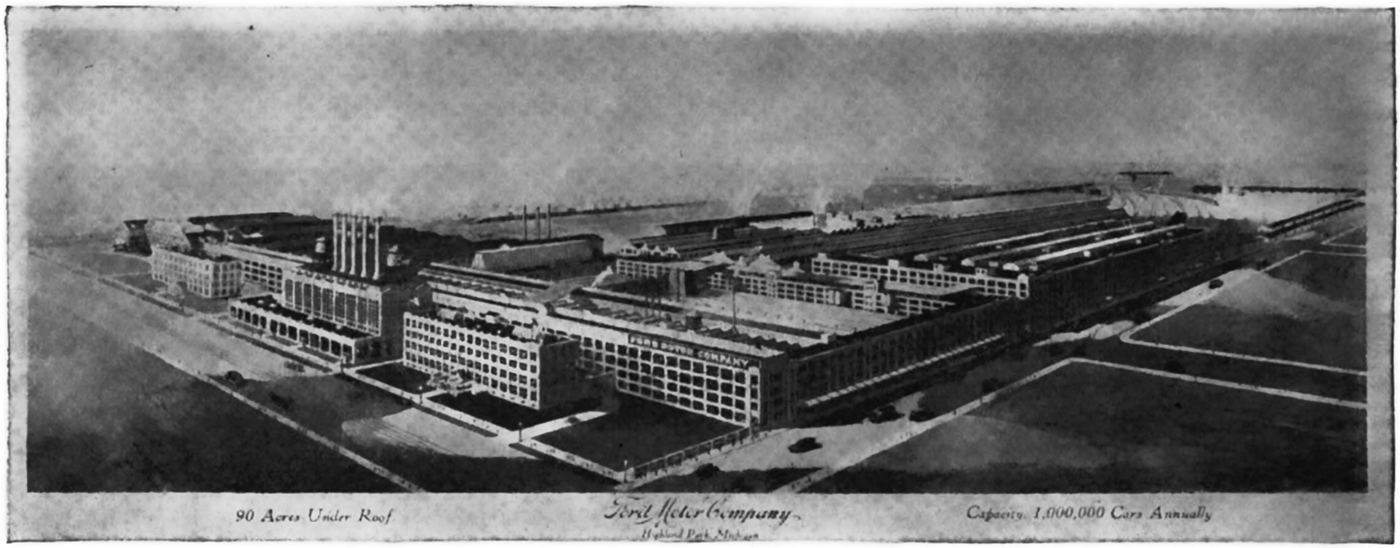
“The Original Assembly Line: The Highland Park Ford Factory, Detroit” (Source: Bernard L. Johnson, “Henry Ford and His Power Farm,” Farm Mechanics [1922].).
Written for a domestic readership, Bahrami's book lent narrative color to the technocratic prose of Millpaugh's reports. As expressions of order and control—of “unification” and “administration”—Bahrami found the spaces of transport preferable to the less manageable outside world: when New York baked in a summer heatwave that led crowds to scramble for cold drinks around Manhattan's grocery stores, Bahrami rejoiced in being able to escape aboard an ocean liner whose air-conditioned cabins made the air fresh and cool.Footnote 121 In constructing a narrative as much as a compendium of facts, in Az Tihran ta Niyu Yurk Bahrami made effective use of the device of the contrast—after describing his seamlessly comfortable circuit around the cities of America, and from New York back to Beirut, as he draws closer to home his tone switches from admiration to terror when he recounts the Nairn Transport Company's convoy being attacked by gun-wielding Bedouin.Footnote 122 With rifles and machine cannons firing in every direction, passengers lying in the dust beside their cars, two English women running to help a wounded countryman, and the stomach of an Arab soldier being ripped open by a bullet, Bahrami's account of the assault is in dramatic contrast with the preceding sections of his narrative. He saw several people left dead. Despite his emotions, Bahrami tried to understand the attackers as defenders of their nation's independence rather than as mere highway robbers. But he noted that only a few days earlier another convoy had come under attack and had its passengers stripped naked and robbed: “The road through the desert is still very dangerous.”Footnote 123 Between Bahrami's depictions of the two transport systems his larger point was obvious: America was a space of order and control whose antithesis lay in the disorderly deserts of the Levant.
Ending his travelogue in an Iran that just a few years earlier had hired Swedish gendarmes to protect its pack-animal paths to the capital, Bahrami's lesson to his readers was clear: a controlled transport infrastructure was fundamental to a nation's order and prosperity. Within a couple of years of his return this lesson was put into action. In 1927, the American Ulen company and the German Konsortium für Bauausführungen in Persien began to construct the first trans-Iranian railroad. In 1931, twenty years after Bahrami had followed the same route in a horse-drawn carriage, the first train ran from the Caspian port of Anzali to Tehran and on to Bandar Shahpur on the Persian Gulf.Footnote 124 When Bahrami had set off, Iran had only 2,000 miles of rough highways, but through the establishment of a Ministry of Roads, by 1941 there were more than 14,000 miles of motorable highways.Footnote 125 Mainly through the importation of cheap American cars, by the late 1930s more than twenty-seven thousand motor vehicles traveled Iran's new roads.Footnote 126 Ultimately it was not the railroad but the new motor-transport revolution that Bahrami and other Iranians first accessed through the Nairn Transport Company that proved most transformative for their country; trucks rather than trains would play the central role in its rapid economic development. As historian Patrick Clawson has phrased what Bahrami had earlier promoted, this was “knitting Persia together.”Footnote 127 The importing of ideas and commodities from America had consolidated Iran as a nation in itself and as a nation connected to the Middle East, and through it, to the world.
THE SPEED OF INDUSTRIALIZATION
One of the main ideas that Bahrami developed in his travel account was that there was an intimate connection between progress, transportation, and industrialization; that is, between speed, the car, and the factory. Reprising the aforementioned Iranian urban legend associating Americans with factories, Bahrami wrote in panegyric detail about the factory-based work he had witnessed in cities like Chicago, Pittsburgh, and Philadelphia. In line with his unifying theme, he made transportation central to his depiction of America's successful industrialization.Footnote 128 The rapid “progress” (taraqqi) that the United States had achieved in only a century was due largely to the relationship between the urban concentration of factories and the development of suburban rail networks that carried workers in from low-rent residential regions outside the city.Footnote 129 Workers now also drove their own cars to their factory workplaces.Footnote 130 Railroads and shipping ports, in turn, enabled the distribution of factory goods to both domestic and international markets.Footnote 131 Once again, speed (sur‘at) was vital to the whole process: when harnessed to organize the movement of goods and citizens, motorized speed afforded the progress of the nation at large.
Writing with Iran's preindustrial economy in mind, Bahrami was careful to explain the agricultural foundations of American wealth both in the past and the present. The early basis of its wealth, he said, was cotton and tobacco, though wood products were also important.Footnote 132 Bahrami's observations were apt and timely because Riza Khan would soon focus on cotton as the transformational crop in his program for developing the Iranian economy, turning over large parts of Khurasan and Mazandaran to cotton production and opening several cotton mills.Footnote 133 It is also important to situate Bahrami's American model in relation to the Soviet model of this period, since in 1925 the Soviet Union was still struggling to recover from the great drought and famine of 1921–1922 and experimenting with the New Economic Policy (Novaya Ekonomicheskaya Politika) that Stalin would abandon in 1928. By contrast, the American situation, as depicted by Bahrami, was one of successful “progress” through the combination of private ownership and mechanization. The American farmer had his “iron cow” (gav-i ahan) plough and, increasingly, his tractor (taraktur)—likely the ubiquitous Fordson—which meant that the individual farmer could now cultivate his land single-handedly. As a result, the tractor had opened a new age in the agricultural economy.Footnote 134 For an Iran that just six years earlier had faced a catastrophic famine, these were important lessons in mechanized private enterprise.Footnote 135
The importance of machines also dominated Bahrami's presentation of industry in the United States, where machines had led to “a new age (dawra-yi jadid) in the world of industry.”Footnote 136 He used the weaving industry to explain how the outcomes of hand production and machine production were incomparable: “All of the work that used to be done by a single person in his own workshop is now done in factories and carried out by machines.”Footnote 137 The factory, with its speeding up of production, was the primary element of American industrialization that Bahrami sought to explain. Factories had been a topic for Persian travelogues since the first Qajar missions to Western Europe in the early nineteenth century,Footnote 138 but writing in the 1920s, and having been escorted on a tour of the factories of no less an industrial city than Pittsburgh, Bahrami was privileged to have witnessed the raw power of the American factory at its zenith. He presented the factory as a site of not just economic but also social improvement. In another symbolic championing of private enterprise, one of the most striking aspects of his section on industry is its emphasis on the positive conditions for the workers (kargaran) in American factories. For instance, he told of special dining rooms set apart from the machine halls, and of night-schools where workers learned new skills.Footnote 139 He used the example of the Pullman Palace Car Company (note again the emphasis on transport), which ran its own school to teach workers how to properly understand the machines they operated. Noting that some twenty-five Iranian workers had already been sent for training in one of these American factory schools, Bahrami stressed the dual benefits of such education for both the working and managerial classes.Footnote 140 Moreover, factory life was inherently good for workers. Factories themselves were complexes of vast expansive buildings that also housed relaxation rooms for the workers and shops where their families could purchase high quality goods.Footnote 141 Some factories even had libraries, hospitals, and cinemas for their workers.
All this was no doubt intended as a counter to the propaganda of the Communist Party of Persia which had been established in June 1920 just a few years prior to Bahrami's departure and remained a potent force at the time he was writing, having seen the Gilan region around the crucial port of Anzali break away as the Persian Socialist Soviet Republic between 1920 and 1921.Footnote 142 Writing, as he was, before the consolidation of Pahlavi power in the 1930s and as a senior member of the police force which would do so much to suppress the communist movement in the 1920s and 1930s, Bahrami was able to use the empirical testament of the travelogue as counter-propaganda in the ideological battle for Iran's future. From his Dodge drive across the desert to his tours of American factories, his travelogue was a testament to capitalist private enterprise.
Even so, there were moments of slippage in his narrative, and the vivid depiction of his visit to Pittsburgh reveals the shock of a first encounter with the stark realities of heavy industry. It was America's most famous factory city, and the smoke of its factories and the steam from its machines were such that even the daytime was dark.Footnote 143 There was so much smoke in the atmosphere that it was impossible to wear a white shirt, and smoke particles permeated one's lungs. Again concerned with the logistics of transportation, Bahrami also visited an “iron girder factory” (karkhana-yi ahan-rizi) that supplied rails for the railroad. With the extreme smoke, black atmosphere, and flames leaping from the machinery, “The factory was like hell (jahannam).”Footnote 144 But he gave even this a positive spin, writing that the workers showed no concern as they carried out their tasks, were supplied with safety goggles, and in any case earned good money (as much as $12 to $20 a day).
With such a well-paid workforce, combined with the scale of factory mass-production, the United States had also invented a new mode of retail. American “shops” (for which Bahrami used the standard Persian term maghaza) were no longer the small enterprises of the preindustrial age, but now comprised much larger buildings known as “stores” (he transliterated the English word as istur).Footnote 145 With multiple stories with large basements for storage and even small factories to prepare goods for sale, these grand edifices of private enterprise were so large they resembled Iran's government headquarters. Such was the size of these “stores” that each had coffee shops, book shops, offices and even restaurants. He told of one in-house restaurant that could seat three hundred people in just one of its sections. In Bahrami's vision of the United States, its consumer culture was not the moral evil that it would become three decades later in the eyes of such Egyptian visitors as the Islamist, Sayyid Qutb (1906–1966).Footnote 146 To Bahrami, American capitalism represented a future to which Iran's new Pahlavi modernizers should aspire.
In publishing his book in the very year of Riza Khan's coronation as shah—so close was the timing that he just managed to squeeze in praise to the new Pahlavi shahanshah on its final page—Bahrami was praising the American model of development at a crucial moment in Iranian history. When he departed in 1925 Iran possessed fewer than twenty modern factories, of which only five employed more than fifty people (in striking contrast to the American factories he described employing twenty thousand workers).Footnote 147 Within fifteen years of his return his country possessed almost 350 modern factories, including thirty-seven textile mills of the kind he had described from the United States. This same short period saw the number of Iran's industrial workers rise from fewer than a thousand in 1925 to more than fifty thousand by time Riza Khan abdicated in 1941.Footnote 148 It would be fanciful to claim that Bahrami's book singlehandedly inspired this transformation, but as possibly the first published Persian travel account of America, it did provide first-hand public testimony of the merits of industrialized private enterprise, the factory, and the Ford.Footnote 149 Given his status as Tehran chief of police, it seems reasonable to surmise that Bahrami furthered the case for the American-inspired development policy Arthur Millspaugh and his companions were advising at the same time.Footnote 150 In Az Tihran ta Niyu Yurk, then, we hear an Iranian voice among policy recommendations more familiar from the English prose of Millspaugh's The American Task in Persia. Though Bahrami was only one contributor to this Fordist vision of an Iranian future, his book provided unique direct testimony to the public in support of policies that were about to transform the world around them.
With its repeated focus on speed, movement, and the mechanical mastery of time and space, and through the precision and persuasion of its prose, Az Niyu Yurk ta Tihran evoked a capitalist modernity that Bahrami hoped the new Pahlavi nation would follow. In the final pages of his book he repeatedly announced the dawning in Iran of a “new age” (‘asr-i jadid, dawra-yi jadid). Carried from the distant United States to what was still in 1925 a geographically isolated Tehran, his was a Fordist vision for a renascent Iranian future.
CONCLUSIONS
I began this essay by citing an Iranian urban legend from the 1920s that told of an American factory manufacturing men in Tehran. Alexander Powell, the journalist who recorded it, went on to explain that what the legend was describing was the American College founded by Protestant missionaries back in 1873.Footnote 151 Though such missionary schools dominated and mediated Iran's encounter with the United States for its first nine decades, what we have seen in this essay is the sudden emergence of a new Iranian vision of America.Footnote 152 This vision was neither Christian nor moralistic but rather commercial and mechanistic. Eschewing the missionary networks that pioneered Iranian interactions with the Atlantic world, this new vision was of an America of factories and cars spread via an infrastructure of altogether more recent invention. Bahrami's vision was the semantic fruit of private enterprise by way of the combined effects of mass-produced American automobiles and Lebanese and New Zealander entrepreneurs—it was the ideological realization of Iran's new Fordist connections.
Against a background of Iran's transportational isolation, Bahrami's journey marked a new phase of interaction with America that responded to the arrival in Tehran of Morgan Shuster and Arthur Millspaugh. Compared to Levantine Arabs, Iranians were late in engaging with America: Bahrami's journey took place more than fifty years after the onset of the Arab mahjar. But his depiction of Tehran's newfound connections with Beirut and thence New York renders this timing comprehensible. As he himself made clear, motor transport was the lynchpin of his journey. This was a time when Iranian intellectuals were more used to looking to Europe or even Japan as acmes of “progress,” and Bahrami's writings capture the turning point when the United States rose on the globalizing horizons of a new Pahlavi generation. Expressly written for his fellow citizens (hamvatanan) and dedicated to the new Pahlavi shah, Az Niyu Yurk ta Tihran was the work of a public servant of a rapidly modernizing Iran that was in search of an anti-imperial model of development.Footnote 153 In the years directly after Bahrami's return, other major figures in Riza Khan's modernizing plans also engaged with the United States, such as the educationalist ‘Isa Sadiq (1894–1978), who gained a doctorate from Columbia University in 1931 before helping found Tehran University in 1935 out of Bahrami's own alma mater, the Dar al-Funun.Footnote 154 Riding on the back of the motor-transport revolution, Bahrami had paved and publicized the way. Both symbolically and substantively, as idea and as action, his journey was a testament to the Fordist connections and Fordist conceptions that saw Iran transformed through access to American products and politics.
Ervand Abrahamian has written that Riza Khan hoped to construct an Iran of “modern economic structures with state factories, communication networks, investment banks and department stores.”Footnote 155 Bahrami's travelogue on America described all of these things in rich detail. If, as Abrahamian continues, Riza Khan's “long-term goal was to rebuild Persia in the image of the West—or, at any rate, in his own image of the West,” then reading Bahrami helps us to see how that image was formed.Footnote 156 After all, Bahrami was the cousin of Farajullah Bahrami (1878?–1951), a close confidant of Riza Khan who in the very year of Bahrami's journey became the ruler's personal secretary and advisor for his early policies.Footnote 157 I am not arguing that Bahrami provides the master key to early Pahlavi modernization policies. But as Tehran's chief of police, he was a senior member of Riza Khan's paramilitary elite, and there is every reason to think that his fellow senior administrators and even the new shah would have read his book. What is clear is that soon after Bahrami's return to Tehran in September of 1925 Riza Khan launched a development policy that closely manifested the lessons of Bahrami's book through the creation of a road and rail infrastructure and a factory-based economy. Carried by Bahrami, Millspaugh, and perhaps many others, Fordism had arrived in Tehran. Bahrami's book is unique in revealing the mechanics and semantics of this exchange as Iran's pro-American half-century began.
Published at the moment of Iran's strategic turn to the United States, Az Niyu Yurk ta Tihran gave public meaning to an America that was as unknown as it was novel an ally against Europe's familiar empires. Over the next half-century, Iran's relationship with America shaped every dimension of its economic life, with oil and the motor car at the heart of those ties. Behind this better-known story of petropolitics, the mid-1920s saw a sudden emergence of new ideas about America that were also focused on transportation and industrialization, on automobiles and factories, and were built likewise on the automotive integration of the United States and Iran.