Introduction
A central question in research on bilingual word recognition is whether bilinguals activate representations from both of their languages when they read words in a single language. Many studies investigating this issue have employed the lexical decision task and have used critical words such as cognates and interlingual homographs, which overlap in spelling with words in their other language (for a review see Dijkstra, Reference Dijkstra, Kroll and De Groot2005). For example, the interlingual homograph coin is a word in both English and French with different meanings in each language, and the cognate train is also a word in both languages but has the same meaning in each language. Studies using these types of words have generally found that decision latencies for cognates and interlingual homographs differ from those of matched single language control words, and the results have been interpreted as indicating that lexical orthographic representations from both languages have been activated. Other studies have provided evidence that bilinguals activate phonological representations from both languages when reading in a single language (e.g., Brysbaert, van Dyck & van de Poel, Reference Brysbaert, van Dyck and van de Poel1999; Jared & Kroll, Reference Jared and Kroll2001; van Wijnendaele & Brysbaert, Reference van Wijnendaele and Brysbaert2002). However, although theoretically important, the magnitude of these cross-language phonological effects is typically quite small. The question that we address here is whether phonological representations in the non-target language are activated strongly enough to have a noticeable influence on the activation of their corresponding semantic representations.
We first present the Bilingual Interactive Activation model (Dijkstra & van Heuven, Reference Dijkstra and van Heuven2002) to provide a theoretical framework for our review of the literature. This is currently the most well-articulated model of bilingual word recognition. Subsequently, we review the evidence that suggests that phonological representations of the non-target language are activated when a bilingual reads in a target language, and then present a study by Duyck (Reference Duyck2005) that provides some evidence for the cross-language phonological activation of meaning before describing our own experiment on this issue.
The BIA+
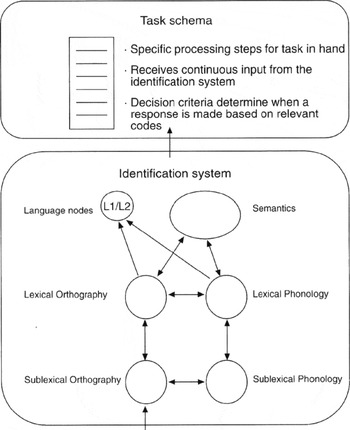
Dijkstra and van Heuven (Reference Dijkstra and van Heuven2002) assume that bilinguals have integrated rather than separate lexicons for each of their languages (see Figure 1). When a word is presented, letter features are activated, which in turn activate corresponding letters and letter sounds. These representations activate the word's lexical orthographic and lexical phonological nodes. These lexical representations both send activation to their corresponding semantic representations. Likewise, the orthographic and phonological nodes also send activation to the language nodes, which serve to identify the language membership of the input. That is, the language of the input is only identified after lexical nodes receive activation. When a word from one language is presented (e.g., bait), not only are orthographic and phonological representations for that word activated, but representations are also activated for visually similar words in the same language (e.g., bail, wait), and from a bilingual's other language (e.g., in French, bain, lait). Lexical competitors are assumed to inhibit one another. This lexical competition is presumed to be the source of longer decision latencies for interlingual homographs than for single language control words.
The BIA+ model for bilingual word recognition. Reprinted from “The architecture of the bilingual word recognition system: From identification to decision”, by T. Dijkstra and W. van Heuven, Reference Dijkstra and van Heuven2002, Bilingualism: Language and Cognition, 5, p. 182. Copyright 2002 by Cambridge University Press.

Cross-language phonological activation
Several studies have provided evidence that phonological representations from both languages are activated when bilinguals read in a single language. For example, Jared and Kroll (Reference Jared and Kroll2001) examined the role of phonology through cross-language shared word bodies. In their study, French–English bilinguals had more difficulty naming English words (e.g., bait) that had word bodies that are pronounced differently in French (e.g., lait) than they did naming English words that did not share word bodies with French words (e.g., bump). However, this cross-language consistency effect was not large (8 ms and 7.1% errors; only the effect in the error data was significant). Furthermore, there was no difference between these two word types for English–French bilinguals for whom the words were in their first language. Both groups of participants did produce larger cross-language consistency effects after they had named a block of French words.
Further evidence that bilinguals activate phonological representations using knowledge of spelling–sound correspondences from both languages comes from a study by Brysbaert et al. (Reference Brysbaert, van Dyck and van de Poel1999, Experiment 2). Using a perceptual identification task, they found that Dutch–French bilinguals had higher identification accuracy on French words that were preceded by brief homophonic nonword primes than non-homophonic nonword primes. The clever aspect of the experiment was that the nonword primes were only homophonic to their French target word when they were read using Dutch spelling–sound correspondences. Duyck, Diependaele, Drieghe and Brysbaert (Reference Duyck, Diependaele, Drieghe and Brysbaert2004) demonstrated that the size of the effect was not influence by second language proficiency. Van Wijnendaele and Brysbaert (Reference van Wijnendaele and Brysbaert2002) further demonstrated that such cross-language pseudo-homophone priming effects also occur from a second language to a first language. The effects in these studies were small, however. The percentage improvement with the pseudo-homophone primes was 7% in the Brysbaert et al. experiment, 6.9% and 7.4% for less and more proficient participants, respectively, in Duyck et al.'s study, and 6% in the van Wijnendaele and Brysbaert experiment. Each participant viewed twelve trials in each condition, so these figures represent a priming effect of less than one correct identification.
Jared and Szucs (Reference Jared and Szucs2002) compared naming performance on interlingual homographs that had different pronunciations in English and French and matched English control words. French–English bilinguals produced a substantial inhibitory homograph effect (62 ms and 9.2% errors), and even the English–French bilinguals produced a small inhibitory effect (6 ms and 3.6% errors) that was significant in the error data. As in the Jared and Kroll (Reference Jared and Kroll2001) study, for both groups the effect was larger after naming a block of French words. This study provides further evidence that activation of phonological representations is not selective for language. The interlingual homograph effect in naming likely arises as a result of competition between the lexical phonological nodes corresponding to the reading in each language. According to the BIA+ there are three potential pathways that could produce activation of lexical phonological representations in the non-target language when a homograph is presented (see Figure 1). Some of the activation of the lexical phonological node for the non-target reading may have come from sublexical phonological representations. However, a homograph would also activate its lexical orthographic representation in the non-target language, which would in turn activate its lexical phonological representation. Additionally, the lexical orthographic representation for the word in the non-target language may have activated its semantic representation, which in turn might have sent feedback activation to its lexical phonological node. The possibility that a printed homograph could activate the semantic representation of the reading in the non-target language independently of any activation of phonology makes this type of word unsuitable for addressing the issue that is the focus here, namely whether phonological representations in the non-target language are sufficiently activated to activate their semantic representations.
Experiments with interlingual homophones have provided further evidence that bilinguals may activate not only sublexical phonological units but also phonological representations at the lexical level in a language non-selective manner. Interlingual homophones are words that share phonology across languages, but not spelling or meaning, such as foe and faux in English and French. Both Haigh and Jared (Reference Haigh and Jared2007) and Lemhöfer and Dijkstra (Reference Lemhöfer and Dijkstra2004) observed that bilinguals identified interlingual homophones more easily than single language control words when they read in their second language (but see Dijkstra, Grainger & van Heuven, Reference Dijkstra, Grainger and van Heuven1999). In Jared and Haigh's first experiment the homophone facilitation effect was quite substantial (65 ms and 7.3% errors), but in a subsequent experiment (3b) in which the proportion of homophones was considerably lower, the facilitation effect was much smaller (9 ms and 5.7% errors). It was also a fairly small effect in the Lemhöfer and Dijkstra study (14 ms, 0% errors); the effect in their latency data was significant only by participants. Haigh and Jared also observed a small homophone facilitation effect in the error data (2.5%) during first language reading with very proficient bilinguals.
Interlingual homophones are an ideal type of word to use to address the issue that is the focus of the present research, namely whether phonological representations in the non-target language activate their semantic representations. Because interlingual homophones’ spellings belong to a single language, it is unlikely that the presentation of one member (e.g., foe) would activate the lexical orthographic representation of the homophone mate (e.g., faux) and in turn activate its corresponding semantic representation. Thus, if there is evidence that the homophone mate's meaning becomes activated, it is most likely to be the result of activation from phonological representations.
Phonological activation of semantic representations
Despite the observation of language non-selective phonological activation in the above studies, it is not evident from that research whether phonological representations from the non-target language are activated sufficiently to influence the activation level of their corresponding semantic representation. As we have pointed out, the cross-language phonological effects observed so far have typically been fairly small. It is possible that non-target language lexical competitors are inhibited by target language lexical representations before much activation extends to their semantic representations.
Only one study that we are aware of has provided some evidence that phonological representations in the non-target language noticeably activate their corresponding semantic representations. Duyck (Reference Duyck2005) conducted a series of cross-language priming experiments. Dutch–English bilinguals performed a lexical decision task in either their second language (Experiments 1, 3 & 5) or in their first language (Experiments 2, 4 & 6). In Experiment 1, critical primes were pseudo-homophones of a Dutch word if Dutch spelling–sound correspondences were applied (e.g., tauw is a pseudo-homophone of the Dutch word touw, which means “rope”) and targets were the English translation equivalent (e.g., rope). Participants made faster lexical decisions on target words that were preceded by these pseudo-homophone primes than when they were preceded by graphemic control primes. In Experiment 2, the targets were in Dutch (e.g., roap–TOUW), and a smaller (26 ms compared to 71 ms) but still significant priming effect was observed. In Experiments 3 and 4, primes were pseudo-homophones of semantic associates of the target words, and a significant priming effect was observed only when participants performed the task in their second language (e.g., tauw–WIRE), and not when they performed the task in their first language (e.g., roap–DRAAD). The 33 ms facilitation effect in Experiment 3 was, however, accompanied by a 4.1% inhibitory trend in the error data. Duyck's account of the priming effects in these experiments was that the pseudo-homophone primes activated sublexical phonological representations and then lexical phonological representations in the non-target language. The lexical phonological representations then activated their semantic representations, which in turn pre-activated lexical representations for corresponding words in the target language, including the lexical representation of the target words. A possible reason that the pseudo-homophone primes in these experiments were good at activating lexical phonological representations in the non-target language, however, is that many contained spelling patterns that seem more typical in the non-target language than in the target language.
In Experiments 5 and 6, Duyck (Reference Duyck2005) used real word primes and target words from the same language. In Experiment 5, the primes were English–Dutch interlingual homophones and the targets were translation equivalents of their cross-language mates (e.g., hook–corner, where hook is an interlingual homophone of hoek, which means “corner” in Dutch). Dutch–English bilinguals produced a 56 ms facilitatory priming effect, although, surprisingly, the effect was significant only in the analysis by participants. Words preceded by homophone primes attracted 2.5% more errors than those preceded by control primes, but the difference was not significant. Post hoc analyses indicated that the priming effect in the latency data was significant only when the frequency of the English prime was greater than the English target word. However, no priming effect was observed in Experiment 6 when the prime and target words were in Dutch (e.g., hoek–HAAK). Duyck concluded that second language homophones activate their phonological representations, which in turn activate the semantic representations associated with each member of an interlingual homophone pair.
The present study
The present study sought further evidence that the unseen mate of an interlingual homophone activates its meaning. We used the category verification task, a task that directly taps semantic representations, rather than the lexical decision task used by Duyck (Reference Duyck2005). The lexical decision task could be performed on the basis of the activation of lexical representations and does not require the use of semantic information. We thought that a task that requires the consultation of word meaning might produce stronger evidence regarding whether the unseen interlingual homophone mate activates its semantic representation. The category verification task has been used successfully in the monolingual literature to examine whether semantic activation is phonologically mediated during reading (Jared & Seidenberg, Reference Jared and Seidenberg1991; van Orden, Reference van Orden1987; van Orden, Johnston & Hale, Reference van Orden, Johnston and Hale1988). In this task, participants must decide if a word belongs to a presented category. On critical trials, the target words are homophones of an actual category member. For example, the category a type of flower was followed by rows, which is a homophone of the category member rose. Van Orden found that homophone foils produced more false positives (i.e., incorrectly deciding that homophones were members of the category) and slower response times than spelling control words (e.g., robs). Because the homophone foils and spelling control words were equally orthographically similar to the correct homophones, differences in processing were attributed to the phonological activation of meaning. Assuming that the bilingual language system is truly language non-selective and fully interactive, homophone interference should be expected to occur not only within a language but also for homophones that are interlingual in nature.
To investigate whether cross-language phonological activation of meaning can be observed in first and second languages, a group of proficient English–French bilinguals and a group of proficient French–English bilinguals performed the task in either English or French. This design is rare in that the majority of studies examining bilingual language word recognition tend to investigate second language processing in a single target language and do not often test bilinguals in their first language (e.g., Dijkstra et al., Reference Dijkstra, Grainger and van Heuven1999; Lemhöfer & Dijkstra, Reference Lemhöfer and Dijkstra2004). Here, two bilingual groups performed a reading task in either their first or second language using two different target languages, thus making results more generalizable. Additionally, the relative frequency of the homophone pair in each language was manipulated. The BIA+ model suggests that language non-selective effects are more likely to occur when the lexical representations are stronger in the non-target language than the target language.
Method
Participants
Ninety-three bilinguals were recruited from McGill University in Montreal, Québec. Forty-seven were English-dominant bilinguals and considered French to be their second language. Twenty-five of these participants completed the task in English and twenty-two completed the task in French. The other forty-six participants were French-dominant bilinguals and considered English to be their second language. Half of these bilinguals completed the task in English and the other half completed the task in French. Participants received either course credit or were paid for their participation.
Experimental design
There were five variables in this experiment: Type of bilingual (English–French vs. French–English), Language of the task (First vs. Second), Word type (Homophone foil vs. Spelling control), Homophone foil frequency (High vs. Low), and Homophone exemplar frequency (High vs. Low). The first two variables were between-participant variables, and the remaining three were within-participant variables.
Materials
Stimuli were developed for both an English and a French version of the category verification task. Forty English–French close interlingual homophone pairs (e.g., shoe and chou where chou means “cabbage” in French) were selected based on their phonological similarity between languages. Since there is no current dictionary of Canadian French pronunciations (which differ from French pronunciations from Europe), homophone selection was based on the authors’ judgment of phonological similarity. There were ten homophone pairs where the English homophone was of high frequency and the French homophone was of low frequency, ten pairs where the English homophone was of low frequency and the French homophone was of high frequency, ten pairs where both members were high frequency, and ten where both members were low frequency.
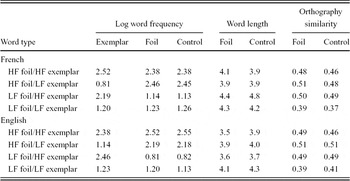
Each member of the homophone pair was matched with a spelling control word in its respective language. For example, shoe was matched with silk and chou was matched with cire (which means wax in English). Interlingual homophones and controls were matched to each other on written word frequency using CELEX for English stimuli (Baayen, Piepenbrock & van Rijn, Reference Baayen, Piepenbrock and van Rijn1993) and Lexique for French stimuli (New, Pallier, Ferrand & Matos, Reference New, Pallier, Ferrand and Matos2001). Stimuli were also matched on word length and their orthographic similarity to the unpresented member of the homophone pair using van Orden's (Reference van Orden1987) orthographic similarity metric (see Table 1 for summary of word characteristics).
Mean log word frequency, mean word length and mean orthographic similarity to the exemplar for both the English and French category verification tasks.

For each word triple (e.g., chou, shoe, silk in the English condition), category names were chosen such that the homophone that was in the non-target language (e.g., chou) was an exemplar of the category (e.g., “a vegetable”), and neither the homophone mate in the target language (shoe, the homophone foil) nor the spelling control (e.g., silk) were members of that category. Similarly, in the French condition (e.g., shoe, chou, cire), a category was chosen such that the English member of the triple (e.g., shoe) was a category exemplar (e.g., “un type de vêtement” [a type of clothing]), and neither the French homophone foil (e.g., chou) nor the French spelling control word (e.g., cire) were members of that category. Only the homophone foils and spelling controls from these triples appeared in the experiment.
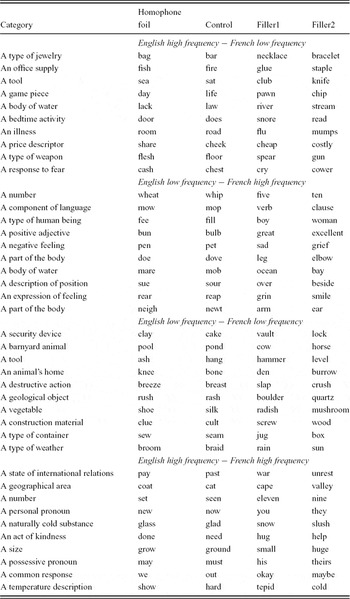
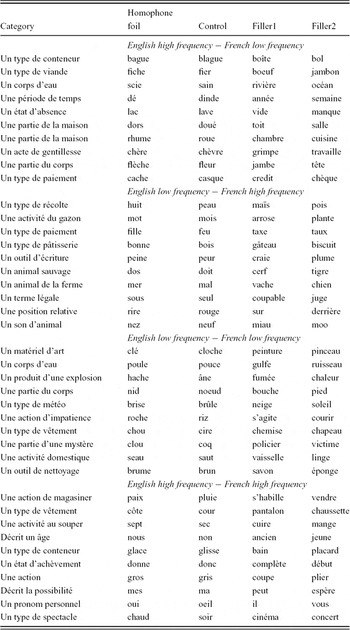
The forty English homophone foils and spelling control words, along with their category names, were placed on a stimulus list to be used in the English version. Eighty English words that were correct members of the categories served as “yes” filler trials. The same process was undertaken with the French stimulus list. In both language versions, half of the trials were positive and half were negative. Target words were homophone foils on 25% of the trials. See Appendices A and B for the English and French stimuli respectively.
To ensure that the English critical stimuli were well matched, twenty-four English monolinguals performed the English category verification task. For both the accuracy and reaction time data, there were no significant differences between the homophone foils and their spelling control words when paired t-tests were performed (all ps > .25). Unfortunately, due to a lack of access to French monolinguals, a control study with the French category verification task was not possible.
Forty-eight line drawings of common objects taken from Snodgrass and Vanderwart (Reference Snodgrass and Vanderwart1980) were used to objectively measure participants’ English language proficiency. A Language Experience Questionnaire (LEQ) was used to obtain a self-report measure of English and French language proficiency and use. Included in the questionnaire were scales asking participants to rate their current level of fluency in listening, speaking, reading and writing in both French and English on a ten-point scale where one was none and ten was very fluent. Questions were also posed about participants’ language experience in school.
Procedure
Participants were assigned to either the English or French version of the task. Stimuli were presented in the center of a computer screen in 18 point Courier New font using E-prime software. A fixation cross was presented for 500 ms, followed by a blank screen for an additional 500 ms. A category name was then presented for 2 s. Following the category name, a target word was presented and remained in the center of the screen until the participant responded. Participants were instructed to press the left button on the button box as quickly and accurately as possible if the presented word was not a member of the preceding category and to press the right button as quickly and accurately as possible if the presented word was a member of the category. If a response was slower than 900 ms, a “too slow” or “trop lent” message appeared on the screen for 1500 ms to promote faster response times. Otherwise, the screen remained blank for the 1500 ms before the fixation cross reappeared. Participants completed sixteen practice trials followed by 160 experimental trials.
Following the category verification task, participants were shown the forty-eight pictures of common objects one at a time on the computer screen and asked to name them in their second language as quickly and accurately as possible into a microphone. Finally, participants completed the paper and pencil questionnaire about their language experience.
Results
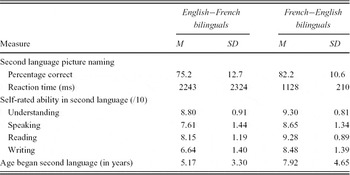
On the Language Experience Questionnaire, English–French bilinguals reported that English was learned first, known best and used most frequently at home. For each language skill (listening, speaking, reading and writing), they reported that their current English ability was significantly better than their current French ability (all ps < .001). Similarly, French–English participants all reported that French was learned first, known best and used most frequently at home, and they reported that their current French abilities were significantly better than their current English abilities (all ps < .01). Refer to Table 2 for further participant characteristics about English–French and French–English bilinguals.
Participants’ objective and subjective language proficiency.

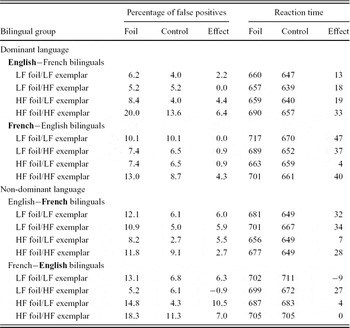
To simplify the analyses, the reaction time and accuracy data for each bilingual group and each language condition were analyzed separately using 2 × 2 × 2 analyses of variance using both participants means (F1) and item means (F2) as units of analysis. Word type (homophone foil vs. spelling control), homophone foil frequency (high vs. low) and homophone exemplar frequency (high vs. low) were treated as within-participant and between-item variables. In the English category verification task, one word pair (pool and pond) was removed from the analysis since it was discovered after the experiment was run that the control word pond was an interlingual homograph. Also, in the French version of the category verification task, the word brise and its control word brûle were removed from the analyses since it was realized after the data were collected that brise could be a member of the category “un type de météo” (a type of weather). Response times less than 200 ms or greater than 2 s or 2.5 standard deviations above the mean for a condition were removed. In the English version of the category verification task this constituted 0.8 % and 0.9% of the data for the English–French and French–English bilinguals respectively, and in the French version of the task, this constituted 0.5% and 0.8% of the data for the English–French and French–English bilinguals respectively. Refer to Table 3 for the percentage of false positives made and the mean response times on the correct “no” trials in each experimental condition.
Mean percentage of false positives and mean RTs on correct “no” trials in the category verification task for English−French and French−English bilinguals reading in their dominant and non-dominant languages.

note: The bolding indicates the language of the task for each bilingual group.
Dominant language
English–French bilinguals. When English–French bilinguals performed the category verification task in English, they made significantly more false positives on interlingual homophones than on spelling control words (F1(1,24) = 6.19, p < .05, MSE = 0.31; F2(1,70) = 3.78, p < .06, MSE = 0.40), and were significantly slower to decide that interlingual homophone foils were not members of a category than their spelling control words (F1(1,24) = 5.98, p < .05, MSE = 3512; F2(1,70) = 4.94, p < .05, MSE = 2125). The interactions of word type × homophone foil frequency, word type × homophone exemplar frequency, and the interaction of word type × homophone foil frequency × homophone exemplar frequency were not significant in either the latency or error data (Fs < 1.5).
French–English bilinguals. On the French category verification task, French–English bilinguals made a similar number of errors on homophone foils and spelling control words (Fs < 1). However, they were significantly slower to decide that homophone foils were not members of the category than spelling control words (F1(1,22) = 24.67, p < .001, MSE = 1862; F2(1,70) = 8.83, p < .01, MSE = 2097). In the error data, the interaction between word type and homophone exemplar frequency approached significance by participants (F1(1,22) = 3.33, p < .09, MSE = 0.14; F2 < 1). None of the other interactions with word type were significant in the error data (Fs < 1). Similarly, in the latency data, none of the interactions with word type were significant. The closest was the triple interaction of word type × foil frequency × homophone exemplar frequency in the participant analysis (F1(1,22) = 2.87, p < .11, MSE = 2044; F2 < 1. All other Fs < 1.3).
Non-dominant language
English–French bilinguals. English–French bilinguals made significantly more errors on French homophone foils than on spelling control words (F1(1,21) = 15.79, p < .01, MSE = 0.32; F2(1,70) = 6.54, p < .05, MSE = 0.54), and were significantly slower to reject interlingual homophone foils as members of a category than their spelling control words (F1(1,21) = 8.60, p < .01, MSE = 3201; F2(1,70) = 7.76, p < .01, MSE = 1820). None of the interactions with word type were significant in either the latency or error data (Fs < 2.4).
French–English bilinguals. French–English bilinguals made significantly more errors on English homophone foils than on spelling control words (F1(1,22) = 34.85, p < .001, MSE = 0.16; F2(1,70) = 4.86, p < .05, MSE = 0.62). In the reaction time data, there was no main effect of word type (Fs < 1). In the participant analysis of the error data there were significant interactions of word type × homophone foil frequency (F1(1,22) = 7.38, p < .05, MSE = 0.26; F2(1,70) = 2.05, n.s., MSE = 0.62), and word type × homophone exemplar frequency (F1(1,22) = 4.81, p < .05, MSE = 0.35; F2(1,70) = 2.47, n.s., MSE = 0.62). These interactions reflect effects of word type in the error data for three of the four frequency groups (not low-frequency homophone foils with high-frequency homophone mates). In the reaction time data, none of the relevant interactions with word type reached significance (Fs < 2). Nonetheless, the 27 ms difference in low-frequency homophone foil with a high-frequency homophone mate condition was marginally significant (t(22) = 2.01, p < .06). This was the only condition that did not produce a significant effect in the error data.
Overall analyses
Overall analyses that included all five independent variables produced results that are consistent with the analyses presented above. There was a significant effect of word type, in both the error (F1(1,89) = 39.66, p < .001, MSE = 0.28; F2(1,280) = 13.30, p < .001, MSE = 0.55) and the reaction time data (F1(1,89) = 25.98, p < .001, MSE = 3061; F2(1,280) = 16.80, p < .001, MSE = 2296.5). Neither the word type × foil frequency interactions (Errors: F1(1,89) = 3.12, n.s., MSE = 1.01; F2(1, 280) = 1.97, n.s., MSE = 0.55; RT: Fs < 1) nor the word type × exemplar frequency interactions (Errors: F1(1,89) = 2.08, n.s., MSE = 0.27; F2(1,280) = 1.02, n.s., MSE = 0.55; RT: F1(1,89) = 2.57, n.s., MSE = 2875; F2(1,280) = 1.70, n.s., MSE = 2296) were significant. Additionally, these analyses indicated that word type did not interact with type of bilingual (Errors: Fs < 1; RT: Fs < 1), but there was a significant interaction of word type and language of the task in the participant error data (F1(1,89) = 7.08, p < .01, MSE = 1.95; F2(1,280) = 1.52, n.s., MSE = 0.55), although not in the latency data (F1(1,89) = 1.73, n.s., MSE = 3061; F2 < 1). This reflects the fact that the magnitude of the homophone interference effect in the error data was larger when participants completed the task in their second language than in their first.
We also examined whether the homophone interference effect diminished across the experimental trials. Each participant's data were divided into two blocks. Word type × type of bilingual × language of the task × block analyses were conducted on error and latency data. No interactions that included word type and block were significant.
Discussion
The goal of the present study was to investigate cross-language phonological activation of meaning, and specifically to determine whether the unseen member of an interlingual homophone pair noticeably activates its corresponding semantic representation. Fluent bilinguals performed a category verification task in either their dominant or non-dominant language. Evidence revealed that both the English–French and French–English bilinguals activated semantic representations from both their languages when reading in a single language. Homophone foils either attracted more errors or had longer response latencies than spelling control words. This finding was true both when bilinguals were reading in their dominant language and when bilinguals were reading their non-dominant language. These findings suggest that bilinguals were activating the phonology of the interlingual homophone, which, in turn, activated both the interlingual homophone's meaning and the meaning of its interlingual homophone mate.
Our observations from bilinguals reading in their non-dominant language are consistent with a growing body of research showing an influence of first language representations on second language reading (see Dijkstra, Reference Dijkstra, Kroll and De Groot2005, for a review). In particular, they are consistent with Duyck's (Reference Duyck2005, Experiment 5) finding of a priming effect from an interlingual homophone (e.g., hook) to a translation equivalent of its cross-language mate (e.g., corner). The priming effect in his study was significant by participants only, but post hoc analyses revealed that it was robust when the prime was higher in frequency than the target. However, in the present experiment, we found evidence that interlingual homophone mates activate their semantic representations regardless of frequency.
We were surprised, however, at the strength of our findings when participants were reading in their dominant language, given that the effects of a bilingual's second language phonological representations on reading in their first language are typically small (Duyck, Reference Duyck2005, Experiment 2; Haigh & Jared, Reference Haigh and Jared2007; Jared & Szucs, Reference Jared and Szucs2002; van Wijnendaele & Brysbaert, Reference van Wijnendaele and Brysbaert2002) or not significant (Duyck, Reference Duyck2005, Experiments 4 & 6; Jared & Kroll, Reference Jared and Kroll2001). Both groups of bilinguals had significantly longer responses on homophone foils than on spelling control words and the English–French bilinguals also made significantly more errors on the homophone foils. In contrast, Duyck (Reference Duyck2005, Experiment 6) did not observe cross-language homophone priming when participants were performing the lexical decision task in their first language. Our use of a task that specifically taps semantic representations is likely one reason why our study provided strong evidence that unseen second language homophone mates activate their semantic representations when bilinguals perform a first language task. With a lexical decision task, participants may make decisions quickly based on lexical activation, particularly when performing the task in their dominant language, before representations in the non-dominant language can influence first language processing. Furthermore, semantic representations related to the meaning of the unseen homophone mate may also have received activation from the category name that was given on each trial of the category verification task. Such top-down pre-activation may exaggerate the observed effects of homophone interference by amplifying the bottom-up processes from orthography to phonology to semantics at the level of semantic representations (Jared & Seidenberg, Reference Jared and Seidenberg1991). Nonetheless, bottom-up processes are still required to observe an effect.
Another factor that may have contributed to the impact observed here of the participants’ second language on reading in their first language is that our participants were more proficient in their second language and acquired it at an earlier age than participants in other studies (e.g., Duyck, Reference Duyck2005; Jared & Kroll, Reference Jared and Kroll2001; Jared & Szucs, Reference Jared and Szucs2002). Indeed, we also tested a group of less proficient English–French bilinguals and they did not show a homophone interference effect when performing the task in their first language (Friesen, Reference Friesen2009). They did, however, produce a significant homophone interference effect when performing the task in their second language.
Theoretical implications
In their BIA+ model, Dijkstra and van Heuven (Reference Dijkstra and van Heuven2002) proposed that sublexical phonological representations from both of a bilingual's languages are activated from a printed string when their languages share an alphabet. Sublexical phonological representations in turn activate their corresponding phonological lexical representations in a single integrated lexicon. In the ‘Introduction’ we reviewed the research that has found empirical support for both of these assumptions. Activated lexical phonological representations are then assumed to activate their corresponding semantic representations in a single semantic store. Our findings have provided evidence for this assumption, and in particular that the lexical phonological representations in the unseen language are activated sufficiently to activate their semantic representations. Furthermore, Dijkstra and van Heuven assumed that linguistic context is able to directly affect the word recognition system. This would provide the mechanism that would account for an influence of the category names on semantic activation.
Although the BIA+ model's principles are able to account for our results, the model is currently unable to simulate our findings because both the phonological and semantic units are not implemented. In fairness to the developers of the BIA+ model, findings demonstrating language non-selective phonological and semantic processing are more recent than the model's development. Nonetheless, a necessary next step is to demonstrate that the model can account for both phonological and semantic effects. A benefit of the current study's design is that simulating such effects requires the entire word recognition system. That is, the interlingual homophone must activate its orthographic code which activates its phonological code and then its semantic code. If the BIA+ can simulate these findings, it would provide substantial support for the BIA+ mechanisms of language non-selectivity.
Conclusion
In conclusion, results from the current study provide evidence for cross-language phonological activation of meaning in bilinguals. Such processing was observed both when bilinguals were reading in their non-dominant language and when they were reading in their dominant language. These results indicate that the architecture of the bilingual word recognition system is language non-selective up to and including the level of semantic representations, as proposed by the BIA+ model.
English stimuli for category verification task

French stimuli for category verification task