]) stops. We argue that the difference between these segment classes is best captured in terms of airstream, not place. Plain clicks use only the lingual airstream, while linguo-pulmonic segments are airstream contours, in which the transition to the pulmonic airstream occurs within the segment rather than at its boundary. Our evidence suggests that the contrast between ‘velar’ and ‘uvular’ clicks proposed for the related language ǃXóõ is likely also one of airstream and that a contrast solely in terms of posterior place would be articulatorily impossible.
1 Introduction
Nǀuu is the only surviving language in the ǃUi branch of the Tuu family (Güldemann Reference Güldemann, Matras, McMahon and Vincent2006; formerly ‘Southern Khoesan’).Footnote 1 Until quite recently, it was thought to be extinct (cf. Traill Reference Traill1999), but it is in fact still spoken by fewer than ten people in the Northern Cape Province of South Africa, and possibly by a few more in southwestern Botswana. The only other Tuu language that has been documented with modern instrumental phonetic techniques is ǃXóõ, the last remaining member of the family's Taa branch. Tuu languages are extremely interesting because of their unique consonant and vowel inventories, which are amongst the largest in the world (Traill Reference Traill1985, Ladefoged & Traill Reference Ladefoged and Traill1994). In this paper, we compare phonetic data from Nǀuu with published reports on similar segments in ǃXóõ, Gǀui (Khoe-Kwadi, ‘Central Khoesan’), Khoekhoe (Khoe-Kwadi), ǂHoan (Juu-ǂHoan, ‘Northern Khoesan’) and Juǀ’hoansi (Juu-ǂHoan) in order to argue for our approach to click description and analysis in Nǀuu. The data presented here are part of a larger project to document the lexical, syntactic, phonological and phonetic structures of the Nǀuu language.
The primary goal of this paper is to describe the consonant inventory of Nǀuu in a phonetically accurate way. Nǀuu is a severely endangered language from an understudied group of languages known for their exceptionally complex sound systems. A description of such a language must necessarily enhance our understanding of the ways these systems are structured. We offer a framework for classifying click-language segments that renders the idea of a click accompaniment unnecessary. The term accompaniment (Traill Reference Traill1985), efflux in older terminology (Beach Reference Beach1938), is a phonetically empty category that has been used as a catch-all for every type of modification to click closures and releases ever reported in a click language. We will show that the traditional articulatory concepts of place, manner, phonation and airstream can be applied to clicks just as easily as to other segments, and that using these linguistic phonetic descriptors allows us to present our inventory in a manner that is consistent with established IPA principles. Doing so also allows us to highlight typological similarities between Nǀuu click and non-click inventories. We believe that it will ultimately be possible to reanalyze the complete inventories of all click languages within the framework we propose, though the actual reanalyses of languages other than Nǀuu are beyond the scope of this paper.
One of our main claims is that the posterior constriction in all clicks involves a uvular component that makes them qualitatively different from velar stops. It has long been maintained that most clicks have a velar back constriction (Doke Reference Doke1923, Beach Reference Beach1938, Traill Reference Traill1985, Ladefoged & Maddieson Reference Ladefoged and Maddieson1996, and references therein), hence the term velaric airstream mechanism. We will show, however, that the different Nǀuu click types in fact have different posterior constrictions, as Miller, Namaseb & Iskarous (Reference Miller2007) have shown for a subset of Khoekhoe clicks, and we will argue for the articulatorily more accurate lingual airstream mechanism. Our results suggest that a complete description of the differences in the posterior places of articulation among clicks, pulmonic velar and pulmonic uvular consonants requires us to distinguish between the upper and lower tongue root, which has not been necessary for describing pulmonic consonants alone. The presence or absence of tongue root retraction involving the tongue root proper, accounts for the C–V co-occurrence pattern known as the Back Vowel Constraint (Traill Reference Traill1985), providing crucial data that this level of phonetic detail must be captured at a phonological level of representation.
Finally, we address claims that clicks can contrast exclusively in terms of their posterior constrictions. ǃXóõ (Traill Reference Traill1985, Ladefoged & Traill Reference Ladefoged and Traill1994), ǂHoan (Bell & Collins Reference Bell and Collins2001) and KhweFootnote 2 (Köhler Reference Köhler and Manessy1981, Kilian-Hatz Reference Kilian-Hatz2003) have all been described as having classes of clicks with independently contrastive velar and uvular posterior constrictions. We will show that comparable segments in Nǀuu actually contrast in the timing and airstream of the click's posterior release, not its place of articulation, and that these segments are best seen as linguo-pulmonic airstream contours. Structurally, they are parallel to contours in manner (i.e. affricates) and nasality (i.e. pre-nasalized stops). In fact, we suspect that a contrast made solely in terms of posterior constriction location, independent of a contrast in either the anterior constriction or the airstream mechanism, is unlikely. Our approach is in many ways similar to Nakagawa's (Reference Nakagawa2006) analysis of the Gǀui inventory, except that we argue for unary contours in Nǀuu rather than consonant clusters. This insight, together with published phonetic descriptions of ǃXóõ, ǂHoan and Gǀui suggests that it will ultimately be possible to reanalyze analogous sounds in these languages in a similar fashion. There are no available phonetic descriptions of the Khwe consonants, so we do not know how the similarly transcribed sounds in that language are realized phonetically.
The structure of the paper is as follows. Section 2 provides the Nǀuu segment inventory, along with a brief discussion of its key features and our novel approach to classifying click-language segments, and section 3 presents our phonetic methodology. Section 4 summarizes our acoustic and articulatory data, separately addressing the closure and release properties of the clicks. This section also provides our evidence for a new type of contrastive segment, the airstream contour, and shows that airstream contours can also be contours in manner of articulation and phonation. Section 5 summarizes our conclusions.
2 The Nǀuu consonant inventory
The inventory presented here is based on a 1400-word lexicon (Sands et al. Reference Sands, Miller, Brugman, Namaseb, Collins and Exter2006) described in Sands, Miller & Brugman (Reference Miller, Brugman, Sands, Exter, Namaseb and Collins2007). Given the modest size of this corpus and the number of segments in the inventory, we expect that there may be accidental gaps, as well as systematic ones. Additionally, some segments are represented by only a small number of lexical items, but it is impossible to tell whether this is the result of highly skewed distributions, or just the small size of the corpus. Our focus here is on the Nǀuu consonant system. Nǀuu also has dense lexical tone specifications similar to other Khoesan languages (Traill Reference Traill1985, Haacke Reference Haacke1999, Miller-Ockhuizen Reference Miller-Ockhuizen2003), but the situation is complicated by the influence of Afrikaans prosody and we have not been able to disentangle the various factors in the analysis.
Nǀuu, like other Khoesan languages, has a limited set of native root shapes. CVV, CVCV, and CVN are the most prominent, and CVVCV is a rare but attested root shape. Obstruent consonants are mostly confined to root-initial positions; see Miller-Ockhuizen (Reference Miller-Ockhuizen2003) for discussion of phonotactic constraints on root shapes in Juǀ’hoansi. A more detailed description of such patterns in Nǀuu is in progress.
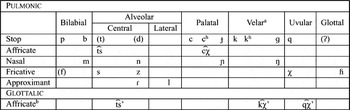
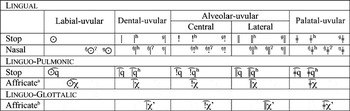
The consonant inventory of Nǀuu is presented in tables 1 and 2, and words exemplifying each of these segments are provided in appendix A. Including marginal segments, there are 25 pulmonic consonants, 3 glottalic consonants, and 45 lingual consonants (clicks), for a total of 73 consonants. This is large by the standards of most languages, but is unexceptional in a Khoesan context: ǃXóõ contrasts 119 consonants, Juǀ’hoansiFootnote 3 89, Kua 79 and KhoekhoeFootnote 4 35 (Traill Reference Traill1985: 99). Note that this inventory recognizes linguo-pulmonic sounds not transcribed by Doke (Reference Doke1936) or Westphal (Reference Westphal1953–1957). This might reflect differences in the language varieties we worked on, or language change between the earlier fieldwork and the present. It is also possible that earlier researchers simply failed to recognize these contrasts. Sound files illustrating each segment are provided at http://www.kalaharipeoples.org/academic/nuu/Segments.html.
Nǀuu pulmonic and glottalic consonants.

aThe velar nasal only occurs in the syllable nucleus, and never as an onset or coda.
bThere is extensive variability in the degree of frication in uvular glottalic affricates, which ranges from no audible frication to strong frication noise between the stop burst and the glottalic release. This variability is found in uvular glottalic affricates and linguo-glottalic clicks, but not in the coronal and velar glottalic affricates. Note that [ ] is a heterorganic affricate. The closure is velar, and the release is uvular, as our transcription suggests.
Nǀuu lingual, linguo-pulmonic and linguo-glottalic consonants.

aWe have not systematically investigated the place of articulation in the fricated release of the linguo-pulmonic affricates. However, these segments differ phonologically from the linguo-pulmonic stops in that they all behave as if they have a uvular release, regardless of click type. Additionally, they are placed in the aspirated column because they are subject to the Guttural OCP in Juǀ’hoansi (Miller-Ockhuizen Reference Miller-Ockhuizen2003) and in ǃXóõ.
bThe glottalic affricates in table 1 and the linguo-glottalic affricates in table 2 are placed in the third column, like the glottalized linguo-pulmonic segments. Linguo-pulmonic stops like [ ǃʔ] and linguo-glottalic stops like [
 ] differ in terms of their release airstream, but both involve a constriction at the glottis. Phonological evidence that these sounds have the same phonation type comes from the participation of both sound classes in the Guttural OCP constraint in Juǀ’hoansi (Miller-Ockhuizen Reference Miller-Ockhuizen2003) and in ǃXóõ.
Tables 1 and 2 are organized in line with the general principles of the International Phonetic Association (IPA 1999). Segments are sorted into columns by place of articulation and into rows by manner of articulation. Phonation type is indicated by the order of segments in each cell (voiceless unaspirated, aspirated, glottalized, voiced). Though airstream contrasts are sometimes treated like manner contrasts in languages with smaller inventories (e.g. Amharic ejectives, Sindhi implosives and Hausa implosives and ejectives in IPA 1999), we present them as sub-divisions of the two tables because of the complexity of such contrasts in this language. Segments in parentheses appear in our lexicon, but their phonemic status is still unclear, so we include them with qualifications. The segments [f], [t] and [d] appear only in loanwords that have been fully adopted into the lexicon, but have not been completely assimilated phonologically. We treat [l] and [ɦ] as low-frequency native sounds, and do not place them in parentheses. Finally, the glottal stop occurs only in word-initial position and in a few lexicalized forms, and is phonetically weak. We take it to be a prosodically conditioned sound, rather than a separate phoneme. That is, it is inserted in onsetless syllables so that every syllable has an onset.
In tables 1 and 2, both click and non-click segments are sorted by place of articulation. In the case of clicks, this sorting requires some discussion, because such stops are characterized by both an anterior and a posterior place of articulation. These two constriction locations form the boundaries of a lingual cavity that is expanded to create a negative pressure air pocket. When the anterior constriction is released, air rushes into this pocket with a distinctive ‘popping’ sound. The auditory impression of the burst is determined by the exact shape of the cavity, as well as the speed and channel (central or lateral) of the release. In Nǀuu, there are five different types of cavity, which correspond to different click types: bilabial [⊙], dental [ǀ], central alveolar [ǃ], lateral alveolar [ǁ] and palatal [ǂ]. It joins ǃXóõ and ǂHoan as being one of three extant languages that contrast these five click types, though Mangetti Dune ǃXung (Miller-Ockhuizen & Sands Reference Miller-Ockhuizen and Sands1999) has been reported to contrast five coronal clicks.
As is clear from their names, click types have traditionally been defined in terms of the anterior constriction, largely because it was assumed that the posterior constrictions were all the same. However, it has been shown that this is not the case in Khoekhoe (Miller, Namaseb & Iskarous Reference Miller, Namaseb, Iskarous, Cole and Hualde2007), and we will show that it is also not the case in Nǀuu. For the sake of expositional clarity, we will continue to refer to the click types by their conventional names, but the column headings in table 2 follow Miller-Ockhuizen (Reference Miller-Ockhuizen2003) in emphasizing that two different places of articulation are always involved. Regardless of the terminological details, the category click type has a coherent articulatory phonetic basis in terms of the anterior constriction location that has been demonstrated by palatographic studies in numerous languages, including ǃXóõ (Traill Reference Traill1985, Ladefoged & Traill Reference Ladefoged and Traill1994), Khoekhoe (Beach Reference Beach1938), Gǁana (Traill & Vossen Reference Traill and Vossen1997), Gǀui (Nakagawa Reference Nakagawa2006), Sandawe (Wright et al. Reference Wright, Maddieson, Ladefoged and Sands1995, Maddieson, Ladefoged & Sands Reference Maddieson, Ladefoged, Sands and Finlayson1999), Hadza (Sands, Maddieson & Ladefoged Reference Sands, Maddieson and Ladefoged1996, Maddieson, Ladefoged & Sands Reference Maddieson, Ladefoged, Sands and Finlayson1999, Ladefoged & Maddieson Reference Ladefoged and Maddieson1996) and Nǀuu (Sands et al. Reference Sands, Brugman, Exter, Namaseb and Miller2007).
Following IPA guidelines (IPA 1999: 8), the rows of tables 1 and 2 sort the Nǀuu consonant inventory by manner of articulation, with individual cells sub-divided by phonation type. With the pulmonic consonants, we find typical contrasts among stops, affricates, fricatives, nasals and approximants, but lingual consonants are restricted to just stops, affricates and nasals, because the lingual airstream requires a stop component. Note that both nasality and phonation differences in lingual segments are superscripted. This is in contrast to the current standard in click representation, where a nasalized click would be transcribed [ŋǃ]. Our intent is to emphasize that these are not sequences of segments (e.g. a nasal and a click), but rather unary elements. The difference between [ǃ] and [ŋǃ], for instance, is equivalent to that between [p] and [m], while that between [ǃ] and [ɡǃ] is equivalent to that between [p] and [b]. Elderkin (Reference Elderkin1989), Vossen (Reference Vossen1997) and Roux & Dogil (Reference Roux, Dogil and Caron1998) have argued that it would be more appropriate to represent such contrasts with diacritics (e.g. [ ] for a voiced click). While we agree with the spirit of this argument, it would be difficult to implement such a system in a language that has as many contrasts as Nǀuu. The voiceless nasal aspirated click, for example, would need to be represented [
 ] rather than [
 ], and a nasalized, epiglottalized vowel with high tone would be [
 ] rather than [
 ]. Because of readability concerns, we have opted for diacritic-like superscripting as a practical compromise between these positions.
The final linguistic phonetic dimension required for our analysis of the Nǀuu inventory is that of airstream. Nǀuu uses all three airstream mechanisms recognized in the phonetic literature: pulmonic, glottalic and lingual. In addition, we will argue that certain segments are best viewed as airstream contours, namely those we call linguo-pulmonic and linguo-glottalic stops and affricates. Plain lingual stops are characterized by a shift to the pulmonic airstream that occurs at the onset of the following vowel, but in contours the shift happens midway through the segment, so that the release portion of the click is a pulmonic or glottalic stop or fricative. All clicks have a posterior release, but in most cases this release is inaudible. It is only in linguo-pulmonic and linguo-glottalic segments that the shift in airstream mechanism makes the posterior release perceptible. Note that our analysis requires a subtle but significant distinction between airstream and airflow. While phonation differences like voicing and aspiration involve a certain amount of pulmonic airflow, we maintain that this is qualitatively different from the airstream that is used in the production of an entire segment. As noted by Abercrombie (Reference Abercrombie1967: 24), airstream crucially ‘makes audible the movement of other organs’, whereas the role of phonation is to modify rather than initiate airflow. Our proposal that consonants can differ in the airstream mechanism employed within a single segment is novel, but it is not surprising given that it parallels proposals for contours on other linguistic phonetic dimensions. There exist manner contours (affricates), nasality contours (pre-nasalized stops), and now airstream contours (linguo-pulmonic and linguo-glottalic stops and affricates).
Before proceeding to our acoustic and articulatory data, we briefly discuss our conventions for representing lingual stops. Clicks are dynamic segments, so discussing them in terms of two static places of articulation is a simplification. Both the anterior and posterior constrictions move in the formation of the negative pressure cavity, and we maintain that it is the constriction locations at the point of release that matter, at least with respect to phonological patterns like the Back Vowel Constraint (see Traill Reference Traill1985, Miller, Namaseb & Iskarous Reference Miller2007 for further discussion). We will show below that the posterior constrictions in all clicks are post-velar and that they differ somewhat for the different click types. It is not, however, clear how best to represent these differences symbolically, so the pulmonic portions of all five linguo-pulmonic stops are represented with [q] for the time being, following the established convention. Similarly, voicing and nasality have historically been represented in clicks with the voiced velar and nasal pulmonic consonant symbols, [ɡ] and [ŋ]. We have retained this convention, although our results suggest that it is not strictly appropriate to symbolize click closure places with pulmonic velars. As discussed above, we superscript the pulmonic velar symbols as in [ɡǃ] and [ŋǃ]. We place the [ɡ] and [ŋ] symbols preceding the click symbols to emphasize that voicing and nasality occur during the closure.
We use the tie-bar only in the sequential sense described in the IPA (1999). That is, we use it to mark sequences of manner specification in the affricates  and sequences of airstream specification in the airstream contours
 . The linguo-pulmonic and linguo-glottalic affricates are contours in both manner and airstream
 . The double place specification necessary for clicks is not represented with a tie-bar, but rather is inherent in the symbols used to represent them. We suggest that the tie-bar should, in fact, be limited to this type of sequential usage, and that labial-velars and other complex segments should, like clicks, ideally be represented with unary symbols.
Our analysis of all Nǀuu consonants strictly in terms of place of articulation, manner of articulation, phonation and airstream is meant to underscore the basic structural similarities among lingual and non-lingual inventories, and the presentation of clicks in an IPA-style chart is intended to emphasize the parallels with their pulmonic and glottalic counterparts. Both pulmonic and lingual stops can, for instance, be voiced, voiceless or aspirated. Both glottalic and linguo-glottalic segments are voiceless affricates in this language. We argue that this is a considerable improvement over approaches that lump every modification of a particular click type in a particular language under the heading of accompaniment, which makes the contrastive features set apart from those employed in the pulmonic and glottalic consonant inventories.
The idea of classifying clicks on the basis of type and accompaniment dates back at least to Beach (Reference Beach1938), who uses the terms influx (i.e. ingressive airflow) and efflux (i.e. egressive airflow), respectively, to describe the inventory of Khoekhoe. The term click type is now the norm in discussing the location and channel (central or lateral) of ingressive airflow, while accompaniment has replaced efflux for referring to all the contrasts in egressive airflow associated with a given click type. As a result, the category click accompaniment groups together phonation contrasts (voiced vs. voiceless, aspirated vs. unaspirated), manner contrasts (oral vs. nasal, stop vs. affricate) and airstream contrasts. We maintain that the practice of lumping qualitatively different types of contrasts under a single heading has served to obscure important structural similarities between click and non-click inventories. Additionally, we argue that decomposing natural classes into phonetically similar groups allows a straightforward mapping between phonetic descriptions and phonological representations.
There have been previous attempts to improve upon the mixed-bag approach. Nakagawa (Reference Nakagawa1996a, Reference Nakagawab, Reference Nakagawa2006) uses the term accompaniment to describe the inventory of Gǀui, but also groups the segments according to their manners, while Miller-Ockhuizen (Reference Miller-Ockhuizen2003) presents Juǀ’hoansi segment categories as much as possible in terms of place and manner of articulation. Our approach follows these ideas to their logical conclusion, explicitly rejects the usefulness of the concept accompaniment, and classifies segments exclusively with the principles of the IPA.
3 Methods
Our description of Nǀuu is based on recordings of the speech of eight Nǀuu elders, all of whom requested recognition for their contribution to our study: Ouma Katrina Esau (KE), Ouma Anna Kassie (AK), Ouma Hanna Koper (JK), Ouma ǀUna Rooi (UR), Ouma Kheis Brou (KB) and Ouma Griet Seekoei (GS), who speak the Western dialect, and Ouma Hannie Koerant (HK) and Oupa Andries Olyn (AO), who speak the Eastern dialect. All of these speakers are bilingual in Afrikaans and Nǀuu and are 65–75 years of age. Ouma Anna Kassie and Ouma ǀUna Rooi also speak some Khoekhoe, as did the late Ouma Kheis Brou, and the two Eastern Nǀuu speakers are also fluent in Setswana. None currently resides in a household with other Nǀuu speakers, and Afrikaans is the dominant language for all. Transmission of the Nǀuu language was seriously disrupted in 1931 when the ǂKhomani people were expelled from the area that became the Kalahari Gemsbok Park (Crawhall Reference Crawhall, Blythe and Brown2003, Reference Crawhall2004), and families dispersed in search of work and other opportunities. Linguistic documentation and the revitalization of Nǀuu began when community member Petrus Vaalbooi spoke with author Namaseb about writing down his mother's language (Chamberlin & Namaseb Reference Chamberlin and Namaseb2001, Namaseb Reference Namaseb2006: 42–43). Vaalbooi's mother, Ouma Elsie Vaalbooi, passed away before our project began, but she played an important role in spearheading Nǀuu documentation and revitalization efforts.
Acoustic recordings reported in this paper were made with four different setups in various fieldwork trips by various subsets of the authors between 2003 and 2006 onto: (i) a Sony TCD D7 DAT recorder with a Sony ECM-MS907 microphone; (ii) an Acer TravelMate 230 laptop using a Sound Devices USBPre combined pre-amp and A/D converter with an AKG C 420 head-mounted condenser microphone; (iii) a Dell 8600 laptop using an Edirol UA-3B pre-amp in conjunction with a Sony ECM-144 electret condenser microphone; (iv) a Marantz 670 digital audio recorder using a Shure SM10A head-mounted microphone. Recordings were made in Upington, South Africa, in quiet rooms in the Belurana guest lodge or the South African San Institute office.
Ultrasound investigations were undertaken with speakers AK, GS, KE and HK. Ultrasound videos were collected using a GE Logiqbook ultrasound machine with an 8C-RS 5–8 MHz pediatric transducer. Head and transducer stabilization were accomplished as in Gick, Bird & Wilson (Reference Gick, Bird and Wilson2005). The acoustic signal was recorded with a Shure SM10A head-mounted microphone and channeled through a Shure FP23 pre-amp. All ultrasound recordings were made in the frame sentence [nɑ kɑ _____ nɑ kɑ qoʢɑʢin], meaning ‘I say _____, I say famished’. Tongue traces of a particular token are always plotted with and discussed relative to the place of articulation of [k] in the first [kɑ] token and/or the initial [q] in the word [qoʢɑʢin], as in Brugman (Reference Brugman2005). Unfortunately, we were unable to completely control for vowel context because of the low lexical frequency of [q] and [k], but we were at least able to keep all segments before back vowels: [k] before [ɑ], the clicks before [u], and [q] before [oʢ]. Note that all plots show the position of the tongue relative to the ultrasound probe, not the palate. For discussion of the methodological issues involved in getting from ‘probe space’ to ‘head space’ with ultrasound, see Stone (Reference Stone2005). For each token, we identified frames immediately before and after the lingual burst. With the linguo-pulmonic stops, we also identified the frames immediately before and after the pulmonic burst. The tongue edge was tracked for each of these frames with EdgeTrak (Li, Khambamettu & Stone Reference Li, Kambhamettu and Stone2005). A complete description of the ultrasound setup used in this study, and the methodology used to align acoustic and articulatory data is provided in Miller et al. (Reference Miller, Brugman and Sands2007).
4 The acoustics and articulation of Nǀuu clicks
The goal of this section is to present evidence supporting our claims about the inventory of Nǀuu lingual stops. As already noted, previous phonetic descriptions of clicks have lumped together phonation type, manner of articulation and airstream contrasts into a click's ‘efflux’ (Beach Reference Beach1938) or ‘accompaniment’ (Ladefoged & Traill Reference Ladefoged and Traill1994). We follow Thomas-Vilakati (Reference Thomas-Vilakati1999) and Miller-Ockhuizen (Reference Miller-Ockhuizen2003) in orienting our discussion temporally by focusing on the characteristics of click closures (section 4.1), place of articulation contrasts (4.2), and release properties (4.3). Specifically, section 4.2 provides acoustic and articulatory evidence for the anterior and posterior places of articulation and makes the case for the term lingual airstream mechanism. Section 4.3 separates contrastive release properties into phonation type, manner of articulation and airstream contrasts. Finally, section 4.4 provides supporting evidence for our claim that clicks do not contrast solely in terms of their posterior place of articulation, and provides evidence for contrastive airstream contours.
4.1 Closure contrasts
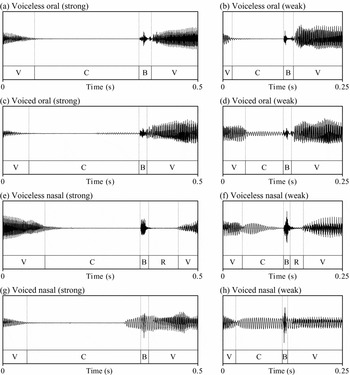
Nǀuu contrasts voiced and voiceless oral clicks, as well as voiced and voiceless nasal clicks. Figure 1 provides waveforms that illustrate these possibilities with voiceless unaspirated, voiced unaspirated, voiceless nasal aspirated and voiced nasal unaspirated central alveolar clicks. The degree of voicing, especially in the voiceless nasal aspirated clicks, is prosodically conditioned. We therefore show each click in two contexts, one where the closure is at a stronger prosodic boundary and one where it is at a weaker boundary. The stronger boundary correlates with longer closure duration and less closure voicing.
Waveforms of clicks with different closures excerpted from the frame sentences [nɑ kɑ _____] ‘I say _____’ (left, stronger prosodic boundary) and [nɑ kɑ ɑ _____] ‘I say your [noun]’/‘I say you [verb]’ (right, weaker prosodic boundary): (a–b) [ǁɑɑᵪe] ‘sister’, (c–d) [ɡǁɑɑ] ‘night’, (e–f) [ǁʰɑɑsi] ‘uterus’ and (g–h) [ŋǁɑɑ] ‘stay’. Labels indicate the locations of vowels (V), closures (C), bursts (B) and releases (R) (Speaker GS).

The difference between voiced (figure 1c–d) and voiceless (figure 1a–b) clicks is directly parallel to that between voiced and voiceless pulmonic stops in Nǀuu, with visible voicing for at least part of the segment's closure portion. Notice that prosodic context conditions differences in the degree of voicing in both lingual and pulmonic stops, just as it does in English (Keating Reference Keating1984) and various other languages. The oral voiced click that comes after a stronger prosodic boundary in figure 1c has weak voicing that starts only half-way through the closure, while the voicing across the weaker prosodic boundary in figure 1d is much stronger, and is maintained throughout the entire closure. We see the same pattern in the voiceless and voiced nasal clicks. It should be noted that the nasalization in the voiced and voiceless nasal clicks occurs throughout the closure and the release, indicating that these segments are not pre-nasalized stops, but rather are fully nasal. Further, the strong bursts and the phonotactic distributions of these sounds, show that they are obstruents and not sonorants.
Voiceless nasal aspirated clicks (e.g. [ǃʰ]) in Nǀuu are usually realized acoustically with at least some audible nasalization in the closure, but nasalization in the closure of clicks with a glottalized release (e.g. [ǃʔ]) is much more variable across speakers, contexts and tokens (see section 4.3 below). There is usually at least some audible nasalization, but the closure phase is much less likely to be voiced in glottalized than in voiceless nasal aspirated clicks. This may be related to the fact that the glottis must close at some point prior to the click burst. Examples of variation brought on by domain-initial articulatory strengthening (Keating et al. Reference Keating, Cho, Fougeron, Hsu, Local, Ogden and Temple2003) are provided in Miller et al. (Reference Miller, Brugman and Sands2007).
4.2 Place of articulation contrasts
In this section, we discuss the differences in anterior and posterior places of articulation found in Nǀuu clicks. Section 4.2.1 summarizes the differences in anterior place of articulation reported in Sands et al. (Reference Sands, Brugman, Exter, Namaseb and Miller2007) in terms of both active and passive articulations. In section 4.2.2, we provide evidence that posterior places of articulation also differ in different clicks and argue that these differences are predictable from the anterior place of articulation. Though they are not independently contrastive, these differences are important and must be represented, because they account for phonological differences in click classes with respect to the BVC in Nǀuu and other languages (Miller-Ockhuizen Reference Miller-Ockhuizen2003, Miller, Namaseb & Iskarous Reference Miller2007).
4.2.1 Anterior constrictions across click types
As shown in table 2, Nǀuu contrasts five click types – four that have a coronal anterior constriction, and one that has a bilabial anterior constriction. Miller et al. (Reference Miller, Brugman and Sands2007) and Sands et al. (Reference Sands, Brugman, Exter, Namaseb and Miller2007) provide palatographic and linguographic data on the four coronal types. Results show that the dental click has a laminal dental articulation, with a fairly broad area of contact. The central and lateral alveolar clicks are clearly alveolar in Nǀuu, and not postalveolar as in IsiXhosa (Sands Reference Sands1991), IsiZulu (Doke Reference Doke1923) and Khoekhoe (Beach Reference Beach1938). Tongue contact primarily involves the tongue tip, as has been reported for ǃXóõ (Traill Reference Traill1985). The palatal click is characterized by an extremely wide contact area between the alveolar ridge and the palatal region. We suspect, based on our viewing of ultrasound movies of this click in Nǀuu and EPG data for this click in Khoekhoe, that the long laminal contact seen in palatograms is due to dynamic movement of the anterior constriction during production of the palatal click, rather than a long laminal closure at the time of the release.
The bilabial click in Nǀuu has been assessed through video images of the lips during its production (Miller et al. Reference Miller, Brugman and Sands2007). Dynamic changes in lip posture show compression and release over the initial 20 ms interval of production, followed by puckering of the lips over the remaining 20 ms of the segment's duration. There is also very salient rounding coarticulation on following vowels in Nǀuu, and words like ‘meat’ are realized as both [⊙oe] and [⊙əe] by the same speaker in the same context. We have also documented a variant production of the bilabial click by Speaker HK that involves contact between the lower lip and the upper teeth. This variant has also been reported in ǃXóõ (Ladefoged & Maddieson Reference Ladefoged and Maddieson1996: 251). Overall, our investigation of anterior place in Nǀuu clicks has shown that clicks exhibit individual phonetic variation similar to that documented for pulmonic consonants.
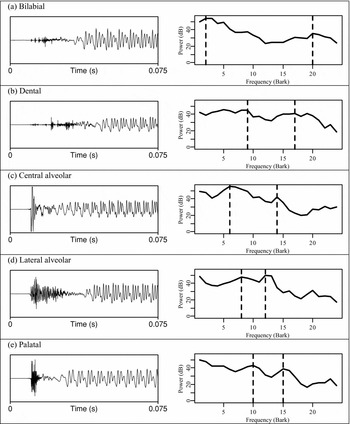
Figure 2 provides waveforms of words that begin with each of the five lingual stops, as well as bark-scaled LPC spectra computed over 10 ms windows. For the spectra, 30 ms windows were extracted with the center of the window aligned at the left edge of the burst. A barkfilter was then created using a 10 ms window, with the bandwidth of each filter being one bark. The waveforms show that the bilabial, dental and lateral alveolar clicks are noisy, while the central alveolar and palatal clicks are abrupt, much like those reported for ǃXóõ (Ladefoged & Traill Reference Ladefoged and Traill1994, Ladefoged & Maddieson Reference Ladefoged and Maddieson1996). That is, the bursts of the central alveolar and palatal clicks exhibit a sharp, intense transient, with little turbulent noise, while the bursts in bilabial, dental and lateral alveolar clicks are noisy, making it difficult to isolate the transient. The differences in noisiness correlate with durational differences: noisy clicks are longer than abrupt ones.
Representative waveforms of bursts extracted from the frame sentence [nɑ kɑ _____] ‘I say _____’ for the lingual stops in: (a) [⊙oɑᵪe] ‘daughter’, (b) [ǀɑɑᵪe] ‘niece’, (c) [!ɑmɑ] ‘kidney’, (d) [ǁɑɑᵪe] ‘sister’ and (e) [ǂəusi] ‘tsama melon’. Normalized bark-scaled LPC spectra of bursts in words: (a) [⊙unun] ‘son’, (b) [ǀunun] ‘boil’, (c) [!uu] ‘acacia’, (d) [ǁuu] ‘grasshopper’ and (e) [ǂuuke] ‘fly’ (Speaker KE).

Ladefoged & Maddieson (Reference Ladefoged and Maddieson1996) attribute both the shorter duration and the dominance of the transient in the abrupt clicks to a faster anterior release. It is interesting to note that the clicks in most languages pattern like those in Nǀuu with respect to their abruptness, but Fulop et al. (Reference Fulop, Ladefoged, Liu and Vossen2003) report that palatal clicks in the Bantu language Shiyeyi tend to be longer and noisier, like the dental clicks, and that lateral clicks are often sharp like the central alveolar clicks. We expect that cross-linguistic studies will show more complexity of this type, as found for pulmonic coronal stops in European languages (e.g. Dart Reference Dart1998).
It is important to note that there is no indication in these waveforms of a pulmonic burst between the click burst and the vowel. Descriptions of clicks often claim that the release of the posterior constriction is a pulmonic stop (e.g. Ladefoged & Traill Reference Ladefoged and Traill1994), but it is crucial to our subsequent argument that this is not the case. We sometimes find low-intensity events between the lingual burst and the vowel onset, and these events may well correspond to the release of the posterior constriction, but they are low amplitude and generally imperceptible, especially given their proximity to the high-amplitude click burst. Traill (Reference Traill1985: 125–126), in fact, makes this same observation for ǃXóõ. He cites Beach's (Reference Beach1938: 82) comment that the posterior closure in Khoekhoe clicks can be released ‘practically silently’ and maintains that the same is true of ǃXóõ. This observation will be important in our discussion of the distinction between lingual and linguo-pulmonic clicks in section 4.4, and we maintain that it is the norm rather than the exception in click production.
The click burst spectra in figure 2 (see also Miller, Brugman & Sands Reference Sands, Miller, Brugman, Payne and Peña2007) provide acoustic evidence of both anterior and posterior place differences among the different clicks. The overall energy distribution patterns in these bursts are consistent with those reported for ǃXóõ (Ladefoged & Traill Reference Ladefoged and Traill1994, Ladefoged & Maddieson Reference Ladefoged and Maddieson1996), in that the dental and palatal bursts have more energy at higher frequencies, the central and lateral alveolar clicks have more energy at lower frequencies and the bilabial click spectra are relatively diffuse. Moreover, we are able to consistently identify two peaks in the burst spectra of the four coronal click types, as well as about half of the bilabial click tokens. The identified peaks in these spectra are marked with vertical lines in figure 2. Though we have not found significant differences among the lower peaks (P1), the higher peak (P2) does distinguish all five click types (Miller, Brugman & Sands Reference Sands, Miller, Brugman, Payne and Peña2007).
The spectral peaks can be modeled with an adaptation of a proposal by Stevens (Reference Stevens1999: 186–187), who models the peaks in abrupt clicks with a short tube. He claims that the whole tube in front of the posterior constriction contributes the spectral peaks in click bursts because the anterior constriction is released within a few milliseconds. Kagaya (Reference Kagaya1978), on the other hand, attributes P1 to the cavity in front of the constriction, as it is in pulmonic egressive stops (Fant Reference Fant1960). We attribute P1 to the entire cavity volume in front of the posterior constriction following Stevens (Reference Stevens1999: 186–187). Although Stevens does not model the higher peak seen in figure 2, we attribute this higher frequency peak to the volume of the lingual cavity between the two constrictions in the coronal clicks. Since we propose that P2 relates to the volume of the lingual cavity, we discuss these values here. P1 values are discussed in section 4.2.2 below, since they provide data about the posterior place of articulation.
The P2 frequency values for the tokens in figure 2 are: 20 bark for [⊙], 17 bark for [ǀ], 15 bark for [ǂ], 14 bark for [ǃ] and 12 bark for [ǁ]. These are comparable to the averages reported for three speakers in Miller, Brugman & Sands (Reference Sands, Miller, Brugman, Payne and Peña2007). The values suggest that among the coronal clicks, the dental has the smallest lingual cavity, followed by the palatal, and the two alveolar clicks. Finally, the high-frequency P2 peak found in about half our tokens of the bilabial click may be attributable to a simultaneous dental constriction in these productions. Traill (Reference Traill1985) reports such a variant in ǃXóõ, and the fact that only half the tokens are characterized by such a peak makes this interpretation likely.
4.2.2 Posterior constrictions across click types
We now turn to our description of the posterior places of articulation in the five Nǀuu click types ([⊙ ǀ ǃ ǁ ǂ]). At least since Doke (Reference Doke1923), the phonetic literature has assumed that all basic click types are produced with a velar posterior place of articulation. Miller, Namaseb & Iskarous (Reference Miller2007) have, however, shown that the palatal and postalveolar clicks in Khoekhoe in fact have different posterior places of articulation, and we will see that the same is true in Nǀuu (Miller et al. Reference Miller, Brugman, Howell and Sands2006). Our first goal here is to provide evidence supporting our claim that the posterior constrictions in Nǀuu alveolar [ǃ] and palatal [ǂ] clicks are qualitatively different from velar stops. Previous descriptions of clicks have focused on the location of the front part of the posterior constriction, which is usually described as velar and equated with [k], but we will show that the shape and dynamics of the tongue root in clicks are actually very different from [k] and from each other. We attribute these differences to the muscular activity involved in click production and constraints on overall tongue shape. We will begin with ultrasound data that show different posterior places of articulation for [ǃ] and [ǂ], and move on to spectral data from the linguo-pulmonic clicks that suggest that the same pattern obtains in these segments, as well.
We begin with our ultrasound data, which allow us to pinpoint the part of the tongue used in the production of clicks, as well as the location of the release relative to velar and uvular consonants. Our discussion in this section distinguishes between three posterior parts of the tongue, namely the dorsum, the upper tongue root and the tongue root proper (the lower part of the tongue root). Generally, the tongue dorsum is at, or in front of, the posterior constriction during click closures, while the upper tongue root and the tongue root proper are behind it. By upper tongue root, we mean the part of the tongue that is at the interface between the oral and pharyngeal cavities in rest position, and by the tongue root proper, we mean the part in the upper oropharynx. We also need to distinguish between the raising of the back of the tongue that occurs in high back vowels and is primarily a vocalic gesture (Esling Reference Esling2005) and the retraction of the tongue root into the pharyngeal region that is involved in alveolar click production and is a consonantal gesture. We show that the raising of the back of the tongue into the uvulo-pharyngeal region found in palatal clicks is in part articulated in the back of the uvular region and is very similar to the production of [u], which follows the clicks in this study. The tongue root proper forms the upper part of the laryngeal constrictor mechanism described by Esling (Reference Esling2005) so in terms of his model, the alveolar click involves the laryngeal constrictor mechanism. However, Edmondson et al. (Reference Edmondson, Padayodi, Hassan and Esling2007) show that languages such as Yi, Akan and Kabiye ‘can use constriction to achieve significant pharyngeal resonator reduction without changing phonation to any great extent’ (p. 2068). The production of Nǀuu alveolar clicks is likely similar to the production of vowels in these languages, then, in using tongue root retraction, and probable concomitant aryepiglottic fold constriction, without changing phonation, as there are no voice quality cues associated with plain voiceless click consonants. Further, constriction of the tongue root proper that is involved in alveolar click production in Nǀuu, is the likely lingual accompaniment to aryepiglottic sphinctering found in epiglottalized vowels in the language (Traill Reference Traill, Singer and Lundy1986; Esling Reference Esling1996, Reference Esling2005; Hess Reference Hess1998). The epiglottalized vowels in Nǀuu involve non-modal phonation similar to the [+ constricted] vowels in Bai and Somali (Edmondson et al. Reference Edmondson, Padayodi, Hassan and Esling2007), which is similar for most speakers to that found in Juǀ’hoansi (Miller-Ockhuizen Reference Miller-Ockhuizen2003, Miller Reference Miller2007). We expect that raising of the upper tongue root involved in palatal click production, would not accompany aryepiglottic sphinctering, as this does not involve the laryngeal sphincter mechanism.
When interpreting tongue traces in this section, it is important to remember that they show the position of the tongue relative to the ultrasound probe, which was positioned beneath the jaw. Raising and lowering of the tongue with respect to the jaw will generally result in raising and lowering with respect to the (hard) palate, but this technology underestimates displacement that results from jaw movement. In addition, ultrasound is an imprecise technology for imaging the tip of the tongue. Ultrasound depends on the transmission of sound waves through tissue, and the sublingual cavity associated with a raised tongue tip allows only poor transmission of these waves. We were not, therefore, able to trace the tip of the tongue reliably in the alveolar clicks. We do, however, know from Traill's x-ray recordings of ǃXóõ that the tongue tip in these segments is pointed upward. We can also deduce the apical gesture in the alveolar click from the extremely concave tongue body shape that we see in our ultrasound videos. We also observe that the tongue root gesture used in the alveolar click involves a convex shape, which corroborates Esling's (Reference Esling2005) claim that tongue body and root shapes are independent.
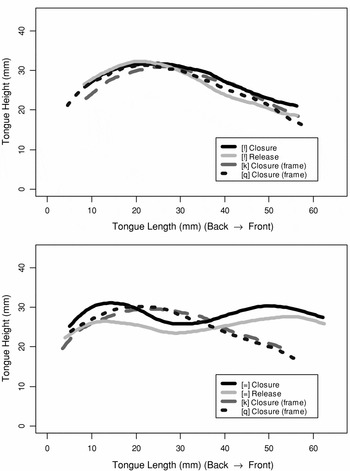
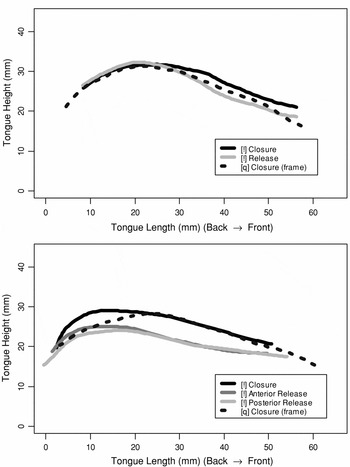
Figure 3 provides representative ultrasound tongue traces from frames that correspond to the closure and release portions of the alveolar [ǃ] and palatal [ǂ] clicks, as well as traces of the pulmonic velar and uvular stops from the frame sentence. These plots make the differences in tongue body shape for these two click types quite clear. Looking first at the top panel, we see small differences in the location of the upper tongue root (i.e. the back sides of the constrictions) in the velar stop [k], the uvular stop [q] and the posterior constriction in the central alveolar lingual stop [ǃ]. Specifically, the upper tongue root in [k] is most advanced, that in [q] is intermediate and that in [ǃ] is most retracted. The differences may in part be due to vowel context. Our impression from viewing the dynamics of this segment in the source ultrasound movies, as well as Traill's x-ray recordings of similar segments in ǃXóõ, is that the same is true of the tongue root proper. One difference between velar and uvular pulmonic stops cross-linguistically is that uvular segments are characterized by tongue root retraction. Hess (Reference Hess1998), for instance, reproduces x-ray traces from Tunisian and Iraqi Arabic that show a much more retracted upper and lower tongue root in [q] than [k]. The retraction of the tongue root proper involved in the production of [ǃ] supports its analysis as an alveolar-uvular segment.
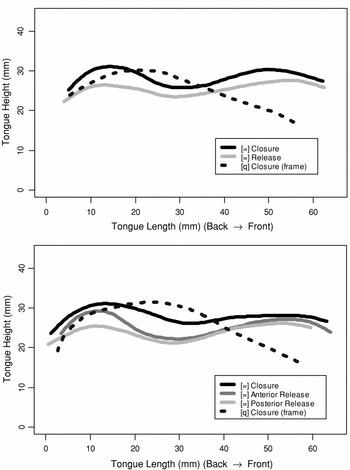
Tongue traces of the closures and releases of the central alveolar [!] (top) and palatal [ǂ] (bottom) click types, as well as velar and uvular pulmonic stop closures in the frame sentence [nɑ kɑ _____ nɑ kɑ qoʢnɑʢin] ‘I say _____, I say famished’. (Note that ‘=’ is used for ‘ǂ’ in the plot.)

Turning to the posterior constriction in the palatal click, we see that the upper tongue root is raised into the back of the uvular region, hence its description as palatal-uvular in table 2. The constriction is technically uvulo-pharyngeal, with contact along the uvula, which is raised in the production of this click. There cannot be a complete pharyngeal constriction, nor can the velum be completely raised in nasal varieties of these clicks, because such raising would block nasal airflow. We do, however, see pronounced retraction in the videos. We know that the upper tongue root is raised and the tongue dorsum is retracted into the upper pharynx, presumably causing bunching. This is akin to the raising gesture that Esling (Reference Esling2005) finds in high back vowels, and differs from the retraction gesture typically found in uvular pulmonic consonants. We surmise the raising of the upper tongue root from hyoid movement, which is visible as movement of the hyoid shadow in the ultrasound recordings. In the palatal click, the upper tongue root makes a constriction in the back of the uvular region. Constrictions can often be seen in ultrasound because the soft palate becomes visible in the image when the tongue touches it. That is, the uvulo-pharyngeal constriction found in the palatal click is not a retraction gesture as found in epiglottals, but is rather a raising gesture like that Esling (Reference Esling2005) describes in the production of high back vowels. The similarity between the [u] gesture that follows the clicks in our data and the palatal click posterior tongue gesture is quite striking. We are not aware of post-velar pulmonic obstruents with such high retracted constrictions, though Ladefoged & Maddieson (Reference Ladefoged and Maddieson1996: 169–170) describe a somewhat similar constriction in the Danish approximant [ʁ], which we might transcribe as [ ]. It might be that the back uvular component of the posterior gesture in the palatal click is more similar to this more open constriction in the Danish approximant. There may also be an upper pharyngeal more open constriction in the palatal click. We cannot ascertain the degree of constriction with our current ultrasound recordings, as we have not been able to trace the palate, but it is clear that the back part of the posterior lingual gesture found in the palatal clicks is a more open gesture, rather than a more constricted consonantal gesture.
In addition to the clear differences in overall tongue shape, our ultrasound recordings also show differences in the timing of the anterior and posterior releases of the central alveolar [ǃ] and palatal [ǂ] click types. In recordings of the central alveolar click, we sometimes see the tongue tip moving downward from the apical articulation which suggests the uncurling of an extreme concave tongue shape. The deep concave tongue body shape indicates a high volume cavity between the two constrictions. In general, the front of the tongue in this click seems to move down faster than the back of the tongue, which is probably related to the extreme jaw lowering involved in its production. In the palatal click, on the other hand, the two constrictions seem to be lowered more simultaneously, as is suggested from the successive frames traced in the bottom panel of figure 3. The cavity between the constrictions is much shallower in this click. These differences in tongue shape and the resultant differences in cavity size account for the differences in the high spectral peak, P2, shown in figure 2 and discussed in section 4.2.1 above.
Our impression from viewing the ultrasound video is that the relationship between the anterior constriction location, the posterior constriction location and resulting cavity volume are highly constrained by the tongue musculature. The tongue muscles are interconnected, and the tongue itself can be divided into four main extrinsic muscles (Zemlin Reference Zemlin1968, Harris, Vatikiotis-Bateson & Alfonso Reference Harris, Vatikiotis-Bateson, Alfonso, Ohala, Nearey, Derwing, Hodge and Wiebe1992, Honda Reference Honda1996), which are divided into groups of compatible vs. incompatible pairs. We suspect that there is muscular incompatibility between apical alveolar and back uvular articulations, the latter of which involve raising the back of the tongue, as well as between laminal dental or laminal pre-palatal anterior constrictions and uvular posterior constrictions, which involve consonantal tongue root retraction. In the palatal click, the tongue body is raised upwards and forwards by anterior genioglossus muscle activity, which goes hand-in-hand with the advancement and raising of the upper tongue root accomplished through the compatible styloglossus muscle activity found in high back vowels (Esling Reference Esling2005). These movements are surmised from the swinging action of the hyoid bone that can be deduced from the movement of its shadow, which we have observed in every token of [ǂ] we have viewed in both Nǀuu and Khoekhoe. Additionally, we surmise that the alveolar click is produced using a smaller degree of styloglossus activity which pulls the tongue dorsum upwards, as well as a larger degree of hyoglossus activity that pulls the tongue root backward.
We turn now to the acoustic evidence for posterior place of articulation differences among the coronal clicks. Recall that we attribute the lower peak in the spectrum (P1) to the cavity in front of the posterior constriction following Stevens (Reference Stevens1999). The P1 values for the dental and palatal clicks are higher than those in the central and lateral alveolar clicks, suggesting a smaller cavity in front of the posterior constriction for the dental and palatal clicks. We attribute the higher peaks found for the dental and palatal clicks to their long, flat anterior and posterior constrictions, which lead to a smaller cavity volume. P1 in alveolar clicks is lower than P1 in the palatal and dental clicks because their apical anterior constrictions and narrow posterior constrictions allow a more concave tongue shape and, consequently, a larger cavity volume. We also see subtle P1 differences in the central alveolar and lateral alveolar clicks. Specifically, P1 is lower for the central alveolar click than for the lateral alveolar click, which we take to indicate a larger cavity in front of the posterior constriction for [ǃ] than [ǁ]. This observation is consistent with the slightly more laminal anterior constriction in [ǁ] (Sandset al. Reference Sands, Brugman, Exter, Namaseb and Miller2007), which leads to a slightly less concave tongue shape and slightly smaller cavity.
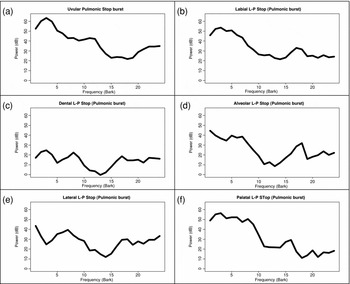
We now turn to acoustic data that corroborate our ultrasound findings, specifically to evidence provided by linguo-pulmonic stops (i.e. [⊙⊃q ǀ⊃q ǃ⊃q ǁ⊃q ǂ⊃q]). We will see below that these stops are characterized by two bursts, the first lingual and the second pulmonic, and we argue in section 4.4 below that lingual and linguo-pulmonic segments with the same click type (e.g. [ǃ] and [ǃ⊃q]) have the same posterior place of articulation. There are, however, differences in the posterior place of articulation across the different linguo-pulmonic stop types, just as we saw in the ultrasound traces of [ǃ] and [ǂ]. The second, pulmonic burst in these segments provides information about their posterior places of articulation. Representative spectra of such bursts are provided in figure 4, where we see that the energy distribution in the bilabial and alveolar linguo-pulmonic stops is very similar to that in the uvular pulmonic stop. All four exhibit a sharply falling spectrum between 0 and 10 bark. Pulmonic bursts in dental and palatal linguo-pulmonic stops, on the other hand, exhibit energy throughout this range. Thus, these spectra provide clear evidence that the pulmonic portion of the bilabial and alveolar linguo-pulmonic stops differs from the pulmonic portion of their dental and palatal counterparts. These data are incompatible with an analysis that represents the pulmonic release of all linguo-pulmonic stops as a uvular stop, whether as part of the same segment or as a separate segment. Moreover, they support our contention that the posterior constrictions vary with click type.
Spectra for posterior bursts in linguo-pulmonic stops extracted from words in the frame sentence [nɑ kɑ _____] ‘I say _____’: (a) [q'ui] ‘good’, (b) [⊙⊃qʰuiɑ] ‘sweat’, (c) [ǀ⊃quu] ‘tobacco’, (d) [!⊃qui] ‘ashes’, (e) [ǁ⊃quu] ‘urine’ and (f) [ǂ⊃quu] ‘neck’ (Speaker GS).

Taken together, these data show that the posterior closures in clicks involve post-velar constrictions that are qualitatively different from [k]. We, therefore, propose a terminological shift from velaric airstream mechanism to the articulatorily more accurate lingual airstream mechanism (Miller, Namaseb & Iskarous Reference Miller2007).Footnote 5 The use of velaric as a descriptor for clicks dates to Beach (Reference Beach1938: 74), whose definition of click encompasses all segments with ingressive airflow. That is, he distinguishes between velaric, glottalic and pulmonic clicks, which in current terminology would be clicks, implosives and pulmonic ingressives. In a system that defines clicks in terms of ‘the inner boundary of the chamber wherein the air is rarefied’, the term velaric makes sense, but as the name of an airstream it is problematic. The other two airstream mechanisms have names that reflect the anatomical source of the airflow – the lungs in the case of the pulmonic airstream and the glottis in the case of the glottalic airstream. By extension, the term velaric suggests that this airstream is somehow initiated by the velum or that it involves a velar stop, and this is clearly not the case. Rather, the tongue is used to create a negative pressure cavity, the anterior release of which initiates the ingressive flow of air. For this reason, we adopt the term lingual airstream mechanism in describing these segments.
4.3 Release contrasts
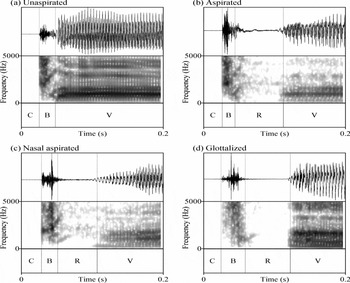
Nǀuu lingual stop releases can be unaspirated, aspirated, glottalized or nasal aspirated. Waveforms illustrating these possibilities with the lateral click are provided in figure 5. The difference between the unaspirated release in figure 5a and the aspirated release in figure 5b is comparable to what we see with aspiration contrasts in pulmonic stops. Turning to the difference between the oral and nasal aspirated releases in figures 5 and 5c, note that these waveforms and spectrograms may look similar, but there is a clear auditory impression of nasality in segments like figure 5c, and the slow rise in vowel amplitude is also characteristic of such onsets. The aspiration in oral aspirated clicks is also more audible. See Ladefoged & Traill (Reference Ladefoged and Traill1984) for a discussion of these segments in Khoekhoe and ǃXóõ. Finally, the glottalized release in figure 5d is exactly what we would expect to see in a pulmonic glottal stop: a period of silence followed by an abrupt vowel onset. This is the canonical production, but we have also noticed a tendency for these speakers to produce tokens with ‘leaky’ closures and gradual, laryngealized vowel onsets (see Miller et al. Reference Miller, Brugman and Sands2007 for waveforms).
Lingual stop releases in words extracted from the frame sentence [nɑ kɑ _____] ‘I say _____’: (a) [ǁɑɑᵪe] ‘sister’, (b) [ǁʰɑɑ] ‘break’, (c) [ǁʰɑɑsi] ‘uterus’ and (d) [ǀʔɑɑ] ‘dead’. Labels indicate the locations of closures (C), bursts (B), releases (R) and vowels (V) (Speaker GS).

Our analysis of the segments in figure 5a–c is much like those of previous authors, but our analysis of the glottalized release in figure 5d is different from most. We follow Miller-Ockhuizen (Reference Miller-Ockhuizen2003) in treating glottalized releases as a type of phonation. Miller-Ockhuizen motivates this treatment phonologically in Juǀ’hoansi, where segments of this type pattern like aspirated segments with respect to the Guttural OCP (Obligatory Contour Principle). There is no active Guttural OCP constraint in Nǀuu, but we extend the analysis in the absence of evidence to the contrary. Moreover, such patterns are also attested outside of Khoesan in consonants produced with the pulmonic airstream. Ladefoged & Maddieson (Reference Ladefoged and Maddieson1996: 74) describe two contrasting stop series in Siona (Tucanoan, Colombia/Ecuador), which are realized as [pʰ tʰ kʰ] and [pʔ tʔ kʔ] in word-initial and post-consonantal positions. Ladefoged & Maddieson report that their impression of recordings is that the latter series has ‘silence between the oral release of a “glottalized” stop and the beginning of voicing for a following vowel’ (p. 74). This sounds strikingly like glottalized releases in Khoesan clicks. Interestingly, Wheeler & Wheeler (Reference Wheeler, Wheeler and Elson1962) and Wheeler (Reference Wheeler, Pérez and Montes2000) note that the glottalized stop series alternates with a voiced series in intervocalic position, suggesting that glottalization behaves like phonation in Siona as well. Our recognition of the glottalized release as a type of phonation, together with the airstream analysis discussed below, removes any motivation for analyses of segments like these as complex onsets consisting of distinct lingual and pulmonic segments (see e.g. Nakagawa Reference Nakagawa2006).
4.4 Airstream contours
Our final goal is to show that the clicks we transcribe [⊙⊃q ǀ⊃q ǃ⊃q ǁ⊃q ǂ⊃q] contrast with [⊙ ǀ ǃ ǁ ǂ] in terms of airstream and not the location of the posterior release. Traill (Reference Traill1985) and Ladefoged & Traill (Reference Ladefoged and Traill1984, Reference Ladefoged and Traill1994) argue that ǃXóõ, also a Tuu language, contrasts a series of clicks with a velar posterior constriction and a series with a uvular posterior constriction. The supposed existence of such a contrast leads Ladefoged & Maddieson (Reference Ladefoged and Maddieson1996) to transcribe every click with either a velar or uvular pulmonic stop, as in [kǃ ɡǃ ŋǃ] and [qǃ ɢǃ], on the grounds that every click has some sort of ‘accompaniment’, even if it is a voiceless unaspirated velar plosive. This is despite Traill's (Reference Traill1985: 125) observation that the inaudibility of the [k] accompaniment ‘makes it somewhat misleading to include it in a list of accompaniments all of which have very prominent auditory characteristics’. Bell & Collins (Reference Bell and Collins2001), among others, follow this practice and describe the supposedly ‘velar’ and ‘uvular’ clicks in ǂHoan as if they differed in their posterior constrictions. The analysis of Gǀui in Nakagawa (Reference Nakagawa2006) is more complex in that it represents all clicks with ‘k’ at a phonological level, but provides narrow phonetic transcriptions of clusters involving uvulars with a preceding ‘q’ (e.g. /kǂɢa/ vs. [ɴqǂɢa], p. 194). In this section, we present acoustic and ultrasound evidence that ‘velar’ and ‘uvular’ clicks in Nǀuu in fact have identical posterior constrictions and that the difference between them lies only in the timing and airstream of the posterior release.
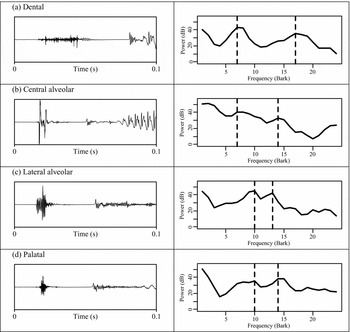
Figure 6 provides waveforms and spectra for the lingual bursts in the four Nǀuu coronal linguo-pulmonic stops. There are no bilabial linguo-pulmonic stops followed by [ɑ] in our lexicon (Sands et al. Reference Sands, Miller, Brugman, Namaseb, Collins and Exter2006), so this segment is not included. Comparing these waveforms to those in figure 2 above, we see that lingual burst durations are comparable in lingual and linguo-pulmonic segments with the same anterior constriction (see also Miller et al. Reference Miller, Brugman and Sands2007 and Miller, Brugman & Sands Reference Sands, Miller, Brugman, Payne and Peña2007 for discussion of this contrast). Linguo-pulmonic stops differ from their lingual counterparts in that the lingual burst is followed by a period of silence and a second, pulmonic burst. In lingual stops, the posterior constriction is released shortly after the lingual burst, but this release is generally inaudible because pulmonic egressive airflow does not begin until after the release. That is, there is insufficient pressure behind the constriction to produce a plosive. In contrast, posterior releases in linguo-pulmonic stops are audible pulmonic events. In Nǀuu, the timing is such that the two bursts are generally separated by a significant period of silence we take to be the extended closure of the posterior constriction.
Waveforms of lingual bursts in words extracted from the frame sentence [nɑ kɑ _____] ‘I say _____’: (a) [ǀ⊃qɑɑ] ‘shiny’, (b) [!⊃qɑnɑn] ‘migrate’, (c) [ǁ⊃qʰɑmɑ] ‘aardvark’ and (d) [ǂ⊃qʰɑɑ] ‘breast’. Normalized bark-scaled LPC spectra in the words: (a) [ǀ⊃quu] ‘tobacco’, (b) [!⊃qui] ‘ashes’, (c) [ǁ⊃quu] ‘urine’ and (d) [ǂ⊃quu] ‘neck’ (Speaker KE). Dashed vertical lines mark two spectral peaks identified in Miller, Brugman & Sands (Reference Sands, Miller, Brugman, Payne and Peña2007).

It is this one-burst vs. two-burst distinction that motivates us to treat the linguo-pulmonic stops as airstream contours. We argue that the transition to the pulmonic airstream in lingual stops is aligned with the end of the segment, but that this transition occurs segment-internally in the linguo-pulmonics. While it is possible to interpret the silence between the lingual and pulmonic bursts as evidence for a second posterior constriction that is formed and released (i.e. evidence of a cluster), we see no positive evidence for such an analysis. Rather, we suspect that the gap between the bursts serves to increase the perceptibility of the second, lower-amplitude pulmonic burst.
The amplitude and frequency of the two bursts provide additional cues to the airstream mechanism involved in the production of each. The lingual bursts, which occur upon release of a click's anterior constriction, are typically high amplitude and characterized by high-frequency energy, as would be produced by a small lingual cavity. The second burst, on the other hand, is clearly pulmonic, as demonstrated by its characteristically low amplitude, as well as the lower-frequency energy we would expect of a larger oral cavity. Quantitative results in Miller et al. (Reference Miller, Brugman and Sands2007) and Miller, Brugman & Sands (Reference Sands, Miller, Brugman, Payne and Peña2007) show that these differences are consistent across the three speakers we have studied.
We also note that Traill (Reference Traill1985: 125–126) reports comparable acoustic differences between these two classes of segments in ǃXóõ. He observes that the voice onset time with [ǂ] is approximately 12 ms, while that with [ǂq] (Traill's Reference Traill1985 transcription without the tie-bar) is closer to 40 ms. He also observes that [ǂq] is characterized by an audible posterior release, while [ǂ] is not. Despite Traill's conclusion that the contrast is primarily one of posterior place, his acoustic results are compatible with our analysis, as are the published Gǀui (Nakagawa Reference Nakagawa1996a, Reference Nakagawab, Reference Nakagawa2006) and ǂHoan (Bell & Collins Reference Bell and Collins2001) data. No acoustic data are available for the Khwe sounds described by Köhler (Reference Köhler and Manessy1981) and Kilian-Hatz (Reference Kilian-Hatz2003).
Crucially, however, if the lingual and linguo-pulmonic segments really contrasted in their posterior places of articulation, we would expect the burst spectra for ‘velar’ and ‘uvular’ clicks to be different. This is not the case in Nǀuu. Indeed, the spectra for the lingual stops in figure 2 and the linguo-pulmonic stops in figure 6 are strikingly similar. Moreover, quantitative analysis in Miller, Brugman & Sands (Reference Sands, Miller, Brugman, Payne and Peña2007) found no indication of differences between the bursts of lingual and linguo-pulmonic stops with the same anterior place of articulation. With no evidence of differences between bursts of the same type, it becomes very difficult to support an analysis in which segments like [ǃ] and [ǃ⊃q] have different posterior constrictions.
Our airstream contour analysis is further supported by articulatory data. In figures 7 and 8, we provide tongue traces of the central alveolar and palatal lingual and linguo-pulmonic stops. Note that the lingual stops in these figures are presented with two traces, while the linguo-pulmonic stops have three. This is because of temporal differences between the simple and contour segments. For the sake of clarity, these plots also include traces of the uvular (but not velar) pulmonic stops from the frame sentence. Looking first at figure 7, we see that the posterior constriction in the first trace of the central alveolar lingual stop is slightly behind the uvular stop from the frame sentence (though it has moved further back in the second trace), while the posterior constrictions in all three traces of the linguo-pulmonic stop are behind the uvular constriction. We suspect that the slight differences in posterior tongue placement may be attributable to head and jaw movement. As mentioned above, these data were collected with only basic head stabilization techniques, so we cannot currently rule out the possibility of head or jaw movement relative to the probe. Turning to figure 8, we see that both the palatal lingual and linguo-pulmonic stops have tongue root positions that are higher and further back than those in the uvular stops. These patterns are consistent across all of our data. In the release of [ǃ⊃q] in the lower panel of figure 7, the upper part of the tongue root appears to be more raised in the trace for the anterior release than in the closure frame, where both constrictions are in place. There are two possible explanations for this effect. The most likely is that this apparent tongue root raising is actually the result of jaw lowering during the anterior release. Another possibility is that the soft palate and the upper tongue root are raised slightly at the time of the anterior release, as we find in [ǂ].
Tongue traces of closures and releases for the central alveolar lingual [!] (top) and linguo-pulmonic [!⊃q] (bottom) stops, as well as the uvular pulmonic closures in the frame sentence [nɑ kɑ _____ nɑ kɑ qoʢnɑʢin] ‘I say _____, I say famished’.

Tongue traces of closures and releases of the palatal lingual [ǂ] (top) and linguo-pulmonic [ǂ⊃q] (bottom) stops, as well as the uvular pulmonic closures in the frame sentence [nɑ kɑ _____ nɑ kɑ qoʢnɑʢin] ‘I say _____, I say famished’. (Note that ‘=’ is used for ‘ǂ’ in the plots.)

Note that we are transcribing the pulmonic portion of all linguo-pulmonic stops with the IPA symbol [q]. We do not, however, intend to suggest that these releases are exactly like [q] in their degree of constriction, nor that they are the same for all click types. We maintain this earlier convention because it is not obvious which IPA symbol would be appropriate for the back uvular pulmonic portion of the segment that follows the anterior release of the palatal click. The posterior constriction in the palatal click is in contact with the very back part of the soft palate, which is raised in the production of this click. The long posterior constriction stretches from a complete back uvular constriction characteristic of a stop to a more open upper pharyngeal constriction that might be most similar in place to the Danish uvular approximant [ʁ].
Taken together, our acoustic and articulatory data show that an analysis of the [⊙ ǀ ǃ ǁ ǂ] vs. [⊙⊃q ǀ⊃q ǃ⊃q ǁ⊃q ǂ⊃q] click contrast in terms of a distinction between ‘velar’ and ‘uvular’ clicks, that differ only in their posterior constriction location, is untenable. Rather, we argue that the relevant contrast is between segments with a single, lingual burst and a silent posterior release, [⊙ ǀ ǃ ǁ ǂ], and airstream contours in which the lingual burst is followed by an audible, pulmonic release of the posterior constriction, [⊙⊃q ǀ⊃q ǃ⊃q ǁ⊃q ǂ⊃q], characterized by a true noiseburst. Note that this analysis is easily extended to clicks with a fricated or glottalic release. These airstream contours are directly parallel to well-established contours in manner (i.e. affricates) and nasality (i.e. prenasalized stops).
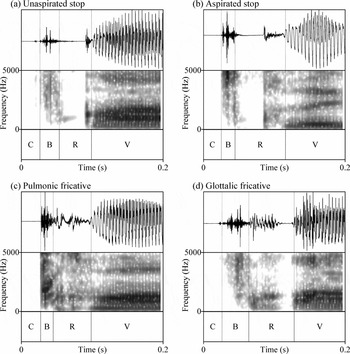
The final point to be made about Nǀuu airstream contours is that they also contrast in terms of manner and phonation. Figure 9 provides waveforms for the Nǀuu linguo-pulmonic (unaspirated, aspirated and affricate) and linguo-glottalic (ejected) click releases. The three linguo-pulmonic clicks in figure 9a–c differ in the phonation and manner of the pulmonic release. In figure 9a, the lingual closure is followed by an unaspirated pulmonic egressive release of the click's posterior constriction. In figure 9b, the release is also pulmonic, but here it is aspirated. In figure 9c the pulmonic egressive release is fricated, so that the segment is a manner contour (affricate), as well as an airstream contour. Note that the difference between the aspirated release in figure 5b and the fricated release in figure 9c is clear in both waveforms and spectrograms of these sounds. The fricated release in figure 9c is characterized by a distinct ‘scraping’ sound, as would be expected of a uvular or uvulo-pharyngeal fricated release. Interestingly, this contrast does not seem to involve a voice onset time component in Nǀuu, as it does in Juǀ’hoansi (Miller-Ockhuizen Reference Miller-Ockhuizen2003: 48). Finally, the ejected release of the linguo-glottalic click in figure 9 looks and sounds like an ejected uvular fricative. As with the glottal stop release in figure 5d, there is generally an abrupt onset of the following vowel. While the releases in figure 5d and figure 9d both involve glottal closure, it is important to remember that the glottal closure in figure 5d is solely one of phonation, while that in figure 9d is associated with the glottalic airstream as well as phonation. We are not aware of a language outside of Khoesan that makes such a distinction.
Linguo-pulmonic and linguo-glottalic releases in words excerpted from the frame sentence [nɑ kɑ _____] ‘I say _____’: (a) [ǀ⊃qɑɑ] ‘shiny’, (b) [ǀ⊃qʰəisi] ‘bird’, (c) [ǁ⊃ᵪɑnɑn] ‘sack’ and (d) [ǀ⊃ᵪ'ɑɑ] ‘hand’. Labels indicate the locations of closures (C), bursts (B), releases (R) and vowels (V) (Speaker GS).

5 Conclusions
This paper provides a complete consonant inventory for the Southern African language Nǀuu, used today by just a handful of elderly speakers. It is only the second language in a family known for its phonetic complexity to be documented by modern instrumental techniques, and so offers an important opportunity to significantly improve our understanding of the sound structures of such languages. We describe the consonant inventory of this language in a phonetically accurate way and provide acoustic and articulatory evidence for the classification of all Nǀuu consonants in terms of just four linguistic dimensions: place of articulation, manner of articulation, phonation and airstream. This description includes discussion of the five different click types, as well as the range of closure and release properties found in these segments. Nǀuu closures can contrast in nasality and voicing, categories directly analogous to those found in pulmonic stop inventories across languages. Releases are characterized by contrasts in phonation, manner and airstream. Such categorization classifies segments in phonetically natural ways, using principles that are well established for non-click consonants. Our analysis obviates the need for the phonetically empty category of accompaniment and highlights fundamental similarities between click and non-click consonants. Khoesan languages may have large, complex inventories, but they are merely making maximal use of categories that are well-motivated cross-linguistically. Like Hawaiian and other languages with unusually small inventories, Khoesan languages represent an endpoint in the spectrum of inventory size, not a fundamentally different type of system.
The crucial insight for our analysis is the recognition of airstream contours. We argue against the idea that clicks can contrast exclusively in their posterior places of articulation and offer an alternative explanation for segments previously known as ‘uvular’ clicks. Our acoustic and ultrasound results show that the bursts and posterior releases of lingual and linguo-pulmonic segments are the same. In most clicks, the posterior release is inaudible, but the clicks we transcribe with a ‘q’ release as in [!⊃q], have a second, pulmonic burst that corresponds to the posterior release. The fact that we observe both high- and low-amplitude bursts is consistent with our argument that the first is lingual and the second pulmonic, supporting the idea of airstream contours, analogous to contours in manner (affricates) and nasality (pre-nasalized stops). The idea of accompaniment has always been a problematic one, and releases that involve a pulmonic stop have always been the most difficult to deal with without resorting to a cluster analysis. By showing that posterior constrictions are the same in lingual and linguo-pulmonic stops with the same anterior place of articulation (e.g. [ǂ] and [ǂ⊃q]), and by recognizing that it is only the airstream of the release that differentiates these segments, the system reduces to one that is readily explained in terms of existing categories.
We expect from previous phonetic descriptions of ‘uvular’ clicks in ǃXóõ (Traill Reference Traill1985) and ǂHoan (Bell & Collins Reference Bell and Collins2001), and of segments analyzed as clusters in Gǀui (Nakagawa Reference Nakagawa2006) that these languages will ultimately prove amenable to an analysis along the lines we have proposed. Published waveforms and spectrograms of these sounds show high-amplitude lingual bursts, followed by smaller pulmonic or glottalic events, just as we see with Nǀuu airstream contours. One challenge for our approach will be to account for x-ray data from ǃXóõ (Traill Reference Traill1985: 130–131) that show a significantly greater pharyngeal width in the segment transcribed [ɡǂ] than in [ɢǂ]. The implication is that ǃXóõ sounds, unlike their Nǀuu counterparts, might exhibit a true difference in posterior place. We observe, however, that the spectrogram of [ɢǂ] also shows the characteristic burst patterns we find in Nǀuu linguo-pulmonic contours (i.e. high-intensity lingual burst followed by a low-intensity pulmonic burst), so it may also be that the primary difference is one of airstream. A second challenge comes from ǀGui, which makes a three-way contrast between segments Nakagawa (Reference Nakagawa2006) transcribes [kǃ’] (ejective complex stop), [kǃq’] (cluster with ejected uvular stop) and [kǃʔ] (cluster with glottal stop). While [kǃʔ] seems equivalent to Nǀuu [ǃʔ], in terms of both its closure and its release, and [kǃq’] looks like a stop version of Nǀuu's ejected linguo-glottalic affricate [ǃ⊃ᵪ’], [kǃ’] is more difficult to account for. We observe, however, that [kǃ’] looks very much like [kǃʔ], except without nasal airflow during the closure, so the difference may be one of nasality. In any case, a full reanalysis of languages other than Nǀuu is beyond the scope of this paper.
Finally, despite our position that clicks cannot differ exclusively in terms of their posterior constrictions, we seek to emphasize that click types differ not only in their anterior places of articulation, but also in the precise locations of their posterior constrictions. This runs contrary to descriptions dating back at least to Doke (Reference Doke1923). Like Miller, Namaseb & Iskarous (Reference Miller2007) and Miller et al. (Reference Miller, Brugman, Howell and Sands2006), we use ultrasound data to show that the central alveolar [ǃ] and palatal [ǂ] clicks differ in the position of the tongue root and that both have post-velar places of articulation. We predict, based on our preliminary ultrasound analysis of the dental [ǀ] and lateral alveolar [ǁ] clicks, that the lingual and linguo-pulmonic dental stops will have a posterior constriction in the back uvular region much like the palatal clicks, and that the lingual and linguo-pulmonic lateral alveolar stops will be similar to the central alveolar clicks in having a uvular constriction with retraction of the tongue root proper in the pharyngeal region. Given that the anterior constriction in the bilabial click does not necessarily involve the anterior part of the tongue, we expect the posterior gestures involved in this click type to be less constrained, and we expect that there may be more variability in the location of the posterior constrictions for the bilabial click both within and across languages. In coronal clicks, we expect that the posterior place of articulation is largely tied to the anterior place of articulation because of muscular constraints on overall tongue shape. These muscular constraints make a click contrast solely in terms of the posterior constriction location improbable, if not impossible.
Acknowledgements
This material is based on work supported by the National Science Foundation, Documenting Endangered Languages Program under grant ‘Collaborative Research: Descriptive and Theoretical Studies of Nǀuu’ to Cornell University (BCS-0236735, Miller & Collins, co-PIs) and Northern Arizona University (BCS-0236795, Sands, PI). Any opinions, findings, and conclusions or recommendations expressed in this material are those of the authors and do not necessarily reflect the views of the National Science Foundation. Author Exter has been supported by grants from DAAD and the University of Cologne, and author Namaseb by grants from Wenner-Gren (ICRG-46) and NSF (BCS-0504187, Megan Biesele, PI).
We are grateful to the staff of the South African San Institute (SASI), particularly Grace Humphreys and Nigel Crawhall, for their part in arranging and facilitating our visits to South Africa, and to our consultants and translators (Gerhardus Damarah, Willem Damarah, Collin Louw, Karen Basson, Magdalena Kassie and the late Gertruida Sauls) for their patience and good humor during our sometimes tedious recording sessions. We would like to thank audiences at Ultrafest II, the 2004 Annual Meeting of the LSA, ACAL 2006, ICPhS 2007, the Cornell University Linguistics Department, the Dartmouth University Linguistics Department, and the University of Delaware Linguistics Department, who provided valuable feedback on various pieces of our analysis. We would especially like to thank Abby Cohn, Masayuki Gibson, Susan Guion, Anastasia Riehl, Irene Vogel and two anonymous reviewers for their helpful comments. We are also grateful to Nina Glatthorn, Jonathan Howell, Danielle Nelson and Laura Suttle for their assistance with data acquisition and processing.
Appendix. Words illustrating Nǀuu segments
In the following lists, columns represent: (i) phonemes, (ii) narrow transcriptions, (iii) example words in transcription, (iv) example words in orthography (Namaseb et al. Reference Namaseb, Sands, Miller and Brugman2005, Collins & Namaseb Reference Collins and Namaseb2007) and (v) English glosses. Note that transcriptions reflect the morphological word, and there are a few cases where morphological and prosodic word boundaries do not coincide. Note also that Nǀuu is a tone language, but that tone has not been transcribed in these examples. Words that occur in only one dialect are marked with (W) for the western dialect or (E) for the eastern dialect. The orthography used in this paper is preliminary. We expect that as more Nǀuu learners read and write in the language, adjustments will be made to the orthography that will enhance their literacy experience.