INTRODUCTION
Cetacean diversity has always been the starting point for investigation on cetacean populations and also, an interesting field for scientists in every ocean (Thiele & Gill, Reference Thiele and Gill1999; MacLeod et al., Reference MacLeod, Hauser and Peckham2004). In the case of the North Atlantic, important investigation efforts on cetacean occurrence have been carried out. Examples of this effort can be found in communications on cetacean distribution in island waters, as in the case of the Azores (Silva et al., Reference Silva, Prieto, Magalhaes, Cabecinhas, Cruz, Gonçalves and Santos2003), or on cetacean abundance in continental coasts, as in the case of the Mediterranean Sea (Gómez de Segura et al., Reference Gómez de Segura, Crespo, Pedraza, Hammond and Raga2006) or the United States shores (Mullin & Fulling, Reference Mullin and Fulling2003). These studies have contributed to the progress of the world's research on cetaceans.
Particularly, in the case of the Atlantic Islands, 62 species of cetaceans—out of a total of 84—are found (Hoyt, Reference Hoyt2005b). Focusing on the Canarian Archipelago, information about cetacean presence has been compiled through the years, coming both from stranding and sightings (Carrillo, Reference Carrillo2003). The Canary Islands are known to receive, at least, 29 cetacean species from resident and migratory groups (M. Carrillo, personal communication, 2007). In an island by island approach, cetacean information from less inhabited islands, as is the case of La Palma, is practically non-existent being limited to stranding information (Canary net of Stranded Cetaceans) and a couple of specific four-days campaigns (Carrillo & Tejedor, Reference Carrillo and Tejedor2004).
High cetacean diversity, in islands such as the Canaries, where the tourism industry is the predominant economic source, generates an important whale watching activity. In fact, whale watching in the Canary Archipelago pulls in about 500,000 people every year (Hoyt, Reference Hoyt2001, Reference Hoyt2005b) and generates more than $6,200,000 (including arrival, lodging, transportation and some other expenses related to whale watching). This places the archipelago in the lead of the activity among the Atlantic islands (Hoyt, Reference Hoyt2005a).
Due to the importance and constant increase of this socio-economic activity, the Canary Government issued a regional Decree (D178/2000, BOC 133, of 1.10.2000) regulating whale watching activities (Plasencia et al., Reference Plasencia, Rodríguez, Herrera and Delgado2001). The principal aim of this regulation is to protect cetaceans. Among other duties, operators are required to obtain a whale watching license, and to carry onboard a ‘Sectorial Tourism Guide’ to whale watching methods certified by the Canary Tourism Authority.
Although this and other measures have helped a lot in the protection of and knowledge about cetaceans in the Canaries, there is still a lot to be done in this field. In this context, the present paper describes, from sighting data obtained during eighteen months, the occurrence and diversity of the cetacean community on the west coast of La Palma Island. This may provide the first step in developing a species list for La Palma Island and an estimation of their status and seasonal variation (Evans & Hammond, Reference Evans and Hammond2004). The paper also describes a possible link between high cetacean diversity and environmental characteristics. The prediction of possible environmental variables connected to cetacean presence, could be very useful in future investigations on cetaceans, such as those of spatial modelling methods.
Survey area
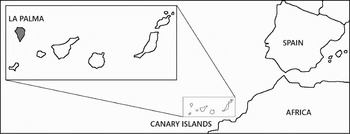
The Canary Archipelago lies about 115 kilometres off the West African mainland, in the Atlantic Ocean (Figure 1). It is composed of seven islands and four islets with a total surface of 7273 km2. All of them are independent volcanic edifices with a subsequent narrow shelf (Anguita & Hernán, Reference Anguita and Hernán2000). This circumstance makes possible the reaching of very deep waters (2000–4000 m) quite close to the coast, which determines some of the oceanographic conditions of the area.
Location of the Canary Archipelago and La Palma Island.

The study area of the present work covers the waters next to the west waters of La Palma, one of the western Canary Islands. In oceanographic terms, this subtropical zone is included in the eastern limb of the subtropical gyre of the North Atlantic (Canary Current). These waters are considered as a transition zone between the cool, nutrient-rich waters of the upwelling regime from the African coast and the warmer oligotrophic waters of the open ocean (Barton et al., Reference Barton, Arístegui, Tett, Canton, García-Braun, Hernández-León, Nykjaer, Almeida, Almunia, Ballesteros, Basterretxea, Escánez, Garcia-Weill, Hernández-Guerra, López Laatzen, Molina, Montero, Navarro-Pérez, Rodríguez, Van Lenning, Vélez and Wild1998). Surface water temperature varies from 25ºC, in September and October, to 17ºC, in winter (Calvet et al., Reference Calvet, Cabrera, Carracedo, Mangas, Pérez-Torrado, Recio and Travé2003). In addition, the Canary Islands act as a natural barrier to the main Canary Current, which seems to induce cyclonic and anticyclonic eddies downstream of the islands (Arístegui et al., Reference Arístegui, Sangrá, Hernández-León, Hernández-Guerra and Kerling1994).
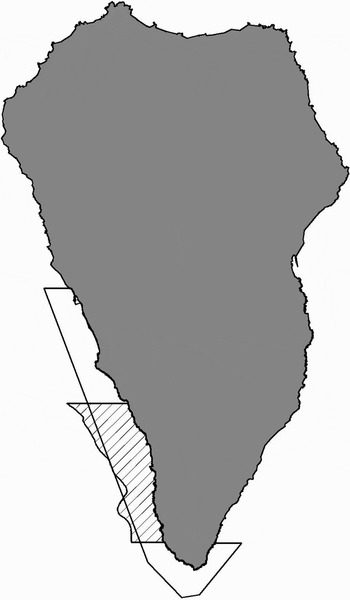
Regarding biological features, the area enjoys an outstanding natural status. A portion of the study area was accepted by the EU to be included in the Natura 2000 Network (D92/43/EEC) as a Site of Community Importance (SCI). The Franja Marina de Fuencaliente SCI was so declared, among other ecological reasons, because of the Tursiops truncatus Montagu, 1821 presence (Figure 2). The prosperous zone also includes La Palma Marine Reserve of Fishing Interest, so declared by the Spanish Government in 2001 (Figure 2). These environmental protection areas help to protect and increase the ecological and biological richness of the study area.
Franja Marina de Fuencaliente SCI (plain shape) and La Palma Marine Reserve of Fishing Interest (striped shape).

MATERIALS AND METHODS
Fieldwork
Cetacean sighting data were collected during 346 days, from November 2003 to April 2005. The platform was the ‘Fancy II’, a whale watching motorboat which carries out regular whale watching trips, along the west coast of La Palma Island. The company is provided with the appropriate license (‘Blue boat’) and a Sectorial Tourism Guide, both requirements demanded by the Canary Decree for whale watching activities (Decree 178/2000). Sectorial Tourism Guides, in whale watching methods, are qualified naturalist guides and experienced observers trained to scan the area searching for cetaceans with 7×50 binoculars. Standing on the ship's flying bridge—approximately 6 m high—during daylight hours, weather permitting (i.e. no rain, Beaufort sea state <5), they search for any cetacean signs.
Every working day, the ‘Fancy II’ begins its crossing in Tazacorte Port, located in the middle of La Palma west coast. It follows random perpendicular transepts to the shore line, depending on the route and weather situation. In spite of the search pattern not being systematic, it followed mainly regular zigzag transepts. The average speed was 8 knots, but it could vary with sea conditions.
Observations were carried out for continuous periods during daylight hours. Whenever a sighting was detected, the transept was interrupted and the vessel was conducted to the sighting point. Approaching and observation always followed the Code of Conduct established by the Canary Government, in the whale watching zone. Sightings data were systematically recorded on pre-prepared data sheets and entered subsequently into a computer database. Data collected for each cetacean group included time, position (by Global Positioning System), species identity, group size, and in some cases, the presence of calves, depth (obtained from the boat's sound), coastal distance or any other parameter collected.
Species were identified to the lowest taxonomic level possible from descriptions in field guides and scientific literature (Carwardine, Reference Carwardine1995). Almost every sighting was positively matched to the species taxonomic level, but in the particular case of pilot whales, just genus level was reached. The study area is potentially inhabited by short-finned pilot whales (Globicephala macrorhynchus Gray, 1864) (Carrillo & Tejedor, Reference Carrillo and Tejedor2004), while long-finned pilot whales (Globicephala melas Trail, 1809) have only been identified once in the Canaries by one strand (M. Carrillo, personal communication, 1995). Nevertheless, since the two species cannot be distinguished at sea with certainty, they have all been pooled together just as pilot whales (Globicephala genus).
Analysis
Once the information was collected, sightings data were processed in order to characterize the cetacean community identified in La Palma waters. To obtain the species temporal distribution, sightings frequency was estimated by a direct count of the number of sightings. Then this number was analysed monthly, calculating the sighting per effort unit (SPEU) referred to the number of sightings per day:

Because trips are similar every day (usually each trip lasts three hours), working days can be used as an effort measure to compare, in general terms, the population tendency in aspects such as temporal distribution or annual presence.
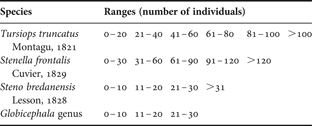
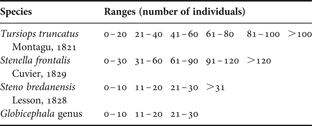
From the most common species, further estimations were carried out. Spatial distribution, group size and composition were analysed. Sightings of the four most frequent species have been located on an island map using the Autodesk Map 2006 software. Whenever data were available, mean depth and coastal distance of those species were analysed. Due to the mobility and swimming speed, the group's size is difficult to estimate. Consequently, we divided the number of individuals sighted in different ranges for every species, according to their usual association pattern (Table 1).
Ranges established for group's size in most sighted cetacean species in La Palma Island.
RESULTS
Sighted species
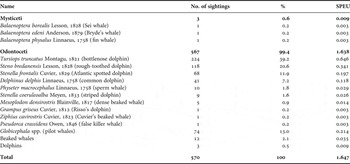
During this study, 570 sightings were made on the west coast of La Palma, with a mean sighting success of 1.7 sightings per day (minimum: 1.2; maximum: 2.0). Thirteen cetacean species and one genus (Globicephala spp.) were positively matched, three of them included in the Mysticeti suborder and the other ten in the Odontoceti suborder. Non-identified sightings were assigned to non-stated general groups, such as pilot whales, beaked whales or dolphins. These species together with the number of sightings effected during the 18 month period of study, its percentage from the total number of sightings, and the SPEU by species (referred to the number of sightings per worked day), are detailed in Table 2.
Cetacean species encountered off La Palma.

Odontoceti suborder species represent the largest amount of sightings (567 sightings; 99.4%) while Mysticeti suborder species, correspond to just 0.6% of all sightings, with an effort of 0.01 sightings per day. To date, Tursiops truncatus corresponds, by far, to the highest number of sightings known in La Palma (39.2%) followed by Steno bredanensis, with almost half the number of encounters. Next most sighted species were Globicephala spp. (13.0%) and Stenella frontalis (11.9%).
Temporal cetacean distribution
Regarding the temporal distribution, the number of sighted species does not seem to follow a seasonal pattern. However, an upward trend can be observed in springtime (6–8 species/month between March and June) and the reverse in winter time (3–4 species/month in December and January). This diversity maximum occurs during the period of time when sporadic and occasional species, such as Mysticeti ones, show up. Bryde's whale and fin whale were sighted in La Palma surroundings during April 2004, in accordance with the accepted migratory pattern. Notwithstanding, Sei whale was sighted in June 2004, contrary to its acknowledged temporal pattern in the Canary Islands.
Regarding most sighted species, Tursiops truncatus presence is constant throughout the year (SPEU = 0.646), with a higher value of sightings/effort in the summer months (mean sighting success: 1.03 SPEU from June to September). Globicephala genus individuals were seen following a constant pattern of presence throughout the year (SPEU = 0.214), except for two peaks, in January 2003 (0.46 sightings/day) and in December 2003–January 2004 (0.66 and 0.44 sightings/day, respectively). Stenella frontalis presence is constant and frequent throughout the whole year (SPEU = 0.197), being always observed from January to May.
Remaining species were sighted occasionally, except for the Delphinus delphis (Table 2). In this case, the sighting frequency followed a marked seasonal pattern, as reported in previous north-east Atlantic studies (López et al., Reference López, Pierce, Valeiras, Santos and Guerra2004). Common dolphin seems to frequent the area from January to May (98% of Delphinus delphis sightings; N = 41, where N is the number of samples studied). Just one sighting took place out of these months (October 2004) and it was one single individual.
Spatial cetacean distribution
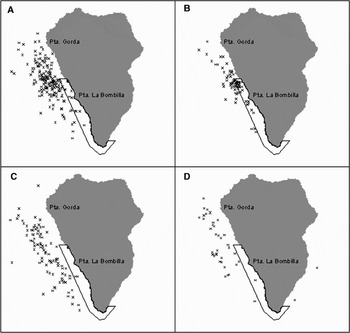
Most of the sightings related to the present study were concentrated in an area located between Punta Gorda and Punta de la Bombilla, on the central western coast of the island (Figure 3). Moreover, in most cases (90% of all sightings), locations exceeded 1.5 nautical miles from the coast and 500 m depth.
Location of the four most sighted cetacean species in La Palma Island. (A, Tursiops truncatus; B, Steno bredanensis; C, Globicephala genus; D, Stenella frontalis).

Most sighted species also follow this distribution pattern, as shown above (Figure 3). Just in Steno bredanensis encounters, a high number of sightings were made closer to the coast (60% appeared between two miles and the coast) and, in consequence, lower depths (from 100 to 500 m depth). On the other hand, 78% from Globicephala genus encounters exceeded the 1000 m depth, being frequently found from four miles onwards. It is also worth highlighting that the deepest locations of Tursiops truncatus were reached in the company of pilot whales (Globicephala genus), exceeding in every case 1000 m depth.
Group size
Group size was studied for the four most often sighted species. In the case of Tursiops truncatus, the size of the sighted groups varied from 1 to 200 individuals, although most sightings were of groups formed by 21 to 40 specimens (47%; N = 165), followed by those of 1 to 20 (36%, N = 165). Group size seems to vary throughout the year, the smallest ones (0–20 animals) appearing in winter, increasing (21–40 animals) in spring and showing the biggest associations (41–60 animals, with 200 individuals peaks) in summer. Only on one occasion a solitary animal was detected. Regarding group structure, just twice were calves part of the sighted group.
As far as Steno bredanensis is concerned, more than half of the sightings (55%) were of groups from 11 to 20 specimens (N = 58). On at least four occasions, females with calves were observed frequenting the area.
In those Globicephala genus sightings when group size was measured, associations from 2 to 30 individuals were observed. When dividing data into ranges of ten individuals each, the most common number of specimens forming a group (67%, N = 49) was from 11 to 20. Curiously on nineteen occasions (38%, N = 49) herds of specifically 15 individuals were found, and at least on eight occasions calf presence was detected.
Likewise, in the case of Stenella frontalis, the most common range (66%, N = 53) is the one that goes from 0 to 30 individuals, followed by the one of 31–60 specimens (28%, N = 53). Ninety-four per cent of sightings correlate with groups smaller than 60 specimens. At least on nine occasions, calves were part of the sighted group.
DISCUSSION
Five hundred and seventy cetacean sightings made during 346 working days on the west coast of La Palma, evidently indicate the high cetacean presence in this area. The sighting success in the present study (1.7 sightings per day) was in good agreement with results from the Canary Net of Stranded Cetaceans and those from Carrillo & Tejedor (Reference Carrillo and Tejedor2004). They estimated a SPEU of 1.8 sightings per day, very close to the value presented in this paper. Moreover, the frequency of sightings is nearly constant, without significant seasonal variations. That is throughout this period, at least once a day a sighting was made on the west coast of La Palma.
Furthermore, La Palma, as well as other Canary Islands (Politi, et al., Reference Politi, Notarbartolo di Sciara and Mazzanti1997; Ritter, Reference Ritter and Evans2001), seems to show a high cetacean diversity. Thirteen species and Globicephala genus were positively matched, confirming the presence in the island of, at least, half of the cetacean species present in the Archipelago (M. Carrillo, personal communication, 2007). Present results also confirm the presence of species only known to be in La Palma waters by strands or short campaigns (Carrillo & Tejedor, Reference Carrillo and Tejedor2004). Compared to those studies, the presence of Kogia breviceps Blainville, 1838 and Orcinus orca Linnaeus 1758, was not confirmed with our results. Notwithstanding, four species were registered for the first time in the island waters. These species are Balaenoptera borealis Lesson, 1828 (Sei whale), Grampus griseus Cuvier, 1812 (Risso's dolphin), Pseudorca crassidens Owen, 1846 (false killer whale) and Steno bredanensis Lesson, 1828 (rough-toothed dolphin). These new records were just seen once, except for the last one, Steno bredanensis, which, surprisingly, was the second most sighted species in the present study (118 sightings; 39.3% of all sightings). It is also significant that this species appeared from January to May, which is in agreement with results on temporal distribution of Steno bredanensis in another Canary Island. According to Pérez-Vallazza & Haroun (Reference Pérez-Vallazza and Haroun2005), rough-toothed dolphins turned up in Gran Canaria Island waters from February to August, vanishing in autumn and the beginning of winter.
About Mysticeti sighted species, they are known to have a typical ‘balaenopterid life cycle’ (Ritter & Brederlau, Reference Ritter and Brederlau1998), supposedly being on their migration route when reaching the Canaries. Bryde's and fin whales appeared in La Palma when they were expected to do so (spring/summer time), but the Sei whale, sighted in June, is only supposed to frequent the archipelago in winter. In any case, very little is known about the stocks of Mysticeti that frequent the archipelago.
Regarding spatial cetacean distribution, most sightings were made in the middle west coast of La Palma, exceeding 1.5 nautical miles from the coast and 500 m depth. Curiously, this area where almost 90% of all sightings occurred, stands outside the Franja Marina de Fuencaliente SCI boundaries or in its limits, which is relevant for its conservation implications. Regarding Tursiops truncatus Montagu, 1821 (one of the SCI's objects of declaration), its presence is also common outside the SCI boundary (95% of this species' sightings occurred outside the protection body). This confirms conclusions derived from other studies in the Canaries, such as those in Franja Marina de Mogán SCI (Gran Canaria Island). In that particular case, sightings of bottlenose dolphins outside the SCI boundary represented 85% of all of these species sightings (H. Martín, personal communication). On the other hand it is worth highlighting that, many Tursiops truncatus sightings were concentrated in the centre of the study area. This particular position could be defined by an opportunistic feeding behaviour in the area connected with its foraging behaviour (Díaz López & Bernal Shirai, Reference Díaz López and Bernal Shirai2006). As far as group structure is concerned, at least in the four most sighted species calf presence was detected. This leads us to believe that this could be a breeding area for some cetacean species.
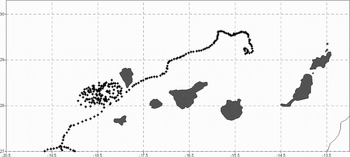
Considering our results, oceanographic characteristics seem to play a decisive role in the La Palma cetacean community, both on diversity and on the total number of animals, which is in agreement with previous studies carried out in the archipelago (Ritter, Reference Ritter and Evans2001). Canary Islands' waters enjoy a complex oceanographic system. In order to study the surrounding currents, in the development of the international collaboration programme from NOAA ‘The Global Drifters Programme: satellite-tracked surface drifting buoys’, a group of drifting buoys were thrown in the seas of the north of the Canarian Archipelago (29º10′N 15º30′W). Figure 4 shows one of this buoy's paths (id 20334) which is visibly held back in the eddies formed off the south-west coast of La Palma.
Path of the drifting buoy (id 20334) thrown in 2000.

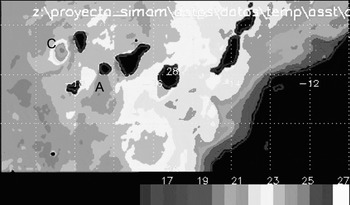
The Canary Islands act as an obstacle to the main current, inducing the development of cyclonic and anti-cyclonic eddies downstream of the islands (Arístegui et al., Reference Arístegui, Sangrá, Hernández-León, Hernández-Guerra and Kerling1994). When cyclonic eddies are induced, as sometimes occurs in La Palma and its surroundings (Figure 5), rich waters come to the surface in the centre of them. This spout produces an increase in productivity and an irregular chlorophyll wake downstream (Arístegui et al., Reference Arístegui, Tett, Hernández-Guerra, Basterretxea, Montero, Wild, Sangrá, Hernández-León, Cantón, García-Braun, Pacheco and Barton1997). This increase in phytoplankton biomass has, definitely, consequences over the high levels of the food chain (Gómez, Reference Gómez1991). Therefore, the high cetacean presence in the study area could be related to these biological consequences of island-induced cyclonic eddies.
Sea surface temperature image (August, 2007) showing cyclonic (C) and anticyclonic (A) island-induced eddies (modified from Pérez-Marrero, J. et al., Reference Pérez-Marrero, Llinás, Maroto-Goikoetxea, Cardona, Rueda, Barrera and Villagarcía2005).

Furthermore, those islands with marked orography, like La Palma, represent an obstacle to the wind-way, generating calm areas leeward of the islands. Both, absence of wind power and high insulation, favour warming and stratification of the sea column, causing warm pluming structures leeward of the wind (Violette, Reference Violette1974). This oceanographic feature and its direct consequences on sea temperature characteristics may also explain the high cetacean presence in the La Palma west coast. A similar connection between the distribution of short-finned pilot whales off Tenerife Island and sea surface temperature was found by Montero & Arechavaleta (Reference Montero and Arechavaleta1996).
In addition to oceanographic processes, and mainly caused by them, food availability could favour cetacean presence in the area. Species such as pilot whales are generally found in deep waters, which may be related to the distribution of deep-water squid, their main prey (Weir et al., Reference Weir, Pollock, Cronin and Taylor2000). Other cetacean prey, such as the chub mackerel (Scomber japonicus Houttuyn, 1792), can be found in Canarian waters during the whole year without seasonal trends (Castro, Reference Castro1991). As an example, chub mackerel appears especially in the wakes formed at the south-western areas of the islands. Also Thunnus spp. frequent the area in some periods. Studies on catch per effort unit (CPEU) in the Canaries developed by González Ramos (Reference González Ramos1992), show a connection between the mesoscale oceanographic features and the fishing of skipjack tuna (Katsuwonus pelamis Linnaeus) and chub mackerel. Skipjack tuna travels to areas rich in food and with an appropriate temperature for its physiological needs. It turns up at mid-spring in the Canary Islands, especially in the south-western areas (González, Reference González Ramos1992). The above mentioned study also proved that skipjack is connected with the ‘island mass effect’, responsible for the warm water production and the subsequent increase in food concentration, in these areas of the islands.
Information acquired through this study enables a better understanding of the Canarian cetacean community. Presence and high cetacean diversity can be secured at the west coast of La Palma Island, where this fact was not already confirmed. This presence seems to be constant in time for the studied area, except for those occasional species with a seasonal temporal pattern. Oceanographic conditions of these waters, together with ecological ones (such as food availability) may create the right conditions to gather a high cetacean presence. Insights gained can play an important role, not only as baseline data on cetacean populations in this area but also as a tool in the establishment of future conservation guidelines for cetaceans.
ACKNOWLEDGEMENTS
We are very grateful for the generous support provided by the ‘Fancy II’ team and especially by the dedicated observers and Marija, always ready to help. We thank Ciro Pérez and Mónica Silva for their valuable comments and advice, which helped improve the manuscript. Thanks also to Manolo Carrillo and the Department of Morphology (Health Sciences Centre and Faculty of Veterinary Medicine, University of Las Palmas de Gran Canaria) for their contribution of previous data. This work was supported by the funds of the INTERREG III B project MARMAC.