Introduction
The ageing population across the developed world poses a stark challenge for health and long-term care services due to the increase in psychiatric and physical ill-health associated with old age. Particular attention has been given to the global prevalence of dementia, which is forecast to triple across the next 40 years, and although some countries have established national strategies for improving dementia care (Challis et al., Reference Challis, Hughes, Sutcliffe, Ames, Burns and O’Brien2010), many have yet to do so (World Health Organization and Alzheimer's Disease International, 2012). To meet these challenges, a range of specialist old-age psychiatry services have emerged (Draper, Reference Draper2000). Community mental health services are regarded as the appropriate first tier of such support (World Health Organization and World Psychiatric Association, 1997), acknowledging the broad consensus that assessment and support in community settings is preferable to hospital services, wherever circumstances permit. The central tasks of the community service include the provision of early assessment and diagnosis of psychiatric conditions and the coordination of long-term support and healthcare to meet identified needs. It is commonly argued that such services demand multidisciplinary working, combining specialist clinical and nursing skills with psychology, social work, and occupational therapy expertise (World Health Organization and World Psychiatric Association, 1997; Rosen and Callaly, Reference Rosen and Callaly2005). Multidisciplinary teams are increasingly prevalent across Europe, North America, and Australasia (Ng et al., Reference Ng, Herrman and Chiu2009; Draper and Anderson, Reference Draper and Anderson2010; Evans et al., Reference Evans2012), but there is notable variation in practice both within and across jurisdictions.
In England, community mental health teams (CMHTs) for older people are regarded as the cornerstone of specialist provision in meeting the mental health needs of later life (Department of Health and Care Services Improvement Partnership, 2005; Wilberforce et al., Reference Wilberforce, Harrington, Brand, Tucker, Abendstern and Challis2011), although their precise remit depends on other locally available community services, such as memory clinics, specialist domiciliary care, and/or care home outreach services. Their importance is demonstrated by the extent to which aspects of their work have been subject to scrutiny through performance measures; Audit Commission inspections; and, with respect to dementia care, repeated Parliamentary inquiries (Audit Commission, 2000; House of Commons, 2008). The National Service Framework for Older People and subsequent guidance, closely mirroring World Health Organization and World Psychiatric Association (1997), recommended that such teams comprise the following six “core” disciplines: mental health nurses; psychiatrists; occupational therapists; psychologists; social workers; and support workers (Department of Health, 2001; Department of Health and Care Services Improvement Partnership, 2005; Royal College of Psychiatrists, 2006). However, multidisciplinary work can result in inter-professional and inter-agency conflict. Integrating some disciplines within CMHTs has consequently proved difficult (National Audit Office, 2007; Tucker et al., Reference Tucker2007), but no recent assessment of progress has been made. This paper aims to fill that gap and to provide a more thorough examination of teams’ membership and management arrangements than has formerly been undertaken.
Models of membership and management
While there are numerous perspectives from which to view the characteristics of mental health teams, their membership and management arrangements have been a regular focus of theoretical and empirical work (Ovretveit, Reference Ovretveit1993; Miller et al., Reference Miller, Freeman and Ross2001). The concept of a “multidisciplinary team” is nebulous, and the term has been described as an “inflationary currency” due to its indiscriminate use to describe a disparate set of organizational approaches (Rosen and Callaly, Reference Rosen and Callaly2005, p. 235) but can usefully be defined as a small group of people from at least two different professional groups, working on interdependent tasks, and combining their skills and knowledge in pursuit of a common purpose (Ovretveit, Reference Ovretveit1993). This definition is purposefully broad and acknowledges that CMHTs can encompass the full range of requisite disciplines in very different ways.
The literature can be used to classify multidisciplinary mental health teams across a spectrum of informal-to-formal management structures. The least formalized arrangements involve groups of practitioners from separate single-discipline teams working together through flexible mechanisms to discuss cases which may require wider expertise (Ovretveit, Reference Ovretveit1993). Such “network” teams may not have firm terms of reference or compulsory membership and may have a rotating “coordinator” arranging and chairing meetings, rather than a formal team leader (Simpson, Reference Simpson and Rassool2006). Membership may be regarded as “sessional,” reflecting only a partial commitment of staff time to such teams. By contrast, more formalized integrated teams are characterized by the “core” membership of their staff, in dedicating the majority of their time to the team's work, with few (if any) obligations to other services (Miller et al., Reference Miller, Freeman and Ross2001). Such teams tend to have formal team managers who directly line manage members within them. Members will be expected to attend regular (usually weekly) team meetings, and are often guided by common objectives and formalized policies and procedures. In addition, there is a range of team structures blending characteristics of both formal and informal membership arrangements. For example, Miller et al. (Reference Miller, Freeman and Ross2001) identify the “core and periphery” team comprising a smaller central team, with additional sessional members making regular contributions, although their main work is in other services.
The membership and management structures adopted by teams are important, with research broadly indicating benefits to more formal multidisciplinary team working, but with obstacles to be overcome. Specifically, formally integrated teams have been linked with improved decision-making and problem-solving; improved referral processes between specialisms (both more appropriate, and more timely); improved person-centered care through a more holistic perspective of service user needs; and greater continuity in treatment, resulting in improved satisfaction and reduced bed use (Onyett and Ford, Reference Onyett and Ford1996; Miller et al., Reference Miller, Freeman and Ross2001; Simpson, Reference Simpson and Rassool2006). Moreover, it is believed that older people with mental illness are particularly likely to benefit from formal integrated working since they are among the largest users of general medical and social care (in addition to specialist mental health) services, and so may be most at risk from fragmented care (Department of Health and Care Services Improvement Partnership, 2005). Where joint working is successful, it can also act to reduce practitioner stress by sharing the burden of responsibility (Priest et al., Reference Priest, Dunn, Hackett and Wills2011).
However, the difficulties associated with formal multiprofessional team structures are also well documented. Joint working is hindered by a reticence to relinquish professional boundaries, which are enmeshed with concepts of status, seniority and cultural attributes generating tension and poor communication (Norman and Peck, Reference Norman and Peck1999). Where boundaries are reduced, role blurring has been reported to create confusion around the limits of responsibility and uncertainty over leadership and supervision (Brown et al., Reference Brown, Crawford and Darongkamas2000). Nevertheless, a recent review of job satisfaction and burnout found little evidence of widespread role conflict among CMHT workers, except for social workers who have particular difficulty in defining their role in such teams (Onyett, Reference Onyett2011).
Aims and methods
This study aimed to assess progress toward integrating the six recommended professional disciplines within CMHTs, and to evaluate the nature of their membership and management arrangements. A postal questionnaire was developed and tested with six team managers, and subsequently sent to 429 CMHTs in England (identified within the national Combined Mapping Framework and audited by the authors to identify changes since that exercise was conducted). Fieldwork concluded in March 2009. To assess changes over time, the 2009 survey was compared with new analysis of data from a 2004 survey, completed by 318 (72% response rate) consultant psychiatrists based within CMHTs (Tucker et al., Reference Tucker2007). Both questionnaires sought information on team membership, including details of whether team members were “core” or “sessional.” The 2009 survey also incorporated open-ended questions asking respondents to identify key positive features of their team, and aspects they would like to change. Responses were organized into a series of codes that emerged from the analysis, under seven broad headings relating to the organization and operation of CMHTs, two of which (staffing and teamwork, and management and supervision) were further investigated for the current paper.
Findings
Sample description
A total of 376 (87.7%) teams returned a questionnaire, spanning 67 Mental Health Trusts. Almost three-quarters (73.4%) of questionnaires were completed by team managers; 15% were completed by service or locality managers; and the remaining responses were from other team members. Most teams (72%) had existed for more than five years, and served either mainly urban (38%) or mixed urban/rural (47%) communities. The majority (71%) worked within just one local authority, although a minority (12%) worked with three or more. Teams received a median of 36 new referrals per month, with significant diversity associated with the size of individual teams. Comparisons between the survey data and the sampling frame indicated that there was no significant response bias with respect to geographical spread or selected team characteristics.
Team membership
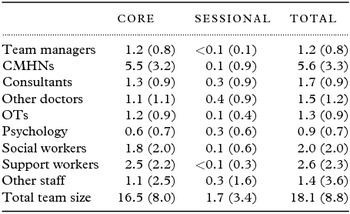
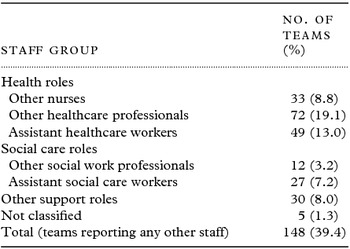
Table 1 shows that the majority of staff working in CMHTs were categorized as core members, with sessional members comprising a small proportion of most teams. Community mental health nurses were the most prevalent discipline within teams, followed by support workers and social workers. Psychologists were the least prevalent discipline, on average. The survey found that 148 (39.4%) teams also had other staff, whose broad range of job titles are summarized in Table 2. “Other nurses” were mostly liaison and Admiral nurses; the latter being nurses supported by a national charity, Dementia UK, with a particular remit to support the informal carers of dementia patients. “Other professionals” were most commonly dieticians, speech and language therapists, and physiotherapists. Other “social care professionals” included senior social work practitioners, while other “assistant social care workers” included a diverse spread of job titles, from brokers to assistant care managers.
Mean (standard deviation) number of staff per team, by professional discipline

Note: n = 376.
Categorization of “other” staff groups

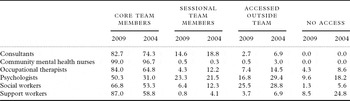
Table 3 shows membership and access arrangements to the six recommended staff groups, contrasted against the findings of the 2004 survey. Responses were categorized according to whether different professional disciplines were available as core team members, sessional team members, outside the team, or not at all. Overall, the 2009 data suggest improved membership and access to all professional disciplines, with a general trend toward core membership. Most (87%) teams had support workers as core members, reflecting a substantial change from the 2004 data, when a quarter of teams could not access support workers at all. An increased number of teams in the more recent survey had psychologists and social workers as team members, although growth was less pronounced. Despite improved access between the two surveys, by 2009 a quarter of CMHTs still did not have a psychologist as a team member.
Team membership by professional discipline (% reporting each category) in 2009 and 2004a

Notes: aHierarchical coding, e.g., those reporting core and sessional membership were coded as having core members, not sessional members.
n = 376 (2009 survey), 304 (2004 survey).
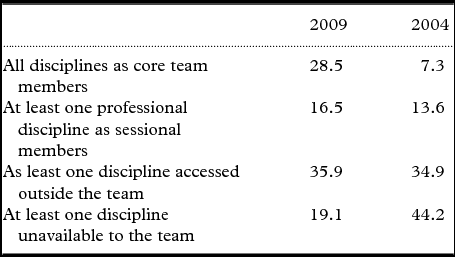
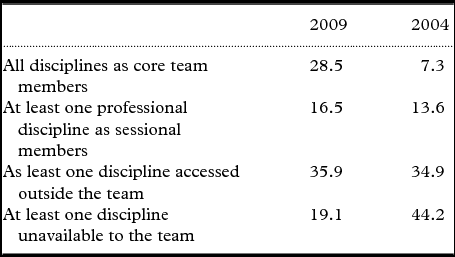
A simple team membership typology was constructed, based on a hierarchy of how the six professional disciplines were represented or accessed. As shown in Table 4, over a quarter (28.5%) of teams in 2009 reported that all six disciplines were core members of the CMHT. A further 16.5% of the sample also reported having all disciplines within the team, but with at least one being only a sessional member. However, most teams did not have all six disciplines represented as members. Over one-third of teams (35.9%) had at least one professional discipline missing, but reported that they could access any missing profession outside the team as required. Just under one in five teams (19.1%) could not access all disciplines. Compared to 2004, the latest survey represents a considerable improvement in access and membership arrangements. In 2004, fewer than one in ten (7.1%) teams had all six disciplines as core members, while 44% reported that at least one discipline could not be accessed at all.
Team membership type (% falling within each category)
Note: n = 376 (2009 survey), 304 (2004 survey).
Management and supervision
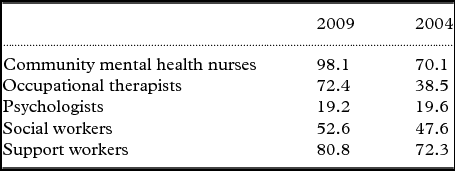
Almost all (96.5%) teams in 2009 reported having a formal team manager, and sometimes two or more depending on the size of the team and any job-share arrangements in place. For 340 teams, the professional discipline of the team manager(s) was reported. Predictably, most (79.7%) teams were managed by a nurse, although a sizeable minority reported being managed by a social worker (20.3%) or, less commonly, an occupational therapist (OT) (5.9%). Table 5 shows the proportion of team members line-managed within the CMHT (as distinct from line-managed through another service). Compared to 2004, a general shift toward management within teams can be noted, as expected with greater core membership. The most significant increase is reported for OTs. In contrast, fewer than one in five (19.2%) psychologists were managed by the CMHT manager, almost unchanged from 2004.
Percentage of CMHT members managed within the team
Note: n = 376 (2009 survey), 304 (2004 survey).
Responses to open-ended questions
Finally, the 2009 questionnaire included open-ended questions exploring the positive features of how CMHTs worked, and what respondents would most like to change. Predictably, teams lacking access to particular disciplines often aspired to fill those gaps: most often, this was with respect to psychology and social workers, however even respondents with access to these disciplines often expressed a wish to expand their numbers. Many respondents identified that successful multidisciplinary working was a notable benefit of their team structure, and further highlighted the importance of “open,” “honest,” and “respectful” communication approaches. However, a small number of teams with narrow membership expressed satisfaction with being specialist, uni-discipline teams, and linked the prospect of greater multidisciplinary working to a dilution of core nursing skills. One respondent reported that social workers had recently left their team, and that the team had “gone back to doing what we know best.” In some cases, despite formal integration of different disciplines, comments suggested that staff continued to work in professional silos, and in one example a respondent attributed this to the numerical dominance of nurses within the team.
With respect to management arrangements, very few comments were made. The most common positive comments related to the autonomous working of all professional groups, with the support of both open team discussions of complex cases and peer supervision. The biggest concern related to the management of sessional members outside the team: it was suggested that a high number of sessional staff led to “fragmented” teams, caused by conflicting priorities between different services. Consequently, a small number of teams with sessional members wished to integrate management structures.
Discussion
The new survey achieved a high response rate (88%), providing a comprehensive and representative portrayal of team composition and management arrangements. The analysis found that membership broadly increased across all professional groups between 2004 and 2009, which is noteworthy, given international concern over the supply of adequately trained staff in old-age psychiatry services, as the baby-boom generation reaches retirement across many high income nations (Draper and Anderson, Reference Draper and Anderson2010).
The 2004 survey revealed that a quarter of CMHTs had no access at all to support workers. However, by 2009 this proportion had fallen to just one in 25 teams, with 87% having support workers as core team members – the second largest staff group. Further, a total of 13%, 7%, and 8% of teams reported having other assistant-grade “healthcare workers,” “social care workers,” and “other support roles” respectively. This proliferation of care workers without professional registration has raised significant debate. Patients have expressed high satisfaction with their role, indicating that support workers both undertake work of value to patients, including the provision of ongoing emotional and social support, and bring personal attributes that are important in developing therapeutic partnerships. For example, Support, Time, and Recover (STR) workers have been reported to offer care founded on a valuable personal relationship, often based on the STR's own life experiences and characterized by empathy, trust, respect, and reliability (Huxley et al., Reference Huxley, King, Evans, Davidson and Beresford2003). Support workers have also reported preferences for new and innovative ways of working in CMHTs (Carpenter et al., Reference Carpenter, Schneider, Brandon and Wooff2003), suggesting that they may bring novel approaches to care. Together, this represents a considerable diversion from traditional models of support centered on technical care skills and well-established care pathways (Huxley et al., Reference Huxley, Evans, Beresford, Davidson and King2009). However, concerns have been expressed about the boundaries to their work vis-a-vis professionally qualified staff (McKenna, Reference McKenna, Kenney and Hasson1995). Without the role clarity afforded by a long professional tradition, formal registration, and peer support, there is evidence that the support worker role reverts to that of a nursing assistant, which, it has been argued, undermines their potential value (McRae et al., Reference McRae, Banerjee, Murray, Prior and Silverman2008). Furthermore, disquiet about patient safety and risk arising from skill substitution between qualified and unqualified staff, where not carefully supervised, has not been resolved.
The latest survey also indicates that clinical psychologists were more likely to be members of CMHTs than in 2004, but that sessional membership remains high. Psychologists were also the least likely of all groups to be line-managed within CMHTs. This is consistent with evidence from working-age adult teams, where psychologists have previously indicated a greater preference for single-profession teams, and have expressed concern that CMHTs are professionally isolating (Mistral and Velleman, Reference Mistral and Velleman1997). Furthermore, a recent survey of working-age adult CMHTs in England and Wales found a significant contraction in psychologist membership compared with data from the 1990s (Evans et al., Reference Evans2012). The relatively poor access to psychological therapies by older people's teams raises concerns that this gap may be filled by other team members without the necessary training or supervision (Evans, Reference Evans2004), or simply not provided at all.
The data also show a greater formalization of team structures over time. The proportion of teams reporting full core membership of all professional disciplines required in standards of good practice had grown from 13% to just under a third between the two surveys. As outlined above, evidence suggests an association between formal integration in CMHTs and measures of team effectiveness. However, many obstacles to successful joint working remain. Data from the 2009 survey reported elsewhere (Wilberforce et al., Reference Wilberforce, Harrington, Brand, Tucker, Abendstern and Challis2011) found that 30% of teams did not use the same structured assessment documentation across professional groups, and just under 70% could not mutually share records with social services. Responses to open-ended questions indicated broad satisfaction with multidisciplinary working within teams. Occasional examples of continued “silo working” were noted in a minority of teams, and it is important to note that these obstacles may nullify the positive effects of integrated services: evidence has suggested that the benefits of multidisciplinary working are contingent upon a healthy team climate and reflective attitudes (Fay et al., Reference Fay, Borrill, Amir, Haward and West2006).
In interpreting the data, there are a number of limitations to consider. First, the 2009 survey was mostly completed by team managers, and it is possible that other members may have offered different interpretations, especially with respect to open-ended questions. In addition, the 2004 survey may have elicited responses from different consultants who worked in the same CMHT, leading to some information being double-counted. Second, the majority of the analysis focused on the presence or absence of particular disciplines and management structures, but did not capture data on the sufficiency or quality of these arrangements. Concern has been raised in Australia over the “veneer of gestural teamwork” being employed where inter-professional differences remain acute (Rosen and Callaly, Reference Rosen and Callaly2005, p. 235) Some further evidence emerged from the current survey in response to open-ended questions, but these were not systematically analyzed for this paper and therefore should be regarded as indicative rather than definitive.
This study raises important questions as to optimal team characteristics. Although the Royal College of Psychiatrists (2006) has made recommendations about the desirable size and composition of CMHTs, these were largely based on expert judgement rather than firm evidence. Indeed, research describing the objective components of successful CMHTs is inconclusive and contradictory, suggesting that service quality may instead be determined by a complex and dynamic array of factors, including nuanced aspects of personal leadership; local service context; the quality of inter-agency and inter-professional partnership; and team climate.
The data described in this paper confirm that the formal multidisciplinary team continues to be a favored organizational model. However, an important unanswered question concerns the extent to which the nature of multidisciplinary working is changing through, for example, the development of trans-disciplinary models characterized by extensive blurring of traditional professional boundaries. Certainly, some evidence suggests that the encouragement of generic working by community mental health managers has led to a retrenchment by practitioners in maintaining their professional identities (Brown et al., Reference Brown, Crawford and Darongkamas2000). This reflects the difficulty in delineating the optimal balance between specialist and generic roles in such a highly skilled and complex service area, which continues to be a priority area for future research.
Conflict of interest
The research was funded by the National Institute for Health Research.
Description of authors’ roles
M. Wilberforce contributed to the design of the survey schedule, managed the survey process, oversaw the analysis, and led the preparation of the manuscript. S. Tucker, M. Abendstern, and C. Brand assisted in the design of the survey schedule and assisted in preparing the manuscript; C. M. Giebel contributed to data analysis; and D. Challis was responsible for the study as a whole and contributed to the design, analysis, and preparation of the manuscript.
Acknowledgments
This paper presents independent research funded by the National Institute for Health Research (NIHR) under its Programme Grants for Applied Research scheme (RP-PG-0606-1109). The views expressed in this paper are those of the authors and not necessarily those of the NHS, the NIHR, or the Department of Health.