Environmental circumstances play an indisputable role in the pathogenesis of depression, including as distal predictors of both long-term risk and short-term precipitants of depressive episodes. However, environmental events do not uniformly influence depression risk, and thus much of contemporary research in the psychopathology of depression has focused on neurobiological and psychosocial mechanisms by which stress and adversity phenomena result in depressive experiences in some people but not others. The numerous, interacting, and mutually influencing factors that likely contribute to depressive vulnerability span diverse systems, including biological (genetic, neural, and neuroendocrine), psychological (personality traits, cognitions, and coping styles), developmental (timing of stressor), and environmental (characteristics and contexts of the stressors), and also involve the interplay between multiple risk and protective factors.
Research using a multiple levels of analysis framework may help elucidate how such varied systems collectively influence depression risk. The study of multilevel dynamics involves identifying the transactions among biological, environmental, and psychosocial processes influencing stage-salient development, leading to diverse outcomes (Masten, Reference Masten2007). Biological and environmental risk factors are not viewed as solitary forces operating in isolation, but instead as interactive pieces in intricate systems that cut across multiple spheres to influence outcomes. To capture such complexity, progressively more integrative models and methodologies are needed (e.g., Cicchetti, Reference Cicchetti2013; Hammen, Rudolph, & Abaied, in press; Masten, Reference Masten2007), particularly those incorporating long-term longitudinal designs that shed light on how experiences occurring across crucial developmental periods impact distal outcomes. As one of the founding principles of developmental psychopathology, the multiple levels perspective has transformed research on risk and protective factors for psychopathology across the life span (Cicchetti & Dawson, Reference Cicchetti and Dawson2002; Cicchetti & Toth, Reference Cicchetti and Toth2009).
The present study examines risk factors for depression across multiple levels of analysis in a sample of youth at risk for depression. We examine interactive effects of multiple systems, including genetic and environmental, consistent with an abundance of research supporting gene–environment interactions (G × E) in predicting depression (e.g., Karg, Burmeister, Shedden, & Sen, Reference Karg, Burmeister, Shedden and Sen2011). Moreover, multiple levels of analysis are further construed to include multiple levels of environmental factors. Rather than view “stress” as a unitary construct, we address contributions of both early childhood adverse conditions and chronic stress more proximal to depressive experiences and their potential interactive relationship. Specifically, we examine whether adverse experiences during developmentally salient early childhood periods affect depressive reactivity to proximal stressors later in life (an environment–environment [E × E] interaction), and whether this “stress sensitization” pattern in turn is moderated by genetic vulnerability (a G × E × E interaction). We focus on two candidate genes relevant to sensitivity to stress: a polymorphism in the promoter region of the serotonin transporter linked gene (5-HTTLPR) and a single nucleotide polymorphism (SNP; rs110402) in the corticotrophin releasing hormone receptor 1 gene (CRHR1).
Early Adversity and Depression
Exposure to adverse conditions in early childhood is strongly predictive of adolescent and adult depressive disorders, as well as anxiety, substance use, and disruptive behavioral disorders, in the United States (Kessler, Davis, & Kendler, Reference Kessler, Davis and Kendler1997; Kessler & Magee, Reference Kessler and Magee1993; McLaughlin et al., Reference McLaughlin, Green, Gruber, Sampson, Zaslovsky and Kessler2012) and internationally (Kessler et al., Reference Kessler, McLaughlin, Green, Gruber, Sampson and Zaslavsky2010). Adversities reflecting family functioning may be especially strongly associated with internalizing disorders (McLaughlin et al., Reference McLaughlin, Green, Gruber, Sampson, Zaslovsky and Kessler2012).
Exposure to early adversities (EA) may increase risk for depression in part by modifying reactivity to proximal stressors. The stress sensitization hypothesis, or the idea that prior childhood adversity exposure predicts greater likelihood of reacting to recent stressors with depression, has been supported in several studies. Hammen, Henry, and Daley (Reference Hammen, Henry and Daley2000) showed that among young women who developed a depressive episode in a longitudinal study of the transition to adulthood, those reporting childhood adversities developed a depressive episode following lower levels of recent stressors than did women without childhood adversity exposure. Harkness, Bruce, and Lumley (Reference Harkness, Bruce and Lumley2006) also showed that adolescents with a history of childhood maltreatment reported a lower severity of stressful life events prior to first depressive episode onset than reported by those without abuse. Similarly, in an epidemiological sample of adults McLaughlin, Conron, Koenen, and Gilman (Reference McLaughlin, Conron, Koenen and Gilman2010) found that past-year stressful life events were more predictive of major depression among those with higher levels of early childhood adversity than among those without adversity.
Genetic Predictors of Sensitivity to Stress
The current study examined genetic moderation of stress sensitization. There are several plausible reasons to expect that some individuals would be genetically predisposed to become more reactive to stressors following EA exposure. The mechanisms presumed to underlie stress sensitization may be influenced by genetic factors. Although both biological and psychosocial processes likely contribute to effects of EA exposure on depression and stress sensitization (Cicchetti, Reference Cicchetti2013), one important mechanism may be disruptions in the development of neuroregulatory processes. For example, hypothalamic–pituitary–adrenal (HPA) axis functioning has been shown to be sensitive to EA exposure (e.g., Cicchetti & Rogosch, Reference Cicchetti and Rogosch2001; Gunnar & Quevedo, Reference Gunnar and Quevedo2007). Exposure to stressful conditions (e.g., family conflict, harsh discipline, or maltreatment) in childhood is linked to abnormalities in basal levels of cortisol (Gonzalez, Jenkins, Steiner, & Fleming, Reference Gonzalez, Jenkins, Steiner and Fleming2009; Taylor, Karlamangla, Friedman, & Seeman, Reference Taylor, Karlamangla, Friedman and Seeman2011) and cortisol reactivity to acute stressors (Wismer Fries, Shirtcliff, & Pollak, Reference Wismer Fries, Shirtcliff and Pollak2008), which are in turn consistent with abnormalities in the HPA axis observed in depressed individuals (Pariante & Lightman, Reference Pariante and Lightman2008; Posener et al., Reference Posener, DeBattista, Williams, Chmura Kraemer, Kalehzan and Schatzberg2000). Thus, disruptions in the HPA axis development, as well as their effects on neural circuitry, may promote sensitivity to stressful life events and result in increased risk for later depression. As such, researchers have suggested that genes that regulate HPA axis functioning may influence the degree to which biological systems are altered by early stress exposure (Gillespie, Phifer, Bradley, & Ressler, Reference Gillespie, Phifer, Bradley and Ressler2009).
In addition, as outlined below, recent G × E research has identified specific candidate genes that interact with environmental stressors (including early childhood adversity and recent acute and chronic stress) to predict depressive outcomes. The current study extends these findings by examining whether genes interact with EA exposure to predict depressive reactivity to proximal stressors in a G × E × E pattern. We focused on two genes that both play an established role in HPA axis functioning and have been shown to interact with stress to predict depression.
CRHR1
Given the central role of CRHR1 in HPA axis functioning (Heim & Nemeroff, Reference Heim and Nemeroff2001), polymorphisms in CRHR1 are considered promising candidates for G × E research in depression. Several studies have examined a three-allele CRHR1 haplotype (or the individual variants that constitute it) involving SNPs at rs7209436, rs110402, and rs242924 as a possible moderator of adversity–depression associations. The first G × E study on this topic found that a TAT haplotype at these loci attenuated the association between retrospectively reported child abuse, assessed using the Childhood Trauma Questionnaire (CTQ; Bernstein & Fink, Reference Bernstein and Fink1998), and adult depressive symptoms (Bradley et al., Reference Bradley, Binder, Epstein, Tang, Nair and Liu2008). A second investigation replicated the TAT haplotype buffering effect in one sample in which child abuse was again measured with the CTQ, but not in another sample that assessed abuse with a combination of prospective and retrospective indices (Polanczyk et al., Reference Polanczyk, Caspi, Williams, Price, Danese and Sugden2009). In other words, in these two studies the A allele rs110402, the main focus of the present analyses (in combination with T alleles at the other two loci), was associated with reduced vulnerability to depression following stress exposure. In contrast, other studies have observed that the TAT haplotype intensifies the association of childhood maltreatment with trait neuroticism and blunted diurnal cortisol rhythms, two phenotypes known to underlie risk for depressive disorders (Cicchetti, Rogosch, & Oshri, Reference Cicchetti, Rogosch and Oshri2011; DeYoung, Cicchetti, & Rogosch, Reference DeYoung, Cicchetti and Rogosch2011). In line with these latter findings, a recent study demonstrated G × E effects where the TAT haplotype was associated with elevated risk for alcoholism (Ray et al., Reference Ray, Sehl, Bujarski, Hutchison, Blaine and Enoch2013), and several studies have directly linked the TAT haplotype to internalizing outcomes, including depression (Ishitobi et al., Reference Ishitobi, Nakayama, Yamaguchi, Kanehisa, Higuma and Maruyama2012; Papiol et al., Reference Papiol, Arias, Gastó, Gutiárrez, Catalán and Fañanás2007; Wasserman, Wasserman, & Sokolowski, Reference Wasserman, Wasserman and Sokolowski2010). Additional investigations have failed to find evidence for G × E involving any of these SNPs and childhood adversity (Lewis, Collishaw, Harold, Rice, & Thapar, Reference Lewis, Collishaw, Harold, Rice and Thapar2012), or have concluded that the pattern of interaction varies for males versus females (Heim et al., Reference Heim, Bradley, Mletzko, Deveau, Musselman and Nemeroff2009). No studies to date have examined the role of CRHR1 variation in predicting the association of proximal stressors to depression, though one investigation demonstrated greater risk of suicidal responses to stress among rs110402 A allele carriers (Wasserman, Wasserman, Rozanov, & Sokolowski, Reference Wasserman, Wasserman, Rozanov and Sokolowski2009). It is evident that CRHR1 G × E findings to date have been inconsistent, and there is some debate over whether interaction findings are dependent on the measure used to define childhood stressors (i.e., the CTQ; Heim et al., Reference Heim, Bradley, Mletzko, Deveau, Musselman and Nemeroff2009; Lewis et al., Reference Lewis, Collishaw, Harold, Rice and Thapar2012), the nature of the stressors (e.g., severity of EA, or sexual versus physical abuse; DeYoung et al., Reference DeYoung, Cicchetti and Rogosch2011; Heim et al., Reference Heim, Bradley, Mletzko, Deveau, Musselman and Nemeroff2009) or characteristics of the sample such as ethnicity. Together, these studies suggest that CRHR1 variants play a role in modulating depressive responses to stress, but more research is needed to discern the exact pattern of risk.
5-HTTLPR
In addition to CRHR1 genotypes thought to moderate the effects of childhood adversity exposure on depression outcomes, another theoretically plausible genetic moderator is 5-HTTLPR, a length polymorphism in the promoter region of the serotonin transporter gene. Caspi et al. (Reference Caspi, Sugden, Moffitt, Taylor, Craig and Harrington2003) initially provided support for a G × E effect for 5-HTTLPR in depression, demonstrating that short (S) allele carriers show heightened depression rates following stress exposure compared to long (L) allele homozygotes. The decade following the publication of Caspi et al.'s (Reference Caspi, Sugden, Moffitt, Taylor, Craig and Harrington2003) findings has seen a tremendous growth of research on this gene in the context of depression. Although there have been several notable failures to replicate Caspi et al.'s (Reference Caspi, Sugden, Moffitt, Taylor, Craig and Harrington2003) G × E pattern (see Risch et al., Reference Risch, Herrell, Lehner, Liang, Eaves and Hoh2009), the majority of longitudinal studies find that short allele carriers experience higher rates of depression following exposure to naturally occurring stressors (Caspi, Hariri, Holmes, Uher, & Moffitt, Reference Caspi, Hariri, Holmes, Uher and Moffitt2010; Uher & McGuffin, Reference Uher and McGuffin2010). A recent quantitative review demonstrated that 5-HTTLPR G × E is a fairly robust phenomenon when only studies that assess stressful environmental conditions with gold-standard interview methods or objective criteria (e.g., legally documented cases of abuse) are included (Karg et al., Reference Karg, Burmeister, Shedden and Sen2011). In addition, there is evidence that 5-HTTLPR interacts more strongly with early childhood adversity, as compared to stressful experiences that are more proximal to depression onset (Karg et al., Reference Karg, Burmeister, Shedden and Sen2011), perhaps due to the chronicity of biological and psychological dysfunction set into motion by early stress exposure (Brown & Harris, Reference Brown and Harris2008).
Further, a growing body of experimental research demonstrates that 5-HTTLPR plays a role in regulating neural, endocrine, and attentional reactivity to stressful conditions (e.g., Munafò, Brown, & Hariri, Reference Munafò, Brown and Hariri2008; Pergamin-Hight, Bakermans-Kranenburg, van IJzendoorn, & Bar-Haim, Reference Pergamin-Hight, Bakermans-Kranenburg, van IJzendoorn and Bar-Haim2012). For instance, several independent teams of investigators have observed that 5-HTTLPR short allele carriers, relative to long allele homozygotes, exhibit heightened cortisol responses to social stressors in the laboratory (Gotlib, Joormann, Minor, & Hallmayer, Reference Gotlib, Joormann, Minor and Hallmayer2008; Way & Taylor, Reference Way and Taylor2010). Taken together, the existing evidence makes a compelling case that 5-HTTLPR genotype plays a crucial role in stress regulation.
The notion that the two genes, CRHR1 and 5-HTTLPR, may influence depressive sensitivity to both early adversities and later proximal stressors in a G × E × E relationship has been proposed (e.g., Homberg & van den Hove, Reference Homberg and van den Hove2012) but rarely tested. As previously noted, research on CRHR1's role in depression has exclusively examined early adversities and not proximal stressors. The larger, more extensive research literature on 5-HTTLPR has separately examined the interactive effects of both early and proximal stressors with 5-HTTLPR genotype, but it has rarely differentiated between their effects. In one recent exception, Grabe et al. (Reference Grabe, Schwahn, Mahler, Schulz, Spitzer and Fenske2012) tested a three-way interaction among 5-HTTLPR genotype, child abuse, and adult trauma exposure. They found support for the G × E × E effect, with short allele carriers exposed to both child abuse and adult traumas showing the highest levels of depression. These results offer compelling preliminary support for our model; however, the Grabe et al. (Reference Grabe, Schwahn, Mahler, Schulz, Spitzer and Fenske2012) study was limited by its cross-sectional design; use of a retrospective, self-report measure of child abuse (i.e., the CTQ); and exclusive focus on adult trauma rather than more normative proximal stressors. Thus, our study seeks to both replicate and extend these findings.
Timing of Early Adversity
Several researchers have proposed the existence of sensitive periods of neural development, during which relevant brain circuitry is maximally plastic and therefore stressful conditions have the greatest potential to disrupt development of stress regulation systems (see Heim & Binder, Reference Heim and Binder2012). Although research has yet to pinpoint the age at which this sensitive period occurs, some evidence suggests that stressors occurring at younger ages, such as preschool age and earlier, may have stronger negative effects on biological markers of stress regulation than those occurring at later ages (e.g., Carpenter et al., Reference Carpenter, Tyrka, McDougle, Malison, Owens and Nemeroff2004, Reference Carpenter, Tyrka, Ross, Khoury, Anderson and Price2009; Heim, Newport, Mlezko, Miller, & Nemeroff, Reference Heim, Newport, Mletzko, Miller and Nemeroff2008; Rogeness & McClure, Reference Rogeness and McClure1996). Stress exposure during this early time period may also disrupt important socioemotional development tasks, such as attachment formation (Bowlby, Reference Bowlby1980), which have lasting implications for stress regulation and mental health (e.g., van IJzendoorn, Schuengel, & Bakermans-Kranenburg, Reference van IJzendoorn, Schuengel and Bakermans-Kranenburg1999). As such, some evidence suggests that adversities experienced in early childhood may be particularly predictive of mental health outcomes (Dunn, McLaughlin, Slopen, Rosand, & Smoller, Reference Dunn, McLaughlin, Slopen, Rosand and Smoller2013; Gunnar & van Dulmen, Reference Gunnar and van Dulmen2007; Keiley, Howe, Dodge, Bates, & Pettit, Reference Keiley, Howe, Dodge, Bates and Pettit2001). In line with these findings, in the current study, we define early adversities as major stressors occurring during the first 5 years of life.
The Present Study
The present study examines the effect of early childhood adversity exposure on depressive responses to stressful conditions in young adulthood, and whether the effects are further modified by genetic variation in the CRHR1 gene (SNP rs110402) and 5-HTTLPR. We hypothesize G × E × E interactions involving each of the two candidate genes, with greater EA exposure increasing depressive responses to chronic stress at age 20, depending on genetic vulnerability.
Chronic, ongoing stress, rather than acute life events, will be the focus for empirical and conceptual reasons: the G × E literature seems to support a stronger association of depression with chronic conditions such as maltreatment than with acute recent events (Brown & Harris, Reference Brown and Harris2008; Karg et al., Reference Karg, Burmeister, Shedden and Sen2011; Moffitt, Caspi, & Rutter, Reference Moffitt, Caspi and Rutter2005), and ongoing stress presents a more stable and reliable picture of stress experience at a particular time point (e.g., Moffitt et al., Reference Moffitt, Caspi and Rutter2005; Rutter, Reference Rutter2005). The data are from a longitudinal sample of youth at risk for depression, studied since mothers' pregnancy and selected from a large cohort to represent children of depressed or never-depressed women. Depressive outcomes were assessed at age 20. The transition to adulthood is a developmentally active period marked by selection into relationship, social, occupational, and academic roles that are increasingly challenging and potentially stressful, and for some, a period of risk for depressive and anxiety disorders and other forms of maladaptation. We assessed both self-reported depressive symptoms and also a broader index of internalizing pathology to test the likelihood that results apply not only to depressive experiences but more generally to the common depression–anxiety mix. Childhood adversity exposure is a multiple-variable scale capturing commonly correlated risk factors affecting the family, such as parental marital instability, parental mental illness or criminality, poverty, and high levels of stressful life events. The measure is based on contemporaneous data collected from the mothers at four time points from pregnancy to child age 5. Measures of youth chronic stress at age 20 included reliable and valid interview assessments across multiple domains, and depressive symptoms were collected at youth age 20. Several previous studies examining CRHR1 and 5-HTTLPR have revealed that gender-specific effects (Du, Bakish, & Hrdina, Reference Du, Bakish and Hrdina2000; Hammen, Brennan, Keenan-Miller, Hazel, & Najman, Reference Hammen, Brennan, Keenan-Miller, Hazel and Najman2010; Heim et al., Reference Heim, Bradley, Mletzko, Deveau, Musselman and Nemeroff2009) and internalizing problems are substantially more common among females (Kessler, McGonagle, Swartz, Blazer, & Nelson, Reference Kessler, McGonagle, Swartz, Blazer and Nelson1993); therefore, gender is a covariate in analyses of the G × E × E hypotheses.
Method
Participants
Participants were drawn from an initial sample of 815 youth who completed procedures at age 15 for a study of youth at risk due to maternal depression, of whom 705 took part in a follow-up study at age 20. Between ages 22 and 25, all youth who could be located were asked to participate in collection of DNA samples, of whom 512 consented. All individuals included in the present analyses had to have been part of the original data collection through age 5, the ages 15 and 20 follow-ups, and the DNA collection. The current study is based on 381 (149 males, 232 females) who were genotyped for 5-HTTLPR and 444 (182 males, 262 females) who were genotyped for the rs110402 SNP of CRHR1. Characteristics and data collection procedures are described in the Genotyping Section below.
The original sample of 815 was recruited from the Mater University Study of Pregnancy (Keeping et al., Reference Keeping, Najman, Morrison, Western, Andersen and Williams1989) consisting of all women who were pregnant and gave birth at the Mater Misericordiae Mother's Hospital in Brisbane, Queensland, Australia, in the early 1980s. The original birth cohort study of youth and mother health and development consisted of over 7,000 families, and it included measures of mothers' circumstances and depressive symptoms during pregnancy, immediately postpartum, at 6 months after birth, and 5 years after birth. Mothers' self-reported depressive symptoms on the Delusions–Symptoms–States Inventory (Bedford & Foulds, Reference Bedford and Foulds1978) were used by investigators (C.H. and P.A.B.) to identify women with varying levels of severity and chronicity of depressive symptoms (or no depression) for a study of children of 815 women. Full details of the original sample selection and ascertainment are reported in Hammen and Brennan (Reference Hammen and Brennan2001). Mothers' depression status was confirmed by the Structured Clinical Interview for DSM-IV (First, Spitzer, Gibbon, & Williams, Reference First, Spitzer, Gibbon and Williams1995) when the children turned 15 years of age; 357 (44%) had diagnoses of major depressive disorder and/or dysthymic disorder in the child's lifetime; 458 (56%) were never depressed. The youth sample at age 15 consisted of 403 females and 412 males. The families were predominately lower and middle income, primarily Caucasian (91.4%; 3.6% Asian and 5% “other” or not reported).
Those participants in the age 20 follow-up who were not included in the DNA sampling encompassed those who could not be contacted, no longer lived in the geographical area, declined to participate, had significant medical problems, or were deceased. There were no differences between those who participated and those who did not on depression history or maternal depressive status, but participants were more likely to be female (χ2 = 21.29, p < .001).
Measures
Youth depressive and internalizing symptoms
The Beck Depression Inventory—II (BDI; Beck, Steer, & Brown, Reference Beck, Steer and Brown1996) is a widely used measure of depressive symptoms with excellent psychometric properties, including reliability and validity, as well as strong sensitivity and specificity for detecting depression in community samples (Beck, Steer, & Garbin, Reference Beck, Steer and Garbin1988; Lasa, Ayuso-Mateos, Vazquez-Barquero, Diez-Manrique, & Dowrick, Reference Lasa, Ayuso-Mateos, Vazquez-Barquero, Diez-Manrique and Dowrick2000). The Cronbach α was 0.92 at the age 20 assessment. The BDI was employed instead of depression diagnoses because (a) relatively few participants met full criteria for current major depressive episode at age 20 (n = 17, 3.8% of the sample); (b) the BDI is a valid measure of risk for diagnosable depression (Beck et al., Reference Beck, Steer and Garbin1988) and is also, in the current sample, predictive of current and future impairment in functioning; and (c) the BDI provides continuous symptom data, which allow greater statistical power for detecting interaction effects. The broadband internalizing scores included the internalizing subscales of the Young Adult Self-Report (YASR). These scales are part of the Achenbach System of Empirically Based Assessments (Achenbach, Reference Achenbach2009). The YASR internalizing scale is based on the sum of the scores of the withdrawn, somatic complaints, and anxious/depressed scales, and included the sum of withdrawn and anxious/depressed subscales. The scales have well-established psychometric evidence of reliability and validity (e.g., Achenbach, Reference Achenbach2009).
EA
A contemporaneous composite measure of family adversity in the first 5 years of the child's life was derived from information provided by the mother at one or more of the pregnancy, birth, 6-month and 5-year assessments (except for maternal Axis I diagnosis). An EA composite was formed from procedures previously reported in Hazel, Hammen, Brennan, and Najman (Reference Hazel, Hammen, Brennan and Najman2008). Variables included as adversities were maternal Axis I diagnosis prior to age 5 years, financial hardship, child chronic illness, parental discord, maternal stressful life events, and mothers' separation from partners. Maternal Axis I diagnoses (omitting specific phobia) between the child's birth and age 5 years were assessed using the Structured Clinical Interview for DSM-IV (First et al., Reference First, Spitzer, Gibbon and Williams1995) at the age 15 years interview, covering the mother's lifetime. The most common diagnoses were major depressive disorder, dysthymic disorder, and social phobia. Kappa for depressive disorders within the child's first 5 years in a reliability sample was 0.81 (p < .01). Financial hardship was assessed by calculating the mean of maternal ratings of total family income at the prenatal, 6-month and 5-year data collections. Childhood illness was assessed at the age 5 years assessment by asking mothers to endorse whether the child had had any of 15 illnesses or injuries (e.g., asthma) lasting 3 or more months that impaired the child's activities at least “some.” Maternal stressful life events were assessed using checklists of nine interpersonal, health or occupational problems that might have occurred in the last 6 months prior to the prenatal and postnatal data collections. The numbers of reported events at the two assessments were highly correlated (r = .59) and were summed to reduce the checklists to a single measure of perinatal stressful life events. Parental discord was evaluated as maternal relationship satisfaction with her romantic partner, assessed using the mean of the eight-item satisfaction subscale of the Dyadic Adjustment Scale (Spanier, Reference Spanier1976) collected during pregnancy and at birth, 6 months, and 5 years (αs ranged from 0.85 to 0.97). If on the age 5 years questionnaire a mother reported that she had been divorced or separated from a partner or that she had changed partners over the last 5 years, the child was considered to have experienced a parental partner separation. The continuous variables, income, the Dyadic Adjustment Scale, and maternal life events, were recoded as present/absent using the 33rd percentile as the cutoff point for each measure to identify the third of the sample experiencing the most adverse conditions. The specific cutoff was chosen as a consistent point across measures that would balance the need for sufficient numbers for meaningful analyses with selection of a moderately adverse level of each variable. A summary measure of early childhood adversity was formed by counting the number of adversities for each child, resulting in a range of 0–6 adversities experienced (distribution: 0 adversities = 23%, 1 = 28%, 2 = 18%, 3 = 16%, 4 = 8%, 5 or 6 = 7%).
The UCLA Life Stress Interview (e.g., Hammen & Brennan, Reference Hammen and Brennan2001) was used to obtain a summary measure of chronic stress at the age 20 interview, covering the past 6 months. It is a semistructured interview for ongoing conditions adapted for younger and older adolescents, and it was developed from earlier versions for adults (e.g., Hammen et al., Reference Hammen, Adrian, Gordon, Burge, Jaenicke and Hiroto1987). The age 20 version included developmentally appropriate domains: social life, close friendship, romantic relations (dating activity and interest), relations with family members, financial, work, academic activity, health of self, and health of close family members. Each scale included parallel versions to capture all participants’ status; for example, the academic scale included versions for those continuing further education and for those not pursuing additional education. Trained advanced graduate student interviewers probed each area with the youth, using standard general probes and semistructured follow-up queries where needed. Each domain was scored by the interviewer on a 5-point scale with behaviorally anchored descriptors to capture objective, factual conditions (1 = superior [exceptional] functioning, 5 = severe difficulties). In order to make the ratings as objective as possible, the interviewer elicited specific information and examples, and each scale value was indicated by specific behavioral information. For example, the “social life” segment queried the number of people in the youth's regular social circle, how close and trusting their relationships are, what kind and frequency of activities do they engage in, how much they are sought out by others, frequency of disputes and conflicts, and how they are resolved, leading to scoring exemplified by levels of the following scale of social life:
-
1 = exceptional social life: many good friends, very popular and engages in frequent social activities outside school, gets along well with others, no conflict
-
3 = average social life but has some conflicts with peers or difficulty making and keeping friends
-
5 = severe social problems with no friends, totally isolated from peers or frequent conflicts and fights, rejected by peers
Reliabilities were based on independent judges’ ratings of audiotaped interviews. Mean intraclass correlation across the domains was 0.81 at age 20. Evidence supporting the convergent and predictive validity of the chronic stress measure in the current sample is reported in Hammen, Brennan, and Keenan-Miller (Reference Hammen, Brennan and Keenan-Miller2008). For the current study, summary measures for chronic stress levels were computed as a sum across all stress domains.
Genotyping
Two to 5 years after the age 20 follow-up (mean interval = 3.32 years, SD = 1.02) participants provided DNA samples for genetic analysis and completed questionnaires. Participants were mailed blood collection kits and consent forms, and had blood samples drawn at local facilities, which were picked up by courier and delivered to the Genetic Epidemiological Laboratory of the Queensland Institute of Medical Research. The institutional review boards of the University of Queensland, UCLA, and Emory University approved this research.
5-HTTLPR
Because of budgetary and procedural constraints, genotyping was restricted to a single full plating of 384 samples; 384 participants were selected randomly for genotyping from the pool of participants who provided blood-based DNA samples. Three samples produced invalid readings, leading to a final sample of 381 participants. Although selection for genotyping was random, by chance more female participants were selected than males (χ2 = 16.49, p < .001); otherwise, the genotyped and nongenotyped participants did not differ by their own depression status at previous follow-ups or by maternal depression status.
Genotyping was conducted at the Queensland Institute of Medical Research using agarose gel analysis of polymerase chain reaction products spanning the central portion of the repeats in the 5-HTTLPR. Polymerase chain reaction utilized Qiagen enzyme and buffer, with 30% deazaguanine and with 10 cycles of Touchdown protocol beginning at 67 °C and finishing at 62 °C with a further 32 cycles. Samples were subject to independent duplicate polymerase chain reaction with primer set 1 (acgttggatgTCCTG CATCC CCCAT, cgttggatgGCAGGGGGGATACTGCGA; lowercase sequence is nontemplated) that gave products of 198 and 154 base pairs for long and short versions, respectively, and primer set 2 (acgttggatgTCCTGCATCC CCCAT, acgttggatgGGGGATGCTG GAAGGGC) for products of 127 and 83 base pairs. Gel analyses were conducted in triplicate for most samples. At least two matching independent results were required for inclusion. Final call rate was 96.4%. To estimate accuracy, duplicate samples were genotyped for 764 individuals in a different study in the same laboratory, following the above procedures, with discordance rates of 0.45%. In the current sample, frequency of genotypes was long/long (L/L) = 122 (32%), L/short (L/S) = 178 (47%), and S/S = 81 (21%), with proportions in Hardy–Weinberg equilibrium, χ2 (1, 381) = 1.61, p < .20. Based on evidence suggesting that the long form variants designated as Lg function similarly to the short allele (Wendland, Martin, Kruse, Lesch, & Murphy, Reference Wendland, Martin, Kruse, Lesch and Murphy2006), 21 L g variants were reclassified as short forms. Following this reclassification, updated allele frequencies were L/L = 101 (27%), S/L = 189 (50%), and S/S = 91 (24%).
CRHR1
Aliquots of blood-based DNA were shipped to UCLA for processing at the Social Genomics Core of the USC/UCLA Biodemography Center. The CRHR1 rs110402 and rs242924 polymorphisms were genotyped because of their frequent use in previous G × E studies; they were highly correlated with each other (r = .99), and constitute two thirds (along with rs7209436) of the TAT haplotype commonly cited in the literature. The rs110402 and rs242924 polymorphisms were assayed by a commercial TaqMan Genotyping Assay (Applied Biosystems, Foster City, CA) performed on an iCycler real-time polymerase chain reaction instrument (BioRad, Hercules, CA) following the manufacturer's specified protocol, as described in Cole et al. (Reference Cole, Arevalo, Takahashi, Sloan, Lutgendorf and Sood2010). Test–retest reliability of duplicated specimens yielded a total genotyping error rate of <1%. Because of the near identity of the polymorphisms, primary analyses were conducted on the rs110402 SNP. Genotype distributions were in Hardy–Weinberg equilibrium, χ2 = 1.28 (p > .05), and were distributed as follows: G/G, n = 140 (31%); A/G, n = 208 (47%); and A/A, n = 96 (22%).
Results
Descriptive statistics and main effects
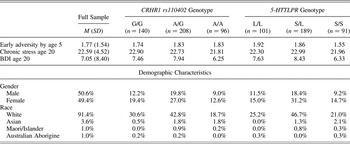
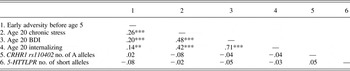
Table 1 displays descriptive statistics for study variables for the full sample and divided by genotype. Table 2 lists bivariate correlations for study variables. Neither the 5-HTTLPR nor the CRHR1 genotype was significantly associated with depressive symptoms at age 20, EA, chronic stress at age 20, gender, or maternal depression status (all ps > .05). Age 20 BDI showed significant, positive bivariate correlations with both EA and recent chronic stressors, which were also correlated with each other (all ps < .001). Both EA and chronic stress variables remained significant when entered simultaneously into a regression predicting age 20 depressive symptoms (chronic stress b = 0.86, SE = 0.07, p < .001; EA b = 0.47, SE = 0.20, p = .020).
Study variables means (standard deviations) and demographic information for full sample and by 5-HTTLPR and CRHR1 genotype

Note: Ns = 633–815 for the full sample. Group differences in study variables by genotype are not significant (ps > .05). Race reflects maternally reported self-identification; additional participants did not report race or identified with another group.
Bivariate correlations between major study variables

**p < .01. ***p < .001.
Interaction of EA and chronic stress in predicting depressive symptoms
All subsequent analyses controlled for gender. We examined whether experiencing adversities in early childhood increased susceptibility to proximal chronic stress, using multiple linear regression with age 20 BDI as the outcome. Both predictor variables were mean centered. We entered main effects for EA and chronic stress in the first step, and their interaction in the second step. The interaction term was significant (b = 0.010, SE = 0.04, p = .014, R 2 = .25, ΔR 2 due to interaction = .01), with stronger associations between chronic stress and BDI at high levels of EA (1 SD above the mean; b = 0.97, SE = 0.08, p < .001) than at low levels (1 SD below the mean; b = 0.67, SE = 0.10, p < .001).
Interactive effects between CRHR1 genotype, EA, and proximal chronic stress
Using the same statistical approach described above, we next separately tested two-way interactions between CRHR1 rs110402 and adversity by age 5, and proximal chronic stress, predicting age 20 depressive symptoms. Genotype was coded as a continuous scale reflecting number of A alleles (G/G = 0, A/G = 1, A/A = 2, an approach used elsewhere; e.g., Bradley et al., Reference Bradley, Binder, Epstein, Tang, Nair and Liu2008), but applying a dichotomous coding scheme (presence vs. absence of A allele) yielded similar results. Number of A alleles significantly interacted with EA (b = 0.95, SE = 0.37, p = .011, R 2 = .07, ΔR 2 = .02), with no effect of EA on depressive symptoms for G homozygotes (b = –0.043, SE = 0.50, β = –0.08, p = .395) but significant effects for A carriers (with similar effects for A/G heterozygotes, b = 1.86, SE = 0.42, β = 0.32, and A homozygotes, b = 1.42, SE = 0.48, β = 0.32, ps < .001). CRHR1 genotype also interacted with recent chronic stress to predict age 20 depressive symptoms (b = 0.29, SE = 0.12, p = .016, R 2= .25, ΔR 2 = .01). Chronic stress significantly predicted greater depressive symptoms across all genotypes (all ps < .001), but at a significantly higher magnitude for A carriers (A/G b = 1.11, SE = 0.14, β = 0.52; A/A b = 1.07, SE = 0.18, β = 0.57) than for G homogygotes (b = 0.62, SE = 0.14, β = 0.36).
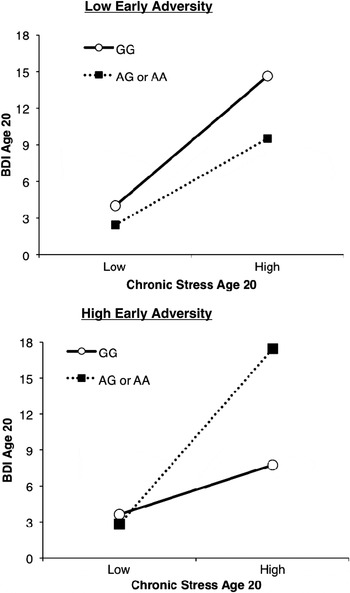
The results should be interpreted in light of the final step, a three-way interaction (CRHR1 Genotype × EA × Chronic Stress) predicting depression. The three-way interaction term was significant (b = 0.24, SE = 0.07, p = .001, R 2 = .29, ΔR 2 = .02), and is illustrated in Figure 1. Conditional effects were evaluated using the PROCESS macro for SPSS (Hayes, Reference Hayes2013). Among A homozygotes, EA potentiated the effect of recent stressors on depressive symptoms (b = 0.35, SE = 0.10, p < .001). In contrast, there was no interaction between EA and chronic stress for G homozygotes (b = –0.13, SE = 0.08, p = .11). In the alternative comparison, the G × E between CRHR1 and chronic stress was significant only for those with higher levels of childhood adversities.
Illustration of three-way interaction between CRHR1 rs110402 genotype, early adversity, and age 20 chronic stress, predicting age 20 depressive symptoms, with differential association between chronic stress and depressive symptoms by genotype presented at low and high levels of early adversity (defined as 10th and 90th percentile, respectively). For ease of visual interpretation, CRHR1 rs110402 genotype has been dichotomized into G/G versus AG and AA.

Substituting broadband YASR internalizing symptoms for depressive symptoms as the dependent variable produced comparable results, with a significant three-way interaction between CRHR1 genotype, chronic stress, and EA (b = 0.21, SE = 0.09, p = .014, R 2 = .18, ΔR 2 = .01) predicting age 20 internalizing symptoms, showing a similar pattern of decomposition. Analyses were repeated using the highly correlated (r = .99) alternate CRHR1 SNP rs242924. The results were virtually identical, with no substantive differences in significance or magnitude.
Interactive effects between 5-HTTLPR genotype, EA, and proximal chronic stress
We next separately tested two-way interactions of 5-HTTLPR genotype with EA and proximal chronic stress in predicting age 20 depressive symptoms. Genotype was defined as the number of short alleles (L/L = 0, S/L = 1, S/S = 2), consistent with the approach of others (e.g., Caspi et al., Reference Caspi, Sugden, Moffitt, Taylor, Craig and Harrington2003), but coding genotype dichotomously (0 = L/L, 1 = S/L or S/S) produced similar results. The number of short alleles did not interact with EA to predict depressive symptoms (p = .767) but did interact with chronic stress to predict age 20 depressive symptoms (b = 0.35, SE = 0.14, p = .011, R 2 = .26, ΔR 2 = .01). In line with expectations, associations between chronic stress and depressive symptoms were stronger for short carriers (S/L: b = 1.07, SE = 0.013, β = 0.54; S/S: b = 1.20, SE = 0.24, β = 0.49, ps < .001) than for long homozygotes (b = 0.56, SE = 0.17, β = 0.33 p = .001).
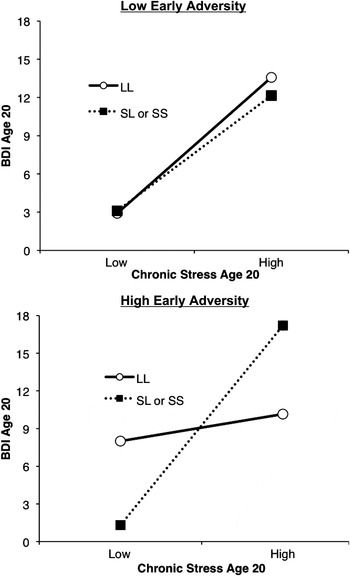
Finally, we tested a three-way interaction between 5-HTTLPR genotype, EA, and recent chronic stress, predicting age 20 depressive symptoms. In a hierarchical linear regression, we entered gender as a covariate, then all main effects, then all two-way interactions, then the three-way interaction term. The three-way interaction coefficient was significant (b = 0.22, SE = 0.08, p = .009, R 2 = .28, ΔR 2 = .01), as illustrated in Figure 2. The conditional effects of the chronic stress by EA interaction at different short allele counts were evaluated using the PROCESS macros for SPSS (Hayes, Reference Hayes2013). This two-way interaction was significant for short homozygotes (b = 0.29, SE = 0.11, p < .010), with stronger effects of chronic stress on depressive symptoms for those with high EA (90th percentile; b = 1.90, SE = 0.29, p < .001) than for those with low adversity (10th percentile; b = 0.74, SE = 0.30, p = .013). The interaction between chronic stress and EA was not significant for long homozygotes (b = –0.14, SE = 0.09, p = .112). Stated otherwise, the G × E between 5-HTTLPR and recent chronic stress was moderated by history of early adverse experiences: it was significant for those with a history of high early adversities (b = 0.79, SE = 0.21, p < .001), with significant reactivity to chronic stressors increasing with the number of short alleles, whereas there was no significant G × E for those with low adversities (b = –0.08, SE = 0.22, p = .720).
Illustration of three-way interaction between 5-HTTLPR genotype, early adversity, and age 20 chronic stress, predicting age 20 depressive symptoms, with differential association between chronic stress and depressive symptoms by genotype presented at low and high levels of early adversity (defined as 10th and 90th percentile, respectively). For ease of visual interpretation, 5-HTTLPR genotype has been dichotomized into L/L versus S/L and S/S.

The three-way interaction between EA, age 20 chronic stress, and 5-HTTLPR genotype was also significant in predicting age 20 broadband internalizing symptoms (b = 0.19, SE = 0.09, p = .032, R 2 = .18, ΔR 2 = .01), and the pattern of interaction was equivalent to that described above.
All genetic data analyses were repeated controlling for race (Caucasian vs. non-Caucasian), with no impact on significance of results. Excluding non-Caucasians from analyses also did not alter results.
Discussion
The current study found support for the hypothesis that specific genetic polymorphisms predict greater depression reactivity to proximal stress among those with high levels of exposure to adverse conditions in early childhood. The multiple levels formulation of G × E × E is consistent with a model of the impact of EA exposure on shaping developing neural, biological, and psychosocial processes toward greater likelihood of emotional reactivity to later stressors (sensitization), guided by genetic vulnerability. The results extend prior G × E findings on 5-HTTLPR and CRHR1, suggesting that some of the inconsistencies in prior findings with these genotypes may be at least partially attributable to unknown and unmeasured variation in exposure to distal or proximal stress.
With a few exceptions, previous G × E studies focusing on these genotypes have examined only the impact of stressors occurring during a single developmental period. Assessing multiple levels of stressors at different time points, the present study specifically examined sensitization processes, in which early childhood stress exposure predicted the strength of depressive reactivity in the face of current stressors, and the extent to which they were intensified by genetic factors. To date, no studies of CRHR1 G × E have examined naturally occurring proximal stressors on depression, although their typical focus on EA exposure may imply the assumption of an underlying sensitization reaction to later stress that has not generally been measured or reported. The larger research literature on 5-HTTLPR and stress has variously included recent or distal stressors including maltreatment in childhood (or both, as in Caspi et al., Reference Caspi, Sugden, Moffitt, Taylor, Craig and Harrington2003; see description of multiple studies in Karg et al., Reference Karg, Burmeister, Shedden and Sen2011). However, we are aware of only one study that has specifically included the sensitization hypothesis of an interaction between early and later stressors. Grabe et al. (Reference Grabe, Schwahn, Mahler, Schulz, Spitzer and Fenske2012) found support for the hypothesis that 5-HTTLPR genotype moderated the interaction between early childhood maltreatment and adult traumas in the prediction of depressive outcomes. The current study both replicated these findings using several superior methodological elements (long-term longitudinal design, prospective assessment of adversities and stressors, and gold-standard interview measure of proximal stress) and extended this conceptualization to a second genotype implicated in stress reactivity and depression etiology.
Our findings add an additional layer of complexity to traditional G × E models, but the complete nature of the relationship among genetic vulnerability, environmental risk, and depression is likely far more intricate still. First, multiple environmental risk factors tend to correlate with each other. Different types of early adversities tend to cluster together (e.g., Kessler et al., Reference Kessler, Davis and Kendler1997), and the dysfunctional family dynamics accompanying various forms of adverse childhood experiences also promote vulnerability through cognitive and socioemotional pathways not tested here (e.g., Cicchetti, Reference Cicchetti2013). Similarly, there tends to be continuity between adversities early in life and stress exposure at later developmental stages; in previous research, we showed that children at risk due to maternal depression tended to have high rates of continuing acute and chronic stress and depression over a 20-year follow-up (Hammen, Hazel, Brennan, & Najman, Reference Hammen, Hazel, Brennan and Najman2012). Thus, the experiences of early childhood and those of later adolescence do not occur within a vacuum, and disentangling their individual influences on depression in interaction with genetic factors can be difficult.
Second, genetic vulnerability is not independent of environmental risk, and previous research has supported a likely role of gene–environment correlations. Many of the ingredients of EA (exposure to maladaptive parenting, maltreatment, family violence, marital instability, and parental mental illness, among others) have heritable components (e.g., Kendler & Baker, Reference Kendler and Baker2007). Children inherit genes and also, in a different manner, environments, affecting not only what they are exposed to but also different coping and resource characteristics. One marker of genetic risk for depression, having a depressed parent, also represents an environmental risk factor (e.g, Gotlib & Colich, in press) and is often accompanied by the multiple early adversities (marital instability, stress, economic disadvantage, and child ill health) included in the current study. Genetic vulnerability for depressive reactivity to stress (specifically 5-HTTLPR genotype) also predicts a tendency to generate or select into stressful contexts following depression (Starr, Hammen, Brennan, & Najman, Reference Starr, Hammen, Brennan and Najman2012). Thus, children at high genetic risk for depression experience more, generate more, and may be more biologically sensitive to stress, a cascade of forces conjointly and interactively promoting depressive vulnerability.
The findings may be particularly relevant to populations at risk for depression due to maternal depression. Mothers’ depressive experiences in the early lives of their children are fairly common, and are often accompanied by the multiple correlated risk factors of comorbidity, marital instability, stress, economic disadvantage, and child ill health included in the current study. We may tend to think of the children of depressed mothers as having a predisposed vulnerability to depression, but another perspective is to view them as having a vulnerability to negative emotional reactivity to stress based on genetically influenced traits and heightened exposure to environmental risk factors, which then increases their risk for depression and other internalizing pathology.
Third, the individual genotypes investigated here likely operate in conjunction with a variety of other genes, which may even interact with each other. A recent study supported a G × G × E effect among early maltreatment, CRHR1, and 5-HTTLPR in predicting depressive symptoms (Ressler et al., Reference Ressler, Bradley, Mercer, Deveau, Smith and Gillespie2010). We did not test interactive effects of both genes in the current study, because testing a four-way interaction (G × G × E × E) would not have been feasible in light of our moderate sample size, but it is plausible that such an effect could exist. It is safe to assume that many other genes also contribute, with possible candidates including FK506 binding protein 5 (FKBP5; Gillespie et al., Reference Gillespie, Phifer, Bradley and Ressler2009), catechol-O-methyltransferase (COMT; Mandelli et al., Reference Mandelli, Serretti, Marino, Pirovano, Calati and Colombo2007), and brain-derived neurotrophic factor (BDNF; Comasco, Aslund, Oreland, & Nilsson, Reference Comasco, Aslund, Oreland and Nilsson2013). In sum, in addition to G × E and G × E × E interactions, environmental risk aggregates with other environmental risk, genetic risk interacts with other genetic risk, and genetic risk directly influences environmental risk. Consequently, many additional genetic and psychosocial factors are undoubtedly in play well beyond the few specific elements modeled in the current study. Although modeling numerous additive and multiplicative effects can be a challenge, strategies of multiple levels of analysis are essential.
There are several issues that require further study and clarification. First, our results suggested that G × E × E effects are not only limited to depression but also apply to more broadly defined internalizing symptoms. Future research should more closely evaluate specificity and explore other noninternalizing outcomes. Second, the effects of EA timing on stress regulation systems need to be resolved, particularly in relation to G × E (or more complicated forms of gene–environment interplay) effects. Research suggests that sensitive periods may occur, during which neural systems are most susceptible to environmental influences, but has yet to precisely identify the age frame in which this occurs (Heim & Binder, Reference Heim and Binder2012). Doing so is methodologically complicated, because it is unusual for stress exposure to occur in a single isolated time period (Hammen et al., Reference Hammen, Hazel, Brennan and Najman2012). Further, there may not be a single, discrete sensitive period; different brain structures mature at varying rates and may be differentially affected by stressors occurring at different ages (Andersen et al., Reference Andersen, Tomada, Vincow, Valente, Polcari and Teicher2008), and there may be multiple periods of plasticity (Heim & Binder, Reference Heim and Binder2012). Moreover, EA may also influence stress sensitization through other mechanisms, such as disruption of psychosocial developmental tasks, which may also occur at different ages. Although our decision to limit our definition of EA to events in the first 5 years of life is supported by available research (e.g., Carpenter et al., Reference Carpenter, Tyrka, McDougle, Malison, Owens and Nemeroff2004; Dunn et al., Reference Dunn, McLaughlin, Slopen, Rosand and Smoller2013; Heim et al., Reference Heim, Newport, Mletzko, Miller and Nemeroff2008), further research is needed to better understand when environmental events have their most potent effects for those with genetic vulnerabilities.
Third, the literature remains inconsistent over the risk versus protective properties of the different alleles of this CRHR1 SNP. In our study, the A allele at rs110402 (and the T allele of rs242924) conferred greater risk for depression in interaction with environmental stressors, conflicting with some previous studies describing the A allele as protective (Bradley et al., Reference Bradley, Binder, Epstein, Tang, Nair and Liu2008; Polanczyk et al., Reference Polanczyk, Caspi, Williams, Price, Danese and Sugden2009 [E-Risk study]), but in line with other studies that also suggest that the A allele elevates risk, both directly (Ishitobi et al., Reference Ishitobi, Nakayama, Yamaguchi, Kanehisa, Higuma and Maruyama2012; Papiol et al., Reference Papiol, Arias, Gastó, Gutiárrez, Catalán and Fañanás2007; Wasserman et al., Reference Wasserman, Wasserman, Rozanov and Sokolowski2009) and in interaction with negative environmental conditions (Cicchetti et al., Reference Cicchetti, Rogosch and Oshri2011; DeYoung et al., Reference DeYoung, Cicchetti and Rogosch2011; Ray et al., Reference Ray, Sehl, Bujarski, Hutchison, Blaine and Enoch2013). Variation in findings may be related to how stress was defined in each study, reinforcing the notion that environmental stressors are complex phenotypes whose specific properties may differentially moderate genetic risk. For example, some research suggests that the A allele protects only against effects of physical and/or severe abuse (Heim et al., Reference Heim, Bradley, Mletzko, Deveau, Musselman and Nemeroff2009) but amplifies the effects of other kinds of forms of maltreatment (DeYoung et al., Reference DeYoung, Cicchetti and Rogosch2011). In contrast to earlier studies, our EA composite measure did not explicitly include maltreatment, but instead assessed aspects of the early family environment that contribute to a stressful milieu. Current findings suggest that the A allele exacerbates the effects of these adversities. Furthermore, studies supporting the protective properties of the A allele have exclusively relied on a single retrospective, self-report measure of maltreatment (the CTQ; Bernstein, Reference Bernstein and Fink1998; e.g., Bradley et al., Reference Bradley, Binder, Epstein, Tang, Nair and Liu2008; Heim et al., Reference Heim, Bradley, Mletzko, Deveau, Musselman and Nemeroff2009; Hsu et al., Reference Hsu, Mickey, Langenecker, Heitzeg, Love and Wang2012; Polanczyk et al., Reference Polanczyk, Caspi, Williams, Price, Danese and Sugden2009 [E-Risk study]). Retrospective self-reports may have been biased by current depressive state and may not provide precision about timing and duration of occurrence.
Far more research is needed to understand the functional properties of the CRHR1 gene and its association with depression, and we hope that future researchers will bear certain points in mind. Given the small size of the literature on this gene, it is likely premature to conclusively describe either allele as “risk” or “protective.” Further, as others have noted (Belsky & Pluess, Reference Belsky and Pluess2009), the concept of risk alleles may be fundamentally oversimplified, because many genotypes may be maladaptive in some circumstances and beneficial in others. Finally, if it is the case that the precise qualitative nature of the environment may influence the G × E effect, it underscores the importance of using methodologically rigorous measures of environmental stressors, ideally collected longitudinally. As others have noted (Monroe & Reid, Reference Monroe and Reid2008), the proliferation of stress assessments with relatively weak psychometric properties has contributed to inconsistent results with the G × E literature (although even studies with high-quality stress measures can yield inconsistent results; Polanczyk et al., Reference Polanczyk, Caspi, Williams, Price, Danese and Sugden2009).
In addition, considerable further study of the mechanisms accounting for depressive reactivity to stress is needed to clarify the enormously complex psychobiological processes of development in the first decades of life. We acknowledge the considerable complexity of biological processes linking genetic, neural, and neuroendocrine pathways between EA exposure and internalizing symptomatology. An important next step will be to elucidate specific biological mechanisms driving the G × E × E effects revealed in this study. We hypothesize (as have others; e.g., Gillespie et al., Reference Gillespie, Phifer, Bradley and Ressler2009) that these genes are associated with susceptibility of HPA axis development to environmental influences during a critical period of development, and that this in turn produces lasting neurological changes that elevate reactivity to further stressors at a later developmental stage. Although our results are consistent with this hypothesis, they do not directly test it. Future research should examine G × E × E effects with biological outcomes that more directly correspond to potential biological mechanisms, including markers of HPA axis reactivity, inflammation, and limbic activation in response to stress.
The present study has several implications for the development of empirically supported preventions and interventions. First, its adds to existing support for the premise that early stress contributes to greater vulnerability to later stress. A reasonable corollary of this finding is that interruption of high stress exposure might lead to more adaptive reactions to later stressful experiences; thus, programs aimed at reducing adverse conditions during critical periods of development may have lasting preventative effects. Second, genetic factors may act as biomarkers that identify children at added risk due to EA exposure, offering the prospect of targeting limited resources to children who are most vulnerable to dysfunctional outcomes. Empirically supported treatments for children exposed to adverse conditions are growing in number and appear to improve outcomes in a variety of areas, including indicators of HPA axis functioning (e.g., Fisher, Gunnar, Chamberlain, & Reid, Reference Fisher, Gunnar, Chamberlain and Reid2000; Toth, Rogosch, Manly, & Cicchetti, Reference Toth, Rogosch, Manly and Cicchetti2006; for reviews of empirically supported programs, see Institute of Medicine and National Research Council, 2013; National Research Council, 2009), although there are a host of challenges associated with implementing such programs with at-risk populations (Toth & Manly, Reference Toth and Manly2011), and further research is needed.
The findings of the present study must be interpreted in the context of some limitations. Studies of gene–environment interaction have many requirements in order to assure credibility, foremost among which are large sample sizes. The present study's moderate size is consistent with those of many G × E studies in the literature. However, we acknowledge the need for even larger samples, and we call for replications of the hypotheses in other and larger samples. The limited sample size also prevented exploration of gender differences; the current study controlled for gender, but it is likely that different patterns of reactivity to stressors may occur and need to be understood. As mentioned above, we also lacked adequate power to evaluate additional joint effects between CRHR1 and 5-HTTLPR. The moderate sample size is balanced by biologically and psychologically plausible hypotheses, and by high-quality measurement of the environmental factors, including a prospective, rather than long-term retrospective, measure of adversity obtained on multiple occasions in the first 5 years, thus improving on limitations due to memory and possibly mitigating the biasing effects of current mood on questionnaire reports of adversity. The assessment of adversities limited to the first years of life represents an additional strength, because this may coincide with a sensitive period for the development of stress regulation systems (Heim & Binder, Reference Heim and Binder2012). We also used a reliable and valid interview measure of current and recent chronic stress, and continuous measures of depressive symptoms and broadband internalizing symptoms.
Our measurement of CRHR1 variants was limited, and we based analyses on two highly correlated SNPs that had been prominent in published studies available at the time of genotyping (and we essentially modeled the TAT haplotype with two of three highly correlated SNPs). Nevertheless, it is possible and even likely that different functions are served by various CRHR1 polymorphisms, and a fuller understanding of the role of this gene in the stress reactivity process will require many studies of a fuller array of SNPs.
We note that despite the advantages of the prospective assessment of childhood adversity, our measure has shortcomings. It did not include severe maltreatment, and it is possible that our measure did not capture as severe adversity as some other studies have done. However, the most common finding about adversities is that they cluster together, so that use of single focus measures may underestimate more common but perhaps less severe experiences. Nonetheless, assessment across diverse content, while more ecologically valid in one sense, may obscure differences between types of adversity, as well as different levels of severity, which could provide important clues about their impact and mechanisms.
In conclusion, framed in terms of interactions among multiple levels of environment and biologically plausible genetic factors, the study supports predictions of increased likelihood of depressive and internalizing symptoms in response to stress among those with EA exposure and A alleles of the CRHR1 rs110402 SNP, and the short alleles of the 5-HTTLPR gene. The study refines our understanding of which individuals under what conditions are more likely to experience depressive responses to stress, and it is consistent with models of genetic susceptibility to the environment and of stress sensitization due to developmentally significant biological and psychosocial processes modified in ways that eventuate in maladaptive outcomes in the face of stressful experiences. Further studies will help to extend these findings with more complete understanding of the mechanisms of stress sensitization and of dysfunctional emotional and coping responses to stress.