Introduction
Delusional parasitosis (DP) is a psychiatric disorder characterized by an unshakable belief that one is infested with small creatures (parasites) in or under the skin despite the absence of medical evidence of a real infection (Arnold, Reference Arnold, Sadock and Sadock2000). The patients experience itching “caused” by these animals (tactile hallucinations), and very often they scratch and clean their skin excessively, which results in self-inflicted wounds and real bacterial infections. Because of their somatic concept of their illness patients very often refuse psychiatric treatment. The disorder is most commonly seen in middle-aged and geriatric patients (Trabert, Reference Trabert1995).
DP can occur as an isolated delusional disorder, somatic type (“primary DP”), but often it is secondary to brain disorders (e.g. vascular encephalopathy, particularly in the elderly), other psychiatric disorders (e.g. depression, schizophrenia) or substance abuse (e.g. cocaine, amphetamines) (Arnold, Reference Arnold, Sadock and Sadock2000; Freudenmann, Reference Freudenmann2002).
Traditionally, the typical antipsychotic pimozide has been considered as the treatment of first choice for DP (Driscoll et al., Reference Driscoll, Rothe, Grant-Kels and Hale1993; van Vloten, Reference van Vloten2003). This was because the only randomized trials investigating treatment of DP used pimozide (Hamann and Avnstorp, Reference Hamann and Avnstorp1982; Ungvari, Reference Ungvari1984; Ungvari and Vladar, Reference Ungvari and Vladar1986). They found pimozide to be more effective than placebo, but sample sizes in the two studies were limited to a total of 21 patients. Treatment remained off-label. Nothing is known about maintenance treatment. More recently, various authors have described successful treatment of DP with atypical antipsychotics (e.g. Gallucci and Beard, Reference Gallucci and Beard1995; Kumbier and Kornhuber, Reference Kumbier and Kornhuber2002; Freudenmann, Reference Freudenmann2003; Kim et al., Reference Kim, Kim, Lee and Kang2003; Wenning et al., Reference Wenning, Davy, Catalano and Catalano2003; Aw et al., Reference Aw, Thong and Chan2004). Unfortunately, only a few of them dealt with primary DP (see below). We have made the case for using amisulpride in an earlier study (Lepping et al., Reference Lepping, Gil-Candon and Freudenmann2005). In view of the distinct absence of controlled clinical trials, little is known about the clinical value of atypical antipsychotics in this most interesting form of DP.
Case report
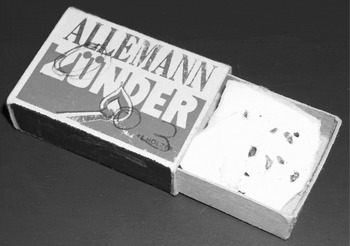
We examined a 77-year-old widow at the Psychiatric University Clinic's outpatient department, referred to us from the Department of Dermatology. She had the delusional belief that she was infested by swarms of “small black animals.” The patient presented with a 15-month history of feeling the animals moving on her skin, predominantly at her neck. She believed that the parasites were breeding in and under her skin and were building nests. She complained that six physicians had failed to find “her infection” and that neither topical antibiotics (gentamicin) nor corticosteroids (betamethasone) had helped her. She tracked the “animals” into the skin with her fingernails or a nail file. She spent hours watching, catching and eliminating the alleged intruders each day. She claimed that she crushed every animal she caught and that she enjoyed hearing them crack. As proof of the infection she presented a matchbox with small skin particles inside (“matchbox sign”, see Figure 1). Sometimes she used a magnifying glass to study the specimen. She also believed that her apartment was similarly infested, and so cleaned it excessively. At the time of her referral, she was planning to contact a pest controller. She appeared to have only vague ideas about the source of the infestation of her body and her flat, but did not believe that malign forces were at work.
Matchbox sign.

Her personal and her family psychiatric history did not reveal any mental disorders. Except for mild chronic heart failure treated with digitoxin, captopril and furosemide, her medical history was unremarkable. She had stopped smoking cigarettes ten years previously and did not drink alcohol. She had never used cocaine or amphetamines.
On mental status examination she was a well-dressed Caucasian woman, friendly and cooperative with good rapport and eye contact, fully oriented and alert. Her speech was coherent and spontaneous, normal in volume, rate and rhythm. She was euthymic. Her affect was mildly irritable. She had the delusional conviction that she was infested with small creatures and suffered from tactile hallucinations. There were no other delusions and no Schneiderian first-rank symptoms. She had no suicidal or homicidal ideation, intent or plans. She had partial insight, in that she lacked insight into her illness, but sought help and accepted treatment. Cognition and memory were normal. Full written informed consent was obtained from the patient.
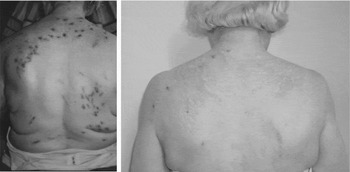
The University Clinic of Dermatology and her general practitioner had ruled out real infections. Her physical examination was within normal range except for self-inflicted excoriations at the neck and the back. Notably, the skin lesions were located asymmetrically at places that she could reach with her right hand (Figure 2, left). Cranial NMR was unremarkable. Laboratory tests were within normal range and the Mini-mental State Examination showed no indications of dementia.
Skin lesions before and after treatment. The pre-treatment picture (left) was provided by the patient and had been taken by her daughter. The post-treatment picture (right) was taken after five months of antipsychotic medication.

A diagnosis of “primary” delusional parasitosis was made. The diagnostic criteria for delusional disorder, somatic type (DSM-IVTR) and persistent delusional disorder (ICD-10 F22) were met.
Olanzapine (OLZ) 2.5 mg at night was introduced to the patient as “being helpful against her distress with infestation and the itching.” Within a week she had reduced picking at her skin. Over the next two visits OLZ was gradually increased to 7.5 mg without adverse affects. Laboratory tests under OLZ, including blood glucose levels, were unremarkable. After four months the itching had subsided most days. The patient gave us her matchbox as a present because she saw no further use for it and no longer considered the skin particles to be animals. However, she still believed that she had been infested. After five months (fifth visit) no fresh skin lesions were noted, only old scars (Figure 2, right). After a brief period of inconsistent compliance with medication she continued to attend our outpatient clinic and took OLZ 2.5 mg daily for the next three years. She had no fresh skin lesions and her preoccupation with the parasites had reduced dramatically.
Discussion
Our case report presents a typical case of primary DP showing all the major clinical features: elderly female, living alone, unshakable belief in infestation, unremarkable psychiatric history, “matchbox sign,” skin lesions in body parts within easy reach.
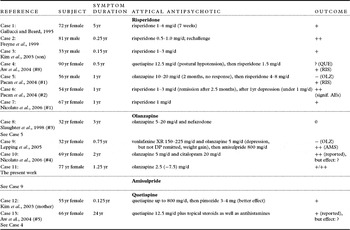
It is, however, one of the first cases to report the use of atypical antipsychotics in DP in general, and, as far as we know, the first case of primary DP treated with olanzapine mono-therapy, which showed a marked clinical response, sustained over many years. All earlier cases treated with OLZ were secondary to a general medical condition or brain pathology (Kumbier and Kornhuber, Reference Kumbier and Kornhuber2002; Le and Gonski, Reference Le and Gonski2003; Freudenmann, Reference Freudenmann2003; Makhija and Bhalerao, Reference Makhija and Bhalerao2004), did not provide many details (Slaughter et al., Reference Slaughter, Zanol, Rezvani and Flax1998), did not respond well (Pacan et al., Reference Pacan, Reich and Szepietowski2004; Lepping et al., Reference Lepping, Gil-Candon and Freudenmann2005) or were not treated with OLZ alone (Nicolato et al., Reference Nicolato, Correa, Romano-Silva and Teixeira2006) (see Table 1).
Cases of delusional parasitosis (meeting DSM-IV criteria of delusional disorder, somatic type) treated with atypical antipsychotics

Note: ++ = remission, + = response, − = no response, 0 = non-compliance, ? = effect cannot be estimated (no effect reported or multiple substances used),
AEs = adverse effects, QUE = quetiapine, RIS = risperidone, OLZ = olanzapine, AMS = amisulpride.
Although DP patients usually refuse psychiatric referral, a lasting therapeutic alliance could be established for 3.5 years, even in a psychiatric outpatient department.
A real pharmacological effect seems likely in view of the clinical course and the long follow-up, although we did not discontinue medication and perform a formal rechallenge for ethical reasons. However, there was an inadvertent rechallenge secondary to non-compliance. During a period of non-compliance after four months of OLZ treatment she developed a relapse within weeks, which subsided again when OLZ was taken regularly. This also indicates the necessity for maintenance antipsychotic treatment.
Olanzapine was used in age-adapted doses in order to reduce cardiac risks in an elderly patient with a history of cardiovascular disease. Pimozide, the traditional antipsychotic in DP, was not chosen because of its potential to cause a prolongation of the QTc-interval (Driscoll et al., Reference Driscoll, Rothe, Grant-Kels and Hale1993). According to the Food and Drug Administration (FDA), pimozide treatment requires baseline and post-treatment ECG controls. In addition, a review of the literature revealed that the common recommendation to use pimozide in DP is based only on two placebo-controlled studies without randomization and small samples sizes of around N = 10 (Hamann and Avnstorp, Reference Hamann and Avnstorp1982; Ungvari and Vladar, Reference Ungvari and Vladar1986). Randomized, placebo-controlled trials in DP for both traditional and atypical antipsychotics as well as direct comparisons between atypicals and pimozide are lacking (Freudenmann and Schönfeldt-Lecuona, Reference Freudenmann and Schönfeldt-Lecuona2005).
Evidence for the use of atypical antipsychotics in primary DP (delusional disorder, somatic type) is limited to 12 previous case reports known to us (obtained using Medline search, with search terms “delusion(s) of parasitosis”, delusional parasitosis” or “monosymptomatic hypochondriacal psychosis” and “atypical antipsychotic(s)” or substance names; carried out May 2006). These 12 cases and the case reported here are shown in Table 1.
The case collection shows a female preponderance in DP (10 of 13 = 77%) and a mean age of 60.3 years (range 32–90), consistent with previous reports (Freudenmann, Reference Freudenmann2002). It also shows that the best evidence in primary DP among atypical antipsychotics is available for risperidone. It was effective in all seven cases (two full and five partial remissions) with daily doses between 0.5 and 8 mg (Gallucci and Beard, Reference Gallucci and Beard1995; Freyne et al., Reference Freyne, Kenny and Cooney1999; Kim et al., Reference Kim, Kim, Lee and Kang2003; Pacan et al., Reference Pacan, Reich and Szepietowski2004; Aw et al., Reference Aw, Thong and Chan2004; Nicolato et al., Reference Nicolato, Correa, Romano-Silva and Teixeira2006). By contrast, none of the three primary DP cases treated with quetiapine improved markedly (Kim et al., Reference Kim, Kim, Lee and Kang2003; Aw et al., Reference Aw, Thong and Chan2004). The cases treated with OLZ have already been discussed. Amisulpride was successful in one patient (Lepping et al., Reference Lepping, Gil-Candon and Freudenmann2005). No data are available for other atypical antipsychotics in this type of DP. According to the 13 cases, the overall outcome in primary DP is fairly good when atypical antipsychotics are used in sufficient doses and duration, while sometimes a substance change is needed (partial or full remission in 10 of 13 cases = 77%). This response rate is far better than is usually assumed for the effects of antipsychotics in delusional disorders in general. Of course, an over-reporting of successful therapies is likely (publication bias). Prospective studies comparing different atypicals in DP would be desirable, but will be difficult to conduct in view of the presumably low adherence to any study protocol in this patient group (Munro, Reference Munro1982; Freudenmann and Schönfeldt-Lecuona, Reference Freudenmann and Schönfeldt-Lecuona2005).
The most intricate problem in the management of DP patients is to achieve effective treatment. Very often DP patients refuse to take oral antipsychotics. Therefore, intramuscular depot medication is an interesting treatment alternative. The study by Frithz showed a full remission in 73% and a partial remission in another 20% of 15 cases of primary DP using a fluphenazine or cisflupenthixole depot (Frithz, Reference Frithz1979). The advent of risperidone microspheres for intramuscular injection has further expanded our therapeutic arsenal.
In conclusion, olanzapine as well as other atypical antipsychotics can be recommended as a first-line antipsychotic and maintenance treatment of DP instead of pimozide, although conclusive evidence from larger controlled clinical trials is absent. We suggest the use of age-adapted doses in this predominantly elderly patient group.
Conflict of interest
None.
Description of authors’ roles
R. W. Freudenmann designed the study, collected the data, and wrote the paper; C. Schönfeldt-Lecuona and P. Lepping designed the study and critically revised the manuscript.